This guide is independent and contains no paid placement. If affiliate links are added later, they will be clearly marked and will not change our editorial checks.
Campbeltown rewards the long drive down Kintyre with miles of dog-friendly sand at Machrihanish and Westport, a tidal walk to Davaar Island, a working harbour and three whisky distilleries in one small town. Come for at least two nights, plan around the tides, and treat the journey itself as part of the trip.
The drive to the end of Kintyre
The journey is the point of Campbeltown, and it is worth saying so plainly before any talk of beaches or whisky. The town sits at the southern tip of the Kintyre peninsula, a long finger of land that points down towards Northern Ireland, and there is only one road in. From Glasgow the A83 runs about 135 miles through Loch Lomondside, over the Rest and Be Thankful, past Inveraray and down the spine of the peninsula through Tarbert, and the last hour feels like a different country: the road narrows, the lochs give way to open moor and farmland, the sea appears on both sides at different moments, and the traffic thins to almost nothing. Most drivers take three and a half to four hours, and dog owners should plan for longer, because the drive only works if the dog arrives relaxed.
Start by thinking about the car, not the destination. A dog that travels badly for four hours will not enjoy the beach at the end of it, so break the journey into two comfortable halves. Inveraray, roughly halfway, is the natural stop: there is parking near the loch, a short flat walk along the shore, and space to stretch legs before the second leg. Tarbert, where the peninsula narrows to a few hundred metres between Loch Fyne and the Sound of Jura, is the second good stop, with a small harbour and a short walk that suits a lead-on stroll. If your dog is nervous in the car, keep the stops short and boring rather than exciting — a toilet break, water, a ten-minute sniff, and back in the car before the excitement builds. Feed a light meal a couple of hours before departure rather than just before you set off, and keep water within reach in a non-spill bowl for the stops.
The Rest and Be Thankful deserves a specific warning. This stretch of the A83 between Arrochar and Cairndow is famous for landslips, and it can close at short notice in heavy rain, with traffic diverted along the old military road. The diversion is slow and winding, which is harder on a car-sick dog than the main road, so check the official guidance before you travel and leave a generous buffer in your plans. The same applies in winter, when the pass can be affected by snow and ice; a four-wheel-drive vehicle is not necessary, but good tyres and a full tank are, because fuel stops become scarce once you pass Tarbert. Fill up in Inveraray or Lochgilphead rather than gambling on the small filling stations further south.
There are alternatives to driving the whole way, and they are worth weighing honestly. A ferry from Ardrossan to Brodick on the Isle of Arran, followed by the short crossing from Lochranza to Claonaig on Kintyre, turns the journey into a two-ferry island hop, and dogs travel well on both crossings if they are used to boats — but the timetable is tight, the Claonaig crossing is seasonal and weather-dependent, and a missed sailing can add hours, so check the official guidance before you travel and book ahead in summer. The Kintyre Express ferry from Ballycastle in Northern Ireland to Campbeltown runs in the summer season and is the fastest way in from Ireland, though it is a passenger service and not every sailing suits every dog. For most visitors from the central belt, the drive remains the simplest option, and it has one advantage no ferry can match: you arrive with your car, your dog's bed, and a boot full of supplies in a town where the nearest large supermarket is a long drive away.
Once you pass Tarbert, the character of the drive changes completely. The road runs south past farms and small settlements, with the Isle of Arran rising across the water to the east and the Atlantic opening to the west. There are passing places, single-track stretches on the side roads, and sheep that treat the verge as their own. Slow down for livestock, keep your dog secure in the car, and resist the urge to stop on every blind bend for a photograph. The final approach into Campbeltown drops down towards the harbour, and the first sight of the town — the curve of the bay, the masts, the low hills behind — is the moment the drive pays off. Park, let the dog out, and take ten minutes doing nothing at all before you start exploring.
First hours: harbour and Davaar Island
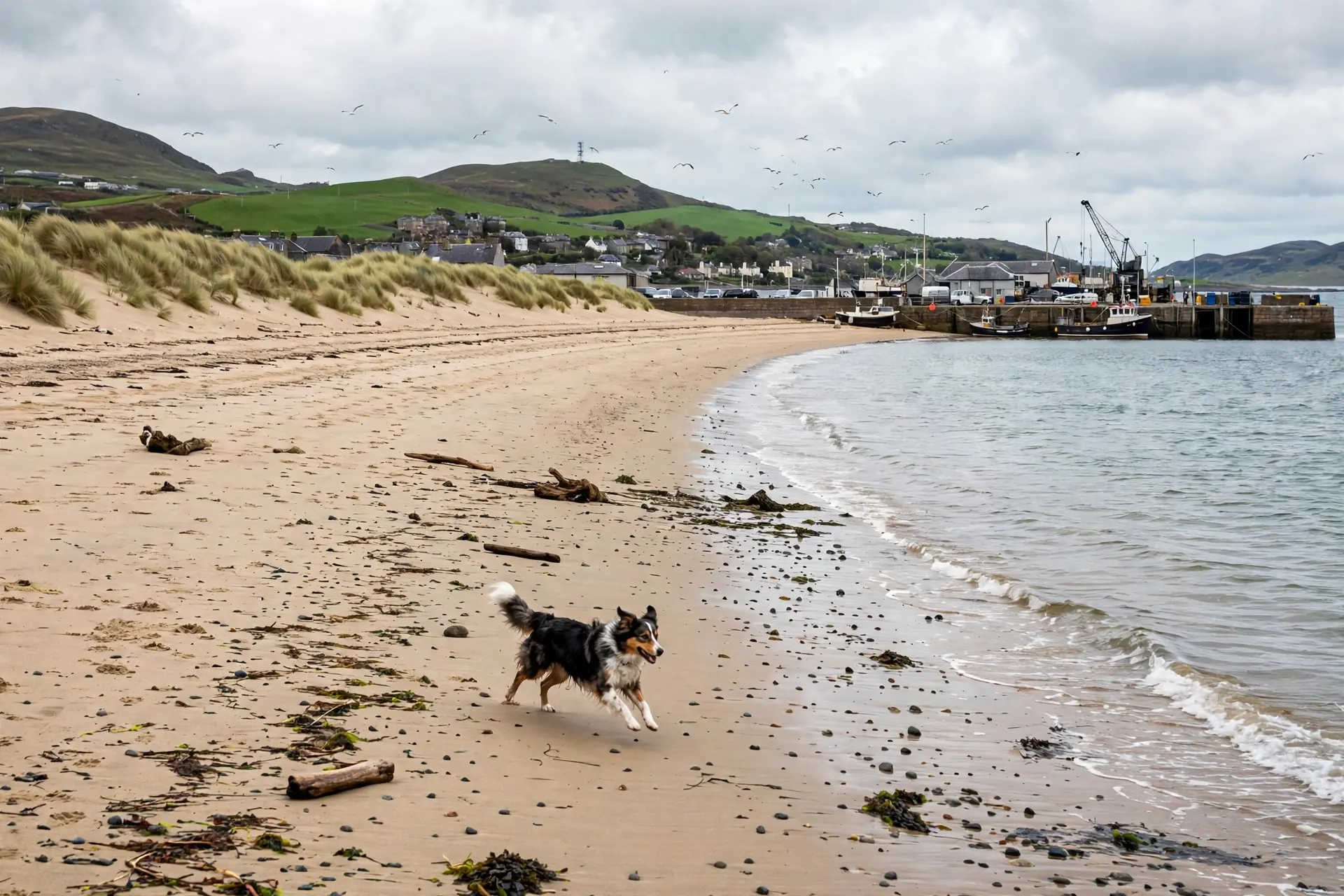
The harbour is the right place to start, because it tells you what Campbeltown is. This is a working harbour, not a prettified marina: fishing boats, a lifeboat station, the ferry pier and the occasional visiting yacht share the water, and the town's life still turns on the tide and the weather. Walk the harbourfront on the lead with your dog and you will see the whole town in miniature — the distilleries behind the waterfront, the museum on the front, the cafes and the small shops along Main Street, and the road out towards the beach. It is a flat, easy walk, which is exactly what a dog needs after four hours in a car, and it gives you a sense of the town's scale before you commit to anything longer.
The walk that defines a Campbeltown visit is the tidal crossing to Davaar Island. Davaar sits just off the town in Campbeltown Loch, connected to the mainland by a natural shingle causeway that appears at low tide and disappears under the water for hours at a time. The island is small, uninhabited except for its lighthouse keepers' cottages, and famous for the cave painting of the Crucifixion on its southern shore, painted in 1887 by a local artist and still visible today. Dogs can cross with you, and the walk is one of the most memorable in Scotland — but it is also the one walk in this guide where getting the timing wrong has real consequences, so treat the tide table as part of your planning, not an afterthought.
Check the official tide times before you set out, and plan to cross within an hour or so either side of low water. The causeway is roughly a mile of shingle and rock, uneven underfoot and slippery with seaweed in places, so wear proper walking shoes and keep your dog on a lead for the crossing — the causeway is exposed, the water comes back faster than it looks, and a dog that chases a gull into the shallows can be in trouble quickly. Allow at least an hour on the island for the walk to the cave and back, and turn around early if the water starts to cover the causeway behind you. The common advice from locals is to watch the causeway, not the clock: if the stones at the far end are disappearing, you are already late. Families with small children and dogs that pull hard on the lead should consider whether the crossing suits them on a given day, because there is no shortcut home once the tide turns.
On the island itself, keep your dog on a lead around the sheep that graze there and the ground-nesting birds that use the grassy areas in spring and summer. The cave painting is a short walk from the landing point, reached by a rocky path that can be steep and slippery when wet — dogs with stiff joints or poor balance may find it awkward, and it is perfectly reasonable to enjoy the island's open grass and views and skip the cave altogether. The views back towards Campbeltown, with Arran rising across the water, are the real reward, and the island is quiet enough that a calm dog can settle for a rest while you take it in. Take water for the dog, because there is no fresh water on the island, and carry a towel for the return crossing: wet shingle and seaweed make for muddy paws, and the causeway stones are hard on pads after a long day.
Back in town, the first evening should stay simple. The harbourfront is at its best at dusk, when the fishing boats come in and the light over the loch turns the water the colour of pewter. Let the dog settle in your accommodation, feed at the usual time, and take a short last walk along the front rather than launching into a long hike. Campbeltown is a town that rewards slow arrival — the distances are short, the pace is unhurried, and nothing you skip on the first evening will be gone by the morning.
The long beaches
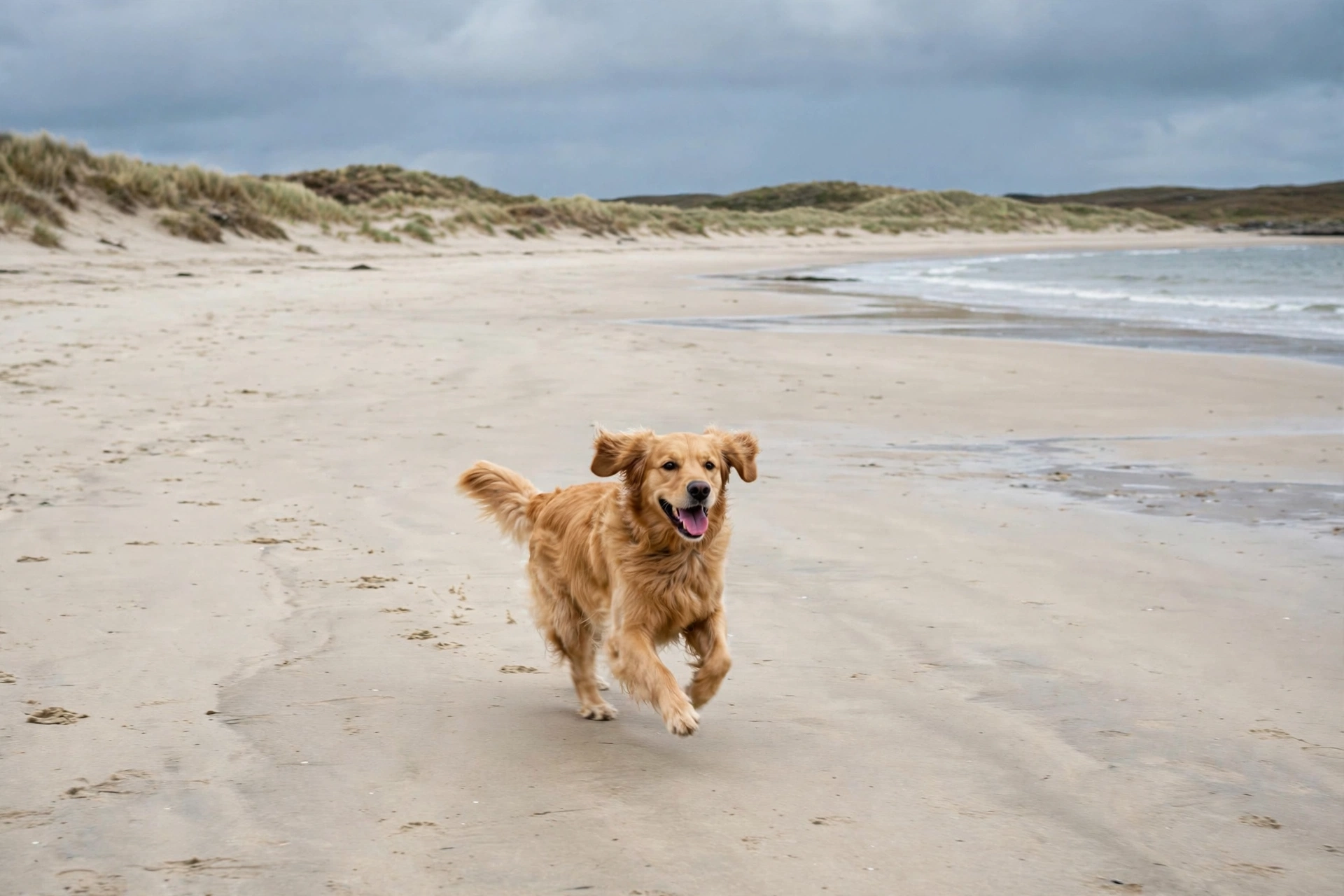
Campbeltown's beaches are the reason most dog owners make the drive, and they do not disappoint. The headline is Machrihanish, a vast sweep of sand on the Atlantic side of the peninsula, about six miles west of the town. The beach runs for roughly three miles in a gentle curve, backed by dunes and the golf course, and at low tide the sand stretches so far towards the water that the sea looks like a rumour. Dogs can run here in a way that is impossible on a crowded south-coast beach: there is room to throw a ball without hitting anyone, room for a nervous dog to keep its distance, and room for a whole morning to pass without seeing another person. The sand is firm enough for running, soft enough for digging, and the dunes give shelter from the wind that can bite on the open shore. It is, by any honest measure, one of the great dog beaches in Britain.
Getting there is straightforward: drive west from Campbeltown towards Machrihanish village, park near the beach or the golf club, and walk in through the dunes. The beach is exposed to Atlantic weather, so check the forecast and dress for wind even on a sunny day — the same breeze that keeps the sand clean can chill a wet dog fast, and a drying coat in the car is worth its weight. There are no lifeguards, and the sea here is the open Atlantic, so keep dogs out of deep water and be cautious after storms, when the currents are stronger and debris washes up. The beach is shared with golfers crossing to the course, walkers, and the occasional horse rider, so keep your dog under control near the golf course boundary and recall them promptly if they head for the fairways. For a broader sense of how Scotland manages its dog beaches, including seasonal rules and tides, our guide to dog-friendly beaches in Scotland is a useful companion to this page.
Westport Beach, on the western side of the peninsula a little further north, is the quieter sibling and in some ways the better choice for dogs that need space. It is a long, wild stretch of sand and dunes reached by a track from the small settlement of Westport, and it feels remote in a way Machrihanish does not — there are few facilities, fewer people, and a sense of being at the edge of things that suits a long, unhurried walk. The dunes here are home to wildlife, including nesting birds in spring and summer, so keep your dog on a lead through the dune areas and on the paths, and only let them run free once you are on the open sand. The beach is also popular with surfers when the swell is up, so watch for boards and keep a reactive dog well away from the waterline where surfers carry their kit in.
Closer to town, Peninver Beach is the local favourite: a smaller, sheltered sandy bay a few minutes' drive south-east of Campbeltown, with views across to Arran and a much gentler feel than the Atlantic beaches. It suits a short evening walk, a first swim for a puppy, or a dog that finds the wide open spaces of Machrihanish overwhelming. The beach is backed by grass and a small car park, and the water is calmer here, though it is still a sea loch and the usual rules apply — check the water, watch for boats, and do not let a dog swim far from shore. In summer the bay can be busy with families, so go early or late in the day if your dog is unsettled by children and beach games.
Beach rules around Campbeltown are generally relaxed, but relaxed is not the same as rule-free, and dog owners should check the official guidance before you travel rather than assuming every beach is open in every season. The long Atlantic sands are generally open to dogs year-round, which is the town's great advantage over the resorts further south, but smaller town beaches, harbour areas and the land behind the dunes can have seasonal or local restrictions, and some stretches run beside grazing land where livestock has priority. The practical rules are the same everywhere: pick up after your dog, keep them under close control near livestock and wildlife, and put them on a lead when you are unsure. A dog that chases sheep on Kintyre is not a minor embarrassment — it is a serious problem for the farmer, and the law is firmly on the farmer's side.
Packing for a Campbeltown beach day is different from packing for a southern beach, because the weather turns faster and the distances are longer. Bring more water than you think you need, because there are no shops on the beach and no fresh water at Machrihanish or Westport; bring a towel and a drying coat, because a wet dog in a cold car is miserable on the drive back; bring a long line for a dog whose recall is unreliable on open sand, because the beach is so wide that a dog can be a long way off before you realise it; and bring a spare lead, because salt water and sand destroy cheap clips. A first-aid kit with saline for sandy eyes, tweezers for thorns in the dunes, and a tick remover is sensible from spring onwards, and a simple check of paws after every beach walk — sand, salt and sharp shells — prevents most of the sore-paw problems that cut a holiday short.
Whisky heritage with a dog
Campbeltown was once one of the great whisky towns of Scotland. In the nineteenth century the town had more than thirty distilleries, and its whisky was famous enough to be called the whisky capital of the world; by the late twentieth century only three remained, and the town's distilling story became a story of survival as much as of success. Today those three — Springbank, Glen Scotia and Glengyle, home of Kilkerran — still distil in the town, and their presence shapes Campbeltown in a way that is visible everywhere: the warehouses along the waterfront, the smell of malt on certain winds, the shop windows full of bottles you will not find in a supermarket, and the steady stream of visitors who come for the whisky and stay for the coast. For a dog owner, the whisky is both a pleasure and a planning problem, because the distilleries are not, for the most part, places you can take a dog inside — and the honest way to enjoy them is to plan around that fact rather than pretend it does not exist.
Springbank is the most famous of the three and the one most visitors want to see. It is a traditional, family-owned distillery that still does much of its work by hand, including malting its own barley on site, and its tours are deservedly popular. Dogs are not permitted on distillery tours, because production areas have strict safety rules around hot liquids, moving machinery and alcohol vapour, and the tasting rooms are indoor spaces where a dog does not belong. The shop and the courtyard are a different matter, and many visitors with dogs find that a short visit to the shop, a look at the buildings from outside, and a bottle bought to take home is the right amount of whisky for a dog holiday. Book tours well ahead in summer, because places are limited and sell out, and check the official guidance before you travel for current tour times and dog policies — these can change, and the distillery's own website is the only reliable source.
Glen Scotia, the town's oldest working distillery, sits a short walk from the harbour and has a similar pattern: tours inside, shop and welcome area outside, and dogs best left out of the production buildings. Glengyle, which produces Kilkerran and was reopened in the early 2000s after decades of silence, is smaller and quieter, and its visitor experience is more low-key. Between the three, a whisky-minded visitor can easily fill a day, but a dog-minded visitor should think of it as two half-days: one person tours while the other walks the dog along the harbour or the beach, then you swap. If you are travelling alone with a dog, be realistic — a distillery tour with a dog waiting in the car is not an option, and it is never acceptable to leave a dog unattended in a vehicle, even for an hour, even with the windows cracked. Plan the whisky around the dog, not the other way round.
There are dog-friendly ways to enjoy the whisky heritage without going inside a distillery at all. The town's whisky shops welcome browsers, and a well-behaved dog on a lead is often fine in the shop itself — ask first, and respect a no if you get one. The Campbeltown Malts Festival, held each spring, brings the town alive with tastings, tours and events, but it also brings crowds, and a nervous or reactive dog will find festival week stressful; if your visit coincides with the festival, plan your walks for early morning and keep the dog away from the busiest streets. Outside festival time, the simplest pleasure is a bottle bought in town and opened at your accommodation in the evening, with the dog asleep at your feet — which is, after all, how most whisky is actually enjoyed.
The heritage runs deeper than the three working distilleries. The Campbeltown Museum, on the harbourfront, tells the story of the town's whisky boom and its fishing and farming past, and it is worth an hour on a wet day; check the official guidance before you travel for opening hours and whether dogs are welcome, because museum policies vary and many small museums allow dogs only in certain areas or not at all. The old distillery buildings scattered around the town — warehouses, chimney stacks, the remains of long-closed stills — make a fascinating walking route in themselves, and a dog on a lead is the perfect companion for it, because you set the pace and stop where you like. The Kintyre peninsula's whisky story is also a story of decline and recovery, and understanding it makes the town feel less like a postcard and more like a real place that has earned its quiet.
The town itself
Campbeltown is a small town, and that is its charm. The centre is compact enough to walk end to end in fifteen minutes, with Main Street running back from the harbour past shops, cafes, pubs and the museum, and the residential streets climbing gently towards the hills behind. For a dog owner, a compact town is a practical blessing: nothing is far, the car can stay parked for the day, and a tired dog is never more than a short walk from home. The pace is slow, the traffic is light, and the town has the feel of a place that is used to visitors but not overwhelmed by them — which means a dog is noticed, greeted, and generally welcomed rather than tolerated.
Eating out with a dog in Campbeltown follows the usual Scottish pattern: many cafes and pubs welcome dogs in certain areas, often the bar or an outdoor terrace, and a few are happy to have a dog inside if it settles quietly under the table. Policies change with the season and the management, so always ask before you sit down, keep your dog on a lead and out of the walkway, and bring a mat or blanket for them to lie on — a dog that has its own place settles far faster than one expected to lie on a cold pub floor. The harbourfront cafes are the best bet for a relaxed lunch, with outdoor seating in good weather and views across the loch, while the pubs on Main Street suit an evening meal if your dog is calm in a busier room. If your dog is reactive or noisy in enclosed spaces, takeaway and a bench by the harbour is the kinder option for everyone, and Campbeltown has enough takeaway choices to make that a genuine pleasure rather than a fallback.
Shopping for dog supplies in town is straightforward but limited, so come prepared. There are supermarkets in Campbeltown for the basics — dog food, treats, poo bags and the like — but the range is smaller than in a city, and specialist items such as a particular prescription diet or a favourite brand of food may not be stocked. Bring a full supply of your dog's normal food from home, plus any medication, and treat the town's shops as top-up rather than resupply. The same goes for equipment: if your dog needs a specific lead, harness or drying coat, bring it with you, because the nearest large pet shop is a long drive away. A local vet practice exists in town, which is reassuring, but its hours can be limited and out-of-hours cover may be based elsewhere — save the number before you travel and check the official guidance for current opening times.
The town's architecture rewards a slow walk. Look for the old whisky warehouses, the Victorian shopfronts along Main Street, the church spires and the houses that climb the hill behind the harbour, and you will see a town that was once far richer than it is now — and that wears its history lightly. The Campbeltown Cross, a medieval carved cross standing near the harbour, is one of the town's oldest landmarks and a good destination for a short stroll. The walk up to the viewpoint above the town, where you can look down over the harbour, the loch and the whole curve of the bay, is short but steep in places; it suits a fit dog on a lead and rewards you with the best view in Campbeltown, especially at sunset when the light comes across the water from Arran.
Walks beyond the beach
Once you have done the beaches and the harbour, the Kintyre peninsula opens up, and the walking is some of the most varied in Scotland. The Kintyre Way, the long-distance route that runs the length of the peninsula from Tarbert to Machrihanish, passes close to Campbeltown, and its southern sections make excellent day walks with a dog. The stretch from Machrihanish to Campbeltown itself is a good example: it crosses farmland and moor, follows the coast in places, and ends with the satisfaction of walking into town on foot. The route is waymarked, but the ground can be boggy after rain and the waymarks can be sparse on the open moor, so carry a map or a downloaded route, keep your dog on a lead through farmland, and tell someone where you are going if you walk alone.
Saddell, a few miles north-east of Campbeltown on the eastern shore, is the other essential walk. The abbey ruins at Saddell sit in a sheltered glen beside a small sandy bay, with a short walk from the car park through woodland to the shore, and the combination of history, trees and beach makes it one of the most rewarding short walks on the peninsula. The bay is quiet, the woodland is cool on a hot day, and the abbey itself — a thirteenth-century Cistercian foundation — gives the walk a sense of depth that a beach alone cannot. Dogs should be on a lead through the abbey grounds and the woodland, and the beach is shared with the occasional boat and angler, so keep them under control at the waterline. The drive to Saddell is along a narrow single-track road with passing places, so take it slowly and be ready to reverse into a passing place for oncoming traffic.
For a longer day, the forests and hills behind Campbeltown offer waymarked trails that are ideal for dogs that need shade and variety. The forestry tracks are generally firm underfoot, the routes are well signed, and the views from the higher ground — across the loch to Arran and south towards Ireland — are among the best on the peninsula. Midges can be a serious problem in the woods from late spring to early autumn, especially in the evening, so carry repellent, consider a light dog coat for a short-coated dog, and plan forest walks for the middle of the day when the midges are least active. Ticks are also present in the long grass and bracken, so check your dog thoroughly after every walk and carry a tick remover; the same check applies after the dunes at Machrihanish, where the long grass harbours them too.
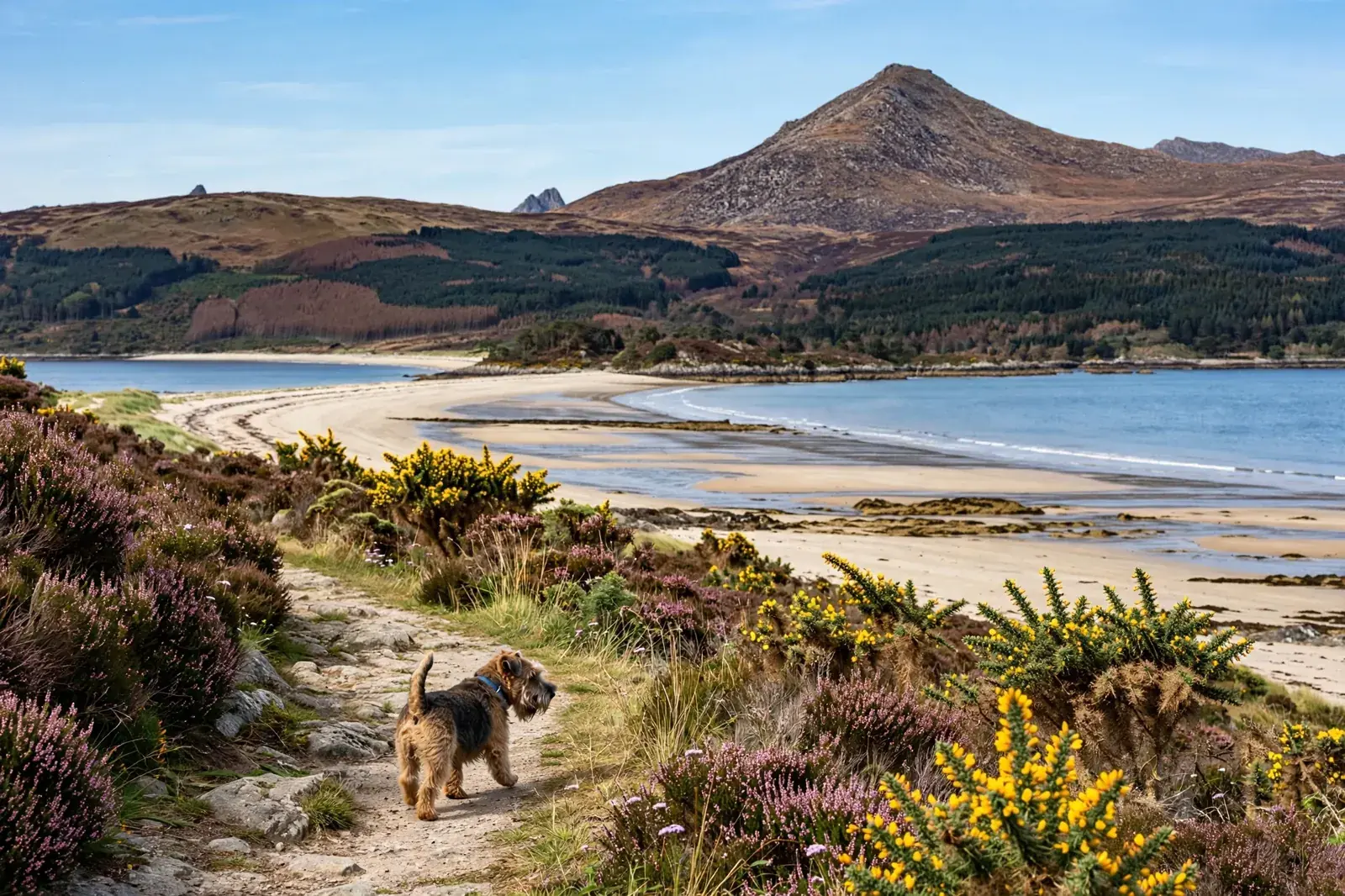
Whatever walk you choose, the ground rules are the same. Keep your dog on a lead through farmland and near livestock — the peninsula is working sheep country, and a loose dog among lambs is a serious incident, not a minor lapse. Close gates behind you, because an open gate on Kintyre can mean a field of sheep on the road within the hour. Carry water on every walk longer than an hour, because streams on the peninsula are not always safe to drink from and the nearest shop may be miles away. And check the weather before you set out: the peninsula's weather is changeable, the wind can rise quickly on the exposed western side, and a walk that starts in sunshine can end in rain. A waterproof for you and a drying coat for the dog turn a soaking into an anecdote rather than a ruined day.
Where to stay with a dog
Accommodation in Campbeltown is small-scale, and that suits dog owners better than a big resort would. The town has hotels, guest houses, bed and breakfasts and a growing number of self-catering cottages, and the self-catering option is usually the best fit for a dog holiday: your own front door, a kitchen for the dog's meals, space to dry a wet dog without worrying about a hotel carpet, and no need to negotiate breakfast times around a dog that needs an early walk. Book early in summer and around the whisky festival, because the town is small and the dog-friendly places go first; in winter, many places offer longer stays at lower rates, and a quiet week in Campbeltown out of season has a charm of its own.
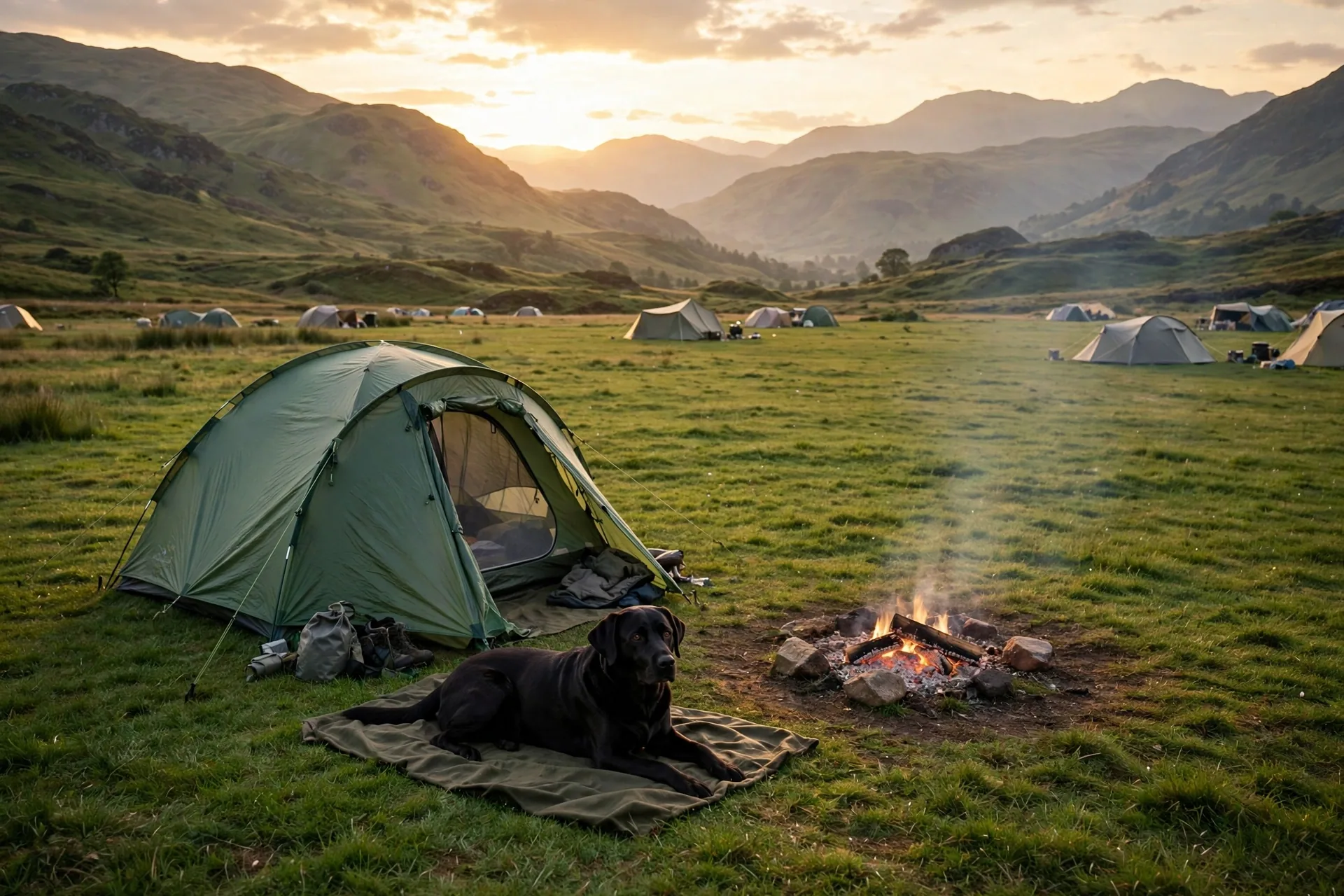
When you book, ask the questions that actually matter for your dog rather than accepting "dog-friendly" at face value. Is there an enclosed garden, and how high is the fence? Where is the nearest practical toilet walk after dark, and is it lit? Is there a hard floor the dog can lie on, or is the whole place carpeted? Is there somewhere to wash a muddy dog, or at least an outdoor tap? How many dogs are allowed, and is there a charge per dog or per stay? The answers tell you more about a place than any number of photographs, and a host who answers them clearly is a host who has thought about dogs properly. If you are camping instead, our beginner's guide to camping with a dog in the UK covers site choice, tent setup and sleeping arrangements in detail, and the same principles apply to the small campsites around Kintyre.
The practical details of a Campbeltown stay are worth getting right before you arrive. Check-in times in small guest houses can be narrower than in a chain hotel, so confirm your arrival time and tell your host if the drive is running late — the Rest and Be Thankful has made many visitors late, and a quick message saves everyone worry. If you are staying in a cottage, ask where to put the bins, because the town's refuse collection is weekly and a cottage full of dog waste in summer is unpleasant for the next guest. Bring your dog's bed from home, even if the accommodation provides one, because a familiar smell settles a dog faster than any new bed; and bring a stair gate if your dog needs to be kept out of certain rooms, since many cottages have open-plan layouts that a determined dog will explore. Finally, leave the place as you found it: a quick vacuum of dog hair, a wipe of muddy paw prints, and a note for the host about any damage — dog-friendly accommodation survives on the goodwill of owners who have had good experiences with dog guests, and every tidy departure makes the next dog's stay easier.
Practical planning
Campbeltown rewards preparation more than most destinations, because it is genuinely remote and the safety net is thinner. Start with the vet: save the number of the local practice before you travel, check its opening hours, and know that out-of-hours cover may be based further away, so allow for a long drive if something goes wrong at night. Carry your dog's vaccination record and any medication in the car rather than buried in a suitcase, and make sure your dog's microchip details are up to date — a dog that slips a lead on a beach the size of Machrihanish can be a long way from you before you realise it, and a chip is the fastest way home. Pet insurance that covers emergency treatment away from home is worth having, and a simple first-aid kit with bandages, saline, tweezers and a tick remover belongs in every dog owner's car on Kintyre.
Weather is the second planning item, and it deserves respect. The peninsula sits between the Atlantic and the Firth of Clyde, and the weather can change in an hour: sunshine, rain, wind and sunshine again is a normal Kintyre day, not a forecast error. Pack waterproofs for yourself and a drying coat for the dog, and check the forecast each morning rather than trusting the forecast you read before you left home. The wind is the factor most visitors underestimate — on the Atlantic beaches it can be strong enough to blow sand into eyes and ears, and on the exposed coastal paths it can unsettle a small dog. If the forecast promises high winds, choose a sheltered walk at Saddell or in the forest rather than the open dunes, and save Machrihanish for a calmer day.
Midges and ticks are the peninsula's small print. Midges appear from late spring to early autumn, worst in the evening and in still, damp air near woods and water; they bite humans far more than dogs, but a short-coated dog can be bothered by them, and the simplest defence is to walk in the middle of the day, avoid still woodland at dusk, and carry repellent for yourself. Ticks live in long grass, bracken and dunes from spring onwards, so check your dog after every walk — ears, armpits, groin and between the toes — and remove any tick promptly with a proper remover rather than pulling it. Ask your vet before you travel whether your dog's parasite cover is up to date, because the peninsula's ticks and the long grass make it a higher-risk area than a city park.
Transport within the town is easy: Campbeltown is walkable, the buses that do run are infrequent, and most visitors rely on their car for the beaches and the walks outside town. If you are travelling without a car, be realistic about what you can reach on foot — the harbour, the town centre, Davaar Island at low tide and the walk to Peninver are all doable, but Machrihanish and Westport need a taxi or a lift, and the Kintyre Way sections need transport to the start. Taxis exist in town but are few, so book ahead, confirm that the driver will take a dog, and bring a blanket for the seat. The small airport at Machrihanish has flights to Glasgow, which is a useful option for a visitor who wants to fly in and hire a car, though flights are infrequent and dogs do not travel in the cabin — check the official guidance before you travel if you are considering it.
Finally, think about connectivity. Mobile signal on the peninsula is patchy, especially on the western side and in the glens, and a walk that starts with full signal can lose it within a mile. Download your maps, tide times and accommodation details before you leave the town, and do not rely on live signal for navigation on the Kintyre Way or the drive to Westport. The same applies to the drive in: the A83 has dead spots between Inveraray and Tarbert, so a paper map or a downloaded route is a sensible backup. Campbeltown is a place to switch off, and the patchy signal is part of that — but a dog owner who cannot call a vet needs a plan, so keep the important numbers saved on the phone itself rather than in the cloud.
A two-day dog plan
Two nights is the minimum for Campbeltown, and the plan below is built around that — one day for the town and the island, one day for the beaches and the whisky, with the drive in and out as bookends. It assumes a reasonably fit dog, a car, and weather that cooperates at least half the time; if the weather does not cooperate, swap the days around and take the sheltered options, because the plan is a guide, not a timetable.
Day one starts with the drive in, a stop at Inveraray or Tarbert, and arrival in the early afternoon. Settle into your accommodation, then walk the harbourfront and let the dog sniff the town. If the tide is right, cross to Davaar Island in the late afternoon, when the light is at its best and the causeway is quiet; if the tide is wrong, save the island for the next morning and take the short walk to Peninver Beach instead. Eat in town or take away to a bench by the harbour, and keep the evening short — the dog has had a long day in the car, and a quiet first night is worth more than a packed itinerary.
Day two is the big beach day. Drive to Machrihanish in the morning, when the beach is at its emptiest and the light is low over the sand, and give the dog a proper run — an hour or two of free running, digging and paddling, with a long line if recall is unreliable. Stop for lunch in Machrihanish village or back in town, then spend the afternoon on the whisky: one person tours a distillery while the other walks the dog, or a shared visit to the shops and the museum if you are travelling alone. Finish with the walk up to the viewpoint above the town for sunset, or a last evening stroll along the harbour if the legs are tired. If you have a third day, add Westport Beach in the morning and Saddell Abbey in the afternoon, and you will have seen the best of the peninsula without ever feeling rushed.
The plan works because it respects the distances. Campbeltown is not a place to cram: the drive in is long, the beaches are wide, the walks are best taken slowly, and the town rewards the visitor who stays put rather than the one who ticks boxes. A dog that has had a long run on Machrihanish, a sniff around the harbour, and a quiet evening at your feet has had a better holiday than a dog dragged through five attractions in a day — and you will have had a better one too. Leave with a full tank, a tired dog, and the road north ahead of you, and the drive home will feel shorter than the drive in, because you will already be planning the return.
Practical questions
Before you go
Can dogs walk to Davaar Island?
Yes, dogs can cross the tidal causeway to Davaar Island at low tide, but the crossing is only safe within a narrow window around low water. Check the official tide times before you set out, allow plenty of time to return, and turn back early if the water starts to cover the causeway. The cave painting is a short walk from the landing point, and dogs should stay on a lead around the island's sheep and nesting birds.
Are Campbeltown beaches dog-friendly all year?
The long sands at Machrihanish and Westport are generally open to dogs year-round, which is one of the main reasons dog owners make the drive. Smaller town beaches and harbour areas can have seasonal or local rules, and some stretches are shared with grazing land or wildlife, so check the official guidance before you travel and keep your dog under close control near livestock and birds.
Can I take my dog into a Campbeltown whisky distillery?
Distillery tours themselves are usually not suitable for dogs, because production areas have strict safety rules and tasting rooms are indoor spaces. Many distillery shops and courtyards are more relaxed, and some welcome well-behaved dogs outside. Ask each distillery directly before your visit, plan for one person to stay with the dog if needed, and never leave a dog unattended in a car.
How long is the drive to Campbeltown from Glasgow?
The drive from Glasgow is roughly 135 miles along the A83 and usually takes three and a half to four hours, depending on traffic and how often you stop. The road narrows past Tarbert and passes the Rest and Be Thankful, which can close in bad weather, so check the official guidance before you travel and build in extra time for comfort stops for your dog.
Is there a vet in Campbeltown?
Yes, Campbeltown has a local veterinary practice, but opening hours can be limited and out-of-hours cover may be based further away. Save the practice number before you travel, check the official guidance for current hours, and carry your dog's medication and vaccination record. For anything serious, the nearest large referral centres are in Glasgow, so allow for the long drive back.