This guide is independent and contains no paid placement. If affiliate links are added later, they will be clearly marked and will not change our editorial checks.
Carlisle is a compact border city where the best dog time is outdoors: walk the castle grounds, cross the cathedral green, follow the River Eden through Rickerby Park and Bitts Park, then use the city as a base for short sections of the Hadrian's Wall Path. Dogs stay outside the castle keep and the cathedral interior, so plan split visits and keep the dog's day built around walks, not interiors.
Why Carlisle works with a dog
Carlisle is the only city in Cumbria, a place of around 110,000 people sitting close to the Scottish border, where the River Eden, the River Caldew and the River Petteril meet. It began as the Roman fort and settlement of Luguvalium, and for centuries afterwards it was a frontier town, fought over, walled, besieged and rebuilt. That history is the reason the city still feels different from other northern market towns: the castle dominates the north-west corner of the centre, the cathedral sits quietly a few streets away, and the Citadel towers guard the southern approach along Botchergate. For a dog owner, the useful part of all this is that the historic core is small. The castle, the cathedral, the main shopping streets and the riverside parks are all within a comfortable walk of each other, which means a dog can be part of the whole day rather than waiting in the car between stops.
The second reason Carlisle works is the ground it sits on. The city centre is largely flat, the riverside paths are level and surfaced for long stretches, and the open country starts quickly in every direction: east towards the Eden Valley and Hadrian's Wall, west towards the Solway coast, north towards the border and the Esk valley. That matters because dogs do not care about castles. They care about sniffing, moving and resting in that order, and Carlisle lets you stack all three into a single day without long drives. A morning at the castle grounds, a midday loop along the Eden, and an afternoon drive to a Wall section is a realistic plan, not an ambitious one.
The third reason is practical: Carlisle is a transport hub rather than a dead end. The station sits on the West Coast Main Line with trains to London, Glasgow, Edinburgh and Newcastle, the M6 runs past the city at junctions 42, 43 and 44, and the Tyne Valley line runs east to Hexham and Newcastle. That makes it a sensible base for a short break that mixes a city day with a countryside day, and a sensible stopover for anyone driving between England and Scotland with a dog that needs a proper break from the car.
There are limits to be honest about. Carlisle is a working city, not a resort, so the centre has traffic, buses and the usual city noise, and the best dog-friendly eating is concentrated in pubs and cafes rather than in grand restaurants. The castle and the cathedral both keep dogs outside their interiors, so anyone travelling alone with a dog needs a split-visit plan. And the weather is northern and changeable: Cumbria is wetter than eastern England, the wind off the Solway can be sharp even on a bright day, and riverside paths can turn muddy after rain. None of that should put you off. It just means the trip works best when the dog's needs are planned first and the sightseeing is fitted around them, which is exactly how this guide is organised.
Castle and cathedral: what dogs can do
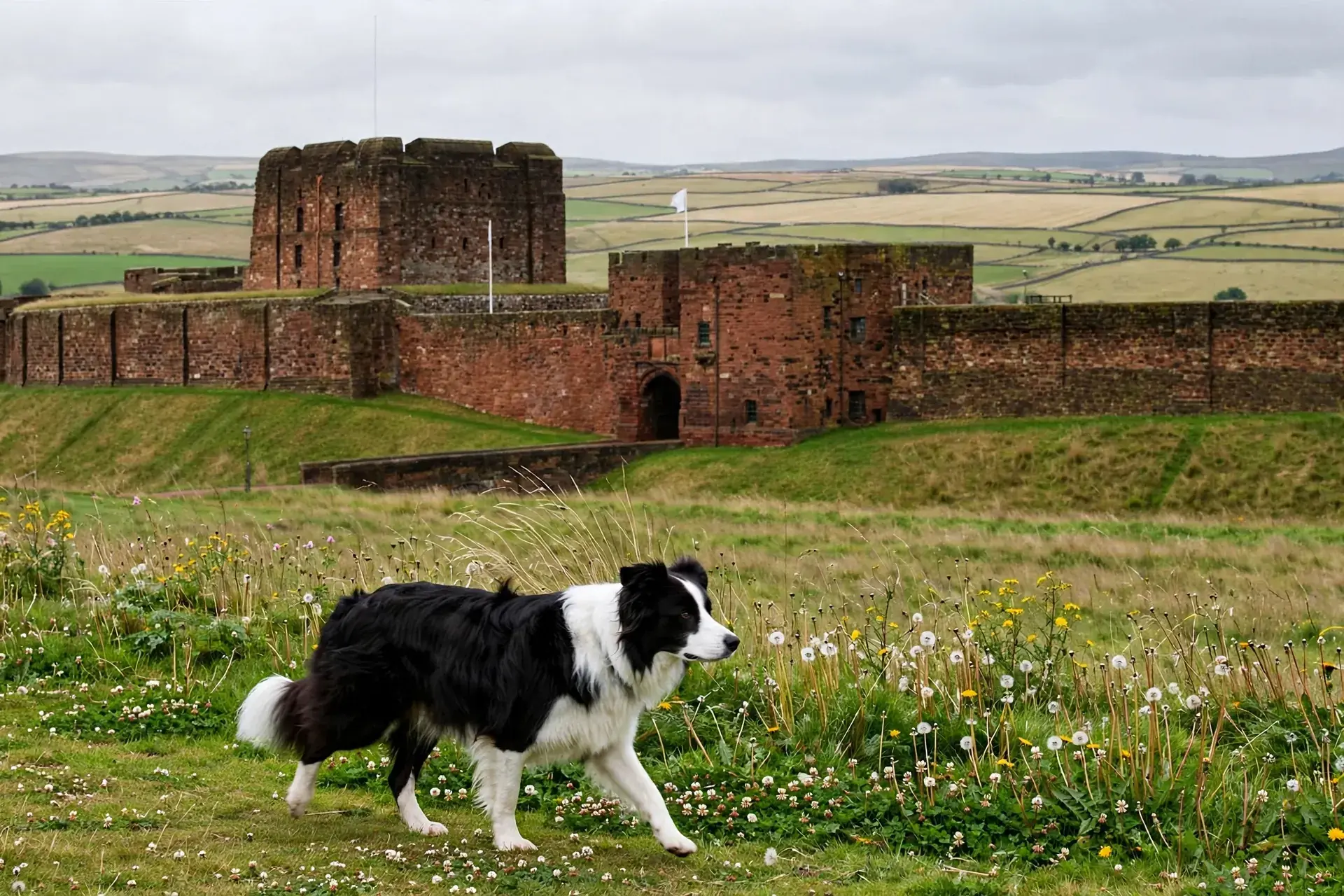
Carlisle Castle is the obvious first stop, and it is worth understanding what a dog can actually do there before you arrive. The castle was founded in 1092 by William II and developed over the following centuries into a major border fortress, with a great keep, curtain walls, a gatehouse and, later, a 16th-century artillery battery. It is managed by English Heritage. Dogs on leads are generally welcome in the castle grounds, which is where most of the open space is: the grassed areas inside the walls, the views up to the keep, and the walk around the outer defences. Only assistance dogs can go inside the keep and the indoor exhibition spaces, so a dog's castle visit is an outdoor one. Check the official guidance before you travel, because access rules can change for events, school visits and conservation work, and because parts of the site may close at short notice.
Plan the castle as a walk rather than a tour. Arrive with the dog already exercised a little, keep the lead short around the entrance and the car park, and let the dog settle into the open grass once you are inside the walls. The ground is mostly level, which suits older dogs, but the stone surfaces can be slippery when wet and the walls and drops around the defences deserve respect: keep the dog close rather than letting a long line run out near an edge. Allow 45 minutes to an hour for a relaxed circuit of the grounds with a dog, longer if you want to sit on the grass and let the dog watch the world. If you are travelling as a pair, the cleanest arrangement is to take turns: one person goes inside the keep while the other stays outside with the dog. If you are travelling alone, accept that the interior will wait for another trip and enjoy the grounds properly instead.
Carlisle Cathedral is a five-minute walk south-east from the castle, through the city centre, and it offers a different kind of stop: quiet, green and calm. The cathedral began as an Augustinian priory church in 1122 and became a cathedral in 1133. It is one of England's smaller ancient cathedrals, and it is best known for its 14th-century east window, one of the largest of its kind, and for its finely carved medieval choir stalls. Only assistance dogs are admitted inside the building. The cathedral green, however, is open to dogs on leads, and it is a genuinely pleasant place to pause: lawns, trees, benches and a view of the cathedral's warm red sandstone, which glows in low evening light. The green works well as a rest stop between the castle and the river, and as a place to give a city-walking dog ten quiet minutes before the next stretch.
Between the two, the walk through the centre is short and straightforward. From the castle, head along Castle Street and into the pedestrianised centre, then south towards the cathedral precinct. The route passes shops, cafes and the covered market area, so it is worth keeping the dog on a short lead and moving steadily rather than weaving between shopfronts. If your dog is nervous around crowds, buses or street clutter, the quieter route is to cut across towards the cathedral green early and avoid the busiest shopping streets altogether. The Citadel, the pair of towers at the southern end of Botchergate, is worth a look from the outside as you pass: built in the 1540s as part of the city's defences, the towers now frame the southern entrance to the centre and make a good landmark for orienting a dog walk.
Two habits make the historic core work well. First, carry water even for a short city walk: there are few obvious dog water stops between the castle and the cathedral, and a dog that has been walking on stone and pavement will drink more than you expect. Second, treat every interior as a bonus rather than a plan. Carlisle's historic buildings reward the people in your party; the dog's reward is the grass, the river and the open Wall country, and the day feels better when you stop apologising for that split.
River Eden walks from the centre
The River Eden is the walk that makes Carlisle work as a dog break. The river flows past the north and east sides of the city, and two parks, Rickerby Park and Bitts Park, sit along its banks within walking distance of the centre. Together they offer the closest thing Carlisle has to a daily dog routine: flat paths, open grass, trees, river views and enough length to tire a dog out without needing the car.
Rickerby Park lies to the east of the centre, beyond the Eden bridges. It is a large area of open grass and riverside paths, popular with local dog walkers, runners and families. The paths are mostly level and surfaced, the river is wide and slow here, and there is plenty of space for a dog to move without being squeezed onto a narrow pavement. Keep the dog under control near the water, especially after rain when the Eden runs high and fast, and remember that the riverbank is not a fenced dog park: a dog that charges into the water after a bird can be hard to recall, and the current is stronger than it looks. The park connects to longer riverside routes heading east out of the city, so a short loop can be stretched into an hour or more without retracing your steps.
Bitts Park sits on the south bank of the Eden, closer to the castle, and it is the more convenient of the two for a short walk from the centre. It has lawns, mature trees, a children's play area and paths that link towards the Eden bridges and the riverside. It is a good choice for a first walk on arrival, when the dog has been in the car and needs to stretch without committing to a long route, and for a last walk in the evening before bed. As with Rickerby Park, keep the dog on a lead around the play area and the car park, and give way to other park users on the narrower paths.
For a longer riverside walk, follow the Eden downstream or upstream from the parks. Heading east out of Rickerby Park, the riverside path runs towards the countryside with the river on one side and fields and woodland on the other, and the city noise fades quickly. Heading west, the river bends towards the Caldew confluence and the outskirts of the city. Either way, the same rules apply: watch for cyclists and runners on shared paths, keep the dog close at bridges and road crossings, and carry a lead even if your dog is reliable off lead, because the path crosses roads and passes through areas where livestock or other dogs may appear. In winter, the low riverside ground can flood after heavy rain, so check the path before you set off and be ready to turn back and use the higher park paths instead.
A few practical details make the Eden walks easier. The parks have no guaranteed dog water taps, so bring a bottle and a bowl. Bins are provided in the parks but not along every stretch of riverside path, so carry bags and be ready to carry them for a while. In summer, the open grass can be hot underfoot at midday, so walk early or late and use the shaded tree lines. And in the darker months, remember that the riverside paths are not all lit: a short evening loop near the centre is fine, but a long unlit stretch after dark is a poor idea with a dog, especially near the river.
Hadrian's Wall from Carlisle
Carlisle sits directly on the line of Hadrian's Wall. The Wall was built from AD 122 on the orders of the emperor Hadrian, running about 73 miles from the Solway Firth in the west to the Tyne in the east, and it is now a UNESCO World Heritage Site. The Roman fort of Luguvalium stood where Carlisle Castle stands today, and the Wall itself passed through what is now the city. That is worth knowing, because it changes how you should picture the Wall here: in Carlisle itself there is very little visible Wall to look at. The stone was reused over the centuries, the city grew over the line, and the dramatic standing remains are out in the countryside to the east and west. Carlisle is best used as a base for the Wall, not as a viewpoint for it.
The Hadrian's Wall Path, the National Trail that follows the Wall's line for 84 miles from Wallsend near Newcastle to Bowness-on-Solway, passes through Carlisle. For dog walkers, the sensible approach is to pick one short section and walk it well, rather than trying to cover a long distance with a tired dog. West from Carlisle, the path follows the Eden and then the Solway shore towards Burgh by Sands, Drumburgh and Bowness-on-Solway, the trail's western end. This is flat, open walking across marshy farmland and estuary edge, with big skies and long views. East from Carlisle, the path climbs gently towards the better-preserved Wall country around Lanercost, Birdoswald and Gilsland, where the walking gets hillier and the visible remains begin.
The western section suits most dogs. From Carlisle, the route to Bowness-on-Solway is roughly 12 miles, which is too far for a single out-and-back with most dogs, so drive to a starting point instead and walk a shorter stretch. Burgh by Sands, about six miles west of Carlisle, is a good base: a quiet village on the marsh, with a church that has a pele tower and a pub, and paths that run across the Solway marshes towards Bowness. The walking here is flat but exposed, with little shade and few facilities, so carry water for the dog, wear windproof layers, and keep the dog on a lead near sheep and cattle. The Solway marshes are also tidal: the estuary floods quickly, the mud is dangerous, and dogs should never be allowed to chase across the mudflats. Check tide times before you travel, stay on the marked path, and turn back in good time.
The eastern section is the one to choose if you want to see the Wall itself. Birdoswald Roman Fort, about 18 miles east of Carlisle, is one of the best-preserved forts on the Wall, with long stretches of Wall, turrets and a dramatic position above the River Irthing. The walking around Birdoswald is hillier and rougher than the western marshes, with uneven ground, stone stiles and open fell, so it suits fit, confident dogs and owners who are comfortable with a longer, slower walk. Dogs on leads are generally welcome on the Wall Path and in the outdoor areas of the fort, but only assistance dogs can go inside the indoor exhibitions, so the same split-visit logic applies as at the castle. Check the official guidance before you travel, because opening times and access arrangements vary by season.
Wherever you walk on the Wall, the Countryside Code is the rulebook. Keep dogs on leads near livestock, and on a lead at all times during the bird breeding season on open access land, which runs from March to July. Sheep graze much of the Wall country, and a dog chasing sheep is not a small problem: it can cause serious harm, and farmers are legally entitled to protect their stock. Use a short lead through fields, shut gates behind you, and keep the dog off the Wall itself where signs ask you to, because climbing on the ancient stonework damages it. Adders live in the Wall country too, mostly on warm, sunny banks and moorland edges from spring to autumn. They are shy and bites are uncommon, but a dog that pokes its nose into a sunny stone wall is at the most risk, so keep the dog moving on the path and know where the nearest vet is before you set out. Ticks are a year-round consideration in this landscape: check the dog after every walk, especially around the ears, the belly and between the toes, and remove any ticks promptly.
Day trips: Brampton, Lanercost and the Solway
Brampton, about ten miles east of Carlisle on the A69, is the easiest day trip and the one most dog owners will use most. It is a small market town with a wide main street, a handful of cafes and pubs, and quick access to two of the best dog walks in the area. Talkin Tarn, a small lake in a country park just outside the town, has a flat, surfaced path around the water that takes about 40 minutes at a dog's pace, with woodland, open water and plenty of sniffing. The tarn is popular with walkers, rowers and families, so keep the dog on a lead near the water and the car park, and be aware that the water is not a safe swimming spot for dogs. Our guide to Brampton with a dog covers the tarn, the woodland trails and the Eden Valley lanes around the town in detail, including parking and vet notes.
Lanercost Priory, about 12 miles east of Carlisle, pairs well with a Wall walk. The priory is a 12th-century Augustinian foundation with substantial surviving stonework, set in a quiet valley beside the River Irthing. Dogs on leads are generally welcome in the priory grounds, with the usual restriction that only assistance dogs go inside roofed buildings, so check the official guidance before you travel. The lanes around Lanercost are quiet and good for a short lead walk, and the village has a pub and a tea room that are worth checking for dog-friendly seating before you sit down. Combined with a short section of the Wall Path towards Birdoswald, Lanercost makes a full, unhurried day out that never feels rushed.
West of Carlisle, the Solway coast offers a completely different landscape: wide estuary, salt marsh, big skies and villages that feel a long way from the city. Bowness-on-Solway, the western end of the Hadrian's Wall Path, is a small village with a pub and a car park, and it is a good place to finish a Wall walk rather than to start a long one. Port Carlisle and Burgh by Sands are quieter still, with marsh walks and long views across the estuary to Scotland. The Solway is not a beach destination in the usual sense: there are no long sandy strands for dogs to run on here, the mud is dangerous, and the tide comes in faster than it looks. Treat it as a walking and looking landscape, keep the dog on a lead on the marsh, and save the off-lead running for the enclosed fields and parks back in the city.
Further afield, the Eden Valley south of Carlisle and the northern edge of the Lake District are both within an hour's drive, and both are worth a day if you are staying for a long weekend. Penrith and the Eden Valley offer riverside paths, village pubs and the castle ruins at Penrith, while the northern Lakes around Keswick and Ullswater offer bigger hills and longer walks for fit dogs. The honest advice is to pick one direction per day rather than trying to cover both: the driving is easy, but a dog that has spent two hours in the car and then walks for three hours will be tired and grumpy, and the day will be worse for it. Carlisle's strength as a base is that the best days out are 20 to 40 minutes away, not two hours.
Eating and drinking with a dog
Carlisle's dog-friendly eating is centred on pubs and cafes, and that is good news: the city has plenty of both, and the pubs in particular tend to be straightforward about dogs. Many pubs in the centre and in the villages around the city welcome dogs in the bar area, often with a water bowl by the door and a tolerant attitude to a dog settling under a table. The rules vary from place to place and can change with the season, so the reliable approach is to check before you sit down, ask where the dog is welcome, and be ready to sit in the bar rather than the restaurant. A dog that can settle quietly for an hour under a table will be welcome almost anywhere; a dog that barks, paces or begs will not, however friendly the pub.
A few habits make pub stops work. Arrive with the dog already walked, so the dog is ready to rest rather than ready to explore. Bring a mat or a blanket so the dog has a defined place to lie, and a chew or a stuffed toy for a longer meal. Order at the bar where that is the custom, keep the lead short and tucked under your chair, and keep the dog away from the kitchen door and the other tables. If the pub has an outdoor area, that is often the easiest option in warm weather, but check whether the garden is enclosed and whether it is next to a road before you let the dog relax. In winter, the bar area with a fire is the place to aim for, and it is worth asking whether the pub expects dogs to stay in a specific area.
Cafes in the centre are more mixed. Some welcome dogs throughout, some welcome them only in an outdoor seating area, and some do not admit dogs at all. The pattern is not predictable from the outside, so check the door sign or ask before you bring the dog in, and do not assume that a cafe that welcomed dogs last year still does. The covered market and the food halls in the centre are not dog-friendly spaces for a browsing visit, so treat them as a quick human errand with the dog waiting outside with a companion, not as a stop on a dog walk.
For a longer break, consider the village pubs around Carlisle rather than the city centre. The pubs at Burgh by Sands, Brampton, Lanercost and the Eden Valley villages are often more relaxed about dogs, with more space, quieter rooms and gardens where a dog can settle. They also pair naturally with a walk: a morning at Talkin Tarn followed by lunch in Brampton, or a Wall section ending at a pub in Bowness, is a better day than a city-centre lunch after a city-centre walk. Wherever you eat, carry the dog's water bowl and a few treats, and be ready to take the dog outside for a short break if it gets restless. A five-minute pause outside is cheaper than a ruined meal and a stressed dog.
Where to stay with a dog
Carlisle has hotels, guest houses, cottages and caravan sites in and around the city, and the choice that works best depends on the dog rather than the price. A calm older dog that sleeps all evening will be fine in a hotel room; a young, noisy or anxious dog will be happier in a cottage or a lodge with its own door to the outside. Before you book anything, ask the specific questions that matter: how many dogs are allowed, whether there is a pet fee and what it covers, whether the dog can be left alone in the room, and where the nearest toilet walk is after dark. Get the answers in writing with the booking confirmation, because "dog-friendly" on a listing can mean anything from a dedicated dog room with a bed and bowls to a grudging tolerance that ends at the first complaint.
Self-catering cottages and lodges are often the easiest option for a multi-night stay. They give the dog a familiar routine, a kitchen for preparing food, and a door you can open at midnight without crossing a hotel corridor. Look for a cottage with an enclosed garden or a fenced area, and check the height and the gaps in the fence before you book: a garden photographed from one flattering angle can have a gap that a terrier treats as an invitation. Ask whether the garden is shared with other guests, whether there are other dogs on site, and whether the cottage has hard floors that are easy to clean after a muddy walk. Our guide to dog-friendly holiday parks in the UK covers the questions worth asking about fees, boundaries and site layouts, and most of them apply just as well to a cottage or lodge park around Carlisle.
Hotels in the city centre can work well for a one-night stop, especially if you are travelling by train and want to be close to the station. Ask whether the dog-friendly rooms are on the ground floor or near an exit, whether there is a charge per dog per night, and whether the dog is welcome in the bar or only in the bedroom. A room with a window that opens onto a busy street can be a problem for a noise-sensitive dog, so ask for a quiet side of the building if that matters. And check the check-in and check-out times: a 3pm check-in with a dog that has been in the car since morning is a long wait, so plan a riverside walk first and arrive with a settled dog.
Whatever you book, pack for the accommodation as well as for the walk. Bring the dog's own bed, so the dog has a familiar smell in an unfamiliar room; bring towels and a drying coat, because Carlisle mud is a certainty rather than a risk; bring the usual food, measured out per day, rather than assuming you can buy the same brand locally; and bring a spare lead, a torch for the last walk, and the details of the nearest vet. On arrival, walk the boundary of any garden, check gates and gaps, move cleaning products and food out of reach, and give the dog a quiet hour to settle before you head out again. A boring first hour in a new place is the fastest route to a relaxed first night.
Getting there and parking
By car, Carlisle is straightforward. The M6 runs past the city, with junction 42 to the south, junction 43 for the city centre and the A69, and junction 44 to the north for the border and the A7 towards Scotland. The A69 runs east to Hexham and Newcastle, the A595 runs south-west towards the west Cumbrian coast, and the A7 runs north to Hawick and Edinburgh. Plan a break every two hours at most, and stop sooner if the dog is restless: the motorway services on the M6 are the obvious option, but a short detour into a village or a park gives the dog a better break than a service-station tarmac strip. Never leave a dog in a parked car in warm weather, even with a window open, and remember that a car in sunshine heats up far faster than most people expect.
By train, Carlisle station is on the West Coast Main Line, with direct services to London Euston, Glasgow, Edinburgh, Manchester and Birmingham, and local services east along the Tyne Valley line to Hexham and Newcastle. Dogs travel free on most UK trains if they are on a lead or in a carrier and do not occupy a seat, but the practicalities matter more than the fare: book a seat near a door if you can, bring a mat for the dog to lie on, and avoid the busiest peak services if your dog is nervous in crowds. The walk from the station to the castle and the centre takes about ten minutes, mostly along main roads, so keep the dog on a short lead for that stretch. Check the official guidance before you travel, because train operators' dog policies and the availability of quieter services can change.
Parking in the centre is manageable. Central car parks such as The Lanes and Devonshire Walk put you a short walk from the castle, the cathedral and the shops, and there are other council car parks around the centre with a mix of short-stay and long-stay spaces. Check the signs for charges, maximum stays and any restrictions before you leave the car, and keep the ticket or the payment confirmation until you are back. For riverside walks, the car parks near Bitts Park and Rickerby Park are the practical starting points, and for a Wall walk, the village car parks at Burgh by Sands, Bowness-on-Solway, Lanercost and Birdoswald are the places to aim for. In the villages, the car parks are small and can fill up on a sunny weekend, so arrive early or be ready to park further away and walk in.
Getting around Carlisle itself is mostly a matter of walking. The centre is compact, the castle, cathedral and riverside are all within a mile of each other, and the pavements are generally wide enough for a dog on a lead. Buses run from the city to the surrounding villages, but not every service is convenient with a dog, and the rural routes can be infrequent, so check the timetable before you rely on a bus to get back from a walk. For most visitors, the car is the practical tool for day trips and the feet are the practical tool for the city, and that combination works well.
Seasons, weather and ground conditions
Carlisle's year divides neatly for dog owners. Late spring, from April to June, and early autumn, from September to October, are usually the best times to visit. The days are long enough for a proper walk and a pub stop, the paths are generally drier than in winter, the Wall country is green rather than brown, and the city is quieter than in the school summer holidays. May and September are the sweet spots: the hedgerows are full, the light is good, and the riverside parks are at their best. If you can choose your dates, choose these months.
Summer, from July to August, brings the warmest weather and the longest days, but also the busiest Wall sections, the most crowded car parks and the highest risk of overheating for dogs. The Wall Path is exposed in places, with little shade and few water stops, so a summer Wall walk needs an early start, plenty of water and a plan to finish before the heat of the day. The riverside parks are better in summer, because the trees give shade and the river gives a breeze, but the open grass can be hot underfoot at midday, so walk early or late and test the pavement with your hand before you set off. Never leave a dog in a car in summer, and be aware that the stone surfaces around the castle can be hot in strong sun.
Winter, from November to February, is the quiet season. The city is calm, the Wall country is empty, and a crisp, cold day on the Solway marshes can be the best walk of the year. But the days are short, the wind off the estuary is sharp, and the low riverside ground can flood after heavy rain. Plan shorter routes, carry a torch, and finish with a warm, dry place: a pub with a fire, a cottage with heating, or simply the car with the heater on. Mud is a winter certainty on the Wall Path and on the riverside tracks, so bring a drying coat and towels, and expect to clean the dog properly after every walk. Fireworks around early November can unsettle noise-sensitive dogs, so check whether there are displays in the city or at nearby venues before you book a stay that week.
Whatever the season, Carlisle's weather changes quickly. A bright morning can turn into a wet afternoon, and a calm valley can be windy on the open marsh. Pack a waterproof for yourself and a drying coat for the dog, carry water in every season, and be ready to swap a long exposed walk for a shorter sheltered one if the weather turns. The city's strength is that it has a plan B for every plan A: if the Wall is too windy, the riverside parks are sheltered; if the riverside is flooded, the castle grounds and the city walk still work; and if the rain is truly horizontal, a pub with a fire and a dog asleep under the table is a perfectly good afternoon.
A practical checklist for the trip
A short checklist, done before you leave home, prevents most of the problems that spoil a Carlisle break. Start with the dog's paperwork and health: make sure vaccinations are up to date, that the dog is microchipped and the details are current, and that you have the vet's phone number saved in your phone. If the dog takes medication, pack more than you need for the trip, in its original packaging, and keep it somewhere you can reach it without unpacking the car. A dog that is due a flea or tick treatment should have it before you travel, because the Wall country and the riverside meadows are tick country.
Next, sort the kit. The essentials are a lead and a spare, a harness that fits, a water bottle and a bowl, poo bags, towels and a drying coat, a torch, and the dog's own bed or blanket. Add a long line if your dog is reliable enough to use one on the open marshes, but remember that a long line is a liability near livestock, roads and cliff edges, so use it only where the ground is safe. A first-aid kit for the dog is worth packing: a tick remover, saline for cleaning a cut paw, bandages, and any medication the dog needs. If you are walking the Wall, add a small pair of tweezers and a magnifying glass for tick checks, and a plastic bag for carrying used bags back to a bin.
Before you set out each day, check three things. First, the weather and the tide times if you are heading to the Solway: the estuary floods quickly and the marsh paths can be cut off. Second, the opening times and access rules for the castle, the cathedral and any Wall site you plan to visit, because they change by season and can close at short notice. Third, the dog itself: paws, ears, appetite and energy. A dog that is slightly off in the morning will not improve on a long, cold Wall walk, so shorten the route and keep the day gentle. Dogs hide discomfort well, and the kindest decision on a border-city break is often the shorter walk.
Finally, know where help is. Save the number and address of the nearest vet to your accommodation before you need it, and know the route there. Rural practices around Carlisle can be a twenty-minute drive away and may close early, and an emergency vet at night may be further still. Keep the dog's insurance details with you, and keep a note of the dog's weight and any allergies in your phone, so you can give a vet accurate information in a hurry. None of this is dramatic: it is the same preparation you would make for any countryside break, and it is what turns a small problem into a short delay rather than a ruined trip.
A relaxed two-day plan
Day one is the city day. Arrive in the morning and start with the riverside, not the castle: a 45-minute loop through Bitts Park and along the Eden gives the dog a proper stretch after the journey and lets you judge how the dog is feeling before the day gets busy. Then walk to the castle, spend an hour in the grounds, and take the slow route through the centre to the cathedral green for a rest. Lunch is a pub stop, ideally somewhere with a bar area where the dog can settle. The afternoon is a longer riverside walk through Rickerby Park and east along the Eden, finishing back at your accommodation with time to dry the dog and settle in. If you are travelling as a pair, one of you can slip into the castle keep or the cathedral while the other stays with the dog; if you are alone, the grounds and the green are the visit, and they are enough.
Day two is the Wall day. Drive east to Lanercost or Birdoswald, or west to Burgh by Sands, and walk one short section of the Hadrian's Wall Path rather than a long stretch. Two to three hours of walking, with breaks for water and sniffing, is plenty for most dogs, and it leaves time for a pub lunch and a slow drive back. If the weather is poor, swap the Wall for Brampton: Talkin Tarn in the morning, the town's cafes and lanes in the afternoon, and a shorter walk if the rain sets in. The point of the second day is not to cover distance but to give the dog a proper countryside walk, and a short section walked well is worth more than a long section walked tired.
For a longer stay, add a third day and change direction: the Eden Valley to the south, the Solway coast to the west, or a day in the northern Lakes for fit dogs. And if you have a spare half-day, York with a dog is a useful comparison: another historic northern city with walls, a minster and riverside walks, but with a busier centre and a different set of dog rules, so the two trips complement each other rather than repeating. Carlisle's advantage is space and quiet; York's is scale and variety. Together they make a good case for taking the dog to the north more than once.
Practical questions
Before you go
Can dogs go into Carlisle Castle?
Dogs on leads are generally welcome in the castle grounds, which is where most of the open space and the best views are. Only assistance dogs can go inside the keep and the indoor exhibition spaces. Check the official guidance before you travel, because access rules can change for events and conservation work.
Can dogs go into Carlisle Cathedral?
Only assistance dogs are admitted inside the cathedral. The cathedral green and the surrounding streets are open to dogs on leads, and they make a pleasant short stop between the castle and the riverside. Plan the visit as a split: one person goes inside while the other waits with the dog on the green.
Where is the best dog walk near Carlisle?
The River Eden paths through Rickerby Park and Bitts Park are the easiest everyday choice: flat, close to the centre and long enough for a proper walk. For a bigger day out, the Hadrian's Wall Path west towards Bowness-on-Solway or east towards Lanercost and Birdoswald gives open countryside, but keep dogs on leads near sheep and check tide times on the Solway.
Is the Hadrian's Wall Path suitable for dogs?
Yes, with planning. The full trail runs 84 miles from Wallsend to Bowness-on-Solway, and most people with dogs walk a short section rather than the whole route. Surfaces vary from surfaced paths to rough fell and farm tracks, livestock is common, and there are few water stops on the open stretches, so carry water, keep the dog on a lead near sheep, and choose a section that matches your dog's fitness.
Where can I park in Carlisle with a dog?
Central car parks such as The Lanes and Devonshire Walk put you a short walk from the castle, the cathedral and the riverside parks. Check the signs for charges and maximum stays before you leave the car, and never leave a dog in a parked car in warm weather. For riverside walks, the car parks near Bitts Park and Rickerby Park are the practical starting points.
When is the best time of year to visit Carlisle with a dog?
Late spring and early autumn usually give the best balance: longer daylight, drier paths and fewer crowds than the school summer holidays. Summer brings the warmest weather but also the busiest Wall sections and the highest risk of overheating for dogs. Winter walks can be lovely and quiet, but expect mud, short days and cold wind off the Solway, so plan shorter routes and a warm, dry place to finish.