This guide is independent and contains no paid placement. If affiliate links are added later, they will be clearly marked and will not change our editorial checks.
Brampton suits dogs that like variety in short doses: a level tarn loop, sheltered woodland, a compact town centre, and open valley lanes. Start at Talkin Tarn, keep dogs on leads near water, livestock and roads, and check the official guidance before you travel for any site-specific dog rules.
Brampton at a glance
Brampton is a small market town in east Cumbria, about nine miles east of Carlisle and close to the border with Northumberland. It sits on the edge of the Eden Valley, with the River Eden to the south, Talkin Tarn to the south-west, and Hadrian's Wall country a short drive to the north and east. That position is exactly what makes it useful for a dog trip: you can stay in one compact town and reach water, woodland, farmland lanes and Roman frontier landscapes without a long drive in any direction.
The town itself is walkable. The market place, the main shopping streets and the surrounding residential lanes form a small grid that a dog can cover in a relaxed half-hour, and most of the practical things a visitor needs — food shops, cafes, a pharmacy, parking and public toilets — are within that small centre. Brampton is not a resort town, and that is part of its appeal for dog owners. There are no long queues, no crowded promenade and no need to plan around a busy seafront. Instead, the day is shaped by the walk you choose: a tarn loop in the morning, a woodland wander after lunch, or a longer lane walk towards Lanercost when the weather is kind.
For planning purposes, think of Brampton as a base rather than a single attraction. A weekend here works well when it is combined with the wider area: the Northumberland border, the Eden Valley villages, and the Hadrian's Wall sites around Birdoswald and Gilsland. If you are weighing a longer trip further north, our Northumberland dog guide covers castles, beaches and Hadrian's Wall walks in more detail, while a stay in the south of the county pairs naturally with our three-day Lake District itinerary with a dog if you want lakes, fells and more demanding walking after Brampton.
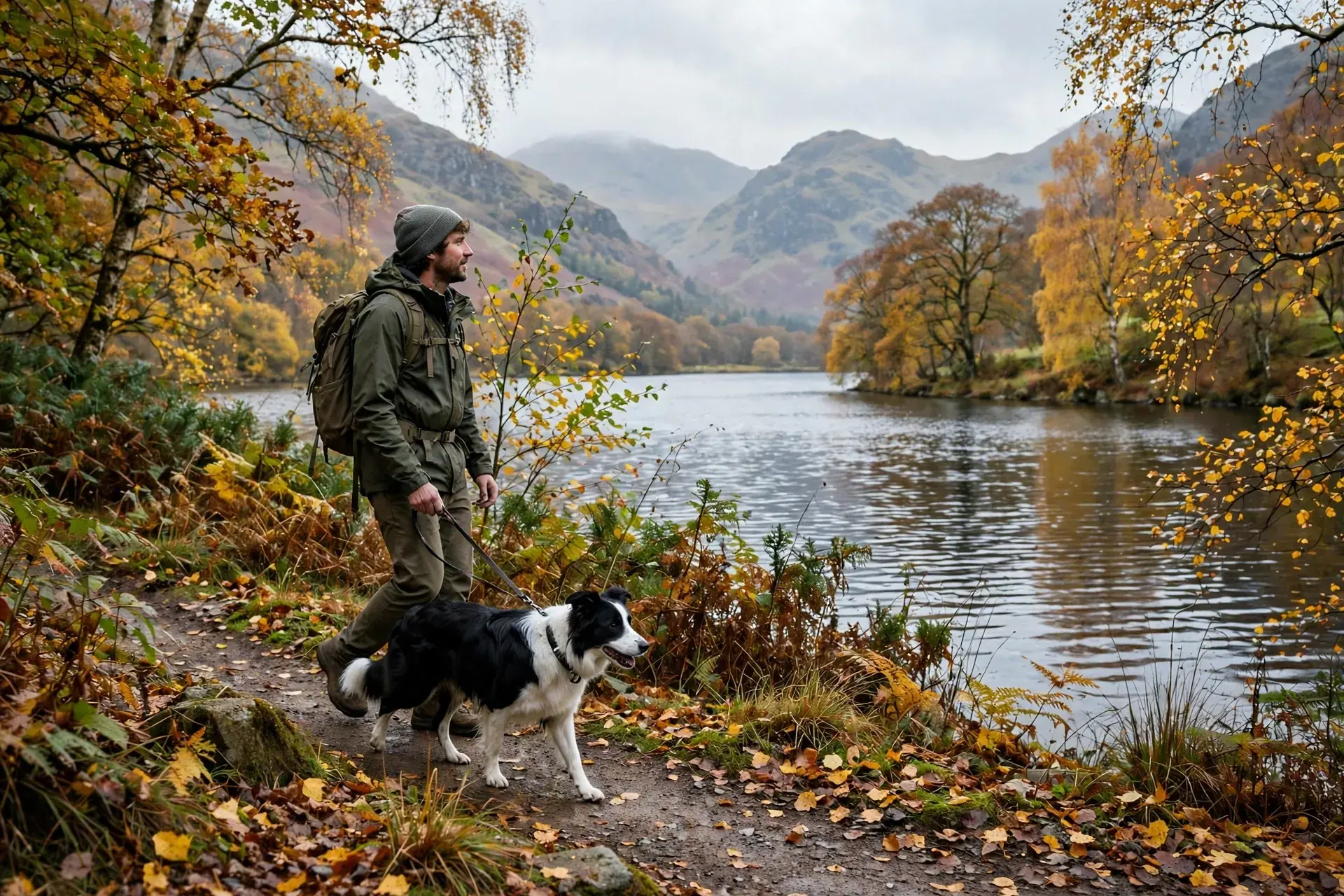
Seasons change the character of the town more than its size suggests. Spring brings lambs in the fields and softer ground on the valley paths. Summer is the busiest time at Talkin Tarn, when the car park fills and the lakeside path carries more walkers, runners and families. Autumn is arguably the best season for dogs here: the woodland around the tarn and on the town's edge turns gold and russet, the air cools, and the leaf-covered paths give dogs a rich scent trail to follow. Winter is quieter and often muddy, with short days and wet ground, so shorter loops and a warm, dry place to return to matter more than distance.
Before you travel, settle the basics for your own dog. Note how your dog copes with other dogs on narrow paths, whether they pull towards water, how they react to sheep and cattle, and how far they can comfortably walk on mixed ground. Brampton rewards that kind of honest planning because its best walks are not long or steep: they are varied, and the dog that enjoys a slow, sniff-heavy hour will get more from them than a dog pushed through a forced march. Keep the first day short, learn which surfaces and slopes suit your dog, and build the second day around what worked.
Talkin Tarn: the lakeside loop
Talkin Tarn is the walk most visitors come for, and for good reason. The tarn is a small glacial lake set in a shallow bowl of woodland and grassland just south-west of Brampton, and a path runs all the way around its shore. The full circuit is about 1.3 miles, which makes it a comfortable morning walk for most dogs, a good warm-up for a longer day, or a gentle evening loop when you want fresh air without a drive.
The path is broadly level, with a mix of surfaced sections, compacted earth and grass. That variety matters for paws: after dry weather the surface is firm and easy, while after rain the unsurfaced stretches can be muddy and slippery, especially on the shaded side where leaves collect. Dogs that are unsteady on their feet, older dogs, and dogs recovering from injury will usually manage the loop in dry conditions, but they may be happier with a shorter out-and-back walk along the flatter, sunnier side rather than the full circuit in wet weather. Allow an hour for the loop if your dog likes to stop and sniff, and longer if you plan to sit on a bench and watch the water.
Water is the main thing to manage at the tarn. Dogs are often seen paddling at the edge, and the shallow margins look inviting on a warm day. Swimming, however, is not a formal dog-swimming venue here, and conditions change with the season. Blue-green algae can affect still water in warm weather, and the tarn is also used by rowers, sailors and other water users at certain times, so a dog charging into the water can cause a problem for everyone. The sensible approach is to keep your dog on a lead near the water, let them paddle at the edge only when the water looks clear and no warning signs are displayed, and rinse them off afterwards. If you are unsure about the water on the day, check the official guidance before you travel, and choose a short paddle rather than a swim.
Wildlife is part of the tarn's appeal and part of its etiquette. Ducks, geese and other water birds use the tarn throughout the year, and the reed beds at the margins are sensitive nesting and feeding areas. A dog that chases birds will need a lead here, not just for the birds' sake but because a chase across a busy path can trip other walkers. Keep to the path, keep your dog out of the reeds, and give anglers and other water users a wide berth. The tarn is at its most peaceful early in the morning and on weekday afternoons, when the path is quieter and a nervous dog has more space.
Practical details help the visit run smoothly. The main car park is close to the tarn, with a cafe and toilets nearby, and there is usually a pay-and-display arrangement, so bring coins or a payment card and check the signs on arrival. The cafe area is a natural stopping point, but dog rules for indoor seating can change, so ask staff before you assume your dog can come inside; outdoor seating is the safer bet in most seasons. Bring water for your dog even on a short loop, because the tarn water is not a reliable drinking source, and carry poo bags — bins are provided, but they are not on every stretch of the path. In autumn, the leaf fall is thick on the wooded side of the loop, so watch for hidden roots, wet leaves on slopes, and the occasional fallen branch after wind.
Talkin Tarn also works as a gauge for the rest of your trip. If your dog is relaxed and happy on the lakeside path, the woodland trails and valley lanes will suit them. If they are unsettled by other dogs, cyclists or water birds, you will learn that quickly on a short, level loop where you can shorten the walk and return to the car without a long walk back. Use the tarn as your first walk, not your longest, and let it set the pace for the days that follow.
Woodland trails and leaf season
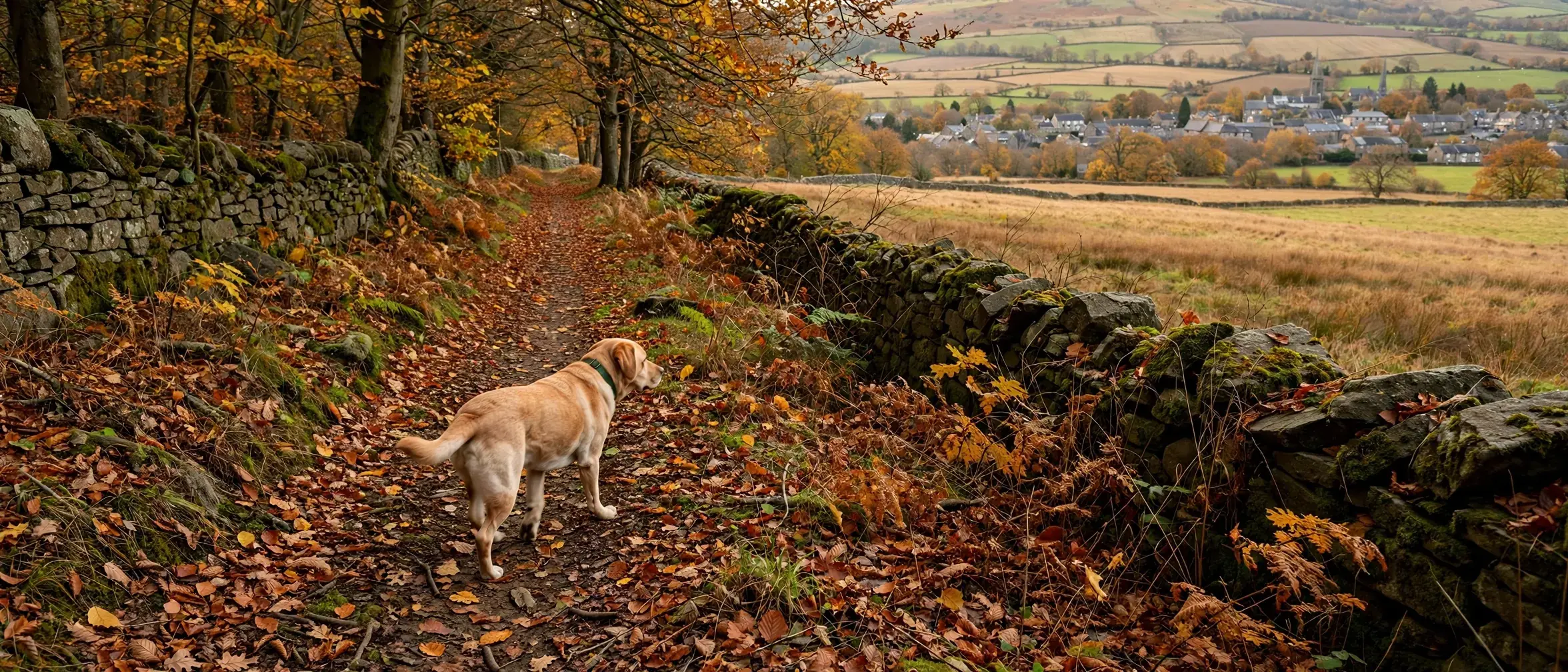
The woodland around Brampton is one of its quiet pleasures. Small woods, shelterbelts and tree-lined field edges break up the farmland, and the paths through them are often sheltered from wind and light rain. In leaf season — roughly late September through November, depending on the year — the ground becomes a thick carpet of beech, oak and sycamore leaves, and the scent changes daily as the leaves dampen, dry and decay. For a dog, that is a rich environment: every few steps bring a new smell, and a slow walk through fallen leaves can tire a dog more effectively than a brisk march on tarmac.
Leaf-covered ground needs a little care. Wet leaves hide roots, stones, rabbit holes and uneven ground, so a dog that runs blindly through deep leaf litter can twist a leg or slip. Older dogs and small dogs are more at risk, and the risk rises on slopes and on paths that cross tree roots. Keep your dog on a lead or a long line on unfamiliar woodland paths until you know the ground, and slow down on descents. After a walk, check paws for thorns, burrs and small sticks caught between the toes, and check ears — especially floppy ears — for seeds and leaf fragments that can cause irritation if left in place.
Autumn also brings fungi, fallen fruit and nuts to the woodland floor. Most fungi are not a problem if a dog simply sniffs them, but some species are toxic if eaten, and a dog that hoovers up everything on the ground needs closer supervision in this season. Acorns and conkers are a similar concern: they are not safe for dogs to eat in quantity, and they are common under oak and horse chestnut trees in Cumbria. Teach a reliable leave-it cue before your trip if your dog is a scavenger, and carry treats so you can trade for anything they pick up rather than chasing them through the leaves.
Beyond autumn, the woods are useful in every season. In summer they offer shade when the open valley paths are hot, and the canopy keeps the ground cooler for paws. In winter they break the wind, though the paths can stay wet and muddy for days after rain. In spring, the woodland floor fills with wild garlic, bluebells and other spring flowers in some areas — beautiful to walk through, but another reason to keep dogs on the path and out of the planted and sensitive areas. Whatever the season, the rule is the same: stay on the marked or well-worn path, keep your dog under control, and leave the woodland as you found it.
If you are staying for a few days, vary the woodland walks rather than repeating the same loop. The tarn-side woods, the small woods on the town's edge, and the tree-lined lanes towards Lanercost each have a different feel, and a dog that has already sniffed one wood thoroughly will find new interest in another. Short, varied woodland walks also suit dogs that tire quickly: two twenty-minute wanders with a rest between them are often better than a single hour-long march, and they leave time for a stop in town or a rest back at your stay.
The market place and town centre
Brampton's market place is the heart of the town, a broad open space surrounded by sandstone buildings, shops and cafes. A market is still held here on certain days, and on market days the square fills with stalls, shoppers and the smells of food and flowers. For a dog, the market place is a social walk rather than a nature walk: it is about people, pavements, other dogs and the small courtesies of town walking — keeping to one side, not blocking doorways, and settling quietly while you queue or chat.
On a market day, keep your dog on a short lead and close to your side. The square can be busy, and a long lead across a crowded pavement is a trip hazard for everyone. Food stalls are a particular temptation: dropped food, hot surfaces and tempting smells are all within nose height for a dog, so a short lead and a watchful eye matter. If your dog is nervous in crowds, visit the market place early, before the stalls are at their busiest, or walk the quieter streets around the square instead and save the market itself for a quick pass-through.
On non-market days the square is calmer, and it makes a good starting point for a town walk. The surrounding streets hold independent shops, a butcher, a baker, cafes and a small supermarket, so you can combine a dog walk with practical errands. Many cafes have outdoor seating in warmer months, and some welcome dogs outside; indoor rules vary, so ask before you bring a dog in. A dog that can settle under a table for ten minutes while you have a coffee is a useful skill to practise at home before a trip, and Brampton's quieter cafes are a forgiving place to try it.
Town walking also means pavements, roads and traffic. Brampton's centre is compact, but the main roads through the town carry through-traffic, including lorries and farm vehicles, so keep your dog on a lead on every pavement and at every crossing. Use the pedestrian crossings where they exist, and do not let a dog wander onto the road to sniff. Pavements can be hot in summer and icy in winter, so check the surface with your hand on a hot day and choose the shaded side of the street when you can. In winter, grit and salt on pavements can irritate paws, so rinse paws after a town walk if your dog has been walking on treated surfaces.
The town centre is also where you will find the practical services that support a dog trip: a pharmacy, a post office, food shops and places to buy extra poo bags, treats or a spare lead if yours breaks. Knowing where those shops are before you need them saves a stressed search later. If you are staying in a self-catering cottage, a quick shop in Brampton on arrival covers the essentials, and the town's small size means you can do it on foot with the dog rather than driving to a larger supermarket.
Lanercost Priory and country lanes
Lanercost lies about two miles north-east of Brampton, down quiet country lanes that are ideal for a longer dog walk. The village is best known for Lanercost Priory, a 12th-century Augustinian priory whose church is still in use and whose ruins stand in a peaceful setting beside the River Irthing. The priory itself is a historic site, and the lanes and riverside paths around it are often the better part of the visit for a dog owner.
The walk from Brampton to Lanercost can be done on foot if your dog is fit and you are comfortable with country lanes, but many visitors drive to the village and walk from there. Either way, the lanes are narrow, with high hedges, blind bends and occasional farm traffic, so keep your dog on a lead on the road sections and walk facing oncoming traffic where there is no pavement. The lanes are quieter than the main roads, but a tractor around a bend or a car at speed can appear quickly, and a dog on a long lead in the middle of the lane is at risk.
At Lanercost, the priory grounds are generally welcoming to dogs on leads, and the open grass and riverside paths give a dog space to walk at a relaxed pace. Access rules for the priory building itself can change, and dogs may not be allowed inside, so check the official guidance before you travel if you plan to go in. Even without going inside, the visit is worthwhile: the priory's sandstone walls, the churchyard, the river views and the quiet of the village make a calm contrast to the busier tarn, and the walk back along the lanes gives the dog a second stretch of countryside.
The River Irthing runs near Lanercost, and the riverside paths are attractive in dry weather. River levels rise quickly after heavy rain, and the banks can be steep and slippery, so keep dogs on a lead near the river and do not let them swim in fast or swollen water. In summer, the river's shallow stretches may look inviting, but the same cautions apply as at the tarn: check the water, watch for hazards, and keep the dog close. After rain, choose the lanes rather than the riverside path, and save the river walk for a drier day.
Lanercost also makes a good half-day outing when combined with a stop in Brampton on the way back. Walk the lanes, visit the priory grounds, and return to the town for lunch or a coffee. If your dog is tired, drive back rather than walking the return leg — a tired dog on a narrow lane is more likely to lag, wander or be startled by traffic. Carry water, especially in warm weather, because the lanes have few places to stop for a drink, and bring a towel if the verges are wet.
Walking the Eden Valley
The Eden Valley is the open landscape south of Brampton, where the River Eden winds through farmland, wooded banks and small villages. The valley walks are gentler than the fells to the south and more open than the woodland paths, which makes them a good middle ground: enough space for a dog to enjoy the walk, but without the steep climbs or exposed ridges that tire older dogs or worry nervous owners.
Valley walking here usually means a mix of public footpaths, bridleways, farm tracks and quiet lanes. The paths are often well signed, but they cross farmland, so the ground can change quickly: a firm track can become a muddy field entrance after rain, and a grassy path can be churned by cattle. Wear boots with a good grip, carry a towel for muddy paws, and be ready to turn back if a path is waterlogged. The best valley walks are the ones you can shorten: a loop with a lane back to the start is more useful than a long linear path that leaves you miles from the car if the weather turns or the dog tires.
Livestock is the main thing to plan for in the Eden Valley. Sheep and cattle graze many of the fields the footpaths cross, and the rules are clear: keep dogs on a lead near livestock, and keep them under close control at all times. Even a friendly dog can worry sheep, and a dog that chases livestock can cause serious harm and put itself at risk from cattle. If you meet cattle on a path, keep your dog on a short lead, walk calmly past at a distance, and do not let the dog approach calves. If cattle become aggressive or block the path, let the dog off the lead only if that is the safest way for both of you to get clear — and check the official guidance before you travel for the current countryside code advice.
The River Eden itself is a feature of the valley, with long stretches of bankside walking and views across the water to wooded slopes. The river is wider and faster than the tarn, and its banks can be steep, so the same water rules apply with more caution: keep dogs on a lead near the bank, do not let them swim in fast water, and be aware that the river level can rise after rain upstream even when it is dry where you are standing. In summer, the river's gravel banks can be a good place for a supervised paddle, but check the water and the access point first, and never let a dog swim alone or out of sight.
Villages in the valley, such as those along the Eden between Brampton and Carlisle, make good turning points for a walk. A village green, a churchyard or a quiet lane gives the dog a change of scene, and a short stop lets you check paws, offer water and decide whether to continue or turn back. If you are planning a longer valley walk, tell someone where you are going, carry a phone, and take a map or a downloaded route, because phone signal can be patchy in the valley and the footpath network is easier to follow with a map in hand.
For dogs that love open space, the Eden Valley is a better fit than the tarn on a busy day. The valley paths are longer, quieter and less crowded, and the dog can settle into a steady walking rhythm. For dogs that need more stimulation, the valley's variety — fields, hedges, river, woodland edges — gives plenty to sniff and explore without the need for a long drive. Either way, the valley rewards a slow pace: walk, stop, let the dog investigate, and enjoy the views rather than chasing a distance target.
Hadrian's Wall and Birdoswald
Hadrian's Wall runs across the countryside north and east of Brampton, and Birdoswald Roman Fort is the nearest major Wall site, a short drive from the town. The fort stands on a ridge above the River Irthing, with views across the valley and along the Wall, and the surrounding countryside is open, windswept and full of history. For a dog owner, Birdoswald is a good day out because the walk around the site is as rewarding as the site itself.
The Hadrian's Wall Path is a long-distance trail that follows the Wall across northern England, and the sections near Birdoswald are among the most scenic. Dogs on leads can usually walk the path and the surrounding countryside, but the path crosses farmland, climbs and descends steeply in places, and runs close to drops and walls. Keep your dog on a lead, especially near livestock, on narrow sections, and where the path runs beside a road. The ground is often uneven, with stones, grass and mud, so this is not a walk for a dog that struggles with rough ground or for a puppy that is still building stamina.
Rules inside paid sites vary. Dogs may be welcome in the grounds and on the outdoor areas of some Wall sites but not inside museums, exhibitions or shops, and the rules can change with the season or with events. Check the official guidance before you travel for Birdoswald and any other site you plan to visit, and plan as if your dog will need to stay outside the indoor areas. That usually means visiting as a pair, taking turns to go inside, or enjoying the outdoor walk and the views and skipping the indoor displays on this trip.
The Wall country around Brampton is exposed, so weather matters more here than in the sheltered woodland. Wind can be strong on the ridge, rain can arrive quickly, and there is little shelter on the open sections of the path. Check the forecast, dress for wind and rain, and carry a coat for your dog if they feel the cold or if the rain is heavy. In summer, the open ground can be hot and there is little shade, so carry extra water and walk in the cooler parts of the day. In winter, the paths can be icy and the wind chill can be sharp, so keep the walk short and return to the car or to Brampton for warmth.
If you want a longer Wall walk, consider the stretch between Birdoswald and Gilsland, or the section towards Banks and Walton, both within easy reach of Brampton. These are quieter than the central Wall sections around Housesteads, and they give a dog more space. If you are heading further east along the Wall, our Northumberland dog guide covers the Wall walks, castles and beaches beyond Brampton in more detail, including the tide safety and lead rules that matter on the Northumberland coast. For a comparison of the two great northern walking areas, our Lake District vs Peak District with a dog guide helps you match terrain, lead rules and swimming water to your own dog before you commit to a longer trip.
Lead rules, livestock and water
Most of the dog rules in the Brampton area come down to three things: leads, livestock and water. Getting those three right covers almost every situation you will meet, from the tarn to the Wall. The details vary by place, but the principles are consistent, and they are worth learning before you arrive rather than discovering them on a busy path.
Leads are required or expected in most of the places a visitor will go: on pavements and roads in town, near the tarn's busiest sections, on narrow lanes, near livestock, and on the Hadrian's Wall Path. Off-lead walking is possible in some open areas, but only where it is clearly allowed, where your dog has reliable recall, and where there are no livestock, no other dogs that might react, and no hazards such as roads, cliffs or fast water nearby. A long line is a useful compromise on valley and woodland paths: it gives the dog freedom to sniff and explore while keeping you in control if livestock, cyclists or other dogs appear.
Livestock deserves special attention in Cumbria. Sheep are common on the fells and in the valley fields, and cattle graze many of the riverside meadows. The law and the countryside code are clear that dogs must be under close control near livestock, and on a lead where livestock are present. A dog that chases sheep can cause ewes to abort lambs, injure themselves on fences, or die from stress, and farmers are entitled to take action to protect their animals. If you see sheep in a field, put your dog on a lead before you enter, keep to the path, and do not let the dog approach or bark at the animals. The same applies to horses, which can be startled by a loose dog.
Water safety is the third pillar. Brampton's water — the tarn, the Eden, the Irthing and the smaller becks — is attractive to dogs, but it is not a swimming pool. Still water can carry blue-green algae in warm weather, rivers can be fast and cold, and banks can be steep and slippery. Never let a dog swim in water you have not checked, never let them swim alone or out of sight, and always rinse them off after a swim or a paddle. If your dog drinks from a river or tarn, watch for signs of stomach upset afterwards, and seek veterinary advice if they seem unwell. In winter, cold water is a particular risk: a dog that falls into cold water can become hypothermic quickly, so keep them on a lead near fast or deep water in cold weather.
Other hazards are smaller but worth knowing. Adders are present in parts of Cumbria, including on sunny banks and in rough grassland in summer, so keep dogs on paths in adder habitat and seek veterinary help immediately if you suspect a bite. Ticks are common in woodland and long grass from spring to autumn, so check your dog after every walk, especially around the ears, armpits and groin, and remove ticks promptly with a tick remover. In autumn, the fungi, acorns and conkers mentioned earlier are a further reason to keep a scavenging dog on a lead in woodland. None of these hazards should stop you walking — they are simply part of walking in the British countryside, and a little awareness goes a long way.
Eating out and staying over
Brampton's size works in its favour for eating out with a dog. The town has cafes, pubs and takeaways, and several have outdoor seating where dogs are welcome in warmer months. Indoor dog rules vary by venue and can change, so the practical approach is to ask before you sit down, choose a table outside when you can, and have a takeaway backup in mind if the weather turns or the venue is full. A dog that can settle under a table for twenty minutes is easier to take out than a dog that needs constant attention, so practise settling at home and bring a mat or blanket that smells familiar.
Pubs in the Brampton area are often the most dog-friendly option, especially those with a garden or a quiet corner. The Eden Valley and the Wall country have a tradition of walkers' pubs, and many welcome muddy boots and dogs in the bar area. Even so, do not assume: ask at the door, keep your dog on a lead, and keep them out of the way of staff carrying food and drink. If you are eating a full meal, choose a pub with outdoor seating or a dog-friendly dining area rather than hoping a busy restaurant will make an exception.
For staying over, Brampton and the surrounding villages offer a mix of self-catering cottages, bed and breakfasts, farm stays and small hotels, many of which accept dogs. The key questions are the same as anywhere: how many dogs are allowed, is there a pet fee, is the garden enclosed, and where is the nearest toilet walk after dark? Ask for the answers in writing before you pay, and check whether the garden fence is secure for your dog's size — a low dry stone wall or a hedge with gaps is not a secure boundary for a determined terrier or a large dog that can jump.
Self-catering is often the easiest option for dog owners in this area, because it gives you a kitchen, a garden and a routine that is close to home. Look for a cottage with a secure garden, a hard floor that is easy to clean after a muddy walk, and a drying area by the door. If you are staying in a bed and breakfast or a hotel, ask whether dogs can be left alone in the room, and plan as if the answer is no: a dog that is left alone in an unfamiliar room may bark, chew or try to escape, and that can end a stay early. Bring your dog's own bed, food and water bowls, and a familiar blanket so the stay feels like home from the first night.
Booking early matters in the busiest seasons. Summer weekends, school holidays and the autumn half-term can fill the dog-friendly cottages around Brampton and the Eden Valley, especially those with enclosed gardens. If you are flexible, a weekday stay in spring or autumn is often quieter and cheaper, and the walks are just as good. Whatever the season, confirm the dog arrangements directly with the owner or the booking platform, and keep the confirmation with your booking details so there is no confusion on arrival.
Parking, vets and practical details
Parking in Brampton is straightforward, but it helps to know the pattern before you arrive. The town centre has on-street parking and small car parks, and Talkin Tarn has its own car park close to the lake. On a busy summer weekend or a sunny autumn day, the tarn car park can fill up, so arrive early or be ready to park in town and walk to the tarn. Check the signs at each car park for charges, time limits and payment methods, because arrangements can change, and do not leave valuables visible in the car. Never leave a dog in a parked car on a warm day, even with the windows open — the temperature inside a car can rise dangerously fast, and a dog left alone can also become distressed.
For Birdoswald and the other Wall sites, parking is usually in a dedicated car park near the site, with a short walk to the entrance. The car parks can be busy in summer, and the lanes to them are narrow, so drive slowly and watch for walkers and cyclists. If you are walking a section of the Hadrian's Wall Path, plan your parking at both ends if you are doing a linear walk, or choose a circular route that returns to the same car park. A circular walk is almost always simpler with a dog, because it avoids a long walk back along a road or a wait for a bus that may not take dogs.
Veterinary care is an important practical detail, especially if you are staying for a few days. Brampton has veterinary services in the town and in nearby Carlisle, and there are out-of-hours services in the wider area. Before you travel, save the number of your own vet and the number of a vet near Brampton in your phone, and note the opening hours. If your dog takes medication, bring enough for the trip plus a day extra, and keep it in its original packaging with the prescription details. If your dog has a health condition, bring a short note of the condition, the medication and your vet's contact details, so a local vet can help quickly if needed.
Other practical details are small but useful. Mobile signal is generally good in Brampton and Carlisle, but it can be patchy in the valley and on the Wall ridge, so download maps and routes before you set out. Public transport in the area is limited: buses run between Brampton and Carlisle and to nearby villages, but services are infrequent, and dogs on buses are at the driver's discretion, so check before you rely on a bus. A car is by far the easiest way to explore the Brampton area with a dog, and it gives you the flexibility to shorten a walk, move to a different car park, or return to your stay if the weather turns.
Packing for Brampton is packing for the Cumbrian countryside: layers for changeable weather, waterproofs for you and a drying coat for the dog, towels for muddy paws, poo bags, water and a bowl, treats for training and recall, a lead and a long line, a tick remover, and a first-aid kit with basics for cuts and stings. In autumn, add a torch for early evenings, because the light fades quickly under the trees. In summer, add sun protection for thin-coated dogs and extra water. The town's shops can cover anything you forget, but the essentials — medication, food, lead and poo bags — should be in the car before you leave home.
A relaxed two-day plan
A two-day stay in Brampton works best when the first day is short and the second day builds on what you learned. Day one is for the tarn, the town and a gentle introduction to the area. Start with the Talkin Tarn loop in the morning, when the path is quieter and the light is good. Walk the full circuit if your dog is fit and the ground is dry, or a shorter out-and-back section if the dog is older or the ground is wet. Allow time to sit by the water, watch the birds, and let the dog settle into the new surroundings.
After the tarn, return to Brampton for lunch. Walk the market place and the surrounding streets, stop at a cafe with outdoor seating if the weather allows, and do any shopping you need for the stay. In the afternoon, take a short woodland walk on the town's edge or a quiet lane walk, keeping it to twenty or thirty minutes. The aim is not distance but familiarity: let the dog learn the smells and sounds of the area, and let yourself learn which paths suit your dog. In the evening, keep the routine close to home — same feeding time, same bed, same last walk — and let the dog rest.
Day two is for the wider area. If the weather is dry, drive to Lanercost in the morning, walk the lanes and the priory grounds, and enjoy the riverside paths. Alternatively, drive to Birdoswald for a Wall walk, choosing a short circular section rather than a long linear stretch. Either option gives the dog a longer walk and a change of scene, and either can be shortened if the dog tires or the weather changes. Stop for lunch in Brampton or at a pub on the way back, and spend the afternoon on a valley walk or a second visit to the tarn, this time at a different time of day when the light and the wildlife are different.
If you have a third day, use it for the Eden Valley or for a longer trip further afield. A valley walk from a village south of Brampton, a drive to Carlisle for supplies and a riverside walk, or a longer Wall walk towards Gilsland all work well as a third day. If you are continuing north or south after Brampton, the town is a natural stopping point on a longer tour: north to Northumberland, south to the Lake District, or east along the Wall. Our three-day Lake District itinerary is a useful next step if you are heading south, while the Northumberland guide covers the coast and castles to the north. For a broader choice between the two national parks, see our Lake District vs Peak District comparison before you decide where to go next.
Whatever plan you choose, keep it flexible. Cumbrian weather changes quickly, and a dog's energy changes with it. A plan that can be shortened, swapped or abandoned without disappointment is a better plan than a rigid itinerary. Brampton rewards that flexibility because its best walks are close together: if the Wall is too windy, the tarn is sheltered; if the tarn is too busy, the valley is quiet; if the valley is too muddy, the town centre is a pleasant alternative. The dog does not care about the plan — only about the walk in front of them.
Practical questions
Before you go
Can dogs swim in Talkin Tarn?
Dogs are often seen paddling at the tarn, but swimming is not a formal dog-swimming venue and conditions change with the season. Keep dogs on a lead near the water, watch for blue-green algae warnings, and check the official guidance before you travel. If in doubt, let your dog paddle at the edge rather than swim, and rinse off afterwards.
Is the Talkin Tarn circular walk suitable for older dogs?
For many older dogs, yes, because the lakeside circuit is broadly level and can be walked at a slow pace with plenty of stops. The full loop is about 1.3 miles, so an older or stiff dog may prefer a shorter out-and-back section instead. Choose dry, calm weather, carry water, and watch for slippery leaves and muddy patches after rain.
Are dogs allowed at Lanercost Priory?
Dogs on leads are generally welcome in the grounds around Lanercost Priory, but access rules for the priory building itself can change, so check the official guidance before you travel. The quiet lanes and riverside paths around Lanercost are often the better part of the visit for a dog, with open views and space to walk at a relaxed pace.
Where can I walk near Hadrian's Wall with a dog from Brampton?
Birdoswald Roman Fort is the nearest well-known Wall site to Brampton, a short drive to the east. Dogs on leads can usually walk the surrounding countryside and sections of the Hadrian's Wall Path, but rules inside paid sites vary, so check the official guidance before you travel. Keep dogs on a lead near livestock, walls and steep drops.
Is Brampton a good base for a rainy day with a dog?
Yes, within limits. Talkin Tarn and the town centre give you short, practical walks, and the woodland paths are sheltered from light rain. Pack a drying coat and towels, choose surfaced paths when the ground is wet, and keep the day short. For a longer wet day, Carlisle is a short drive away for supplies, while the dog can rest back at your stay.