This guide is independent and contains no paid placement. If affiliate links are added later, they will be clearly marked and will not change our editorial checks.
Treat York Minster and the big museums as split visits because pet dogs stay outside, walk the riverside, Museum Gardens and Rowntree Park for daily exercise, check the current rules before using the city walls with a dog, and take the Shambles and the centre early in the day on a short lead.
A city of layers, taken one at a time
York compresses two thousand years into a centre you can cross on foot in twenty minutes, and that density is both its charm and its challenge with a dog. Roman walls under medieval walls, Viking streets under Georgian terraces, a cathedral above it all: the sightseeing instinct is to stack it into one heroic day. Resist it. York with a dog works as layers taken one at a time — a riverside morning, a slow lane-wandering afternoon, one interior visited properly while your dog has a proper walk, and an evening pub to finish. Owners who pace it that way see more, not less, because nobody in the party is frazzled by lunchtime.
The practical shape of a York day is helped by how green the centre is for a historic city. The River Ouse curves through it with paths on both banks, Museum Gardens gives ten acres of trees and ruins beside the Minster quarter, and Rowntree Park, a short walk south along the river, adds a large local park with a lake and cafe. A dog based near any of these can be exercised properly without a car, which matters because York's centre is largely pedestrianised in the daytime and driving to walks across it is rarely the answer.
Choose your visiting hours as carefully as your sights. The central lanes, Stonegate and the Shambles above all, are narrow, famous and, from late morning on a weekend or in summer, extremely full. The same streets at 8am are a pleasure: deliveries finishing, shopkeepers opening, space to let a dog actually look around. Many owners find the winning pattern is an early centre, a green middle of the day, and a return in the evening when day-trippers have gone and the pubs — where York's dog welcome is strongest — come into their own.
York Minster: the split visit, done well
Start with the fact that organises everything else: pet dogs are not admitted inside York Minster. The Minster is a working cathedral as well as one of the great Gothic buildings of Europe, and its visitor policy admits assistance dogs only. Check the official site before you go for current opening arrangements, service times and any special-event closures, because the building's calendar shapes access on the day. The precinct and the green spaces around it, including Dean's Park beside the Minster, are outdoor ground where a lead walk is possible, subject to the signs on the day — but the interior, the tower and the exhibitions belong on the human-only list.
The split visit is painless here because the dog's alternative is excellent. While one person spends an hour or two inside — and the Minster deserves that time — the other can walk the dog through Museum Gardens, among the ruins of St Mary's Abbey and the trees along the river, or take the Ouse path north toward Clifton. Swap roles for a second attraction later, or accept one interior each per trip and keep the rest of the day together. Solo travellers will usually get more from York by embracing its outdoor wealth — walls, rivers, gardens and lanes — and saving the interiors for a future visit with company or with trusted local dog care arranged.
Expect the same assistance-only default at the city's other headline interiors, including the Jorvik Viking Centre, the Castle Museum and the merchant houses and galleries, unless a venue confirms otherwise. Our guide to dogs at English Heritage sites explains the pattern across historic properties, and Clifford's Tower, the English Heritage keep with panoramic views, is worth checking individually because outdoor and rooftop elements sometimes follow different rules from fully indoor museums — verify on the official site before you go rather than assuming either way. Building your itinerary on confirmed rules, not hopeful ones, is what keeps a York day relaxed.
City walls, bars and snickelways
York's city walls are the most complete in England, and walking them is the classic York experience — which makes their dog position the question to settle before you set out, not at the steps. Rules for dogs on the wall walk have varied, sections close for maintenance and weather, and some stretches are narrow with drops and no passing room, so check the official site before you go for the current position on dogs, open sections and hours. If dogs are not permitted on the section you had in mind, the walk at the foot of the walls, following the circuit through streets and gardens, is a genuinely good alternative that many owners prefer anyway: easier underfoot, simpler with a reactive dog, and full of gates — the bars — to admire from ground level.
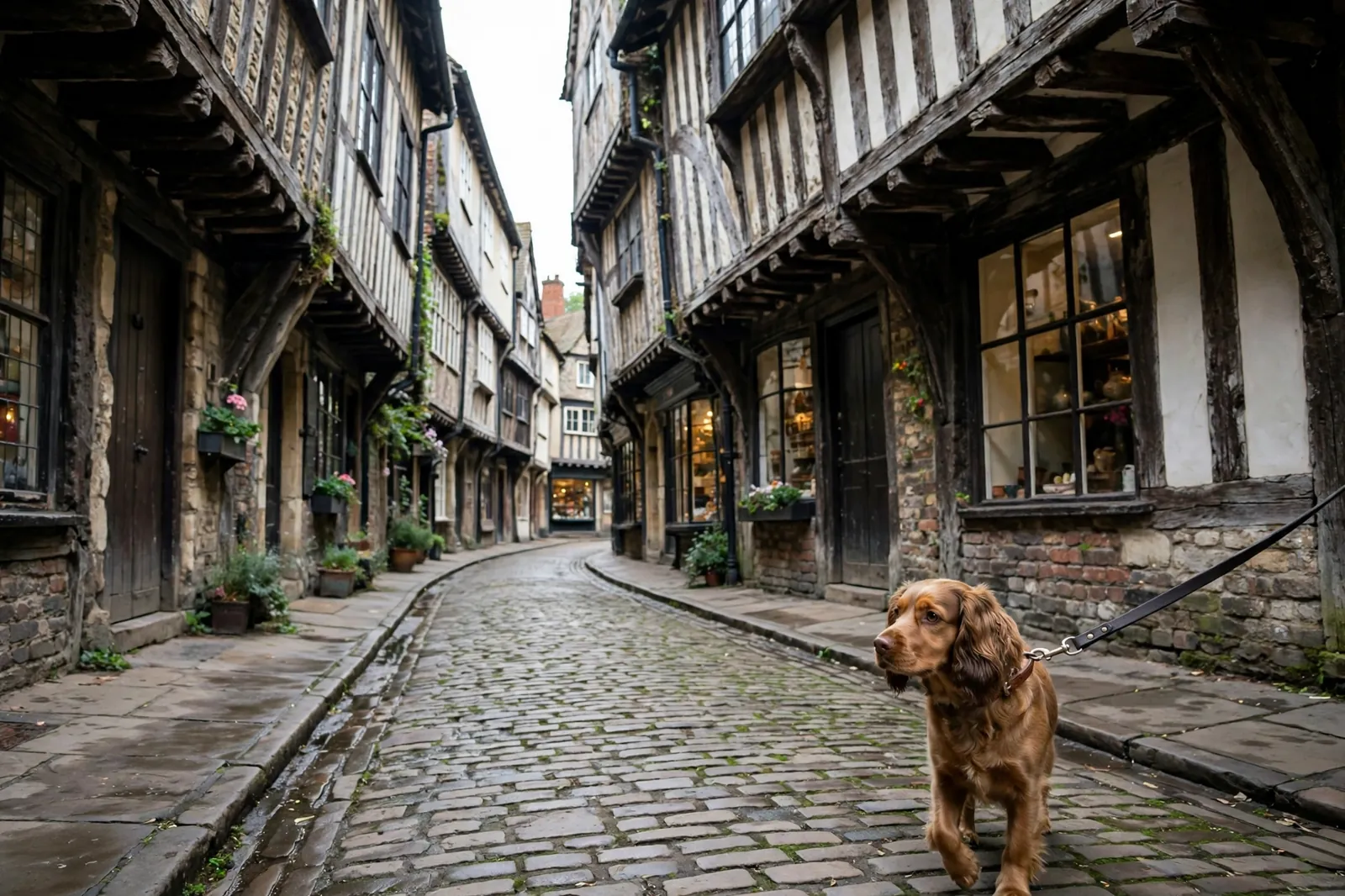
The four main bars, Bootham Bar, Monk Bar, Fishergate Bar and Walmgate Bar, punctuate any circuit, and the streets between them are a history lesson in themselves. Within the walls, York's famous snickelways — the narrow passages and lanes threading between the main streets — are delightful with a dog at quiet times and close to impassable at busy ones. A short lead, a willingness to step aside, and early timing turn them from an ordeal into one of the best parts of the trip. The Shambles, the medieval butchers' street with overhanging jetties, is the extreme case: go before the shops fill, keep the visit purposeful, and never try to browse its busiest hours with a dog at ankle height in the crowd.
Pavement quality deserves a word. Much of the centre is stone-flagged or cobbled, handsome but slippery when wet and hard on older paws over a full day. Alternate pavement hours with grass hours — Museum Gardens, the riverbanks, the green spaces around the Minster — and keep an eye on pads if your dog is unaccustomed to city surfaces. In icy weather the wall-top paths and the steeper lane junctions are best avoided entirely, and a dog who pulls needs a short lead and a handler with good footwear on the gradients around the bars.
The Ouse, Museum Gardens and Rowntree Park
The River Ouse is York's dog-walking backbone. Paths follow both banks through the centre and out in both directions: north toward Clifton and the open ground beyond, south past Rowntree Park and the racecourse side toward Bishopthorpe. The central stretches are paved, level and well lit, ideal for the first and last walks of the day, while the outer sections grow grassier and quieter. After heavy rain the Ouse floods famously, and riverside paths are among the first casualties — barriers and closures must be respected, and an inland alternative chosen without argument, because floodwater on these paths arrives fast and leaves deep mud behind.
Museum Gardens, in the Minster quarter between the river and the library, is the centre's green drawing room: ten acres of trees, lawns and the romantic ruins of St Mary's Abbey, with the Yorkshire Museum at its heart. Dogs on leads are the working assumption for gardens of this kind — follow the signage on the day — and the space suits a calm lead walk, a sit on a bench and a picnic rather than off-lead running. It pairs naturally with a Minster split visit and with coffee in the streets around Bootham. At peak times it fills with visitors and school groups, so early and late visits show it at its best.
Rowntree Park, about fifteen minutes south of the centre along the river, is where local dogs actually live their lives: a large park with a lake, tree avenues, tennis, a reading cafe and generous grass. It suits proper exercise for dogs under good control away from the lake, play areas and sports, and leads near the waterbirds, who are confident and numerous. The park can close when the river floods, so check the position locally after heavy rain. Between the Ouse paths, Museum Gardens and Rowntree Park, a York dog has a complete daily routine without ever needing the car — the surest sign of a well-chosen base.
Railway heritage and wet-weather thinking
York is a railway city, and the National Railway Museum is its second great interior. Museum dog policies differ and change, and large indoor museums of this kind are commonly assistance-only for pet dogs; check the official site before you go for the current position, and plan it as another split visit if you want to see the great locomotives properly. The dog's half can be the river path south or the green spaces around Leeman Road, and the station area itself is busy transport ground to cross purposefully on a lead rather than linger in with a nervous dog.
Wet weather is the honest test of any York itinerary, so build the answer in advance rather than improvising in the rain. Covered shopping streets and arcades generally still count as indoor space for dog purposes unless a venue says otherwise, so the realistic rainy-day pattern is: a long, properly waterproofed morning walk along the river or in Rowntree Park between showers, a dog-welcoming pub or cafe lunch booked ahead, a split-visit museum in the afternoon, and an early evening. Pack for the dog as seriously as for yourself — a drying coat, a towel for the accommodation door and a spare lead transform a wet York day from endurance into routine.
Day trips widen the options if you have a car or a train plan. The Howardian Hills and the edges of the North York Moors lie within reach for a bigger country day, while the coast at Whitby and Scarborough is the classic longer excursion — each needs its own dog checks for livestock, cliffs and seasonal beach rules, and our guide to dog-friendly National Trust visits is a useful starting point for the properties scattered across this countryside. Many owners, though, find York itself fills a short break completely; the day trip is a bonus, not a necessity.
Where to stay with a dog in York
Base yourself by the morning walk and York becomes easy. Streets around Bootham and Clifton put Museum Gardens and the northern river path at hand and tend to be calmer at night. The area south of the river around Bishopthorpe Road — a well-loved local shopping street of independent cafes and shops — gives quick access to Rowntree Park and a neighbourhood feel many visitors prefer to the very centre. Staying inside the walls maximises atmosphere and minimises sightseeing effort, but ask hard questions about the nearest real grass for a 7am toilet walk, because a beautiful lane is not a substitute at that hour.
Run the full dog-policy checklist before booking, in writing where you can: which rooms take dogs, and are they reached by stairs or a lift — relevant in York's converted townhouses and coaching inns; the fee per night or per stay; size and number limits; whether dogs may join you for breakfast or in the bar; and whether a dog may be left alone in the room, the answer that decides your Minster strategy. Our national guide to dog-friendly hotels in the UK sets out the complete list of questions, and York adds two of its own: what happens to access during floods, and how noisy the street is on race days and weekend nights.
Self-catering within or just outside the walls often gives dogs the calmest stay, with hard floors and a door routine you control, but verify any yard or garden is truly enclosed — York's yards can open onto shared snickelways. Book well ahead for the busiest dates: summer, the Christmas market period and race meetings fill the best dog-welcoming rooms early, and prices follow demand. Arrive with the settling kit that makes a strange room familiar fast — the dog's own bed or blanket, a chew for the first evening, poo bags in every pocket and a towel by the door for Ouse-side mud.
Pubs, cafes and eating together
York's pub culture is the strongest card in its dog-friendly hand. This is a city of historic inns and local breweries, and a great many pubs welcome dogs in their bar areas with water bowls and firesides as a matter of course — always confirm with the individual venue, because dining rooms and refurbished spaces vary, and policies change. Independent cafes around Bishopthorpe Road, Fossgate and the quieter streets outside the walls are the daytime equivalent, generally more spacious and more relaxed with dogs than the famous centre at its busiest. Our UK dog-friendly cafes guide covers the etiquette that keeps all these welcomes warm.
Markets and food halls need a plan rather than an assumption. The Shambles Market and the city's food venues are busy, aromatic and full of dropped-food temptation at ground level; some outdoor market areas are workable with a settled dog on a short lead at quiet times, while indoor halls may restrict dogs to assistance only. Check the current rules for the specific venue before you build lunch around it, go early, and treat any food area as a pass-through rather than a lingering space for a dog who scavenges. A walked, fed dog and a handler with treats for attention will manage far better than a hungry dog at lunchtime in a food crowd.
For evening meals, the pattern that suits most dogs is an early sitting in a pub or restaurant you have confirmed welcomes them, preceded by a proper walk so the dog arrives ready to settle. Carry a mat for stone floors, a portable bowl and a long-lasting chew for the wait between courses. If your dog cannot settle indoors, York picnics beautifully in season — delis and bakeries across the city, a bench in Museum Gardens or the Rowntree Park grass — and nobody's trip is diminished by eating this city's excellent takeaway food in its green spaces instead of its dining rooms.
Getting there, floods, ghosts and seasons
York station is one of the great railway arrival points in England, ten minutes' walk from the Minster, and arriving by train spares you the city's park-and-ride calculation entirely. Dogs travel under the usual national conditions; our guide to taking a dog on UK trains covers busy services, leads and platform etiquette. If you drive, use the park-and-ride sites around the ring road and bus in — central parking is limited and the daytime pedestrianised core is not designed for cars — and check the official site before you go for current park-and-ride and bus arrangements. Local buses generally carry dogs at the driver's discretion, on leads and off seats.
Two York specifics deserve space in every plan. The first is flooding: the Ouse and the Foss both flood, riverside paths, low car parks and occasionally Rowntree Park close as a result, and a winter or early-spring visit should include checking river levels and being ready to reroute walks inland. The second is the evening economy of ghosts. York's famous ghost walks and evening tours fill the lanes after dark in a friendly but sudden way — groups appearing from snickelways, guides projecting stories, crowds in narrow spaces. Dogs who dislike surprises will prefer their last walk along the lit river path rather than through the evening centre, and accommodation on a lane used by tours is worth a question at booking.
Seasonally, spring and autumn are York's sweet spots: gardens in leaf or colour, rivers usually behaving, crowds present but manageable. Summer brings the full programme, the races and the busiest lanes — walk early, rest the dog at midday and book everything ahead. Winter is atmospheric, with the Christmas market period at its most demanding for dogs in the centre and short, dark days that reward a base near good lit walks. Whenever you visit, note a local veterinary practice near your stay before you need it, and leave slack in the plan: York's lanes reward unhurried wandering, for owners and dogs alike.
Practical questions
Before you go
Can dogs go into York Minster?
Pet dogs are not admitted inside York Minster; only assistance dogs are allowed in. The grounds and streets around the Minster can be walked on a lead, subject to signs on the day. Travelling pairs usually split the visit, with one person touring the Minster while the other walks the dog in Museum Gardens or along the River Ouse.
Are dogs allowed on York's city walls?
The position on dogs on the wall walk can change, and sections close for maintenance and weather, so check the official site before you go for the current rules and open sections. If dogs are not permitted on a section, walking the circuit at the foot of the walls is a good alternative, with easier ground and the same historic gates to see.
Where can dogs go off lead in York?
Dogs with reliable recall can usually exercise off lead in the open areas of Rowntree Park and on suitable stretches of the riverside paths outside the centre, away from roads, play areas, sports and waterbirds. Museum Gardens and the central streets are lead territory. Always follow local signage, and use a long line if recall is not secure.
Can I take my dog into the Shambles?
The Shambles is a public street, so a dog on a lead can walk through it, but it becomes extremely crowded from late morning on busy days. Go early, keep the lead short, and avoid trying to browse busy shops with a dog in the crowd. Many owners enjoy the street most before the shops open, when there is space to look around.
When is the best time to visit York with a dog?
Spring and autumn usually give the best balance of mild weather, open attractions and manageable crowds. Summer is lively but the central lanes get very busy, so walk early and rest dogs at midday. Winter visits are atmospheric, but check river levels, as Ouse flooding can close riverside paths and Rowntree Park.