This guide is independent and contains no paid placement. If affiliate links are added later, they will be clearly marked and will not change our editorial checks.
Walk the two-mile walls circuit early with your dog on a short lead, drop into the Rows galleries for window shopping, treat the cathedral interior as a split visit, and save the Meadows across the Dee for off-lead time. Base yourself inside or just outside the walls, and check the official site before you go for wall closures and cathedral rules.
The walls circuit, step by step
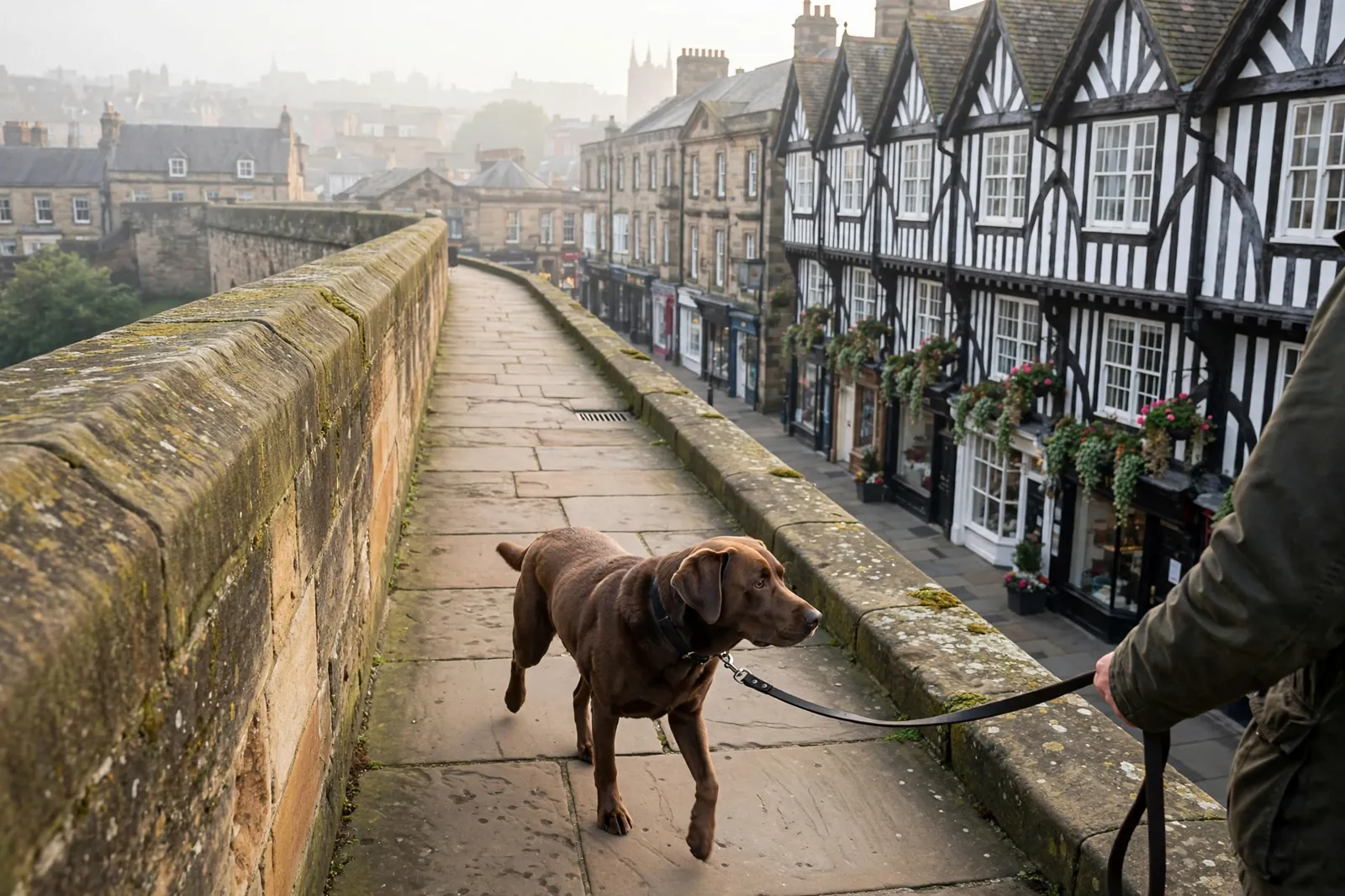
Chester's city walls are the most complete circuit of defensive walls in Britain, and they double as the best possible first walk with a dog. The full loop is roughly two miles, almost entirely level once you are up, paved throughout, and free to enter at any hour. Dogs are welcome on leads, and the height pays off immediately: you look down on the traffic rather than weaving through it, and the views across the rooftops, the cathedral tower, the racecourse and the Welsh hills give you a mental map of the whole city before you explore any of it at street level.
Access is by stone staircases at the gates and towers — Northgate, Eastgate, Bridgegate and Watergate among them — so a dog that dislikes steps, or an older dog with stiff joints, needs a little route planning. The gentlest way up is near the Northgate and along the northern stretch, where the walkway runs beside the canal cutting. The Eastgate, with its famous ornate clock, is the busiest point on the circuit and the pavements below it are Chester's most crowded; pass through promptly rather than pausing for photographs with a dog among the tour groups. The southern stretch, from Bridgegate down toward the river, is quieter and often the most relaxed section for a nervous dog.
Two practical rules make the circuit work. First, keep the lead genuinely short on the narrow sections and at the towers, where the path pinches and other dogs appear suddenly round blind corners; an extending lead has no place up here. Second, expect interruptions: individual sections of the walls close periodically for repair and conservation, and the signed diversion simply drops you to street level for a few hundred metres. Check the official site before you go, build the loop in the morning when it is coolest and quietest, and carry water — there is no shade worth the name on the exposed southern and western stretches in summer, and a full circuit with stops takes most dogs a good hour and a half.
If your dog cannot manage the stairs at all, the walls still work as a series of viewpoints rather than a circuit. Walk the street-level route beneath them instead, which follows the same line past the gates, and use the stretches of walkway that are reachable from the canal side where gradients are kinder. You lose the rooftop perspective on a few sections, but you keep the structure of the day: walls first, streets second, river last.
The Rows and shopping streets with a dog
The Rows are Chester's signature sight: continuous galleries of shops at first-floor level, set back above the street behind black-and-white timbered fronts, running along Watergate Street, Northgate Street, Eastgate Street and Bridge Street. For a dog owner they are a pleasant surprise — the gallery walkways themselves are open public space, and a dog on a lead can walk them with you, browsing the fronts of independent shops in the dry even when it rains. That covered, elevated stroll is something very few British shopping streets offer a dog.
Entering shops is a different matter, and honesty here saves awkwardness at doorways. Each business sets its own policy: some independent shops, gift shops and jewellers welcome a well-behaved dog, many do not, and food shops will almost always refuse. Look for a sign, ask before you step in with muddy paws, and never assume that because the gallery allows dogs the stores do too. The larger chain stores on the main streets mostly follow the national pattern of assistance dogs only. Plan shopping the way you would in any city: one person browses the interiors while the other keeps the dog in the gallery or on the pavement below, then swap outside a cafe.
Street level needs crowd judgement rather than rules. Eastgate Street and the Cross, where the four main streets meet, are Chester's pedestrian heart and can be dense on Saturdays, on race days and through December. A dog that copes will enjoy the atmosphere; a dog that does not is better walked along Watergate Street toward the quieter western end, or through the side streets toward the cathedral quarter and the walls. Early weekday mornings are the sweet spot for the whole central area — deliveries done, shops opening, and the Rows galleries almost empty.
Cathedral quarter: what dogs can and cannot do
Chester Cathedral stands a few steps from the Northgate stretch of the walls, and its quarter — the cathedral green, Abbey Square and the lanes around Northgate Street — is one of the calmest corners of the centre and a good dog-walking pause in its own right. The building itself is where the line is drawn: pet dogs are not generally admitted to the cathedral interior, while assistance dogs are welcome. The gardens, cloister areas and cafe arrangements have their own policies that have changed over time, so check the official site before you go rather than relying on any guide, including this one.
The standard solution is the split visit, and Chester makes it easy. One person tours the cathedral — allow an hour or more for the building, the cloisters and the tower or exhibition spaces if booked — while the other takes the dog on the northern walls circuit or down to the canal towpath below the Northgate, both within a few minutes' walk. Reunite in Abbey Square or on the green, compare notes over coffee, and swap if both of you want the interior. Solo travellers face the familiar choice: enjoy the exterior, the quarter and the Falconry or garden areas only where dogs are confirmed welcome, or arrange trusted local care for the visit window. Leaving a dog in a car or tied up outside is not an option we would ever suggest.
While you are in the quarter, the streets north of the cathedral toward the canal are worth deliberate wandering with a dog. They are residential, quiet and pretty, and they lead naturally to the Shropshire Union Canal towpath, which is one of the best lead-walking routes out of the city. For a longer Shropshire towpath and hill day out from a Chester base, see our Shropshire dog walks guide, which covers the Ironbridge and Severn sections in detail.
River Dee, the Meadows and Grosvenor Park
Every Chester dog day should end up at the river. Cross the Old Dee Bridge from Bridgegate, or the suspension bridge from Grosvenor Park, and you reach the Meadows: a large, flat water meadow on the far bank of the Dee that is the city's best off-lead space near the centre. Away from the riverside path, confident dogs with reliable recall can run properly here, and the local dog-walking crowd is sociable in the mornings. Stay alert near the riverbank itself — the Dee is tidal in feel if not in fact here, the current is real, and banks can be slippery after rain — and keep dogs away from any grazing animals and ground-nesting birds in season.
On the city side, the Groves riverside promenade runs along the Dee below the walls, with bandstand, cafes and boat trips. It is a lead-walk space, busy on sunny weekends, and the boats themselves generally do not take pet dogs — check the official site before you go if a river cruise is on your list, and expect a no. The promenade connects neatly westward toward the racecourse and eastward to Grosvenor Park, Chester's classic Victorian park: formal lawns, avenues, flower displays and a miniature railway in season. Grosvenor Park is a lead-walking park in practice, with dogs kept off the formal bedding areas; treat it as the scenic route between the city and the river rather than an exercise field, and use the Meadows for the running.
Swimming deserves a clear word. Dogs do paddle in the shallows by the Meadows and along quieter Dee banks, and on a hot day it is tempting. Choose entry points with a gentle shelf, avoid the weir area entirely, never let a dog swim after heavy rain when the river runs high and fast, and watch for blue-green algae warnings in still water in summer. If in doubt, a wet towel and a drink of water do the cooling job without the risk.
Canal, racecourse and longer walks
Chester rewards a second day. The Shropshire Union Canal towpath leaves the city from the Northgate area and runs flat and navigable in both directions — north toward Ellesmere Port, south into open Cheshire countryside — giving you a traffic-free linear walk you can extend or cut at any bridge. Keep dogs on leads near moored boats, anglers and cyclists, and off the water at lock flights. The towpath is surfaced for much of its city stretch and muddier beyond, so winter walks need boots for you and a paw rinse plan for the dog.
West of the walls, the Roodee — Chester Racecourse, the oldest still-operating racecourse in England — is ringed by public paths and open grass outside race meetings, and locals use the surrounding routes heavily for dog walking. On race days the whole area, including the riverside and the Grosvenor Bridge approaches, becomes busy, fenced and noisy; give it a wide berth with a dog and choose the Meadows or the canal instead. The calendar is published well ahead, so check the official site before you go and plan race weekends deliberately rather than discovering them at a barrier.
For a half-day out of the city, the Countess of Chester Country Park and the green corridors along the Dee toward Wales both work without a long drive, and the Cheshire plain offers pub-and-towpath combinations in almost every direction. Cyclists with dogs should note the traffic-free Greenway path toward Connah's Quay, which is shared-use and popular with dog walkers too. Whatever you choose, Chester's gift to the dog owner is density: walls, river, canal and park all sit within twenty minutes of each other, so a rained-off plan can be replaced, not abandoned.
Where to stay with a dog
Chester has dog-welcoming hotels inside the walls, chain hotels around the station and the business parks, and a good stock of self-catering apartments and guest houses in the residential streets of Hoole, Handbridge and Upton. Choose by the first and last walk of the day. Inside the walls you gain atmosphere and lose green space: the nearest real grass is the cathedral quarter, the walls circuit (lead only) or the walk down to Grosvenor Park. In Hoole or Handbridge, across the river, you trade a ten-minute walk into the centre for quieter streets and an easier bedtime toilet walk — for many dogs the better bargain.
Ask the standard questions precisely, and get answers in writing where you can: which rooms accept dogs, and are they ground-floor or up stairs in a converted townhouse? What is the fee per dog, per night or per stay? May the dog join you in the bar or a designated dining area, and may it be left alone in the room at all — the answer shapes your cathedral and restaurant plans. Our national guide to dog-friendly hotels in the UK sets out the full checklist; Chester adds two local filters: ask about race-day pricing and noise if your dates clash with a meeting, and confirm parking, because in-walls hotels often rely on public car parks a walk away.
Self-catering suits dogs best here as it does in most cathedral cities: hard floors, your own door routine, and space for a familiar bed. Check whether any garden is genuinely enclosed — Chester's terraced yards often have gates onto shared entries — and where the nearest bin-equipped green space sits for the late walk. Book race weekends, bank holidays and December early; Chester fills completely on its biggest race days, and the dog-welcoming rooms with ground-floor access go first.
Eating and drinking with a dog
Chester's traditional pubs are the reliable heart of eating with a dog: several of the old city-centre and riverside pubs welcome dogs in their bar areas, provide water bowls and tolerate a settled dog under the table, while formal dining rooms and hotel restaurants more often refuse. Independent cafes around Northgate Street, Watergate Street and in Handbridge across the bridge are frequently dog-welcoming too, but policies belong to each business and change with refurbishments, so check the official site before you go or ask at the door — a thirty-second question that prevents a wasted journey across town.
Timing does the rest of the work. Race days and Saturdays push every popular venue to its limit by one o'clock; eat at noon or after two, choose the bigger bar areas where tables have space between them, and in summer favour beer gardens and the riverside terraces along the Groves, where a dog has room to lie down out of the walkway. In winter, a bar fire after a walls circuit in the wind is one of the genuine pleasures of a Chester trip, and arriving before the evening peak secures the corner seat a tired dog needs.
Bring the small kit that keeps welcomes warm: a portable bowl, a chew for waits, a light mat that marks the dog's spot, and bags in every pocket. Walk and toilet the dog immediately before you sit down, keep the lead short and out of staff routes, and never let a dog sit on seats or beg at neighbouring tables. If your dog cannot settle indoors, Chester picnics well — delis and the market supply the food, and the Meadows, Grosvenor Park benches and the Groves all provide the room.
Getting there, parking and seasonal tips
Chester station sits just outside the eastern walls, about ten minutes' walk from the Cross, with direct trains from London, Manchester, Liverpool and north Wales. Dogs travel free on UK trains on a lead or in a carrier and off the seats; the walk from the station along City Road and across the walls area is straightforward, though the station forecourt and the canal bridge are busy at peak times. Drivers should plan around the inner ring road and use the city's car parks or the well-signed park and ride sites rather than hunting for central spaces — in-walls parking is limited, priced accordingly, and often a walk from your hotel. State the dog when booking any taxi, and expect the usual driver-discretion rules on local buses.
Season by season: spring brings the Meadows and Grosvenor Park into flower and the walls into their best light, with manageable crowds. Summer adds race meetings, river crowds and hot exposed wall sections — walk the circuit before ten, rest the dog through the middle of the day, and never leave a dog in a parked car anywhere near the Roodee on a race afternoon. Autumn is arguably Chester's best dog season: quieter streets, colour along the canal and Dee, and pubs at their most welcoming. Winter means short days, early darkness on the unlit Meadows, and the Christmas market period filling the cathedral quarter — beautiful, busy, and best done early in the day with a dog.
Health and backup notes are the usual ones, done properly. Save the number of a Chester veterinary practice and the local out-of-hours service before you travel. Check paws after walls and towpath walks for grit and, in winter, road salt; rinse them at the door. Ticks are possible in the Meadows' long grass and in Cheshire countryside in season, so check legs and belly after rural walks. Finally, leave slack in the plan. Chester is a city that rewards a second loop of the walls at a different hour, a lane you missed, a pub you walked past — and a schedule with room in it is what makes the trip feel like a holiday for the dog as well as for you.
Practical questions
Before you go
Can dogs walk the full Chester city walls circuit?
Yes. Dogs on leads are welcome on the Chester city walls, and the complete circuit is about two miles on a mostly level, paved walkway. There are steps at the access points and at some towers, narrow sections where you should keep your dog close, and occasional closures for repairs, so check the official site before you go and be ready to drop down to street level for a short stretch if a section is closed.
Are dogs allowed in Chester Cathedral?
Pet dogs are not generally allowed inside Chester Cathedral itself; assistance dogs are welcome. Policies for the cathedral gardens, cloisters and cafe areas can differ and do change, so check the official site before you go. Many visiting pairs split the visit, with one person touring the cathedral while the other walks the dog along the walls or through the streets below, then swapping.
Can dogs go into the Rows shops in Chester?
Dogs can walk with you along the open gallery walkways of the Rows, but whether a dog may enter an individual shop is each shop's own decision, and most larger stores do not allow pet dogs inside. Look for a dog-friendly sign, ask at the door, and expect food shops to refuse. The street-level pavement below the Rows is a straightforward alternative for window shopping with a dog.
Where can dogs run off lead in Chester?
The Meadows on the far bank of the River Dee is the most popular off-lead space close to the centre, with large open grass away from the riverside path. Grosvenor Park is mainly a lead-walking park, and the walls, Rows and shopping streets are lead-only in practice. Always keep dogs under close control near livestock, nesting birds and other park users, and follow any local signage on the day.
Are dogs allowed on buses and trains in Chester?
Dogs travel free on most UK trains, including services to Chester, provided they are kept on a lead or in a carrier and do not sit on seats. Local bus operators in Chester generally carry dogs at the driver's discretion, on a lead and off the seats. Travel off-peak where you can, and check the latest operator guidance before you travel, as conditions can change.