This guide is independent and contains no paid placement. If affiliate links are added later, they will be clearly marked and will not change our editorial checks.
Llandudno with a dog works best when you plan around its two bays. North Shore is the classic resort front, with the promenade, pier and town at hand, but with seasonal dog restrictions on parts of the beach. West Shore, a short walk or drive across town, is quieter and better for a longer low-tide walk. Add Great Orme walks from Happy Valley, check tramway, cable car and pier dog policies before you rely on them, keep a short lead on the promenade, and read beach signs at every entrance on the day.
Two bays, two holidays: North Shore versus West Shore
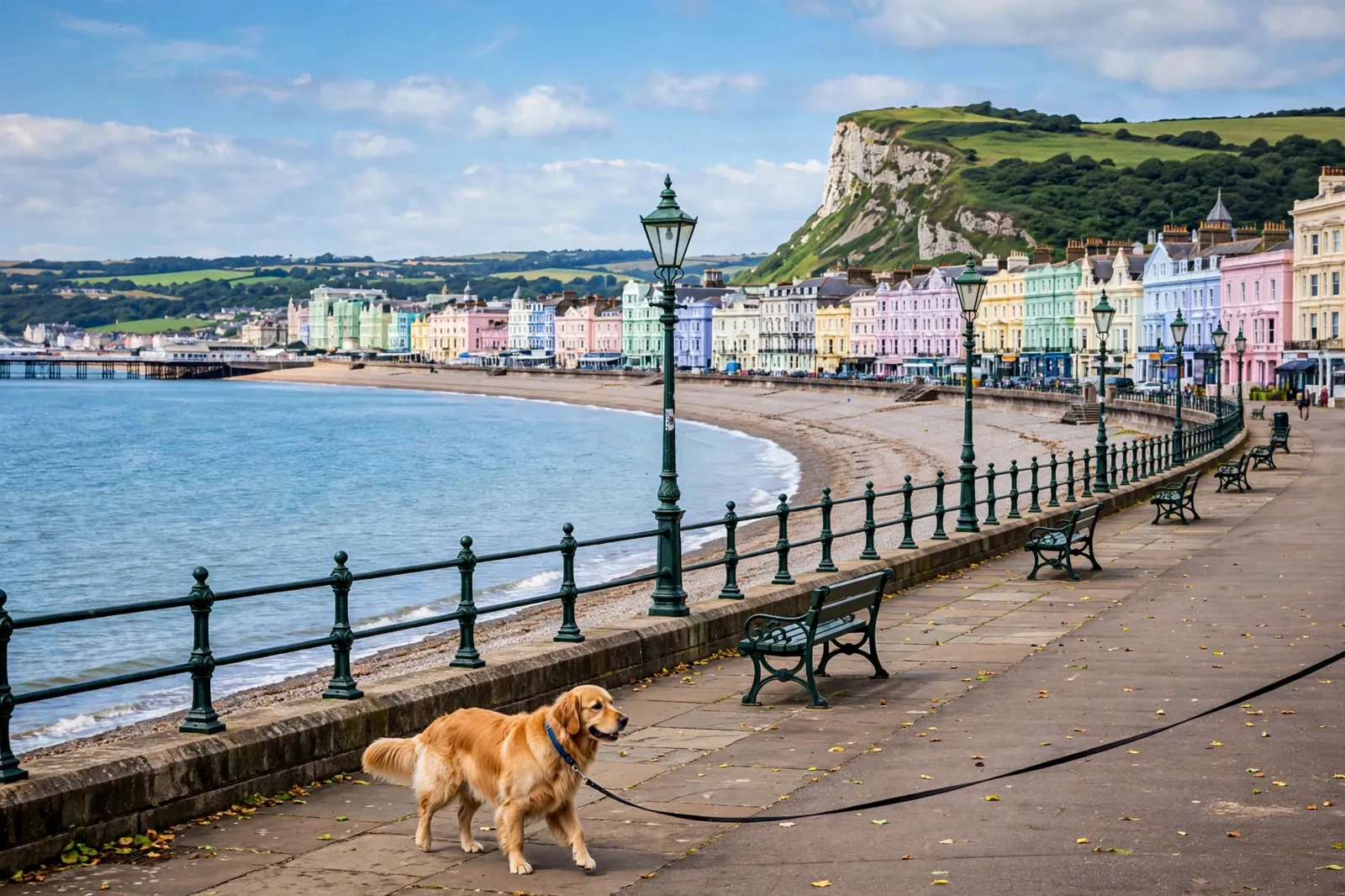
Start with a comparison, because Llandudno is really two seaside towns sharing one street plan. North Shore faces north-east across Llandudno Bay towards the Little Orme, and it is the postcard: a broad, curving promenade lined with pastel Victorian hotels, a long pier reaching into the sea, Punch and Judy and donkeys in season, and the Great Orme rising like a stage backdrop at the western end. Everything a first-time visitor imagines is here, along with everything that makes dog management matter — crowds on fine weekends, food dropped on pavements, gulls with strong opinions and a beach whose dog rules change with the season. A dog that can settle on a short lead among distractions will enjoy North Shore enormously; a dog that cannot will find it a lot, all at once.
West Shore faces the other way, west across the Conwy estuary towards Conwy itself, the mountains of Snowdonia — Eryri — and, on clear days, Anglesey. It is lower, quieter and more residential, with a smaller promenade, a boating lake, dunes and a beach that at low tide opens into a vast walk towards Deganwy. There are fewer facilities, fewer people and far fewer dropped ice creams, which is precisely the point. For a morning walk before the town wakes, for a nervous dog building confidence, or for a long low-tide stretch of legs, West Shore is usually the better bay. For an evening stroll past lit hotels with a café stop and people to watch, North Shore wins every time.
The geography helps you use both. The two shores are separated by the width of the town, a walk of roughly fifteen to twenty minutes through the shopping streets or over the shoulder of the Great Orme through Happy Valley, so a Llandudno day naturally splits in two: West Shore for the walk itself, North Shore for the wander afterwards. The Great Orme stands over both, which means almost every plan in this guide connects — beach in the morning, headland after lunch, promenade at dusk. That compactness suits dogs of all ages, because no single outing needs to be long for the day to feel full.
Choose your base with the bays in mind. Staying on the North Shore puts the promenade at your door for late and early lead walks, at the price of busier pavements. Staying towards West Shore or in the quieter streets behind the town centre trades the view for calmer evenings and an easier first walk of the day. Either works, provided you ask where your dog will actually relieve itself at night: a grand seafront hotel and a small side-street guest house can offer identical welcomes and very different midnight logistics. Llandudno rewards owners who think about the boring walks as carefully as the scenic ones.
Beach rules and seasonal restrictions: read signs before sand
Beach access is the detail most likely to catch dog owners out in Llandudno, because the answer depends on which beach, which stretch of it and which month you have arrived in. Seasonal restrictions apply to parts of both North Shore and West Shore during the main holiday season, creating signed dog-free zones on the most popular bathing sections, while other parts of the same beaches usually remain open to dogs. At North Shore the restricted stretch sits in front of the main resort frontage; at West Shore a section near the promenade and facilities is similarly controlled in season. Boundaries are marked by signs at access points rather than painted on the sand, so the golden rule is simple: read the sign at the entrance you actually use, on the day you actually visit, and plan from that rather than from any guide, including this one.
Dates and precise boundaries change, and enforcement is real. Seasonal dog restrictions on Welsh resort beaches are typically made under local orders, and ignoring them can mean being asked to leave or facing a fixed penalty, quite apart from spoiling the welcome for the next dog owner. Before you travel, check the latest guidance from the local council for current dates and maps, and on arrival walk to the nearest entrance sign before you unclip anything. Our dog-friendly beaches UK rules guide explains how seasonal bans, public spaces protection orders and fines work across Britain, and Llandudno is a textbook example of why that national picture matters locally: the rules are lawful, signed and usually sensible once you can see the map.
Tides reshape both beaches completely. North Shore at high tide narrows to a band of shingle and steep shelving sand in front of the promenade, fine for a paddle at the edge with a dog on a lead but no place for a run; at low tide the sand opens out and the walking improves dramatically, though the water retreats a long way and soft mud and channels appear. West Shore is even more tidal: a modest beach at high water becomes an enormous flat at low tide, with pools, channels and a real distance to the sea. Check tide times before every beach walk, keep an eye on channels filling behind you at West Shore, and never let a dog swim out towards a falling or rising tide in the estuary, where currents are stronger than the calm surface suggests.
Practical beach discipline completes the picture. Carry water and a bowl, because neither beach offers a dog a sensible drink. Expect shingle at the top of North Shore that is hard on older paws, and plan soft-sand time accordingly. Bag and remove everything, including well below the high-tide line — the next tide does not make waste acceptable, it just moves it. Keep dogs out of bathing areas marked by flags or signs, away from any donkeys or beach activities in season, and under close control around the gulls, waders and occasional resting seals that use these shores; a seal hauled out on sand should be given a wide, quiet berth and reported to the usual marine wildlife contacts if it appears injured, without letting your dog approach at all.
Great Orme walks: limestone, goats and big views
The Great Orme is Llandudno's second holiday hiding inside the first: a massive limestone headland rising to about 207 metres, designated for its geology, flowers, seabirds and history, and crossed by paths that range from a gentle summit stroll to a proper half-day circuit. For dogs it offers what the beaches cannot — grass, rock, enormous views in every direction and, on most days, a fraction of the promenade's crowds. It also offers livestock, cliffs and wildlife in concentrated form, so it asks for the most careful dog management in this guide. The reward is proportional: a dog walked well on the Orme has had one of the great urban-edge walks in Wales.
Route choice starts with ambition. The summit area, reached by tramway, cable car or the road, gives short loops around the top, the summit complex and viewpoints back over both bays, ideal for older dogs or a first visit: an hour of grazing-paced walking with constant views. The Marine Drive circuit, following the toll road around the headland at mid-height, makes a longer walk of around five miles with sea on one side and limestone on the other, quieter towards the far side where seabird colonies occupy the cliffs in season. Fuller circuits combine the drive, summit paths and the zigzag returns into town. Whichever pattern you choose, carry a map or a downloaded route, because paths braid across the limestone and mist can arrive off the sea with very little notice.
The Orme's famous residents need a specific plan. A herd of Kashmir goats, descended from animals kept here for generations, roams freely and regards dogs with aristocratic indifference that dogs do not always return. Keep your dog on a lead anywhere near goats, sheep or grazing animals — which on the Orme means being ready to shorten the lead at every blind rise — and give herds a wide berth, especially with young animals in spring. If goats block a path, waiting or detouring beats pressing through a herd with a dog at heel. The same lead discipline protects ground-nesting birds, the choughs and ravens that work the cliffs, and the grey seals that haul out on the shingle at the Orme's far side, around Angel Bay near Penrhyn Bay, where viewing belongs at a distance through binoculars, never at the water's edge with a dog.
Exposure is the other honest warning. The Orme has almost no shelter once you leave the town side: sun in summer reflects off pale rock, wind in any season funnels around the headland, and paths near cliff edges demand a short lead as a matter of physics rather than policy. Keep dogs well away from edges, be extra careful where paths cross the tramway track, and turn back without embarrassment when weather or a tired dog says so — the summit road and the tramway corridor mean retreat is usually straightforward. Grey seals, goats, seabirds and limestone flowers share this headland by tolerance; dogs that visit quietly, on leads, with waste carried down, are part of how that tolerance continues. Treat the Orme as a nature reserve that happens to have a town attached, and every rule on it will feel obvious.
Cable car, tramway and Marine Drive: riding up with a dog
Not every dog needs to walk up the Great Orme, because Llandudno offers three ways to gain the height, each with its own character and its own dog question. The Great Orme Tramway, running since the early twentieth century from Victoria Station in town via a halfway station to the summit, is the romantic option: a funicular-style ride in two sections, slow, scenic and gentle enough for most dogs that can settle in a busy carriage. The cable car, running from Happy Valley to the summit when weather allows, is the spectacular option, swinging over the headland with the town shrinking below. Marine Drive, the one-way toll road around the Orme, is the flexible option: drive the circuit, stop at viewpoints and walk the sections your dog will enjoy most, at your own pace and with the car as a mobile base.
Dog policies for the tramway and cable car have generally allowed dogs to travel, usually on a lead, under close control and sometimes for a small charge, but both services are seasonal, weather-dependent and entitled to change their conditions, and busy days can mean queues, full carriages and a judgement call at the station. The cable car additionally suspends operation in wind that a dog may find unsettling even when services run. Treat every statement in this section as a starting point only: check the latest official information for the tramway and the cable car before you travel, confirm the dog policy again at the station on the day, and have a plan B — the summit paths from Happy Valley or a Marine Drive walk — so that a changed policy or a cancelled service rearranges your day rather than ruining it.
Judging your own dog matters as much as the operator's rules. A tram carriage is a confined, rattling, slowly tilting room full of strangers' legs, and a cable car cabin adds height, sway and a long wait in a queue where dogs stand close together. Short, confident, lead-trained dogs usually cope well; large dogs in a full carriage, dogs that guard space and dogs that panic at motion need an honest owner who chooses the walk instead. Muzzle training, a mat to settle on and travelling at quiet times — first services of the day, weekdays outside school holidays — improve everyone's odds. If you ride up, consider walking down: the descent through the Orme's paths or via the zigzags into Happy Valley is many dogs' favourite part of the whole Llandudno trip.
Marine Drive deserves its own etiquette. The road is narrow, one-way and shared with walkers, cyclists and viewpoint traffic, so a dog beside a parked car or on a road section belongs on a short lead on the seaward side's verge or path where provided, never wandering the carriageway. Tolls, opening arrangements and any restrictions change, so check the latest local information before relying on driving the circuit, and note that the drive also serves the Great Orme's residents and lighthouse end at its far side. Used well, it is the kindest option for a senior dog: drive, stroll a viewpoint, drive on, picnic, and let the headland come to the dog rather than the other way round.
Pier and promenade: lead etiquette on a Victorian stage
Llandudno Pier, stretching far into the bay from the North Shore, is one of the longest and best-loved piers in Wales, and the promenade in front of it is one of the broadest in Britain — together they form the town's stage, where the whole holiday performs itself daily. For a dog, that stage is a training ground and a pleasure at once: space to walk, endless interest, and a constant audience of ice creams, chips, toddlers, scooters and other dogs. The promenade is where your lead work shows, and where Llandudno decides whether dogs belong. Happily, the promenade is wide enough that good handling has room to work: walk your dog on the side away from café seating and shopfronts where possible, pass other dogs in an arc rather than head-on, and keep greetings brief, on loose leads and only with permission.
On the pier itself, be guided entirely by the operator's current rules. Policies for dogs on Llandudno Pier have varied over time, including restrictions on how far dogs may go and conditions around food areas, and they can change with management, season or refurbishment work. Read the signs at the pier entrance on the day, check the latest operator information before you travel if the pier matters to your plans, and if dogs are not currently welcome beyond a certain point, accept it cheerfully and make the promenade itself the walk — it is, after all, the view the pier was built to decorate. Where dogs are permitted, a short lead, no toileting on the boards if you can possibly manage timing beforehand, and complete avoidance of fishing lines, dropped bait and food stalls keep the privilege safe for everyone.
Promenade etiquette has a few local specifics. The promenade runs beside a road with parking and traffic, so the lead is not only about people: a lunging dog at a gull can be in the carriageway in one stride, which is why a short, fixed lead — not an extending lead at full stretch — is the right tool here. Benches, shelters and the famous wide expanse invite settling, and a dog that can lie on a mat under a bench while its owners have coffee is living the Llandudno ideal; build that skill at quiet times of day first, early morning and evening, when the promenade belongs to locals, joggers and a better class of gull. Events, from air shows to festivals and rally finishes, periodically fill the promenade to capacity; on those days, walk the dog early, use West Shore and the Orme, and let the crowds have the stage without a stressed animal in the front row.
Finally, the unglamorous essentials make the glamorous walk possible. Bins line the promenade at short intervals, so there is never an excuse for waste left on the tarmac or, worse, bagged and abandoned on a bench. Fresh water is your responsibility, carried in a bottle. Dogs should be lifted off flower beds and kept out of the floral displays the town is rightly proud of, and after a beach session, paws washed of sand and salt before a long promenade stroll prevents the sore-pad limp that ends so many seaside weeks early. The Victorians built Llandudno for promenading; a clean, calm, short-lead dog is the most promenade-appropriate animal of all.
Happy Valley, Haulfre and the town between the bays
Between the pier and the summit sits Happy Valley, the landscaped gardens on the Great Orme's lower slopes that have hosted everything from open-air theatre to ski-slope experiments, and for dog owners it is simply the best green space in the resort: lawns, paths, a café area, shade on warm days and the cable car station at its edge. Dogs on leads are the working assumption in gardens of this kind, and Happy Valley rewards the rule, because it functions as the decompression chamber between busy promenade and wild headland. A dog can have a proper sniff and a settle here, children can run off their own steam, and the walk up to the Orme can begin at a pace that suits the whole party rather than the fittest member of it.
Behind Happy Valley, the Haulfre Gardens climb the Orme's town side in terraces, steeper and quieter, with paths that reward steady legs and give a different, greener view back over the bay. For a dog team wanting a real walk without leaving town, Happy Valley into Haulfre and on towards the summit paths is a complete itinerary, and for a dog team wanting the opposite — a short, civilised loop with a bench and a view — the lower gardens alone suffice. Carry water even for these, because gardens on a limestone slope are drier than they look, and keep leads short on the narrower terraces where a passing dog has nowhere polite to step aside.
The town between the bays holds its own for dogs more than most resorts. Mostyn Street and its side streets carry the shopping, with water bowls appearing outside cafés in the warmer months and a growing number of places admitting dogs inside or in covered outdoor areas — always ask at the door rather than assuming, and be ready for the answer to differ between summer and winter staffing. The residential streets behind the seafront, laid out on a generous grid, are an underrated dog resource: calm, flat, interesting-smelling evening walks on nights when the promenade is windswept or crowded, and the natural route for last walks from most accommodation. Llandudno's other famous residents, the Alice in Wonderland connections celebrated in statues around town, make a useful game for families: a statue trail gives children a route and a dog a series of short, purposeful walks between photo stops.
Day trips radiate naturally. Conwy, with its castle, walls and harbour, is a short hop and a different, more compact dog day. The coast east towards Colwyn Bay and west along the shore path gives longer, flatter walking. Our Anglesey with a dog guide covers the island visible from West Shore on a clear day, and our Llyn Peninsula with a dog guide completes the north Wales coast for a longer tour — Llandudno makes an excellent first base for that sequence, because its facilities forgive the mistakes every dog holiday makes in its first two days.
Where to stay and eat with a dog in Llandudno
Llandudno was built to accommodate holidaymakers, and its range still shows it: grand seafront hotels on the North Shore promenade, smaller family-run guest houses and bed and breakfasts in the grid behind, self-catering flats and houses towards West Shore and Craig-y-Don, and caravan and holiday parks on the town's edges. Dogs are accepted in a good share of that range, but accepted means many different things, so the booking questions matter more here than the label. Ask about charges per dog per night, how many dogs and what sizes are allowed, whether dogs may stay alone in the room, which dining areas — if any — admit them, and where the nearest patch of ground for a first and last walk actually is. A seafront room is a joy; a seafront room from which the only night-time option is a busy promenade under streetlights is a fact worth knowing in advance.
Match the stay to the dog, using the two bays as your map. Anxious or reactive dogs do better in self-catering or small guest houses on quieter streets, ideally near West Shore, where the first walk of the day avoids a hotel lobby and a lift full of strangers. Confident, sociable dogs thrive in the bigger hotels, where lounges, other guests and bustle are entertainment rather than stress. Older dogs need step-free access and short routes to grass more than they need a sea view, and young dogs need an honest conversation about chewing, house training and what happens if they bark at corridor noises at two in the morning in a Victorian building with thin party walls and thinner patience.
Eating with a dog in Llandudno runs from promenade cafés and kiosks to pubs and restaurants in the town centre and along the shore, with dog-welcoming arrangements that change by season and by business, so treat every recommendation — including any in this guide's orbit — as a prompt to check, not a promise. The reliable pattern is this: daytime cafés with outdoor seating are the easiest win, pubs with bars or gardens are next, and formal hotel dining rooms are the least likely, though many will serve dog owners in a lounge or terrace instead. Fish and chips eaten on the promenade with the dog settled on a mat remains the definitive Llandudno supper, provided the gulls are managed with the respect their organisation deserves: eat away from the densest flocks, never feed them, and guard chips from above, not just from the side.
Supplies and safety nets are straightforward. The town has the usual supermarkets, pet supplies within reach and veterinary practices in and around Llandudno and Conwy — save the number of the nearest practice and its out-of-hours arrangement before you arrive, because a dog emergency on a Sunday evening is the wrong moment to discover how resort-town rotas work. Sea water drinking, scavenged beach food and rich holiday scraps are the three classic causes of a ruined Llandudno week; fresh water carried everywhere, a lead near bins and picnic areas, and the dog's normal food kept normal will prevent almost every avoidable vet visit this town ever sees.
Shaping your days: tides, weather and an easier pace
A good Llandudno dog day is built backwards from the tide table. When low tide falls in the morning, give the morning to West Shore: a long, flat walk as the sand opens, a paddle at the edge under control, and back across town before the channels fill. When low tide falls in the afternoon, reverse it — Happy Valley and the lower Orme in the morning cool, lunch and a settle in town, then the beach as the water drops. High-tide days are promenade, pier-subject-to-rules, gardens and shopping days, and weeks that ignore tides entirely spend half their beach time staring at a narrow strip of shingle wondering what went wrong. The tide is not an inconvenience in Llandudno; it is the timetable, and the dogs that get the great walks belong to the owners who read it.
Weather sorts the rest. The Orme on a clear, calm morning is one of the finest walks in north Wales and should be seized without debate when it offers itself, because the same headland in a westerly gale is a place to admire from the promenade with a coffee. Rain does not cancel Llandudno the way it cancels purely beach resorts: the town's grid, cafés, gardens between showers and a short, brisk West Shore walk in waterproofs keep a wet day respectable, and a dog coat earns its packing space here in every month except the most settled summer weeks. Heat needs the opposite discipline — Orme and beach early, shade and Happy Valley at midday, promenade in the evening — because pale stone, sand and tarmac store the sun and the promenade offers almost no shade at noon.
For an easier pace, Llandudno is unusually generous. The promenade is flat, wide and bench-rich, the town centre is level, Happy Valley's lower paths are gentle, and Marine Drive or the tramway can place a less mobile team at the summit without a climb. Senior dogs can be given a complete Llandudno holiday in daily instalments: West Shore at first light while it is empty, a long rest, a promenade stroll to a café, another rest, and a lamplit grid walk to finish. Puppies get the same structure with shorter instalments and more naps, and both benefit from the fact that nothing in Llandudno needs to be done at length to be done properly. Distance is optional here; rhythm is everything.
End the trip the way the town would want. Leave beaches cleaner than the tide left them, gates and garden rules respected, leads where they belonged and a dog that other visitors remember, if at all, for being calm on a busy promenade. Llandudno has welcomed holidaymakers and their animals for well over a century by being particular about standards, and that particularity is exactly why it still works: two bays, one great headland and a promenade built for everyone, dogs included, provided everyone behaves as if they would like to be invited back. Walk it that way, and you will be.
Practical questions
Before you go
Are dogs allowed on Llandudno beaches all year?
No, not on every stretch all year. Seasonal restrictions apply to parts of North Shore and West Shore in the main season, with signed dog-free zones, while other sections usually remain open. The exact dates, boundaries and any lead requirements change, so read the signs at each beach entrance on the day and check the latest council guidance before you travel.
Can dogs ride the Great Orme Tramway and cable car?
Dogs have generally been carried on the Great Orme Tramway and on the cable car under conditions set by the operators, usually on a lead and sometimes for a small charge, but policies, seasons and weather closures change. Check the latest official information for both services before you travel and confirm again at the station on the day, especially for busy periods.
Can dogs go on Llandudno Pier?
Policies for dogs on Llandudno Pier have varied, and access may be restricted to part of the pier or changed by the operator. Do not assume dogs are welcome along the full length. Check the signs at the pier entrance on the day and the latest operator information before you travel, and keep any permitted dog on a short lead away from food outlets.
Where is the best beach in Llandudno for dogs out of season?
Out of season, West Shore is often the calmer choice for a longer walk, with wide sand at low tide and views towards Conwy and Anglesey, while North Shore suits a shorter promenade and beach combination near town facilities. Always check tide times before setting out, because both beaches change completely with the tide, and follow any signs in force.
Do dogs need to be on a lead on Llandudno promenade?
Keep your dog on a short lead on the promenade. It is a busy shared space with walkers, children, mobility scooters, cyclists in permitted areas and traffic alongside, and local orders and signs may require leads in specific places. A short lead, close passing and clearing up promptly are the etiquette that keeps the promenade welcoming for dogs.