This guide is independent and contains no paid placement. If affiliate links are added later, they will be clearly marked and will not change our editorial checks.
Chichester is one of the easiest cathedral cities in southern England to visit with a dog. Start on the cathedral green, walk the flat canal towpath towards the harbour, loop the Roman walls and the city centre on foot, then drive a short way to Goodwood downland or West Wittering beach. Keep your dog on a lead in the city, in the gardens and on the towpath, and check the official guidance before you travel, because beach rules and canal boat policies change with the season.
Why Chichester works with a dog
Chichester is a small cathedral city in West Sussex, and its size is the first reason it works so well with a dog. The historic centre is compact enough to cross on foot in about fifteen minutes, the ground is mostly flat, and the main sights sit close together: the cathedral and its green, the Market Cross at the meeting of the four main streets, the Roman walls, Bishop's Palace Gardens, Priory Park and the canal basin. That means a dog does not have to spend the day in and out of a car, and an older dog or a puppy can manage a satisfying visit with rest stops built in.
The second reason is variety without distance. Within a single day you can give a dog a calm sniff around a green, a long straight towpath walk with water and birds to watch, a city loop with plenty of smells and people to observe, and then a completely different landscape a short drive away: open chalk downland around Goodwood, woodland at Kingley Vale, or a wide sandy beach at West Wittering. Few English cities offer a cathedral, a canal, a harbour and a beach in the same day trip, and fewer still do it on such level ground.
The third reason is temperament. Chichester is a working market city rather than a theme-park version of one, so the streets feel lived-in: independent shops, a market, cafes with outdoor seating, students and shoppers, and plenty of other dogs. That everyday bustle is good socialisation for a confident dog and easy to manage for a nervous one, because you can always step into a quiet side street, a garden or the green when the main streets get busy. The city is also well used to visitors arriving by train, which makes it a natural choice for a car-free day out with a dog.
Plan the day in layers rather than as a single long march. A good shape for most dogs is a morning on the green and in the gardens, a midday canal walk when the towpath is at its quietest, a late-afternoon loop of the walls and the centre, and then a drive to the coast or the downs for a final run. Puppies and older dogs will be happy with the first two layers alone. Fit, energetic dogs will want the third and fourth. Build in water, shade and rest at every stage, and remember that a cathedral city in summer can be surprisingly warm on stone pavements, so check the ground with the back of your hand before a long city walk.
Finally, Chichester rewards the visitor who slows down. The cathedral has stood on this site for nearly a thousand years, the Roman walls follow a circuit laid out in the third century, and the canal was built in the early nineteenth century to link the city to the sea. None of that history needs to be rushed. A dog does not care about dates, but a dog does care about a route that is interesting, safe and comfortable, and Chichester gives you all three in a very small area.
Chichester Cathedral and the green
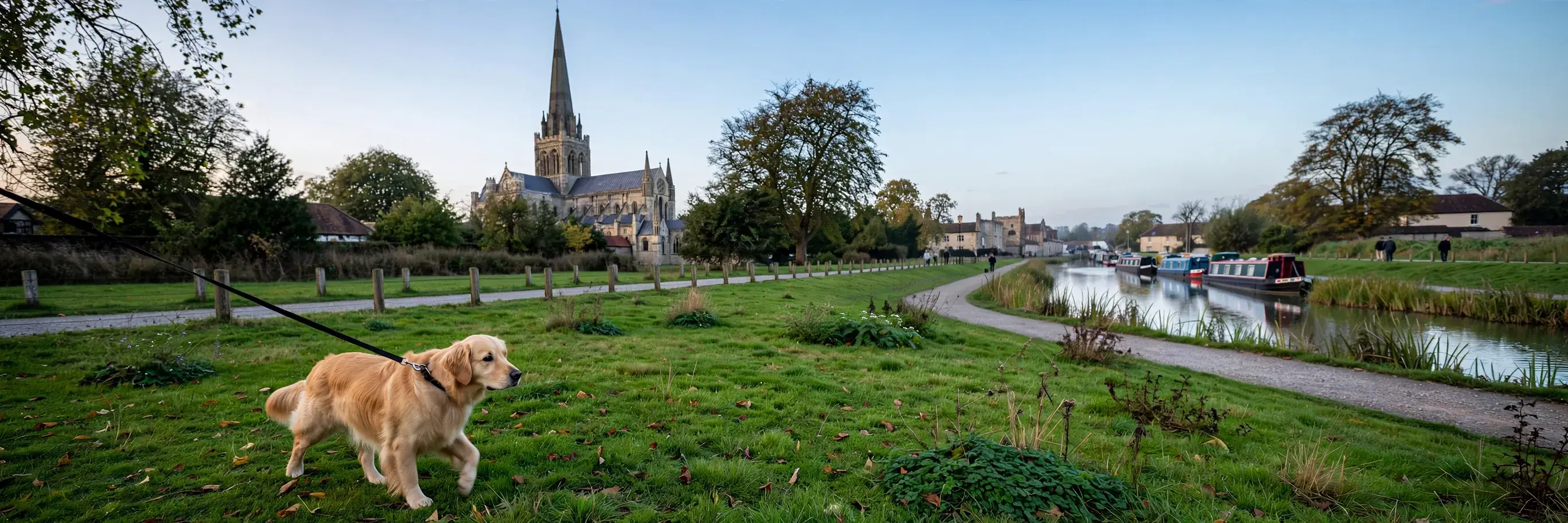
Chichester Cathedral dominates the city, and its green is the natural starting point for a visit with a dog. The cathedral, dedicated to the Holy Trinity, was founded in the late eleventh century and rebuilt after a fire in the twelfth century, and its detached bell tower and tall spire are visible from much of the surrounding countryside. The green is the open grassed area around the building, crossed by paths, edged by trees and lawns, and used by visitors, office workers, students and dog walkers alike. It is the place to let a dog settle after the journey, have a drink, and get used to the sounds of the city before you walk further.
Dogs on a lead are generally welcome on the cathedral green, and Chichester Cathedral is widely known as a dog-friendly cathedral. Keep your dog on a short lead here rather than a long line, stay on the paths and the grassed areas where visitors are expected, and keep your dog away from planted beds, memorials and any roped-off areas. Pick up after your dog without exception: the green is a shared space used for sitting, picnics and quiet reflection, and a single uncollected mess does real damage to the welcome that dogs receive here.
Inside the cathedral, the position is more nuanced and worth checking before you go. Many cathedrals welcome dogs on leads, and Chichester has a reputation for doing so, but access can be restricted during services, concerts, weddings, funerals and special events, and individual staff may ask you to keep your dog close or to wait outside if the building is crowded. The sensible approach is to treat the inside of the cathedral as a privilege rather than a right: ask at the door, keep the visit short if you do go in, keep your dog beside you and off the furniture, and be ready to step outside without fuss if the building is busy or a service is about to start. If your dog is restless, noisy or anxious indoors, enjoy the outside of the building instead — the green, the cloisters walk and the views of the spire are a full visit on their own. Check the official guidance before you travel, because rules for dogs inside the cathedral can change.
The green also works as a base for the rest of the morning. There are benches to sit on, shade under the trees on a warm day, and a gentle level surface that suits older dogs and puppies. Use it for a training reset: a few minutes of calm sitting, a drink of water, and a short settle on a mat will pay off later when you walk through the busier streets. If you are visiting with two people, one can take the dog for a loop of the green while the other looks inside the cathedral, and then swap — a simple arrangement that keeps everyone happy and avoids leaving a dog tied up outside.
Respect the quiet character of the place. The cathedral is a working church as well as a historic building, and people come to the green to sit quietly as well as to sightsee. Keep barking to a minimum, keep your dog from approaching people who are sitting or eating unless they invite it, and move away promptly if your dog becomes overexcited. A calm dog on the green is the best advertisement for dog-friendly visiting in Chichester, and it is what keeps the welcome open for the next visitor.
The Chichester Canal towpath
The Chichester Canal is the city's most dog-friendly walk, and the one most visitors remember. Built in the early nineteenth century to connect Chichester with the sea at Chichester Harbour, the canal runs for about four miles from the canal basin near the city centre south to the harbour. The towpath beside it is flat, straight and easy to follow, which makes it ideal for dogs of all ages: puppies can manage a short stretch, older dogs can walk as far as they feel comfortable and turn back, and fit dogs can walk the whole length and back.
Start at the canal basin, where the water is wide and still and the old canal buildings give the walk a sense of place. From here the towpath heads south through a mix of open water, reeds, hedgerows and fields, with views across to the South Downs on a clear day. The surface is mostly compacted earth and grass, with some surfaced stretches near the city, so it can be muddy after rain — bring a towel and be ready for wet paws. The route is popular with walkers, runners and cyclists, so keep your dog on a lead and close to your side, especially on the narrower stretches where the path runs close to the water.
Water is the main hazard on a canal walk, and it deserves a paragraph of its own. The canal is deep enough to be dangerous for a dog that falls in, and the banks are steep and reedy in places, so a dog that slips in may struggle to climb out. Keep your dog out of the water, do not throw sticks or balls into the canal, and be particularly careful with dogs that love to swim or chase ducks. The canal is home to swans, ducks, moorhens, coots and herons, and a dog that chases water birds can cause real distress to wildlife and can itself be injured by a defensive swan. Keep the lead short when birds are close, and move on calmly rather than stopping to let your dog stare.
Cyclists are the second thing to plan for. The towpath is shared, and cyclists can approach quietly and quickly from behind. Walk on the side away from the water where you can, keep your dog on the same side as you, and avoid a long lead stretched across the path. A short lead and a dog that walks close to your heel makes the towpath safe and pleasant for everyone. If your dog is reactive to bicycles, walk the towpath early in the morning or in the evening when it is quieter, and use the wider stretches near the basin for training.
Canal boats add another layer of interest. The Chichester Canal Trust runs trip boats from the basin, and the sight of a narrowboat moving slowly along the water is one of the pleasures of the walk. Dogs may or may not be allowed aboard depending on the trip, the boat and the day, so check with the operator before you travel if you hope to take your dog on a boat. Even if you stay on the towpath, teach your dog to stand calmly as a boat passes: the wash, the engine noise and the movement can unsettle a nervous dog, and a calm wait is a useful skill to practise here.
How far should you walk? The full canal is about four miles one way, which is eight miles there and back — too far for most dogs as a single walk, and unnecessary. A better plan is to walk out for thirty to forty-five minutes, turn around, and walk back, giving a total of one to one and a half hours of gentle exercise. That covers the prettiest stretch near the city and leaves time for the gardens and the city centre later. Bring water for your dog, because there is no drinking water along the towpath, and carry bags: there are bins near the basin but few further along, so be prepared to carry waste back.
Roman walls, Market Cross and the city centre
Chichester's city centre is built on a Roman plan, and the four main streets — North Street, South Street, East Street and West Street — still meet at the Market Cross, an ornate fifteenth-century stone cross that stands at the centre of the city. The cross is a natural meeting point and a useful landmark for a dog walk: if you get separated from your group, agree to meet at the cross. The streets radiating from it are lined with shops, cafes and historic buildings, and the whole centre is compact enough to explore on foot with a dog.
The Roman walls are the city's other great walk. Chichester was a Roman town, Noviomagus Reginorum, and the walls that still stand follow a circuit laid out in the third century, later rebuilt and repaired over many centuries. You cannot walk the full circuit on top of the walls, as you can in some cities, but you can follow the line of the walls on footpaths and pavements around the centre, and there are stretches where the walls themselves are clearly visible, particularly on the eastern and southern sides. The walk is level, well paved and easy to follow, and it gives a dog a satisfying loop with plenty of new smells and a clear sense of progress.
Start at the cathedral, walk east along West Street and East Street to the East Gate, then follow the line of the walls south and west around the centre, passing Priory Park and the gardens, and return to the Market Cross. The loop takes about forty-five minutes at a dog's pace with stops, and it passes benches, water points in cafes, and quiet side streets where you can step out of the flow if your dog needs a break. Keep your dog on a short lead throughout the centre: the pavements are narrow in places, the streets are busy with shoppers and delivery vehicles, and a long lead across a pavement is a trip hazard for other people.
The Market Cross itself deserves a pause. Built in the late fifteenth century, it is one of the finest market crosses in England, with flying buttresses, pinnacles and carved figures. It stands in the middle of a pedestrian area, so it is a good place to stop, take a photograph and let your dog have a drink. Do not let your dog climb on the cross or on any of the low walls around it, and keep your dog clear of the road where vehicles still pass on the streets leading into the cross.
Shopping with a dog in Chichester needs a little planning. Some shops welcome dogs inside, some allow dogs only in the doorway or outside, and some do not allow dogs at all. Look for a sign, ask before you enter, and do not assume that a shop that welcomed a dog yesterday will welcome one today — staffing, stock and the presence of other animals can all change the answer. If you are travelling as a pair, one person can wait outside with the dog while the other shops. Never leave a dog tied up outside a shop unattended: it is stressful for the dog, it can be a target for theft, and it blocks the pavement. The weekly market, held in the city centre, is worth a visit with a dog that is comfortable in crowds, but keep the lead short, keep your dog close, and move through steadily rather than stopping in the middle of a busy stall.
Street safety is straightforward but worth stating. Chichester's centre is largely pedestrianised, but vehicles still use the surrounding roads and some of the streets into the centre, and delivery vans and buses pass through at all hours. Keep your dog on the pavement side, use pedestrian crossings, and do not let your dog walk in the road. In summer, the stone pavements can become hot in direct sun, so walk in the shade where you can, check the ground with the back of your hand, and carry water. In winter, the same pavements can be slippery after rain, so slow down and keep the lead short.
Bishop's Palace Gardens and Priory Park
Bishop's Palace Gardens is the city's most beautiful green space after the cathedral green, and it is the place to go when you want flowers, lawns and quiet paths rather than a long walk. The gardens sit behind the cathedral, beside the Bishop's Palace, and are laid out with herbaceous borders, lawns, trees and a small pond. Dogs on leads are welcome, and the gardens are a good place for a calm, slow walk with a dog that enjoys sniffing and watching the world go by.
Keep your dog on a lead in the gardens at all times, stay on the paths, and keep your dog out of the planted beds and out of the pond. The borders are the point of the gardens, and a dog that runs through them does real damage. The pond is home to ducks and other water birds, so keep your dog well away from the edge and do not let them drink from it or chase the birds. The gardens are also a popular place for people to sit and read, so keep your dog from approaching people who are sitting on benches or on the grass unless they invite it. Pick up after your dog, and use the bins provided at the entrances.
Priory Park is the larger, more open space nearby, and it suits a different kind of visit. The park occupies the site of a former priory and a Norman castle motte, and it contains open grass, trees, a children's play area, tennis courts and a cricket ground. It is a good place for a longer walk, a game with a ball on the open grass, and a picnic. Dogs are welcome here, and at quiet times, when the park is not crowded and there are no sports matches in progress, many owners let their dogs off the lead on the open grass — but always check the signs at the entrance first, because rules can change for events and for sports fixtures, and keep your dog away from the play area, the courts and the cricket square.
The two spaces work well together as a morning or afternoon pair. Start in Bishop's Palace Gardens for a calm, on-lead walk among the flowers, then move to Priory Park for a longer, more energetic stretch on the open grass. The walk between them is short and level, and both are close to the city centre, the cathedral and the canal basin, so you can link them into a single loop without using a car. Bring water for your dog in both places: there is no reliable drinking water for dogs in the gardens, and the pond water is not safe to drink.
Seasonal notes matter here. In spring the gardens are at their best, with bulbs and blossom, but the paths can be busy with visitors and photographers, so keep your dog close and move steadily. In summer the lawns are popular for picnics, and a dog that begs for food will be unwelcome — keep your dog on a mat beside you and bring a chew. In autumn the trees in Priory Park are spectacular, but fallen leaves can hide litter, conkers and acorns, all of which can be harmful if eaten, so watch what your dog picks up. In winter the paths can be muddy and slippery, so wear suitable footwear and be ready to towel a muddy dog down before you go into a cafe.
Goodwood and the countryside around Chichester
A short drive north of Chichester brings you to the South Downs, and the Goodwood estate is the best-known landmark in that landscape. Goodwood is famous for its motor circuit, its racecourse and its Festival of Speed and Revival meetings, but for dog walkers the estate matters for a different reason: it sits in open chalk downland crossed by public footpaths and bridleways, with wide views, big skies and long, satisfying walks. The downs around Goodwood are a completely different landscape from the city, and a dog that has spent the morning on a lead in town will love the space.
Walking on the downs needs a different set of rules from walking in the city. Keep your dog on a lead near livestock, near roads, and near any event or racecourse activity. Sheep, cattle and horses graze the downland, and a dog that chases livestock can cause serious harm and can itself be in danger. Even a friendly dog that only wants to say hello can panic a flock, and the law takes livestock worrying seriously. Use a lead whenever you can see animals, and put the lead back on before you reach a field boundary rather than after your dog has already noticed the sheep.
Kingley Vale, a few miles north-west of Chichester, is the other great countryside walk in the area. It is a National Nature Reserve famous for its ancient yew trees, some of the oldest living things in Britain, and for its chalk grassland, woodland and views across the coastal plain. The reserve has a network of waymarked trails of different lengths, from a short loop through the yews to a longer walk up to the top of the downs. Dogs are welcome on leads, and the trails are well maintained, but the ground is steep in places and the paths can be slippery after rain, so wear proper walking boots and allow plenty of time. Do not let your dog disturb the yews or the wildlife, and keep your dog on the path in the most sensitive areas.
Goodwood's event calendar changes the countryside around it. On race days and festival days the roads are busy, the car parks are full, and the footpaths can be crowded, so a dog walk near the estate on an event day needs extra care or a different route altogether. Check the official guidance before you travel if you plan to walk near Goodwood on an event weekend, and consider walking in the morning before the crowds arrive, or choosing a quieter downland route further from the estate. On ordinary days the same paths are quiet and spacious, and they are some of the best dog walking in West Sussex.
Practical points for downland walking are simple but important. There is little shade on the open downs, so carry water for your dog and for yourself, and avoid the middle of the day in hot weather. The chalk paths are hard on paws in dry weather and slippery in wet weather, so check your dog's paws after a long walk. There are few bins on the downs, so carry waste bags and take them home with you. Ticks are a risk in long grass and woodland from spring to autumn, so check your dog after every countryside walk and remove any ticks promptly. Finally, tell someone where you are going and when you expect to be back if you walk alone on the downs, because mobile phone signal can be patchy in the valleys.
If you want a shorter countryside walk without driving to the downs, the fields and lanes to the south of the city, towards the harbour and the villages of Fishbourne and Bosham, offer a gentler alternative. Fishbourne Roman Palace, a short walk west of Chichester, sits beside the harbour, and the lanes around it are quiet and level. Bosham, a few miles further south, is a picturesque harbour village with a church, a quay and a causeway that floods at high tide — a beautiful place to walk a dog on a lead, but one where you must check the tide times before you go, because the causeway can be cut off by the incoming tide. Check the official guidance before you travel for tide times and for any local restrictions.
West Wittering and the coast
West Wittering beach, about seven miles south-west of Chichester, is the nearest proper sandy beach, and it is the one most Chichester visitors choose for a dog. The beach is wide, sandy at low tide, backed by dunes, and popular with families, kite surfers and dog walkers. At low tide the sand stretches a long way out, giving dogs room to run, and the shallow water is good for paddling. The beach is managed as a private beach by the West Wittering Estate, with a car park, a cafe and toilets, and there is a charge for parking, so bring a payment card and arrive early on a sunny weekend, because the car park fills quickly.
Dog rules at West Wittering change with the season, and this is the single most important thing to check before you go. The main bathing beach has a seasonal dog restriction in the summer months, while dogs are generally welcome on other stretches of the beach and outside the restricted season. The exact dates, the boundary of the restricted area, and any fines for breaking the rules are set locally and can change from year to year, so check the official guidance before you travel and look for the signs at the beach entrance and at the top of the beach. Do not rely on what another dog owner tells you on the day: the signs at the entrance are the authority, and a fine for breaking a dog ban can be substantial.
Our full guide to dog-friendly beaches in the UK explains how seasonal bans work, how public space protection orders and fines operate, and how to check a beach before you go. The same principles apply at West Wittering: know the dates, know the boundary, and have a backup beach in mind. East Wittering, a short drive east, and the beaches further along the coast towards Bognor Regis and Littlehampton have their own rules, and some stretches welcome dogs all year round. If West Wittering is restricted on the day you visit, a short drive can often find a beach where your dog is welcome.
Beach safety for dogs deserves care. The sea at West Wittering is shallow and generally gentle, but the tide moves quickly over the flat sand, and a dog that runs out at low tide can find itself cut off from the shore. Keep an eye on the tide, keep your dog within sight, and do not let your dog swim out after a ball in deep water. The sand can be hot in summer, so check it with the back of your hand and carry your dog across the hottest stretch if necessary. Watch for fishing lines, hooks and broken glass in the sand, and for jellyfish washed up on the shore. Bring fresh water for your dog: sea water causes stomach upsets, and a dog that drinks from the sea will need fresh water and a toilet break soon after.
After a beach visit, rinse your dog with fresh water if you can, dry them thoroughly, and check their paws and ears for sand. Sand between the toes can cause soreness, and salt water in the ears can cause irritation. Bring a towel, a drying coat and a spare lead, and be ready for a sandy car. If you are staying overnight, a beach walk is best done in the morning or the evening, when the beach is quieter, the sand is cooler, and the light is at its best.
Chichester Harbour itself is a separate pleasure, and one that suits a quieter kind of dog. The harbour is a large natural harbour, a designated Area of Outstanding Natural Beauty, with creeks, mudflats, salt marshes and sailing boats. The harbour-side paths around Bosham, Dell Quay and Itchenor are beautiful and level, and they are good for a calm, on-lead walk with a dog that likes water and birds. Keep your dog on a lead near the water, keep them out of the mudflats, which can be deep and dangerous, and keep them away from nesting birds in spring and summer. The harbour is a working landscape as well as a beautiful one, so be considerate of boat owners, fishermen and other walkers.
Dog-friendly cafes, pubs and places to stay
Chichester has a good supply of dog-friendly places to eat and drink, and the city centre is small enough that you can usually find somewhere within a few minutes of wherever you are. Many cafes welcome dogs inside as well as on an outdoor terrace, and many pubs welcome dogs in the bar area, sometimes with a water bowl and a dog biscuit. The pattern is not universal, though: some places welcome dogs only outside, some welcome dogs only at quiet times, and some do not welcome dogs at all. The only reliable approach is to look for a dog-friendly sign, ask before you sit down, and have a backup in mind.
When you do sit down with a dog, make it easy for the staff and for other customers. Keep your dog on a short lead under the table, bring a mat for your dog to lie on, and bring a chew or a stuffed toy to keep them occupied. Order quickly, keep your dog from approaching other tables, and be ready to take your dog outside if they become restless or noisy. A dog that settles quietly under a table will be welcomed back; a dog that barks, begs or wanders between tables will not. If you are visiting in a group, consider taking turns to go to the counter while the other person stays with the dog.
Outdoor seating is the safest option on a warm day, and Chichester has plenty of it: cafe terraces on the main streets, pub gardens, and seating on the cathedral green and in Priory Park where you can eat a picnic or a takeaway. Outdoor seating has its own rules, though: keep your dog on the pavement side rather than in the walkway, keep the lead short so it does not trip passers-by, and be ready to move if the sun moves and your dog is left in direct heat. In winter, outdoor seating can be cold and windy, so bring a coat for your dog and a blanket for their mat.
For places to stay, Chichester offers a range of dog-friendly options, from city-centre hotels and bed and breakfasts to self-catering cottages and holiday parks in the surrounding countryside. When you book, ask the specific questions that matter for your dog: is there a pet fee, and how much is it; are dogs allowed in the bedroom or only in a specific room; is there a garden or a toilet area; can the dog be left alone in the room, and for how long; and is there a charge for cleaning if the dog makes a mess. Get the answers in writing with your booking, and do not assume that a hotel that welcomed a dog last year still does — policies change, and the room you book may not be the room that accepts dogs.
Self-catering accommodation often suits dogs best, because it gives you a kitchen, a garden and a routine that is close to home. Holiday parks in the Chichester area and across West Sussex can also work well, especially for a longer stay, and our guide to dog-friendly holiday parks in the UK explains how to compare pet fees, boundaries, walks and cancellation terms before you book. For a shorter stay, a city-centre hotel with a dog-friendly room and a nearby park for the morning toilet walk can be just as good, provided you confirm the details in advance.
One practical tip: book early for weekends and for school holidays, and mention your dog at the time of booking rather than on arrival. A hotel that knows a dog is coming can allocate a suitable room, put a water bowl in it, and tell you where the nearest toilet area is. A hotel that discovers a dog at check-in may have to turn you away or charge a fee you had not budgeted for. The same applies to restaurants: if you want to eat in a particular place with your dog, telephone ahead and ask, rather than turning up and hoping.
Getting there and getting around
Chichester is easy to reach by train, and the train is often the best way to arrive with a dog. Chichester station is on the West Coastway line between Brighton and Portsmouth, with direct trains from London Victoria via Horsham, from London Waterloo via Portsmouth, and from Brighton and Portsmouth themselves. The journey from London takes about an hour and forty minutes, and from Brighton about forty-five minutes, depending on the route and the stops. Dogs travel free on most UK trains when they are kept on a lead or in a carrier and do not take up a seat, and most train operators welcome well-behaved dogs. Keep your dog on a lead on the platform and on the train, keep them off the seats, and sit in a quieter carriage if you can. Check the official guidance before you travel, because engineering works, replacement buses and timetable changes can affect the journey, and a replacement bus may have different rules for dogs.
The station is a short walk from the city centre, the cathedral and the canal basin — about ten minutes on foot, all level, with pavements the whole way. That makes Chichester a natural car-free day trip: arrive by train, walk to the green, walk the canal, loop the walls, and walk back to the station. If you arrive by car, the city has several car parks, including the Cattle Market car park to the north of the centre and the Avenue de Chartres car park to the east, both within a short walk of the cathedral. Parking charges apply, and the car parks fill up on market days and on sunny weekends, so arrive early or use the park-and-ride if it is operating. Check the official guidance before you travel for current charges and for any changes to car park opening times.
By car, Chichester is reached from the A27, which runs along the south coast from Portsmouth to Brighton and beyond, and from the A285 and A286 from the north. The A27 can be busy at peak times, especially around the Chichester bypass, so allow extra time and plan a toilet stop for your dog before you reach the city. Never leave a dog in a parked car, even for a short time: a car heats up quickly in sun, and a dog can overheat in minutes. If you need to leave the car, take the dog with you or wait until you can park in shade with the windows open and the dog supervised.
Getting around the city itself is best done on foot. The centre is compact, the ground is level, and the main sights are within a few minutes of each other. Buses run from the city centre to the surrounding villages, to West Wittering and to the Goodwood area, and most bus operators allow dogs, usually at the driver's discretion and on a lead, but policies vary and a busy bus may not have room for a large dog. Check the official guidance before you travel if you plan to use a bus with your dog, and have a taxi number as a backup. Taxis in Chichester vary in their attitude to dogs: some welcome dogs, some charge extra, and some do not accept them at all, so telephone ahead and confirm.
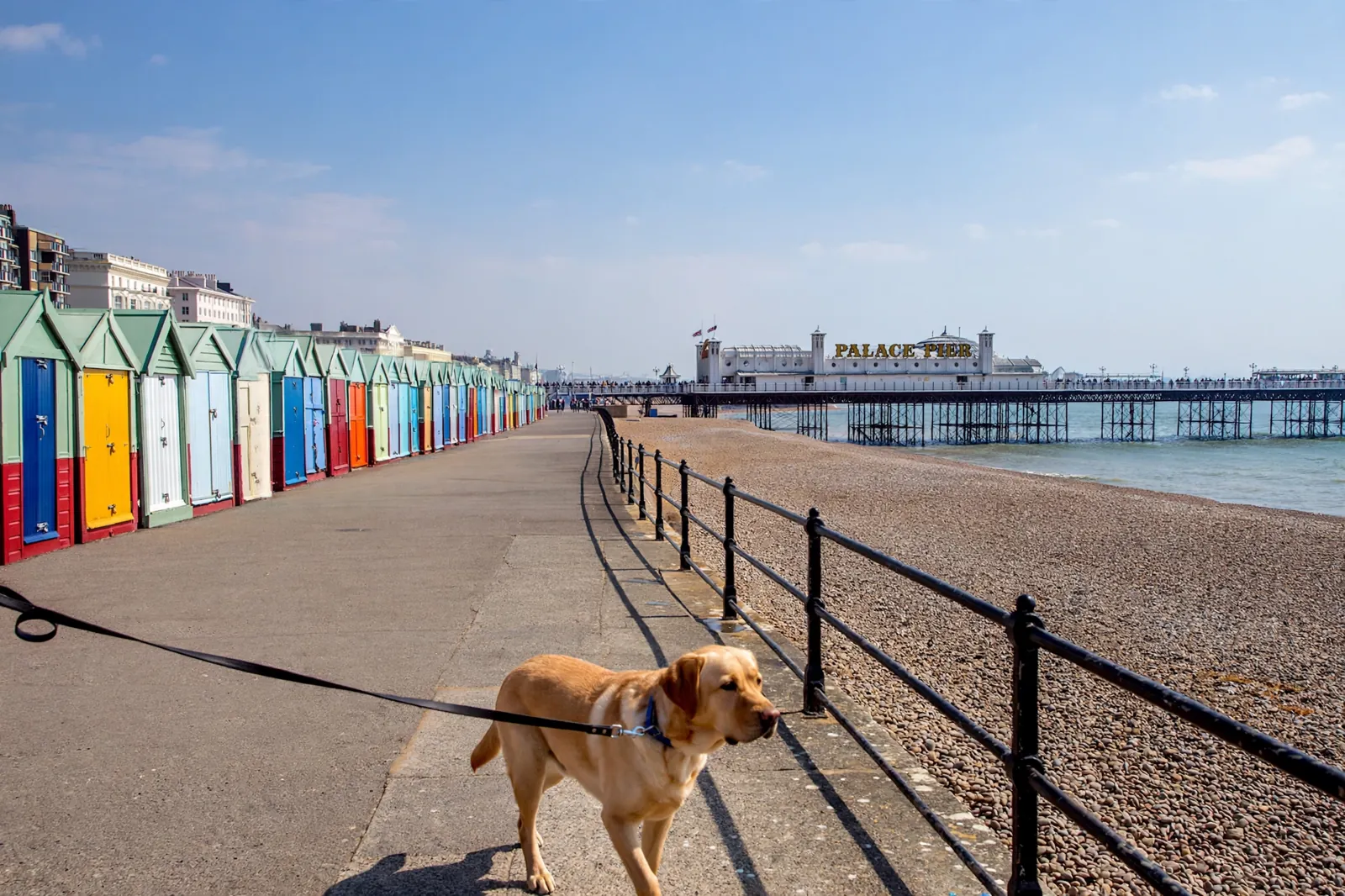
For a longer stay, consider basing yourself in Chichester and using it as a hub for day trips. The coast to the south, the downs to the north, and the cities of Portsmouth and Brighton to the west and east are all within an hour's drive or train ride. Our guide to Brighton with a dog covers the coast to the east, with its seasonal beach rules, promenade walks and dog-friendly cafes, and it pairs well with this guide if you want to combine a city break in Chichester with a day on the Brighton seafront.
Practical checklist: water, wildlife and weather
A day in Chichester with a dog is easy to pack for, but a short checklist makes it easier. Bring a lead and a spare lead, a harness if your dog wears one, water and a collapsible bowl, waste bags and a holder, a towel, a drying coat in wet or cold weather, a mat for cafes, a chew or a toy, and any medication your dog needs. Bring more water than you think you will need: the city has water points in cafes, but the canal towpath, the downs and the beach have none, and a dog that has walked for an hour in sun will drink a lot.
Wildlife is part of the pleasure of Chichester, and part of the responsibility. Swans, ducks, herons, squirrels, rabbits and deer all live in and around the city, and a dog that chases them can cause distress and can itself be injured. Keep your dog on a lead near water, near livestock and in the gardens, and teach a reliable recall before you let your dog off the lead anywhere. In spring, ground-nesting birds on the downs and in the harbour area are particularly vulnerable, so keep your dog on the path and on a lead in those places. In autumn, watch for conkers, acorns and mushrooms, all of which can be harmful if eaten, and in summer watch for adders on the downs — rare, but present, and a reason to keep your dog on the path in long grass.
Weather in Chichester is typical of the south coast: milder than much of England, but changeable. Summer days can be warm and sunny, with the stone pavements and the sand at West Wittering heating up quickly, so walk in the morning or the evening, carry water, and never leave a dog in a car. Winter days can be cold, wet and windy, especially on the downs and on the beach, so bring a coat for your dog and a towel for the car. Rain can arrive at any time of year, so pack a waterproof for yourself and a drying coat for your dog, and have a wet-weather plan: a shorter canal walk, a visit to a dog-friendly cafe, and a drive to a covered attraction rather than a long exposed walk.
Finally, know where the nearest vet is before you need one. Chichester has several veterinary practices in and around the city, and the nearest emergency vet may be a short drive away, especially at night. Save the number in your phone before you set out, and keep your dog's vaccination record and any medication with you. If your dog is injured, unwell or overheated, seek veterinary help promptly rather than waiting to see if it improves. A calm, well-planned day in Chichester is a pleasure for both of you, and a little preparation is what makes it calm.
Chichester rewards the dog owner who takes it slowly. Walk the green, follow the canal, loop the walls, sit in the gardens, and finish the day on the downs or on the beach. Keep the lead short in the city, carry water everywhere, and check the official guidance before you travel for beach rules, boat trips and cathedral access. Do that, and Chichester will give you and your dog a day that is interesting, comfortable and easy to repeat.
Practical questions
Before you go
Can dogs go on the green at Chichester Cathedral?
Yes, in general dogs on a lead are welcome on the cathedral green, which is the open grassed area around the cathedral, and the cathedral itself is known as a dog-friendly cathedral. Keep your dog on a lead, stay on the paths and grassed areas where visitors are expected, pick up after your dog, and be ready to step aside during services, weddings and funerals. Rules can change for particular events, so check the official guidance before you travel.
Can dogs walk the Chichester Canal towpath?
Yes. The Chichester Canal towpath is a public route from the canal basin in Chichester down towards Chichester Harbour, and dogs on a lead are welcome on it. Keep your dog close to you on the narrow towpath, keep them out of the water, watch for cyclists, moored boats and water birds, and carry water and bags. Canal boat trips have their own rules, so check with the operator before you travel if you hope to take your dog aboard.
Are dogs allowed on West Wittering beach?
It depends on the season and the part of the beach. West Wittering has a seasonal dog restriction on the main bathing beach in the summer months, while dogs are generally welcome on other stretches and outside the restricted season. The exact dates, the boundary of the restricted area and any fines are set locally and can change, so check the official guidance before you travel and look for the signs at the beach entrance.
Is Chichester easy to reach by train with a dog?
Yes. Chichester station is on the line between Brighton and Portsmouth, with direct trains from London Victoria via Horsham or via Brighton, and dogs travel free on most UK trains when they are kept on a lead or in a carrier and do not take up a seat. The station is a short walk from the city centre and the cathedral, so most visitors can walk straight into town. Check the official guidance before you travel, because engineering works and replacement buses can change the journey.
Where can dogs go off the lead near Chichester?
The safest off-lead options are enclosed or clearly open spaces away from roads, livestock and water, such as Priory Park at quiet times and some of the open downland and harbour-side paths where local rules allow it. The cathedral green, the canal towpath, the city centre and the Bishop's Palace Gardens are on-lead places. Always check the signs at the entrance, recall your dog before you unclip, and put the lead back on near roads, cyclists, livestock and other dogs.
Are dogs welcome inside Chichester cafes and pubs?
Many Chichester cafes and pubs welcome dogs, often inside as well as on an outdoor terrace, but it is never universal. Policies vary by business and can change with the season, the time of day and how busy the room is. Look for a dog-friendly sign, ask before you sit down, keep your dog on a lead under the table, and bring a mat and a chew so your dog can settle. If a place only allows dogs outside, have a wet-weather backup in mind.