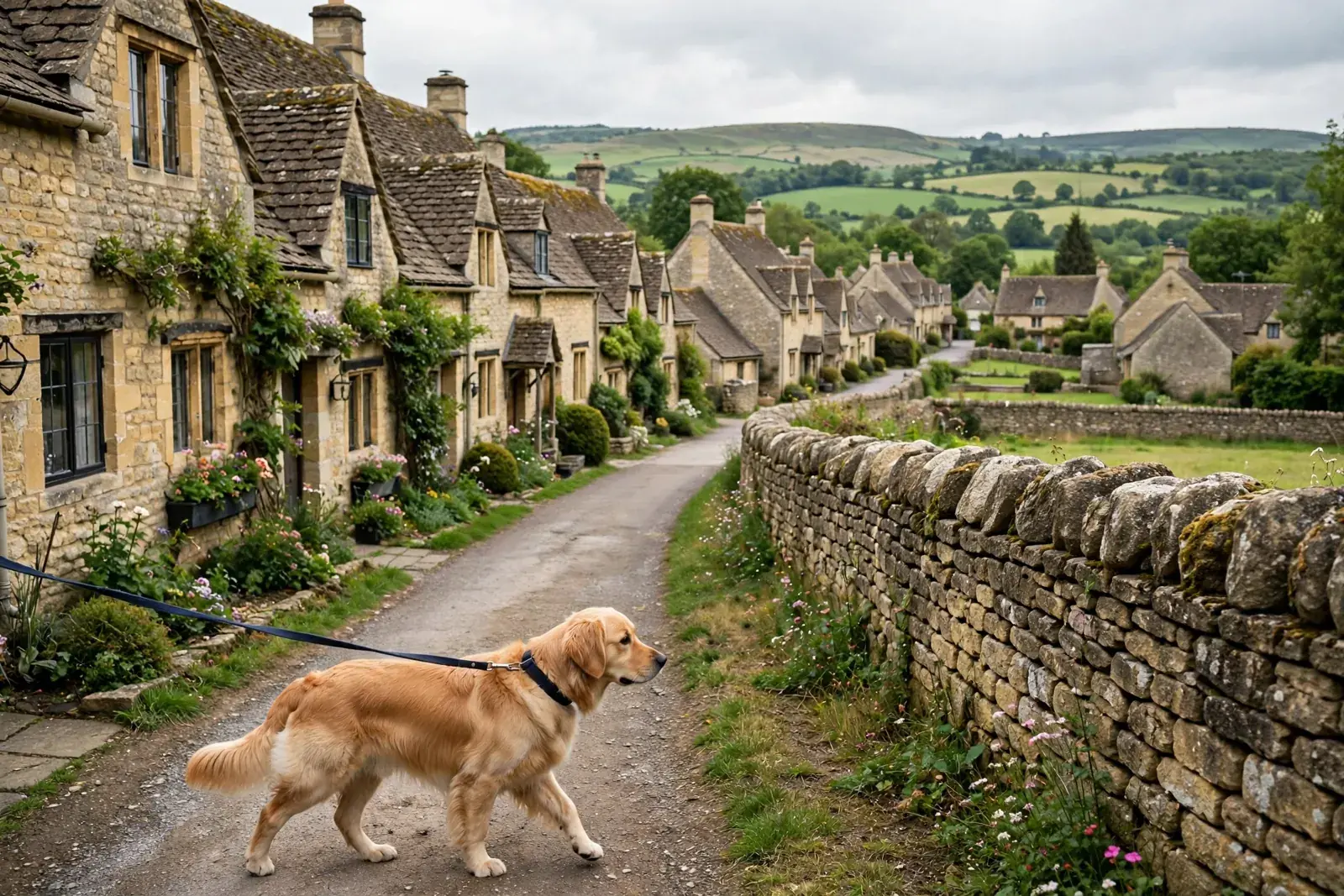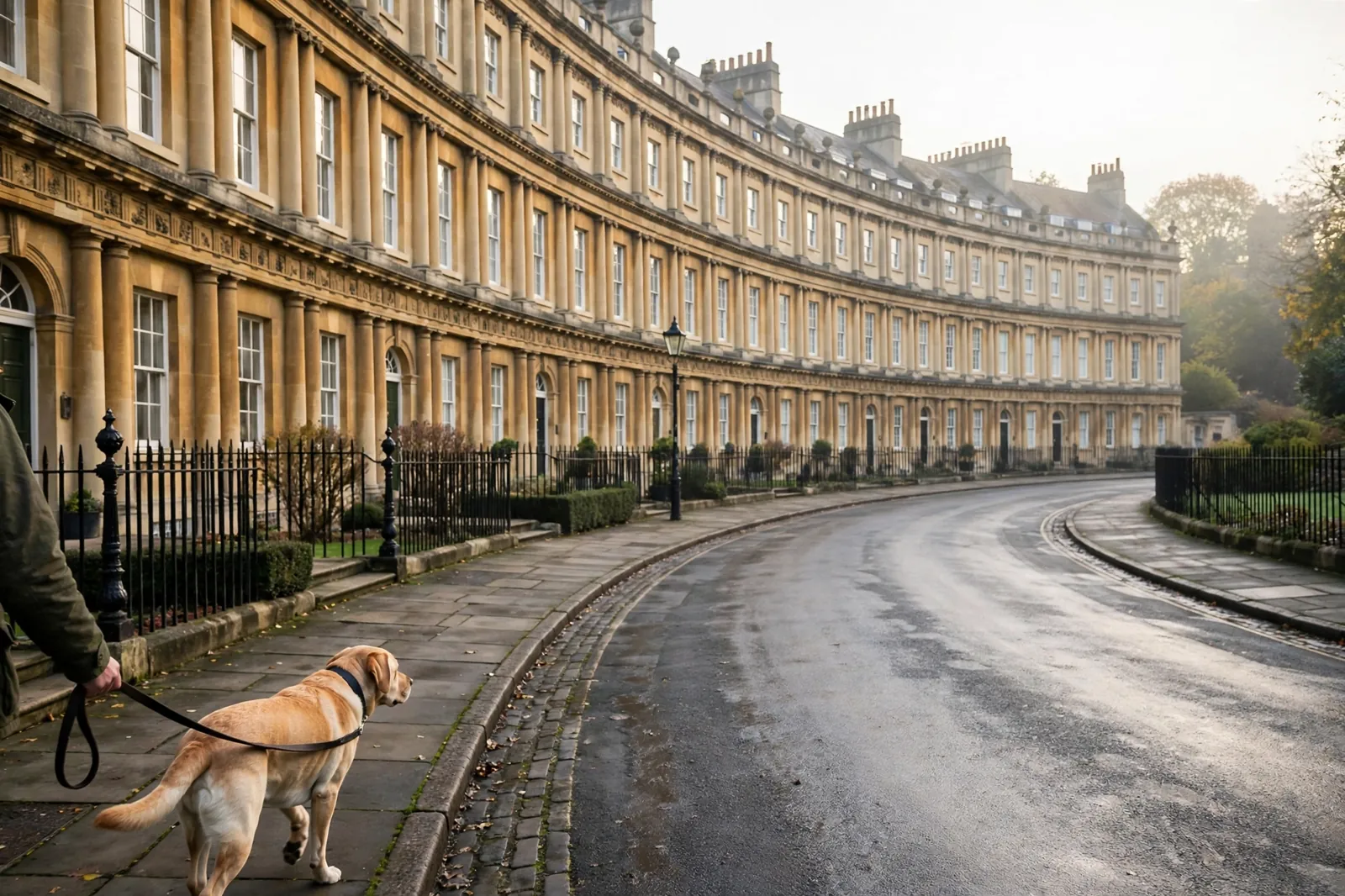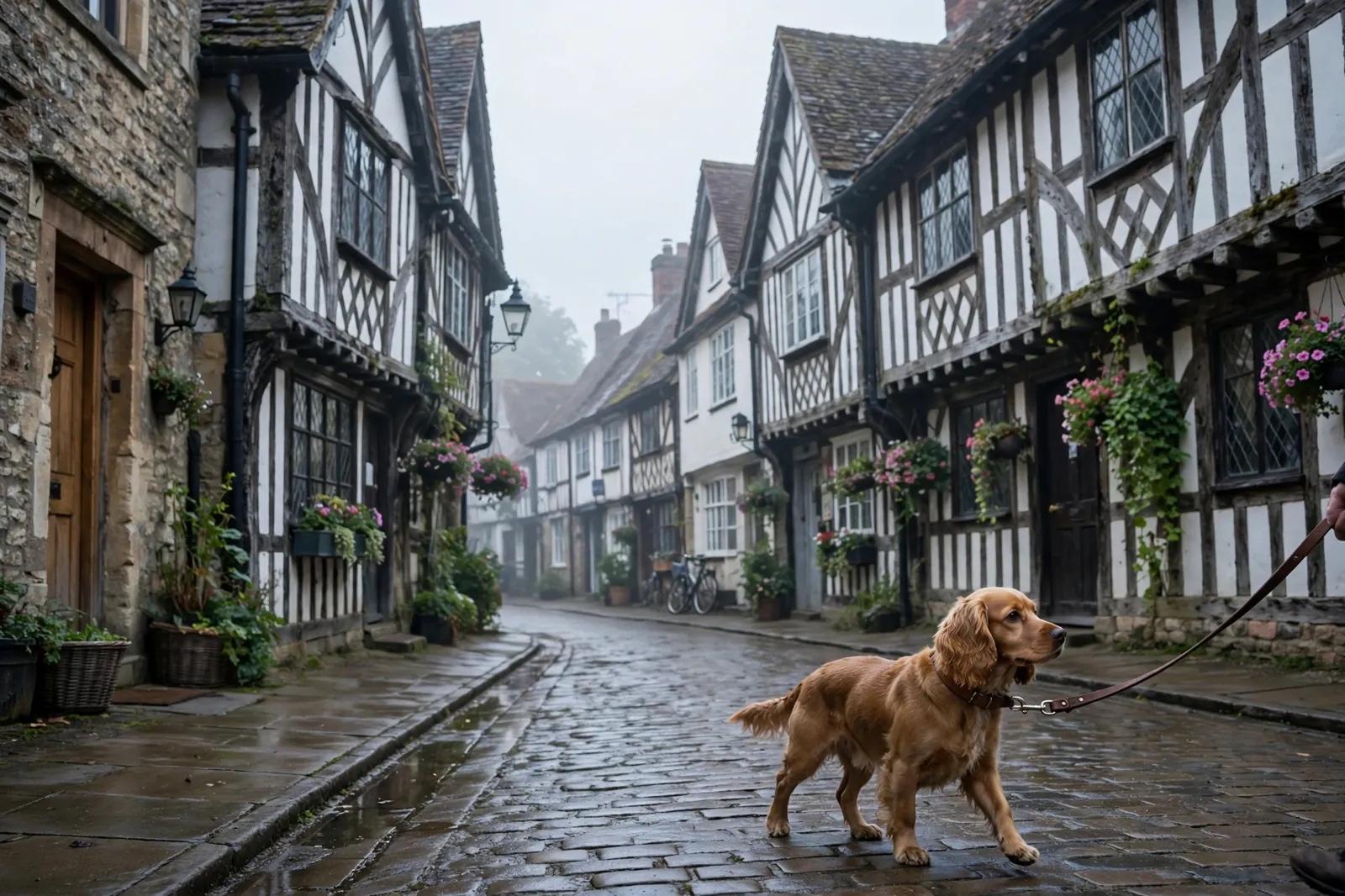
This guide is independent and contains no paid placement. Dog rules at churches, gardens, pubs and places to stay change, so treat every rule below as something to confirm before you travel.
Chipping Campden rewards a slow day, not a rushed one: wander the long, curving high street and the Market Hall, look up at the wool merchants' stone, visit St James's Church from the outside if the interior rule is unclear, then give the dog a real walk on Dover's Hill. Check the official guidance before you travel for every indoor or garden visit, and keep the dog on a lead on streets, in churchyards and wherever livestock may be grazing.
The high street and the Market Hall
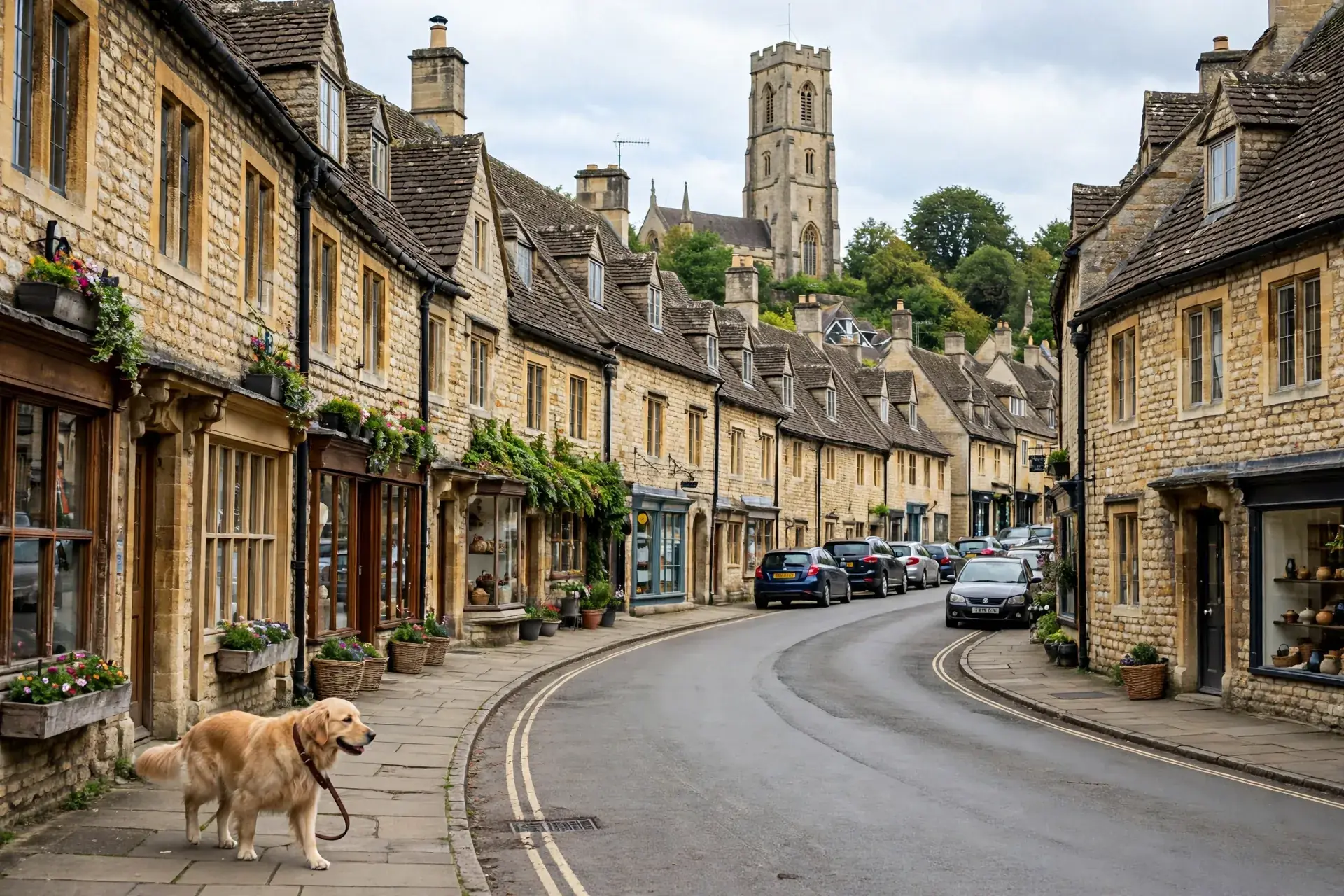
Chipping Campden is best understood as a town that wool built, and the high street is the evidence. In the Middle Ages this was one of the great Cotswold wool towns, and the word "chipping" itself points to a market place: this was where wool was traded, weighed and taxed, and where the merchants who grew rich on fleeces built in honey-coloured local stone. The street that survives is unusually long and gently curving, so it never reveals itself all at once. It bends, it narrows, it opens again, and each bend frames another run of stone facades, gables and mullioned windows. For a dog walk, that shape is a gift: there is always another stretch to sniff, another corner to turn, and no need to hurry.
Start at the southern end and walk slowly north, or the other way round, it hardly matters, because the street rewards both directions. The first thing to notice is the consistency of the building material. Cotswold stone gives the whole town a warm, unified colour that changes with the light, from pale gold in morning sun to a deeper amber late in the afternoon. Look above shopfront level. The ground floors have changed with each generation of trade, but the upper storeys, the stone roofs, the chimneys and the carved details still carry the merchant town. Some of the finest houses were built by wool merchants and their families, and their scale tells you how profitable the trade once was: these are not cottages but town houses, built to impress fellow merchants and to house a household, servants and stock in trade.
The Market Hall stands at the heart of this story and is the single most photographed structure in the town. Built in the early seventeenth century, it is an open-sided stone shelter with arches, a stone roof and a small upper room, and it was raised so that market traders could sell protected from sun and rain. Stand under its arches with a dog and you are standing in the working part of the town, not a museum reconstruction. The hall still hosts markets and events, so the space can be busy at market times and quiet at others. Keep the dog on a lead here, keep the lead short when other dogs pass under the arches, and remember that stone floors can be slippery when wet. The hall is also a useful landmark for meeting, resting and getting your bearings before you turn towards the church or the lanes that lead out of town.
Walking the high street with a dog needs a street-wise routine rather than a countryside one. This is a working town street with parked cars, delivery vans, cyclists and pedestrians, and pavements that vary in width. Keep the lead short at junctions, at shop doorways and wherever the pavement narrows. Let the dog sniff the stone walls and the grass verges, but do not let a long lead trail across the pavement or into the road. If your dog is reactive to other dogs, the high street can be demanding at busy times: step into a wider stretch, turn the dog to face the wall for a moment, or cross to the quieter side rather than forcing a head-on meeting in a narrow pinch point. A calm high-street walk is a training walk as much as a sightseeing walk, and it is worth treating it that way.
Practical details make the difference. There is no single fenced dog exercise area on the high street, so plan the street as the first, gentle part of the day and save the real run for Dover's Hill or a footpath walk afterwards. Carry water, especially in warm weather, because stone streets hold heat and there is little shade at midday in summer. Bring bags and use the bins provided, and keep the dog off planted front gardens and off the low stone walls that edge some properties. If you stop to look at a shop window or to read an information board, move to the side so the dog is not blocking the pavement for wheelchair users, pushchairs and other walkers. Small courtesies like these are what keep a busy historic street welcoming for dogs.
The side streets and alleys repay a detour, provided you keep the same lead discipline. Short lanes run off the high street to the church, to old almshouses and to quieter residential corners where the stone is older and the traffic thinner. These lanes are where the town feels most like a place people live in rather than a place people visit, so keep voices low, keep the dog close, and do not peer over garden walls. If you are building a wider Cotswolds trip, our Cotswolds dog guide sets Chipping Campden in context with the villages, commons and walking routes around it, which helps you decide whether to linger here for a full day or to pair the town with a second village.
St James's Church, the wool church
St James's Church is the town's other great wool monument, and it is often called a wool church because wool money paid for so much of its building and embellishment. The church stands slightly apart from the main run of the high street, and approaching it on foot is part of the experience: you leave the shopfronts behind, pass stone walls and gateways, and arrive at a building whose tower dominates the town. The size of the church is the point. A small farming village would never have built on this scale. Chipping Campden could, because the wool trade concentrated wealth here, and the merchants who benefited gave generously to the church that served their town and displayed their standing.
Outside, the details repay slow looking. The tower, the large Perpendicular windows and the stonework all speak to a period of rebuilding and enrichment in the fifteenth century, when the wool trade was at its height. In the churchyard, look for the tombs and memorials of wool merchant families, whose inscriptions and carvings record names, dates and the trade that made them. Keep the dog on a lead in the churchyard at all times, keep the dog on the paths where the ground is worn, and do not let the dog dig or disturb graves or memorials. Churchyards are also wildlife habitats in many places, so a dog that chases birds or squirrels needs a short lead here even when the yard looks empty.
The interior holds the richest wool story of all, from memorial brasses and monuments to the craftsmanship of wood and stone, but interior dog access is exactly the kind of rule that must not be assumed. Dog rules for the inside of the church can change with services, events and conservation work, so check the official guidance before you travel rather than assuming access. If dogs are not admitted inside on the day you visit, or if you are unsure, one person can visit while the other waits outside with the dog, or you can enjoy the exterior and churchyard and move on. That is not a failed visit. The exterior, the tower and the churchyard already tell the wool story clearly, and a dog that has waited calmly outside is in a better state for the next walk than a dog that has been stressed by an echoing interior.
Services and events change the atmosphere of a church visit entirely. During a service, a wedding, a funeral or a concert, the building is in use for its primary purpose, and visitors with dogs should be especially discreet or should choose another time. If you arrive to find a service in progress, enjoy the exterior and return later rather than entering with a dog mid-service. The same courtesy applies to the churchyard: keep the dog quiet, keep the lead short, and move on promptly if a private ceremony is taking place. A church is a working building, not only a historic attraction, and the dog-friendly choice is the one that respects the people using it.
For dogs that find new interiors unsettling, the churchyard-first approach has a practical advantage. Stone floors, echoing acoustics, sudden organ notes and the smell of polish and flowers can unsettle a nervous dog, and a dog that barks inside a church disturbs everyone. Let the dog settle outside, sniff the walls, watch the birds from a distance and get used to the place at its own pace. If interior access is confirmed and you do go in, keep the visit short, keep the dog close beside you, and leave promptly if the dog becomes restless. A short, calm visit teaches a dog more than a long, stressful one.
From the church, the walk back to the high street is short and pleasant, and it completes the town-centre circuit. Retrace your steps past the stone walls, pause at the Market Hall again from a different angle, and notice how the town's two great wool monuments, the market shelter and the church, face each other across the story of the place: one for trade, one for faith and display, both paid for by the same fleeces. That pairing is what makes Chipping Campden different from a merely pretty Cotswold village, and it is worth pointing out to children and fellow walkers as you go.
Arts and Crafts heritage around Court Barn
Chipping Campden has a second creative story layered over the wool story, and it begins in the early twentieth century with the Arts and Crafts movement. In 1902 the designer and craftsman C. R. Ashbee moved his Guild of Handicraft from London to Chipping Campden, bringing silversmiths, furniture makers, printers and other craftspeople to the town. The move was deliberate: Ashbee and his followers believed that good design, honest materials and skilled handwork belonged in a living community, not only in a London workshop, and a Cotswold wool town with empty workshops and affordable stone buildings offered room to try. The guild's time in the town was relatively short and its history is more complicated than the simple romance suggests, but its imprint on Chipping Campden lasted, and it is why the town is still associated with craft, design and making today.
Court Barn, close to the church, is the place where this story is now told, through a museum of the Arts and Crafts movement in the Cotswolds. The displays cover the guild, its makers and the wider movement, and they help visitors understand why a small Gloucestershire town became a centre for designers who cared about how things were made. For dog owners, the key point is a practical one: museum and gallery dog rules vary, and they can change with exhibitions, events and the layout of the rooms, so check the official guidance before you travel for Court Barn and for any other indoor craft venue you plan to visit. Do not assume that a dog welcome in a museum shop is welcome in the galleries, and do not plan the day so tightly that a changed rule unravels it. A good approach is to treat Court Barn as a confirmed visit only once the current rule is known, and to keep the high street, the church exterior and Dover's Hill as the spine of the day either way.
Even without going inside, the Arts and Crafts story is visible in the town itself. Look for the emphasis on local materials, on hand-finished stone and wood, and on buildings that were adapted for workshops rather than demolished for something new. The movement's interest in the whole environment, not just single beautiful objects, fits a town walk well: a door handle, a carved sign, a well-proportioned window and a garden wall are all part of the same idea. Walk slowly, look up, and notice how many of the town's details reward close attention rather than a quick photograph. Dogs are good companions for this kind of looking, because a dog's pace, with pauses to sniff and watch, is naturally slower than a route-march pace.
The craft heritage also shapes what to look for in the town's shops and workshops today. Chipping Campden still has makers, galleries and small shops selling handcrafted work, and browsing them is part of the town's appeal. Here again, the dog rule is per premises, not per town: one shop may welcome a dog on a lead while the next asks dogs to wait outside, and a workshop with tools, fragile stock or a resident cat may have good reasons for its rule. Ask at the door, keep the dog close and off the displays, and accept a no graciously. If one person browses while the other waits with the dog, the dog still gets the walk, the street and the Market Hall, which is the better part of the day for most dogs anyway.
If the Arts and Crafts story catches your interest, it also gives the day a theme to carry beyond Chipping Campden. The movement's Cotswold footprint extends to other villages and houses in the area, and the contrast between a wool merchant's town house and a craftsman's workshop is a useful way to talk about how the Cotswolds changed from a wool economy to a craft and visitor economy. Keep the theme light, though: a dog does not care about design history, and the day works best when the history is woven into walks, pauses and views rather than delivered as a lecture. Let the dog set the rhythm, and let the craft details be the things you notice while the dog sniffs.
Dover's Hill and the Cotswold Way
Dover's Hill is where Chipping Campden stops being a town walk and becomes a proper hill walk, and it is the part of the day most dogs will remember. The hill rises to the north-west of the town, topped by a broad, open plateau with wide views across the Vale of Evesham and, on a clear day, far beyond into the Severn Vale and towards the Malverns and Wales. The name is linked to Robert Dover's Olimpick Games, the early seventeenth-century sporting festivities held on the hill, which mixed athletics, dancing and revelry in a way that still colours local celebrations. You do not need to know the full history to enjoy the hill, but it helps to know that this open ground has been a gathering and walking place for centuries, not a recent invention for visitors.
The climb from the town is steady rather than brutal, but it should still be treated as a hill walk. Paths rise through fields and lanes before opening onto the plateau, and the ground can be uneven, muddy after rain and exposed at the top. Wear proper walking shoes, not town shoes, and carry water for both humans and dogs, because there is no reliable water supply on the open hill. In summer, the plateau is hot and exposed, with little shade, so walk early or late and watch for a dog that is panting heavily or lagging. In winter, the same openness means wind and driving rain, and a waterproof coat for the dog is a kindness, not an indulgence, for short-coated or older dogs.
Livestock is the main dog-control issue on and around Dover's Hill. Fields around the hill may hold sheep or cattle, and the rule is simple: keep the dog on a lead wherever livestock may be present, and keep the lead short near gates and field boundaries. Even a dog that is normally reliable off lead can behave differently around sheep, and the consequences of a chase are serious for the animals, the farmer and the dog. Follow the Countryside Code: keep dogs under close control, leave gates as you find them, stay on marked paths where they cross farmland, and clean up after the dog. The Cotswold Way passes through this landscape, and its waymarked route is a useful spine for a longer walk, but waymarks do not override livestock rules: where the path crosses a grazed field, the lead stays on.
For a longer outing, the Cotswold Way offers a natural extension. The national trail runs for just over one hundred miles from Chipping Campden to Bath, and Chipping Campden is its northern starting point, which makes the town a fitting place to walk the first stretch and turn back. A sensible dog plan is to walk the opening section as far as suits the dog, then retrace the route, rather than committing to a long linear walk that needs a car at the far end. Check the official guidance before you travel for the current state of the path, any diversions and any seasonal restrictions, especially after storms or heavy rain when stiles, gates and muddy sections can change. Our Cotswolds dog guide covers the trail's character, livestock and parking in more detail, and it is worth reading before you attempt a longer section.
At the top of Dover's Hill, give the dog time to enjoy the space. Let the dog sniff the turf, watch the birds and rest in the wind, but keep the dog away from the steep edges and drops, and keep the lead on if the dog is inclined to run towards other walkers, dogs or distant livestock. The plateau is popular with families, runners and other dog walkers, so expect meetings and be ready to shorten the lead and step aside. A picnic at the top works well if you pack food the dog cannot reach, carry all litter home or use the bins provided, and keep the dog settled on a mat or blanket rather than roaming between other people's picnics. The view is the reward, but a calm dog at the top is what makes the view enjoyable rather than stressful.
After the descent, the town feels different. The high street that seemed long on the way up now reads as a compact, sheltered place, and the dog that has had a real hill walk will settle far more easily in a cafe garden or a quiet corner. Plan the descent with the same care as the climb: tired dogs slip on steep, muddy ground, older dogs feel descents in their joints, and a dog that has run hard at the top may be less responsive on the way down. Slow the pace, offer water, and finish with a gentle wander through the town rather than a second demanding walk. That sequence, town, church, hill and town again, is the shape of a good Chipping Campden day.
Nearby gardens: check before you go
Chipping Campden sits within easy reach of some of the Cotswolds' best-known gardens, and Hidcote and Kiftsgate are the two names most visitors ask about first. Both lie a short drive from the town, both are celebrated for their planting and design, and both are tempting additions to a day that already includes the high street and Dover's Hill. The temptation needs a check, though, because garden dog rules are among the most variable rules in this whole guide. They can differ by garden, by season, by event and even by area within a single garden, with some gardens admitting dogs on leads in certain areas and others admitting them only on specific days or not at all.
For Hidcote, Kiftsgate and any other garden you plan to visit, check the official guidance before you travel for the date you are travelling, and do not build the day around a garden visit until you have confirmed the current rule. Read the rule in full rather than relying on a headline: note whether dogs are admitted at all, whether they must stay on a short lead, whether they are restricted to particular garden areas, and whether the rule changes at weekends, in school holidays or during events. If the rule is unclear, contact the garden directly before you set out, and keep a note of the reply with your travel plans. A garden that admits dogs in the outer grounds but not in the formal garden rooms is a different visit from one that admits dogs throughout, and the difference matters for how long you can stay and what you will see.
There is also a practical garden question that has nothing to do with rules: will your dog enjoy it? Formal gardens involve narrow paths, delicate planting, other visitors standing still to look at flowers, and long periods on a short lead with little to sniff that the dog is allowed to touch. A calm, older dog that is happy to walk slowly beside you may enjoy it. A young, excitable dog that pulls towards every border and every other dog may find it frustrating, and frustration on a lead in a crowded garden is stressful for everyone. Be honest about which dog you have. A garden visit that suits the humans but not the dog is better replaced by a lane walk, a village wander or a second stretch of the Cotswold Way, where the dog can move, sniff and settle naturally.
If the garden rule does allow dogs, plan the visit like a town walk with extra care. Keep the dog on a short lead, keep the dog on the paths, keep the dog away from planting, water features and other visitors' picnics, and carry water and bags. Avoid peak visiting times if the dog is uneasy in crowds, and keep the visit shorter than you would without a dog, with a proper walk afterwards as the dog's reward. If the garden rule does not allow dogs, do not try to bend it: use the time for the lanes and footpaths around Chipping Campden, for the churchyard and the Market Hall, or for a longer Dover's Hill circuit, and save the garden for a visit without the dog or for a day when the rule has changed. The Cotswolds have no shortage of walks, and a missed garden is not a missed day.
The same check-before-you-go discipline applies to other nearby houses and gardens in the area. Many properties in the north Cotswolds have their own dog rules, often stated on their own websites and sometimes updated at short notice for lambing, conservation work or private events. A single search result or a social media post from last year is not a reliable source for today's rule. Confirm the rule for the date you travel, confirm it from the property's own guidance where possible, and have a backup walk ready. That habit, applied to gardens, churches, museums and places to stay alike, is the single most useful habit in this guide.
Eating and staying with a dog
Eating out with a dog in Chipping Campden is best approached venue by venue, because there is no town-wide rule and no safe assumption. A pub, cafe or restaurant may welcome dogs in its garden but not inside, in its bar but not in its restaurant, or in certain rooms only, and the rule may change between lunch and dinner, between weekdays and weekends, or between summer and winter. Do not assume any particular pub, cafe or place to stay welcomes dogs inside; rules differ by venue, by room and by season, so check the official guidance before you travel and confirm the exact arrangement when you book. That sentence is worth repeating because it is the one that prevents the most awkward moments: arriving hungry with a tired dog and discovering that the dog must wait outside, or that the room you booked is not the room that accepts dogs.
When you check, ask specific questions rather than accepting a general reassurance. Ask whether dogs are welcome inside, in the garden or both, and whether there is a limit on the number or size of dogs. Ask whether the dog needs to stay on a lead and under the table, whether water bowls are provided, and whether the dog can be left briefly in the room while you eat if you are staying overnight. Ask whether there is a charge for the dog and what it covers. Get the answers in writing where possible, ideally in the booking confirmation, so that a change of staff or a busy evening does not turn a confirmed arrangement into a debate at the door. If you are travelling on to Stratford-upon-Avon with a dog, the same questions apply there, and asking them in the same form makes comparing venues much easier.
On the day, set the dog up to succeed. Feed the dog before you eat, or bring a small chew or a stuffed toy to keep the dog settled under the table, and choose a table near the door or in a quieter corner rather than in the middle of the room. Keep the lead short and the dog off other diners' feet, bags and food. If the dog barks, paces or begs persistently, take the dog outside for a short calming walk rather than waiting for a complaint. A dog that has already had a Dover's Hill walk will usually settle far better than a dog that has only had a high-street wander, which is another reason to put the hill before the meal, not after it.
Staying overnight needs the same care, applied earlier. When you book, confirm that the specific room or cottage you are booking accepts dogs, not merely that the property sometimes accepts dogs somewhere. Ask about the number of dogs allowed, any size or breed conditions, any charge per dog per night or per stay, and whether the dog can be left alone in the room and for how long. Ask about the practical details that shape a stay: is there a secure garden or a nearby toilet walk for last thing at night, is the flooring easy to clean after a muddy walk, and is there a place to dry a wet dog? A property that answers these questions clearly has usually thought about dogs properly. A property that answers vaguely may still be fine, but the vagueness is itself information, and it is worth clarifying before you pay a deposit.
Pack for the stay as well as for the walk. Bring the dog's own bed or blanket so the room smells familiar, bring food, bowls, a lead, bags, towels and a drying coat, and bring a torch for the last walk of the evening in a town whose lanes are not all well lit. If the property provides a dog bed, use it alongside the dog's own blanket rather than instead of it. Keep the dog off beds and furniture unless the property explicitly allows it, and leave the room as you found it. Good dog guests are what keep properties dog-friendly, and a clean, quiet stay makes the next dog owner's booking easier.
Finally, think about the evening. Chipping Campden is quiet in the evening compared with a city, and that quiet suits a tired dog. A short evening stroll along the high street, a last toilet walk, and an early night after a hill day is a good rhythm. If you plan an evening out without the dog, check the property's rule about leaving the dog alone in the room before you book, not after you arrive, and have a backup plan, such as one person staying in, if the rule does not allow it. A dog left alone in an unfamiliar room may bark, and barking in a quiet town at night travels further than you expect.
Parking, seasons and practicalities
Parking in Chipping Campden is straightforward if you arrive with a plan and allow time for a short walk into the centre. The town has public car parks within walking distance of the high street, and on-street parking is limited and often short-stay, so a car park is usually the calmer choice with a dog. Check the official guidance before you travel for current charges, time limits and any seasonal changes, because parking arrangements in a popular Cotswold town can change with roadworks, events and market days. Park, let the dog out calmly, give the dog water and a short toilet walk before you start the sightseeing, and do not leave the dog in a parked car, especially in warm weather, when a car heats dangerously fast even on a mild day.
Market days and event days change the town's character. On a market day the Market Hall and the high street are livelier, with more people, more dogs and more distractions, which can be enjoyable for a sociable dog and overwhelming for a nervous one. If your dog is uneasy in crowds, choose a quieter weekday or start early before the town fills. If your dog loves people and other dogs, a market day can be a highlight, provided the lead stays short and the dog is not allowed to approach stalls, food or other dogs without an invitation. Check the town's event calendar before you travel if a particular market or festival matters to your plans, and be ready to adapt if the day turns out busier than expected.
Seasons change the practicalities as much as the scenery. Spring brings lambs in the surrounding fields, which means leads on and extra care on footpaths, and it brings mud on the hill paths after rain. Summer brings heat on the stone streets, busy weekends and the need for water, shade and early walks. Autumn brings the Cotswolds at their most colourful, with quieter weekdays, harvest activity in the fields and shorter days, so a torch and a reflective lead become useful for evening walks. Winter brings frost, ice on stone pavements and the hill paths, and the possibility of short, sharp daylight, so plan the hill walk for the middle of the day and the town walk for the lighter hours. Each season works with a dog, provided the plan matches the season rather than fighting it.
Wet weather deserves its own plan, because the Cotswolds are wet often enough that a rain plan is not pessimism. A wet day in Chipping Campden still offers the high street, the Market Hall shelter, the church exterior and the shops that welcome dogs, but the hill walk needs a rethink: muddy descents, slippery stiles and a soaked dog are a poor combination. Shorten the hill walk, choose a surfaced lane walk instead, or walk the lower footpaths and return to the town for a longer, drier pause. Pack a drying coat and towels, dry the dog before entering any indoor venue, and keep a spare lead and a plastic bag for a muddy harness. A dog that is dried and settled is welcome anywhere; a dog that is dripping across a stone floor is not.
Before you leave home, run through a short checklist. Water and a bowl, bags, a lead and a spare lead, food and any medication, a towel and a drying coat, a torch, and the phone numbers for your accommodation and for the nearest vet. Save the vet's details before you need them, because finding a vet in an unfamiliar town in an emergency is stressful without a saved number. Tell someone your walking plan if you are heading onto Dover's Hill or a longer Cotswold Way stretch alone, and take a charged phone. None of this is dramatic; it is simply the kit that turns a good day into a safe one.
Chipping Campden is not the Cotswolds' loudest town, and that is its charm. It does not shout for attention with a single famous view or a single famous attraction. Instead it offers a long street built by wool, a market shelter that still works, a great church paid for by fleeces, a craft story that still shapes the town, and a hill that puts the whole landscape in front of you. Walked slowly, with a dog on a lead and time to look, it is a day that feels complete without being exhausting. Check the rules, climb the hill, and let the town's two great trades, wool and craft, do the talking.
Practical questions
Before you go
Is Chipping Campden's high street a good walk for a dog on a lead?
Yes, for a calm dog that is comfortable on a lead. The high street is long and gently curving, with wide pavements in places and plenty to sniff, but it is a working street with traffic, so keep the lead short near junctions and crossings. Treat it as a slow wander with pauses, not a run, and plan a proper off-street walk on Dover's Hill or a nearby footpath afterwards.
Can dogs go inside St James's Church in Chipping Campden?
Dog rules for the inside of the church can change with services, events and conservation work, so check the official guidance before you travel rather than assuming access. The churchyard and the exterior, including the wool-merchant tombs and the view of the tower, can still be enjoyed from outside with a dog on a lead, and that is often the calmer option for a dog that finds echoing interiors stressful.
Is Dover's Hill suitable for dogs?
Dover's Hill suits fit, lead-trained dogs and owners who are happy with a steady climb and open, exposed ground at the top. Keep dogs on a lead where livestock may be grazing, carry water in warm weather, and watch for uneven ground and steep drops near the edges. On a clear day the views across the Vale of Evesham reward the climb, but in high wind or driving rain a shorter valley walk is the kinder choice.
Can we visit Hidcote or Kiftsgate with a dog?
Garden dog rules change by season, event and area within each garden, so check the official guidance before you travel for Hidcote, Kiftsgate and any other garden you plan to visit. Do not build the day around a garden visit until you have confirmed the current rule for the date you are travelling, and have a backup walk ready, such as the lanes and footpaths around Chipping Campden itself, in case dogs are not admitted.
Where can we eat or stay in Chipping Campden with a dog?
Do not assume any particular pub, cafe or place to stay welcomes dogs inside; rules differ by venue, by room and by season, so check the official guidance before you travel and confirm the exact arrangement when you book. Ask whether dogs are welcome in the bar, the garden or only in certain rooms, whether there is a size or number limit, and whether a dog can be left briefly in the room. Booking a place that states its dog rule clearly in writing avoids the awkward arrival conversation.