This guide is independent and contains no paid placement. If affiliate links are added later, they will be clearly marked and will not change our editorial checks.
Check the tide before you check the weather. In summer, dogs are excluded from the main resort beach between Wonderland Rock Groyne and Cleethorpes Leisure Centre, but the beach south of the leisure centre towards Humberston Fitties is open to dogs all year round. From October to Good Friday the main beach opens to dogs too. The promenade, Country Park and estuary paths give you a full day even when the central sands are off limits.
Tides first: how the Humber sets the day
Stand on the Cleethorpes sea wall at low water and the first thing you notice is not the town behind you but the scale of what lies in front of you. The Humber estuary opens out into a wide, flat horizon, with sand stretching far towards the water, mud banks catching the light, and the far shore little more than a low line. At high water the same view closes in: the sea comes right up to the wall, the beach narrows to a strip, and the promenade becomes the walk. That daily change is the whole secret of a good dog trip here. Cleethorpes is not a resort where you simply turn up and walk onto the sand whenever you like. The tide decides how much beach there is, how far you can safely go, and how much time you have before you need to be back on firm ground.
The Humber is a working estuary, not a sheltered bay. Its tides move fast, and the water can return across flat sand more quickly than a walker expects, filling channels and cutting off routes that looked dry an hour earlier. There are no lifeguards on Cleethorpes beach, so nobody is watching the water for you. That does not mean the beach is dangerous for a careful visitor; it means the planning matters. Before you leave your accommodation, look up the tide times for Cleethorpes for that day, note the time of low water and the time of the incoming tide, and build your walk around them. A falling tide after high water gives you a lengthening beach and a comfortable margin. A walk that starts two hours before low water and turns back well before the tide turns is a very different outing from one that drifts further and further out as the water starts to come back in.
Keep your dog close to the main beach and off the mud banks. Soft mud, deep channels and sandbanks are the hazards that catch people and dogs out on this coast, and they are hardest to judge when the sand looks uniform. A dog that chases a ball towards a channel, or follows a scent across wet mud, can get into trouble quickly, and a person who follows the dog can get into trouble faster. Use a long line rather than letting a dog run free if you are unsure of the ground, keep balls and toys close to the promenade side of the beach, and treat any dark, wet, rippled patch as ground to avoid rather than ground to cross. If you are walking south towards the Fitties, remember that the landscape becomes wilder and more estuarine as you go: salt marsh, creeks and nature reserve land replace the groomed resort beach, and birds and wildlife need space, especially in the breeding and wintering seasons.
The seasonal dog rules are the second clock you need to set your day by. North East Lincolnshire Council operates a Public Spaces Protection Order for the resort beach. From Good Friday to 30 September inclusive, dogs must not go onto the main resort beach between Wonderland Rock Groyne and Cleethorpes Leisure Centre. Breaching the order can result in a £100 fixed penalty, and the boundary is marked on the council's official dog-exclusion map. From 1 October until the following Good Friday, dogs are permitted on the main resort beach again, subject to other local rules and signs. The beach south of Cleethorpes Leisure Centre towards Humberston Fitties is open to dogs all year round. That southern stretch is the key to a summer visit: it is where you go when the central sands are closed to dogs, and it is also the quieter, more natural end of the beach in every season. Because Good Friday moves each year, the start of the restriction moves with it, so check the official guidance before you travel rather than working from last year's dates. Signs on the promenade and at beach access points are the final word on the day.
Within those rules, the practical rhythm of a beach day is simple. In winter, arrive around low water, walk the main beach while it is at its widest, and use the promenade for the return leg if the tide is already coming in. In summer, start at the leisure centre end and walk south, where dogs are welcome all year, and save the central promenade, gardens and pier area for a lead walk rather than a beach run. In both seasons, carry water for the dog, because there is no fresh water on the sand, and bring a towel and a drying coat for the walk back: Humber sand is fine and gets everywhere, and a wet dog in a car after a beach walk is a familiar Cleethorpes problem. Pick up after your dog everywhere, including on the open beach, and carry a means to do so. The resort is at its best when dog owners leave no trace, and the rules are far easier to keep when everyone does.
It is also worth understanding what the beach is made of. Cleethorpes is a long, very flat stretch of sand backed by a broad promenade, gardens, arcades and the pier. Access to the sand is by slipways, including the Wonderland, Pier and Brighton Street slipways, with wooden ramps between them in places. The flatness is what makes it so appealing for older dogs, puppies and dogs that struggle with steep coastal paths: there are no cliffs to climb and no long flights of steps to negotiate. The same flatness is what makes the tide so deceptive, because water can spread a long way across a gentle slope. Walk with that in mind, keep an eye on the sea wall behind you as a reference point, and agree a turn-back time before you set off rather than deciding when you are already a long way out.
Pier and promenade
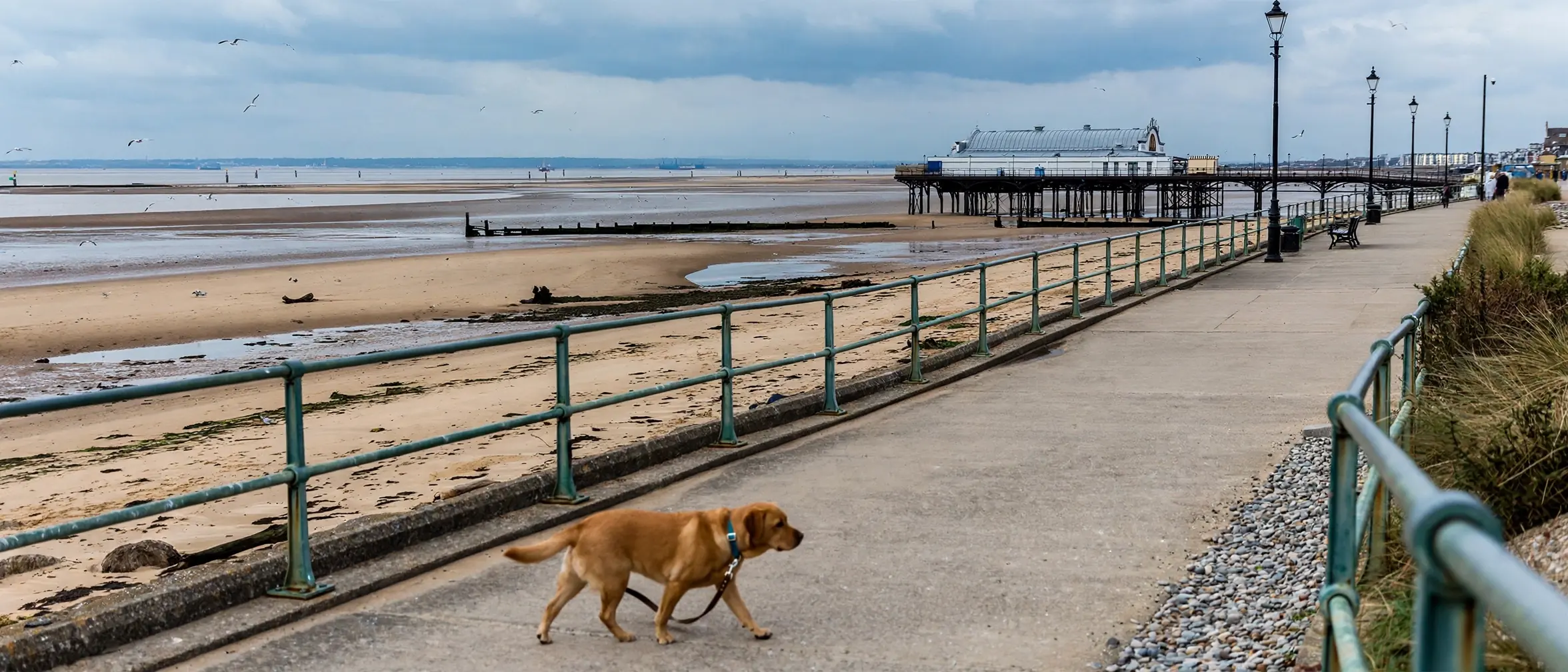
The promenade is the backbone of a dog trip to Cleethorpes. It runs along the sea wall, flat and surfaced, with the beach on one side and the resort on the other, and it works in every season and at every state of the tide. When the beach is closed to dogs in summer, the promenade is still there. When the tide is high and the sand has narrowed to almost nothing, the promenade is still there. When the wind is up and the rain is coming in sideways, a short promenade loop with a cafe stop is still a better plan than a long exposed beach walk. Dogs on leads are a normal sight here, and the rhythm of the place suits them: a steady walk, plenty of smells, benches to pause on, and a clear route back to the car or the station.
Cleethorpes Pier is the landmark that anchors the northern end of the resort. The pier was built in the early 1870s, when the railway company was turning a small fishing village into a seaside resort, and it stretches out over the Humber on cast-iron legs, offering views along the coast, across the estuary and towards Spurn Point on a clear day. Today it is a managed attraction with its own opening times, access rules and charges, and those arrangements can change with the season and with events. Dogs are not automatically able to walk the full length of the pier, so check the official guidance before you travel rather than planning your day around a pier walk that may not be available. Even if you do not go out onto the pier itself, the pier area is worth a slow lead walk: the gardens, the sea wall, the view back along the promenade and the bustle of the resort give a dog plenty to take in without needing to go anywhere near the water.
Walk south from the pier and the promenade changes character as you go. The northern stretch is the classic resort: arcades, cafes, ice-cream kiosks, the boating lake and the gardens. The central stretch, around the leisure centre, is where the beach rules change and where the summer dog beach begins. Further south still, the resort thins out, the buildings give way to open grass and sea defences, and the walk becomes quieter and more estuarine. That gradient is useful for dog owners, because you can choose your level of stimulation. A nervous or reactive dog does better on the quieter southern promenade, away from the arcades and the crowds, while a confident, sociable dog may enjoy the busier northern end in the morning before it fills up. Early morning and late afternoon are the kindest times in summer, when the promenade is cooler, quieter and less crowded, and the light over the Humber is at its best.
Ross Castle, on the cliff-top gardens above the promenade, is a useful landmark and a good short detour. The mock castle was built as part of the resort's Victorian pleasure gardens and named after Edward Ross, a secretary of the railway company that developed Cleethorpes. It is not a real castle, and it is not a place to take a dog inside, but the gardens around it, with their winding paths, seats and views over the Humber mouth, make a pleasant lead walk and a natural pause point. The gardens also show how Cleethorpes was designed: as a planned resort, with a sea wall, a promenade, gardens and a pier all built as one piece of Victorian enterprise, rather than a town that happened to grow up beside the sea. That history explains why the resort feels so walkable today. Everything is on one level, everything is close together, and the dog walk, the cafe stop and the train home are all within a short distance of each other.
The Greenwich Meridian Line also passes through Cleethorpes, and a marker on the seafront records the fact that the resort sits on the line of zero longitude. It is a small detail, but it is a good reminder of where you are: on the edge of England, looking east across the Humber towards the North Sea, at the meeting point of river and sea. For a dog walk, the practical point is simpler. The promenade is exposed, and the wind off the Humber can be cold even on a sunny day. Bring a windproof layer for yourself and a drying coat for the dog, and plan a sheltered stop. The cafes and pubs along the seafront vary in their dog policies, and those policies change, so ask before you settle in, look for a water bowl by the door, and be ready to take a takeaway coffee and keep walking if a particular place is not welcoming dogs that day.
Meridian Showground, inland from the seafront, is the resort's event ground, used for shows, fairs and community events through the year. It is not a daily dog-walking destination, and its access depends on what is on, but it is worth knowing about if you are visiting during an event weekend, because the seafront and the car parks will be busier than usual and the promenade will fill up earlier. If you are staying for a weekend and an event is on, plan your beach walk for early morning, use the southern promenade and the Country Park for the middle of the day, and return to the seafront in the evening when the crowds have thinned. That kind of simple timetable turns a busy resort weekend into a relaxed dog break.
Estuary walks and the open sky
South of the resort, Cleethorpes stops being a seaside town and starts being an estuary. The beach gives way to salt marsh and sea banks, the promenade gives way to the King Charles III England Coast Path, and the view opens out across the Humber towards Spurn Point and the far shore. This is the part of Cleethorpes that surprises people who only know the pier and the arcades. It is flat, open, windswept and wonderfully empty, and it suits dogs that like a long, steady walk with space to sniff and room to move, rather than a short, busy beach run.
The coast path south from Humberston Fitties follows the sea defences and the edge of the salt marsh, with the Humber on one side and grazing marsh, nature reserve land and the Tetney Marshes on the other. The ground is flat throughout, which makes it accessible for older dogs and for owners who do not want hills, but it is also exposed, with little shelter from wind or rain, so check the forecast and dress for the estuary rather than for the town. Keep your dog on a lead or under close control near the salt marsh and the nature reserve, and keep dogs out of the creeks and channels. The Humberston Fitties area and the marshes beyond are important for birds, including wading birds that roost at high tide and breed in the summer, and disturbance from a loose dog can do real harm. The rule is simple: enjoy the view, keep to the marked paths, and give wildlife a wide berth.
One of the pleasures of an estuary walk is that the landscape changes with the tide in a way a resort beach does not. At low water, the mud flats and sandbanks are exposed, wading birds feed along the water's edge, and the Humber looks like a wide, shallow river. At high water, the marsh fills, the birds move to the roosts, and the estuary looks like a sea. Walking the same stretch at different states of the tide feels like walking two different places, and it is worth doing if you are staying for more than a day: a morning walk at low water, a shorter evening walk at high water, and a pause to watch the light change over the water. Bring binoculars if you have them, because the estuary is a serious birdwatching coast, and a dog that can settle quietly on a lead while you watch the birds will get far more out of the walk than one that is pulling to chase them.
North of the pier, the coast path continues towards Grimsby, but that stretch is more industrial and less obviously a dog walk, with the docks and the working port shaping the route. Most visitors with dogs will get more from the southern walk, towards the Fitties and the marshes, where the path is quieter and the landscape is more open. If you do walk north, keep your dog on a lead, stay on the marked route, and be aware of traffic and port activity. The southern walk is also the better choice in summer, when the resort beach is restricted: it is cooler, quieter and further from the crowds, and it connects naturally with the year-round dog beach and the Country Park, so you can build a circular walk that uses all three without ever needing to cross the restricted central sands.
For a longer day, the coast path can be combined with the inland lanes around Humberston and Tetney, but that needs a map, a charged phone and a realistic sense of distance. The estuary is flat, but it is not short, and a walk that looks modest on a map can take longer than expected when you are walking into the wind with a dog that wants to stop and sniff every gatepost. Plan a route with a clear turn-back point, carry water for both of you, and let someone know where you are going if you are walking alone. The coast path is well marked, but the marshes are not a place to improvise, and the tide timetable matters here just as much as it does on the beach.
Country Park and the Fitties
Cleethorpes Country Park is the resort's green alternative to the beach, and for many dogs it is the best walk in town. The park is a Local Nature Reserve between Cleethorpes and Humberston, owned and managed by North East Lincolnshire Council, with woodland, grassland and a central lake that provide habitat for wildflowers, invertebrates, wildfowl and skylarks, and over winter wading birds commonly roost there at high tide. Visitors follow a network of paths and lakeside access points for walking, wildlife watching, picnics and fishing, enjoying a natural contrast to the nearby seafront. For a dog, the change of surface matters as much as the change of scenery: grass and woodland paths instead of sand, shade instead of open sun, and a lake to look at instead of a tide to watch.
The park is particularly useful when the beach is restricted or the tide is high. A circuit of the lake, with a detour through the woodland and grassland, makes a gentle walk of an hour or so, and the paths are generally flat and well maintained. The lake even has a gated area where dogs can play in the water away from other users, which is a rare and welcome facility for dogs that love to swim but should not be swimming in the Humber. Check on-site signs for lead requirements around the lake and the wildlife areas, and never assume that every part of the park is suitable for off-lead exercise. The park is a nature reserve first and a dog park second, so keep your dog under control near the water, do not let them chase wildfowl, and pick up after them on the paths and the grass.
Parking at the Country Park is free, which makes it a practical base for a walk, and the park is close enough to the seafront to combine with a beach walk on the same day: a morning in the park, a lunch stop, and an afternoon on the southern beach, or the other way round. Facilities in the park are limited, and toilets and refreshments are not always available, so bring what you need and plan your cafe stop for the seafront rather than expecting it in the park. That limitation is also part of the park's charm. It is quieter than the resort, less commercial, and a better place for a dog that needs calm rather than stimulation. If your dog is reactive, the Country Park's wider paths and open grassland give you more room to create distance than the narrow promenade does, and the woodland edges give you places to pause and let other walkers pass.
Humberston Fitties, south of the Country Park and the leisure centre, is the other half of this quieter Cleethorpes. The Fitties is a conservation area of vintage chalets backing onto the beach, with a character quite unlike the resort to the north. The chalets, many of them dating from the early twentieth century, sit in small plots behind the sea defences, and the beach in front of them is the year-round dog beach: open, sandy, and far less crowded than the central sands. Walking here feels more like walking on a natural coast than walking through a resort. There are no arcades and no crowds, just sand, sky, chalets and the estuary. The Fitties beach is also the gateway to the longer estuary walks south, towards the salt marsh and the nature reserve, so it works as a starting point for a short beach walk, a long coast-path walk, or a simple sit on the sand with a dog that is happy to do nothing at all.
The practicalities of the Fitties are straightforward but worth knowing. There is a small tearoom a short walk away, but few shops, so bring water, food and waste bags with you rather than expecting to buy them on the beach. The chalets are private homes and holiday lets, not public facilities, so respect their boundaries and keep dogs out of private gardens. The beach itself is sandy and flat, but the same tide rules apply as everywhere else on this coast: check the tide times, stay on firm sand, and do not walk out onto the mud or into the channels. In winter, the Fitties beach is at its best, with the whole main beach open to dogs and the light low over the Humber. In summer, it is the place to be, because it is the one stretch of sand where dogs are welcome all year round.
Weelsby Woods, in Grimsby, is a useful backup if you want a woodland walk rather than a coastal one. It is a short drive from Cleethorpes, with open spaces, woodland paths and room for dogs to run, and it is a good option on a windy day when the coast is too exposed, or on a hot day when the woodland shade is cooler than the open beach. As with the Country Park, check on-site signs for lead requirements, keep your dog under control, and treat it as a change of scenery rather than a replacement for the coast. The point of Cleethorpes is that you do not have to choose one kind of walk. Beach, promenade, park, woodland and estuary are all within a short distance, and the best dog trips use two or three of them in a day, matching each walk to the tide, the weather and the dog's energy.
Light railway and family attractions
The Cleethorpes Coast Light Railway is one of the resort's most distinctive attractions, and it is worth understanding before you plan a family day around it. The railway is a 15-inch minimum-gauge line that runs from Cleethorpes Kingsway station, next to Cleethorpes Leisure Centre, over a viaduct above the boating lake and along the sea wall to Lakeside, the main station with its engine sheds, cafe and workshops, and on towards Humberston. It began as the Cleethorpes Miniature Railway in 1948, was extended and renamed over the following decades, and became the Cleethorpes Coast Light Railway when it was privatised in 1991. The line was lengthened in 2007 to reach Humberston North Sea Lane, near the mouth of the Buck Beck, although the Humberston section has been closed to the public since the 2019 running season because of level crossings in need of upgrades. Check the official guidance before you travel for the current running days, routes and dog policy, because a heritage railway's timetable and rules change with the season and with maintenance.
For a dog owner, the railway is best treated as a human attraction with a dog waiting plan, rather than a dog activity in itself. Small heritage trains, crowded platforms and the noise of a steam locomotive are not comfortable for every dog, and the railway's own rules about dogs on trains are the ones that matter. If dogs are welcome on a particular service, keep your dog on a short lead, settle them on the floor rather than on a seat, and be ready to step off if they are distressed. If dogs are not welcome on the train, the railway still makes a good walk: the line runs beside the sea wall and the boating lake, and the walk from Kingsway to Lakeside, past the sheds and the cafe, is a pleasant lead walk in its own right. The boating lake, the gardens and the leisure centre area give you plenty to do while other members of the party ride the train, and the dog gets a walk rather than a wait in a hot car.
The wider family attractions around the seafront follow the same pattern. Cleethorpes is a traditional resort, with a boating lake, gardens, arcades, a leisure centre and seasonal fairground attractions, and each of them has its own dog policy. The leisure centre, the arcades and the indoor attractions are generally not places to take a dog inside, and the fairground is not a comfortable environment for most dogs, with noise, crowds and moving machinery. That does not make Cleethorpes a poor family destination for dog owners; it makes it a destination where the family splits its time sensibly. One adult takes the children to the fairground or the leisure centre while the other walks the dog on the southern beach or in the Country Park, then the family meets for a walk on the promenade and a meal at a dog-friendly cafe or pub. Planning that split in advance, rather than discovering it on the day, is what keeps a family break relaxed.
The Meridian Showground and the resort's event calendar add another layer to plan around. Summer weekends, school holidays and event days bring more people, more noise and more traffic to the seafront, and a dog that is comfortable on a quiet weekday promenade may not be comfortable on a crowded Saturday in August. If you are visiting in peak season, walk early, use the quieter southern end of the resort, and save the busiest attractions for the times when the dog is resting at your accommodation. If you are visiting out of season, the resort is quieter, the beach is open to dogs, and the family attractions run on reduced hours, so check opening times before you travel and build your day around what is actually open. Cleethorpes rewards the visitor who plans around the season, not the one who expects the resort to be the same in February and in August.
Where to stay and eat with a dog
Cleethorpes has a good range of dog-friendly places to stay, from hotels and guest houses on the seafront to self-catering chalets at the Fitties, caravan parks and holiday parks inland, and the choice you make shapes the trip as much as the walks do. A seafront hotel puts you on the promenade in minutes, which is ideal for early-morning and late-evening walks, but it also puts you in the busiest part of the resort, with more noise and more people passing the door. A chalet at the Fitties puts you on the year-round dog beach, with a quieter setting and more space, but with fewer shops and cafes within walking distance. A holiday park inland gives you more facilities and a garden or patio, but you will need to drive or walk to the beach each day. There is no single right answer; there is the answer that fits your dog. Our guide to dog-friendly holiday parks in the UK explains how to compare pet fees, boundaries and walks before you book, and the same questions apply here: how many dogs are allowed, what is the pet fee, is the outdoor space enclosed, and where is the nearest practical toilet walk after dark.
Ask the specific questions before you pay, and get the answers in writing. How many dogs per unit, and is there a size or breed condition? Is there a pet fee per night or per stay, and does it include a deep-clean charge or a refundable deposit? Are dogs allowed in the bar, the restaurant or only on the terrace? Can the dog be left alone in the room or unit, and for how long, and under what conditions? Where is the nearest vet, and what is the out-of-hours number? A place that answers those questions clearly is a place that has thought about dogs properly. A place that answers with a vague reassurance is a place to treat with caution. If you are staying in a chalet or a caravan, check the decking for gaps a small dog could slip through, check the fencing and the gate, and walk the boundary on arrival before you let the dog off the lead. If you are staying in a hotel, ask for a ground-floor room near an exit if your dog needs frequent toilet trips, and bring the dog's own bed so the room smells familiar from the first night.
Eating out with a dog in Cleethorpes follows the usual British pattern: many cafes and pubs welcome dogs, some welcome them only on the terrace or in the bar, and a few do not welcome them at all, and the policy can change with the season and with the management. The seafront has the widest choice, with cafes and pubs along the promenade, and the quieter streets inland have a smaller number of dog-friendly places that are often calmer and less crowded. Do not assume that a place that welcomed dogs last year still does, and do not assume that a place that welcomes dogs in the bar also welcomes them in the restaurant. Ask when you arrive, look for a water bowl, and be ready to move on if the answer is no. A takeaway fish and chips eaten on a bench on the promenade, with the dog on a lead beside you, is a perfectly good Cleethorpes meal, and on a fine evening it is often a better one than a crowded restaurant.
For self-catering stays, the practicalities are simple. Bring the dog's usual food, because changing food on holiday is a reliable way to cause an upset stomach, and bring more of it than you think you need, in case a shop is closed or a journey is delayed. Bring a familiar bed, a towel, a drying coat, waste bags and a long line, and pack a small first-aid kit with tick removers, saline for eyes and a spare lead. If your dog is on medication, bring more than the trip requires and keep it in its original packaging with the prescription. For a beach trip, add a dog-specific sun screen for pale noses and ears if your vet recommends it, and a pair of dog boots if your dog has sensitive paws and you plan a long walk on hot sand or rough ground. The aim is to make the accommodation feel like a second home for the dog, not a strange place to be tolerated, and the fastest way to do that is to keep the feeding time, the bed and the last-outing routine the same as at home.
Seasons change the staying and eating picture too. In summer, book early, because the dog-friendly rooms and chalets sell out first, and expect higher prices and a minimum stay at weekends. In winter, the resort is quieter, prices are lower, and some hotels and attractions close or run reduced hours, so check what is open before you book and do not assume that a cafe you remember from August will be open in January. The shoulder months, May and September and October, are often the best balance for a dog trip: the beach rules are changing in your favour in October, the weather is still mild, the resort is calmer, and the prices have come down. That is also when the light over the Humber is at its most dramatic, with long evenings and big skies, and a dog walk at sunset along the southern promenade is one of the best free pleasures on this coast.
Getting there, trains and parking
Cleethorpes is easy to reach, and the station is part of the reason the resort works so well for a car-free dog trip. Cleethorpes station sits at the northern end of the seafront, close to the pier and the promenade, with regular services through Grimsby, Doncaster and Sheffield towards Manchester, operated by TransPennine Express. That means a visitor from Sheffield, Doncaster, Manchester or Leeds can reach the seafront without a car, step out of the station, and be on the promenade in minutes. Dogs travel on trains in the UK without a ticket, on a lead and under control, and a well-behaved dog on the floor at your feet is a normal sight on these services. Bring water for the journey, a familiar blanket for the dog to settle on, and a plan for the walk from the station to your accommodation, because the station area is busy in summer and the first few minutes set the tone for the day.
If you are driving, the approach is straightforward, with the A180 and the A46 bringing you into Grimsby and Cleethorpes from the motorway network, and the seafront car parks are well signed. The Central Promenade car park, beside the seafront, is the council's largest seafront car park, and there are other car parks along the promenade and inland. Charges, hours and payment methods change, so check the official guidance before you travel and do not rely on a price you remember from a previous visit. In summer and on event weekends, the seafront car parks fill early, so arrive before mid-morning or park further south and walk in along the promenade. The Country Park has a free car park, which makes it a useful base if you want to avoid the seafront charges, and the Fitties has more limited parking, so walk or cycle there if you can rather than expecting to park on the beach front.
Never leave a dog in a parked car, even for a short time, and especially not in summer. A car in sun can become dangerously hot in minutes, even with a window open, and a dog left in a car on a Cleethorpes seafront car park is at risk even on a day that feels mild to a person. If you need to leave the car, take the dog with you or leave one person with the dog in the shade. The same rule applies to the beach: do not leave a dog tied up outside a shop or a cafe while you go inside, because a tied dog is a vulnerable dog, and a dog that is left alone in a strange place will often bark, chew the lead or try to follow you. Plan your day so the dog is with you, or resting comfortably at your accommodation, and never as an afterthought in a car park.
For visitors coming from further afield, Cleethorpes works well as a base for a longer Lincolnshire coast trip, with Grimsby, Humberston and the Wolds within a short drive, and the coast path giving you a way to explore on foot. If you are combining Cleethorpes with a city break, our guide to York with a dog covers walls, riverside walks and a city of layers, and it makes a useful contrast: a day in York for history and riverside, a day in Cleethorpes for sand, sky and estuary. The two trips share the same planning habits, checking the rules, the tide or the river level, and the dog's energy, and the same reward, a dog that has had a full day and a quiet evening. For the wider rules that govern beaches across the country, our guide to dog-friendly beaches in the UK explains when seasonal restrictions apply, how fines work and how to check a beach before you go, and it is worth reading before any coastal trip, not just this one.
Tide and safety checklist
The Humber rewards respect and punishes complacency, so a short checklist before every walk is worth more than a long list of rules you only read once. Start with the tide times for Cleethorpes for that day, and write down the time of low water and the time of the incoming tide. Decide your turn-back time before you leave, and stick to it even if the beach looks inviting and the dog is still full of energy. Check the weather forecast for wind and rain, because the estuary is exposed and the weather can change quickly, and check the council's beach guidance for the current dog rules, because the seasonal restriction, the boundary and the fine are all set by the council and can change.
On the beach, stay on firm sand near the promenade, keep your dog close, and keep balls and toys on the promenade side of the beach rather than out towards the water. Avoid soft mud, channels and sandbanks, and do not walk out onto ground that looks wet, dark or rippled. Keep your dog on a lead near the salt marsh, the nature reserve and the bird roosts, and keep dogs out of the creeks. Carry fresh water for the dog, a towel and a drying coat, waste bags and a spare lead, and a phone with a charge, in a waterproof pouch if you have one. After a beach walk, rinse the dog's paws and coat with fresh water, check between the toes for sand and salt, and dry the ears, because salt water and sand can irritate skin and ears if they are left to dry on the coat.
Know where the nearest vet is before you need one, and save the number in your phone. Cleethorpes and Grimsby have veterinary practices, but their hours vary, and an out-of-hours emergency vet may be a drive away, so do not leave this to the moment of a cut paw or a swallowed fish hook. If your dog swims, watch for the signs of trouble: a dog that is struggling, coughing after swallowing water, or shivering and lethargic after a swim needs warmth, rest and veterinary advice. The Humber is not a swimming beach for most dogs, and the Country Park's gated swimming area is a safer place for a dog that loves the water. If your dog eats something on the beach, from discarded food to fishing bait, watch for vomiting, diarrhoea or lethargy and seek veterinary advice promptly.
Finally, think about the dog you actually have, not the dog you wish you had. A puppy needs short walks, frequent toilet breaks and a warm place to rest, and should not be doing long beach walks in the heat. An older dog needs a flat route, a slow pace, a ramp or a lift into the car, and a warm bed at the end of the day. A reactive dog needs space, a quiet route and a plan for passing other dogs on a narrow promenade, and the southern promenade and the Country Park will serve them better than the busy northern seafront. A dog that chases birds needs a lead on the estuary, and a dog that chases balls needs a long line on the beach. Cleethorpes is a generous resort for dogs, with sand, park, woodland and estuary all within a short walk, but it is generous to the owner who plans, not to the owner who improvises. Check the tide, check the rules, choose the walk that fits the dog, and the Humber will give you a day that is hard to beat.
- Tide times: look up Cleethorpes tide times for the day, note low water and the incoming tide, and set a turn-back time before you leave.
- Beach rules: confirm the seasonal restriction and the boundary on the council's official guidance, and use the year-round beach south of the leisure centre in summer.
- Ground: stay on firm sand, avoid mud, channels and sandbanks, and keep your dog close to the promenade side of the beach.
- Wildlife: keep dogs on a lead near salt marsh, nature reserve land and bird roosts, and keep them out of creeks.
- Water and warmth: carry fresh water, a towel and a drying coat, and rinse salt and sand from paws and coat after the walk.
- Vet: save the nearest vet and the out-of-hours number before you need them, and check the official guidance before you travel if anything is unclear.
Practical questions
Before you go
Can dogs go on Cleethorpes beach in summer?
Yes, but not on the main resort beach in summer. From Good Friday to 30 September, dogs are excluded from the beach between Wonderland Rock Groyne and Cleethorpes Leisure Centre under a council Public Spaces Protection Order, with a £100 fixed penalty. The beach south of the leisure centre towards Humberston Fitties is open to dogs all year round, and the main beach opens to dogs again from 1 October until Good Friday. Check the official guidance before you travel, because dates and boundaries can change.
Is Cleethorpes beach safe for dogs at low tide?
Low tide is the best time for a long beach walk, but it still needs care. The Humber has fast-moving tides, soft mud, sandbanks and channels that can cut walkers off from the shore. Stay on firm sand near the promenade, keep your dog close, watch the incoming tide, and leave the beach well before the water turns. There are no lifeguards on the beach, so do not rely on rescue cover.
Can dogs walk on Cleethorpes pier and promenade?
Dogs on leads are a normal sight on the promenade, which is the most reliable year-round walk in Cleethorpes. The pier itself is a managed attraction with its own access rules, opening times and charges, so check the official guidance before you travel rather than assuming dogs can walk its full length. The gardens, sea wall and quieter southern promenade give you plenty of alternatives if the pier is not suitable on the day.
Where is the best year-round dog walk in Cleethorpes?
The beach south of Cleethorpes Leisure Centre towards Humberston Fitties is the best year-round sandy walk, because it stays open to dogs through the summer restriction. For a change from sand, Cleethorpes Country Park offers lake paths, grassland and woodland, including a gated area where dogs can swim, and the Humber estuary paths south of the Fitties give long, flat views towards Spurn Point.
Is Cleethorpes easy to reach by train with a dog?
Yes. Cleethorpes station sits at the northern end of the seafront, close to the pier and promenade, with regular services through Grimsby, Doncaster and Sheffield towards Manchester. That makes a car-free day trip realistic for many visitors. Arrive with a lead, water and a plan for the walk back, because the station area is busy in summer and the promenade is the natural first route south.