This guide is independent and contains no paid placement. If affiliate links are added later, they will be clearly marked and will not change our editorial checks.
The Cotswold Way is 102 miles from Chipping Campden to Bath. Most dog walkers take eight days, keep the dog on a lead through farmland and near livestock, book dog-friendly pubs and B&Bs well ahead, and finish at Bath Abbey with a train home from Bath Spa station.
Before you go: the checklist
The Cotswold Way is the gentlest of Britain's big long-distance trails, and that gentleness is exactly why it is easy to under-prepare for it. The hills are rolling, the villages are pretty, the pubs are welcoming, and none of that removes the need for a proper check before you set off. Work through this list a week before the trip, not the night before, because the items on it take time to fix if they are wrong.
- The dog's fitness: can your dog walk two long days back to back, on hills, on a lead, without stiffness the next morning? If not, build up over six weeks or plan a shorter trip.
- The dog's paws: check for cracks, sore spots and overgrown nails, and trim nails before the trip. Pack paw balm and a basic first-aid kit with tick tweezers.
- Every overnight stay confirmed in writing — which room takes the dog, what the nightly dog fee is, whether the dog can be left alone for a while, and where it sleeps. A spoken 'dogs welcome' is not enough on arrival.
- Baggage transfer booked, with pick-up times, weight limits and drop-off addresses agreed for each stop — or a firm decision to carry everything yourself.
- Food and medication: the dog's normal food in sealed, labelled portions for the whole trip, plus any regular medication, with one day's supply in the day pack.
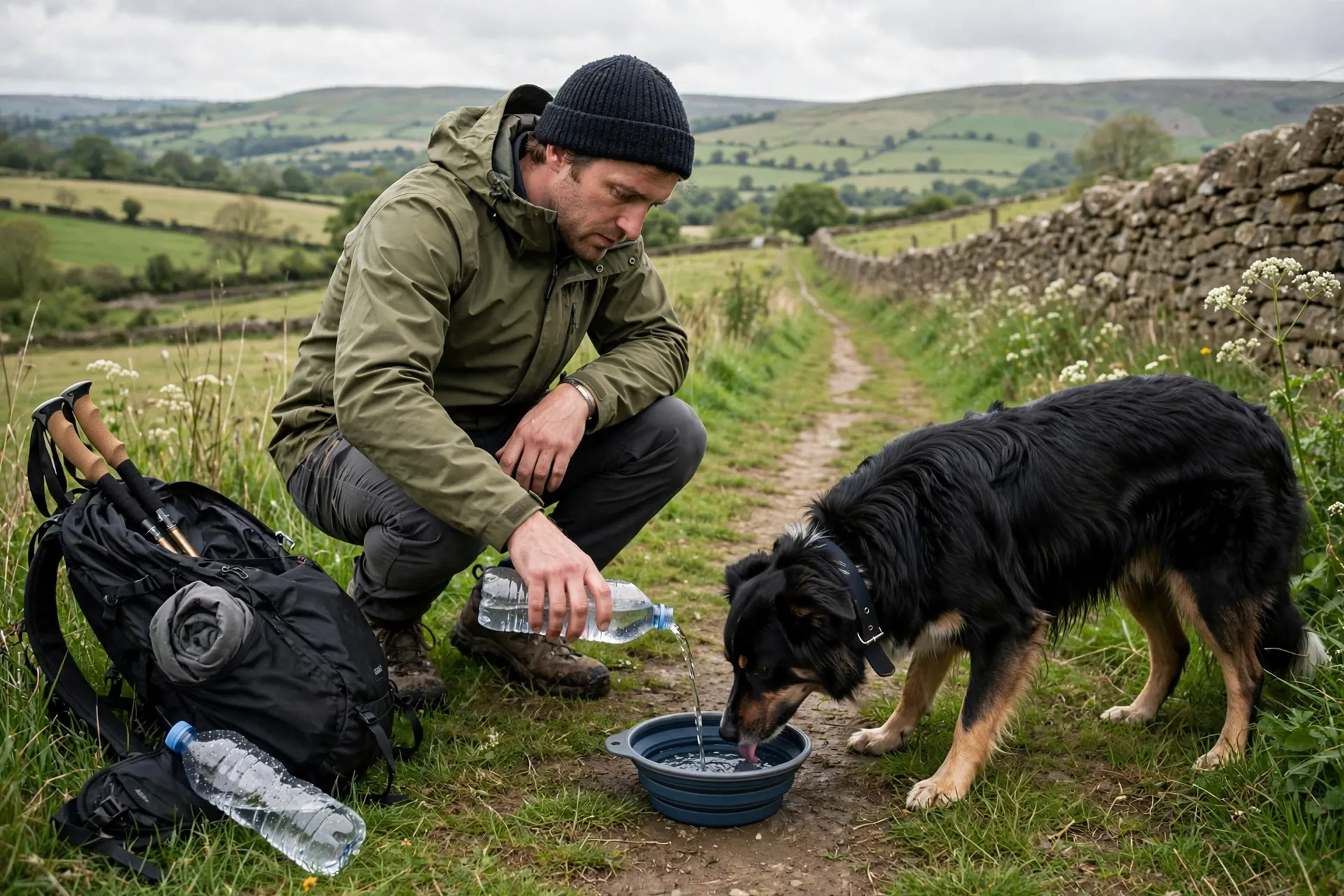
- Water kit the dog will actually use: a collapsible bowl it drinks from happily, and room for at least a litre of water for the dog, tried out at home first.
- Harness and leads checked for wear — a harness that fits, with a handle, plus a lead and a spare. Rubbing on day one becomes agony by day four.
- Vet cover sorted before you set off: the numbers of vets near Chipping Campden, Cheltenham and Bath in your phone, with the vaccination record saved alongside.
- Route and weather: check the official guidance before you travel for diversions, closures and the forecast, and pack waterproofs for both of you.
- Travel home: confirm the train from Bath Spa station, and check the current rules for dogs on the services you plan to use.
That list looks long, but it takes an evening to work through, and it is the difference between a trip that runs smoothly and one that unravels on day two because the harness rubs, the food runs out or the B&B does not actually accept dogs. The Cotswolds reward the prepared walker: the villages are at their best when you arrive unhurried, with a dog that is comfortable, fed and ready for the pub garden.
The route at a glance
The Cotswold Way covers 102 miles (164 kilometres) between Chipping Campden and Bath, tracing the western edge of the Cotswold hills almost throughout. It is a National Trail, and among the most walked in England — gentle ground, stone villages, and pubs, tea rooms and beds at regular intervals. Most people walk it south, Chipping Campden to Bath, finishing in one of England's finest cities with the prevailing wind at their backs. The hills are never high, but the route climbs onto the escarpment and drops back into the valleys again and again, and those repeated climbs are the walk's real work.
The stages in the table follow the overnights most walkers use, from Chipping Campden through Broadway, Winchcombe and Cheltenham, then Painswick, Stroud and Dursley to Bath. The mileages are guidebook figures, so allow a mile or two either way depending on where the night is spent. Use them to plan the days, and check the official guidance before you travel for the current route and any diversions.
| Day | From – to | Miles | Character |
|---|---|---|---|
| 1 | Chipping Campden – Broadway | 9 | Gentle start, Broadway Tower |
| 2 | Broadway – Winchcombe | 12 | Rolling hills, Sudeley Castle |
| 3 | Winchcombe – Cheltenham | 13 | Down to the town, then up again |
| 4 | Cheltenham – Painswick | 14 | Long ridge, the Beacon |
| 5 | Painswick – Stroud | 12 | Valleys and the Frome |
| 6 | Stroud – Dursley | 13 | Wooded slopes, Uleybury |
| 7 | Dursley – Wotton-under-Edge | 13 | Open downland, big views |
| 8 | Wotton-under-Edge – Bath | 16 | Final hills, then down to the city |
Climb, descend, repeat — that is the shape of the whole eight days. The ascents onto the escarpment are short and never steep, yet they accumulate, and the descents on limestone and wet clay are hard on paws and joints. Between climbs the villages arrive regularly, the pubs are frequent, and a road or a town is never far off, which makes this one of the most forgiving long trails for a dog. A dog that walks well all week will finish at Bath Abbey still keen; one that has never done consecutive long days will feel it in the second half, so train for it properly.
Stone villages and dry stone walls
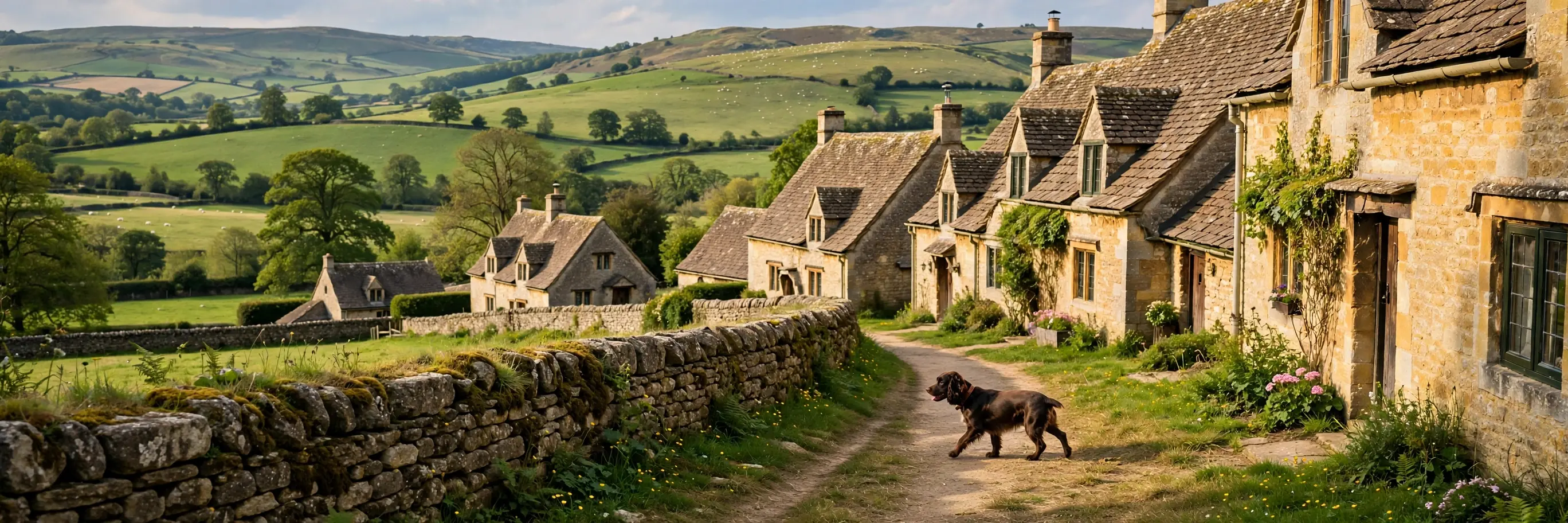
The Cotswolds are built of stone, and the stone is the first thing a walker notices. The villages — Chipping Campden, Broadway, Winchcombe, Painswick, Stroud, Dursley, Wotton-under-Edge — are built of a warm, honey-coloured limestone that glows in the evening light, and the fields are divided by dry stone walls built without mortar, some of them centuries old. The walls are beautiful, and they are also a practical feature of the walk: they mark the field boundaries, they shelter the path from the wind, and they are a reminder that this is working farmland, not a theme park.
For the dog, the stone villages are a pleasure and a discipline. The villages are compact, with narrow streets, low walls and gardens that open onto the path, and a dog on a long lead can be a nuisance in a busy village street. Keep the lead short through the villages, keep the dog close, and do not let it jump up at walls or push through gates into gardens. The dry stone walls themselves are fragile: a dog that scrambles over a wall can dislodge stones, and a wall that has stood for two hundred years can be damaged in a minute. Keep the dog on the path, and let it sniff the wall from the ground, where the interesting smells are in any case.
The villages are also where the route's social life happens. The pubs, the tea rooms, the village shops and the churchyards are all part of the walk, and a dog that is calm in a pub garden and comfortable meeting strangers will enjoy them enormously. A dog that is reactive or nervous will find the villages stressful, especially at weekends, when Broadway and Painswick are busy with visitors. If your dog struggles with crowds, plan to pass through the busiest villages early in the morning, and choose quieter overnight stops where the dog can settle.
Rolling hills and the escarpment
The Cotswold Way follows the western edge of the Cotswold hills, and the edge is a steep scarp that drops down to the Severn Vale below. The path climbs onto the scarp, runs along the top with views across the vale to the Malverns and the Welsh hills, and then drops back down into the next valley, only to climb again. The climbs are short — rarely more than a hundred metres of height gain at a time — but they come again and again, and the cumulative effect over eight days is significant. A dog that bounds up the first hill may be plodding up the fifth, and the descents are just as demanding on joints and paws.
Every surface in the Cotswolds has its own mood. The scarp top is short turf over limestone, firm underfoot when dry and treacherous when wet, and the stone can be sharp on pads. The valley floors are clay that holds water for days, clogging boots and paws alike. Between the two, the wooded slopes are thick with tree roots and fallen branches, and they stay slick long after the rain stops. Expect muddy legs whatever the forecast says, and keep a towel in the day pack for them.
The scarp pays for the climbing with views. On a clear day the eye runs across the Severn Vale to the Malvern Hills and the Black Mountains, and the dog's nose runs further still — sheep, rabbits, foxes, and the hundred small creatures that live in the turf. The edge itself demands the lead: the drop is steep, the wind is strong, and a dog chasing a smell can be over the edge before you can call it back. Through the breeding season, March to July, stay on the path as well, because skylarks and other downland birds nest on the ground up here. For lead rules in the Welsh uplands, see our Brecon Beacons with a dog walking guide; the same discipline applies on the scarp.
Pubs and tea rooms with a dog
The Cotswold Way is famous for its pubs, and with good reason: there is a good pub within a day's walk of every overnight stop, and many of them welcome dogs warmly. The tradition is strongest in the village pubs, where a dog by the fire is part of the furniture, and where the landlord will often have a water bowl and a biscuit ready before you have ordered. The rules vary from pub to pub: some welcome dogs in the bar, some only in the garden, and a few do not accept dogs indoors at all, so ask before you sit down, and do not assume that a pub that welcomed dogs last year still does.
Tea rooms are a different matter. The Cotswolds are full of them, and they are one of the great pleasures of the walk, but many of them do not allow dogs indoors, and some do not allow dogs in the garden either. The ones that do welcome dogs usually have a designated area, and they will expect the dog to be on a lead, under the table and quiet. Carry a mat for the dog to lie on, bring a chew or a stuffed Kong to keep it occupied, and do not let the dog beg at other tables. A dog that settles under the table is a dog that will be welcomed back; a dog that barks at every passing tray is not.
The afternoon closing trap is the thing to learn first. Village pubs in the Cotswolds often shut between lunch and evening, so a pub you counted on for water and shade can be locked when you reach it on a hot hill — check the hours before you rely on one. Build the day's lunch around a dog-friendly pub instead, and treat the tea rooms as a reward for a tired, settled dog: many take dogs outside or in a set area, but few are set up for a wet, muddy animal. A long pub lunch doubles as heat management — walk early, eat in the shade of the garden, and take the last miles in the cooler evening. Keep the lead on in the garden: most gardens back onto a road or a car park, and a loose dog among cars is a hazard.
Section by section: what each stretch is really like
The walk begins in Chipping Campden, one of the prettiest towns in the Cotswolds, with a wide high street of golden stone and a market hall that has stood for centuries. The first day to Broadway is short and gentle, a good day for the dog to settle into the routine, and Broadway Tower, on the hill above the village, gives the first real view of the route ahead. Broadway itself is a favourite stop, with dog-friendly pubs and a village green where the dog can stretch its legs.
The middle days, from Broadway through Winchcombe and Cheltenham to Painswick, are the heart of the walk. Winchcombe is a quiet, handsome town with a castle and a church, and the walking around it is on rolling hills and wooded slopes. Cheltenham is a proper town with shops, a vet and a railway station, and it makes a good place to restock and recover. Painswick, known as the Queen of the Cotswolds, is a beautiful village of golden stone with a churchyard full of yew trees, and it is a fine place for a rest day. The walking on this stretch is on a mix of scarp top, woodland and valley paths, and the dog will find it varied and interesting.
The final days, from Painswick through Stroud and Dursley to Wotton-under-Edge and Bath, are the most rewarding. The valleys deepen, the woods thicken, and the views from the scarp grow wider. Wotton-under-Edge is the last village before the final push, and the last day to Bath is the longest on the route, with a final climb and then a long descent through the city's parks to Bath Abbey. The finish is urban and satisfying: a cup of tea, a photo, and a short walk to the station for the train home.
Livestock, birds and leads
Sheep are the Cotswolds' permanent residents, grazing the hills from Chipping Campden to Bath, with cattle in the valley pastures below — around Winchcombe, in the Frome valley near Stroud, and on the lower slopes towards Dursley. Spring brings lambs and protective ewes, the season when a loose dog does the most harm. The lead rule is not complicated, but it is absolute: on whenever livestock are in the field, and on again whenever a dry stone wall hides what is on the other side. A wall looks like a barrier and is not one — a determined dog can get over it or through a gap in seconds. Farmers have strong legal powers where a dog worries livestock, and the fields are their workplace, not a dog park.
The scarp top belongs to the skylarks in spring. They nest in the short turf, March into July, and a dog ranging off the path can destroy a nest in a moment — damage you will never see, because a deserted nest looks exactly like grass that never held one. Keep to the marked path and keep the lead on through the breeding season. Horses are the other regulars on these hills: the Cotswolds are riding country, and a horse on a bridleway needs the same courtesy as a cyclist — short lead, step aside with the dog at your side, and let it pass before you carry on.
You will cross stiles and gates all day, and the dog needs a plan for both. Some stiles on the Cotswold Way have a dog gate or a gap alongside; many of the old stone ones do not, and then a large dog must be lifted over while a small one is passed through. Rehearse the lift at home so it is routine rather than a struggle on a stile in the rain, and never let a dog jump a stile with its lead attached — a caught lead can injure a dog badly. Gates are simpler and stricter: leave every gate as you found it, shut if shut, open if open, and check it again once the dog is through, because a gate left open is a gate a farmer remembers.
Water and food on the trail
The valleys carry the water and the scarp carries none. Between Chipping Campden and Bath the streams run in the bottoms — the Windrush, the Coln, the Frome — while the scarp top can run dry for miles, and the villages and pubs sit down in the valleys with them. Carry water for the dog on top of your own — at least a litre, more on a warm day — and fill up at every sure source: the overnight stay, a pub, a village tap, a cafe. For quantities and drinking rhythm, our dog hydration on long walks guide goes into detail, and it is worth a read before this trip.
A stream in the valley is a detour, not a wayside tap. The Coln at Winchcombe, the Frome below Stroud, the little brooks under Painswick — the water runs clear and fast, and a dog will drink from it gladly, but each one sits at the bottom of a climb you must then walk back up. An hour can go on a single drink if the valley is deep. So never count on finding water you have not seen on the map, and skip any water that looks green, smells stale, or flows past a farmyard. Offer sips often on a hot day, and splash the belly and paws at any water you pass. A dog that stops drinking, pants without easing, or will not keep walking has had enough for the day — stop, rest, and get it to shade and water.
Feed for the work, not for the holiday. A dog walking eight days burns far more than it does at home, so the evening meal can be a little bigger — but the shape of the day should not change: feed morning and evening as usual, keep the middle of the day light, and carry a pocket of the usual kibble or treats for small top-ups on the move. Changing the food for the trip is the surest way to an upset stomach, and a dog with a sore gut will not walk. If the bags are being transferred, divide the food into sealed, labelled daily portions, and keep a day's worth in your own pack, so a bag that goes astray never means a hungry dog — and see that fresh water is on hand at every overnight stop.
Where to stay with a dog
Book the beds before anything else. The dog-friendly rooms on the Cotswold Way are limited and the route is busy from May to September, so fix the dates and book early, starting with Cheltenham and Bath, where hotels give the widest choice. Between them the nights fall into a familiar pattern: village pubs with rooms, small bed and breakfasts, farm stays and guesthouses. Most places take dogs, though usually in only some of the rooms, and a small nightly charge per dog is common. Get it in writing when you book — the room, the fee, whether the dog can be left alone for a while, and where it sleeps — because a warm 'dogs welcome' down the phone can narrow a good deal by the time you arrive.
Camping suits a dog that settles. Several campsites sit within a short walk of the path around Broadway, Winchcombe and Stroud, and a tent of your own gives the dog its own space, away from strange rooms and other guests. The cost is weight in the pack, and a dog that must be content to lie quiet on its own bed when footsteps pass in the dark, rather than barking at every sound. A dog that barks through the night will make the campsite a long one for everyone. Hostels are uneven: some have private rooms that take dogs, others take none at all, so ask before assuming. Whatever the roof, keep the evening close to home: the usual feeding hour, the dog's own bed, one last toilet walk before dark, then a quiet hour to settle.
Walk light and let the bags travel separately. Local firms will carry luggage between overnight stops along the whole route, charging per bag per day, and with a dog the money is well spent: the day pack then carries just the day's water, food and bowl for the dog, waterproofs and a first-aid kit. Keep the dog's essentials in the day pack, never in the transferred bag — food for the day, medication, the spare lead, poo bags and a towel. The South West Coast Path with a dog guide uses the same day-pack system, and the system fits the Cotswolds just as well.
Arriving in Bath
Bath is one of the great finishes in British walking. The last day, from Wotton-under-Edge, is the longest on the route, and the final miles run through the city's parks and along the River Avon to Bath Abbey, where the trail ends. The city is a World Heritage Site, built of the same golden stone as the villages you have walked through, and it feels like a natural conclusion to the journey: the stone that began in Chipping Campden ends here, in a city built of it.
Bath welcomes dogs widely, but not everywhere. Pubs and cafes take them, and several hotels accept them, yet the Abbey, the Roman Baths and the museums do not — so one of you stays outside with the dog while the other goes in, or keep the sightseeing for a return trip without the dog. For a tired dog, the walk along the Avon is a gentle final stretch, and the parks give a last leg-stretch before the train home. Bath Spa station runs trains to London, Bristol and the south-west, dogs travel on a lead, and the current rules are worth checking before you travel.
Staying a night in Bath is worth considering, especially if the last day has been long. A dog-friendly hotel or guesthouse in the city gives the dog a proper bed, a proper meal and a night to recover, and it gives you a chance to enjoy the city without rushing for a train. Book ahead, because Bath is popular year-round, and confirm the dog arrangement in writing. A night in Bath is a fine way to end a walk that began eight days earlier in a small market town in the north Cotswolds.
Paws, weather and fitness
The feet set the limit on this trail. Limestone on the scarp can be sharp under paws, the valley clay holds mud after rain, and the wooded slopes are thick with roots that can twist a leg. Make the evening check a habit: rinse the mud and grit away with clean water, dry the feet thoroughly, and look for nicks, sore spots between the toes, and pads that have gone red or swollen; rub in paw balm when the pads are drying out. A dog that starts limping needs a rest, not encouragement — one day off in a village is cheap, while three more days on a worsening limp can end the trip.
The weather comes in from the west. The scarp catches the wind off the Severn Vale, and rain can arrive with very little warning, so pack waterproofs for both of you, and a dog coat for a wet week — short-coated, older and small dogs lose heat fastest. Summer flips the risk: the open scarp has little shade, so heat is the bigger danger. Walk early, sit out the middle of the day, and look out for heavy panting, or a dog that simply stops and will not go on. On the steep drops and the slick woodland slopes, a harness with a handle helps steady the dog.
Prove the fitness before you book, not on the trail. Start with the vet for any dog with arthritis, a heart problem or an old injury, and take the vet's advice seriously — an eight-day walk is a big ask for an older dog. Then give the training six weeks: work towards two consecutive long days on mixed ground, much of it on a lead, with real climbs in the mix. Two test weekends on Cotswold ground will tell you more than a month of flat walks — up Cleeve Hill one day and Broadway Tower the next, with water stops and an evening feed, exactly as the trip will run. If the dog fades on the second day, split the route across several weekends instead — far kinder than a dog running out of steam halfway to Bath.
What to pack for the dog
Pack light, but pack for the dog first. A harness that fits, with a handle for the steep descents, and a lead and a spare. A collapsible bowl, and room for at least a litre of water for the dog. The dog's usual food in sealed portions, poo bags, and a towel. Then the small things: paw balm, a rain coat for the dog, a first-aid kit with tick tweezers and any regular medication. The dog's own bed or blanket comes too, for settling in at each stop. And before you set off, save the numbers of vets near the route in your phone, with a copy of the vaccination record.
Sort the food before you leave, day by day: a labelled portion for each day, with the day pack holding one day's worth and the transferred bag holding the rest. Pack extra poo bags — more than you think the trip needs — and bring every one of them home again. The Cotswolds is protected landscape and working farmland at once, and a bagged pile left by the path is still litter, however neatly tied. Keep the dog's food and medication in a small dry bag, safe when the rain comes in sideways; keep a spare towel in the transferred bag for drying the dog off when you get in.
Give the dog time to be a dog: every gatepost and every dry stone wall deserves a sniff, and every patch of sheep-scented grass deserves a pause. Those pauses are the walk itself, not an interruption of it, so build them into the day and eight days will feel generous rather than rushed.
Practical questions
Before you go
Can dogs walk the full Cotswold Way?
Yes — dogs can walk all 102 miles of the National Trail from Chipping Campden to Bath, on public rights of way through the Cotswolds. The lead goes on through farmland and near livestock, and a few stretches cross private land where dogs must stay on the lead. Check the official guidance before you travel for current access rules.
How long does the Cotswold Way take with a dog?
Most walkers take seven to ten days at 12 to 15 miles a day. Eight days suits most dogs, with a rest day in Broadway or Painswick. The hills roll rather than climb steeply, yet the miles still add up, and a tired dog will thank you for a shorter day in the middle.
Is the Cotswold Way very hilly for a dog?
It is rolling rather than mountainous. The route climbs onto the Cotswold escarpment and drops into the valleys below it, again and again, with climbs of 100 to 200 metres at a time. Fit dogs cope well, but the descents on limestone and mud can be hard on paws and joints, especially for older dogs.
Are dogs allowed in pubs and tea rooms on the Cotswold Way?
Many pubs along the route welcome dogs, often in the bar and almost always in the garden, and several village tea rooms allow dogs outside or in a designated area. Rules vary from place to place, so ask before you sit down, keep the dog on a lead and under the table, and carry a mat for the dog to lie on.
Where does the Cotswold Way finish in Bath?
The trail finishes at Bath Abbey, in the centre of Bath, after a final stretch through the city's parks and along the River Avon. Bath has a railway station, dog-friendly pubs and hotels, and a riverside walk for a gentle last leg stretch. Dogs are not allowed inside the Abbey, so plan for one person to wait outside with the dog.
What should I check before I set off on the Cotswold Way with a dog?
Check the dog's fitness and paws, confirm every overnight stay accepts dogs in writing, book baggage transfer if you want it, check the weather and the route for diversions, and make sure the dog's food, medication and vaccination record are packed. A quick vet check before a multi-day walk is sensible for older dogs.