This guide is independent and contains no paid placement. If affiliate links are added later, they will be clearly marked and will not change our editorial checks.
Walk the South West Coast Path with a dog in sections, not in one go. Keep the dog on a lead on cliff tops and near livestock, check each beach's seasonal rules before you set off, book dog-friendly stays early, and let a luggage courier carry the bags while you and the dog carry only a day pack.
The 630-mile route in numbers
The South West Coast Path runs for 630 miles around the coast of Somerset, Devon, Cornwall and Dorset, from Minehead in the west to Poole Harbour in the east. It is the longest of England's National Trails and the only one that follows a coastline for its entire length, which means the walking never really settles into a rhythm: every headland climbs, every valley drops to a cove, and the total ascent across the full route is roughly four times the height of Mount Everest. For a dog owner, the headline number matters less than what it implies. This is not a trail you conquer in a fortnight with a dog in tow; it is a trail you collect in sections, one holiday at a time, over several years if you like.
The path is waymarked throughout with the familiar acorn symbol, and the official route is divided into 52 shorter sections that make sensible planning units. Each section typically covers between 8 and 15 miles, and most are designed around a village or small town with somewhere to sleep. That structure is a gift for dog walkers, because it means you can pick a stretch that matches your dog's fitness, book stays at both ends, and walk a linear route without ever needing to retrace your steps. The National Trail website publishes section-by-section distances, ascent figures and public transport links, and it is worth reading those figures before you commit to anything, since two sections of the same length can feel completely different.
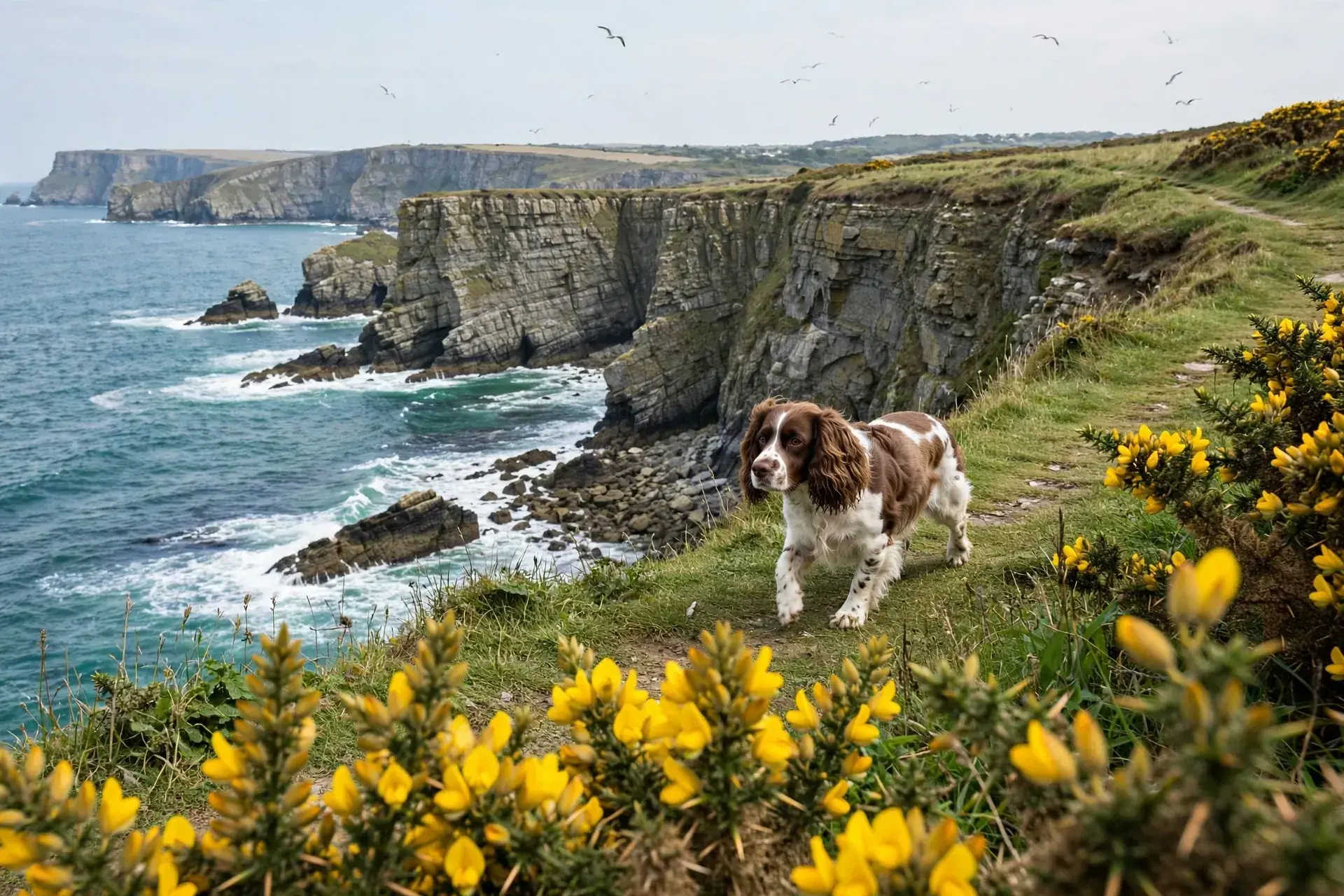
Terrain varies enormously along the way. The north Cornish coast between Padstow and St Ives is famous for long, grinding climbs and exposed cliff tops; the south Cornish coast is gentler, with wooded valleys and sheltered coves; the Dorset stretch along the Jurassic Coast mixes chalk cliffs with long shingle beaches; and the Somerset section at the start is flatter, with wide views across the Bristol Channel. A dog that copes happily with the south coast may struggle on the north coast's relentless ups and downs, so matching the section to the dog is the single most useful decision you will make. Check the official guidance before you travel for any closures or diversions, because cliff falls and landslips reroute parts of the path most years.
One more number deserves attention: the path passes through more than a hundred towns and villages, which sounds reassuring until you realise how many of the gaps between them are empty of shops, taps and shade. On a hot day, a 10-mile stretch with no water source is a genuine problem for a dog, so the numbers that matter on the day are not the total mileage but the distance to the next water point, the next patch of shade and the next place a tired dog can rest. Carry a printed or downloaded section map, note the water points before you leave, and treat the trail as a series of short journeys between known stops rather than one long line on a map.
Choosing your section: where to start
If this is your first coast-path trip with a dog, start on the south coast of Cornwall or Devon rather than the north. The walking is kinder, the villages are closer together, and there are more beaches where a dog can cool off at the end of the day. The stretch from Falmouth to Fowey, for example, mixes harbour towns, wooded creeks and short ferry crossings, and it gives a first-timer a proper taste of the trail without the punishing climbs of the north coast. The stretch from Plymouth to Dartmouth offers similar variety, with estuaries, sandy beaches and pubs that welcome dogs at the end of the day.
More experienced walkers with a fit, confident dog often head for the north coast, where the rewards are bigger and so are the demands. The section from St Ives to Penzance is one of the finest coastal walks in Britain, with open moorland, old mine engine houses and huge Atlantic views, but it is also exposed, with long stretches where there is nowhere to shelter and nowhere to buy water. The section from Padstow to St Ives is equally dramatic and equally demanding, and it is best saved for a dog that has already proved itself on shorter cliff walks. If your dog is older, small, or nervous of heights, neither of these is the right first choice.
Think about logistics as well as scenery. Sections that start and finish in towns with a railway station or a regular bus service are far easier to organise than sections that end in a hamlet with one bus a day. St Ives, Penzance, Falmouth, Plymouth, Exmouth, Weymouth and Swanage all have decent public transport, which makes it simple to get back to your car or your first night's stay. Sections around the Lizard or the far north Cornish coast are beautiful but harder to reach and harder to leave, so they suit a trip where you have a car and a driver, or where you are happy to use taxis. The South West Coast Path Association publishes transport information for each section, and a few minutes checking bus times before you book can save an expensive taxi at the end of a long day.
Finally, consider the time of year when you choose. A section with long beach stretches is a joy in October, when the dogs are allowed back on the sand, and a frustration in August, when the same beaches are restricted. A section with high, exposed cliffs is exhilarating on a calm May morning and miserable in a November gale. There is no single best section; there is only the best section for your dog, your dates and your transport. Pick one, walk it well, and come back for the next one.
Cliff edges and lead rules
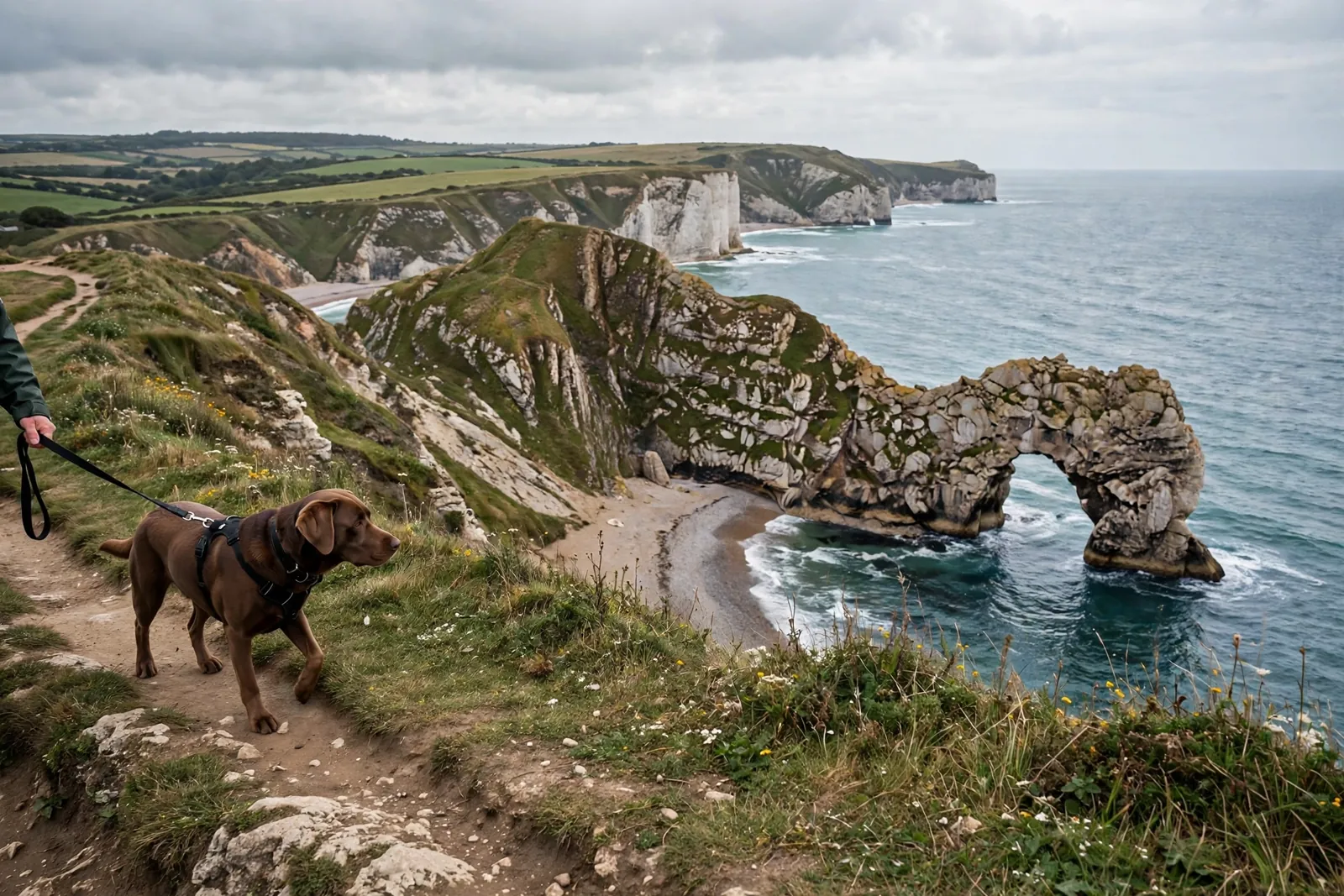
Cliff safety is the most serious subject on this trail, and it deserves to be treated as such. Every year, dogs fall from coastal cliffs in Britain, and the South West Coast Path, with its narrow paths and sheer drops, is one of the places where it happens. The rule is simple and non-negotiable: keep your dog on a lead whenever the path runs along a cliff top, and keep the lead short. A long line or a flexi lead gives a dog enough slack to reach the edge before you can react, and a dog chasing a gull or a rabbit can cover that distance in a second. A short lead, held in your hand with the dog on the inland side of the path, is the only arrangement that actually works.
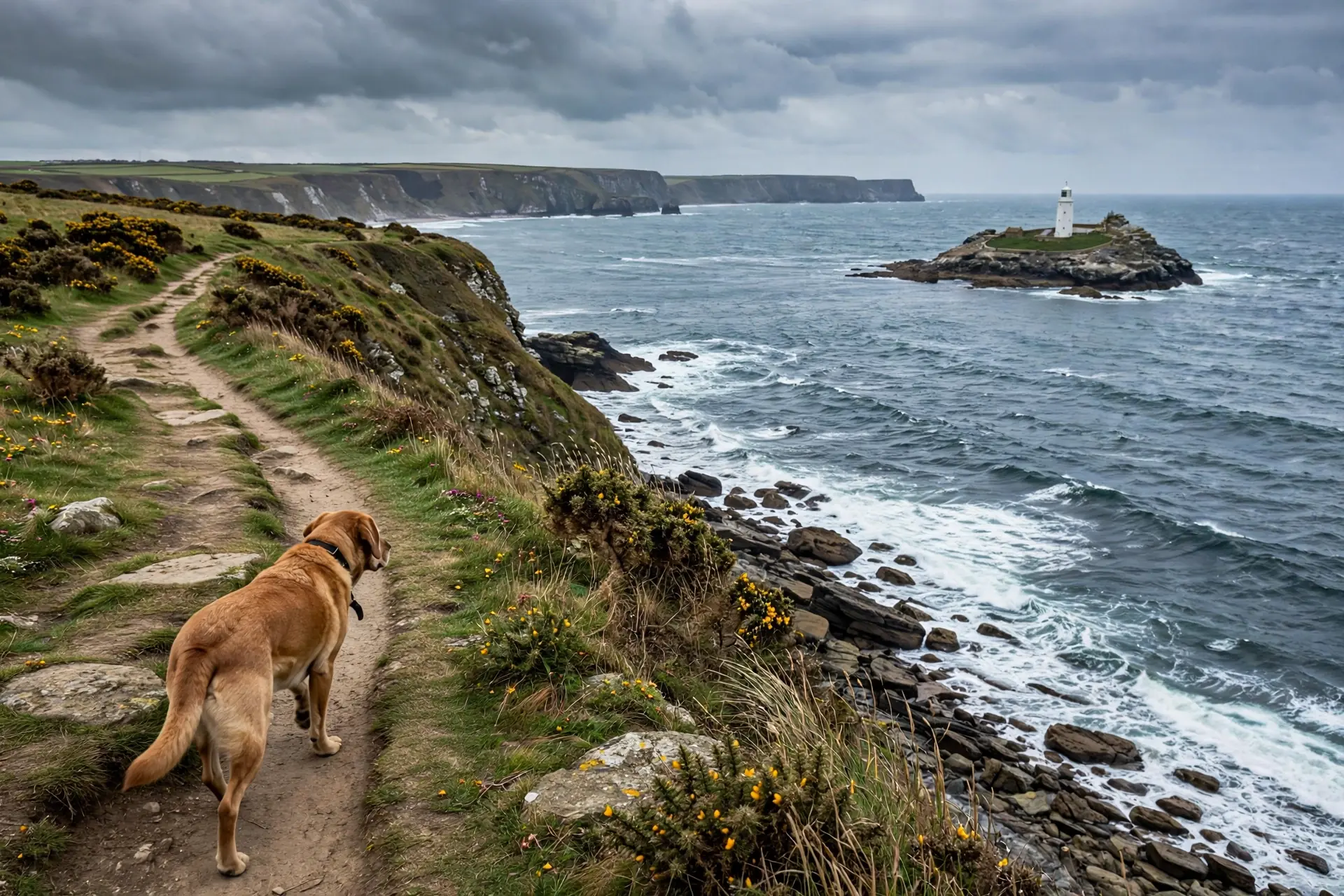
Watch for the places where the path narrows or the ground falls away on both sides. Some stretches of the north Cornish coast have paths less than a metre wide with a steep drop on the seaward side and a steep bank on the other, and a dog that pulls or lunges can unbalance a walker. If your dog pulls on the lead, fit a harness with a back handle or a short traffic lead for these sections, and walk at a pace that lets you stop quickly. If the wind is strong, treat it as a hazard in its own right: gusts on an exposed headland can catch a dog off balance, and a small dog can be genuinely buffeted. On the windiest days, choose a sheltered inland alternative or a wooded valley section instead.
Livestock is the other reason to keep the lead on. The path crosses grazing land throughout Cornwall, Devon and Dorset, and sheep, cattle and ponies are a normal part of the walk. Dogs must be kept under close control around livestock, and on a lead near farm animals, and a dog that chases sheep can be shot by a farmer under the law, quite apart from the distress it causes. Keep the dog close, move steadily past grazing animals without stopping to let the dog stare, and if cattle block the path, take a wide detour rather than pushing through. Ponies on the open moorland sections near the coast are usually calm, but a loose dog can still spook them, so the lead stays on until you are well clear.
There are also stretches where the path passes through farmland with no fence between the walker and a field of crops or young livestock. Here the Countryside Code applies in full: keep to the marked path, keep the dog on a lead, and leave gates as you find them. A dog that runs off across a field can damage a crop or disturb nesting birds, and ground-nesting birds are a particular concern on the coastal heathland in spring. The path is a shared space, and the lead is what makes sharing it possible.
Beaches and seasonal rules
Beaches are one of the great pleasures of the South West Coast Path, and also one of the most confusing parts of planning a trip. There is no single national rule. Each beach is governed by its local council, and the rules change from beach to beach, from season to season, and sometimes from one end of a beach to the other. The pattern most walkers meet is a seasonal restriction on the busier resort beaches, typically running from around Easter to the end of September, often between 10am and 6pm, enforced by a public space protection order with fines for breaches. Outside those hours and outside the season, the same beach may welcome dogs freely.
That pattern has practical consequences for route planning. In summer, a section that drops down to a resort beach in the middle of the day may force you onto the road or onto a cliff-top alternative, because the beach itself is closed to dogs during the restricted hours. In October, the same section becomes a straightforward beach walk. Some beaches have a designated dog area at one end, separated from the family area, which is a good compromise but is easy to miss if you arrive from the coast path rather than the car park. The signs at the beach entrance are the authority on the day, and they should be read every time, even on a beach you have visited before, because orders are renewed and changed.
Our guide to dog-friendly beaches in the UK explains the 2026 rules, bans and fines in more detail, including how public space protection orders work and which beaches stay open all year. It is worth reading before you plan a summer trip, because the difference between a beach that bans dogs and a beach that restricts them by time of day can change a whole day's walking. As a rule of thumb, the quieter and more rural the beach, the more likely it is to welcome dogs year-round, while the big sandy resort beaches are the ones with the strictest rules.
Swimming needs its own care. The sea off the south-west coast is cold even in summer, and rip currents are a real hazard on many of the surf beaches. Never let a dog swim where there are strong currents, and never follow a dog into the water if it gets into trouble; throw a floating object and call for help instead. After a swim, rinse the dog with fresh water if you can, because salt water and sand irritate skin and paws, and watch for the dog drinking sea water, which can cause vomiting and diarrhoea. If your dog swims in a river or stream inland, check for blue-green algae warnings first, especially in warm weather, and keep the dog out of the water if you see a green scum on the surface.
Luggage transfers and getting back
Luggage transfer is what turns the South West Coast Path from a backpacking expedition into a civilised holiday. Specialist couriers operate along the whole route, collecting your bags from one night's accommodation in the morning and delivering them to the next by the afternoon, usually for a fee per bag per day. You book the sequence in advance, label each bag, and leave it at reception by a set time, typically around 9am. You then walk with only a day pack containing water, food, the dog's lead and a few essentials, which transforms the walking for both you and the dog.
Booking a transfer is not quite as simple as it sounds, and the details matter. First, confirm that every stay on your route is covered by the courier's service area, because some remote hamlets and individual cottages are outside the standard route. Second, check the weight and size limits, which are usually around 20 kilograms per bag, and remember that a week's worth of dog food is heavy; consider having food delivered to a stay midway, or buying it locally, rather than carrying it all from the start. Third, keep anything the dog needs during the day in your own pack: medication, a collapsible water bowl, a spare lead, poo bags and a towel. If a transfer is delayed, the dog still needs to eat and drink.
Getting back to your starting point is the other half of the logistics. The South West Coast Path is a linear trail, so at the end of a section you are a long way from where you began. The usual options are the bus, the train, a taxi, or a second car left at the far end. Buses along the coast are generally good in summer and thin in winter, and many routes are infrequent, so check the timetable before you commit to a section that depends on a particular bus. Trains serve the larger towns, and the scenic branch lines to St Ives, Falmouth and Looe are part of the pleasure of the trip. Dogs travel free on most trains and buses in Britain, but check the operator's rules before you travel, because some require the dog to be on a lead and kept off the seats.
Taxis are the fallback, and they are worth pricing in advance. A taxi from one end of a section to the other can cost more than a night's accommodation, especially on the remoter stretches, so a section that ends in a town with a bus service is almost always cheaper than one that ends in a hamlet. Some walkers leave a car at each end, driving one car to the finish the day before, which works well for a group but is a lot of driving for a solo walker. Whatever you choose, sort it out before you leave home; the end of a long day on a cliff path is the worst time to discover that the last bus left an hour ago.
Where to stay with a dog
Dog-friendly accommodation along the coast path is plentiful but competitive, and the best places book up months ahead for summer and school holidays. The range runs from campsites and bunkhouses to pubs with rooms, bed and breakfasts, self-catering cottages and a handful of hotels that genuinely welcome dogs rather than merely tolerating them. For a multi-day walk, the most practical pattern is a mix: a pub or bed and breakfast where you can dry the dog and eat without cooking, alternating with self-catering nights where you can wash muddy gear and feed the dog on your own schedule.
When you book, ask the questions that actually matter rather than settling for a "dogs welcome" tick box. Is there a charge per dog per night, and is there a limit on the number or size of dogs? Is the dog allowed in the bedroom, or only in a specific room? Is there somewhere secure to leave the dog if you go for dinner, and is there an enclosed garden or a nearby field for a last outing? Is there a tap or a dog wash for muddy paws, and is there somewhere to dry a wet dog and hang wet coats? The answers separate the places that have thought about dogs from the places that simply charge for them.
Campsites deserve a special mention, because they are the cheapest option and often the most flexible for a dog walker, but they come with their own rules. Many coastal campsites require dogs to be on a lead at all times on site, and some restrict dogs from the shower blocks and the play areas. Check whether the site allows dogs in the tents or only in caravans, and whether there is a dog exercise field. A campsite with a pub next door and a beach within walking distance is a very good base for a dog walker; a campsite on a windswept headland with no shelter is a poor one in bad weather.
Book the whole sequence before you set off, and confirm each stay in writing with the dog noted on the booking. A common and expensive mistake is to book a chain of stays and then discover that one of them has changed its dog policy, or that the room you booked is one of the few that does not accept dogs. A short email to each host, confirming the dates, the number of dogs, the breed and the pet fee, is cheap insurance. If you are walking in the school holidays, book at least three months ahead; for the popular Cornish sections, six months is not excessive.
Food, water and resupply
Food and water planning is where many coast-path trips with dogs quietly go wrong. The dog needs more food on a walking holiday than at home, typically 25 to 50 percent more depending on the distance and the weather, and it needs to be food the dog already eats. A change of diet on a walking holiday is a reliable recipe for an upset stomach, so bring the usual food from home or buy the same brand locally. If you are using a luggage transfer, the food can travel in the transferred bag, but keep a day's supply in your day pack in case of a delay.
Water is the harder problem. On many stretches of the path there is no tap, no shop and no stream for miles, and a dog working hard on a warm day can drink a litre or more over a few hours. Carry at least a litre of water for the dog on top of your own, in a bottle with a collapsible bowl, and refill at every opportunity: cafes, pubs, campsites, churches and village taps are all fair game if you ask politely. Coastal streams are not always safe to drink from, because they may run through farmland or contain salt water at high tide, so treat any water you are unsure about as a last resort and check the official guidance before you travel if you plan to rely on natural sources.
Resupply is a matter of knowing where the shops are. The larger villages and towns along the path have supermarkets or village shops, but the gaps between them can be two or three days' walking, and the small shops in hamlets may stock very little dog food. Plan your resupply points on the map before you leave, and carry enough food to reach the next one with a day in hand. If your dog eats a specialist diet, order food online for delivery to a stay midway along the route, and confirm with the host that a parcel can be accepted. A dog that runs out of food two days from the nearest pet shop is a problem you do not want.
Feeding times matter too. Feed the dog at least an hour before you start walking in the morning, and wait at least an hour after a hard day before the evening meal, because exercising on a full stomach increases the risk of bloat in deep-chested breeds. Carry a small amount of the dog's normal food or treats for a midday top-up, and offer water at every break rather than waiting for the dog to look thirsty. A dog that is fed and watered on a steady routine will walk further and recover faster than one that is fed in big, irregular meals.
Paws, fitness and daily distance
Coastal walking is hard on paws. The path mixes tarmac, gravel, grass, mud, sand, rock and, in places, sharp slate, and a dog that is used to pavements and park grass will feel the difference within a day or two. Before the trip, build up the dog's walking gradually over several weeks, including some rough and hilly ground, and check the paws after every walk. Look for cracked pads, redness between the toes, small cuts and signs of tenderness, and carry a basic paw-care kit: a paw balm, a few booties for emergencies, and a small first-aid kit with bandages and antiseptic.
Daily distance should be set by the dog, not by the map. Most fit adult dogs can manage 10 to 15 miles a day on the coast path, but the ascent matters more than the mileage: a 12-mile day with 800 metres of climbing is a very different proposition from 12 flat miles. Older dogs, puppies and brachycephalic breeds need shorter days, and a dog that is carrying a pack should carry no more than 10 percent of its body weight. Plan a rest day after every three or four walking days, or at least a short day, and watch for the signs of a dog that has had enough: lagging behind, lying down on the path, a stiff gait in the morning, or a reluctance to start. A dog that is pushed too far on day two will not enjoy day five.
Heat is a particular risk on the south-west coast, where the sun is strong and the cliff-top paths offer little shade. Walk early in the morning on hot days, take the shaded valley routes where they exist, and never leave a dog in a car, even for a few minutes. Carry extra water, offer it frequently, and learn the signs of heatstroke: heavy panting, drooling, confusion and collapse. If a dog overheats, move it into shade, cool it with water on the belly and paws, and get veterinary help. The same caution applies to cold and wet weather, where a small or short-coated dog can lose heat quickly on an exposed headland; a dog coat is worth carrying from October to April.
Fitness is not just about the dog. The coast path is demanding walking, and a tired walker makes mistakes on cliff tops and loses concentration on a lead. Build up your own walking before the trip, break in your boots, and carry a pack that is light enough to let you react quickly if the dog pulls. A walking pole helps on the steep descents, which are where knees and ankles suffer most, and a pole also gives you a free hand for the lead. The best coast-path trips are the ones where both ends of the lead are fit for the day.
Weather, wind and when to go
The south-west coast has a maritime climate, which is a polite way of saying the weather can change four times before lunch. The best months for walking with a dog are usually May, June, September and October. May and June bring long days, wildflowers on the cliff tops and relatively settled weather, though the gorse and bracken can be thick and ticks are active. September and October bring warm seas, quieter paths and the lifting of most seasonal beach restrictions, though the days are shorter and Atlantic storms begin to arrive. July and August are the busiest and hottest months, with crowded paths, restricted beaches and the highest prices.
Winter walking is possible but demanding. The path is open all year, and a crisp January day on an empty coast can be beautiful, but the days are short, the mud is deep, and the wind on an exposed headland can be genuinely dangerous. If you walk in winter, plan shorter days, carry a head torch, and be ready to abandon a cliff-top section for a lower inland route. Check the forecast the night before and again in the morning, and check the official guidance before you travel for any path closures after storms. The Met Office forecast for the coast is the one to trust, and a forecast of strong winds on an exposed section is a reason to change the plan, not a challenge to be accepted.
Wind deserves its own paragraph, because it is the weather feature that most surprises first-time coast walkers. On a headland, the wind is stronger, colder and more changeable than the forecast for the nearest town suggests, and a gust can knock a small dog off balance or blow a hat, a map or a poo bag into the sea. Keep the dog on the inland side, keep a firm grip on the lead, and if the wind is strong enough to make you lean into it, consider dropping down to a beach or a valley path. Rain is less of a problem than wind, provided both of you have proper waterproofs, but a wet dog on a cold, windy headland loses heat fast, so carry a drying towel and a dog coat and be ready to cut a day short.
Whatever the season, the rule is the same: check the forecast, check the path conditions, and have a plan B for every day. The coast path is at its best when you are not fighting it, and a day spent on a sheltered estuary walk while the wind howls on the headland is not a wasted day. It is a sensible one.
A sample seven-day plan
A realistic first week on the South West Coast Path with a dog might look like this: a gentle start, a steady build, and a rest day in the middle. Day one could run from Falmouth to the Helford River, a short and forgiving introduction with wooded creeks and a ferry crossing that dogs can usually join. Day two continues along the Helford to Coverack, with quieter paths and a village pub at the end. Day three takes you around the Lizard, the most southerly point in mainland Britain, with wildflowers, serpentine rock and long views; it is a day to take slowly, with plenty of water stops.
Day four is a rest day, and it is worth treating it as one rather than sneaking in a long walk. A short beach stroll, a swim if the beach allows it, a wash of muddy gear and a good meal will do more for the rest of the week than another 12 miles. Day five resumes from Coverack to Porthleven, a longer and more exposed stretch that rewards an early start. Day six runs from Porthleven to St Ives, passing through Marazion with its view across to St Michael's Mount, and day seven is a short walk out of St Ives to Zennor or a day off to explore the town, with the train home from St Ives station.
This is a plan, not a prescription, and it should be adjusted to the dog in front of you. A young, fit dog might add a few miles a day; an older dog might need the rest day earlier and shorter days throughout. The point is the shape of the week: a gentle start, a build, a rest, and a finish that leaves the dog tired but happy rather than exhausted. Book the stays first, then fit the walking to the stays, and leave a spare half-day at the end for transport delays or a day lost to weather. The path will still be there next year, and a week that ends well is a week you will want to repeat.
Before you commit to any itinerary, check the official guidance before you travel for the current state of the ferries, the beach restrictions and the path itself. Ferry timetables change with the season, some ferries stop running in winter, and a ferry that does not run can add several miles of road walking to a day. The same applies to the pubs and cafes you plan to rely on for water and lunch: many coastal businesses close in winter or open only at weekends, so a phone call the day before is cheap insurance.
Packing list for a coast-path dog
A good packing list for the dog is short, specific and tested before the trip. Start with the essentials: a well-fitting harness, a short lead and a spare lead, a collapsible water bowl and at least a litre of water, the dog's normal food measured into daily portions, poo bags, a towel, and any medication the dog takes, with a copy of the prescription. Add a paw balm, a small first-aid kit, a dog coat for cold or wet weather, and a light or reflective collar for early starts and late finishes. If the dog carries a pack, keep it under 10 percent of body weight and test it on a long walk before the trip.
For the walker, the list is the familiar one: broken-in boots with good grip, waterproof jacket and trousers, layers for wind and sun, a hat and sunscreen, a map and a compass or a charged phone with offline maps, a head torch, a basic first-aid kit, and a walking pole for the descents. Pack a dry bag for the dog's food and your spare clothes, because a wet pack is a miserable companion, and carry a small repair kit for boots and straps. A pair of lightweight shoes for the evening is worth its weight in gold after a day in boots.
One item that first-timers often forget is a means of carrying a tired dog. A small or older dog that runs out of energy on a cliff path cannot simply be left there, and a carry sling or a dog rucksack can be the difference between a problem and an inconvenience. For a larger dog, the answer is different: plan shorter days and know where the nearest road access is, so that a taxi can reach you if the dog cannot walk further. Either way, the plan should include an exit route for every day, not just the intended route.
Finally, pack the paperwork. Carry the dog's vaccination record and the vet's phone number, and save the number of the nearest emergency vet for each night's stay. If you are travelling from abroad, check the rules for bringing a dog into the UK before you travel, and carry the required documents. A phone with the numbers saved, a charger and a power bank complete the kit. The best packing list is the one you have actually used on a practice walk, not the one you wrote the night before.
For more on the places and walks that pair well with a coast-path trip, our guides to Dartmoor dog walks and Snowdonia with a dog cover the moorland and mountain walking that many coast-path walkers try next, with the same attention to livestock, lead rules and weather.
Practical questions
Before you go
Can dogs walk the whole South West Coast Path?
Yes, in principle, but almost nobody walks all 630 miles in one trip. Most dog owners walk it in sections over several holidays, using luggage transfer services and public transport to return to their starting point. A few stretches involve steep steps, cliff-edge paths and seasonal beach restrictions, so check the official guidance before you travel and plan each section separately.
Do dogs have to stay on a lead on the South West Coast Path?
Dogs must be kept on a lead near cliff edges, around livestock and on many beaches during the summer season. On open moorland and quiet stretches a well-behaved dog can often walk off lead, but keep a lead in your hand at all times and clip it on whenever the path narrows, the ground drops away or other walkers, horses or sheep appear.
Which beaches on the South West Coast Path ban dogs in summer?
Many of the busier resort beaches in Cornwall, Devon and Dorset restrict dogs between roughly Easter and the end of September, usually from 10am to 6pm, with fines under local public space protection orders. Quieter coves and many rural beaches welcome dogs all year. Always check the signs at the beach entrance and the official guidance before you travel, because rules change from beach to beach.
How do luggage transfers work on the South West Coast Path?
Specialist baggage couriers collect your bags from one night's accommodation and deliver them to the next, usually for a fee per bag per day. You book the whole sequence in advance, leave bags at reception by a set morning time and walk with only a day pack. Confirm that your chosen stays are covered by the courier's route and that your dog's food and medication travel in your day pack, not in the transferred luggage.
How far should a dog walk each day on the coast path?
Most fit adult dogs manage 10 to 15 miles a day on the coast path if the walking is spread over several days with rest breaks, water and food. The climbs are the hard part: a 12-mile day with 800 metres of ascent is far tougher than the same distance on flat ground. Build up gradually, watch for sore pads and tiredness, and plan a shorter day after any long or steep section.
When is the best time of year to walk the South West Coast Path with a dog?
Late spring and early autumn are usually the best windows: mild temperatures, longer days, fewer crowds and most seasonal beach restrictions lifted. Summer brings heat, busy paths and dog bans on resort beaches, while winter brings short days, mud and exposed cliff-top wind. Whatever the season, check the official guidance before you travel and carry water, because coastal paths often have long stretches without a tap or shop.