This guide is independent and contains no paid placement. If affiliate links are added later, they will be clearly marked and will not change our editorial checks.
Carry clean water for the dog as well as for yourself, offer it every 20 to 30 minutes in small amounts, and plan refill points before you set off. A dog that is still panting hard after a shaded rest, lagging behind or showing a dry mouth needs a stop, shade and water now, not another mile to the next landmark.
Watch the panting first
Most hydration advice starts with litres and distances. On a real walk, the first useful signal is simpler and noisier: the dog's breathing. Dogs do not sweat the way people do. They lose heat mainly by panting, and panting itself costs water. That is why a dog can look fine at the start of a climb, sound busy halfway up, and then go quiet in a way that is easy to misread as settling down. Learning the difference between normal working panting and struggling panting is the skill that makes every litre calculation in this guide work, because numbers alone cannot tell you how this dog is coping on this hill in this weather.
Start by noticing the dog's resting pattern before the walk begins, while the dog is still calm in the car park or at the trailhead. A relaxed dog breathes through the nose with the mouth closed, or pants gently with a loose tongue and a soft, open mouth. The body looks loose, the ears move normally, and the dog still shows interest in smells, other walkers and the path ahead. That baseline matters because every dog is different. A fit collie may trot uphill with a rhythmic, open-mouthed pant and recover within two minutes of stopping. An older labrador may breathe more heavily on the flat and take longer to settle. A flat-faced breed may sound louder at rest and tire sooner. Comparing the dog to an average from a chart will mislead you; comparing the dog to itself, an hour earlier, will not.
As the walk goes on, watch for changes in three things at once: speed, depth and recovery. Speed means how fast the panting becomes. A dog that starts with a steady pant and then shifts to rapid, shallow breaths with the tongue pulled back or curled is working much harder to cool down. Depth means how the chest and belly move. Laboured breathing that pulls the whole ribcage, flares the nostrils or makes the dog stretch its neck forward is a sign to stop, not a cue to admire the view for one more minute. Recovery means what happens when you pause in the shade. Healthy working panting should ease noticeably within a few minutes of rest, shade and a small drink. Panting that stays fast, gets louder or turns into noisy, harsh breathing after a proper rest is a warning, and the correct response is shade, water in small amounts, cooling and a reassessment of the route, not encouragement to carry on.
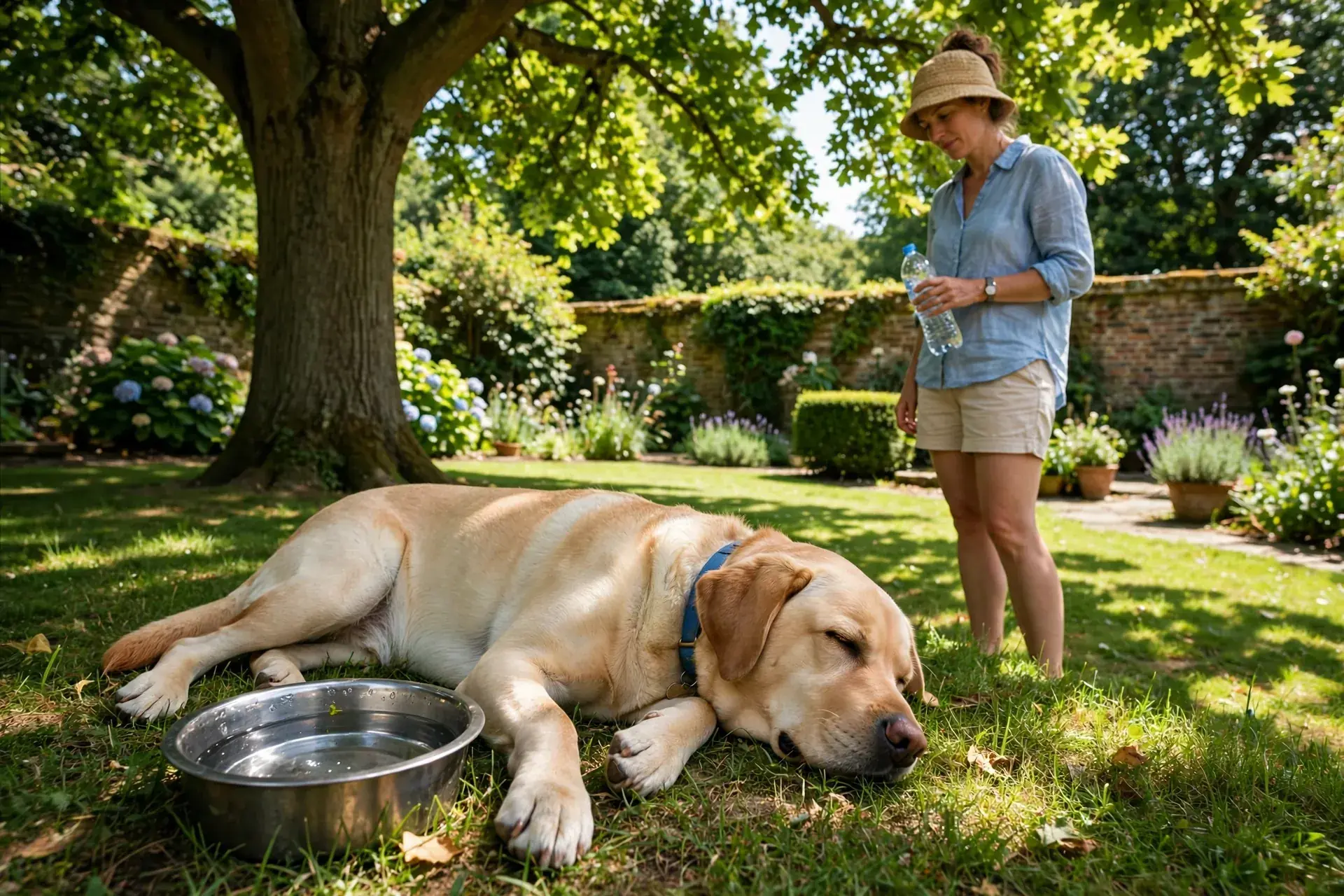
There are subtler changes worth catching before the obvious ones. A dog that stops sniffing, stops pulling towards interesting smells or starts walking behind you instead of ahead may be tiring or overheating, even if the panting does not yet look dramatic. Drooling that suddenly increases, a tongue that looks darker red than usual, or a dog that seeks out shade, lies flat on cool grass or tries to lie in a ditch is telling you something directly. Dogs are good at masking discomfort while the walk is exciting, especially sociable breeds that want to keep up with the group. That enthusiasm is not evidence that the dog is coping well. If the group wants to push on and the dog's breathing says otherwise, the dog's breathing wins the argument.
Use panting as a timetable, not just an alarm. When the panting quickens on a climb, that is the moment for a short stop before the summit, not at the summit. Offer water, stand in the shade for three to five minutes, and let the breathing settle before you ask for more effort. On a long walk, these micro-stops cost very little time in total and save the much longer stop that follows overheating. They also teach you the dog's pattern for the day. If the dog needs a stop every twenty minutes on a humid morning, that pattern will probably hold for the afternoon, and your refill plan should be built around it. Weather, ground and gradient all change the pattern, so keep watching rather than assuming the morning's rhythm will last all day.
One caution matters here. Panting is a useful everyday signal, but it is not a diagnosis. A dog with a heart condition, breathing problem, pain or anxiety may pant for reasons that have little to do with water, and heat illness can develop quickly even in a dog that seemed to be drinking well. If panting does not settle with rest, shade and small drinks, if the dog vomits, staggers, collapses or cannot stand, or if the gums look pale, grey or very dark, stop the walk and seek veterinary help urgently. Do not try to force large amounts of water into a dog that cannot drink normally, and do not pour ice-cold water over a collapsed dog without veterinary advice. For any dog with a known health condition, check the official guidance before you travel and ask your vet what limits apply to that dog on a long walk.
How much water to carry
A useful planning figure for a day of walking is roughly 50 to 100 millilitres of water per kilogram of body weight, in addition to what the dog drinks at home before and after the walk. That range is deliberately wide, because the right amount depends on temperature, humidity, gradient, pace, coat and the dog's own condition. A 10-kilogram terrier therefore needs roughly 500 millilitres to a litre as a planning allowance for the walking day, a 20-kilogram spaniel needs roughly one to two litres, and a 35-kilogram retriever needs roughly 1.75 to 3.5 litres. These are planning figures, not a prescription, and they are meant to be adjusted upward on warm, humid or hilly days and downward only with caution on cool, short, flat walks. It is always better to carry a little too much and bring some home than to run out halfway along a ridge with no refill point.
Think of the total in three parts: the dog's normal drinking, the extra lost through panting and exercise, and a reserve. Normal drinking covers what the dog would take at home on a quiet day. Exercise adds to that because panting and movement increase water loss, and heat adds more again. The reserve covers the things that go wrong on British walks: a path closure that adds two miles, a slower pace because of mud, a missed refill point, or a hotter afternoon than the forecast suggested. A reserve of at least 500 millilitres for a medium dog, and a litre for a large dog, is a sensible habit on any walk longer than two hours. If you are walking with two dogs, double the dog allowance rather than hoping they will share politely from one bottle at the same moment.
Temperature changes the maths more than most walkers expect. A cool, overcast day in the teens may feel easy to a human in a windproof jacket, but a dog in a thick coat working uphill is still generating a lot of heat. Humidity matters as much as the thermometer reading, because damp air makes panting less efficient at cooling, so the dog pants harder and loses more water for less benefit. Wind helps, shade helps, and a breeze along a ridge can transform a walk, but none of these remove the need to carry water. Conversely, a cold winter walk still needs water: a dog that is working hard in cold air loses moisture with every breath, and a frozen stream is not a water source. Do not let a low temperature talk you out of carrying a bottle.
Distance and terrain deserve the same honest treatment. A flat canal towpath mile and a steep, rocky mile are not the same walk for a dog, even if the map distance is identical. Muddy ground, deep sand, snow, long grass and repeated stiles all slow a dog down and increase effort. So does walking on tarmac in warm weather, which adds heat from below as well as from the sun. When you plan the water, plan for the hardest section of the route, not the average. If the middle three miles are exposed, uphill and without shade, that is where the dog will need the most frequent drinks, and that is where a refill point matters most. A route that looks short on paper can still be a long walk for a small dog with short legs, an older dog with stiff joints, or any dog that has to work hard to keep up with a human stride.
Carry the water in a way that keeps it usable. Two containers are better than one large one, because a leak, a dropped bottle or a cap failure then costs you half the supply rather than all of it. Keep the dog's water separate from your own where possible, so you are not forced to choose between your thirst and the dog's. Insulated bottles help on hot days, but they are not essential; what matters more is that the water stays clean, the cap seals, and you can pour it without wasting half of it on the grass. At the start of the walk, check that every cap is tight, every bottle is full, and the bowl is reachable without unpacking the whole rucksack. A bottle buried under a waterproof jacket at the bottom of a pack is not really carried water, because you will delay using it until the dog is already very thirsty.
Finally, do not rely on the dog to tell you exactly how much it needs. Some dogs drink eagerly at every stop and some barely sip until they are quite thirsty, and neither pattern is a reliable meter on its own. Offer water on schedule, note roughly how much the dog takes, and adjust the next stop accordingly. If the dog consistently refuses water at stops and then drinks heavily later, shorten the intervals and offer smaller amounts more often. If the dog drinks everything you offer and still pants hard, you may be under-carrying for the conditions, and the route should be shortened or rerouted towards shade and a refill. The goal is a dog that finishes the walk bright, interested and keen to drink at home, not a dog that collapses at the car and empties a bowl in one desperate go.
Build a drinking rhythm
The rhythm matters as much as the total. A dog that drinks a litre at lunchtime and nothing for three hours either side of it is not hydrated as well as a dog that takes small drinks every half hour, even if the totals are the same. Small, regular drinks keep the mouth moist, support steady panting and avoid the stomach discomfort that can follow gulping a large volume after hard exercise. A practical rhythm for a long walk is a proper water stop every 20 to 30 minutes, with shorter sips available more often on hot days, steep climbs and exposed sections. Set the rhythm by time, not by distance, because a slow, muddy mile can take twice as long as a firm, flat mile and the dog is working for all of that time.
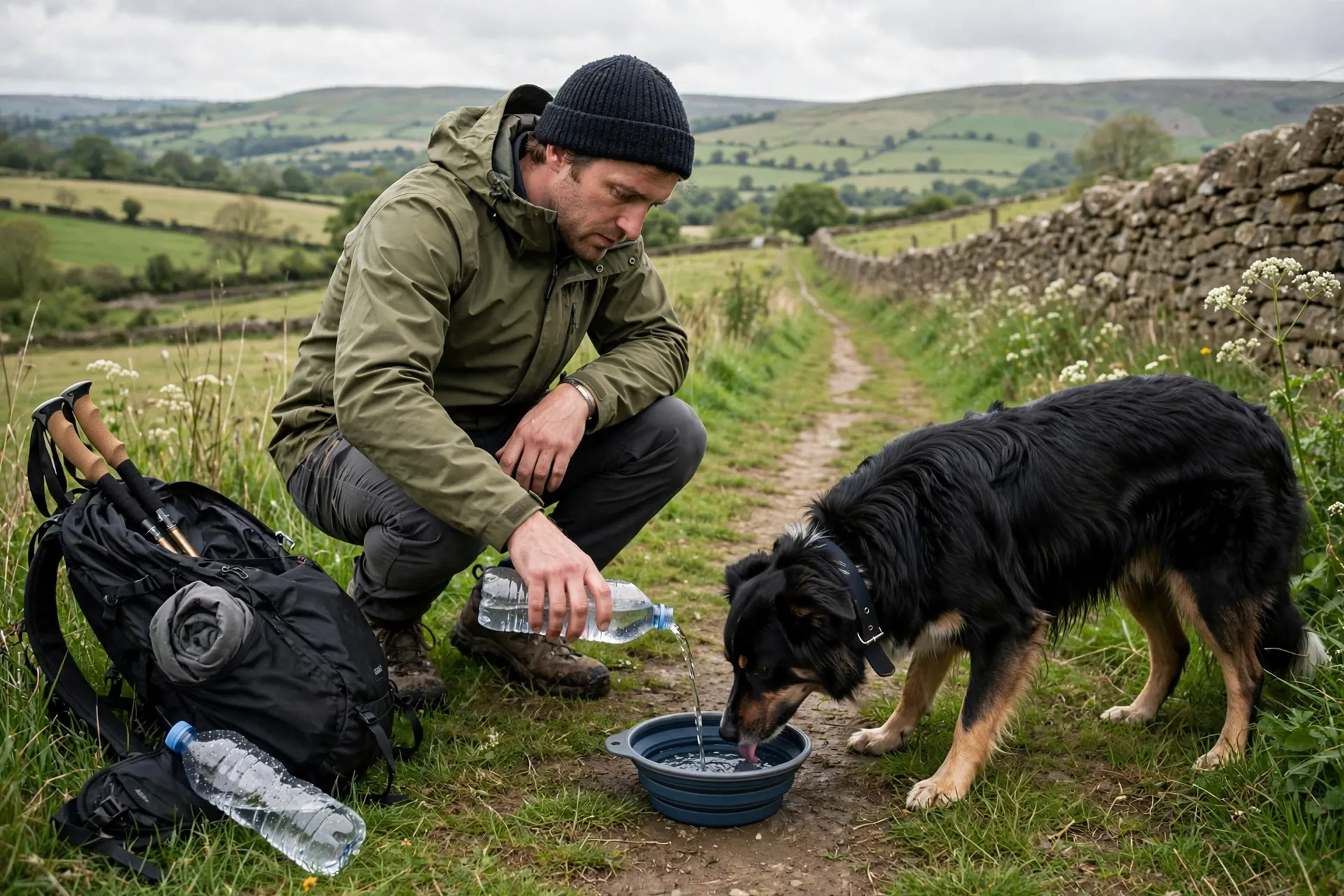
Make each stop calm and unhurried. Find shade if you can, even if it is only the shadow of a hedge, a wall or a single tree. Put the bowl down on level ground, pour a small amount, and let the dog drink at its own pace. If the dog laps eagerly and looks up for more, pour a little more. If the dog sniffs and walks away, do not force it, but offer again at the next stop and watch the breathing. A stop of three to five minutes is usually enough for a drink and a breathing reset, and it is also a good moment to check paws for mud balls, thorns or soreness, to adjust a harness, and to decide whether the next section is still sensible. Treat the stop as part of the walk, not as an interruption to it, and the dog will learn to expect it and settle into it.
Morning, midday and afternoon need different rhythms. In the morning, the dog starts the walk after a night's rest and a drink at home, so the first stop can be a little later, but do not skip it entirely on the assumption that the dog is still full from breakfast. By midday, especially in summer, the rhythm should tighten: shorter intervals, more shade, and a willingness to cut the route short if the heat rises. In the afternoon, tiredness joins heat as a factor, and a dog that was coping well at 11am may need more frequent stops at 3pm even if the temperature has not changed. If you are walking a circular route, plan the hardest or most exposed section for the cooler part of the day where possible, and keep the final mile gentle so the dog finishes tired but not depleted.
Watch the dog's drinking style as well as the amount. A dog that laps steadily, pauses and laps again is drinking normally. A dog that plunges its whole muzzle in, coughs, splutters or tries to drink frantically may be very thirsty, overheated or anxious, and needs a calmer approach: a smaller amount in the bowl, a pause, and then another small amount. A dog that refuses water repeatedly while panting hard is a concern, not a quirk to walk through. Stop, shade, cool the dog gently with water on the belly and paws if veterinary guidance for the situation supports it, and seek advice if the dog does not improve. Never force water into a dog's mouth, and never offer water to a dog that is vomiting repeatedly or cannot swallow safely without veterinary advice.
There is also a rhythm to the day before and the day after a long walk. A dog that starts the walk already a little dry, because it drank less than usual the evening before or travelled in a warm car without a drink, will struggle sooner. Offer water before you leave, allow a toilet stop, and offer again at the trailhead. After the walk, keep the same steady pattern rather than switching to unlimited gulping. Small drinks, shade and rest first, then a normal meal once the dog has cooled and settled. If you use a portable dog water bottle for the walk, practise with it at home first so the dog is not learning a new drinking method while also coping with heat and tiredness on the hill.
Choose portable kit that works
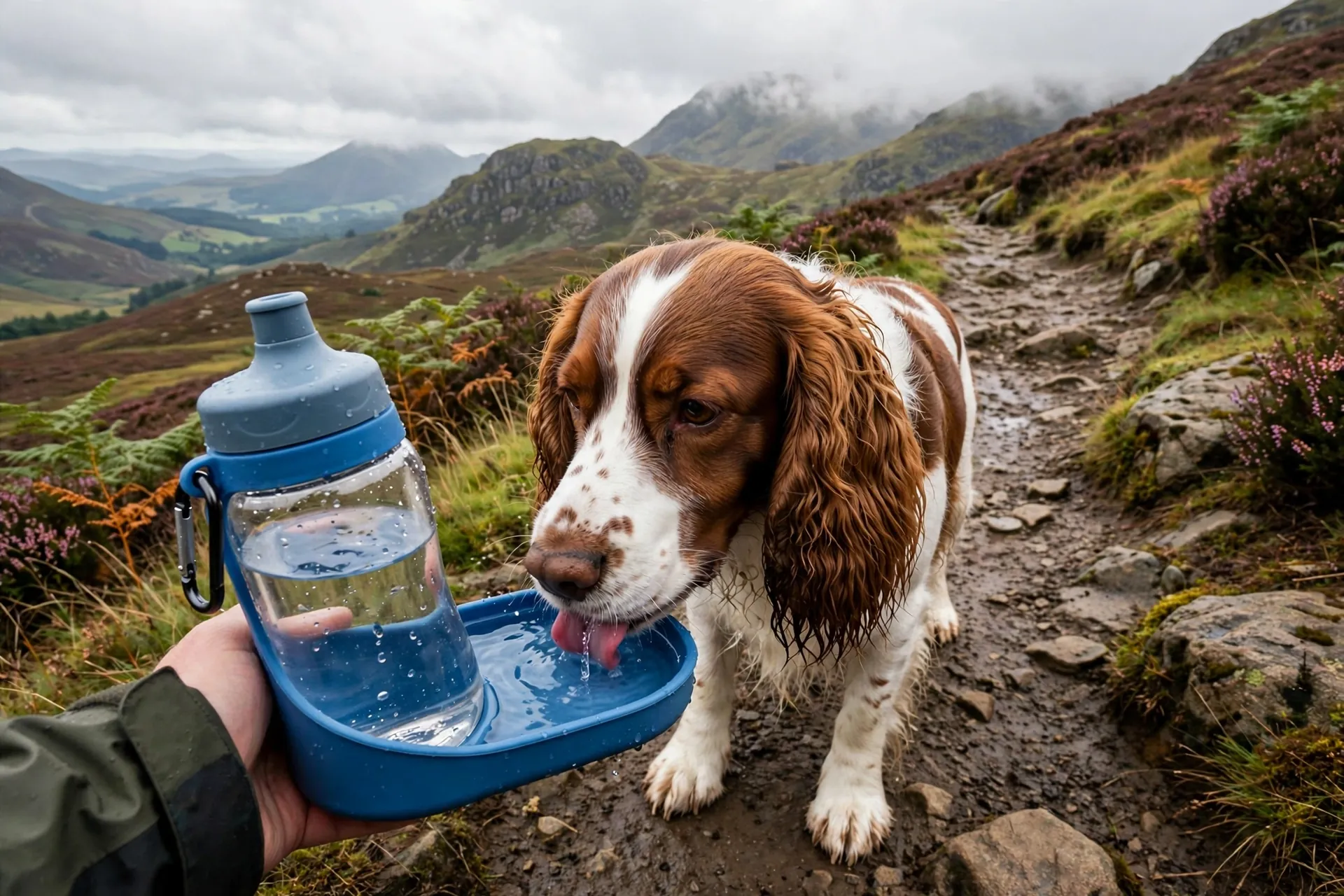
The best hydration kit is the kit you will actually use at every stop, not the most elaborate system you own. For most long walks, that means a bottle or two for the dog, a bowl the dog will drink from, and a way to carry both without a struggle. A collapsible dog bowl is popular for good reasons: it weighs little, clips to a pack, opens flat for a stable drink and folds away wet without taking up much space. A rigid bowl is more stable in wind and easier for a dog that paws at a floppy bowl, but it takes up more room. A bottle with a built-in tray or cup can work well for one dog on a short stop, although it can be awkward to control the flow, hard to clean thoroughly, and too small for a large, thirsty dog. Whichever type you choose, test it at home and on a short local walk first. A dog that has never drunk from a new bowl or bottle may sniff it, tip it or refuse it on the hill, and that is not the moment to discover the problem.
Size the kit to the dog, not to the pack. A small dog may drink happily from a shallow bowl that holds 200 to 300 millilitres at a time, while a large dog may need a bowl that holds 500 millilitres or more to avoid constant refilling. Depth matters too: a very deep, narrow bowl can be uncomfortable for a flat-faced dog, while a very wide, shallow bowl spills easily on uneven ground. Silicone bowls are light and easy to clean, fabric bowls pack smaller but can absorb smells and are harder to rinse properly, and stainless steel bowls are durable but heavier. Check the seams, the base and the rim before every long walk. A bowl that collapses under a paw, slides across a rock or leaks through a worn seam will waste water exactly when you need it most.
Think about cleaning as part of the kit, not as an afterthought. A bowl that held water in the morning, then sat damp in a warm rucksack all afternoon, can develop a slimy film and an unpleasant smell that puts a dog off drinking. Rinse the bowl at refill points where clean water is available, wipe it dry at the end of the walk, and wash it properly at home. Bottles need the same attention: caps, seals, threads and any built-in tray can harbour mould if they are put away damp. If a bottle has a filter, check the manufacturer's instructions before relying on it for stream water, because a filter that removes sediment does not necessarily remove every risk, and a clogged filter can slow the flow to a trickle. For any product claim you are unsure about, check the official guidance before you travel rather than assuming the packaging covers every situation on a British footpath.
Carrying method affects how often you stop. A bottle in a side pocket of a rucksack, a bowl clipped to the outside of a pack, and a lead that leaves one hand free will produce more water stops than a system that requires you to take the pack off, open three zips and dig past lunch every time. If you walk with a dog backpack, be careful with weight: the dog should not carry its own full day's water on a long walk, because the added load increases effort and heat, and a shifting load can rub or unbalance the dog. A light, well-fitted dog pack for a small amount of gear is one thing; asking a dog to carry litres of water up a hill is another. Keep the heavy water with the human, and let the dog carry at most a small, balanced load if it is accustomed to a pack and the vet has no objection.
For hot days, add cooling kit to the hydration kit, but do not confuse the two. A damp cooling coat, a wet towel for the belly and groin, or a shaded rest can help a dog lose heat, but none of them replace drinking water. A cooling coat that dries out in the wind stops cooling and can even trap heat, so it needs rewetting with clean water, which reduces the water available for drinking if you have not carried extra. Plan for that: if you intend to wet a coat repeatedly, carry additional water for it. Similarly, a paddling pool at the end of a walk is a pleasant cool-down, not a substitute for drinks during the walk. Keep the roles clear in your packing list: drinking water first, cooling water second, and a reserve that is not already promised to both.
Plan refill points on the route
A hydration plan that exists only in your head will fail at the first closed gate or dry tap. Plot refill points on the map before you leave, and be honest about which ones are certain and which ones are hopeful. Certain refill points include a village shop, a pub or cafe that welcomes dogs, a visitor centre, a campsite tap, a public toilet block with a drinking-water tap, and a car park with a known tap. Hopeful refill points include a farm tap you have not checked, a stream you have not seen, a churchyard tap that may be locked, and a vague memory of a fountain from a previous visit. Build the route around certain points where you can, and treat hopeful points as a bonus, never as the plan. If the gap between certain points is longer than the dog's comfortable interval, shorten the route, carry more water, or choose a different path.
When you check a route online or in a guidebook, look specifically for water information rather than assuming it. Many route descriptions mention pubs, cafes and viewpoints but say nothing about whether a dog can drink there, whether the tap is inside or outside, or whether the establishment is open on the day you walk. A pub that is closed on a Monday, a cafe that only opens at weekends, or a visitor centre that shuts in winter can all remove a refill point without warning. Where the information is uncertain, check the official guidance before you travel, and carry enough water to cross the gap even if the refill point is closed. On a long linear walk, remember that the return leg needs water too: a refill point near the start is no help at the far end unless you can refill again before turning back.
On the walk itself, refill early and often rather than waiting until a bottle is empty. If you reach a certain refill point with half a bottle left, top it up anyway. The weight penalty of a full bottle is small compared with the cost of running dry later, and topping up early gives you a chance to rinse the bowl and check the caps while you are still in a comfortable place. At a refill point, also give the dog a drink before you move on, even if the dog drank recently. Dogs often drink more readily in a calm place with a proper bowl than on a windy hillside, and a drink taken now is water already inside the dog when the next exposed section begins.
Think about the whole day's water, not just the walking hours. The car journey to the trailhead, a wait in a warm car park, and a stop at a busy viewpoint all use water and patience before the walk has properly started. Offer water before you leave the car, keep a bottle in the car for the return, and do not let the dog drink from a puddle in the car park simply because it is there. At the end of the walk, a drink in the shade before the drive home helps the dog travel more comfortably, and a second bottle in the car means you are not relying on a service station stop that may be an hour away. If you are walking with a group, agree the refill plan out loud at the start: who is carrying the dog's water, where the next refill is, and what happens if someone's bottle leaks. A plan that everyone knows is a plan that actually happens.
Seasonal changes affect refill points as well. In summer, some outdoor taps are turned off, some streams run low, and some cafes run out of patience for muddy paws at peak times. In winter, taps can freeze, pipes can be lagged and locked, and shorter daylight hours can turn a comfortable refill stop into a rushed one in the dark. In spring and autumn, farm tracks and field edges can be muddy, and water that looks plentiful may be contaminated by recent slurry spreading or heavy rain washing soil into ditches. None of this means you should avoid long walks in any season. It means the refill plan should be checked for the season you are actually walking in, not copied from a summer route guide for a February walk.
Recognise dehydration early
Dehydration rarely announces itself with a single dramatic symptom. It usually builds gradually: the dog slows a little, pants a little longer after stops, shows a little less interest in the path, and drinks a little more eagerly when water is finally offered. Catching that gradual change is the whole point of regular stops. At each stop, run a quick, calm check that takes less than a minute. Look at the breathing: is it easing in the shade, or staying fast? Look at the mouth: are the gums moist and a healthy pink, or dry, tacky or pale? Look at the dog's attitude: is it still interested, still moving freely, still responding to its name? And look at the gait: is the dog moving evenly, or starting to lag, stumble or walk with a stiff, tired stride? Any one change on its own may mean little, but two or three together mean the walk needs to change.
The skin elasticity check is useful, but it needs to be done gently and interpreted with care. Pinch a small fold of skin on the back of the neck or between the shoulder blades, lift it slightly and let go. In a well-hydrated dog, the skin should spring back quickly. Skin that stays tented or returns slowly can suggest dehydration, but older dogs and some breeds naturally have looser skin, so a slow return is not proof on its own. Use it alongside the breathing, gums and behaviour, not instead of them. Similarly, a dry nose on its own is not a reliable sign: noses dry out in wind and sun and after sleep, and a wet nose does not guarantee that a dog is well hydrated. The pattern matters more than any single test.
More serious signs need an immediate change of plan. These include vomiting, diarrhoea, staggering, weakness, collapse, very dark or very pale gums, a rapid heartbeat that does not settle, confusion, or a dog that cannot stand or will not drink. Heatstroke can develop alongside dehydration, especially in hot, humid weather, and it can progress quickly. Move the dog to shade, offer small amounts of water if the dog can drink safely, cool the dog gradually with water on the belly, groin and paws, and seek veterinary help urgently. Do not try to walk the dog back to the car if it cannot walk safely, do not force it to drink, and do not delay calling for help in the hope that it will recover on its own. Tell the vet what happened, how long the dog was walking, what the weather was like, and how much water the dog drank, because that history helps the vet assess the situation quickly.
Prevention is less dramatic than rescue, and it is where this guide earns its keep. Shorten the walk before the dog is exhausted, rather than after. Choose shaded, lower routes on hot days, even if they are less scenic. Walk in the cooler hours, carry more water than the calculation suggests, and stop on schedule rather than on request. If you are unsure whether a dog is fit for a particular long walk, ask your vet before the trip, especially for older dogs, puppies, dogs recovering from illness, dogs on medication that affects drinking or urination, and dogs with heart, kidney or breathing conditions. For any uncertain situation, check the official guidance before you travel and build in a shorter alternative route that you can switch to without embarrassment. Turning back early is not a failed walk; it is a walk that ends with a healthy dog.
Streams, puddles and field water
British walks are full of water that looks inviting and may not be safe. A fast, clear upland stream over clean rock is a very different proposition from a slow, warm ditch below a field, a stagnant pond with a green edge, or a puddle in a farmyard. Even clear water can carry bacteria, parasites, farm chemicals, road run-off or sewage after heavy rain, and none of these are visible to the eye. The safest rule is simple: offer clean carried water first, at regular stops, so the dog is not desperately thirsty when it reaches a stream. A dog that has just drunk is much less likely to gulp from the first ditch it finds, and you have more control over the situation.
Learn to read water before you let a dog near it. Avoid water with a blue-green, pea-soup scum, a paint-like slick, or a strong, musty smell, because blue-green algae can be extremely dangerous to dogs, and even a small amount can cause serious illness. Avoid stagnant pools, water with dead fish or animals nearby, water below a slurry store, a muck heap or a recently sprayed field, and water that runs off a road or a car park. Be cautious after heavy rain, when field run-off and overflowing drains can wash contaminants into streams that looked clean the week before. If you are walking near a lake or slow river in warm weather, check local warnings before you travel, because algae blooms can appear quickly and may not be signposted on every path. Our guide to blue-green algae and dogs explains the signs and emergency steps in more detail.
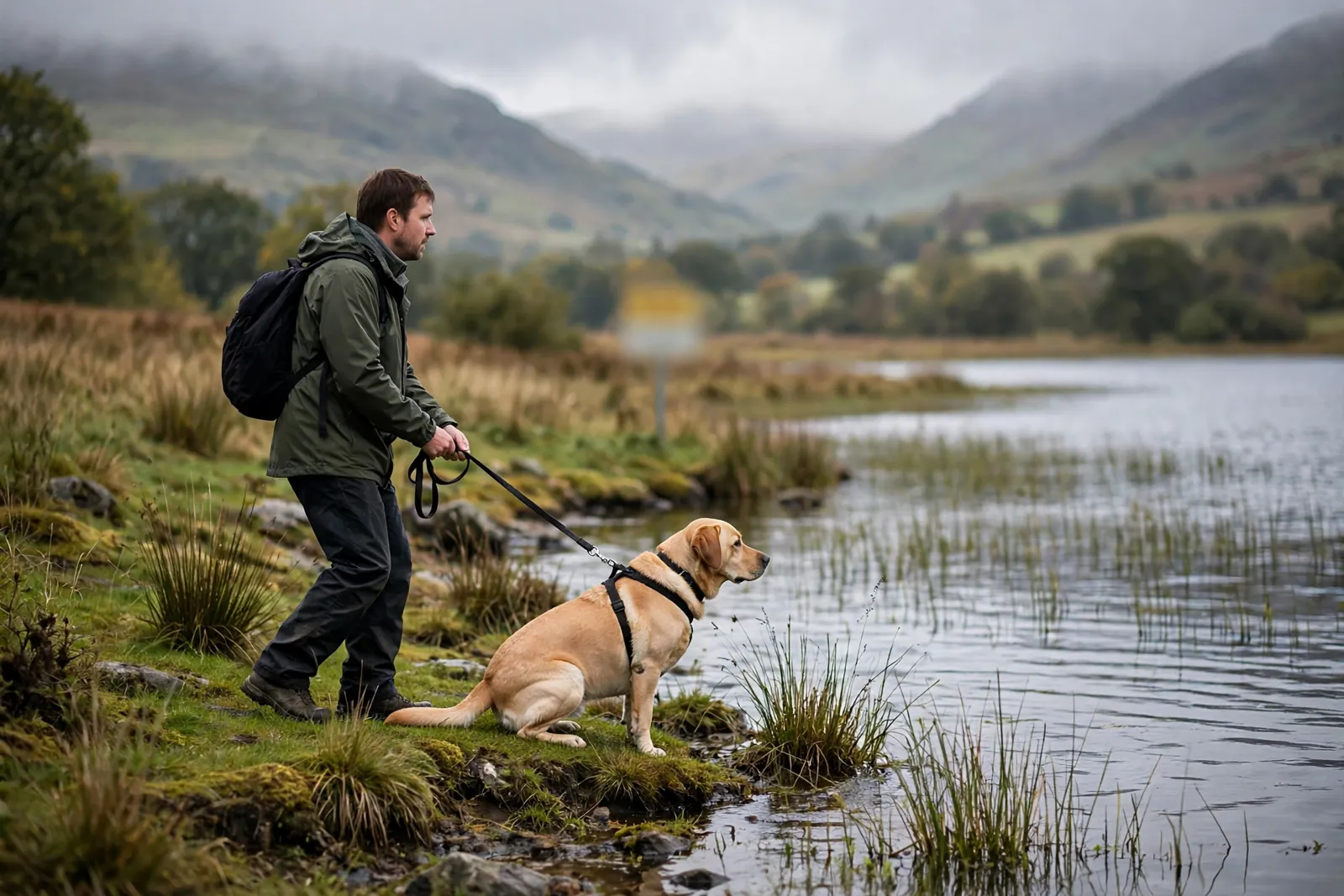
Leads and timing give you control. Keep the dog on a lead near suspect water, especially if the dog is a keen drinker or swimmer that will plunge in before you can assess the water. On a hot day, plan a proper swim or paddle in known safe water as a reward at a suitable point, rather than letting the dog drink from every ditch along the way. After any swim or drink from natural water, watch the dog for the rest of the day and the next day for vomiting, diarrhoea, lethargy, loss of appetite or unusual behaviour, and contact a vet promptly if any of these appear. Rinse the dog with clean water after swimming in natural water where possible, and do not let the dog lick a coat covered in algae or mud from a suspect pond.
There is a balance to strike here. Not every stream in Britain is dangerous, and many walkers have dogs that drink from upland becks for years without incident. The point is not to ban natural water outright, but to make it a decision rather than a default. Choose the water, rather than letting thirst choose it for you. Prefer fast-flowing, clear water over clean rock away from fields and roads, avoid the edge scum and still corners even in a good stream, and keep carried water as the main supply. If you are unsure about a particular stretch of water, keep the dog on the lead, offer carried water, and move on. A few minutes of caution cost nothing; a night at the emergency vet costs a great deal more.
Food, treats and salt on the trail
Food and water work together on a long walk, and getting the balance wrong can make hydration harder. A dog that eats a large meal immediately before a long, hot walk may feel uncomfortable, pant more and be less keen to drink steadily. A dog that eats nothing for six hours of hard walking may run low on energy and then eat too much too quickly at the end. The practical middle ground is a normal breakfast a couple of hours before the walk, small, easily digested treats during the walk, and a normal meal after the dog has cooled down and had a few small drinks. Keep treats small, soft and easy to chew, because a dog that is panting hard cannot safely bolt down large, dry biscuits. Avoid salty treats as a trail staple: salt increases thirst, and a dog that has eaten a lot of salty food will drink more without necessarily being better hydrated.
Do not be tempted to add salt, sports drinks or electrolyte powders to the dog's water without veterinary advice. Human sports drinks are formulated for people, not dogs, and they can contain sugars, sweeteners or other ingredients that are unsuitable for dogs. Electrolyte products made for dogs exist, but they are meant for specific situations, such as illness or veterinary guidance, not as a routine addition to every walk. For most healthy dogs on a long walk, plain clean water, offered regularly, is the right choice. If your vet has recommended an electrolyte product for a particular dog, follow the vet's instructions exactly, including the dilution and the situations in which to use it, and do not improvise with human products as a substitute.
Water-rich treats can help, but they are a supplement, not a replacement for drinking. Small pieces of cucumber, watermelon without seeds, or a few blueberries can be refreshing on a hot day, but they contain only a small amount of water compared with what a working dog needs, and some fruits are unsuitable for dogs in larger quantities. Keep portions tiny, introduce any new treat at home rather than on a long walk, and avoid grapes, raisins, onions, garlic, chocolate and anything sweetened with xylitol, all of which are harmful to dogs. If the dog has a sensitive stomach, stick to its usual treats on a long walk. A new treat that causes diarrhoea on a remote path creates a hydration problem far worse than the small benefit of the treat.
Think about the timing of the post-walk meal as part of hydration. A dog that has just finished a long walk is hot, panting and thirsty, and a large bowl of food straight away can cause vomiting or discomfort. Let the dog cool in the shade, offer small drinks over fifteen to thirty minutes, and wait until the breathing has settled and the dog is calm before feeding. For deep-chested breeds, which are at higher risk of bloat, this unhurried approach matters even more: small drinks, a calm rest, and then a normal meal, rather than a frantic gulp of water followed by a large feed. If the dog vomits after drinking or eating, seems bloated, paces restlessly or cannot settle, contact a vet promptly, because these can be signs of a serious problem.
Older, young and flat-faced dogs
Not every dog needs the same hydration plan, and the differences are large enough to change a route. Older dogs may drink less eagerly, tire sooner, and recover more slowly from heat, even if they were enthusiastic walkers in their prime. Their kidneys may handle water and salt differently, and joint pain can make them reluctant to walk to a water stop that is only a short distance away. For an older dog, shorten the intervals between stops, choose routes with regular shade and easy access to water, and accept that a shorter walk with more stops is a better day than a long walk that ends with a stiff, exhausted dog. Keep the dog's usual medication and any veterinary advice in mind, and ask the vet about limits before a new, longer route.
Puppies and young dogs need a different kind of care. A puppy is still learning to regulate its temperature and energy, and it may run enthusiastically until it suddenly tires, without the pacing sense of an adult dog. Short, frequent stops, a shaded route, and a willingness to carry the puppy for part of the way if it tires are all sensible. Do not push a puppy to complete a long adult route simply because the map distance looks modest. Puppies also need toilet stops more often, and a puppy that is desperate for a toilet break may be too distracted to drink properly. Build toilet breaks into the water-stop rhythm, and keep the whole outing shorter than you would for a fit adult dog of the same breed.
Flat-faced breeds, including bulldogs, pugs and French bulldogs, face a particular challenge on long walks. Their shorter airways make panting less efficient, so they heat up faster, cool down more slowly, and may struggle to drink from a deep or narrow bowl while also breathing hard. For these dogs, the margin for error is smaller: walk in cooler hours, choose flat, shaded routes, offer water very frequently in small amounts, and stop at the first sign of laboured breathing. A harness that does not press on the neck, a shallow, wide bowl, and a route with an easy exit to the car are all worth planning. If a flat-faced dog has had breathing surgery or has a known airway condition, ask the vet for specific limits before attempting a long walk at all.
Coat type changes the picture too. A thick-coated dog in summer carries its own insulation, which is a disadvantage when it needs to lose heat. A clipped or thin-coated dog may cope better with heat but lose heat faster in cold wind and rain. A dog that has recently been clipped may sunburn on exposed skin, which adds discomfort to an already demanding walk. None of these factors should stop a walk on their own, but together they should shape the plan: a thick-coated dog on a humid day needs more stops, more shade and a shorter route than the same dog on a cool, breezy day. Grooming, coat condition and even mud caked into the coat can affect how well a dog cools, so a quick groom before a long summer walk is practical preparation, not vanity.
Finally, consider the dog's fitness and recent history. A dog that has been unwell, has recently had surgery, is on new medication, or has not walked far for several weeks should not jump straight into a long, hilly route, however keen it looks at the trailhead. Build distance gradually over several weeks, watch the panting pattern on each walk, and let the dog's recovery tell you whether the next walk can be longer. A dog recovering from a stomach upset may need extra care with water and food for days afterwards, and a dog that has had diarrhoea or vomiting should not be taken on a long walk until it is fully recovered and drinking normally at home. When in doubt, a shorter walk that ends well is always better than a long walk that ends at the vet.
After the walk: cool, drink, recover
The walk does not end when you reach the car. The recovery hour is when good hydration habits pay off, and when mistakes are most likely. Start with shade and stillness: let the dog stand or lie in the shade for a few minutes before loading it into a warm car. Offer a small drink, check the paws for cuts, thorns or sore pads, and look at the breathing. If the breathing settles within a few minutes, the dog is recovering well. If it stays fast, the dog needs more shade, more time and possibly veterinary advice before you drive home. Never leave a dog in a warm car while you celebrate the walk in a pub or shop, and never assume that a short drive home will cool a dog that is still overheated.
At home, keep the same steady drinking pattern for the first hour or two. Leave fresh water available, but do not be alarmed if the dog drinks less than you expected after a good walk with regular stops: a dog that drank steadily on the route should not need to gulp at home. If the dog does drink very large amounts at home, note it and watch for vomiting or restlessness, and contact a vet if the dog seems unwell. Feed a normal meal once the dog has cooled and settled, rather than immediately on arrival, and keep the evening calm. A long walk is a big day for a dog, and a quiet evening with a comfortable bed, fresh water and a gentle toilet walk is the right ending.
Use the evening to learn for the next walk. How much water did the dog actually drink, and how much did you bring home? Where were the refill points, and were they open and usable? How long did the dog's breathing take to settle after the hardest climb, and did the rhythm of stops feel right? A few notes in a phone or a walking journal will make the next route much easier to plan, because you will be working from your dog's real pattern rather than from a generic chart. If the dog drank everything and still seemed thirsty, carry more next time or shorten the route. If you brought half the water home and the dog finished bright and keen, your plan was about right for those conditions, though a hotter day will still need more.
Watch for delayed problems overnight and the next day. A dog that seems fine at the car but vomits in the evening, has diarrhoea, refuses food or water, seems lethargic or develops a cough after swimming or drinking from natural water should be seen by a vet. Similarly, a dog that drank from a suspect stream, swam in a lake with algae warnings, or ate something unknown on the path deserves closer watching even if it seemed fine at the time. Keep the vet's number and an emergency vet's number saved in your phone before a long walk, not searched for in a panic afterwards. For any dog with a health condition, or any situation you are unsure about, check the official guidance before you travel and ask your vet what warning signs to watch for after a long walk.
Good hydration on a long walk is ultimately a habit, not a single decision. It is the bottle packed the night before, the stop taken on schedule, the refill point checked on the map, the panting watched on the climb, and the calm recovery at the end. None of these steps is difficult on its own, but together they turn a long walk from a test of endurance into a day the dog enjoys and recovers from well. Plan the water as carefully as you plan the route, trust the dog's breathing over the group's timetable, and be willing to shorten the walk when the day demands it. The best long walk is the one the dog would happily do again tomorrow.
Practical questions
Before you go
How much water should I carry for a long walk with my dog?
Start from your dog's weight, then add a margin for heat, hills and a longer route than planned. As a planning figure, allow roughly 50 to 100 millilitres per kilogram of body weight for a full day of walking, carry it in two containers where possible, and add extra on warm days. Offer small drinks at regular intervals rather than waiting until the dog is very thirsty, and keep a reserve for the walk back to the car.
How often should my dog drink on a long walk?
Offer water every 20 to 30 minutes on a long walk, and more often in heat, on steep ground or for a dog that is panting hard. Keep each drink small and calm: a few laps, a pause, and then a chance to drink again if the dog still wants it. Short, regular stops also give you a chance to check the dog's breathing, gait and interest in the walk before tiredness becomes a problem.
Is it safe for my dog to drink from a stream in the UK?
Not automatically. A clear-looking stream can carry farm run-off, road pollution, bacteria or blue-green algae, especially in slow, warm water after dry weather. Offer clean carried water first, keep the dog on a lead near suspect water, and avoid stagnant pools, scummy edges and water below fields or roads. If the dog drinks from doubtful water and later vomits, has diarrhoea or seems unwell, contact a vet promptly.
What are the first signs of dehydration in a dog on a walk?
Early signs include panting that stays fast after a rest, a dry or tacky mouth, reduced enthusiasm, lagging behind, and a loss of skin elasticity. Stop in the shade, offer small amounts of water, and do not push on to the next landmark. If panting does not settle, the gums look dry or pale, the dog vomits, staggers or cannot stand, treat it as urgent and seek veterinary help.
Should I let my dog drink a large amount of water all at once after a long walk?
No, not in one big gulp. After a long, hot walk, offer small drinks spaced a few minutes apart, let the dog cool down in the shade, and wait before feeding a full meal. Gulping a large volume quickly can cause vomiting and stomach discomfort, and it is a particular concern for deep-chested breeds. If the dog vomits repeatedly, seems bloated or cannot settle, contact a vet.