This guide is independent and contains no paid placement. If affiliate links are added later, they will be clearly marked and will not change our editorial checks.
Devizes works best as a canal day: park at Caen Hill, walk the locks flight on the towpath, loop back through the Market Place and the brewery quarter, then finish in a dog-friendly pub. The locks are the walk, the town centre is the interest, and the Kennet Valley is the longer route when you have a second day.
A canal town
Devizes sits on the Kennet and Avon Canal in the middle of Wiltshire, roughly between Bath to the west and Hungerford to the east, with the market town of Marlborough a short drive to the north-east and Salisbury further south. The town grew up where the canal meets the market square, and that pairing still shapes a visit: the water is the walk, the square is the centre of everything else, and the two are close enough that a dog can cover both in a single unhurried morning. The town has no railway station of its own, so most visitors arrive by car or by bus, with the nearest stations at Pewsey and Chippenham; check the official guidance before you travel if you are planning a bus or train connection, because rural services run less often than city ones.
The first thing to understand about Devizes is its scale. This is a working market town of around twelve thousand people, not a resort, and that is exactly why it suits a dog. The centre is compact: the Market Place, Long Street, St John's Street, Northgate Street and the wharf all sit within a few minutes' walk of each other, so a dog that tires easily can still see the town without long stretches of pavement. The streets are a mix of Georgian facades, Victorian brick and older timber, and the town's castle — a Norman foundation rebuilt in the Victorian period — stands on a rise at the edge of the centre, privately owned and not open to the public, but visible from several streets and a useful landmark when you are finding your bearings.
Arrival is easiest by car. The Caen Hill car park beside the locks is the natural starting point for the canal walk, while the car parks around the town centre serve the Market Place and the brewery quarter. Market days are Thursday and Saturday, and the centre fills up then; if your dog is nervous in crowds, arrive early or choose a weekday, when the same streets are quiet enough for a relaxed sniff. Charges, time limits and disabled bays change over time, so check the official guidance before you travel rather than trusting a parking sign remembered from a previous visit.
Water and shade deserve a mention before anything else, because Devizes in summer is warmer than its canal setting suggests. The towpath has long exposed stretches with little cover, and the Market Place is open stone with no shade at midday. Carry water for the dog even on a short walk, and plan the locks walk for the morning or late afternoon in hot weather. In winter the reverse applies: the towpath can be muddy and the lock-side ground slippery, so allow extra time and keep the dog on a lead near the water. The town's vets and pet shops are in the centre if you need supplies, and the wharf area has a cafe where you can sit outside with a dog.
What makes Devizes different from other Wiltshire towns is the canal's presence in daily life. Narrowboats are moored along the wharf, boaters work the locks by hand, and the flight at Caen Hill is a working piece of industrial heritage rather than a museum piece. A dog will meet cyclists, anglers, canoeists and lock-keepers on the towpath, so a short lead and a recall you can trust matter more here than on an open downland walk. If your dog is reactive to cyclists, keep to the grassy edge of the towpath and step aside early, because the path is narrow and passing space is limited.
Timing a visit is straightforward. A single day covers the locks, the Market Place and the brewery quarter comfortably, with the locks walk taking the largest share of the time. A weekend lets you add the Kennet Valley towpath east towards Pewsey or the climb to Roundway Hill and the Devizes White Horse, which is cut into the hillside above the town and visible from much of the canal. Spring and autumn are the best seasons: the towpath is drier than in winter, the crowds are thinner than in high summer, and the hedgerows along the canal are at their most interesting. If you are combining Devizes with a longer trip, our Bath with a dog guide covers the city at the western end of the same canal, and the two towns pair well as a two-centre break.
Caen Hill Locks: the walk
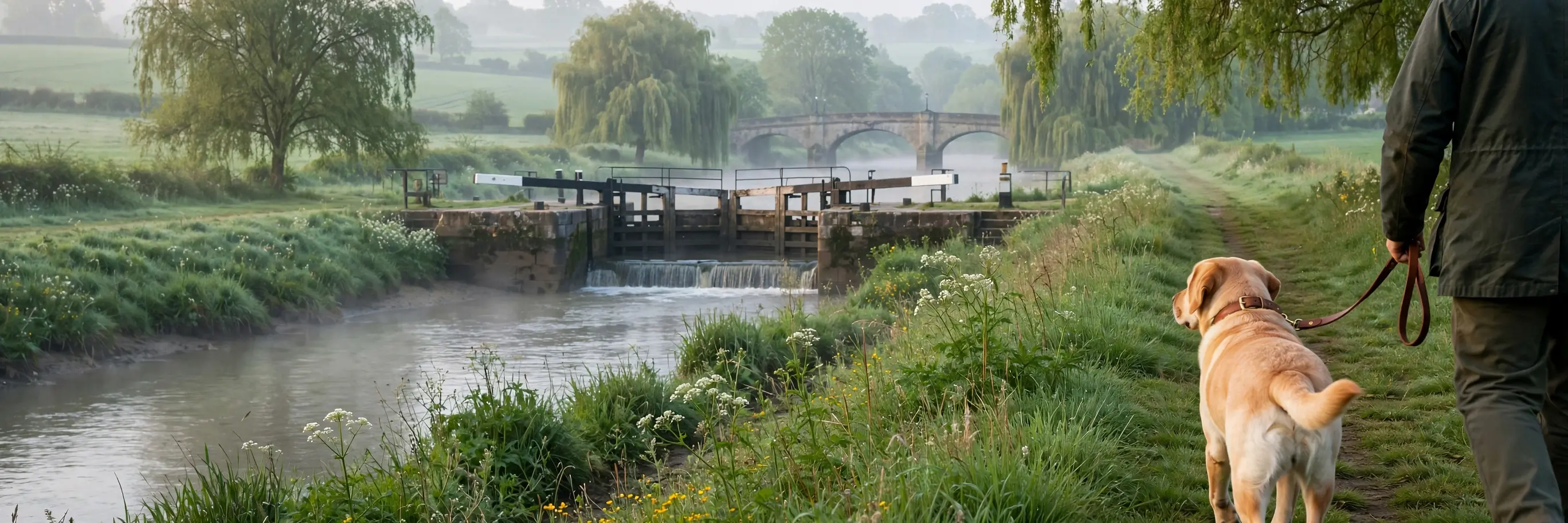
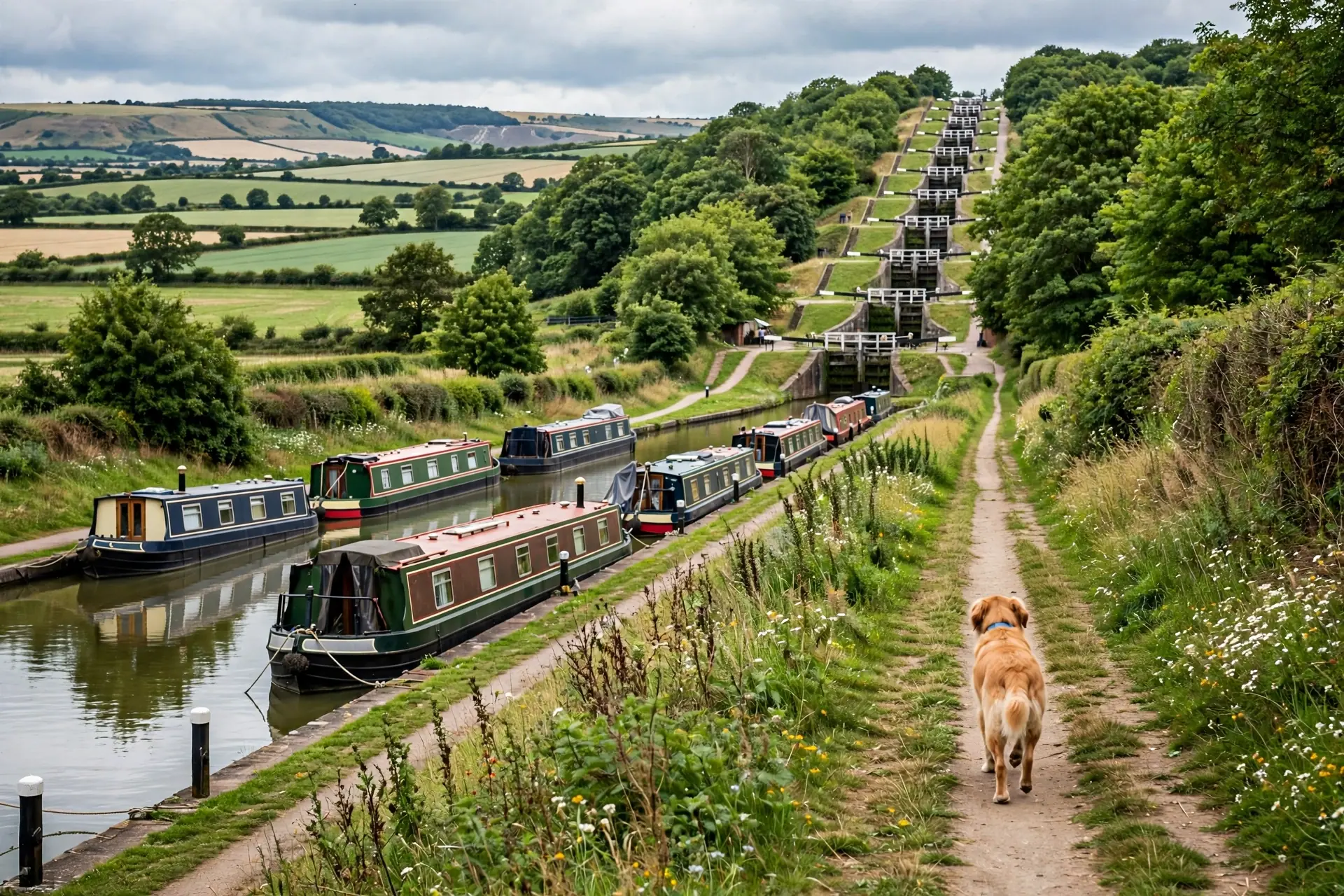
Caen Hill is the reason most dog owners come to Devizes, and it earns the attention. The flight is a staircase of 29 locks in total, with 16 of them in the main flight rising 237 feet — about 72 metres — over roughly two miles of canal, an engineering feat designed by the canal engineer John Rennie and opened in 1810 as part of the Kennet and Avon Canal. The locks are Grade II* listed, and they still work exactly as they did two centuries ago: boaters open and close heavy wooden gates by hand, water pours between chambers, and a boat climbs the hill one lock at a time. For a dog, the interest is simpler — a long towpath walk with water on one side, hedgerows on the other, and narrowboats to watch at every lock.
The standard walk starts at Devizes Wharf, at the town end of the canal, where the Kennet and Avon Canal Trust has its base and where narrowboats are moored along the bank. From the wharf, the towpath runs south and then east towards the flight, passing the lower locks one by one before reaching the long straight staircase that is the centrepiece. The full walk from the wharf to the top of the flight at Foxhangers is about two miles each way, which most dogs cover in around an hour and a half to two hours at a sniffing pace, including stops to watch boats. The towpath surface is mostly firm gravel and grass, but it narrows beside the locks and can be muddy after rain, so check the official guidance before you travel if your dog has mobility problems.
Lock etiquette is the practical heart of this walk. Keep your dog on a lead for the whole flight, not just near the gates: lock-side ground is uneven, the chambers are deep, and a dog that slips into a lock or a pound between gates is in serious trouble. Never let a dog walk across a lock gate, and keep them well clear of the ground paddles and the balance beams that boaters swing to open the gates. The side ponds — the water-filled chambers built alongside the locks to save water — look like inviting ponds to a dog, but they are part of the lock system and should be treated as out of bounds. If a boat is working through a lock, give the crew space and stand on the towpath side, away from the gate machinery, until they have finished.
The locks themselves reward a slow pace. Each lock in the flight is numbered, and the flight climbs so steeply that from the middle you can look back down the staircase and see a dozen chambers stacked below you, each with its own gates and water level. The lock-keepers' cottages and the small bridges between locks are part of the charm, and the hedgerows along the flight are good for birds in spring. At the top, Foxhangers marks the end of the flight, and the canal levels out towards Seend and then Bath. Many walkers turn back here; the return walk gives you the view down the flight in the other direction, which is the better photograph.
If your dog needs more than the flight, the towpath continues in both directions. West from the wharf, the canal runs towards Bath through Seend, Semington and Bradford-on-Avon, a route that can be walked in stages and is part of the longer Thames Path network of riverside walking in the south of England — though the Kennet and Avon is a canal towpath, not the Thames itself, and the two routes meet only in the wider network of waterside paths. East from Foxhangers, the canal runs towards Pewsey and Hungerford through open valley country. Either direction gives you a flat, easy walk with water for the dog to look at, though not necessarily to drink from: canal water is not drinking water, so carry a bottle and a bowl.
Crowds are the one thing to plan around. Caen Hill is one of the best-known sights in Wiltshire, and on summer weekends the towpath fills with walkers, cyclists and boat-watchers, particularly around the middle of the flight where the view is best. A nervous dog will do better on a weekday morning, when the flight is quiet and the boaters have the locks to themselves. Anglers fish the canal year-round, so keep your dog away from lines and hooks on the bank, and watch for the swans and ducks that nest along the pounds in spring — a dog that chases waterfowl should be on a short lead through the nesting season. The Canal and River Trust looks after the flight, and its guidance on towpath use and dog control is the reference to check before you travel.
Finally, the practicalities of the locks walk: there is no shop on the flight itself, so bring water, a bowl and waste bags, and use the bins at the wharf and the Caen Hill car park. The wharf cafe is a good place to start or finish, with outside seating where dogs are welcome. In wet weather the towpath drains slowly and the lock-side grass becomes slippery, so allow more time and wear proper footwear. In hot weather, remember that the towpath has almost no shade along the flight, and the stone and metal of the lock furniture get hot — walk early, carry water, and give the dog a rest in the shade of the hedgerows between locks.
Market Cross and the town centre
The Market Place is the centre of Devizes, and the Market Cross is its landmark: a stone cross built in 1814, Grade I listed, standing at the junction of the town's main streets with a distinctive open canopy on slender columns. It is not a church cross but a market cross, built to mark the town's trading rights, and it still works as a meeting point — "meet at the Cross" is the Devizes equivalent of meeting at the town hall steps. For a dog walk, the Market Place is an open paved square with plenty of sniffing interest: market stalls on Thursday and Saturday, shopfronts around the edges, and the Bear Hotel on one side, its timbered frontage one of the oldest in the town.
Market days are the best time to see the centre at work. The Thursday market is the larger of the two, with stalls selling food, plants, household goods and local produce, and the Saturday market is smaller but still busy. Dogs on leads are welcome in the open square, but the stalls are close together and the crowds can be thick by late morning, so an early visit suits a nervous dog better. Most stallholders are happy to see a dog, but ask before letting your dog sniff the food stalls, and keep them clear of the hot food counters. The Shambles, the covered area beside the Market Place, is worth a look for its old shopfronts, though the narrow lanes there are less comfortable for a large dog in a crowd.
From the Cross, the town centre unfolds in several directions, and a short loop covers the main streets. Long Street runs south from the Market Place and is home to the Wiltshire Museum, a red-brick building holding one of the largest collections of Bronze Age gold in England alongside its Stonehenge gallery; dogs other than assistance dogs are not normally admitted indoors, so plan for one person to wait outside with the dog, and check the official guidance before you travel for current admission rules and opening hours. St John's Street runs north from the square towards St John's Church, the oldest church in Devizes, with a Norman tower that is worth a look from the churchyard, where dogs on leads are welcome on the paths.
The castle is the town's other landmark, though it is the least accessible of the three. Devizes Castle stands on a mound at the edge of the centre, a Norman foundation that was rebuilt in Victorian times and remains a private home, so there is no public access to the grounds. You can see its towers and walls from the streets around the castle mound, and the view from the higher ground near the castle is a good orientation point, but do not plan a visit to the castle itself. The Devizes White Horse, cut into Roundway Hill above the town in the 19th century, is visible from the canal and from several streets, and it makes a useful marker when you are finding your way back to the wharf.
Shopping with a dog in Devizes follows the usual small-town pattern: most independent shops and cafes will welcome a dog on the terrace or in the doorway, but few admit dogs inside, so plan your errands around one person waiting outside. The town has a good range of independent shops along the Brittox and in the Market Place — a butcher, a baker, a bookshop and several cafes — and the pet shops in the centre stock the basics if you have run out of food or waste bags. The town's supermarkets are on the edge of the centre, and the car parks beside them are a practical place to leave a car while you walk into town with the dog.
One street deserves a special mention for dog owners: the Brittox, the narrow street running from the Market Place towards the castle, is lined with independent shops and cafes and is the prettiest shopping street in the town. It is also narrow, so keep your dog close on market days. The Corn Exchange building, which stands on the Market Place, is a reminder of the town's trading history, and the old coaching inns around the square — the Bear most famously — are the reason Devizes was once a stopping point for travellers on the London to Bath road. That coaching history is still visible in the wide doorways and the stable yards behind the inns, some of which now serve as pub gardens.
Wadworth and the brewery quarter
No account of Devizes is complete without Wadworth, the brewery that has been part of the town since 1875, when Henry Wadworth founded it on Northgate Street. The brewery's red-brick Victorian buildings still stand on Northgate Street, a short walk from the Market Place, and the smell of malt on a brewing day is one of the town's signatures. Wadworth's best-known beer is 6X, a traditional bitter that has been brewed in Devizes for generations, alongside Horizon, Henry's Original IPA and a rotating range of seasonal ales. The brewery shop sells the full range, and it is a useful stop for a gift, though the shop itself is a retail space and dogs are not normally admitted inside — check the official guidance before you travel if you are hoping to browse with your dog.
The brewery's most famous tradition is its shire horses. Wadworth still keeps a team of shire horses that deliver beer to pubs in Devizes and the surrounding villages, a practice that has continued for over a century and is now one of the few surviving horse-drawn delivery rounds in Britain. The horses are stabled at the brewery and can often be seen in the yard or on their rounds in the town, and they are a genuine delight for dog owners — though a large horse and a dog on a long lead are a combination that needs care, so keep your dog close and on a short lead if you meet the dray in the street. The horses usually work on weekday mornings, and the brewery publishes its delivery schedule in advance; check the official guidance before you travel if you want to time a visit to see them.
Brewery tours run from the Northgate Street site and are the way to see inside the working brewery, with guides explaining the brewing process from malt to cask. Tours need to be booked ahead, places are limited, and dogs are not generally admitted to the working brewery for safety reasons, so the tour is best planned as a human-only activity while the dog rests at your accommodation or waits with a companion. Availability changes through the year, and the tour programme is reduced in winter, so check the official guidance before you travel. Even without a tour, the brewery quarter is worth a walk: the Victorian brickwork, the brewery chimney, the dray yard and the old brewery offices give Northgate Street a character that no other street in Devizes has.
The brewery quarter extends beyond the brewery itself. The streets around Northgate Street and the wharf are where the town's brewing and canal histories meet: the wharf was once the point where malt and barley arrived by boat, and the pubs around the Market Place were the places where the beer was drunk. Several Wadworth pubs in the town welcome dogs, and the brewery's own pubs are the natural place to try a 6X after a walk on the locks. The Bear Hotel, the Three Crowns, the Pelican and the Vaults are all Wadworth houses or have long associations with the brewery, and each has its own character — the Bear for its history, the Vaults for its position on St John's Street, the Pelican for its garden. Ask at the bar about the dog policy before you settle in, because policies differ between the bar, the dining room and the garden, and they can change with the season.
For a dog owner, the practical point about the brewery quarter is that it is compact and walkable. From the Market Cross, Northgate Street is a five-minute walk, and the wharf is a few minutes beyond that, so a loop from the Cross to the brewery and back to the wharf covers the town's industrial heritage in under an hour with a dog. The brewery buildings are best seen in the morning light, when the brickwork glows and the dray horses are often out, and the wharf is at its liveliest in the afternoon, when narrowboats are moving and the cafe is busy. If you are staying overnight, the brewery quarter is also where several of the town's smaller places to stay are located, and the walk from a Northgate Street guesthouse to the canal is one of the shortest in town.
The Kennet valley beyond the town
Devizes sits at the edge of the Kennet Valley, and the valley is where the longer walks begin. The River Kennet runs to the east of the town, and the Kennet and Avon Canal follows the valley floor, so the towpath east from Foxhangers is a valley walk as much as a canal walk: open water meadows, hedgerows, small woods and the occasional village. The towpath from Devizes to Pewsey is about seven miles, a half-day walk that suits a fit dog, and the village of Pewsey has a pub and a station for the return journey. Further east, the canal runs through Hungerford and on towards Newbury, and the whole towpath from Devizes to Bath in the other direction is about 21 miles — a two-day walk with an overnight stop, or a series of day walks using the stations at Pewsey, Bradford-on-Avon and Bath.
Roundway Hill is the other valley walk, and it is the one that gives you the view. The hill rises to the north-east of Devizes, and the path up from the town climbs through fields to the Devizes White Horse, the chalk figure cut into the hillside in the 19th century, and to Oliver's Castle, the Iron Age hillfort on the summit where a Civil War battle was fought in 1643. The climb is steady rather than steep, and the reward is a wide view across the Vale of Pewsey and back towards the town and the canal. The hill is open downland with sheep grazing, so keep your dog on a lead through the fields, and watch for ground-nesting birds in spring — the skylarks on Roundway Hill are one of the valley's best sounds, and they nest on the ground where a loose dog can disturb them.
Drews Pond Wood, on the southern edge of the town, is the local woodland walk and the best option on a hot day, when the towpath is exposed and the Market Place is baking. The wood is a community woodland with surfaced paths through oak and ash, and it is popular with local dog walkers, so it is a good place to let a dog socialise — though the usual rules apply: keep your dog under control, pick up after them, and watch for other dogs on the narrow paths. The wood is also the closest thing Devizes has to a shaded walk, and it is worth knowing about if you are staying in the town for more than a day.
Avebury is the valley's famous neighbour, about eight miles north of Devizes, and it makes a natural second day. The stone circle at Avebury is older and larger than Stonehenge, and the National Trust land around it is open to dogs on leads, with wide grassland for walking and a village pub for lunch. The drive from Devizes to Avebury takes about twenty minutes, and the route passes through the Pewsey Vale villages that are worth a stop in their own right. Cherhill White Horse, another chalk figure on the hillside above the A4, is visible on the way, and the village of Cherhill has a pub that welcomes dogs. Check the official guidance before you travel for the current access rules at Avebury, because the stone circle and the manor house have different policies.
Wildlife is part of the valley walk, and it shapes the rules. The Kennet Valley is a stronghold for water voles, kingfishers and otters, and the canal pounds and the river are their habitat. A dog that swims in the canal or the river can disturb them, and the water is not always clean, so keep your dog out of the water except at designated spots. The valley's fields are grazed by sheep for much of the year, and lambing season in spring means dogs must be on leads on farmland — a legal requirement as well as a courtesy. The hedgerows along the canal are good for butterflies and birds, and the towpath is a good place to spot a heron standing motionless in a pound at dawn.
Seasonal change is more visible in the valley than in the town. In spring the towpath hedgerows are full of blossom and the water meadows are green; in summer the valley is warm and the canal is busy with boats; in autumn the woods turn and the towpath is quieter; in winter the valley can flood, and the towpath near the river can be under water after heavy rain. Check the official guidance before you travel in winter, because the towpath east of Devizes is low-lying and can be impassable after a wet week. The Canal and River Trust publishes notices about towpath closures, and local knowledge — asking at the wharf cafe or in a pub — is often the fastest way to find out whether a stretch is walkable.
Pubs and stays
Devizes is a good town for a pub lunch with a dog, because the town's pubs are old, numerous and mostly dog-friendly in at least part of the building. The Bear Hotel on the Market Place is the most famous: a coaching inn with a history going back to the 16th century, timber-framed and Grade II* listed, with a bar that welcomes dogs and a garden behind the building. The Three Crowns on Maryport Street and the Pelican on the same street are both Wadworth houses with a local feel, and the Vaults on St John's Street is a small, traditional pub that is popular with walkers coming off the canal. The Lamb on St John's Street and the Black Horse on the Bath Road are further options, and the Southgate Inn on the southern edge of the town has a garden that suits a dog on a warm day. Policies differ from pub to pub and can change with the season, so ask at the bar before you order, and check the official guidance before you travel if a particular pub is the reason for your visit.
The practical rules for a pub with a dog are the same in Devizes as anywhere, but they matter more in small, busy pubs. Keep your dog on a lead and under the table or beside your chair, bring a mat or blanket for them to lie on, and order at the bar rather than expecting table service in the dog-friendly area. Most pubs in Devizes allow dogs in the bar and the garden but not in the dining room, so if you want a full meal, check whether the bar serves food or whether you need to eat in the garden. Water bowls are usually available if you ask, and the staff in the town's pubs are used to dogs — a polite dog that settles quickly will be welcome back, while a dog that barks at every arrival will not.
Staying overnight in Devizes with a dog is straightforward, though the choice is smaller than in Bath or Salisbury. The Bear Hotel takes dogs in selected rooms, and the town has several bed and breakfasts and guesthouses that welcome dogs, particularly around the Market Place and Northgate Street. Canal-side cottages and self-catering properties near the wharf are the best option for a longer stay, because they give you a private garden and direct access to the towpath — though you should confirm the garden is secure before you book, and ask about the dog charge, which is usually a flat fee per stay rather than per night. Our dog-friendly holiday parks guide explains the questions to ask about boundaries, fees and cancellation before you pay, and the same checklist works for a cottage or a guesthouse in Devizes.
Booking ahead matters in Devizes more than the town's size suggests. The town has a limited number of dog-friendly rooms, and the canal festival and the market-town events in summer fill them quickly. The locks and the brewery tours also draw visitors, and the weekend before a bank holiday can be fully booked weeks in advance. If you are planning a summer weekend, book the accommodation first and the walk second, and confirm the dog policy in writing — "dogs welcome" can mean one small dog in a ground-floor room, not two large dogs anywhere in the building. Ask about the check-in time, the parking arrangement and the nearest evening toilet walk, because the streets around the Market Place are busy at night and the towpath is unlit.
For a longer break, Devizes works well as a base. Bath is about an hour's drive to the west, Salisbury a similar distance to the south, and Avebury and the Pewsey Vale are on the doorstep, so a week in Devizes can cover the canal, the valley, the stone circles and two cathedral cities without moving accommodation. The town's supermarkets and pet shops make self-catering easy, and the wharf cafe and the Market Place pubs give you somewhere to eat without cooking every night. The one thing to plan for is the return journey: the towpath walks are linear, so arrange a lift or a bus back, or walk out and back, rather than assuming a taxi will be waiting at the far end of the flight.
Practical questions
Before you go
Can dogs walk the Caen Hill Locks towpath?
Yes. The towpath alongside the Kennet and Avon Canal at Caen Hill is open to walkers with dogs, and it is the most popular dog walk in Devizes. Keep your dog on a lead near the locks, lock gates and moored narrowboats, and keep them out of the water beside moving lock gates. The towpath surface is mostly firm but can be muddy after rain, so check the official guidance before you travel if your dog struggles on slippery ground.
Is the Market Cross area dog-friendly?
The Market Place around the Market Cross is an open public space where dogs on leads are welcome, and the Thursday and Saturday markets make a good sniffing circuit. Most shops will not admit dogs inside, so plan on one person waiting outside with the dog, and check the official guidance before you travel if you want to visit a particular shop or the museum.
Can I take my dog on a Wadworth brewery tour?
The Wadworth brewery on Northgate Street runs guided tours, but dogs are not generally admitted to the working brewery itself. Tours should be booked ahead, and availability changes through the year, so check the official guidance before you travel. You can still see the brewery buildings and the shire horses from the street, and several Wadworth pubs in the town welcome dogs.
Where can I park in Devizes with a dog?
The most useful car park for a dog walk is at Caen Hill, beside the locks, which puts you straight onto the towpath. There are also car parks around the town centre, including near the Market Place and the wharf, but spaces fill up on market days. Charges and time limits change, so check the official guidance before you travel, and leave your dog in a cool, ventilated car only for a very short stop, never on a warm day.
How far is Devizes from Bath on the canal towpath?
Following the Kennet and Avon Canal towpath west from Devizes to Bath is roughly 21 miles, which is a full day's walk for a fit dog and walker, or a two-day trip with an overnight stop. Most visitors walk the short Devizes stretch to Caen Hill and Foxhangers instead, which is about two miles one way from the wharf. For the longer route, plan water and rest stops in advance and check the official guidance before you travel.
Are dogs allowed in the Wiltshire Museum?
The Wiltshire Museum on Long Street is an indoor museum, and dogs other than assistance dogs are not normally admitted. It is still worth a visit while one person waits outside with the dog, and the museum's Bronze Age gold and Stonehenge collections are the reason to go. Check the official guidance before you travel, because admission rules and opening hours change seasonally.