This guide is independent and contains no paid placement. If affiliate links are added later, they will be clearly marked and will not change our editorial checks.
The Thames Path is the gentlest of Britain's National Trails for dogs: 184 miles of mostly flat riverside walking from Seven Springs in the Cotswolds to the Thames Barrier. Walk it in sections, keep your dog on a lead near locks, weirs, livestock and busy town stretches, and check flood warnings before you travel — winter water can close riverside sections entirely.
The Thames Path at a glance: 184 miles, source to sea
The Thames Path is a 184-mile National Trail that follows the River Thames from its source in the Cotswolds to the Thames Barrier at Woolwich in London. It is the only National Trail that traces a single river from beginning to end, and that simple idea is what makes it so appealing for dog walkers: the route is almost entirely flat, the navigation is obvious because the river is always beside you, and every day ends somewhere with a pub, a bus stop or a train station. For a dog, the trade-off is equally clear. There is water everywhere, which is both the joy of the walk and the thing that needs managing — locks, weirs, swans, mud and floodwater all sit within a few metres of the path.
It helps to think of the trail in three broad stretches. The upper river, from the source at Seven Springs near Cirencester to Oxford, is about 65 miles of quiet water meadows, small stone bridges and villages that feel a long way from anywhere. The middle river, from Oxford to the outskirts of London, is roughly 100 miles of market towns, locks, riverside pubs and commuter-belt towpaths. The London stretch, from Hampton Court through Richmond and central London to the Thames Barrier, is about 20 miles of city walking where the river is wide, the path is paved and the crowds are the main challenge. Most dog walkers never attempt the whole thing in one go. The trail is at its best as a series of day walks or two- or three-day breaks, and this guide is written for that approach first, with the end-to-end plan second.
The walking itself is undemanding by National Trail standards. There are no serious climbs, no exposed ridges and no long stretches without a way out. What the trail demands instead is attention to ground conditions: the towpath can be a firm gravel track one day and a churned, ankle-deep mud bath the next, and the difference is usually one wet week. A dog that copes happily with 12 to 15 miles a day on flat ground will do well here, while a dog that struggles with distance will still enjoy the many short, scenic sections around Oxford, Henley, Windsor and Richmond. Before you commit to any stretch, check the official guidance before you travel, because diversions and closures are common and the river changes its mind often.
Towpaths, riverbanks and where your dog can walk
The Thames Path is a waymarked National Trail, which means the route follows public rights of way along the riverbank and towpath for almost its whole length. Dogs are welcome on the trail, but the right to walk is not the same as the right to let a dog run free. Much of the route crosses farmland, and the standard rules apply: keep your dog on a lead around livestock, keep to the marked path, and close gates behind you. The riverbank is a working landscape as well as a leisure one, and sheep and cattle graze the water meadows along the upper river in particular. A dog that chases livestock is not only breaking the law in the worst cases, it is also at risk from a protective cow or a startled flock.
Off-lead walking is realistic on some stretches, especially the quieter water meadows above Oxford and the open riverside grass at places like Port Meadow, but it is a judgement call every time. The path runs close to the water for mile after mile, and a dog that cannot be recalled reliably away from ducks, swans and other dogs should stay on a lead or a long line. Swans are famously territorial in the breeding season, and a dog that splashes towards a nesting swan can be injured badly. Geese and moorhens are less dangerous but just as distracting. In the towns, the path narrows, cyclists appear, and the lead goes back on as a matter of course.
There are also short stretches where the trail leaves the riverbank altogether and follows lanes or field paths, usually to get around a private stretch of bank or a lock island. Waymarking is generally good — look for the acorn symbol of the National Trails — but a paper map or an offline mapping app is worth carrying, because riverside diversions are rarely obvious at first glance. If a section is signed as closed, respect it: the closure is usually there because the bank has slipped or the path is under water, and neither is a safe place for a dog.
Locks, bridges and ferries: crossing the river with a dog
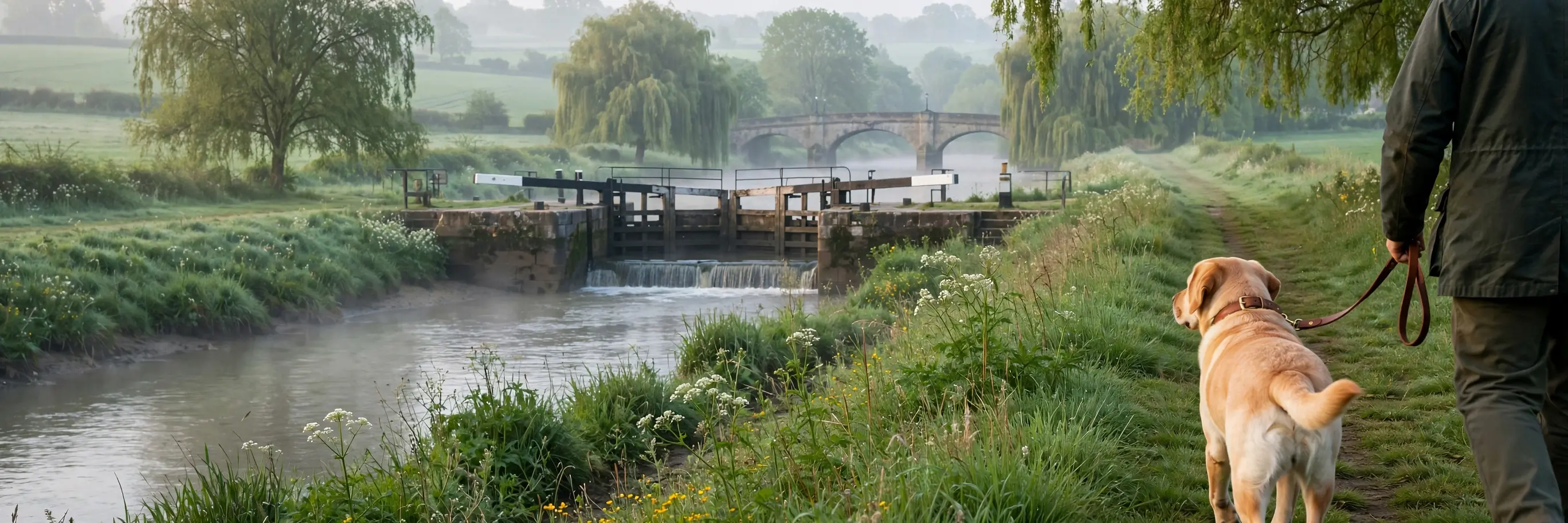
The Thames has more than forty locks between Lechlade and Teddington, and they shape the rhythm of the walk. Most locks have a footbridge across the tail of the lock, which is how the path crosses from one bank to the other, and the routine quickly becomes familiar: reach the lock, cross the bridge, check the dog, carry on. Keep your dog on a short lead at every lock. The lockside is a confined space with deep water, moving gates, slippery stone and moored boats, and a dog that darts across a narrow bridge can cause a genuine accident. Never let a dog walk across lock gates or balance on the narrow beams, and never let one swim in the lock chamber itself, where the water level can change without warning.
Weirs are the other feature to respect. The Thames Path passes many weirs, and the water below them is fast, deep and full of hidden currents. Even a strong swimming dog should be kept out of weir pools, and the lead stays on until you are well past the fast water. The same caution applies at the handful of places where the path runs along the top of a flood bank with the river on one side and a steep drop on the other. It looks harmless on a calm day, but a dog that slips on wet grass can end up in the river before you can react.
Bridges give the walk its structure. The upper river has small stone and wooden footbridges that suit dogs well, while the middle river has grander crossings at towns like Wallingford, Henley and Marlow. Ferries still operate at a few points on the Thames, and these are worth checking in advance: timetables are seasonal, some run only at weekends, and a few are suspended in winter or in high water. If a ferry is not running, the detour to the nearest bridge can add several miles, so build that into your plan rather than discovering it at the riverbank. As always, check the official guidance before you travel, because ferry times and lock opening hours change with the season.
London and the countryside: two very different walks
The Thames Path contains two walks in one, and dogs experience them very differently. Above Oxford and through the middle river, the trail is a country walk: water meadows, willow trees, kingfishers, village greens and riverside pubs with gardens. The path surface varies from firm gravel to grass, the crowds are thin outside the honeypot towns, and a dog can settle into a steady, sniffing rhythm for hours. This is the Thames Path most people picture, and it is the part that suits most dogs best.
London is a different proposition. From Hampton Court down through Richmond, Kew, Putney and central London to the Barrier, the path is paved, busy and full of distractions: joggers, cyclists, children, other dogs, food smells and sudden crowds at every bridge and pier. The river is wider and faster here, the bank is a wall rather than a meadow, and there is very little shade on a hot day. That does not make it a bad walk — the views of the city from the riverside are superb, and dogs that are comfortable in busy places often love the constant stimulation — but it is not a walk to attempt with a nervous, reactive or very young dog on a Saturday afternoon. Go early in the morning, or on a weekday, and keep the lead short through the busiest stretches.
The practical difference is that in London you are never far from a station, a cafe or a vet, while on the upper river you may be several miles from the nearest road. Plan accordingly: in the countryside, carry water and a first-aid kit and know where the nearest exit point is; in London, plan around crowds and heat, and use the frequent transport links to shorten the day if your dog is tiring. Both halves are worth walking, but they ask different things of you and your dog.
Flood season and muddy banks: when to go
The Thames floods, and the path floods with it. Winter is the season to treat with the most respect. After heavy rain, the river spreads across the water meadows, the towpath disappears under brown water, and sections of the trail can be closed for weeks. The Environment Agency publishes flood warnings for the Thames, and these are worth checking before every winter walk, not just before a multi-day trip. A path that was passable last weekend can be impassable this one, and walking a flooded towpath with a dog is not a minor inconvenience — the water is cold, fast and dirty, and the hidden edges of the path are a real hazard.
Spring and autumn are the sweet spots for most dog walkers. April to June brings firm paths, long evenings and the river at its prettiest, though the ground can still be soft after a wet winter. September and October offer cooler walking, autumn colour and quieter towns, and the flood risk is lower than in midwinter. Summer has the best weather but the hardest conditions for dogs: the towpath is exposed for long stretches, shade is patchy, and the river water warms up enough for blue-green algae to appear in slow, still reaches. Never let a dog drink from or swim in water that looks green, blue-green or scummy, and check the official guidance before you travel if algae warnings are in force.
Mud deserves its own warning. The Thames Path is famously muddy after rain, and clay-based stretches around the upper river can stay slick for days. Dogs pick up mud between their toes, and a long day on wet clay can sore a dog's paws. Pack a towel and a small bottle of clean water for paws, check pads at lunchtime, and consider dog boots if your dog is prone to sore feet. A muddy dog is a happy dog, but a dog with cracked, sore pads is a dog that should not be walking another fifteen miles tomorrow.
Planning a multi-day Thames Path walk with a dog
Walking the whole Thames Path takes most people between twelve and fifteen days at 12 to 15 miles a day, and the flat terrain makes that pace realistic for a fit dog. That said, very few people walk it end to end, and there is no obligation to. The trail is designed to be walked in sections, and the public transport links are good enough that you can walk it as a series of long weekends over a season. A sensible first multi-day trip is three days: Lechlade to Oxford, or Oxford to Henley, or Henley to Windsor, each of which gives you a taste of the river without the logistics of a fortnight away.
Accommodation is the main planning constraint. Dog-friendly pubs with rooms, bed and breakfasts and small hotels cluster in the towns, and they book up early in summer, especially in Henley, Marlow and Windsor. Book well ahead and confirm the dog policy in writing: some places accept one dog but not two, some charge a nightly fee, and some restrict dogs to certain rooms. Campsites are fewer along the river, and wild camping is not an option. Baggage transfer services operate on the Thames Path, and they are worth the cost on a multi-day walk — a dog that has to carry nothing and a walker with a light day pack will both enjoy the walk far more than a team loaded down with three days of kit.
Transport is the other half of the plan. Trains serve the major towns along the river, including Oxford, Reading, Henley, Windsor and London, and buses connect many of the smaller villages, though services can be infrequent. Work out your exit points before you start each day: if your dog goes lame or the weather turns, you want to know where the nearest station or bus stop is rather than guessing. The same forward planning applies to food and water, because the upper river in particular has long stretches with no shops. Our guide to the Coast to Coast walk with a dog covers the same multi-day logistics in harder country, and the principles — short first days, booked accommodation, a known exit at every stage — transfer directly to the Thames.
Towns, pubs and places to stop
The Thames Path is a town-to-town walk, and the towns are half the pleasure. Lechlade is a good starting point for the upper river, with its riverside setting and easy access from the Cotswolds. Oxford needs little introduction: the path passes through Port Meadow, one of the great open spaces of the walk, where dogs can stretch their legs on open grass before the trail threads past the colleges and out towards Abingdon. Abingdon, Wallingford and Henley each offer a riverside pub, a market square and a bridge worth photographing, and the path between them is some of the prettiest on the whole river.
Further downstream, Marlow and Windsor are the highlights of the middle river. Marlow has a handsome suspension bridge and a cluster of dog-friendly pubs and cafes, while Windsor pairs the castle with the Long Walk and the open meadows of the Great Park nearby. Richmond is the gateway to the London stretch, with its deer park, riverside pubs and a towpath that feels like a village high street. Greenwich and the approach to the Thames Barrier offer a fitting end to the walk, with the river at its widest and the city skyline opening out. In every town, the same rule applies: check the pub's dog policy before you arrive, because gardens and terraces are usually welcoming while dining rooms often are not.
Stopping well matters as much as walking well. A dog that has walked fifteen miles needs water, food and a proper rest, not another hour in a crowded beer garden. Choose lunch stops with shade and space, give the dog a proper break rather than a hurried biscuit, and save the longer pub visit for the end of the day. If your dog is tired, a short riverside sit with a view is better than pushing on to the next town for a marginally better pub. The river will still be there tomorrow.
Kit, water and heat: the riverside essentials
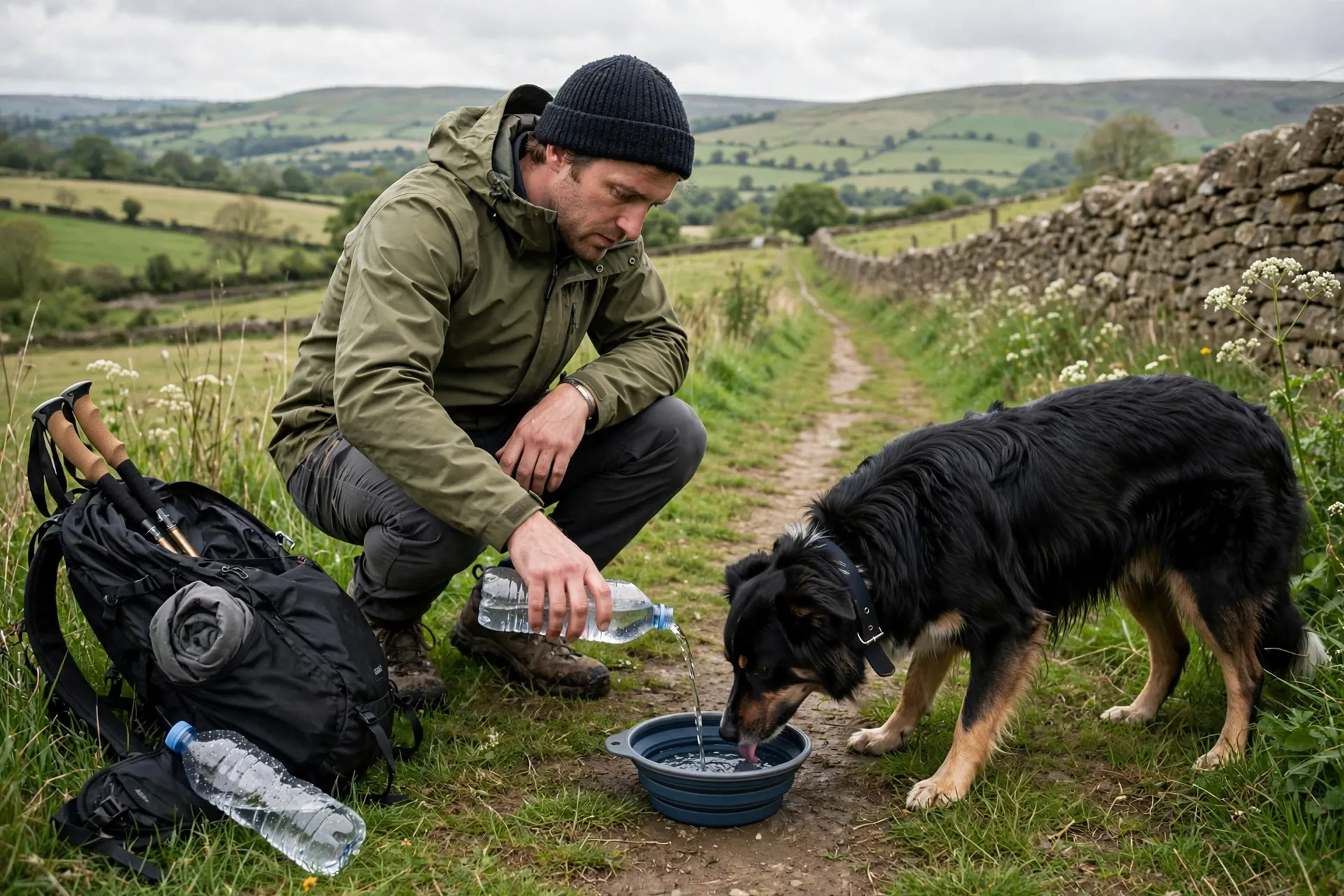
The Thames Path is a flat walk, but it is not a kit-free walk. Water is the first priority. Although the river is always beside you, river water is not drinking water for a dog: it carries bacteria, agricultural run-off and, in warm weather, algae. Carry clean water and a collapsible bowl, and plan refill points at pubs, taps and shops along the way. Our guide to dog hydration on long walks explains how much water a dog needs by weight and temperature, and the Thames in summer is exactly the scenario it is written for — long, exposed miles with few shady stops.
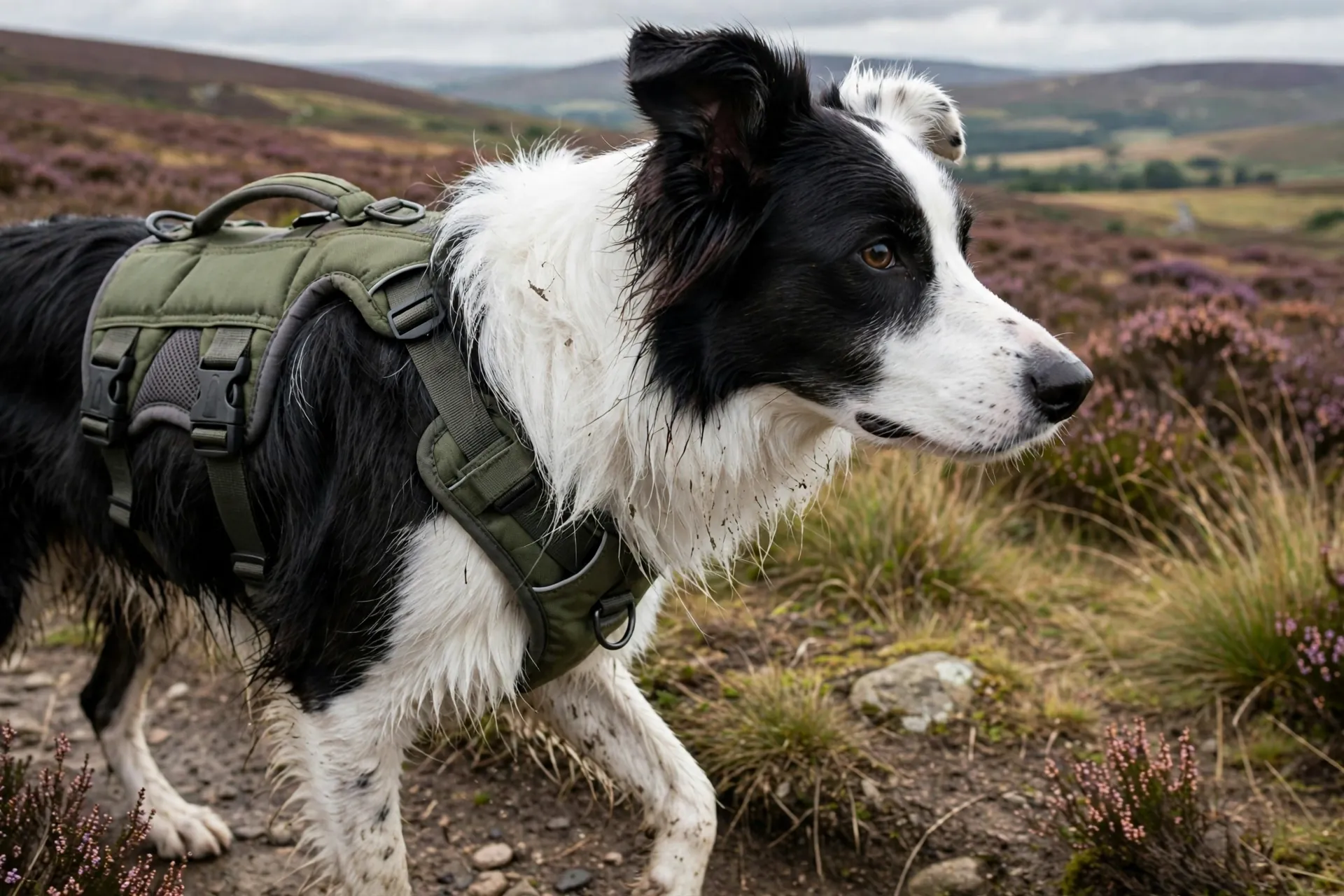
A well-fitted harness is the second essential. A collar is fine for a short town walk, but a dog that pulls on a lead for fifteen miles a day will be more comfortable and safer in a harness that spreads the load across the chest. Our dog hiking harness guide covers fitting, sizing and the rubbing points that only show up after a few miles. Add a lead you can hold comfortably for hours, a long line for the open meadows, poo bags (and a way to carry them — there are long stretches with no bins), a towel, a basic first-aid kit with tick removers and paw balm, and a lightweight drying coat for the end of the day.
Heat is the hidden risk on this trail. The towpath is exposed for long stretches, the sun reflects off the water, and there is less shade than the tree-lined name suggests. Walk early in summer, rest in the middle of the day, and watch for the signs of overheating: heavy panting, drooling, a bright red tongue and a dog that slows down or seeks shade. If your dog shows any of these, stop, cool them with water on the belly and paws, and get to shade or a vet. The river is not a safe way to cool a dog down unless you know the spot is safe for swimming, the current is gentle and the water is clean — and on much of the Thames, at least one of those conditions fails.
Wildlife, livestock and river hazards
The Thames is one of the most wildlife-rich rivers in Britain, and your dog will notice before you do. Kingfishers flash along the bank, herons stand motionless in the shallows, and otters have returned to stretches of the upper river. The animals that matter most for a dog walker, though, are the ones that can hurt a dog: swans in the breeding season, territorial geese, and the cattle and sheep that graze the water meadows. A swan can break a small dog's bones with a wing strike, and a dog that swims towards a swan's nest is in real danger. Keep the dog on a lead wherever swans are nesting, and keep it out of the water entirely in those spots.
Livestock is the everyday hazard. Cattle with calves are protective and unpredictable, and a dog off the lead among cattle is a recipe for a chase that ends badly for the dog, the cattle or both. Sheep are less dangerous but easily stressed, and the law is clear that a dog worrying livestock can be shot by the farmer. The practical rule is simple: lead on through every field with animals in it, even if the animals are at the far end, and keep the dog close when you pass through a gate. Ticks are common in the long grass and woodland edges along the river, so check your dog thoroughly at the end of each day, paying attention to ears, armpits and groin.
Water hazards complete the list. The Thames looks gentle, but it is a deep, powerful river with strong currents in places, especially below weirs and around bridge piers. Only let a dog swim where you can see a safe entry and exit, the current is slow, and there are no boats. Never let a dog swim near locks, weirs, marinas or moored boats, and never let one drink from stagnant backwaters. If your dog does swim, rinse them afterwards and check for cuts, because riverbanks hide broken glass and sharp stones. Check the official guidance before you travel if there are pollution or algae warnings on your stretch.
If you only walk one section: the best day walks
If you only have a day, choose a section that gives you the river at its best without the logistics of a multi-day trip. Oxford to Abingdon is a classic: about ten miles through Port Meadow and along the river to a market town with good pubs, and an easy bus or train ride back. Henley to Marlow is a similar distance and arguably the prettiest single day on the trail, with riverside meadows, a suspension bridge and two towns that welcome dogs. Windsor to Staines is shorter and flatter, and it suits older dogs or a first long walk, with the castle, the river and plenty of places to stop.
For a London day, Richmond to Hampton Court is hard to beat: a level riverside walk past the deer park, with wide grass, pubs and a palace at the end, and trains at both ends. Greenwich to the Thames Barrier is the other end of the story, a flat walk through maritime London that ends at the great silver gates of the Barrier itself. Both London walks are best done early in the day or on a weekday, when the towpath is quieter and the dog can walk at its own pace.
For the quietest day of all, try the upper river between Lechlade and Newbridge. This is the Thames before it becomes a highway: narrow, winding, lined with willows, and often empty except for the odd heron. The path is grassy and can be muddy, the villages are small, and the sense of space is out of all proportion to the distance from London. It is the stretch that turns people who came for a day walk into people who start planning the whole 184 miles — and for a dog, it is about as good as riverside walking gets.
Practical questions
Before you go
Can dogs walk the whole Thames Path?
Yes. Dogs are welcome along the whole 184-mile National Trail, from Seven Springs to the Thames Barrier. Most walkers do it in sections over several trips, at 12 to 15 miles a day. Keep your dog on a lead near locks, weirs, livestock and busy town stretches, and check flood warnings before you travel, because winter water can close riverside sections.
Is the Thames Path safe for dogs in flood season?
It can be risky. Winter flooding can put the towpath under water for weeks, and flooded paths hide the edges of the bank and carry fast, cold, dirty water. Check the Environment Agency flood warnings before you travel, respect signed closures, and choose a different walk or a different season if your stretch is affected.
Do dogs have to be on a lead on the Thames Path?
There is no blanket lead rule for the whole trail, but dogs must be on a lead around livestock, and a lead is strongly advised near locks, weirs, swans, busy town stretches and anywhere the path runs close to deep water. Off-lead walking is realistic on quiet open meadows only if your dog has a reliable recall away from waterfowl and other dogs.
Can dogs swim in the Thames?
Only in carefully chosen spots. The river is deep and fast in places, and swimming is unsafe near locks, weirs, marinas, moored boats and bridge piers. Never let a dog swim in water that looks green or scummy, which can indicate blue-green algae. If your dog does swim, rinse them afterwards and check for cuts from glass or sharp stones.
Where can I stay with a dog on the Thames Path?
Dog-friendly pubs with rooms, bed and breakfasts and small hotels cluster in the towns along the river, including Oxford, Henley, Marlow, Windsor and Richmond. Book well ahead in summer and confirm the dog policy in writing, including any nightly fee, the number of dogs allowed and whether dogs are welcome in the bar or only in certain rooms.
What is the best time of year to walk the Thames Path with a dog?
Late spring and early autumn are usually best. April to June and September to October offer firm paths, cooler temperatures and quieter towns. Summer brings heat and algae risks on exposed stretches, while winter brings flooding and deep mud. Whatever the season, check the official guidance before you travel.