This guide is independent and contains no paid placement. It is general information, not veterinary advice. If your dog is seriously ill or injured, phone a veterinary practice straight away. Fees, services and out-of-hours arrangements change, so check the latest official information before you rely on any detail here.
Save two numbers before you travel: the nearest practice to your accommodation and its out-of-hours provider. In an emergency, keep your dog safe and warm, phone that provider before you set off, take your dog's microchip number, medication list and insurance details, and ask for a cost estimate. Afterwards, get the clinical notes sent to your home vet and keep every invoice for insurance.
Prepare before you go
An emergency vet on holiday is much easier to find at two in the afternoon, a week before you travel, than at two in the morning from a dark holiday cottage. A short preparation routine removes most of the panic from the worst case, costs nothing, and takes about fifteen minutes. Do it for every trip, even a single overnight stay, because out-of-hours cover in rural Britain often sits in a different town from the practice you would use in the daytime.
Start by finding the veterinary practice closest to where you will actually sleep, not just the nearest town on the map. The Royal College of Veterinary Surgeons runs the RCVS Find a Vet search, which lists registered practices and is a sensible first check for any unfamiliar area — confirm opening hours and the address on the practice's own website afterwards. Then look specifically for the out-of-hours arrangement. Many smaller practices share night and weekend cover through a dedicated emergency provider, sometimes based at a larger hospital some distance away. Save both numbers in your phone under clear names such as “Holiday vet — daytime” and “Holiday vet — nights”, and save the out-of-hours address as a pinned location so navigation works even when you are flustered.
Next, check what your own arrangements already cover. Note your home practice's phone number and its out-of-hours line too, because a familiar team can sometimes advise by phone and can receive records afterwards. If you use an online triage or advice service — Vet Help Direct is one example offered in general terms by some practices and insurers to help owners judge urgency — check before you travel whether you have access, how it works and what it does not do. These services can help you decide how urgent a problem sounds; they cannot examine your dog or replace a local practice. Rules and services change, so check the latest official information from the provider and your insurer rather than relying on an old screenshot.
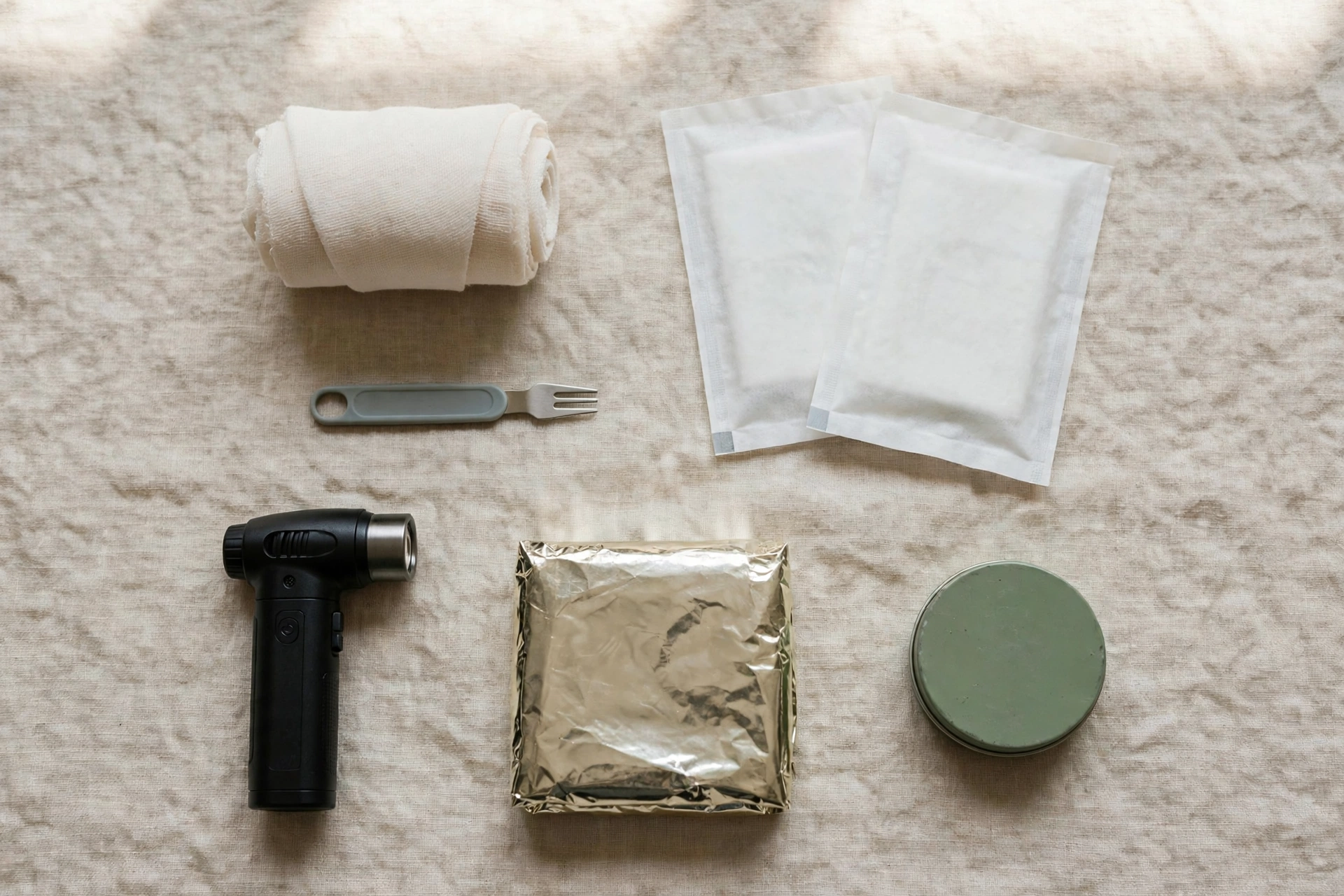
Finally, tell someone where the information lives. If you travel with another adult, both phones should hold the vet numbers, the accommodation postcode and your insurance details. If your dog will spend any time with a pet sitter, walker or family member during the trip, give them the same details in writing, plus your home vet's number and permission arrangements for emergency treatment. A well-stocked kit helps with minor problems too — our guide to a dog travel first-aid kit covers what to pack for cuts, stings and upset stomachs that do not need an emergency visit.
What counts as an emergency
Owners worry about wasting a vet's time, but emergency teams would far rather triage a false alarm by phone than meet a dog who arrived hours too late. The safest rule is simple: if you are frightened by what you are seeing, phone and describe it. That said, some signs should always be treated as urgent, day or night, wherever you are in the UK.
Treat these as emergencies: difficulty breathing, noisy or laboured breathing, or blue or very pale gums; collapse, unresponsiveness, or repeated seizures, or a single seizure lasting more than a couple of minutes; heavy bleeding that does not slow with firm pressure, or a deep wound; a swollen, hard abdomen, repeated retching without bringing anything up, or obvious severe pain — all possible signs of gastric dilatation-volvulus, often called bloat, which is life-threatening, especially in large, deep-chested breeds; inability to pass urine, particularly in male dogs; suspected poisoning, including eating chocolate, xylitol (also labelled birch sugar), grapes, raisins, human medication, slug pellets or antifreeze; eye injuries or a suddenly cloudy, bulging or very painful eye; difficulty giving birth; heatstroke signs such as heavy panting, drooling, staggering or collapse on a warm day; and any road traffic accident, even if your dog walks away apparently unhurt, because internal injuries are easy to miss.
Other problems are urgent but may safely wait for a morning appointment if the emergency team agrees after triage: a single episode of vomiting or diarrhoea in an otherwise bright dog, a mild limp without a wound, a broken nail that has stopped bleeding, or a small graze. The distinction depends on your dog's age, size, existing conditions and how quickly things are changing. Puppies, elderly dogs, pregnant dogs and dogs with long-term conditions such as diabetes, heart disease or epilepsy deteriorate faster, so lower your threshold for calling. When in doubt, describe exactly what you see, when it started and what has changed, and let the clinical team decide the timescale. Never give human painkillers unless a vet specifically tells you to: some common household medicines are dangerous for dogs.
While you wait for advice, keep first aid simple and safe. Apply firm pressure to bleeding with a clean cloth, keep a dog with breathing difficulty calm and cool and avoid covering its head, move a seizuring dog away from hazards without restraining it or putting hands near its mouth, and keep a dog with suspected heatstroke in shade while you phone — the vet will advise on cooling. For anything more involved, follow our dog travel first-aid guidance only as a bridge to professional help, not as a substitute for it.
Call first: what to say
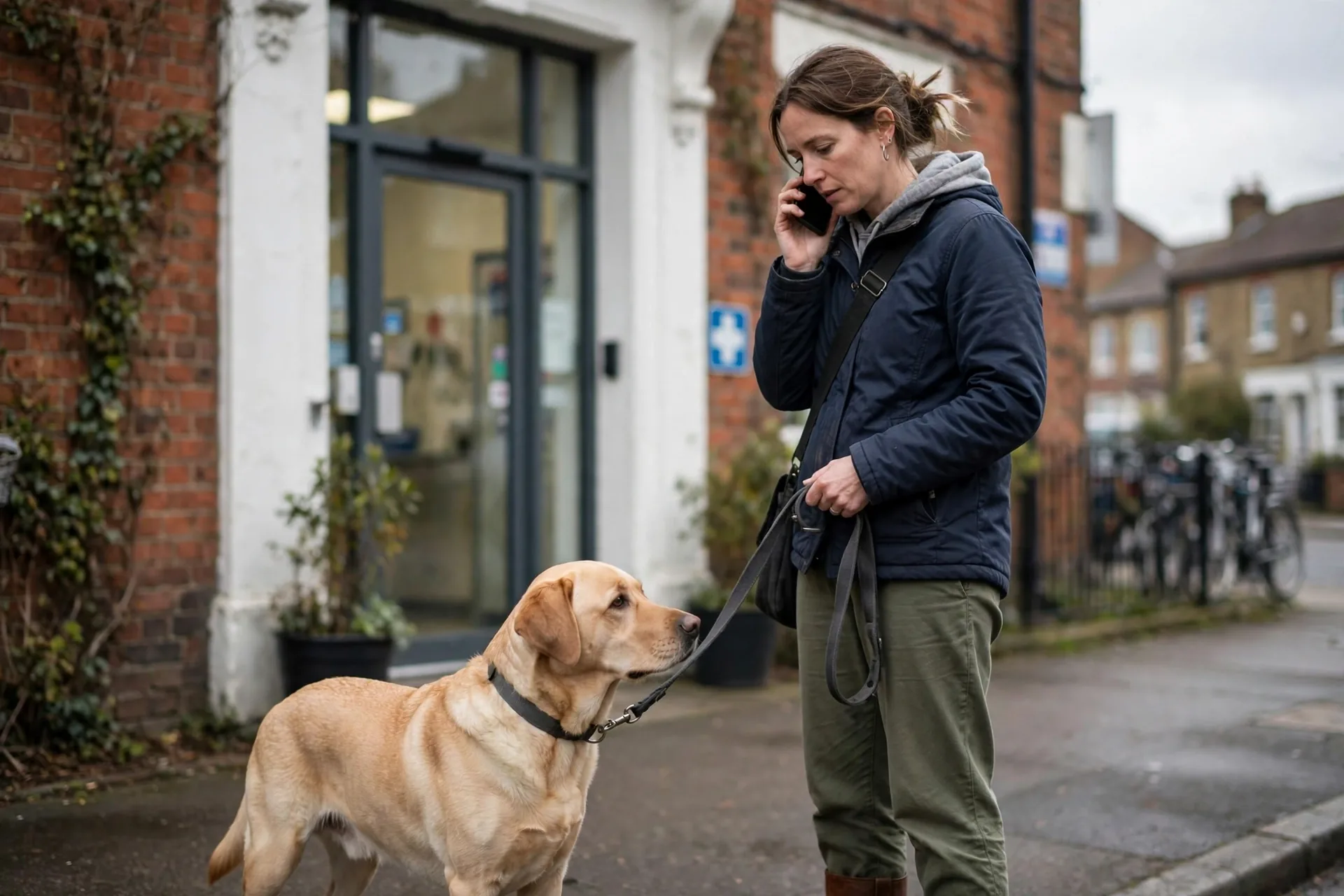
Unless your dog needs immediate life-saving action on the spot, phone before you drive. Calling ahead does three things that matter. First, it confirms you are going to the right building: out-of-hours cover may have moved to a hospital site across town, and arriving at a locked daytime practice wastes critical minutes. Second, it lets the team prepare — an operating theatre, oxygen or extra staff can be ready when you arrive. Third, it gives you triage advice for the journey itself, including whether to feed, cool, warm or simply leave your dog as still as possible.
Have your facts ready before you dial, ideally written on your phone notes. Say who you are and that you are on holiday in the area, then give your dog's breed, approximate age and weight, what happened and when, the signs you can see now, any long-term conditions, current medication and when the last dose was given, and your estimated arrival time. If your dog may have eaten something toxic, name the product and, if you can, the amount and the time — take a photo of the packaging or bring it with you. If breathing is laboured, bleeding is heavy, your dog has collapsed or seizures are continuing, say that in your first sentence so the call handler can prioritise correctly.
Ask three practical questions before you hang up: where exactly should you park and which entrance should you use; roughly what will the initial consultation and stabilisation cost, and how is payment taken; and is there anything you should or should not do on the way. Write down the name of the person you spoke to and the time of the call. If the first practice cannot help, ask them directly who is covering emergencies locally that night rather than starting a fresh search — practices know the rota. If a dog goes missing during the confusion of an accident or a dash to the vet, our guide to a lost dog on holiday in the UK sets out the fastest reporting steps to run in parallel.
Records and microchip details to carry
An unfamiliar vet treating your dog at midnight has no history to work from unless you bring it. A small, well-organised set of details — on your phone and, ideally, as a paper copy in the car — speeds up safe treatment and reduces the risk of a drug clash or a duplicated vaccination. Assemble it before you travel and update it whenever medication changes.
Carry your dog's microchip number and the database it is registered with, and check before the trip that your mobile number on that database is current; since microchipping is a legal requirement for most dogs in the UK, an up-to-date record is also how a lost or injured dog gets back to you. Carry a vaccination record or a photo of it, a list of current medication with doses and timing, known allergies and drug reactions, and a short summary of long-term conditions, recent operations and recent blood results if your home vet can provide one. Many home practices will happily email a clinical summary for travel if you ask a few days ahead. Add your home vet's name, address and phone number, your own photo ID and payment method, and your insurance policy number and insurer's claims helpline if you are insured.
Keep the set proportionate. You do not need a full lifetime history file; one or two phone photos of the latest prescription label, vaccination card and insurance schedule answer most questions an emergency team will ask. Store copies in a shared album or note that your travel companion can open if you are the one driving or upset. If your dog has a complex condition, travels on controlled medication, or has recently had surgery, ask your home vet whether a short “if seen elsewhere” note would help, and carry any medication in its original labelled packaging rather than loose in a bag — labels prove the drug, dose and prescribing practice at a glance.
Getting your dog there safely
How you move an ill or injured dog matters almost as much as how quickly. A dog in pain may snap at a familiar hand, a dog with a suspected spinal or limb injury can be harmed by being lifted carelessly, and a loose, distressed dog in a moving car endangers everyone. Take thirty seconds to plan the lift and the journey before you start the engine.
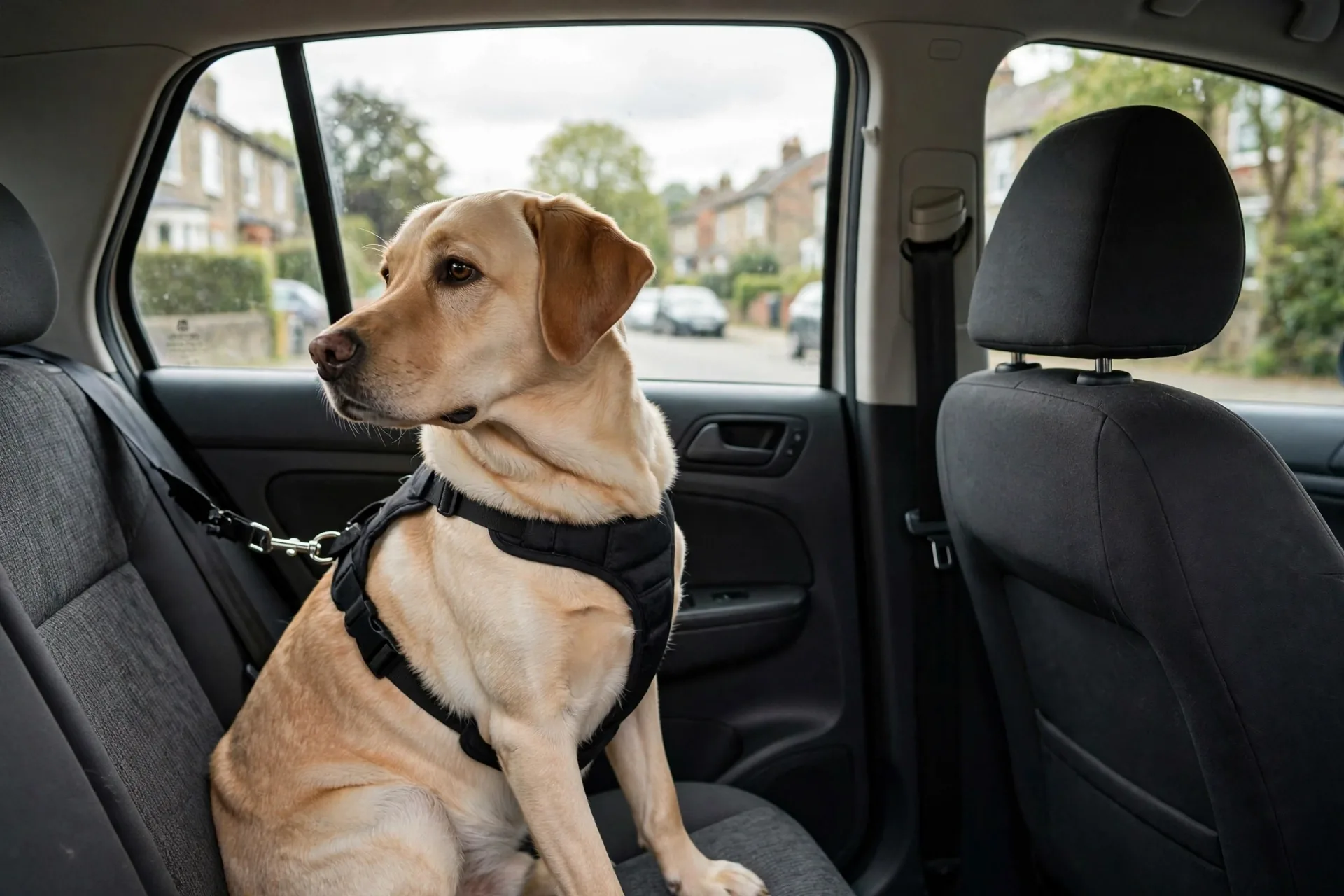
For a dog that can walk, use a lead and, if the dog is in pain or frightened, a muzzle or a makeshift scarf muzzle — unless breathing is difficult, the dog is vomiting, or the injury is to the mouth or jaw. For a dog that cannot walk, slide a blanket, towel or flat board underneath and lift with help, keeping the body as level as possible; small dogs can travel in a secure carrier or a sturdy box lined with bedding. Support the abdomen gently if bloat is suspected and do not press on a swollen stomach. Note the legal and safety basics for the drive itself: a dog should be suitably restrained so it cannot distract the driver, as our guide to driving with a dog and UK law explains — in an emergency that means a harness, guard, crate or a second person holding the dog securely in the back, not a dog loose on a lap.
Ask a second person to come if at all possible: one to drive, one to watch the dog, keep it warm or cool as advised, apply pressure to bleeding, and phone the practice with updates. If you must drive alone, secure the dog, set navigation before moving, and use hands-free if you need to call. Keep the car at a comfortable temperature, drive smoothly rather than simply fast — harsh braking helps nobody — and on arrival, go in and tell reception you are there before struggling to lift the dog out alone; staff will often come to the car with a trolley or stretcher. If your dog is too large or injured to move safely at all, say so on the first call: the practice can advise whether a vet or nurse can come out, or help you find an animal ambulance or taxi that will carry an injured dog.
Costs, out-of-hours fees and insurance
Emergency care out of hours costs more than a routine daytime appointment, and it helps to know why rather than meet the bill as a shock. Night and weekend cover is commonly provided by a separately staffed team or a dedicated provider, with a vet and nurses on site all night whether or not any patient arrives. That staffing is reflected in the consultation fee before any test or treatment begins.
As a very general guide only, an out-of-hours emergency consultation in the UK can commonly fall in a broad range of around £150 to £300 or more, depending on region, provider and the time of night. Stabilisation, blood tests, X-rays, ultrasound, intravenous fluids, hospitalisation and surgery are charged on top, and a serious case involving overnight care or an operation can run into several thousand pounds. Daytime emergency appointments at a regular practice usually cost less than the overnight equivalent, but still more than a booked routine visit. These figures are indicative ranges, not quotes: prices vary widely and change over time, so ask for an estimate on the phone, ask again before tests or treatment start, and check the latest fees with the practice treating your dog. A good emergency team expects cost questions and will talk through options, priorities and what can safely wait until your home vet opens.
Payment is usually expected at the time of treatment, so carry a payment method with a sufficient limit and tell the practice early if cost is a problem — it is far easier to plan staged treatment or discuss payment options before costs escalate than afterwards. If you are insured, most UK pet policies cover emergency treatment at a different UK practice while you are away within the UK, but excesses, limits, exclusions and notification deadlines differ, so check your wording as soon as you reasonably can. Some insurers will deal directly with the practice; many require you to pay and claim back. Either way, paperwork is everything: keep every itemised invoice, receipt and clinical note, ask for copies before you leave, and have the treating practice complete and stamp the vet section of the claim form or provide the clinical history your insurer needs. Photograph documents on the spot in case paper copies go astray on the journey home, and note the dates, times and names involved. If you have no insurance, keep the same paperwork anyway — your home vet will need the clinical notes even if no claim follows.
Afterwards: follow-up with your home vet
Good emergency care does not end at discharge. The handover back to your usual vet is where medication changes, recheck dates and warning signs are most often lost — especially when you still have a drive home, a holiday to cut short or continue, and a tired dog in the back of the car. Build the follow-up into the same day, not the following week.
Before you leave the emergency practice, confirm five things in writing: the diagnosis or, if it is not yet certain, the working explanation; every medicine dispensed, with dose, timing and when to stop; what feeding, exercise and wound care are needed for the next few days; the specific signs that should trigger another urgent visit; and when and where the next check should happen. Ask the practice to send the full clinical notes, test results and any images directly to your home vet, and take your own copies as well — emails go astray, and a photo of the discharge sheet on your phone has saved many a confused Monday-morning phone call. If your dog was hospitalised or had surgery, ask what the emergency team would want checked at the first recheck and whether stitches, drains or a bandage need attention on particular dates.
Phone your home vet on the next working day, even if your dog seems fine. Explain what happened, confirm the notes have arrived, book any recheck, and reconcile medication: emergency treatment sometimes pauses, substitutes or adds to long-term drugs, and only your home vet holds the full picture. If you cut the holiday short, plan the journey home around the discharge advice — more frequent stops, no long walks at services, and medication timed before you set off if the vet advises it. If you continue the holiday, adjust honestly: shorter, lead-only walks, no swimming with wounds or stitches, and the saved vet numbers kept in place for the new, quieter plan. Finally, while the experience is fresh, update your travel file — microchip check done, records photographed, numbers saved — so the preparation you did under pressure becomes the routine that protects the next trip as well.
Practical questions
Before you go
How do I find an emergency vet near where I am staying in the UK?
Start with the numbers you saved before the trip: your destination practice and its out-of-hours provider. If you have not saved them, search the RCVS Find a Vet service for practices near your postcode, then phone the nearest practice — its voicemail or website should name the out-of-hours provider covering that night. You can also try an online triage service such as Vet Help Direct in general terms for guidance on urgency, but always check the latest official information and phone a local practice for a definite answer.
Should I call the vet before setting off?
Yes, almost always. Calling ahead lets the team triage your dog, prepare equipment, tell you the correct entrance and warn you about any diversion to a different out-of-hours site. Give your dog's breed, age and weight, what happened and when, current symptoms, any medication and your estimated arrival time. If your dog is struggling to breathe, bleeding heavily, collapsed or having repeated seizures, say so immediately and follow the team's instructions on what to do while you travel.
How much does an out-of-hours emergency vet cost in the UK?
Out-of-hours care costs more than a daytime appointment because a separate team is staffed overnight. As a general guide, an emergency consultation alone can commonly fall in a broad range of around £150 to £300 or more before treatment, tests or hospitalisation, and total bills for serious cases can run into thousands of pounds. Prices vary widely by region and provider, so ask for an estimate on the phone and again before treatment starts, and check the latest fees with the practice directly.
Will my pet insurance cover emergency treatment on holiday within the UK?
Most UK pet insurance policies cover emergency treatment with a different UK practice while you are on holiday in the UK, but terms, excesses and exclusions vary, and some insurers need to be notified promptly. Keep every invoice, clinical note and receipt, ask the treating practice to complete their part of the claim form, and check your policy wording as soon as you can. If you have no insurance, tell the practice early so costs and payment options can be discussed before treatment escalates.
What information should I take to the emergency vet?
Take your dog's microchip number, vaccination record, a list of current medication and doses, known allergies or long-term conditions, your home vet's name and phone number, your insurance details if you have them, and photo ID and a payment method for yourself. A phone photo of recent prescriptions and your home vet's summary is often enough. Having these ready saves phone calls at midnight and helps the emergency team treat your dog safely and quickly.