This guide is independent and contains no paid placement. It summarises the Highway Code for general information, not legal advice. If affiliate links are added later, they will be clearly marked.
Under Highway Code Rule 57, dogs in cars must be suitably restrained — with a seat-belt harness, pet carrier, crate or dog guard — so they cannot distract the driver or be injured in a sudden stop. Never let a dog ride on your lap, and always check the latest official Highway Code wording before you travel.
What Rule 57 actually says
Rule 57 of the Highway Code deals with animals in vehicles. In plain terms, when in a vehicle you must make sure dogs or other animals are suitably restrained so they cannot distract you while you are driving, or injure you, themselves or other passengers if you stop quickly. The rule adds that a seat-belt harness, pet carrier, dog cage or dog guard are ways of restraining animals in cars. That short paragraph is the foundation of dog car law in the UK, and it is worth reading the current wording on the official government website before a long trip, because the Highway Code is updated from time to time.
Two points in the wording matter more than most social media summaries suggest. First, the test is functional, not decorative: the question is whether the restraint actually stops distraction and reduces injury risk, not whether you bought something labelled for car travel. A loose lead looped around a headrest, a harness clipped to a collar rather than to the harness itself, or a guard that rattles free on a bend does not meet the spirit of the rule. Second, the rule covers the whole journey, not just motorways. A five-minute drive to a local walk is still a drive, with junctions, cyclists, sudden stops and the same physics as a longer trip.
It also helps to understand what the Highway Code is — and is not. Many of its rules reflect legal requirements, while others are guidance whose breach can still be relied on in court as evidence when deciding whether driving fell below the required standard. Rule 57 is usually discussed in that second, practical sense: an unrestrained dog that climbs into the footwell, blocks a mirror or startles a driver is strong evidence of a problem if something goes wrong. The sensible approach is simple: treat Rule 57 as mandatory in everyday planning, restrain your dog properly every time, and do not look for loopholes based on journey length, road type or how well behaved your dog normally is.
What counts as suitably restrained
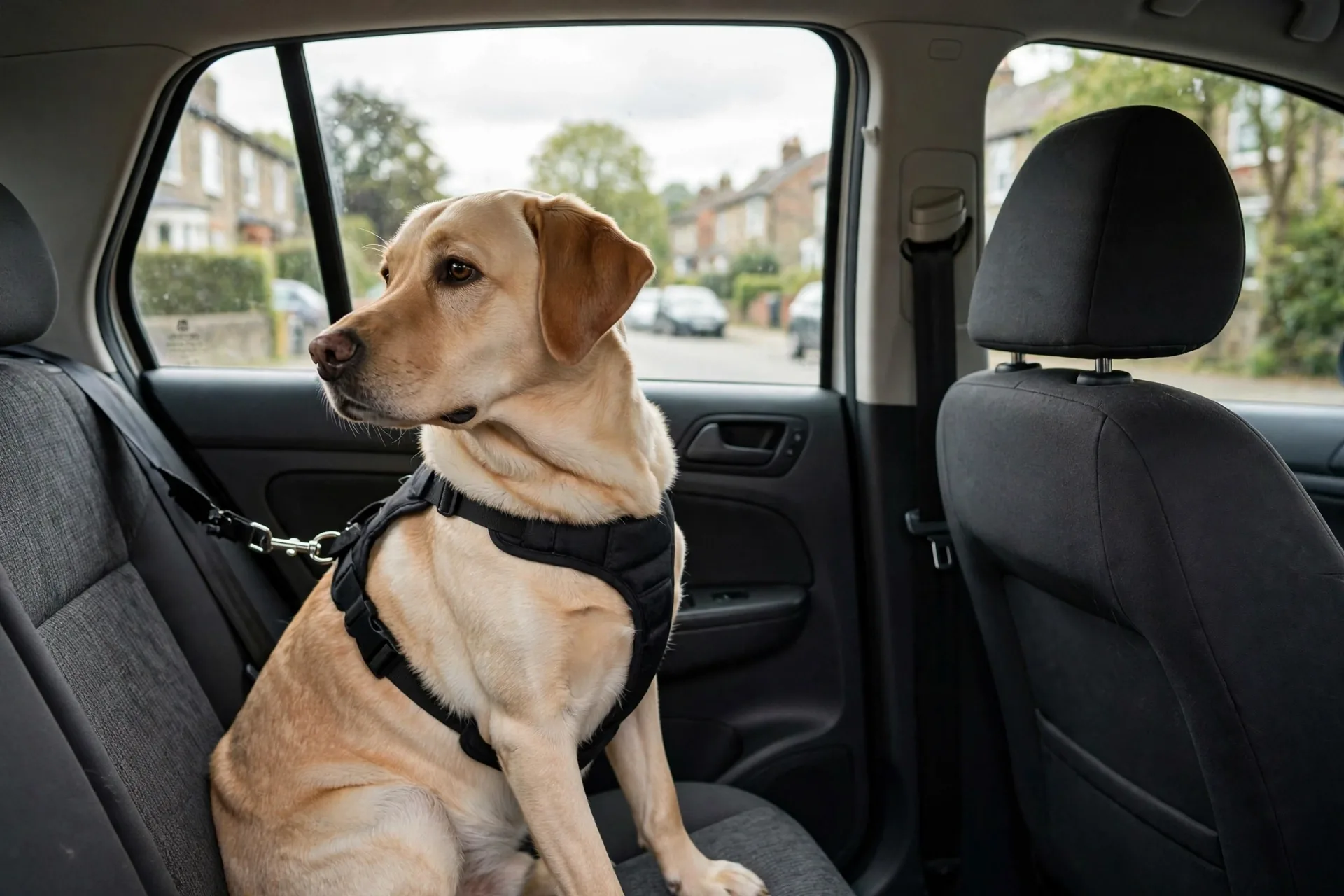
The Highway Code names four broad approaches, and each can work well when it is fitted and used correctly. A seat-belt harness fits around the dog’s chest and shoulders and attaches to a seat-belt buckle or a tested tether point, allowing the dog to sit and lie down but not to roam, jump into the front or be thrown forward. A pet carrier suits small dogs that already relax in a carrier at home, provided the carrier itself is secured so it cannot slide or tip. A crate, often called a dog cage in the Code, works in a boot or on a folded-seat load area when it is the right size and is strapped or wedged so it cannot move. A dog guard separates the boot from the passenger cabin in an estate, hatchback or SUV, keeping the dog in the load area — ideally combined with a divider, tailgate guard or tether for larger or more active dogs.
What does not count is equally important. Holding a dog, letting a passenger hold an unrestrained dog on their lap, letting a dog put its head fully out of a moving window, or allowing a dog to ride in the front footwell all leave the animal free to distract and vulnerable in a sudden stop. Window guards and a small, safe gap for ventilation are different from a dog leaning out into traffic, where grit, insects and passing vehicles create obvious risks. Likewise, a normal walking lead is not a car restraint: it can tighten around a neck, tangle around seats and controls, and offers no controlled deceleration in a collision.
Fit is the detail that decides whether a good product is actually suitable. A harness should be snug without rubbing behind the front legs, with the attachment at the back rather than the neck. A crate should allow the dog to stand, turn and lie flat, without so much spare space that the dog is thrown across it. A guard should be specific to, or properly adjustable for, your car model, with no gaps at the sides that a determined small dog could squeeze through. If you are preparing for a holiday rather than a local drive, our dog travel packing checklist helps you gather the harness, spare lead, water and cleanup kit in one place instead of discovering a missing clip at the service station.
Penalties, points and insurance
Online articles often quote a single fine as if there were a fixed ticket labelled “unrestrained dog”. The real position is less tidy. If police consider that an unrestrained dog has contributed to driving without due care and attention, or to a more serious offence, the penalty depends on the offence, the facts and whether the case is dealt with by a fixed penalty or in court. Careless driving can carry points and a substantial — in court, potentially unlimited — fine, and dangerous driving carries far more serious consequences including disqualification and imprisonment in the worst cases. Do not rely on a neat round figure copied from another website; check the latest official guidance on driving offences and penalties before you rely on any amount.
Insurance is the second, quieter risk. Motor insurers expect policyholders to drive with reasonable care and to comply with the policy conditions. If a claim follows a collision in which an unrestrained dog distracted the driver, obstructed the controls or made injuries worse, an insurer may investigate whether the policy terms were breached and whether payment should be reduced or refused. That decision will depend on your individual policy wording and the evidence, so no guide can promise a single outcome. What you can control is straightforward: restrain the dog, keep it away from pedals, gear lever, mirrors and airbags, and keep a clear record of the equipment you use if you ever need to describe it.
There are related rules to keep in mind alongside Rule 57. You must not drive without proper control of the vehicle, you must have a full view of the road ahead, and you must not use a hand-held phone to film your dog, adjust a camera or check a route while driving. If your dog needs attention, find a safe place to stop, apply the handbrake and switch off the engine before you deal with a tangled harness or spilled water. That habit — stop first, then sort the dog — removes most of the legal risk in one move.
Harness, crate, guard or boot gate
Choose the system that matches your dog, your car and the journeys you actually make, rather than the system that photographs best. A harness and seat-belt attachment is usually the simplest starting point for a medium or large dog that travels on the rear seat. It is inexpensive, folds away, and lets the dog see you, which helps many dogs settle. Protect the seat with a washable cover, route the tether so it cannot wrap around a leg, and give the dog enough length to lie down but not enough to reach the front cabin or fall into the footwell if you brake.
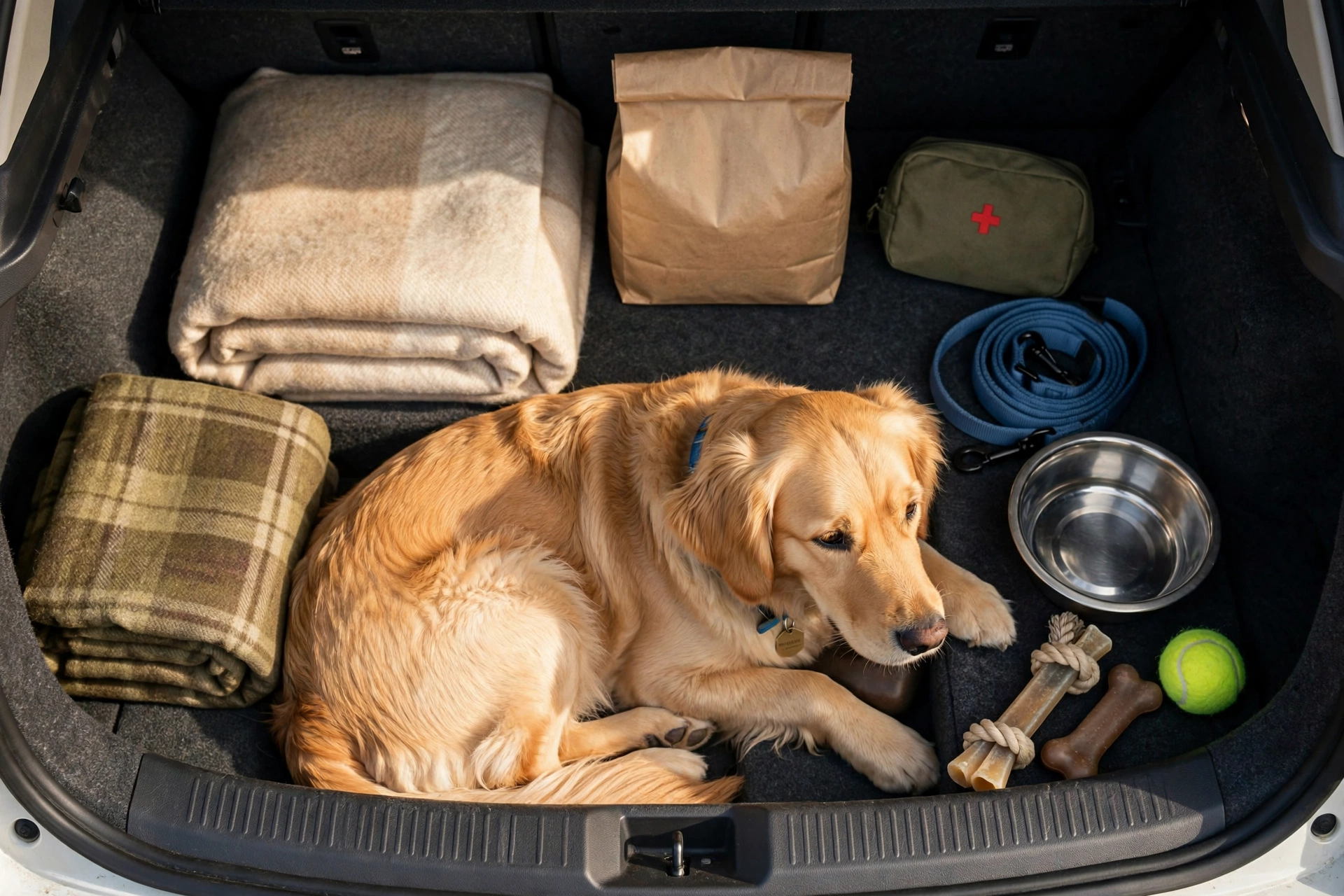
A secured crate is often the calmest option for a dog that is already crate-trained, for a dog that gets over-stimulated by passing traffic, and for multi-dog households where separate spaces prevent squabbles. Measure the boot carefully, including the slope of the rear seats and the height under a parcel shelf or tailgate, and secure the crate against sliding and tipping. Add non-slip bedding, but avoid piling in loose toys and chews that become projectiles or choking hazards on the move. If the crate is only used for car journeys and the dog resists it at home, build the association gradually with short, stationary sessions and treats in the parked car before any real drive.
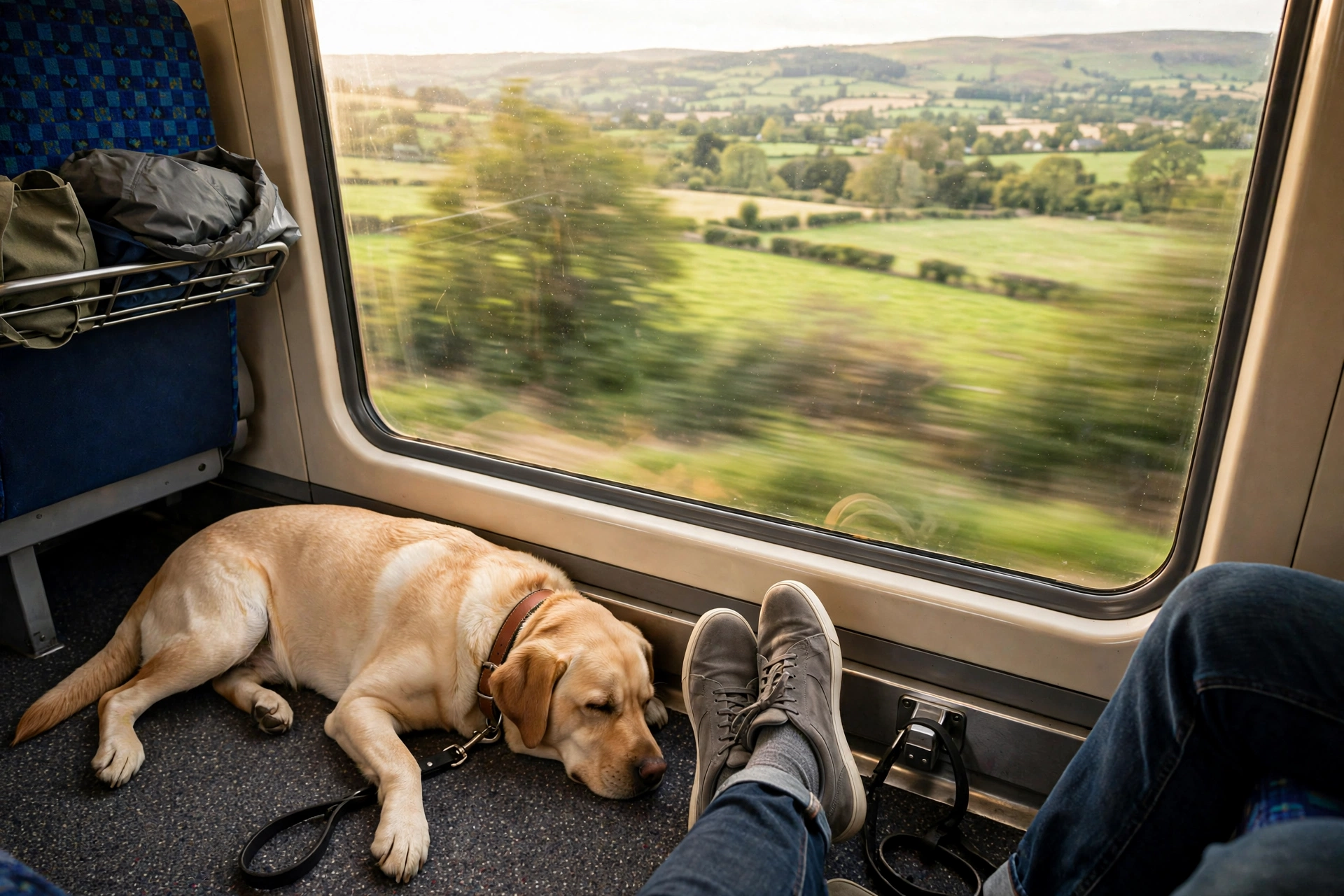
A guard plus boot setup suits dogs that prefer their own space and owners who want the cabin kept hair-free for passengers. The strongest setups combine a fitted guard behind the rear seats with a tailgate guard or internal divider, so the dog cannot bolt the moment the boot opens at a car park or service area. That last moment is a genuine risk point in Britain’s busy coastal and countryside car parks: clip a lead on before you open the tailgate fully, every time. Whichever system you choose for the drive, think ahead to the destination too — if you are combining the drive with rail for part of the trip, read our guide to taking a dog on UK trains so the car leg and the train leg use compatible leads, carriers and routines.
Set up the car step by step
Start with an empty, clean load area or rear seat. Remove loose heavy objects — bottles, tools, tins and unsecured luggage — that could strike a dog in a sudden stop, and store essentials in the footwell behind the front seats or in a closed compartment instead. Fit the guard, crate or harness attachment and test it with a firm pull from several angles. Check that nothing presses on a seat-belt buckle release, blocks an airbag zone or interferes with a child seat if you carry one; dogs and children should each have their own defined, restrained space, and a dog should never share a seat belt with a person.
Next, settle the dog in the parked car before you drive anywhere. Let the dog get in, find the bedding, be clipped in and relax while the engine is still off, then repeat with the engine running and finally with a short drive around the block. Watch for the small problems that only appear in motion: a tether that is long enough to let the dog step off the seat, a crate door that rattles, a guard mount that loosens on speed bumps, or a harness that twists when the dog lies on one side. Fix those issues at home, not on the hard shoulder.
Finally, set the cabin up for the driver. Mirrors must show the road, not just the dog; ventilation should reach the dog without a gale through an open window; and water should be stored for stops rather than offered from a bowl on the move. Put the dog’s lead, poo bags, towel and a small first-aid kit where you can reach them at a stop without unloading the boot. If you are heading away for a couple of nights, our plan for weekend breaks with dogs in the UK shows how to time the drive, arrival walk and first evening so the journey feels like part of the break rather than an ordeal before it.
Breaks, heat and long journeys
Restraint solves the legal and safety problem while the car is moving; welfare on a long journey is about stops, temperature and routine. As a practical pattern, stop every two hours or so — sooner for puppies, older dogs and dogs that travel anxiously — in a safe, legal place where the dog can toilet, stretch, drink and settle on a lead away from traffic. Motorway services, signed rest areas and supermarket car parks on your route all work better than a verge. Keep the stop boring and brief if your dog gets excited: toilet, water, a short sniff, then back into the same restrained position with the same bedding and cue word.
Heat deserves uncompromising language. Dogs can overheat in a parked car very quickly, even on a mild day, even in shade and even with a window left partly open. Never leave a dog alone in a car in warm weather, and plan fuel, food and toilet stops so that one adult can stay with the dog or the dog can come with you where dogs are allowed. If you see a dog in distress in a hot car, official advice is to call the police on 999 if you believe the dog is in immediate danger, and to note the vehicle details and time — check the latest RSPCA and police guidance for the current recommended steps rather than relying on memory.
Cold, wet British weather creates the opposite routine problem: a soaked, muddy dog steaming up windows and shivering on a thin mat. Carry a drying towel and a spare dry blanket, swap wet bedding at a stop, and keep the cabin ventilated enough to clear condensation so your view stays legal and safe. Feed a normal meal well before travel rather than a large meal immediately before a winding rural drive, and carry familiar food for the destination so a sensitive stomach is not dealing with motion, excitement and a new diet all on the same day.
Puppies, nervous and older dogs
Puppies need restraint from their very first car journey, not after they are big enough to cause trouble. A small, secured carrier or a properly fitted puppy harness builds the correct habit early and protects a fragile body in a sudden stop. Keep early journeys short and end them somewhere pleasant where possible, but avoid the temptation to cuddle an unrestrained puppy on a lap “just this once” — that first exception teaches both puppy and driver the wrong routine, and a frightened puppy in a footwell near pedals is a genuine hazard.
Nervous dogs benefit from predictability more than from novelty. Use the same door, the same bedding, the same clip-in routine and the same calm cue, and consider covering part of a crate to reduce visual stimulation if your dog relaxes that way at home. Talk to your vet about persistent travel sickness, drooling, panting or refusal to get into the car; there may be a medical or behavioural plan that helps, and any medication or supplement should come from veterinary advice rather than an online recommendation. Desensitisation — sitting in the parked car, then engine on, then very short drives — works, but only at the dog’s pace.
Older dogs and dogs with joint problems need an access plan as well as a restraint plan. A ramp or a low step can prevent an injurious jump from a high boot, non-slip matting stops splayed legs on a smooth boot floor, and a harness with a handle can help you support weight without lifting by the collar. Position bedding so an older dog can lie fully stretched rather than curled against a crate door, and plan more frequent, shorter stops. If a dog’s mobility or health changes, ask your vet whether long journeys remain appropriate and what pain relief or rest pattern they recommend — and check official guidance again if rules or advice have been updated since you last looked.
A pre-journey legal checklist
Before every journey, run the same short checklist until it becomes automatic. First, restraint: is the harness, carrier, crate or guard fitted, secured and in good condition, with no frayed straps, cracked clips or loose mounts? Second, position: is the dog clear of the driver’s controls, mirrors, airbags and footwells, and can every passenger use their own seat belt properly? Third, load: is luggage secured away from the dog, and are heavy or sharp items unable to slide into the dog’s space?
- Restraint fitted and tested: harness on the chest, crate strapped, guard firm, tether the right length.
- Identification and contacts: collar tag and microchip details up to date, vet number saved, lead clipped on before any door or tailgate opens.
- Water, breaks and weather: water and a spill-proof bowl for stops, a break planned roughly every two hours, and no plan that leaves the dog alone in a warm car.
- Driver readiness: route set before departure, phone out of hand, mirrors adjusted, ventilation reaching the dog.
- Destination rules checked: parking, lead rules and dog access at the destination confirmed, so arrival is not improvised in a busy car park.
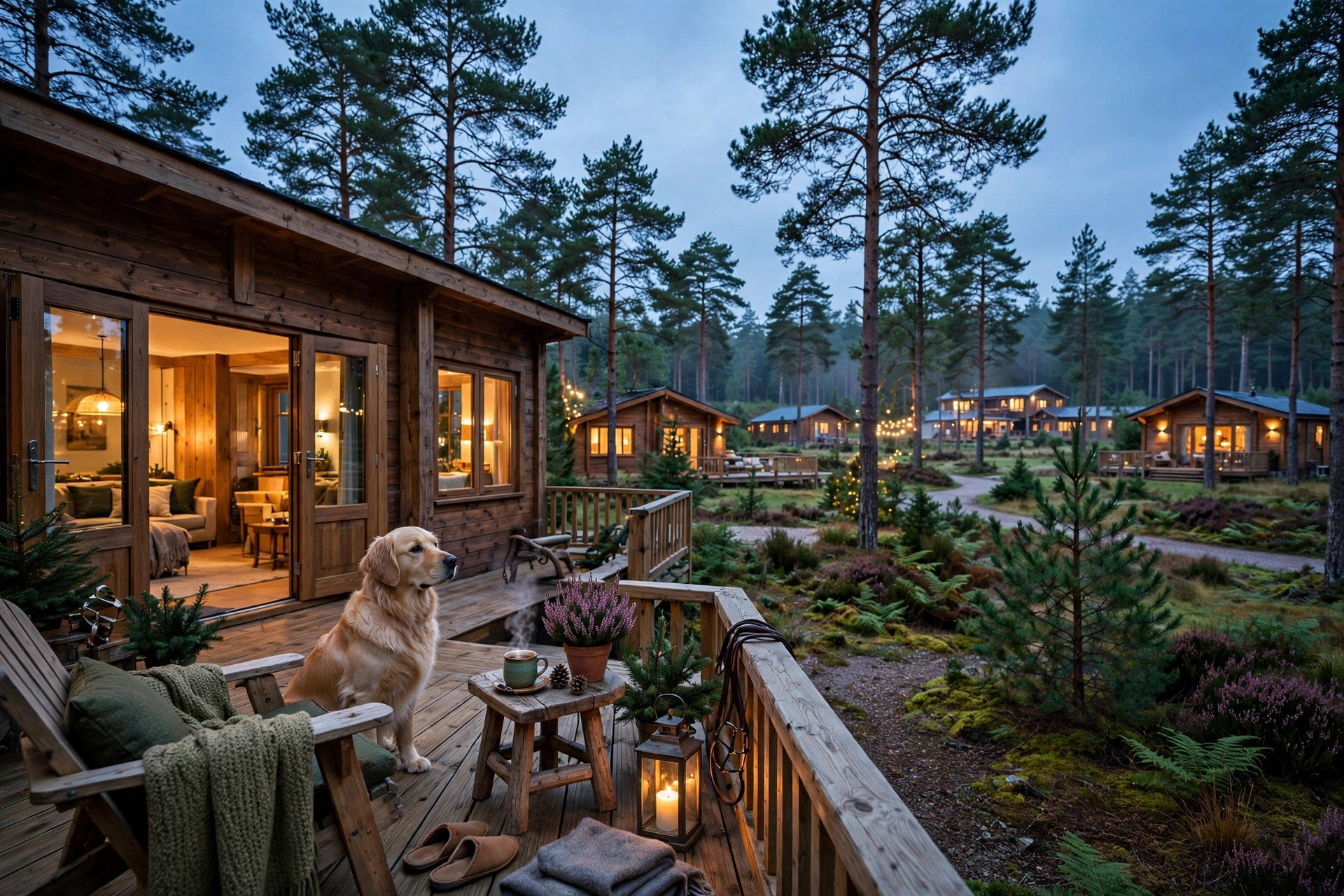
If you are staying in self-catering accommodation or on a holiday park after the drive, our guide to dog-friendly holiday parks in the UK covers the questions to ask about parking beside the unit, arrival routines and after-dark toilet walks — all of which are easier when the dog gets out of the car calm, restrained and already on a lead. Keep this checklist with your packing list, and remember the standing caveat for all legal summaries: rules, penalties and official advice can change, so before an important journey, check the latest Highway Code and government guidance and treat that official wording as the final word.
Practical questions
Before you go
Is it illegal to drive with an unrestrained dog in the UK?
Rule 57 of the Highway Code says dogs and other animals must be suitably restrained in a vehicle so they cannot distract the driver or injure themselves or others if you stop quickly. The Highway Code itself is not a single standalone criminal offence for every rule, but breaking it can be used as evidence of careless or dangerous driving, and an unrestrained dog that distracts you can lead to a penalty. Restrain your dog on every journey and check the current official Highway Code wording before you travel.
Can my dog sit on my lap or on the front seat?
A dog should never travel on the driver’s lap, because that interferes with steering and concentration. A dog on a front passenger seat must still be suitably restrained, the seat should be pushed as far back as practical because of the airbag risk, and many owners find the rear seat or boot area safer and calmer. If in doubt, use the rear seat with a crash-tested-style harness and seat-belt attachment, or a secured crate or guard in the boot.
What fine or penalty could I face for an unrestrained dog?
There is no single fixed fine labelled simply as a Rule 57 fine. If an unrestrained dog contributes to careless or inconsiderate driving, penalties can include a fixed penalty, points, an unlimited fine and disqualification in more serious cases, depending on the offence charged. Insurers may also argue that an unrestrained dog contributed to an incident. Figures and penalty frameworks change, so check the latest official guidance before relying on any amount quoted elsewhere.
Does Rule 57 apply to dogs travelling in the boot?
Yes, in practical terms. Rule 57 covers animals carried in a vehicle, wherever they sit. A dog in an estate or hatchback boot should be contained by a properly fitted dog guard, a secured crate or a tether system designed for that space, with ventilation and enough room to lie down. A loose dog behind an unsecured guard is not suitably restrained, and luggage should never be stacked where it could fall onto the dog.
Will my car insurance be invalid if my dog is unrestrained?
It could be challenged. Insurers expect you to drive with reasonable care and to follow the Highway Code. If an unrestrained dog distracted you or worsened the outcome of a collision, an insurer might reduce or refuse a claim, depending on the policy wording and the facts. Read your policy, restrain your dog properly, and never let a dog interfere with the controls, mirrors or your view of the road.
Does my dog legally have to wear a harness in the car in the UK?
No single product is named in the law. Rule 57 of the Highway Code says a dog must be suitably restrained so it cannot distract you, or injure you or itself if you stop quickly, and it lists a seat belt harness, pet carrier, dog cage or dog guard as suitable options. A dog harness for car travel, clipped to a seat belt, is therefore a legal way to comply, but a secured crate or a guard can meet the rule too. What matters is that the dog cannot move freely around the car.