This guide is independent general information, not emergency or legal advice. Council, microchip database and rescue arrangements change — always check the latest official information for the area you are in before relying on a phone number or procedure.
If your dog is lost on holiday in the UK: stay near the last known point, search calmly, then within the first hour call your microchip database to flag your dog as missing, contact the local council dog warden where you are staying, ring nearby vets and rescues, and register free on DogLost. Keep one phone charged and free, log every sighting, and never chase a frightened dog.
The first hour: stay, search, note
The single most useful thing you can do is resist the urge to range widely. Many lost dogs, especially in unfamiliar countryside, circle back to the place where they last saw you — a car park, a cottage gate, a beach access point or the spot where a lead slipped. If everyone leaves that point to search, there may be nobody there when the dog returns. Wherever possible, one person should stay at the last known point, visible and unhurried, while others search. If you are alone, return to that point frequently between short search loops rather than pushing steadily further away.
Search the immediate area first and search it thoroughly. Check the hiding places a frightened dog actually uses: under cars and caravans, inside open sheds and barns, behind bins, in dense hedges, under decking, and along ditches and stream banks. Call in a normal, familiar voice and then stop and listen — a trapped or tangled dog may whine quietly, and a collar caught on fencing will not free itself. Shake a treat bag or squeeze a familiar toy if that sound normally brings your dog running at home. Avoid a crowd of shouting helpers in the first hour; noise that feels like enthusiasm to people can feel like pressure to a dog already in flight mode.
Write down the facts while they are fresh: the exact time your dog was last seen, a map pin or what3words reference if you use it, the direction of travel, what your dog was wearing — collar colour, harness, lead still attached — and any distinguishing marks. Take a clear, recent photograph onto the front screen of your phone so you can show it and send it instantly. This small record becomes the basis of every phone call, poster and online post you make next, and it prevents the slow drift of details that happens under stress.
Use scent and routine
Dogs navigate by smell far more than by sight, and scent is the tool you control even in unfamiliar territory. Place unwashed items that smell strongly of home and of you — a worn jumper, your dog's own blanket or bed — at the last known point and outside your holiday accommodation. If it is safe and you have permission, leave water nearby. Do not leave food unattended for long periods where it will attract other animals and cause confusion about whether your dog has visited; instead, check the spot at quiet times, particularly at dawn and dusk, when a nervous dog is most likely to move.
Keep routines pointed at return. Walk the same short route from your accommodation to the last known point at the times you would normally walk, using familiar phrases. If your dog knows the sound of your car, a quiet engine start at the car park can carry further than a voice. At a holiday cottage, park or campsite, ask the owners to keep gates as they were and to check outbuildings before locking them at night. A dog that slipped into a store room at midday can be locked in by a tidy evening routine, so a polite request to look — and look again — is never wasted.
Who to call in the UK
Work through these calls in order, and keep a note of who you spoke to and when. First, your microchip database. In England, Scotland and Wales, microchipping is a legal requirement for most dogs, and the chip only helps if the contact details attached to it are current. Phone the database your dog is registered with — the details will be on your registration paperwork or searchable via an official chip-checking service — flag your dog as missing, confirm your mobile number is correct, and add your holiday address as a temporary contact point if the database allows it. If you are unsure which database holds the record, check before you travel next time and save the number in your phone; our dog travel first aid guide covers the health and document checks worth doing before any trip.
Second, the local dog warden. Stray dogs in the UK are normally the responsibility of the local council for the area where the dog is found, so you need the warden service for the council covering your holiday location, not your home council. Council websites publish the warden number and the out-of-hours arrangement, which varies by area — always check the latest official information on the council site rather than relying on an old listing. Report your dog as missing even if no matching dog has been collected yet, give a precise description, and ask where collected dogs are kennelled and how long they are held. By law, councils generally hold stray dogs for a statutory period while efforts are made to reunite them, but reclaim fees and procedures differ, so ask directly.
Third, vets, rescues and kennels within a sensible radius. A finder often takes a dog to the nearest veterinary practice to be scanned, so ring practices in the nearest towns, including the out-of-hours provider, and follow up by email with a photograph. Contact local rescue centres and any breed rescue relevant to your dog. If your dog was lost near a beach, farmland or a nature reserve, also inform the relevant rangers, lifeguards or land managers where a reporting route exists. If your dog may have strayed onto a railway line or a major road, contact Network Rail or the highways authority and the police non-emergency number 101 as appropriate — do not attempt to retrieve a dog from a live road or track yourself.
Register online: DogLost and local groups
Register your dog free on DogLost, the long-established UK lost and found dog service, as soon as the phone calls are under way. A DogLost listing generates a shareable poster, alerts local volunteers who have registered to help in that area, and creates a single page you can link to everywhere else, which keeps updates in one place. Fill in the location as where your dog was lost, not your home postcode, and upload the clearest full-body photograph you have.
Then use local networks, which on holiday are often faster than national ones. Post in the community Facebook groups for the village or town you are staying in, in local lost and found pet groups, and on neighbourhood platforms used in that area. Ask your accommodation provider, the nearest pub, café and village shop to share the post or display a poster — in rural Britain these are genuine information hubs. Keep the post factual: photograph, description, where and when lost, and one phone number. Update the same post as news comes in rather than starting new threads, so sightings stay in one thread that helpers can follow.
Protect your contact details sensibly. Use a mobile number you can keep charged and answered, and be ready for well-meaning calls at odd hours. If you would rather not publish your number widely, DogLost and group admins can often relay messages, but a direct number on posters materially speeds up a sighting call — most finders will not fill in a web form while holding someone else's dog.
Posters and sightings
Posters still work, particularly in the countryside where phone signal is patchy and the people most likely to see your dog — farmers, dog walkers, delivery drivers, posties — are outdoors rather than online. Keep the design stark: one large photograph, the words LOST DOG in big type, the area and date, and your phone number large enough to read from a car window. Put posters at the car park and path entrances where your dog was lost, at the nearest shops and noticeboards, and along the routes between sightings. Ask permission where you can, remove posters once your dog is found, and refresh weather-damaged ones if the search continues.
Log every sighting with time, place and direction of travel, and plot them on a map. Patterns usually emerge: lost dogs often settle into a rough triangle between shelter, water and a food source, and return to the same fields or lanes. Share the map with your core helpers only. Publicising every sighting in real time can draw a crowd to the exact spot a nervous dog has chosen, and undo days of patient work. Ask the public to phone sightings in and to note the location, rather than approaching the dog.
If your dog is sighted: do not chase
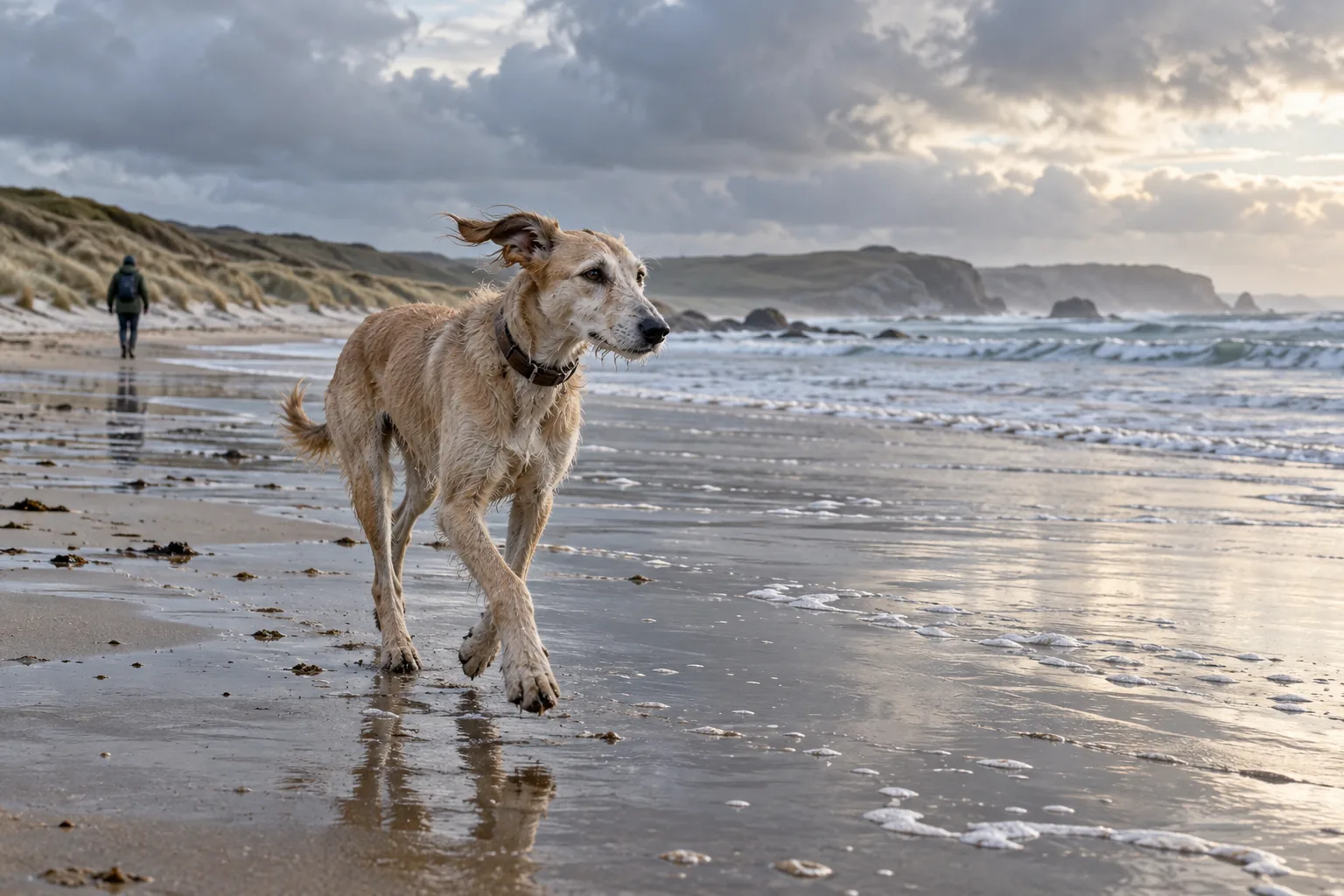
This is the hardest advice to follow and the most important. A dog that has been lost for hours or days may not behave like your dog: even gentle, sociable pets can enter a survival mindset in which every approaching person — including, briefly, their owner — is something to run from. Chasing, cornering, shouting a name repeatedly or sending well-meaning strangers out to grab a collar drives a dog further, and the most dangerous version of that flight is across a road or off a cliff path. Beach losses carry their own risks, so it also helps to understand the local rules and hazards set out in our guide to UK dog-friendly beaches and their rules before you search tidal areas, and never put yourself at risk on mudflats or in rising water.
If you see your dog yourself, stop, get low, turn slightly sideways and avoid direct staring. Let the dog notice you and come to you, which may take many minutes. Speak quietly in familiar phrases, toss smelly food — hot dog pieces, sardines, strong cheese — gently to the side rather than at the dog, and resist lunging for the collar when they first come close. If sightings settle in one area but the dog will not approach anyone, ask DogLost or a local trapping volunteer group about humane trap support; experienced teams do this safely and legally, and amateur attempts usually scatter the dog again.
Scams, rewards and safety
Publicising a lost dog also attracts a small number of dishonest calls. Be cautious with anyone who claims to have your dog but will not send a photograph, who demands money before describing the dog, or who asks for payment codes or bank details. A genuine finder or a vet, warden or rescue holding your dog will be able to describe markings and will expect you to prove ownership with photographs, microchip details and purchase or adoption records. Council reclaim or kennelling fees are paid through official channels — ask for the council or kennels' own payment route, and check the latest official information if anything feels off.
Think carefully before advertising a specific reward amount. Many owners do offer rewards and many finders refuse them, but a large publicised sum can encourage false sightings and, in rare cases, worse. A simple “reward offered” without a figure is a common compromise. Keep your own search safe too: search in pairs after dark, tell someone your route, carry a torch and a charged phone, and respect farmland, livestock and closed paths. A lost dog near sheep is an emergency for everyone — inform the farmer if you can, and keep your own conduct beyond criticism while you search.
After 24 hours
If the first day ends without your dog, widen the system rather than simply repeating it louder. Extend poster coverage and vet calls to a larger radius, because a fit dog can cover surprising ground, but keep the base at the last known point staffed or checked — returns after two or three days to the original spot are common. Re-confirm with the dog warden and your microchip database that your dog is still flagged as missing and your numbers still work. Ask DogLost volunteers about scent-tracking dog teams and about drone search groups that operate with trained volunteers in some areas; availability varies, and any drone use must follow current official rules, so check the latest guidance rather than assuming.
Manage the human side deliberately. Searching owners stop eating, sleeping and thinking clearly, which helps nobody. Work in shifts with family or friends if you can, keep one person rested and on phone duty, and keep your holiday accommodation as your base for as long as you reasonably can — many owners delay travelling home, and accommodation providers are often flexible when they understand the situation, so ask early rather than on checkout morning. If you do have to leave the area, leave scent items, posters and a local contact in place, register clear instructions with the warden and vets, and plan to return quickly for a credible sighting. Dogs are found days and sometimes weeks later; a tidy, well-logged search gives those later chances the best foundation.
When your dog is found, get a vet check promptly even if they seem unhurt — paws, pads, dehydration, ticks and swallowed objects are common findings, and an injured dog may hide pain well. Our first aid guide explains what to check and what belongs in a travel kit. Then close the loop: update DogLost, your posts and every poster location, and thank the local groups. Those updates stop strangers searching for a dog who is asleep at home, and they keep local goodwill intact for the next owner.
Prevention for the rest of the trip
Once your dog is back — or, better, before anything goes wrong on your next break — tighten the simple systems that prevent most holiday losses. Check that the collar and harness fit snugly enough not to slip over the head, use a lead or long line in new places until recall has been tested against real distractions, and add a holiday ID tag with your mobile number and accommodation details alongside the legally required tag information. Keep microchip details updated whenever your number changes, and photograph your dog, their chip paperwork and their vaccination record onto your phone at the start of the trip. A tracker that fits your dog's collar can help in areas with signal, but it is a backup, not a substitute for a lead in livestock fields or near cliffs.
Plan the break itself defensively: settle your dog with the routines in our weekend breaks with dogs guide, check garden fences and cottage doors on arrival before the dog is loose indoors, and be extra careful at the classic escape moments — unloading the car, pub gardens, beach car parks, and doors opened by other guests. Most lost-dog stories begin with ten ordinary seconds. A short checklist, repeated calmly at every stop, is what stops them.
Practical questions
Before you go
What should I do first when my dog goes missing on holiday?
Stay close to the point where your dog was last seen, because many dogs circle back. Have one person remain there with familiar scent items while others search the immediate area calmly, calling in a normal voice. Note the exact time and location, then start the phone calls to the microchip database, local dog warden and nearby vets within the first hour.
Should I call the local dog warden, and how do I find the number?
Yes, always. In the UK, stray dogs are usually collected by the local council's dog warden service. Find the number via the council website for the area where you are staying, not your home council. Report your dog as missing even if the warden has not collected a dog yet, so your details are logged if one is brought in. Check current arrangements on the official council site, as out-of-hours services vary.
How does my dog's microchip help if someone finds them?
A vet, warden or rescue that scans your dog can read the microchip number and contact the database holding your details. It only works if those details are current, so log in or phone your database provider, confirm your mobile number, flag the dog as missing and add a temporary holiday address. In England, Scotland and Wales microchipping is a legal requirement for most dogs; check the latest official guidance if you are unsure.
My dog has been sighted but runs away when approached. What should I do?
Do not chase, shout or send strangers after your dog. A frightened dog, even a normally friendly one, may run further, including across roads. Keep sightings logged with time and location, stay low and quiet if you see the dog yourself, let them approach you, and use familiar food smells rather than pursuit. Ask helpers to report sightings to you instead of trying to catch the dog.
What if my dog is still missing at nightfall?
Leave scent items and, if safe and permitted, a sheltered spot at the last known point and at your accommodation, and arrange for someone to check at dawn, when lost dogs often move again. Continue online alerts and posters, keep your phone charged and with you, and contact local search volunteers via DogLost. Do not give up after the first night: many dogs are found within a few hundred metres of where they were lost.