This guide is independent and contains no paid placement. Airport, airline and border rules change, so check the official guidance before you travel rather than relying on any single guide.
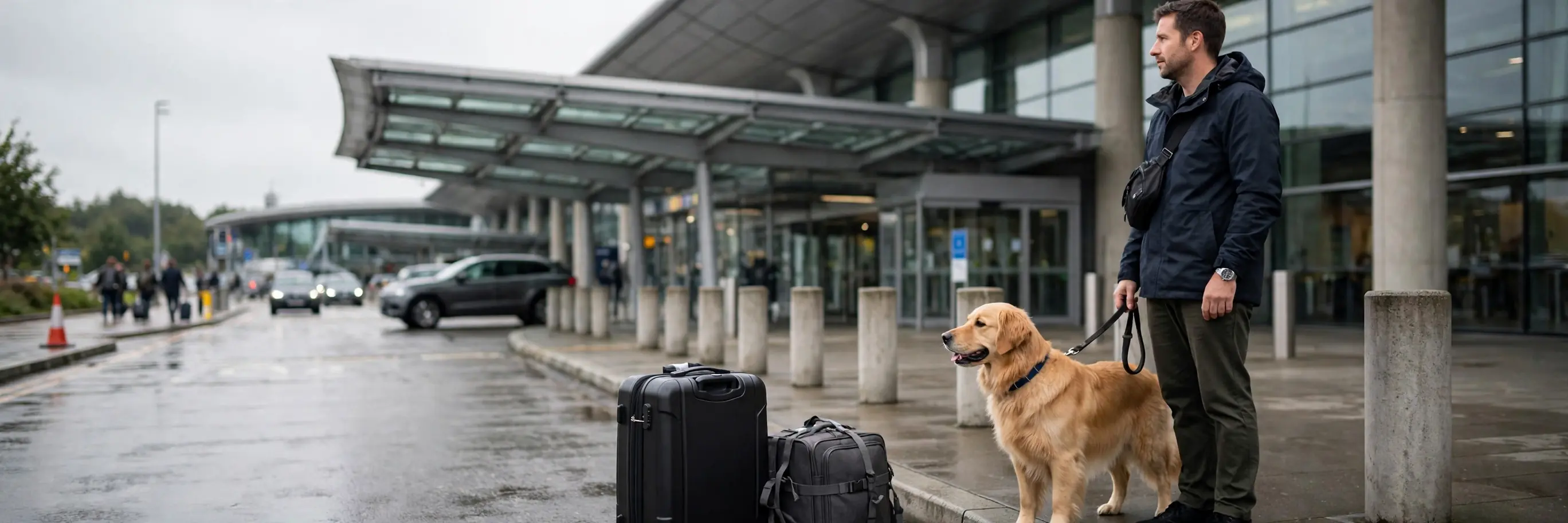
Pet dogs almost never fly in the cabin from the UK. Your dog will normally be dropped off as cargo, met on arrival at a separate animal facility, or simply saying goodbye at the kerb. Plan around the cargo timetable, not the passenger one, and confirm every detail with your airline or handler in advance.
The premise: no cabin, three journeys
Search for a dog-friendly airport in the UK and the results can mislead. The phrase sounds as if your dog might trot through departures beside you, browse the shops and settle under the seat. For the overwhelming majority of pet dogs, that is not how British air travel works. UK airlines do not generally carry pet dogs in the cabin, and dogs entering the UK by air must travel as cargo. That single fact shapes everything else in this guide, and it is worth absorbing before you book anything, because it changes where you go in the building, when you arrive, what you pack and who is responsible for your dog at each stage.
Instead of one airport experience, there are really three. The first is the farewell: you drive someone to the airport, or you are driven there, and the dog comes along for the ride and the goodbye. The second is the welcome: you collect a dog arriving on a flight, or you meet a friend whose dog is travelling. The third is the cargo journey: your own dog flies, in an approved crate in the aircraft hold, handled by airline cargo staff and specialist ground handlers rather than by you. Each journey uses different parts of the airport, different timetables and different rules, and confusing one for another is the most common source of stress on the day.
The farewell and the welcome are the most familiar, because they resemble any other airport run. You park, you walk to the terminal, you hug, you wave. The dog's role is small but real: a final toilet break, a drink, a calm wait in the car while bags are checked in. The cargo journey is a different operation altogether. You will usually deal with a cargo building that sits away from the passenger terminal, with its own entrance, security checks and acceptance hours. Your dog may be accepted hours before your own flight, if you are travelling on the same aircraft, or on a completely different flight from yours. Either way, the handover point is rarely the check-in desk you know from family holidays.
Understanding this split also explains why airport websites rarely publish a single "pet policy". The passenger terminal operator, the airline, the cargo handler and the border authorities each own a slice of the journey, and their rules overlap rather than match. The terminal operator decides whether dogs are allowed in public areas. The airline decides whether it carries animals at all and on which routes. The handler runs the acceptance building and the loading process. The border authorities decide what paperwork a dog needs to enter the country. A smooth trip means getting a consistent answer from all four, in writing, before you travel — and if any one of them says something different, believe the most restrictive version until you have clarified it.
There is one major exception to the no-cabin picture, and it matters enormously to the people it affects: registered assistance dogs. An assistance dog travelling with its handler is not treated as cargo luggage. It normally travels in the cabin, free of charge, under arrangements agreed with the airline in advance, and it may enter passenger areas of the terminal that pet dogs cannot. This guide treats assistance dogs separately throughout, because applying pet-dog rules to them — or assistance-dog freedoms to a pet — leads to real problems at the airport. If you travel with an assistance dog, read the dedicated section below first and notify your airline as early as you possibly can.
Finally, a word about expectations. Flying is the fastest way to move a dog a long distance, but it is rarely the simplest, the cheapest or the least stressful option for the animal. For many UK trips, especially domestic ones, driving or taking a ferry keeps the dog with you and avoids the cargo system entirely. If you are weighing up modes of transport, our guide to dogs on UK ferries explains how crossings work when the dog stays in the vehicle, a kennel or a pet cabin. Flying earns its place when distance, time or an international border makes the alternatives impractical — and when it does, this guide will help you plan it properly.
Drop-off, meet, or cargo: the comparison
The easiest way to plan is to name which of the three journeys yours is, then follow only that column. The table below is a simplification — individual airports and airlines differ — but it captures the contrasts that catch people out.
The farewell (drop-off). The dog does not fly. You are seeing off a passenger, or you are the passenger and the dog has come along for the goodbye before going home with someone else. The dog's airport time is short and mostly outdoors: the car park, the drop-off kerb, perhaps a terminal forecourt. The questions that matter are practical ones: where can the dog relieve itself before the drive home, where can you park without leaving the dog in a hot or cold car, and whether the dog is even allowed inside the building while you help with bags. Nobody checks the dog's passport, because the dog is not travelling.
The welcome (meet on arrival). The dog arrives on a flight, or arrives with a passenger you are collecting. If the dog flew as cargo, you will not meet it at the baggage carousel. You will collect it from the animal reception centre or cargo facility, which may be in a different building, with different opening hours, and you may need the airwaybill number, photographic identification and the dog's paperwork before the staff can release the animal to you. Build in waiting time: unloading, veterinary and customs checks and the drive between buildings all take longer than collecting a suitcase. If the dog arrives with its owner as an assistance dog, by contrast, the pair will come through the passenger terminal together, and your job is simply a normal airport pickup with a little extra space and patience.
The cargo journey. The dog flies without you in the cabin, in an approved crate, in a heated and pressurised hold. You hand the dog to cargo staff at an acceptance point, often hours before departure, and you collect it — or someone else collects it — from the destination's animal facility after landing and clearance. You cannot visit the dog during the flight, you cannot ask the cabin crew to check on it, and you will have limited information while it is airborne. The trade-off for that separation is a system built specifically for animals: trained handlers, temperature limits, loading procedures and contingency plans. It works best when the owner treats it as a freight operation with a beloved passenger, not as an extension of their own check-in.
Compare the three on the points that actually bite. Timing: a farewell takes as long as a normal drop-off; a cargo acceptance can require arrival three to four hours before departure, and collection after landing can take one to three hours after touchdown. Access: a farewell dog may be restricted to outdoor areas; a cargo dog goes to a building you have probably never visited; an assistance dog goes everywhere its handler goes. Paperwork: none for a farewell, identity and airwaybill for a collection, and a full file of health and entry documents for a cargo journey. Cost: a farewell costs parking; a cargo journey costs freight charges, crate, veterinary certificates and sometimes handler fees. Stress for the dog: a farewell is a car ride with a walk at the end; a cargo journey is a long day of unfamiliar handling, noise and waiting, which is why crate training and a calm temperament matter so much.
One more contrast deserves emphasis: who you talk to. For a farewell, the airport's own website and car-park signs are usually enough. For a collection, you need the cargo handler's phone number and the flight's airwaybill details. For a cargo booking, you need the airline's cargo department or a specialist pet shipper, not the passenger reservations line — passenger agents often cannot see cargo availability or animal acceptance rules at all. If the first person you speak to cannot answer a cargo question confidently, ask to be transferred rather than accepting a guess. A wrong answer about acceptance hours or crate sizes, discovered on the day, can mean a missed flight.
Use this comparison to choose your next step. If your journey is a farewell, skip to the drop-off section and the parking and walking advice. If you are collecting, read the arrivals and animal reception sections and have the paperwork ready. If your dog is flying, read the whole guide in order, and start with the document checklist — it is the longest lead-time item and the one most likely to delay a trip.
Drop-offs and arrivals in practice
Drop-off zones at UK airports are built for speed: cars pause, bags come out, passengers hurry inside. A dog changes that rhythm, and planning for it keeps the goodbye calm rather than chaotic. Before you set off, decide who holds the lead while bags are unloaded, and keep the dog on a short lead from the moment the car door opens. Airport forecourts are busy with trolleys, buses, taxis and distracted pedestrians, and even a steady dog can be startled by a reversing vehicle or a sudden announcement. A harness with a secure clip, rather than a collar alone, is worth it for the ten minutes at the kerb.
Time the last toilet break before you reach the terminal. Many airports have grass verges or landscaped areas near the car parks, but not a signed dog toilet area, and the forecourt itself is not a place to linger. Give the dog a proper walk at the last services or a quiet side road before the airport approach, then a short pavement break on arrival if needed, with bags for waste. If the dog is staying in the car while you help someone inside, never leave it unattended for long, and never in a warm car: even on a mild day, a parked car heats quickly, and airport car parks offer little shade. One adult stays with the dog, or the dog stays with the departing passenger's companion, and the goodbye happens at the car.
Whether the dog can enter the terminal at all varies by airport and by area. As a general rule, pet dogs are not permitted inside UK passenger terminals except in specific circumstances, and assistance dogs are the exception. Some airports tolerate a small dog carried through a public concourse, others will ask you to wait outside, and policies can differ between terminals of the same airport. The safe assumption is that the dog stays outside: say goodbye at the kerb, at the entrance doors, or in the car park. If entering matters to you — for example, helping an elderly relative to check-in — telephone the airport in advance and ask for the rule for your terminal on your date, and get the answer in writing if you can. Do not rely on a blog post or a forum anecdote from another year.
Meeting an arriving passenger with a dog follows the same logic in reverse, with one extra complication: you do not know exactly when the passenger will emerge. Park where you can wait with the dog comfortably, keep the dog in the car or on a short lead in a quiet corner of the car park, and agree a meeting point outside the terminal rather than inside. If the passenger is delayed, the dog still needs water and a toilet break, so choose a car park with space to walk rather than a multi-storey deck where the only exercise is concrete ramps. Short-stay car parks are convenient but expensive for long waits; a longer-stay park with a shuttle, or a free drop-off waiting area where one exists, may suit a long delay better. Check the airport's parking pages before you travel, because drop-off charges and free waiting periods change frequently — check the official guidance before you travel for current tariffs.
When the dog itself is the arriving passenger, the process is entirely different and is covered in the animal reception section below. The key point here is not to go to the arrivals hall expecting the dog. Cargo animals do not come through the passenger terminal, and waiting in arrivals with a lead and a hopeful expression will only cost you time. Go to the cargo or animal reception building named in your booking confirmation, bring identification and the airwaybill number, and allow for the checks that happen before release.
Two practical habits make both drop-offs and meetings smoother. First, keep a small airport kit in the car: a lead and harness, a collapsible bowl and a bottle of water, waste bags, a towel for wet paws, and the dog's usual treats. Second, save the airport's phone number and the terminal map offline before you leave home. Mobile signal in multi-storey car parks and cargo estates can be patchy, and the moment you most need the number is the moment you cannot load the website.
Cargo and hold travel explained
Cargo sounds industrial, and in some ways it is — but the animal hold of a modern aircraft is heated, pressurised and dimly lit, and airlines that accept animals have detailed procedures for them. The dog travels in a rigid crate that meets the International Air Transport Association live animal standards: large enough for the dog to stand, turn around and lie down naturally, ventilated on enough sides, with a secure door, a water container and absorbent bedding. The crate is the dog's room for the journey, so its quality and familiarity matter more than any other single item you buy. A dog that has slept in its crate at home for weeks will cope far better than one introduced to a new box on travel morning.
Booking usually starts with the airline's cargo department or a specialist pet transport company, not with a passenger ticket. You will be asked for the dog's breed, weight and crate dimensions, the route, and the dates, and you will be given an acceptance window — the period during which the dog must be delivered to the cargo facility. Acceptance windows are typically several hours before departure, because the dog must be checked in, weighed, documented and loaded in a planned sequence, and because some airports will not accept animals on very hot or very cold days, or on flights with tight connections. Treat the window as fixed. Arriving late can mean the dog does not fly that day even if you are already checked in for your own seat.
Costs are freight costs, not ticket costs. Expect to pay by weight and volume, with a minimum charge, plus handling, and sometimes a separate fee for the destination's animal reception and clearance. A medium dog on a long-haul route can cost several hundred pounds; a large dog on a complex route can cost considerably more. Get an itemised quote before committing, and ask what it includes: veterinary inspection on arrival, customs clearance and delivery to the reception centre are sometimes separate charges. Pet shippers bundle these into one price and handle the coordination; booking direct with the airline can be cheaper but leaves you to coordinate the handler, the vet and the paperwork yourself. There is no universally right choice — it depends on how much of the administration you want to carry.
Breed and health restrictions are real and sometimes surprising. Brachycephalic breeds — flat-faced dogs such as bulldogs, pugs and some spaniels — face restrictions or outright embargoes on many airlines and routes, because they are more vulnerable to breathing difficulties and heat stress in transit. Very young puppies, very old dogs, pregnant dogs and dogs with certain medical conditions may also be refused. Airlines publish lists, but the lists change, and the final decision can rest with the captain or the cargo supervisor on the day if temperatures exceed limits. If your dog is brachycephalic, older, or has any health condition, raise it at the first enquiry, not at the acceptance desk, and ask for the airline's decision in writing. An honest early no is far better than a refused acceptance on the morning of travel.
On the day, the acceptance process follows a pattern. You, or your shipper, deliver the crated dog to the cargo building. Staff check the crate, the dog's condition, the paperwork and the booking. The dog is weighed, the crate is labelled, and water is checked. You say goodbye at the acceptance counter — there is no airside visit, no watching the crate being loaded, and no cabin crew update during the flight. From that point, the airline is responsible for the animal, and your role is to be contactable and to be at the destination's collection point at the right time. Some handlers offer tracking updates; most do not provide live updates, so agree in advance how you will be told about delays or diversions.
Preparing the dog is as important as preparing the paperwork. Crate-train gradually over weeks, not days: feed meals in the crate, build up to closed-door rests, and practise car journeys in it. Exercise the dog well the day before, but avoid a frantic long run on travel morning — a tired, calm dog settles better than an exhausted one. Feed a light meal several hours before acceptance, as advised by your vet, and attach a familiar-smelling blanket that cannot tangle. Do not sedate the dog unless your vet specifically recommends it for air travel: sedation can affect breathing and temperature regulation at altitude, and many airlines will refuse a visibly sedated animal. If your vet does recommend medication, carry the prescription and a letter explaining it.
Finally, think about the season. Summer heat is the biggest weather risk for cargo animals, and airlines impose temperature embargoes when forecasts exceed safe limits at departure, transit or arrival airports. Winter cold brings its own limits, particularly for short-coated or small dogs. If your dates are flexible, spring and autumn are usually the kindest months for cargo travel. If your dates are fixed in a heatwave or a cold snap, ask your handler early whether the booking is at risk, and have a backup plan — a later flight, a different routing, or postponing — rather than discovering the embargo at the cargo door.
Animal reception and border checks
When a dog lands in the UK, it does not appear on a carousel. It is unloaded by cargo staff, transferred to the airport's animal reception centre, and checked before it can be released. This facility — sometimes called the animal reception centre, the border inspection post or the live animal facility, depending on the airport — is where veterinary, identity and customs checks happen. It is a working building, not a passenger lounge, and it runs to its own timetable, which is why collection can take one to three hours after landing, and longer if checks raise questions.
What happens inside follows a logical order. Staff confirm the dog's identity against its microchip and paperwork. A veterinary officer or authorised checker examines the animal and verifies the health certificate, rabies vaccination record and any required tapeworm treatment. Customs and border officials confirm that import conditions are met. Only when every check passes is the dog released to the named collector. If a document is missing, expired or inconsistent — a microchip number that does not match the certificate, a rabies vaccination given before the chip was implanted, a tapeworm treatment outside its permitted window — the dog may be held, quarantined or, in serious cases, refused entry. This is why the document checklist at the end of this guide is not bureaucracy for its own sake: it is the difference between a same-day reunion and a quarantine bill.
Quarantine is the outcome everyone wants to avoid, and it is avoidable in almost all cases by getting the paperwork right. Dogs that fail entry checks may be placed in an approved quarantine facility at the owner's expense until the problem is resolved, which can take weeks and cost a great deal. The most common causes are preventable: a rabies vaccination that is out of date, a health certificate signed too early or too late, a missing tapeworm treatment, or a microchip that cannot be read. Have your vet check every document against the official requirements well before travel, and carry originals plus copies. If anything looks uncertain, resolve it before the flight, not at the reception centre.
For the collector, preparation is straightforward but worth doing carefully. Bring photographic identification matching the name on the booking, the airwaybill number, and copies of the dog's paperwork. Know the reception centre's address — it is often on the cargo estate, not in the passenger terminal — and its opening hours, which may not cover evenings and weekends in the same way as the terminal. Confirm who is authorised to collect: if you booked the shipment, but a friend is collecting, the handler may need that person's details in advance. Bring a lead, a harness, water, a bowl and waste bags, and a car prepared for a dog that may be thirsty, stiff and desperate for a toilet break after a long journey.
The first hour after collection sets the tone for the next day. Let the dog relieve itself as soon as you are somewhere safe and quiet, offer water in small amounts rather than a large bowl at once, and keep the first walk short and calm. Avoid a busy service station or a crowded car park for the first break if you can; a quiet side road or a grass verge away from traffic is kinder. If the dog seems unwell — persistent vomiting, laboured breathing, lethargy beyond ordinary tiredness — contact a vet promptly rather than waiting to see if it passes. Most dogs recover quickly from a flight with rest, water and a familiar bed, but a professional opinion is cheap insurance after a long journey.
If your dog goes missing after landing, or escapes during the chaos of collection, act immediately using the same first-hour principles as any lost dog on holiday — search the immediate area, alert the airport staff and the local dog warden, and use the microchip and alert services. Our step-by-step guide to a lost dog on holiday in the UK covers the first-hour search, microchip and DogLost alerts, wardens and vets in detail, and it is worth reading before you travel, not after something goes wrong.
Pets in the terminal vs assistance dogs
The distinction between a pet dog and an assistance dog is the most consequential rule in this guide, and it is also the one most often misunderstood. A pet dog, however well behaved, is subject to the terminal's pet restrictions, the airline's cargo rules and the border checks described above. An assistance dog — a dog trained by a recognised organisation to assist a disabled person, such as a guide dog, hearing dog or mobility assistance dog — travels under a different legal and operational framework, and confusing the two categories causes problems in both directions.
Assistance dogs normally travel in the cabin with their handler, free of charge, on UK airlines and on many international routes into the UK. They may enter passenger areas of the terminal, including security and departure lounges, and they are not subject to pet cargo charges. This is not a courtesy extended at staff discretion; it reflects the handler's rights and the airline's obligations. But the right comes with its own requirements: the airline must be notified in advance, usually at booking or at least 48 hours before departure, and the handler may need to provide evidence of the dog's recognised assistance status, such as an identification book or harness from a recognised organisation. The dog must also meet the health and entry requirements for the destination, including microchip, rabies vaccination and any tapeworm treatment, and the handler should carry that paperwork.
Emotional support animals sit in a different category again, and this is where expectations most often collide with reality. An emotional support animal is not an assistance dog under UK rules, and airlines are not obliged to carry one in the cabin. Most UK airlines will treat an emotional support dog as a pet for travel purposes, which means cargo rules apply. If you travel with an emotional support dog, do not assume cabin access: ask the airline directly, in writing, what it will allow, and plan on the cargo basis unless you have a clear written confirmation otherwise.
For pet owners, the practical lesson is simple: do not present a pet dog as an assistance dog, and do not expect assistance-dog access for a pet, however calm or well trained. Airport and airline staff are trained to check status, and misrepresentation can lead to refusal of travel and serious consequences for future bookings. For assistance-dog handlers, the lesson is the mirror image: notify early, carry proof, and confirm the arrangements for security screening, seating and relief areas in advance, because each airport handles the details slightly differently. If you are unsure which category applies to your dog, ask the airline and the assistance-dog organisation that trained it before you book.
Relief areas deserve a specific note. Many UK airports provide assistance-dog relief areas, sometimes called "spend-a-penny" areas, airside and landside. These are facilities for assistance dogs, not general dog toilets, and they are usually located after security for departing handlers and before passport control for arriving ones. If you travel with an assistance dog, ask where the relief areas are for your terminal and whether you need to be escorted to them. If you travel with a pet dog, do not plan to use them: your dog's toilet breaks happen before you enter the terminal and after you leave it.
Walking and parking around the airport
The land around a UK airport is rarely designed for dog walking. It is a patchwork of car parks, hotels, cargo estates, dual carriageways and security fencing, and the pleasant footpaths of the surrounding countryside can be surprisingly hard to reach from the terminal. That does not mean the dog must go without a walk — it means the walk needs planning, ideally before travel day, using a map rather than hope.
Start with the airport's own grounds. Some airports have landscaped areas, hotel grounds or perimeter paths where a short lead walk is possible; others are effectively all tarmac and fencing from the terminal to the motorway. Check the airport's website for green spaces, and look at a satellite map of the area around your car park: a strip of grass beside a hotel, a verge along an access road, or a footpath leaving the airport estate can all serve for a short break. What you are looking for is not a scenic hike but a safe, quiet spot where the dog can relieve itself without traffic, crowds or security barriers. A ten-minute sniff around a grass verge beats a stressed wait in the car.
For a longer break, look one step beyond the airport boundary. Most UK airports sit near villages, country parks or canal towpaths that offer a proper walk within a ten-minute drive. If you have time before a drop-off, or a long wait after a collection, a twenty-minute drive to a country park can transform the dog's day. Pack for it: walking boots or waterproofs for yourself, a long lead if the area allows, water and a towel. And allow for the return journey — airport traffic peaks unpredictably, and a relaxed walk that makes you miss an acceptance window is worse than no walk at all. Work backwards from the time you must be at the cargo building, and add a generous buffer.
Parking choices matter as much as walking choices. Short-stay car parks beside the terminal are convenient for a quick goodbye but expensive for waiting, and they are usually multi-storey concrete decks with no green space. Longer-stay parks are cheaper and often have open-air areas, but they add a shuttle ride, which complicates a trip with a dog: some shuttle buses accept dogs, others do not, and a dog that has just flown may not cope well with a crowded bus. If you are collecting a cargo dog, driving to the cargo estate directly — rather than parking at the passenger terminal and shuttling — is usually simpler. Check whether the reception centre has its own parking or a waiting area, and whether you need to register your vehicle.
Meet-and-greet and valet parking are worth a specific check. These services usually involve handing your car to a driver who parks it off-site, which is awkward if the dog is travelling in the car or if you need the car to be accessible on your return. If the dog is staying with you, a self-park option where you keep the keys is almost always simpler. Similarly, if you are dropping off a passenger and the dog is going home with you, a car park you can walk from, with a clear pedestrian route to the terminal, beats a cheaper remote park with a bus transfer and a dog in tow.
Finally, think about the car itself as the dog's base. Before a long airport day, prepare it as you would for any long trip: a non-slip mat or crate, water that cannot spill, ventilation, and shade if you must park in the open. Never leave a dog unattended in a parked car at an airport for more than a few minutes, and never in warm weather. If your plans require leaving the dog while you go inside, rethink the plan: take another adult, use the kerb for the goodbye, or arrange for the dog to wait at home. The airport is no place for a dog alone in a car.
Connections, delays and the dog's day
A direct flight is kinder to a dog than a connecting one, and the difference is larger than the extra hours suggest. Every transfer adds handling: unloading, a wait in a transit facility, reloading, and another cycle of noise and vibration. Some airlines and airports handle animal transfers smoothly, with dedicated transit facilities and staff who check the animals between flights. Others require the dog to be collected and re-checked, which may be impossible on a short connection. When you are offered a routing with a connection, ask specifically how the animal transfer works: is the dog transferred airside by the airline, or must someone collect and re-check it? What is the minimum connection time for animals, which is often longer than the passenger minimum? What happens if the first flight is late and the connection is missed?
Delays are the other great unknown, and they deserve a plan before you travel rather than improvisation at the airport. If your flight is delayed before the dog is accepted, the handler may ask you to wait, or may accept the dog and hold it in the animal facility until departure. If the delay happens after acceptance, the dog is in the airline's care, and the handler should be able to tell you where the animal is held and what provisions are made for water, ventilation and checks. Ask these questions at booking: how are delayed animals cared for, who do you call for updates, and at what point would the dog be offloaded rather than held? Keep the handler's phone number, the airwaybill number and the airline's cargo number in your phone and on paper, because you may need them when your own phone battery is low and the departure board is unhelpful.
Overnight delays and diversions are the hardest cases. A dog diverted to another airport may be held there, transferred to a later flight, or, in rare cases, require new paperwork for the diversion country. This is one reason to consider a pet shipper for complex routings: the shipper's job includes contingency handling, and a single phone call to them is simpler than coordinating three airports yourself at midnight. It is also a reason to build slack into your plans at the destination: do not book a non-refundable onward journey, a hotel with a strict check-in window, or a long drive immediately after a cargo collection. Give the dog, and yourself, a buffer day where possible.
Think about the dog's whole day, not just the flight. A dog accepted at 9am for a 1pm departure, flying for five hours, then waiting two hours for clearance, has had a ten-hour day before it reaches its bed. Add the drive to the airport and the drive onwards, and the day can stretch to fourteen hours. That is a long day for any animal, and it argues for preparation: a good night's sleep the night before, a calm morning, a familiar crate, and a quiet destination where the dog can rest undisturbed on arrival. Avoid stacking novelties on arrival day — a new house, new people, a party — and let the dog decompress. Most dogs bounce back within a day; a few need two or three. If the dog is still not eating, drinking or moving normally after 48 hours, seek veterinary advice.
One practical tip for the travelling owner: keep your own plans flexible too. If you are on the same flight as your dog, remember that you may clear passport control and collect your bags long before the dog is released. Do not book a taxi with a fixed pickup time, and tell anyone meeting you that your arrival time is uncertain. If you are not on the same flight, make sure the collector knows the flight number, the airwaybill number and the reception centre's location, and that they are authorised to collect. A missed collection because the named person changed is an avoidable delay for a tired dog.
The pre-departure document checklist
Paperwork is the least glamorous part of flying with a dog and the most likely to cause a failed journey. Use this checklist as a starting point, then verify every item against the official requirements for your specific route and origin country — rules vary, and they change. Where this guide says "check the official guidance before you travel", it means the UK government's pet travel guidance and your airline's or handler's current instructions, not a summary on any single website.
- Microchip. The dog must be microchipped, and the chip number must match every document exactly. Have the chip scanned and verified by your vet well before travel, and confirm the chip is registered with your current contact details. A chip implanted after a rabies vaccination can invalidate that vaccination for travel purposes, so the order matters: chip first, then vaccinate.
- Rabies vaccination. The dog needs a valid rabies vaccination, given after microchipping, with the waiting period after primary vaccination fully elapsed before travel. Check the certificate for the vaccination date, the vaccine batch and the vet's signature, and confirm the vaccination has not expired. Booster rules and waiting periods vary by origin country, so verify them for your route.
- Health certificate or pet passport. Depending on the origin, the dog may need an official veterinary health certificate issued within a specific window before travel, or a pet passport where that scheme applies. The window is strict — a certificate signed a day too early can be rejected — so coordinate the vet appointment with the flight date carefully, and confirm who must sign it: not every vet is authorised for export certification.
- Tapeworm treatment. Dogs entering the UK from most countries need tapeworm treatment administered by a vet within a defined window before arrival, typically between 24 hours and 5 days before the scheduled arrival time, and recorded in the health certificate or passport. The timing is tight and time-zone sensitive: a treatment given too early or too late can mean refusal or quarantine. Confirm the exact window for your route and have your vet record the date and time precisely.
- Airline and handler booking confirmation. Keep the booking reference, the airwaybill number, the acceptance window, the cargo building address and the handler's phone number together, in your phone and on paper. Confirm the crate dimensions and weight limits, and confirm that the booking names the correct collector at the destination.
- Crate compliance. Confirm the crate meets the airline's size, ventilation and door requirements, is labelled with the dog's name, your contact details and "live animal" markings as required, and contains an attached water container and absorbent bedding. Photograph the crate, the dog in it, and the labels before handover — useful if anything is queried later.
- Your own travel documents. If you are travelling on the same journey, keep your passport, ticket and the dog's paperwork in separate, accessible places, not buried in checked luggage. If someone else is collecting, make sure they have copies of everything and written authorisation where the handler requires it.
- Veterinary contact and insurance. Save your vet's number, the destination vet's number, and your pet insurance details, including whether the policy covers air travel, delays and quarantine costs. Some policies exclude cargo travel or require notification in advance — check before you fly, not after a claim.
Run the checklist twice: once when you book, to catch long-lead items such as rabies waiting periods, and once a week before travel, to catch expiry and timing issues. Ask your vet to review the whole file, not just to sign the certificate — a second pair of eyes on chip numbers, dates and signatures catches the transcription errors that cause refusals. And keep copies of everything: originals for the officials, photographs on your phone, and a set left with someone at home who can send them if a document is lost.
If any item on the checklist cannot be confirmed, pause the booking rather than hoping it will resolve itself. A delayed trip is an inconvenience; a refused entry or a quarantine stay is a serious welfare and financial problem for the dog. Airlines, handlers and vets deal with these cases regularly, and an early conversation about a doubtful document is always better than a confrontation at the acceptance desk.
Practical questions
Before you go
Can my dog fly in the cabin from a UK airport?
Almost never. UK airlines generally do not allow pet dogs in the cabin, and dogs arriving in the UK by air must travel as cargo. Registered assistance dogs are the main exception and travel under separate arrangements agreed in advance.
Can I walk my dog into the terminal to say goodbye?
Usually not beyond the public areas, and many airports ask that pet dogs stay outside the terminal or in the vehicle until handover. Say goodbye at the kerb or in the car park, and confirm the exact meeting point with the cargo handler before travel day.
How early should I arrive for a dog travelling as cargo?
Plan to arrive several hours before departure, because cargo check-in, document checks and loading run on a different timetable from passenger check-in. Your handler or airline will give an exact acceptance window; treat it as fixed, not advisory.
What happens if my flight is delayed while my dog is in cargo?
The airline and its ground handler are responsible for the animal during the delay, including holding arrangements and rebooking. Ask in advance how delays are handled, keep the handler's phone number with you, and do not assume you can visit the dog mid-delay.
Does an assistance dog need the same cargo paperwork as a pet dog?
No. Assistance dogs travel under different rules, usually in the cabin with their handler, but they still need advance notification, recognised status and the correct health and entry paperwork. Notify the airline as early as possible and carry proof of status.
What documents does my dog need to fly into the UK?
Typically a microchip, a valid rabies vaccination, an accepted health certificate or pet passport where applicable, and tapeworm treatment for dogs where required. Rules vary by origin country, so check the official guidance before you travel and have every document checked well ahead of the flight.