This guide is independent and contains no paid placement. Ferry pet policies, fees and ship facilities change regularly. Where details are given below, treat them as a planning guide and always confirm against the operator's latest official information before you travel.
Yes, dogs can travel on most UK ferry routes, including cross-Channel, Irish Sea, North Sea and Scottish island services. The key difference is where the dog spends the crossing: in your vehicle, in onboard kennels, in a pet-friendly cabin or with you in a designated pet area. Fees, limits and document rules vary by operator and direction, so book the dog at the same time as your own ticket and check the official rules for your exact sailing before departure.
Can dogs go on ferries in the UK?
For most owners, the honest answer is yes — with conditions. Dogs are routinely carried on ferries from Britain to Ireland, France, Spain, the Netherlands and Belgium, as well as on domestic routes to the Isle of Wight, the Isles of Scilly, the Scottish islands and other island communities. Foot passengers should be more cautious than car passengers: some operators only accept dogs travelling in a vehicle, some accept foot-passenger dogs on selected sailings only, and a small number of fast-craft and seasonal services restrict pets more tightly. If you do not have a car, check that point first, before you compare prices.
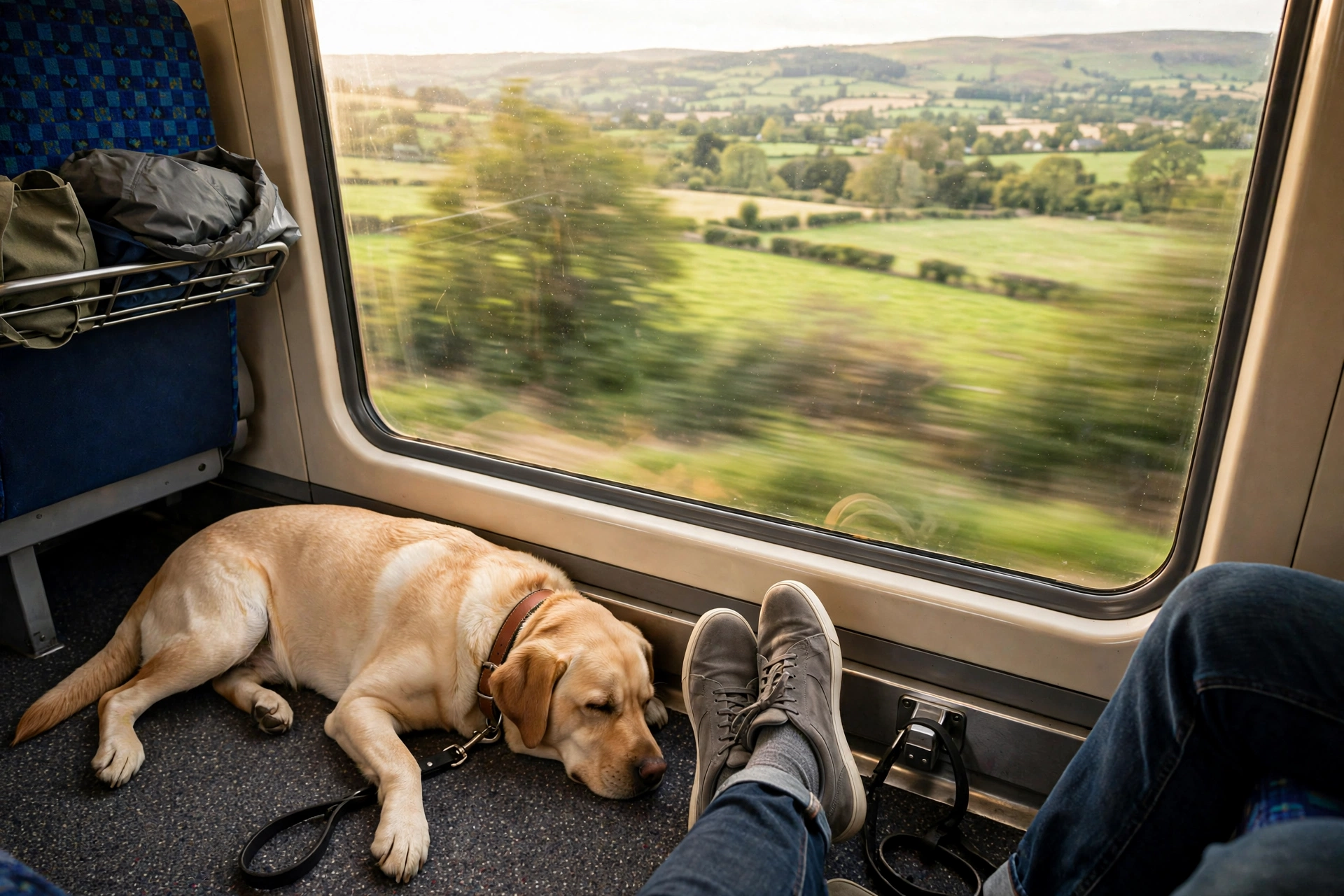
The other condition is numbers. Pet spaces are limited on many ships, especially pet cabins and kennels in peak season, and they sell out earlier than ordinary vehicle spaces. Adding a dog later, by phone, does not always work if the pet allocation for that sailing is full. Treat the dog as a passenger with a quota: declare the correct number of dogs when you book, pay the pet fee up front, and keep the confirmation that shows the dog is included. If you are combining ferry travel with rail at either end, our guide to taking a dog on UK trains covers the onward leg, including lead, platform and ticketing basics that differ from ferry rules.
Finally, distinguish three kinds of crossing, because the rules follow the category more than the brand. Domestic crossings within the United Kingdom are the simplest and normally need no pet travel documents. Common Travel Area crossings to Ireland are straightforward for the outward journey but have specific return requirements to consider. Crossings between Great Britain and the European Union involve formal pet travel rules, approved routes and document checks at check-in. Knowing which category your trip falls into tells you how much preparation time to allow.
How operator rules differ
No single rulebook covers every company. The summaries below describe the general pattern for the largest operators serving Britain. Ships differ even within one company, refits move kennels and pet cabins between vessels, and seasonal timetables change what is offered. For that reason, every summary ends the same way: please check the operator's latest official guidance for your route, ship and date before travel.
Stena Line is one of the most useful operators for dog owners because several of its routes have historically offered a choice of arrangements, which on some ships has included dogs staying in the vehicle, onboard kennels and, on selected routes, pet-friendly cabins. Stena sails on the Irish Sea — for example between Holyhead and Dublin, Fishguard and Rosslare, Liverpool and Belfast, and Cairnryan and Belfast — as well as between Harwich and the Hook of Holland. Visiting arrangements for kennelled dogs, any designated dog exercise area and whether foot passengers may bring dogs all vary by route and vessel, so check the detail for your sailing rather than assuming the best arrangement you have read about applies everywhere. Stena Line's official pets page lists the kennel, pet cabin and vehicle options by route.
DFDS operates cross-Channel services between Dover and both Calais and Dunkirk, the longer Newhaven to Dieppe route, and the overnight Newcastle to IJmuiden route to the Netherlands. On the short Dover crossings, the usual model is that dogs remain in the vehicle for the crossing, which suits many dogs precisely because the sailing is brief. On longer routes, kennel and other pet arrangements may be offered depending on the ship. DFDS also operates a pet lounge concept on some services, but availability is route-specific. Confirm at booking whether your dog stays in the car, uses a kennel or has access to any pet facility, and whether there is a maximum number of dogs per booking or per vehicle. DFDS's official pet travel page sets out the arrangements by route.
P&O Ferries operates the Dover to Calais route, Irish Sea services between Liverpool and Dublin and Cairnryan and Larne, and the Hull to Rotterdam overnight route. On Dover to Calais, P&O has offered a dedicated pet lounge on its newest ships, which is a materially different experience from leaving a dog in the car — but it applies only to those ships and must be booked as the correct product, not assumed. On other routes and older vessels, dogs typically travel in the vehicle or in kennels where provided. Because fleet changes alter what is available, check which ship is rostered for your date and what pet product is actually on sale for that sailing. P&O's official pet lounge page describes the Dover–Calais lounge, where dogs stay with their owners for the crossing.
Brittany Ferries connects Portsmouth, Plymouth and Poole with France and Spain, including long crossings to Santander and Bilbao. It is well known among dog owners for pet-friendly cabins on a number of its ships, alongside kennels and, on some vessels, designated exercise areas. Those cabins are limited in number and are often among the first cabin types to sell out for summer and school-holiday sailings. On the longest Spain crossings, the arrangement you choose matters more than on any other route in this guide: a dog that can stay with you in a cabin faces a very different twenty-plus hours from a dog in a kennel with set visiting times. Book early, read the kennel visiting rules carefully, and check the operator's latest official information before travel. Brittany Ferries' official travelling with your pet guide covers vehicle, kennel and pet-friendly cabin options, and its muzzle rule for dogs outside the vehicle or cabin.
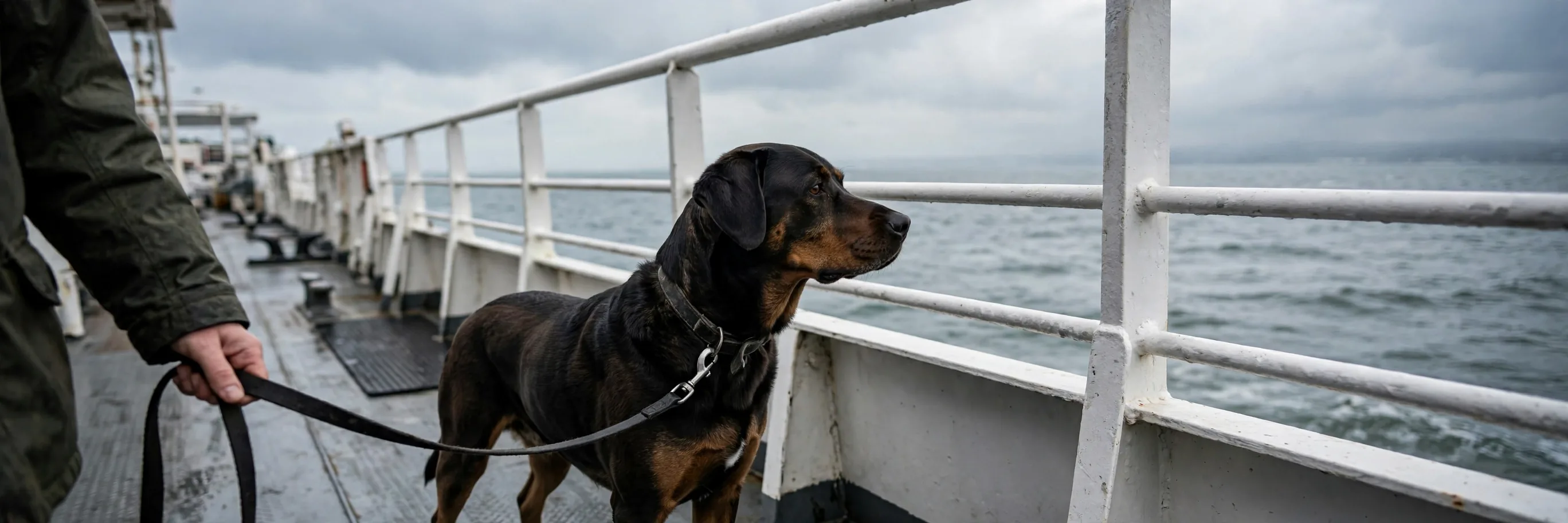
Beyond the big four, domestic and island operators — including Caledonian MacBrayne (CalMac) in Scotland, NorthLink Ferries to Orkney and Shetland, Red Funnel and Wightlink to the Isle of Wight, and the Isles of Scilly Steamship Company — generally welcome dogs, often with dogs allowed in designated areas of the ship rather than confined to a vehicle. Rules about leads, muzzles on some international services, and which lounges are excluded still apply. The pattern to remember is simple: the shorter and more domestic the crossing, the more likely your dog can stay close to you; the longer and more international it is, the more likely a vehicle, kennel or booked pet cabin is involved.
Irish Ferries' official pet travel FAQs cover its Irish Sea routes: dogs may stay in the vehicle, in a kennel, in the Pet Den lounge with their owner where available, or in a pet cabin on the James Joyce only.
Where your dog will actually stay
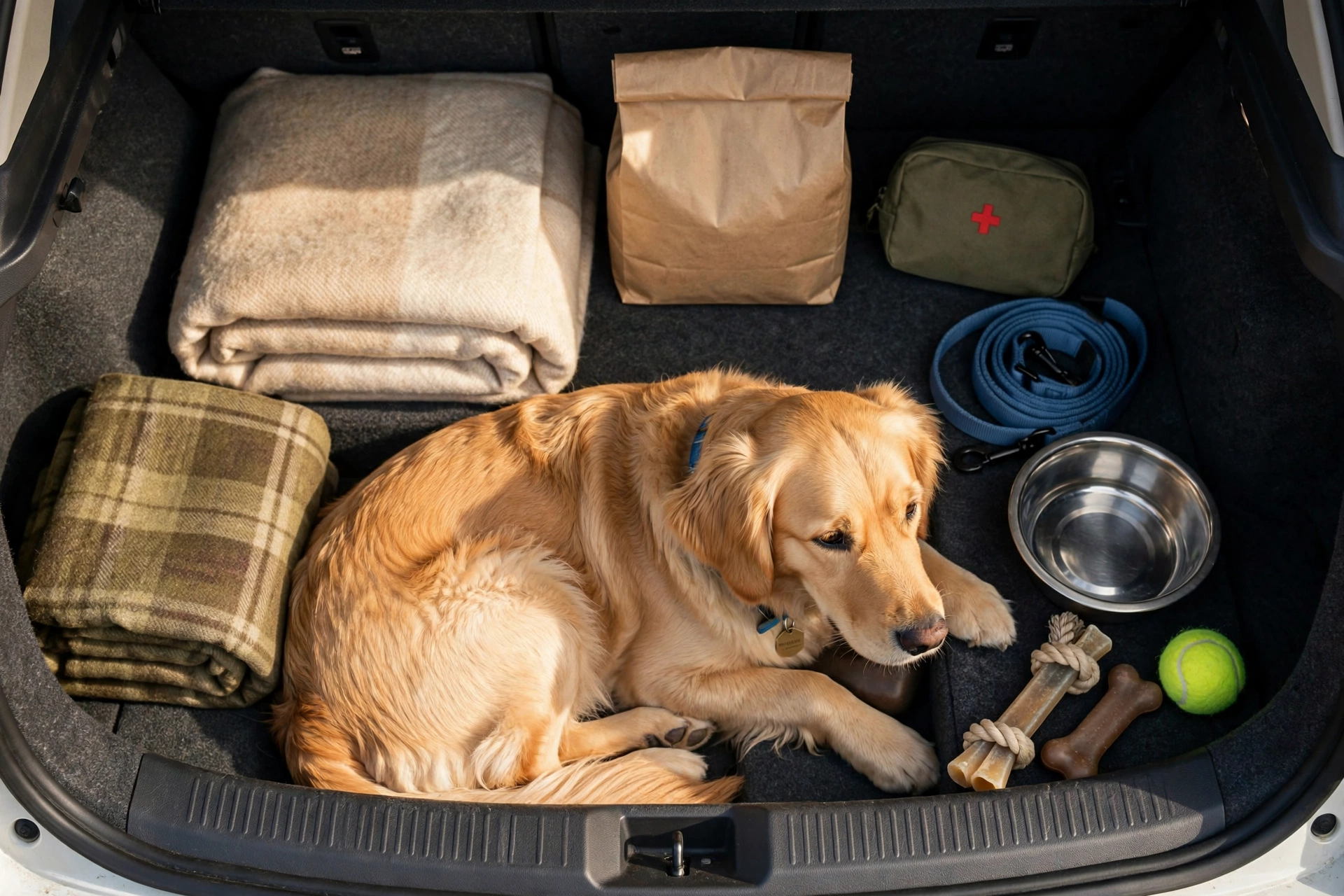
There are four main arrangements, and choosing between them — where you have a choice — is the most important welfare decision in ferry travel. The first is staying in your vehicle. This is common on short crossings and suits dogs that settle well in the car. The downsides are fixed: you cannot stay with the dog, you normally cannot visit during the sailing because passengers must leave the car deck, and temperature inside a vehicle on a steel deck needs thought in summer. Never assume you will be allowed back to the car mid-crossing to check.
The second arrangement is onboard kennels. Kennels vary from basic cages in a dedicated room to larger kennel areas with bedding space and water. You usually supply bedding, and on some ships you can visit at set times, sometimes accompanied by crew. Kennels suit dogs that are crate-trained and unbothered by neighbouring dogs; they are a poor fit for dogs that bark continuously at strangers or guard their crate. Ask about kennel sizes if you have a large breed, and whether two dogs from the same household may share.
The third is a pet-friendly cabin, available mainly on overnight and longer routes. Your dog stays with you, usually with a laminate or easily cleaned floor, and there is normally a designated exercise area nearby. This is the least stressful option for most dogs and the most expensive and scarcest. The fourth is a pet lounge or designated dog area, where dogs stay with their owners in a specific room or deck area for the crossing, on a lead, and are excluded from other passenger areas. This works well on medium-length crossings but requires a dog that can settle in company for several hours. Whichever arrangement you book, pack for it using a proper list — our dog road-trip packing checklist covers bedding, water, food and paperwork organisation that transfers directly to ferry travel.
Assistance dogs are the exception throughout. They are generally permitted to remain with their handler in passenger areas and should not be charged a pet fee or counted in the same way as a pet dog. If you travel with an assistance dog, tell the operator at booking so any access arrangements and documentation checks are handled before you reach the port, and carry the identification the operator and destination require.
Operator comparison: where your dog stays
The table below summarises, for the largest operators, where dogs stay and whether they can stay with their owner. Arrangements vary by route and ship, so treat this as a starting point and confirm the exact product for your sailing.
| Operator | Where the dog stays | Can the dog stay with its owner? | Official source |
|---|---|---|---|
| P&O Ferries | In the vehicle, or in the Pet Lounge on Dover–Calais (must be booked) | Yes, in the Pet Lounge; no, in the vehicle | P&O pet lounge |
| Stena Line | In the vehicle (selected routes), in an onboard kennel, in a pet-friendly cabin, or in the Pet Lounge on Cairnryan–Belfast Superfast sailings | Yes, in a pet-friendly cabin or the Pet Lounge; no, in a kennel or the vehicle | Stena Line pets |
| DFDS | In the vehicle, in a kennel, or in a pet-friendly cabin, depending on the route (Newhaven–Dieppe and Newcastle–IJmuiden offer cabins and kennels) | Yes, in a pet-friendly cabin; no, in a kennel or the vehicle | DFDS pet travel |
| Brittany Ferries | In the vehicle, in a kennel, or in a pet-friendly cabin on selected ships; dogs must wear a muzzle outside the vehicle or cabin | Yes, in a pet-friendly cabin; no, in a kennel or the vehicle | Brittany Ferries pet travel |
| Irish Ferries | In the vehicle, in a kennel, in the Pet Den lounge where available, or in a pet cabin on the James Joyce only | Yes, in the Pet Den or a pet cabin; no, in a kennel or the vehicle | Irish Ferries pet travel FAQs |
Whether foot passengers may bring dogs, and which exact arrangement applies to a given ship, varies by route — check the operator page linked above for your sailing. Figures were checked against the operator pages in October 2026; always confirm the latest official guidance before you travel.
What it costs
Expect to pay a per-dog, per-crossing fee on most international routes. As a broad planning range, short cross-Channel crossings have commonly charged in the region of £15–£25 per dog each way, Irish Sea and North Sea routes somewhat more, and long routes to Spain at the higher end, with pet cabins priced as a cabin upgrade on top of the pet fee. Domestic island crossings are often cheaper: some include dogs free, particularly for foot passengers, while others charge a few pounds. These figures are indicative only, they change frequently, and promotional vehicle fares rarely include the pet element. Always check the operator's latest official prices for your route and direction before you travel, and get the all-in total — vehicle, passengers, dogs, cabin and any port or environmental supplements — on one confirmation.
Two cost traps catch people out. The first is direction: fees can differ by direction of travel, and a return booking sometimes prices each leg separately, so a headline one-way pet price quietly doubles. The second is change fees. If you amend a sailing, confirm the dog booking and any pet cabin move with it; an amended vehicle booking does not automatically guarantee the pet product survives the change. If you are comparing a ferry against driving through the Channel Tunnel with your dog, compare total door-to-door cost and total time the dog spends confined, not just the ticket price — the cheapest crossing is poor value if it adds three stressful hours for the dog.
Budget also for the small extras that make the crossing work: a spare lead and collar, familiar bedding you are willing to wash, poo bags for port and exercise areas, bottled water and a non-spill bowl, and food measured into individual meals for long crossings. None of this is expensive, but all of it is harder to improvise at a port shop at midnight.
Documents and entry rules
For domestic UK crossings — to the Isle of Wight, the Scottish islands, the Isles of Scilly and similar destinations — no pet passport or health certificate is normally needed. Bring your normal essentials anyway: a lead, an up-to-date microchip record, your vet's number and any medication your dog needs, stored where you can reach it rather than locked in the car if the dog is travelling in a kennel or cabin.
For international travel, the rules are formal and they change. Travelling from Great Britain to an EU country or to Northern Ireland generally requires your dog to be microchipped, vaccinated against rabies and in possession of either a valid pet passport issued in an EU country or Northern Ireland, or an animal health certificate issued by an official veterinarian within the required window before travel. Returning to Great Britain has its own requirements, including, for most routes, tapeworm treatment administered by a vet within a specified window before return when travelling from certain countries. Dogs must travel on approved routes with approved carriers for the pet travel scheme, which the main ferry operators on international routes generally are. Prohibited types and breed-specific rules at your destination are a separate check again.
None of the above should be taken from a travel guide alone, including this one. Rules, time windows and accepted documents are set by government and change with little notice. Check the current official government guidance on taking your pet abroad and your operator's latest pet travel pages several weeks before departure — an animal health certificate, in particular, cannot be arranged the day before you sail. Allow time for a vet appointment, check the certificate details letter by letter when it is issued, and carry paper copies as well as phone photos. A document error discovered at check-in usually means the dog does not travel, and sailings do not wait.
Ireland deserves a specific note. Travel between Great Britain and the Republic of Ireland and between Great Britain and Northern Ireland has not always been treated identically, and requirements have been revised in recent years, including checks for movements into Northern Ireland. Do not rely on an older trip, a forum post or a previous crossing as evidence of what is required now. For any Ireland crossing, check the latest official guidance for your exact direction of travel before you book, not just before you sail.
Booking step by step
Start with the route, then check the pet product, then book everything together. First, choose the shortest crossing that fits your wider journey if your dog is an untested sailor — a two-hour crossing is a sensible trial before committing to an overnight or a Spain sailing. Second, on the operator's booking path, add the dog explicitly and select the arrangement you want: vehicle, kennel, pet cabin or pet lounge where offered. If the website offers no pet option for a sailing, that usually means pets are not carried on that sailing or must be booked by phone — do not simply turn up.
Third, read the conditions attached to the pet product before paying. Look for maximum dogs per vehicle or cabin, any muzzle requirement at check-in or in public areas of the ship, whether you may visit kennelled dogs and when, and what happens in rough weather if an exercise area closes. Fourth, note the check-in deadline for vehicles carrying pets, which can be earlier than the standard deadline because document checks take longer on international routes. Build in extra time at the port regardless: a calm toilet break and a short walk before boarding is worth more than a last-minute dash.
Fifth, keep everything together. Save the booking confirmation showing the dog, the pet travel documents, your vet's contact details and the operator's pet policy page for your route in one place. If you are planning a wider trip around the crossing — for example a short stay immediately after landing — our plan for weekend breaks with dogs in the UK will help you keep the first day deliberately light, which matters after an early check-in or an overnight sailing.
On the day of the crossing
Feed and exercise with the sailing in mind. A proper walk and toilet opportunity shortly before check-in, a small meal several hours before boarding rather than a full bowl at the port, and fresh water offered regularly suit most dogs better than travelling on a full stomach. At the port, follow the lanes and instructions for vehicles with pets; document checks, where they apply, usually happen before boarding, and staff may scan your dog's microchip, so make sure you can present the dog safely and calmly on a lead.
Once on board, settle the dog exactly as booked. In a vehicle, leave familiar bedding, ensure ventilation as directed by crew instructions, remove anything that could fall during the sailing and never leave windows or conditions in a way that staff have told you not to. In kennels, set up bedding, water as permitted and a familiar item, then leave promptly — lingering makes most dogs worse. In a cabin or pet lounge, establish the dog's bed in one corner, offer water, and keep the lead on in shared areas as required. Dogs are normally excluded from restaurants, standard lounges and shops even on dog-friendly ships, so plan your own meals and breaks around that, in pairs if you are travelling with another adult.
Motion sickness and anxiety are manageable if you plan for them. Signs include drooling, lip-licking, restlessness and vomiting. Short crossings, a position near the middle of the ship where you have any choice, familiar smells and a settled routine all help. If your dog already struggles in the car, speak to your vet well before the trip about motion sickness or anxiety options; do not experiment with human medication. In rough weather, accept that deck exercise areas may close and that a crossing may simply be endured rather than enjoyed — a dog that has toileted well before boarding copes far better with a delayed chance afterwards. On arrival, give the dog a toilet break and water before any long onward drive, and check them over before you settle into the journey.
Choosing a route by length
Match the crossing to your dog, not just to the map. Crossings under about two hours — Dover to Calais or Dunkirk, most Isle of Wight services and many Scottish island hops — suit almost any dog that can settle in a car or on a lead, and they are the right place to learn how your dog handles ferries. Crossings of roughly two to six hours, such as Newhaven to Dieppe, Holyhead to Dublin or Portsmouth to the Channel Islands and northern France, reward a kennel, pet lounge or cabin where available, and a dog that has already done a short crossing calmly.
Overnight crossings of seven hours and more — Newcastle to IJmuiden, Hull to Rotterdam, Liverpool or Cairnryan to Belfast and the longer Brittany Ferries routes — should be planned around sleep. A pet cabin transforms these crossings for both dog and owner and is worth booking months ahead in peak season. The longest routes, to northern Spain, are a commitment of a full day or more on board; consider honestly whether your dog, and especially an older dog, a puppy or a dog with a medical condition, is better served by a shorter crossing plus a road journey broken with overnight stops. Your vet can advise on fitness to travel for long sailings, and that conversation belongs weeks before departure, not at check-in.
Whichever route you choose, the preparation is the same: book the dog at the same time as yourself, confirm the arrangement for the specific ship, verify documents and prices against official sources before travel, and keep the first day on the far side deliberately undemanding. Done that way, ferries are one of the most practical ways to travel with a dog from Britain — your dog travels with your car, your luggage and your routine, and arrives ready to start the trip rather than recover from it.
Keep exploring
Taking the ferry route to Skye via Mallaig? The Isle of Skye dog guide covers the crossing, single-track roads and lead rules. See: Isle of Skye with a dog.
Practical questions
Before you go
Can dogs go on ferries in the UK for free?
Rarely on longer international routes. Most cross-Channel, Irish Sea and North Sea operators charge a per-dog, per-crossing fee, while some short domestic and Scottish island crossings include dogs at no extra charge or for a small fee. Always check the total for your exact route and direction before booking, as prices and inclusions change and should be confirmed against the operator's latest information before travel.
Can my dog stay with me during the crossing?
Only where the operator offers pet cabins, a pet lounge or a designated dog area on that ship and route. On many routes dogs must stay in your vehicle or in onboard kennels and cannot enter passenger restaurants and lounges. Assistance dogs are treated differently and are generally allowed with their handler. Check the arrangement for the specific ship sailing on your date, not just the route in general.
Does my dog need a passport to travel on a ferry?
For purely domestic UK crossings, such as to Scottish islands or the Isle of Wight, no pet passport is normally required. For travel between Great Britain and the EU or Northern Ireland, and for return to Great Britain, you will need to meet the current pet travel rules, which can include microchipping, rabies vaccination and an animal health certificate or valid pet passport. Rules change, so check the official government guidance and your operator's latest requirements well before travel.
Can I visit my dog during the crossing?
It depends on where the dog is travelling. Dogs in pet cabins stay with you, and kennel areas on some ships allow visits at set times accompanied by crew. Dogs left in vehicles on the car deck usually cannot be visited during the sailing because passengers are not allowed on the car deck while at sea. Confirm visiting arrangements when you book if regular checks matter for your dog.
What if my dog gets seasick or is frightened?
Choose the shortest suitable crossing first, travel on a calm-weather day where you can, feed a small meal several hours before sailing rather than a full meal just before boarding, and provide water, familiar bedding and a long-lasting chew where the travel arrangement allows it. Speak to your vet well in advance about motion sickness or anxiety if you already know your dog struggles in cars. Never give human travel-sickness medicine unless a vet advises it.
Do dogs need a pet passport for UK domestic ferries?
No — for domestic routes within the UK, such as to Scottish islands or the Isle of Wight, your dog does not need a pet passport. International routes, including cross-Channel sailings, require an animal health certificate and other documents, so check your operator's requirements before booking.