This guide is independent and contains no paid placement. If affiliate links are added later, they will be clearly marked and will not change our editorial checks.
Rent a hut where the owner or council explicitly allows dogs inside or on the veranda, and check the beach rules separately, because a dog-friendly hut does not guarantee a dog-friendly beach. Pack a bed, water, shade and a towel, and plan walks around tides and heat. Book early for peak weekends.
What a beach hut actually is
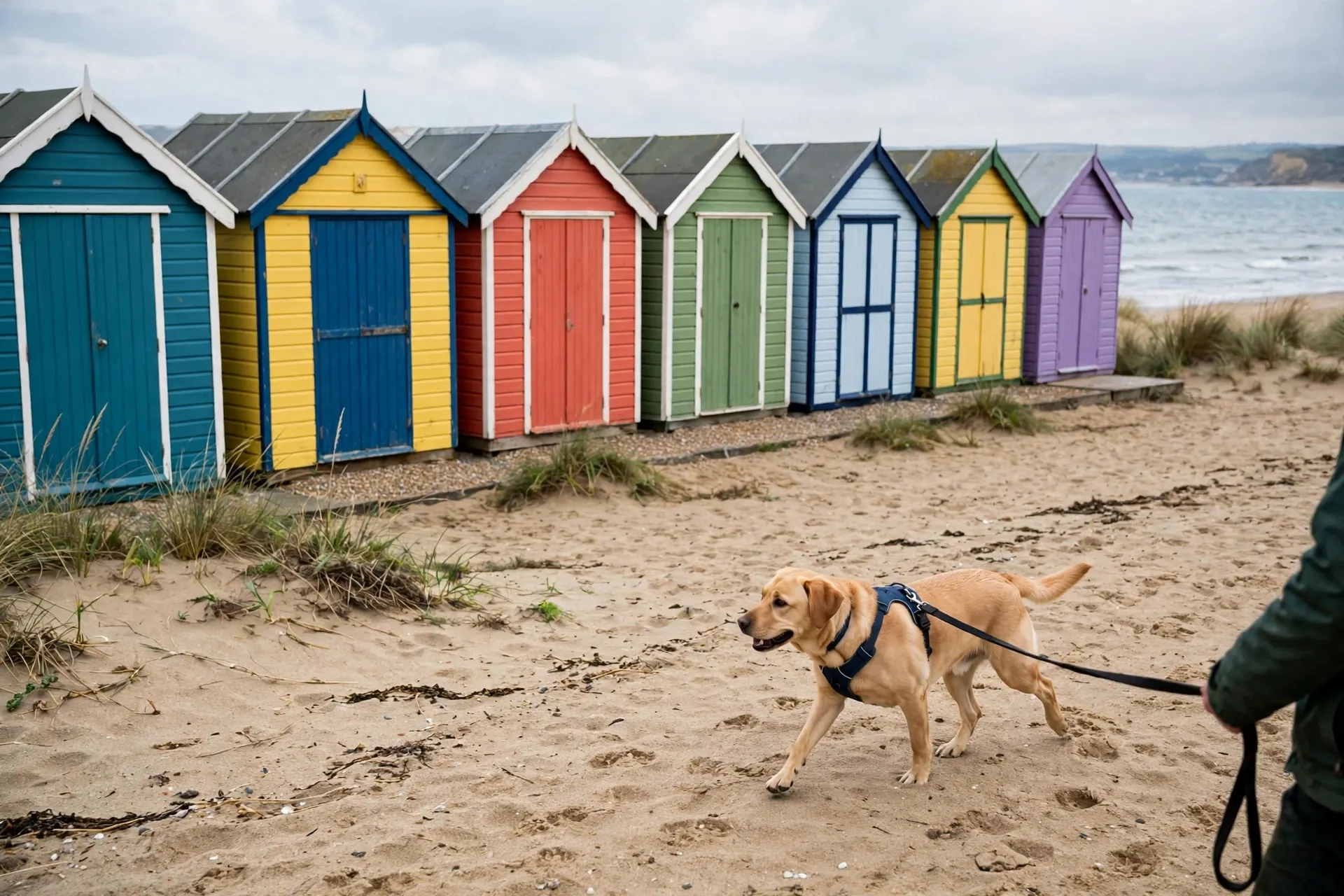
A beach hut is a small, wooden, day-use structure on or just behind a beach, usually painted in bright colours, with a door that opens onto a veranda or a small deck. Inside, there is typically space for chairs, a small table, storage, and sometimes a kettle, a gas stove, a sink or a cupboard, but there is rarely a toilet, a bed, heating or running water in the sense a cottage has. A hut is a base for a beach day: a place to change, to eat, to shelter from wind or a shower, to store bags, and to sit in the shade, not a place to live in.
That distinction matters for dogs, because a hut day is still a beach day, with all the beach's rules, risks and pleasures. A dog in a hut still needs water, toilet walks, shade, and supervision, and a hut does not make a hot, crowded or restricted beach suitable for a dog that would otherwise struggle there. What a hut does offer is structure: a familiar spot the dog can return to, a shaded place to rest between swims and walks, a windbreak on a breezy day, and a secure place to store bags while you walk the dog along the shore. For many owners, that structure turns a beach day from a scramble into a relaxed outing.
Huts vary enormously by location. A hut on a wide, sandy resort beach in Dorset, Devon or Norfolk, with a promenade, cafes and toilets nearby, is a different product from a hut on a quiet, shingle beach in Suffolk or Northumberland, where facilities are minimal and the hut is simply a shelter. Some huts are large enough for a family and a dog to sit inside comfortably. Others are barely large enough for two chairs and a dog bed, and the real living space is the veranda and the sand in front. Ask for the hut's size, its veranda, and what is actually inside, because photos taken with a wide lens can make a tiny hut look spacious.
Huts also vary in ownership and management. Council-owned huts are usually rented by the day, week or season through the local council, with standard rules and standard facilities. Privately owned huts are rented by owners, often through local agencies or holiday platforms, with individual rules, individual furnishings, and individual attitudes to dogs. A hut that is part of a holiday park or a beach club may come with extra facilities, such as a cafe, a shop or a dog wash, while a standalone hut may come with nothing but a key. The ownership model determines who you ask about dogs, who you pay, and who you call if something goes wrong, so work it out before you book.
Day hire, weekly hire and private huts
Day hire is the most common way to try a beach hut, and the simplest way to test whether your dog enjoys a hut day. You book a single day, usually from morning to evening, collect a key from a council office, a beach office or a key safe, and return the key at the end of the day. Day hire suits a one-off beach trip, a birthday, or a family day where you want a base but do not want to commit to a week. It also suits dogs that are new to huts, because a single day is a low-stakes trial.
Weekly hire, or a short break of several days, suits a holiday where the beach is the main attraction and you return to the same hut each day. Weekly huts are often rented from Saturday to Saturday, or for a set number of days, and may include a parking permit, a toilet key, or access to a beach club. A weekly hut gives the dog a routine: the same hut, the same veranda, the same walk to the water, day after day, which many dogs love. It also gives you a reason to stay in one place, rather than driving to a different beach each day, which can be more relaxing for everyone.
Seasonal hire, where a hut is rented for a whole summer season, is usually for local residents or regular visitors, and is rarely relevant to a holidaymaker, but it explains why some rows look fully occupied even when few huts seem in use. Seasonal hut owners often know each other, have established routines, and may be less welcoming to a one-day visitor who does not know the local etiquette. If you are day-hiring in a row dominated by seasonal owners, be extra considerate about noise, dogs and shared space, because you are a guest in a small community, not just a customer on a beach.
Private huts rented through agencies or platforms can offer better furnishings, more flexible dates, and clearer dog policies than council huts, but they can also be more expensive and less standardised. A private hut may include chairs, a kettle, a barbecue, a windbreak and a dog bed, or it may include nothing but an empty shell. Read the listing carefully, ask what is included, and check reviews for dog-specific comments, because a listing that says dogs welcome may mean dogs welcome on the veranda only, or dogs welcome inside if they are clean and dry, or dogs welcome with an extra cleaning fee. The details, not the headline, determine whether the hut works for your dog.
Finding and booking a dog-friendly hut
Start with the beach, not the hut, because a hut on a beach that does not allow dogs, or that is crowded, steep or far from parking, is not a good hut for a dog holiday, however pretty it looks. Choose a beach that allows dogs on your dates, that has a gentle slope to the water, that has shade or space for a windbreak, and that is close enough to parking that you can carry hut kit, dog kit and a dog without a long trek. Then look for huts on that beach, rather than falling in love with a hut and discovering the beach does not suit your dog.
For council huts, search the local council's beach hut pages, which usually list availability, prices, rules and booking contacts. Council pages are often less polished than commercial listings, but they are authoritative for rules, and they will tell you whether dogs are allowed, whether there is a charge, and what facilities are included. For private huts, search local agencies, holiday platforms and hut owner associations, and filter for dog-friendly, but always confirm the dog policy directly with the owner, because platform filters are unreliable and often out of date.
When you contact an owner or a council, ask specific questions, and keep the answers. Is a dog allowed inside the hut, on the veranda, or only outside? Is there a limit on the number or size of dogs? Is there an extra charge or a deposit for dogs? What happens if the dog damages the hut or fouls nearby? Is there a toilet, a water point, a dog wash or a bin nearby? Is parking included, and how far is it from the hut? A owner who answers these clearly is an owner who has thought about dogs, and a hut that comes with clear answers is a hut you can plan around.
Book early for peak times, because popular huts in popular resorts book out months ahead for summer weekends, school holidays and bank holidays. If you need a hut at a quiet end of a row, a hut near a toilet or a water point, or a hut with a large veranda for a large dog, say so when booking, because hut location within a row matters as much as the hut itself. A hut at the end of a row, away from the main access point, is quieter and better for a reactive or nervous dog, while a hut in the middle of a row, near a cafe or a toilet, is more convenient but busier. The booking conversation is where you secure the location that suits your dog, not just a hut with a number.
Dog rules: hut, veranda and beach
Dog rules for a beach hut break into three separate sets, and confusing them causes most problems. The first set is the hut rules: whether a dog may go inside, whether it must stay on a lead, whether it must be on its own bed, whether it may be left alone in the hut, and whether wet or sandy dogs are allowed inside. The second set is the veranda and immediate area rules: whether a dog may sit on the veranda, whether it must be tethered, and how far the dog's area extends. The third set is the beach rules: whether dogs are allowed on the beach at all, at what times of year, in which zones, and on what kind of lead.
Hut rules are set by the owner or the council, and they vary. Some owners welcome dogs inside, provided they are clean, dry and on a bed, and they provide a dog bowl and a towel. Others allow dogs only on the veranda, because inside space is small, furnishings are vulnerable, or allergies are a concern for the next guest. Others allow dogs only outside the hut entirely, which effectively means the hut is a storage base, not a shared space. None of these is wrong, but they are very different holidays, and you need to know which one you are booking. If a listing says dogs welcome without specifying inside or outside, ask, because the difference between inside and veranda-only can determine whether a rainy day is enjoyable or miserable.
Beach rules are set by the council, usually through a Public Spaces Protection Order, and they are independent of hut rules. A beach may ban dogs entirely from May to September, may allow dogs only on a designated stretch, may require dogs to be on leads on the promenade but allow off-lead on the sand, or may allow dogs all year. These rules change by beach, by season and by zone, and they are enforced with fines. Our guide to dog-friendly beaches in the UK explains seasonal bans, PSPO fines, assistance-dog exceptions and how to check a beach before you go, and it is essential reading before any hut booking, because a hut on a banned beach is a hut you cannot use with a dog on the sand in front of it.
Also check the rules for the promenade, the car park, the cafe and the toilets, because a hut day involves all of them. A dog may be allowed on the beach but not on the promenade, or allowed on the promenade on a lead but not in the cafe, or allowed in the cafe only on a terrace. Plan the day around these rules, not against them: a hut near a dog-friendly cafe, with a promenade that allows dogs, and a beach zone that allows dogs, is a hut day that flows, while a hut where every step involves a different rule is a hut day that feels like an obstacle course. Check the official guidance before you travel for the specific beach, hut and council, because rules change and online listings do not always keep up.
Setting up a hut day with a dog
A hut day starts with unloading, and unloading is easier if you plan it. Park as close as you can, carry hut kit and dog kit in as few trips as possible, and set up the hut before you let the dog settle, because a dog that is trying to settle while bags are being moved, chairs are being unfolded and a kettle is being found will be unsettled for longer. Set up the dog's bed in a shaded, draught-free spot, inside the hut or on the veranda as the rules allow, with water nearby, a lead hooked where you can reach it, and treats in a pocket. Let the dog sniff the hut, the veranda and the immediate sand, on a lead, before you sit down, because a dog that has explored its base will settle faster than a dog that is asked to sit still in a strange place.
Plan the day in blocks, not as one long beach session. A morning walk along the shore, a swim or a paddle, a rest in the hut, a lunchtime walk, an afternoon rest, and an evening walk is a rhythm that suits most dogs, especially in summer when heat and crowds peak at midday. Use the hut for the rest blocks: shade, water, a chew, and a quiet settle, while you read, eat or watch the sea. A dog that rests in the hut at midday is a dog that will enjoy the evening walk, while a dog that is kept on a hot beach all day will be exhausted, dehydrated or over-excited by evening.
Shade, water and wind protection are the three practical needs of a hut day. A hut provides shade inside, but the veranda and the sand in front may be in full sun, so bring a windbreak, an umbrella or a shade cloth for the dog's outside area. Water should be fresh and available at all times, in a bowl that will not tip over in wind, and refilled regularly, because a dog on a beach drinks more than at home. Wind protection matters on a breezy day, because a dog that is cold and windswept will not settle, even in a hut, so a windbreak, a blanket and a drying coat all help. Pack for the hut you have, not the hut you imagined: a small hut with no veranda needs more outside shade, while a large hut with a veranda needs less.
End the day with a routine, too. Walk the dog, clean the hut, shake out the bed, wash the bowl, and return the key as instructed, with the hut in the condition you found it. Take a photo of the hut on arrival and on departure, so any dispute about damage or cleanliness can be resolved quickly. A hut that is left clean, with no dog hair, sand or damage, is a hut that will welcome dogs again, and a guest who leaves a hut clean is a guest who will be welcomed back. Hut communities are small, and reputations, for dogs and owners, travel fast.
Weather, tides and safety
Weather on a beach changes faster than weather inland, because wind, sea mist and showers arrive without warning, and a hut that is sunny at 10am can be cold, wet and windswept by 2pm. Pack for the forecast plus one step worse: a waterproof jacket, a warm layer, a towel and a drying coat for the dog, and a windbreak for the veranda. Check the forecast the night before and again in the morning, and check the tide times, because a beach that is wide at low tide can disappear at high tide, leaving no sand for a dog walk and no space in front of the hut.
Tides matter for safety as well as for space. A dog that is playing on a wide beach at low tide can be cut off by a rising tide around a headland, a groyne or a rock, and a hut that is accessible at low tide may be reached only by a promenade at high tide. Know the tide times, know where the safe exit points are, and do not let a dog swim in strong currents, near groynes, piers or harbour entrances, or in water with blue-green algae, pollution or debris. If you are unsure about water safety, check our guide to dog swimming safety and check the official guidance before you travel for the specific beach and conditions.
Heat is the other safety issue on a hut day. Dogs overheat quickly on sand, which radiates heat, and in a small hut, which can become hot in sun, even with the door open. Provide shade, water and rest, avoid vigorous exercise at midday, and watch for signs of overheating: excessive panting, drooling, lethargy, vomiting or collapse. If a dog overheats, move it to shade, wet its belly and paws with cool water, offer small amounts of water, and seek veterinary help promptly, because heatstroke can become serious quickly. Never leave a dog alone in a hut on a hot day, even with the door open, because a hut heats up like a car, and a dog that cannot move to shade or water is at risk.
Cold, wind and rain need the same attention. A dog that is wet, windswept and cold after a swim or a shower will chill quickly, especially if it is small, young, elderly or short-coated. Dry the dog, put on a drying coat, and let it warm up inside the hut or in a sheltered spot, before the next walk. A hut day that is planned around weather, tides and heat is a hut day that is safe, while a hut day that ignores them can become uncomfortable or dangerous, however beautiful the hut looks in a photograph.
Neighbours, noise and hut etiquette
Beach huts are close together, often with only a wooden wall between neighbours, and hut etiquette matters more than in a hotel or a cottage, because sound, smells and dogs travel easily. Keep barking to a minimum, especially early in the morning and in the evening, when neighbours are relaxing. If your dog barks at passing dogs, people or children, keep it inside the hut or on a lead close to you, and distract it with a chew or a treat, rather than letting it bark from the veranda at everyone who passes. A dog that barks continuously from a hut will quickly become unpopular, and a neighbour who complains to the owner or the council can affect future dog bookings for everyone.
Clean up after your dog, on the beach, on the promenade, and around the hut, without exception, and carry poo bags on every walk. Hut rows often have bins, but not always, and bins can be full on busy days, so carry a bag for used bags until you find a bin. Do not let a dog foul in front of a neighbour's hut, on a veranda, or on a path where other guests walk barefoot, and clean up immediately if it happens, with an apology if a neighbour is nearby. Hut communities notice who cleans up and who does not, and a clean hut row is a hut row that welcomes dogs.
Respect shared space. Do not spread your kit, your windbreak, your chairs and your dog's bed across the front of a neighbour's hut, do not let a dog run loose through a row of huts, and do not play loud music or have a large, noisy gathering that disturbs neighbours. A hut day is a shared day, even if you have rented a private hut, because the beach, the promenade and the row are shared. A small amount of consideration, a friendly greeting to neighbours, and a dog that is under control go a long way, and they are often repaid with local tips, help with a key, or a recommendation for a dog-friendly cafe.
Finally, respect the hut itself. Do not let a dog chew woodwork, scratch doors, or urinate on hut walls, and clean sand, hair and mud from the hut before you leave. If damage does occur, tell the owner promptly, rather than hoping it will not be noticed, because honesty preserves trust and makes a future booking more likely. A hut that is returned in good condition, with a thank-you note or a message to the owner, is a hut that will be offered to dog owners again, and that benefits every dog owner who wants a hut day in the future.
Costs, deposits and booking tips
Costs for a beach hut vary widely by location, season and facilities. Day hire typically costs 20 to 60 pounds, with popular resorts and peak weekends at the top of that range, and quieter beaches and off-peak days at the bottom. Weekly hire can cost several hundred pounds, and seasonal hire can cost thousands, but those are rarely relevant to a holidaymaker. Always ask what is included: chairs, a table, a kettle, a gas stove, a toilet key, parking, and a cleaning fee are all items that can be included, extra, or not available at all, and the total cost depends on them.
Dog charges and deposits are part of the total, and they should be clarified before booking. Some huts include dogs free, some charge a small extra fee, and some require a refundable damage deposit, often 50 to 100 pounds, which is returned if the hut is left clean and undamaged. Ask whether the deposit is per stay, per dog, or per booking, how it is paid, and when it is returned, because a deposit that takes weeks to return is a different proposition from one returned on the day. Get the total, including the dog charge, the deposit, parking and any cleaning fee, in writing before you pay, so there are no surprises on arrival.
Cancellation terms vary too. Council huts often have strict terms, with no refund for a cancelled day, especially in peak season, while private huts may be more flexible, especially if the owner can re-let the hut. Check the terms before you book, and consider whether a hut day that depends on good weather is worth booking far ahead, or whether a last-minute booking, when the forecast is known, is a better strategy. For a special occasion, book early and accept the risk. For a casual beach day, watch the forecast and book late, if availability allows.
Finally, combine a hut day with a wider holiday plan, rather than making the hut the whole holiday. A hut day works best as part of a coastal holiday, where you also have accommodation that welcomes dogs, walks that suit your dog, and cafes and pubs that welcome dogs. Our guide to dog-friendly holiday parks can help if you want a base with facilities, a garden and a beach nearby, and a hut day can be the highlight of that holiday, rather than the only plan. A hut, a beach, a dog and a good forecast, planned together, make a day that is hard to beat, and that is why beach huts, despite their simplicity, remain one of Britain's most loved seaside traditions.
Practical questions
Before you go
Can dogs stay inside a beach hut?
It depends on the hut and the owner. Many rented huts allow a well-behaved dog inside, on a lead and on its own bed, while others allow dogs only outside the hut or on the veranda. Council huts and privately owned huts have different rules, so ask the specific owner or council before you book, and get the answer in writing.
Do beach huts allow dogs on the beach itself?
Not automatically. A dog-friendly hut does not mean the beach in front of it allows dogs at that time of year. Many beaches have seasonal dog bans or zoned areas, enforced through Public Spaces Protection Orders. Check the beach rules for your dates, and check the official guidance before you travel for the specific beach.
How much does it cost to rent a beach hut for a day?
Day hire typically costs 20 to 60 pounds, depending on location, season and facilities, while a week can cost several hundred pounds. Peak summer weekends and popular resorts cost most. Ask what is included, such as chairs, a kettle, a toilet key or parking, and whether there is an extra charge or deposit for dogs.
Can you sleep overnight in a beach hut with a dog?
Usually no. Most beach huts are day huts, with no sleeping facilities, no overnight permission and no heating or plumbing for overnight use. A few places offer huts or chalets that can be slept in, but these are a different product with different rules. Do not assume overnight use is allowed unless the listing explicitly says so.
What should I pack for a beach hut day with a dog?
Pack a dog bed or mat, a water bowl and water, food and treats, a lead and a spare, poo bags, a towel and a drying coat, and shade for the dog. Beach huts are small and often unshaded in front, so a windbreak, an umbrella or a shade cloth helps. Bring a torch if you will be there into the evening.
Are beach huts suitable for a reactive dog?
They can be, if the hut is at a quiet end of the row, the beach is not crowded, and the dog has a shaded, enclosed spot to settle. A hut in the middle of a busy row, with dogs passing constantly and children playing nearby, will be hard for a reactive dog. Choose a quiet location, visit at off-peak times, and keep the dog on a lead outside the hut.


