This guide is independent and contains no paid placement. If affiliate links are added later, they will be clearly marked and will not change our editorial checks.
Most outdoor UK Christmas markets welcome dogs on leads, but indoor halls and food courts often do not. Go on a weekday morning, keep the visit short, skip the busiest Saturday afternoons, and plan a dog-friendly pub as your warm-up stop.
Which markets welcome dogs
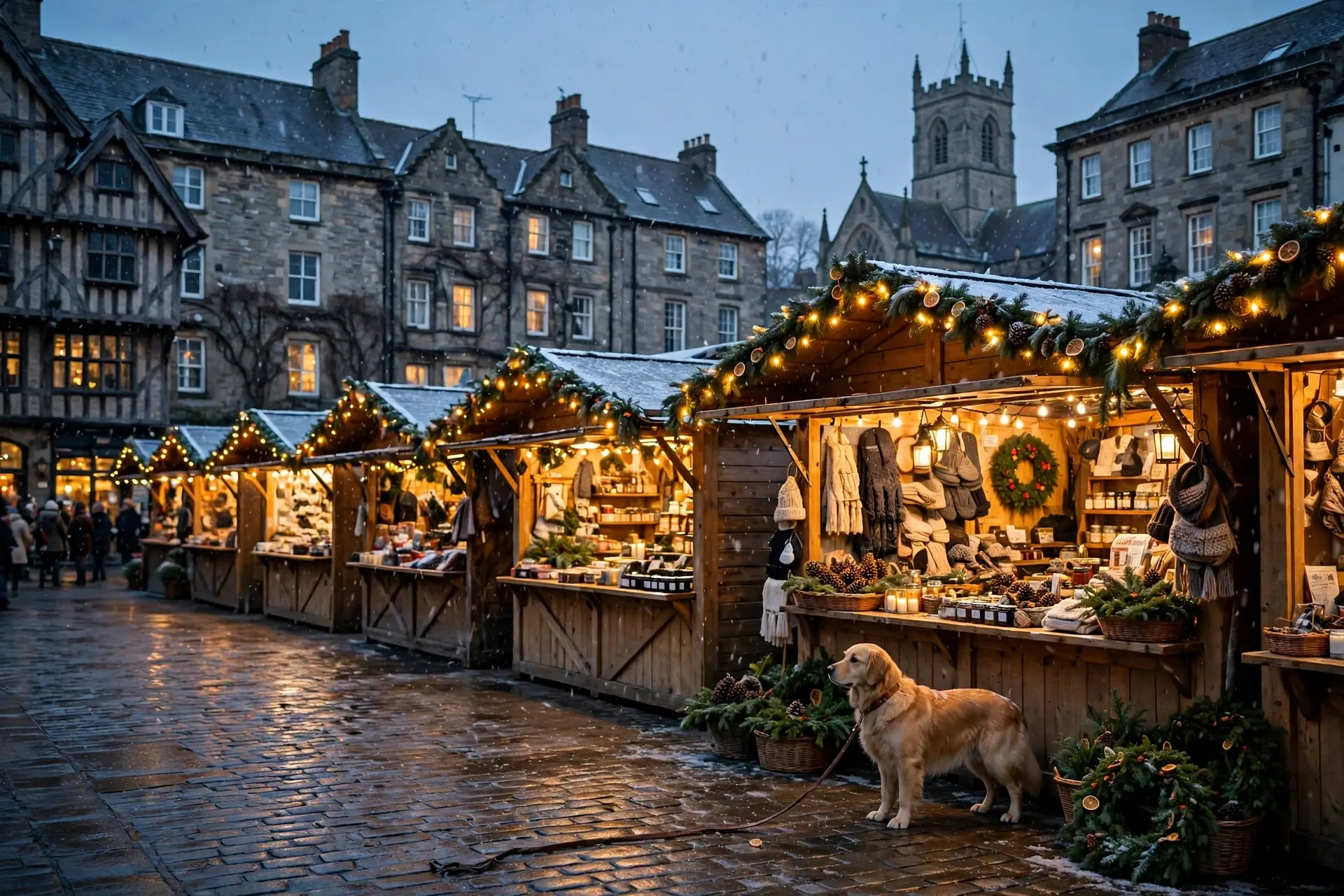
A British Christmas market is rarely one single place with one single rule. The typical market spreads across a square, a pedestrian street and sometimes a covered hall, and the dog policy can change from one part to another. The outdoor stalls are usually the easy part: a dog on a short lead is welcome at most open-air markets, from the wooden chalets of Bath Christmas Market to the stalls along York's Parliament Street during the St Nicholas Fair. The problems start at the threshold of a building. Covered food halls, indoor craft markets, heated marquees with seating, and the grottos and ticketed attractions that sit beside many markets often exclude dogs, sometimes for hygiene reasons and sometimes because the space is simply too tight for animals and queues to mix safely.
That split is why the phrase "dog-friendly Christmas market" needs checking every single year. A market that allowed dogs everywhere last December may have added an indoor food court this year, or a market that once welcomed dogs into its main hall may have changed its insurer's terms. Winchester Cathedral Christmas Market, for example, is set in the cathedral close with outdoor stalls, which suits dogs far better than a market built inside a shopping centre. Edinburgh's Christmas markets around East Princes Street Gardens combine open-air stalls with rides and ticketed areas, so a dog may be fine among the stalls and unwelcome at the fairground rides. Manchester Christmas Markets spread across several city-centre squares, which means a dog can enjoy the open squares and skip the enclosed Albert Square food areas if needed. The point is not to memorise a list, but to read each market's own visitor page before you travel, and check the official guidance before you travel if anything is unclear.
City-centre markets and small-town markets behave differently, and the difference matters for dogs. Large city markets such as Birmingham's Frankfurt Christmas Market or the Southbank Centre Winter Market in London draw enormous crowds, run late into the evening, and sit beside busy roads, trams and bus routes. They are exciting for people and exhausting for dogs, and they work best as a short, carefully timed visit rather than an all-day outing. Smaller markets in market towns — places such as the Christmas market in the market square at Skipton, the stalls around the cathedral green at Hereford, or the festive market at St Albans — tend to have wider gaps between stalls, fewer amplified stages, and a calmer pace, which suits nervous dogs and older dogs far better. A small market also makes it easier to leave: you can be back at the car or the station in five minutes instead of fighting through half a mile of crowd.
Some markets are simply a poor fit for dogs no matter how welcoming the organisers sound. A market built inside a single narrow lane, one that funnels every visitor through a single entrance arch, or one with a large funfair section will be stressful for most dogs. The same goes for markets that run a Christmas light trail through a wooded park after dark: the lights are beautiful, but the combination of darkness, crowds, music and excited children is a lot for a dog to process. If the market's own photographs show shoulder-to-shoulder crowds under a roof, take that as a warning rather than an invitation. Choose the open-air, daytime version of the experience instead.
Before you choose a market, run through four quick checks. First, is the market mostly outdoors, and does its website say dogs are welcome on leads? Second, is there an indoor hall or food court you will need to avoid, and does that leave enough of the market still worth visiting? Third, is there a green space, a riverside walk or a quiet side street within a few minutes where the dog can decompress? Fourth, how far is the car park or station, and can you get back to it without crossing the busiest part of the market? If the answers are mostly yes, the market is a reasonable choice. If the market's website says nothing about dogs at all, treat silence as a question to ask the organisers by email rather than as permission. Our guide to dog friendly Christmas accommodation covers the other half of the trip: booking a cottage or hotel where the dog can rest properly after a market visit, which matters just as much as the market itself.
Opening dates and hours also shape the decision. Most large UK Christmas markets open in mid-November and run until just before Christmas, with a few extending into the first days of January. The first week is usually the calmest, because the novelty has not yet drawn the weekend crowds, and the stalls are fully stocked. The final weekend before Christmas is the busiest and the least dog-friendly, with queues at every food stall and shoppers carrying armfuls of parcels at knee height — exactly the height of a small dog's head. Markets that close on Christmas Eve or run reduced hours on Sundays can catch visitors out, so check the day's hours on the market's own site on the morning you travel rather than trusting a listing from last year.
The best times to go
Timing is the single biggest lever you have. The same market can feel like a gentle stroll at 10am on a Tuesday and like a rugby scrum at 4pm on a Saturday, and your dog will notice the difference long before you do. Weekday mornings are the quietest window at almost every UK Christmas market. Stalls open, the light is good for photographs, the food queues are short, and there is room for a dog to walk without being stepped on. Late mornings on weekdays are nearly as good, although school groups and coach parties sometimes arrive around 11am, so an early start still wins. If you can only visit at the weekend, aim for the first hour after opening on a Sunday rather than Saturday afternoon, which is the peak for most markets.
Evenings need a separate judgement. Christmas markets look their best after dark, when the lights come on and the steam rises from the mulled wine stalls, and many visitors only ever see them that way. For a dog, though, the evening brings a stack of extra pressures: bigger crowds, louder music, more alcohol, more dropped food, and the sudden noise of a light switch-on or a firework display. Some dogs cope perfectly well with an evening visit, especially confident, well-socialised dogs that are used to busy streets. For a nervous dog, a rescue that is still settling in, or a puppy on its first festive outing, the evening is the wrong time to find out. If you do go after dark, keep the visit to thirty or forty minutes, stay on the edge of the market rather than in the middle of the crowd, and leave before the closing-time rush.
The calendar matters as much as the clock. The first week of a market's run is usually calm, the second and third weeks build steadily, and the final week before Christmas is the busiest of all. Late November weekdays are often the sweet spot: the markets are open, the lights are up, the stalls are full, and the Christmas Eve panic has not yet started. The weekend of the light switch-on ceremony is the one date to avoid with a dog unless you know the market well — switch-on nights draw huge crowds, often with live music, countdowns and fireworks, and they are the night most likely to feature a lost or frightened dog. The same applies to late-night shopping evenings in city centres, when markets stay open until 9pm or later and the surrounding streets fill with people who have been drinking since lunchtime.
Weather changes the timing calculation too. A dry, cold, bright day is ideal: the ground is firm, the dog stays clean, and the cold air keeps smells down. Rain turns market squares into a churned mix of mud, grit and dropped food, and a wet dog in a crowd is a miserable dog. Strong wind makes stall canopies flap and banners snap, which can startle a noise-sensitive dog. Snow is pretty but treacherous, because pavements are gritted and the dog's paws will be in salt for the whole visit. Check the forecast for the market town, not just for your home, and be ready to swap a Saturday plan for a Friday if the weather turns. A market that is delightful in sunshine can be a poor choice in a downpour, and there is no shame in postponing.
Finally, plan the journey around the market rather than the other way round. Arriving by train is often kinder than driving, because you avoid the hunt for a parking space and the long walk from a distant car park, but check whether the station is step-free and how busy the trains are on a Saturday. If you drive, book a car park in advance where that is possible, and choose one on the quieter side of the market so the walk in is short. Aim to arrive within the first hour of opening, give yourselves a clear leaving time before you go in, and treat that leaving time as a promise to the dog. A two-hour visit that ends on a high note beats a four-hour visit that ends with a tired, cold, overstimulated dog.
Crowd safety for dogs
Crowds are the main risk at a Christmas market, and they are a risk to the dog rather than from the dog. A market crowd moves unpredictably: people stop suddenly to look at a stall, turn around without warning, step backwards while taking a photograph, and swing shopping bags at knee height. A small dog at ankle level is almost invisible in that flow, and a large dog's tail is at exactly the height of a toddler's face. The most common accidents are not bites but stepped-on paws, tripped-over leads and knocked-over dogs, and all three are preventable with positioning and a short lead.
Keep the lead short — around one metre — and keep the dog on your inside, away from the stall front where people queue and reach. This sounds simple and it is, but it is the habit that most visitors forget once they start browsing. A long lead across a busy walkway is a trip hazard for everyone, and a retractable lead at a Christmas market is a genuine hazard: the thin cord is hard to see, it wraps around legs and pushchairs, and it gives the dog enough range to dart into a food queue. If your dog pulls towards food smells, hold the lead with both hands when you pass a food stall, and walk past briskly rather than lingering. A dog that has learned a solid "leave it" at home will still find a market full of dropped sausages and spilled hot chocolate a serious test, so do not rely on training alone.
Children deserve a special mention, because Christmas markets are full of them and they are the visitors most likely to rush up to a dog. Excited children in the run-up to Christmas, many of them hyped up on sugar and the promise of Santa, will often run straight at a dog with their hands out. Most dogs tolerate this, some enjoy it, and a few will snap if they are cornered or grabbed. Stand between your dog and an approaching child, ask the parent to let the child approach slowly, and be ready to say no politely. A dog wearing a bright yellow "please do not stroke" lead sleeve or a harness with a clear message gives strangers a visible cue before they reach you. It is not rude to protect your dog's space; it is the responsible thing to do.
Other dogs are the other variable you cannot control. Markets attract many dogs, and not all of them are under control. A loose dog racing up to yours, a pair of dogs squaring up over a dropped piece of food, or a reactive dog lunging from a stall queue can turn a pleasant visit sour in seconds. Watch the dogs ahead of you, not just the stalls: if you see a dog that is fixated, stiff or pulling hard towards yours, cross to the other side of the walkway or duck down a side street. Keep your dog moving rather than letting it stand and stare, and if another dog does approach, keep your lead loose, keep walking, and do not pick your dog up in the middle of a crowd — a lifted dog at face height in a busy market is a bite risk for everyone nearby.
Noise is the hidden crowd problem. Brass bands, choirs, fairground music, tannoy announcements and the constant hum of a thousand conversations add up to a soundscape that is far louder than a normal walk. Dogs with noise sensitivity, older dogs with hearing that has changed, and dogs that have recently been rehomed can find this overwhelming even when they look calm. The signs are subtle at first: ears pinned back, lip licking, yawning, a tucked tail, or a dog that keeps looking for the exit. If you see those signs, leave. Do not wait for the dog to start shaking or trying to bolt, because by then the stress has already built. A quiet side street, a riverside path or the car, with water and a few calm minutes, is the right response.
Have an exit plan before you go in. Know where the nearest side street is, where the market thins out, and how to get back to the car or station without crossing the main crowd. Agree with your companions that any one of you can call the visit off at any time, no questions asked. If the dog is lost in a crowd, stay where you are for a few minutes and call calmly rather than chasing through the market, and make sure your dog's tag and microchip details are up to date before you travel. Markets are not the place to test a new recall or a new lead, and they are not the place to find out that your dog's collar slips over its head when it pulls backwards.
Cold, salt and tired paws
December in Britain is cold, damp and dark, and a Christmas market asks a dog to stand still on cold stone for far longer than a normal walk. The dog is not moving enough to keep warm, the ground is often wet or frozen, and the visit can stretch to two or three hours if you are not careful. Short-coated breeds, small dogs, puppies, older dogs and dogs with arthritis feel the cold first. A dog that is shivering, holding a paw up, or trying to climb into your coat is telling you it is cold, and the answer is to go indoors or go home, not to buy another mulled wine and hope it warms up.
Grit and de-icing salt are the specific winter hazard at Christmas markets. Councils and market operators grit pavements and squares when frost is forecast, and the salt sits exactly where your dog walks. It stings cracked pads, dries the skin between the toes, and tastes unpleasant enough that many dogs will lick it off, which can upset their stomachs. The signs are a dog that keeps lifting its feet, limping slightly, or stopping to chew at its paws. If you see that, pick the dog up and carry it to a clear patch, wipe the paws with warm water when you get indoors, and check between the toes for redness or small cuts. A thin layer of paw balm before you leave home can help, and dog boots are a genuine option for a dog that will tolerate them — try them on a few quiet walks first, because a dog that has never worn boots will spend the whole market visit trying to shake them off.
Standing still is harder on a dog than walking. On a normal walk the dog moves, sniffs, changes pace and keeps its muscles warm. At a market the dog stands at your heel while you queue, stands at your heel while you browse, and stands at your heel while you chat to a friend. After half an hour of standing on cold stone, even a fit dog's legs stiffen up. Build movement into the visit: walk the market in a slow loop rather than standing in one place, step out to a nearby street or square between stalls, and give the dog a short proper walk before you go in so it is not starting cold. If the dog is lying down on the pavement, that is not a dog enjoying the market — it is a dog that has had enough.
Water and warmth need planning because markets rarely provide either for dogs. There is no dog water bowl at most stalls, and the hot drinks are for people. Bring a small bottle of water and a collapsible bowl, and offer water every half hour, especially if the dog has been walking in the cold air and panting. A drying coat or a fleece jumper helps a short-coated dog stay warm between stalls, and a spare towel in the car is worth its weight in gold if the dog gets wet. For the journey home, a blanket on the back seat and the heating on low will let a cold dog warm up gradually; do not put a wet, cold dog straight into a hot car and blast the heater, because the sudden change is uncomfortable and the condensation will fog every window.
How long is too long? For most dogs, an hour at a Christmas market is plenty, and ninety minutes is the sensible maximum for a confident, well-coated dog on a dry day. Puppies, older dogs, small breeds and nervous dogs should be out in thirty to forty-five minutes. Watch the dog, not the clock: a dog that is still bright-eyed, walking freely and interested in smells is fine, while a dog that is lagging behind, sitting down, shivering or trying to pull towards the exit has finished, whether or not you have seen every stall. The market will still be there next year, and a short happy visit this year makes a longer visit next year more likely, not less.
Market etiquette
A Christmas market runs on goodwill: stallholders are working long hours in the cold, shoppers are carrying hot drinks and fragile purchases, and everyone is packed into a small space. A dog owner who behaves well makes the next dog owner's visit easier, and one who behaves badly can get dogs banned from a market that welcomed them for years. The rules below are not written on a sign at most markets, but they are the expectations that stallholders and organisers actually hold.
Keep the dog out of the stall. That means out of the stall's footprint, not just out of the doorway: the dog's nose, tail and lead should not cross into the display, knock over a basket of baubles, or sweep a table of handmade chocolates onto the ground. Stand to one side with the dog while your companion browses, or browse from the front of the stall with the dog held close behind you. If the stall is narrow and the dog cannot fit without blocking the walkway, skip it and come back when it is quieter, or ask the stallholder whether you can look while the dog waits outside the stall with your companion. Stallholders notice this courtesy, and many will offer the dog a treat when they see a well-managed visit.
Food is the etiquette test that most dogs fail. Market food is everywhere — bratwurst, roasted chestnuts, fudge, mince pies, chocolate-dipped everything — and it is all at dog height on low tables and in open trays. A dog that steals food from a stall can be charged for it, can eat something dangerous such as chocolate, raisins, onions or xylitol-sweetened treats, and can cause a scene that ends with the stallholder asking you to leave. Keep the dog's nose away from food stalls, do not let it eat anything dropped on the ground, and never feed the dog market food as a treat. If your dog does grab something, tell the stallholder at once, pay for anything damaged, and check the official guidance before you travel about which festive foods are dangerous to dogs — chocolate, mince pies with raisins, and anything containing xylitol are the ones to know by name.
Toilet breaks need a plan, because a dog cannot wait for two hours in a crowd and the middle of a market square is not a toilet. Before you go in, find the nearest patch of grass, a quiet side street or a riverside path, and give the dog a proper toilet walk there. Carry poo bags — several, not one — and a small bottle of water to rinse a pavement if needed. If the dog does go in the market, clean it up immediately, without embarrassment and without leaving it for someone else, and move on. A dog owner who cleans up promptly is remembered; one who pretends not to notice is remembered too, for the wrong reason.
Barking, jumping and pulling are the behaviours that get dogs noticed for the wrong reasons. A dog that barks at every Santa, jumps up at every passer-by, or pulls its owner into every food queue is not enjoying the market and is making it worse for everyone else. If your dog is doing any of these, shorten the lead, move to the edge of the market, and consider leaving. This is not a training session: a crowded Christmas market is the worst possible place to teach a dog to be calm, because the environment is working against you. Go home, train in a quiet street, and come back another day if the dog is ready.
Finally, respect the stalls that say no. Some stallholders keep dogs out of their stall for good reasons — a glassware stall, a stall selling food, or a stallholder who is allergic or frightened of dogs. A polite "no dogs in this stall, please" is not a personal insult, and arguing about it helps nobody. Thank them, step back, and browse from outside. The same applies to the market's own rules: if a sign says dogs are not allowed in a particular area, do not test it. Markets that welcome dogs do so because dog owners have behaved well in the past, and the fastest way to lose that welcome is to treat it as a right rather than a privilege.
Where to warm up: dog-friendly pubs nearby
Every good Christmas market visit needs a warm-up stop, and in Britain that usually means a pub. A dog-friendly pub near the market is not a luxury — it is the practical heart of the trip, the place where a cold dog can dry off, drink some water, lie down under a table and recover before the journey home. The best pub for this is not the grandest one on the square, but the one a short walk away, with a fire, a quiet corner, and staff who genuinely like dogs rather than merely tolerating them.
Finding the right pub takes a little research, and it is worth doing before you travel. Look for pubs that describe themselves as dog-friendly in the main bar, not just on a terrace, because a terrace in December is no warmer than the market. Check whether the pub allows dogs in the dining area or only in the bar, whether there is a fire or a radiator the dog can lie beside, and whether the pub serves food at the time you will arrive — a pub that stops serving food at 2:30pm is no use if you arrive at 3pm hungry. Our guide to dog friendly cafes covers the same ground for daytime stops: many market towns have a cafe that welcomes dogs indoors and serves lunch, which can be a better warm-up stop than a pub if you are travelling with children or if the dog is not comfortable in a busy bar.
Pub etiquette for dogs is similar to market etiquette, with a few additions. Bring a blanket or a mat for the dog to lie on, because pub floors are cold and often wet, and a dog lying on a mat is a dog that settles. Order a bowl of water as soon as you sit down, and ask the staff where the dog can go to the toilet — most pubs have a small yard or a quiet street outside. Keep the dog on its lead at all times inside the pub, even if it is lying down, because a loose dog in a pub will wander into the kitchen, beg from every table, or get under the feet of a waiter carrying hot food. If the pub is busy and there is no quiet corner, consider taking your drink outside to a covered area, or moving on to a quieter pub a street or two away.
Some pubs are famous for their Christmas atmosphere, with roaring fires, candlelight and a tree in the corner, and these are wonderful places to end a market visit — provided the dog is settled enough to enjoy them. A dog that is already tired and cold will not enjoy a noisy, crowded pub any more than it enjoyed a noisy, crowded market, so read the dog before you choose the pub. A quiet backstreet pub with a fire and three regulars is a better warm-up stop than the busiest pub in town, however pretty its decorations. If the dog is very cold or very tired, the kindest option is to skip the pub altogether, drive home, and let the dog warm up on its own bed.
Plan the pub stop as part of the route, not as an afterthought. Pick a pub that sits between the market and the car park or station, so the walk home is short and the dog does not have to cross the market again after warming up. Check the pub's opening hours, because many country pubs close in the afternoon between lunch and dinner, and a pub that opens at 5pm is no use at 3pm. If you are staying overnight, choose a pub near your accommodation rather than near the market, so the dog can go straight to bed afterwards. And remember that a pub visit is for the dog's benefit as much as yours: if the dog is asleep under the table, let it sleep, and do not drag it back out into the cold for one more stall.
What to buy and what to skip
Christmas markets are designed to make you buy things you did not know you wanted, and that is half the fun — provided you buy with the dog in mind. The best purchases for a dog owner are the ones that survive the journey home, do not endanger the dog, and do not require you to carry a fragile parcel through a crowd with a dog on a lead. Handmade dog treats from a reputable stall, a new collar or lead from a local maker, a dog-themed bauble that goes on a high branch of the tree, and a jar of local honey or chutney for the kitchen are all good market buys. Buy them early in the visit, ask the stallholder to wrap them well, and put them in a bag you can carry on your shoulder so your hands stay free for the lead.
Food gifts need more thought. A box of handmade fudge, a bottle of sloe gin, a Christmas pudding or a hamper of local cheese are classic market purchases, and they make excellent gifts, but they are also exactly the things a dog will try to eat. Chocolate, mince pies, Christmas cake and anything containing raisins, currants, sultanas or xylitol are dangerous to dogs, and a gift box left on the floor of the car or by the front door is an invitation to a veterinary emergency. Keep food gifts in a sealed bag, out of the dog's reach, and check the ingredients before you let the dog near the wrapping. If you buy dog treats at the market, check the ingredients too: a stall selling "festive dog biscuits" may still use ingredients your dog cannot have, so ask what is in them and how long they keep.
Some market purchases are better skipped when you have a dog with you. Glass baubles, ceramic ornaments and anything fragile are a poor choice when one hand holds a lead and the other holds a bag, because a single tug from the dog can smash a whole purchase. Live plants, including potted Christmas trees and poinsettias, are awkward to carry and, in the case of poinsettias, mildly toxic if a dog chews them. Candles and reed diffusers smell wonderful at a stall and can be a problem at home: scented candles and essential oils can irritate a dog's airways, and a lit candle at dog-tail height is a fire risk. If you do buy candles, choose unscented or lightly scented ones, keep them well away from the dog, and never leave one burning unattended.
Dog-specific stalls are a growing feature of larger Christmas markets, and they are worth seeking out. A stall selling handmade dog coats, snoods, collars or leads lets you try the fit on your dog there and then, which is far better than guessing a size online. A stall selling natural chews or dried treats can be a good source of stocking fillers, provided you ask about the origin of the chews and whether they are suitable for your dog's size and chewing style. A stall selling dog Christmas jumpers is fun, but buy one your dog will actually wear: a jumper that is too tight, too hot, or covered in jingling decorations will be worn once and then live in a drawer. Let the dog try it on at the stall, watch whether it moves freely, and take it off again if the dog freezes or tries to bite it.
Finally, think about what not to buy at all. A market is not the place to buy a puppy, a kitten, or any live animal, and any stall offering animals for sale should be reported rather than supported. Avoid buying a dog a new toy that squeaks loudly at the stall, because the squeak will excite every dog in the market. And resist the temptation to buy the dog a whole Christmas dinner from a food stall: a bratwurst with onions, a portion of stuffing, or a slice of Christmas pudding can make a dog seriously ill. The dog's Christmas treat is a walk, a warm pub and a quiet evening at home — not a plate of market food. Buy the humans their gifts, buy the dog a chew it can enjoy at home, and save the rest of your money for the next market.
Practical questions
Before you go
Are dogs allowed at UK Christmas markets?
It depends on the market. Most outdoor markets in squares and along riversides allow dogs on leads, while indoor halls, covered food courts and some ticketed events may not. Always check the official guidance before you travel, because rules change from year to year and a single market can have different rules for its outdoor and indoor areas.
When is the quietest time to take a dog to a Christmas market?
Weekday mornings and early afternoons are usually the calmest, especially in the first week of opening and before the last weekend before Christmas. Avoid Saturday afternoons, late-night shopping evenings and the switch-on night, when crowds, music and lights are at their most intense.
How do I protect my dog's paws from salt and cold at a Christmas market?
Keep visits short in freezing weather, stick to cleared paths where you can, and wipe paws with warm water when you get indoors. Grit and de-icing salt can sting cracked pads, so check paws for redness and soreness during the visit and head for a warm pub or the car if your dog starts lifting its feet or limping.
Can dogs go inside the food halls at Christmas markets?
Usually not. Covered food halls, indoor craft halls and heated seating areas often exclude dogs for hygiene reasons, even when the outdoor stalls welcome them. Plan for one person to wait outside with the dog while the other buys food, or choose markets with outdoor seating and takeaway stalls instead.
What should I do if my dog gets stressed at a Christmas market?
Leave straight away. Move to a quiet side street, give your dog water and a few calm minutes, and do not try to push through the crowd to finish shopping. A short, happy visit that ends before stress builds is far better than a long one that ends with a frightened dog.