This guide is independent and contains no paid placement. If affiliate links are added later, they will be clearly marked and will not change our editorial checks.
Book holiday daycare at least eight weeks ahead in peak season, because good providers cap group sizes and fill early. Compare daycare, boarding and home care for your dog's temperament, verify licensing and insurance in writing, run a trial session, and agree a backup plan before you travel.
Book the daycare before the days out
The most common daycare mistake on a UK holiday is treating it as an afterthought. Visitors book the cottage, reserve the restaurants and plan the castle visit, then start ringing daycare providers a week before departure and discover that every reputable place within twenty miles is full. Daycare is not a hotel with spare rooms to open; it is a staffed, ratio-limited service, and a provider that accepts one dog too many is cutting corners on supervision. In school holidays, half-term weeks and bank-holiday weekends, the best-run settings near honeypot destinations can be booked out six to eight weeks ahead, and some take regular local dogs first, leaving only a handful of holiday places each day.
That scarcity is actually a useful signal. A provider with a waiting list, a proper assessment process and a firm cap on numbers is usually a provider that takes welfare seriously. Be suspicious of the opposite: a setting that will take any dog, any day, with no questions asked, no trial and no paperwork. Convenience at booking time can mean chaos at playtime, and your dog pays the price. Start with the daycare search at the same time as the accommodation search, and treat a confirmed daycare place as part of the holiday booking, not an optional extra to sort out later.
Distance matters more than most people expect. A daycare centre thirty minutes from your cottage sounds manageable until you add a wet morning, an unfamiliar rural road and a dog that gets car-sick. Aim for somewhere within fifteen to twenty minutes of where you are staying, and drive the route once before the first drop-off if you can. Check opening hours against your plans too: some rural providers close early on Saturdays or do not open on Sundays, which can quietly rule out the very day you needed cover. If your itinerary includes a long day trip, confirm the latest collection time in writing, because late-collection fees and, worse, a dog left waiting after closing, are avoidable problems.
Finally, be realistic about what daycare is for. It suits a sociable dog that enjoys group play and can settle in a busy room. It is a poor solution for a dog that panics in groups, guards resources, or needs constant one-to-one attention. Booking early gives you time to discover that honestly, through a trial, and to switch to a different form of care if needed. Booking late removes that choice entirely, and the fallback is often leaving the dog alone in unfamiliar accommodation, which most holiday lets prohibit anyway.
Daycare, boarding and home care compared
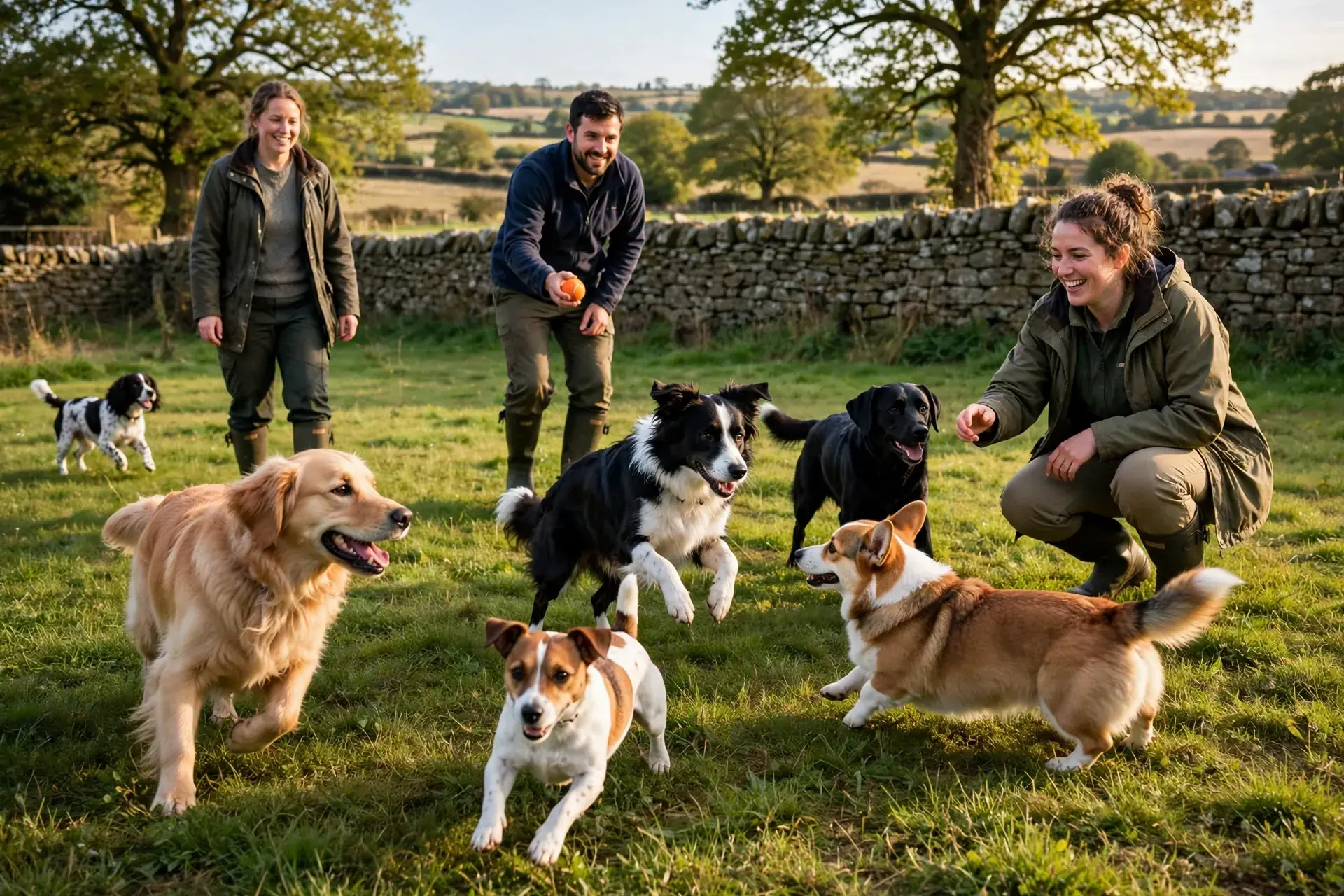
Daycare, boarding and home care solve different problems, and the cheapest option is rarely the kindest one for a particular dog. Daycare means your dog spends the day at a staffed facility, usually in group play with rest periods, and comes back to your accommodation in the evening. It works well when you need cover for specific days, such as a visit to a place where dogs are not allowed, while keeping nights together. The dog sleeps in a familiar place, which suits anxious dogs, but the days can be tiring and overstimulating for dogs that struggle with groups.
Boarding, whether at a kennel or with a home boarder, covers nights as well as days. It suits longer absences, multi-day trips without the dog, and owners who would rather not do daily drop-offs. The trade-off is a bigger adjustment: the dog sleeps somewhere unfamiliar for consecutive nights, and a dog that copes with a single daycare day may still find a week of boarding hard. Home boarding in a sitter's house is usually calmer than a kennel block, but standards vary widely, so the same credential checks in this guide apply with even more force. Our comparison of dog boarding vs daycare costs in the UK breaks down how the total bill changes with the number of days, because daycare looks cheap per day until you multiply it across a fortnight.
Home care, where a sitter visits your accommodation or stays with the dog there, is the gentlest option for nervous, elderly or reactive dogs, and often the only sensible choice for a dog that cannot cope with groups. It is also the most expensive per day and the hardest to arrange at short notice in an unfamiliar area, because a good sitter will want to meet the dog first. Some owners combine options: daycare for the sociable dog on big days out, and a sitter visit for the quiet evening. Whatever mix you choose, decide it early enough to trial each element, and make sure the dog's routine, feeding times and medication stay consistent across providers.
Ask one question for each option: what does a bad day look like here, and what happens then? A good daycare will describe how it separates an overwhelmed dog, rests it, and calls you. A good boarder will explain its night checks and what it does if a dog refuses food. A good home sitter will explain its backup if it falls ill. Vague answers to that question tell you more than glossy photos of playrooms, so listen for specifics: staff numbers, rest areas, sleep arrangements and the point at which they phone you rather than managing alone.
Check credentials, insurance and staffing
In England, dog daycare businesses that look after dogs in their own premises generally need a licence from the local authority under the Animal Welfare (Licensing of Activities Involving Animals) (England) Regulations 2018, and similar licensing arrangements apply in Scotland and Wales, though the exact framework differs by nation, so check the official guidance before you travel if you are unsure which rules apply to your destination. A licence is not a guarantee of excellence, but its absence is a red flag worth taking seriously. Ask for the licence number and the licensing authority, and check that the licence covers daycare specifically rather than only boarding, because the two activities are licensed separately in some areas.
Insurance matters just as much. A reputable provider carries public liability insurance and care, custody and control cover for the dogs in its charge, and should be willing to confirm the insurer and the scope of cover without fuss. Ask what happens if your dog is injured, if your dog injures another dog, or if property is damaged, and get the answer in writing. Also ask about veterinary cover: some providers include emergency vet fees up to a limit, others expect the owner's own pet insurance to pay, and the distinction matters at 6pm on a Saturday when a decision cannot wait for a phone call.
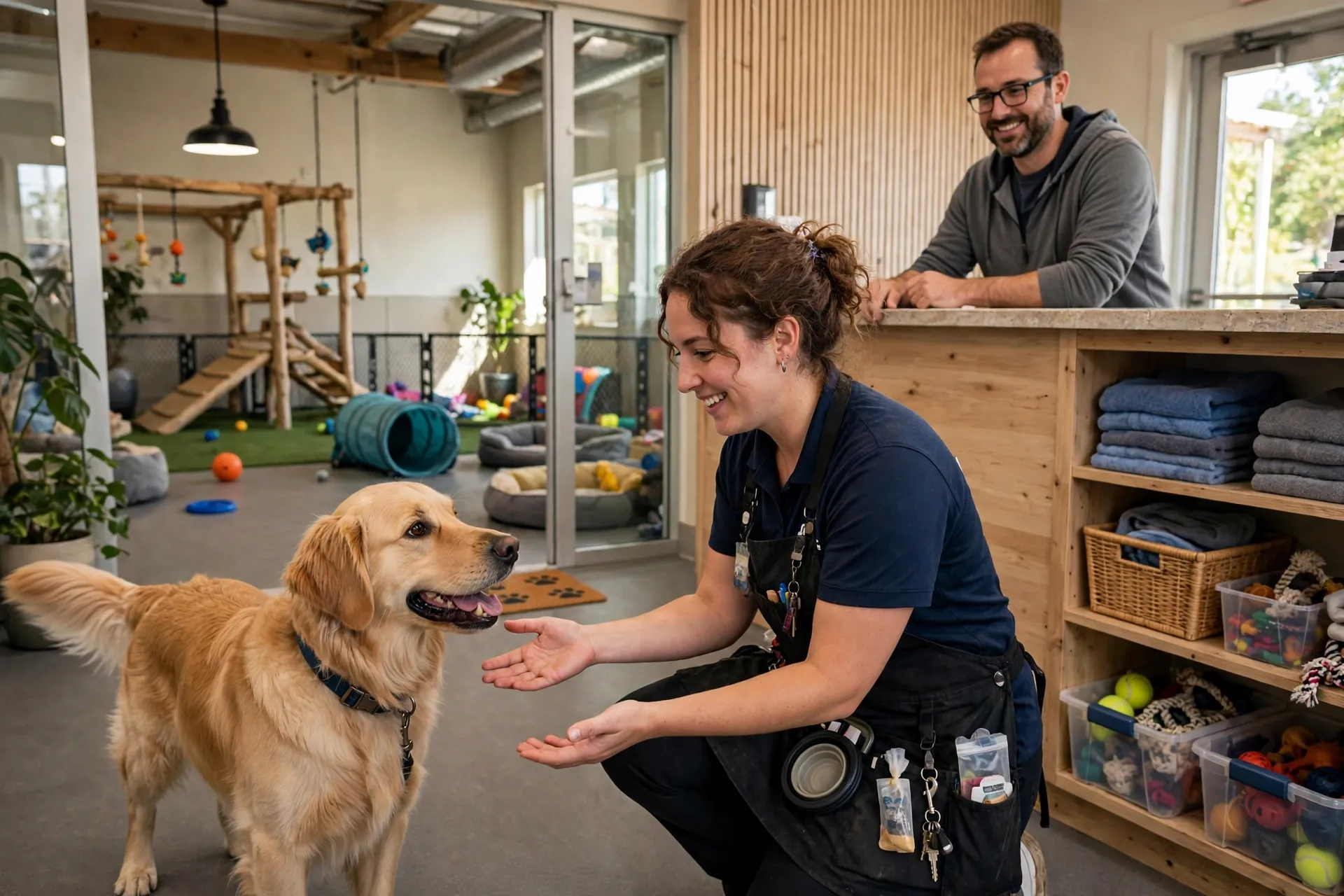
Staffing is where quality shows. Ask for the staff-to-dog ratio and how it changes across the day, because a ratio that looks fine at 10am may thin out at lunchtime when staff rotate breaks. Ask whether staff are trained in canine body language, first aid and safe handling, and whether the same handlers work with your dog each day, since consistency helps nervous dogs enormously. A provider that can name its training, describe its incident reporting and show you its daily routine is giving you evidence; one that answers every question with "we love dogs" is giving you sentiment. Also check the premises: secure fencing of adequate height, separate areas for small and large dogs, quiet rest zones away from play, shade and water in summer, and a clean, dry indoor space for wet weather.
References and reviews deserve a sceptical read. Recent reviews from holiday visitors are more useful than a hundred local regulars, because they describe the exact situation you will be in. Look for mentions of communication, honesty about incidents, and how the provider handled a dog that struggled. One bad review among many good ones is normal; a pattern of dogs coming home exhausted, injured or distressed is not. If the provider belongs to a trade body or holds additional qualifications, note them, but treat the licence, the insurance and the staffing answers as the core checks that no badge can replace.
Trial sessions and settling in
Never send a dog to a new daycare for a full day on holiday without a trial first, if the provider offers one. A trial, usually called an assessment or taster session, is a short visit in which staff observe how your dog enters the building, meets other dogs, responds to handlers and settles during rest periods. Good providers use it to decide honestly whether they can meet your dog's needs, and that honesty is a service, not a rejection. A provider that declines your dog after a trial has saved you a miserable holiday week; a provider that accepts every dog without assessment has not yet learned which dogs it cannot help.
Arrange the trial as early as possible, ideally during a previous visit to the area or at the very start of the holiday, before the days you actually need cover. One short trial is the minimum; two is better, because the first visit measures novelty and the second measures how the dog copes once the place is familiar. Ask for a written report after each trial: how the dog played, whether it rested, what it ate and drank, and any moments of stress. Ask specifically about toilet habits, appetite and sleep, because a dog that will not drink or rest in daycare is telling you something important, even if the play photos look joyful.
Settling in is a process, not a single morning. For the first real day, keep drop-off calm and brief: long, emotional goodbyes raise arousal and make separation harder, while a cheerful, matter-of-fact handover lets staff take over smoothly. Tell staff your dog's signals honestly, including the awkward ones: resource guarding around food bowls, fear of men in hats, a habit of mounting when overexcited. Staff cannot manage what they do not know, and a surprise behaviour in a group of twenty dogs is far harder to handle than a known one they have planned for. If your dog takes medication, demonstrate the dose and the method, and leave written instructions rather than relying on a rushed verbal explanation at the door.
Watch the first evening carefully. A tired dog after daycare is normal; a dog that is withdrawn, refuses food, drinks excessively, limps, or seems unusually distressed is giving you information. Raise concerns with the provider the same evening, while details are fresh, and be prepared to change plan. Sometimes the answer is a shorter day, a smaller group or a different rest arrangement; sometimes the answer is that daycare is not right for this dog on this trip, and a sitter or a change of itinerary is kinder. Making that call early protects both the dog and the rest of the holiday.
Vaccinations and health paperwork
Almost every UK daycare provider requires proof of vaccination, and the requirements are stricter than many owners expect, so check them weeks before travel, not the night before. The usual core vaccinations cover distemper, parvovirus and infectious hepatitis, and most providers also require kennel cough vaccination, which must usually have been given at least two weeks before attendance to be effective. Some also ask for leptospirosis cover, and a few require a recent flea and worm treatment. Because requirements vary, ask for the exact list in writing and compare it against your dog's vaccination card line by line, including dates, because a booster given too recently or a kennel cough vaccine given three days before drop-off can both mean refusal.
Keep the paperwork accessible. Photograph the vaccination card and store it on your phone, and carry the original or a vet-stamped copy in the car. If your dog has a medical condition, bring a short written summary: diagnosis, medication name and dose, timing, side effects to watch for, and your vet's phone number. Tell the provider about allergies, including food allergies, because group settings involve treats, and a well-meaning staff member offering a biscuit can undo careful management. Dogs that are unwell, even mildly, should not attend daycare: coughing, diarrhoea or vomiting can spread quickly through a group, and most providers will turn an unwell dog away at the door, which leaves you without cover for the day.
Neutering and season policies also catch owners out. Some providers will not accept entire males over a certain age, or bitches in season, because of the disruption to group dynamics. If either applies to your dog, declare it at enquiry stage rather than at drop-off. The same applies to dogs with a bite history or a formal control order: honesty at booking protects you legally and practically, whereas a withheld fact discovered mid-stay can end the arrangement immediately and leave you stranded. If your dog is not yet fully vaccinated, for example a puppy still completing its course, daycare may not be an option at all, and a sitter or family help may be the safer route; check the official guidance before you travel if the vaccination schedule is unclear.
Finally, confirm the provider's illness policy. Ask what happens if your dog becomes ill during the day, who authorises veterinary treatment, and how quickly you will be contacted. A provider that calls you at the first sign of trouble is doing its job; one that waits until collection to mention vomiting or a limp is not. Agree the vet to use, the spending limit you authorise without further contact, and the transport arrangement, because a rural daycare may be twenty minutes from the nearest practice and your own car may be parked at a visitor attraction.
Fees, deposits and cancellation terms
Daycare pricing in the UK typically runs from around £20 to £40 per dog per day, with London and the South East at the higher end and rural areas often cheaper, though holiday-area providers may charge a premium in peak weeks. The headline daily rate is only part of the bill. Ask about half-day rates, late-collection fees, charges for extra walks, medication administration fees, and whether food is included or you supply it. Some providers charge a separate assessment fee for the trial session, sometimes refundable against the first booking, sometimes not, so clarify that before you book the trial.
Deposits and payment timing vary. Some providers take full payment in advance for holiday bookings, others take a deposit with the balance due on the first day, and a few operate pay-as-you-go for regulars but require prepayment from visitors. Peak-season bookings often carry stricter cancellation terms: a deposit may be non-refundable within four weeks of the stay, or the full fee may be due if you cancel within seven days. Read the terms before paying, and compare them with your accommodation cancellation terms, because a dog-related cancellation and a cottage cancellation rarely align, and travel insurance may not cover both.
Get the total in writing, itemised per dog per day, including any extras you have agreed. If you have two dogs, ask whether a second-dog discount applies; many providers offer one, but it is not universal. Ask what happens if you need fewer days than booked: some providers refund unused days with notice, others do not, and the difference can be substantial across a fortnight. Also confirm the payment method, since some rural providers take bank transfer only, and a card payment made at drop-off may not be possible if their card machine has no signal.
Keep perspective on value. The cheapest daycare in the area is not a bargain if it runs large groups with thin staffing, and the most expensive is not automatically the best if its premium buys grooming extras your dog does not need. Judge value by the ratio, the rest arrangements, the trial quality and the communication, then check the price. A provider that sends a short end-of-day update with a photo is giving you reassurance worth paying for, especially on the first days of a holiday when you are still learning to trust a stranger with your dog.
Emergency contacts and vet authorisation
Before the first drop-off, build a small emergency pack and hand it over in writing. It should contain your mobile number and a second contact, your accommodation address and phone number, your vet's name and number, your pet insurance details and policy number, and a clear statement of what treatment you authorise if you cannot be reached. Most providers have their own emergency form; fill it in fully rather than leaving fields blank, and include the awkward details, such as a dog that panics at the vet or needs muzzling for examinations.
Agree the decision thresholds in advance. At what point should staff call you: vomiting once, a limp, a refusal to eat, a fight with another dog? The answer will differ by dog, but agreeing it beforehand prevents both under-reaction and overreaction. State a spending limit for emergency treatment when you cannot be contacted, for example authorising first aid and stabilisation up to a named amount, and confirm who pays the vet bill and how it is reclaimed. If your pet insurance requires the use of a particular vet network or pre-authorisation for costs above a threshold, say so, because a rural emergency practice may not be in that network.
Locate the nearest veterinary practice yourself, not just the one the provider uses. Save the address, opening hours and out-of-hours number in your phone, and check the drive time from both your accommodation and the daycare. In remote parts of Wales, the Scottish Highlands and rural Cornwall, the nearest emergency vet can be a long drive, and knowing that in advance changes how you plan days out. Also agree how the provider will reach you if phone signal fails at a castle or on a coastal walk: a text message, a call to your accommodation, or a message to your travelling companion are all worth naming.
Finally, plan for the human emergency too. If you fall ill, your car breaks down, or a road closure delays collection, who can collect the dog, and what identification will the provider require? Name that person in advance and tell them they are named. A provider that will only release a dog to the person who dropped it off is protecting your dog, but that protection becomes a problem if you are stuck in a hospital waiting room, so a named backup collector is a small arrangement with an outsized payoff.
The booking timeline: 8 weeks to the day
A clear timeline turns a stressful search into a manageable checklist. The dates below assume a peak-season holiday; for low-season trips you can compress them, but keep the order the same, because each step depends on the one before it.
Eight weeks before: research and shortlist
List every daycare provider within twenty minutes of your accommodation, then narrow the list to three. Check licensing, insurance, opening hours and group sizes online, then phone each one. Ask about holiday availability for your exact dates, the trial requirement, the vaccination list and the cancellation terms, and note the answers side by side. This is also the moment to check your dog's vaccination card against the strictest requirement on your list and book any booster the vet recommends, remembering that kennel cough vaccination needs about two weeks to take effect. If your dog is nervous or has a history that might complicate group care, say so now: an early, honest conversation with a provider is far more productive than a last-minute disclosure. For dogs that find groups overwhelming, our guide to reactive dog holidays explains how to choose quiet stays and off-peak walks, which can reduce the number of daycare days you need in the first place.
Four weeks before: trial, paperwork and payment
Book and complete the trial session, ideally two short visits rather than one long one. Collect the provider's written report, agree the daily routine, and confirm the exact days, drop-off and collection times, and the total price in writing. Pay the deposit if one is required, and read the cancellation terms once more before the money leaves your account. Gather the paperwork: vaccination card, vet details, insurance policy number, medication instructions and your emergency contact sheet. If you need a second provider as backup, book its trial now too, because a backup you have never visited is only a name on a list. This is also the week to confirm your own plans: which days the dog goes to daycare, which days it comes with you, and what happens on the days in between.
One week before: confirm everything twice
Phone the provider to confirm the booking, the days, the times and the price, and ask whether anything has changed: staffing, opening hours, group arrangements or health requirements. Pack the daycare bag: measured food for each day, medication with written instructions, a lead, a familiar blanket if allowed, and a labelled bag for each day if you are booking several. Confirm the driving route and the parking arrangement, and save the provider's number and the nearest vet's number in your phone. Tell your accommodation host that the dog will be at daycare on certain days, in case they need to contact you, and agree who collects the dog if you are delayed. If the trial raised any concern, this is the last sensible week to switch provider or change the plan.
On the day: calm drop-off, honest handover
Arrive on time, not early and not late. A rushed drop-off stresses the dog, and an early one can disrupt the provider's morning routine. Keep the goodbye short and cheerful, hand over the food and medication with the written instructions, and confirm the collection time and the number to call. Ask how the provider will update you, whether by text, photo or a call at lunchtime, and agree when you will hear from them if all is well. Then go and enjoy the day. Resist the urge to phone every hour; a provider that has to manage anxious owners all day has less time for the dogs. If the provider does not contact you by the agreed time, a single polite message is reasonable. At collection, ask how the day went, whether the dog ate and rested, and whether anything needs adjusting tomorrow. The first day is a learning day for everyone, and small adjustments, such as a shorter day or a different rest spot, often make the second day much better.
When plans change: backup options
Holidays rarely follow the itinerary exactly. A day trip is cancelled by weather, a restaurant turns out not to allow dogs, a child falls ill, or the dog itself has an off day. Each of these can change your daycare needs at short notice, so a backup plan agreed in advance is worth more than a perfect plan made on the day. Start by asking your chosen provider whether extra days are possible and what notice it needs. Some providers hold one or two flex places each day; others run at full capacity and cannot add a dog, however politely you ask. Knowing which kind you have booked prevents a panicked morning of phone calls.
Your second line of defence is a named alternative: a second daycare provider, a local home sitter, or a dog walker who covers the area. Research one alternative before you travel, complete its trial if you can, and keep its number saved. Home sitters are often more flexible than facilities for a single extra day, because they take fewer dogs, but they also book up early in peak season, so do not assume a sitter will be free on a Saturday in August. If you are staying near a town, a dog walker who offers group walks can cover a half day, which may be enough for a short visit to a dog-free attraction.
Sometimes the kindest backup is changing your own plans rather than finding more cover. If the dog is struggling with daycare, swapping a long day trip for a shorter one, splitting the party so one person stays with the dog, or choosing a dog-friendly alternative to the attraction can salvage the day without adding stress. Many historic houses, gardens and coastal walks welcome dogs on leads, and a day built around the dog is often the most enjoyable day of the holiday anyway. Keep a short list of dog-friendly alternatives for each planned day out, so a closed door does not become a crisis.
Finally, know your cancellation rights. If you need to drop a booked daycare day, tell the provider as early as you can; an early cancellation may be refunded or credited, and it frees a place for another dog. If the provider cancels on you, for example because of staff illness or a facility problem, ask what alternative it can offer and whether it will help you find cover. A provider that takes responsibility for its own cancellation is showing you its standards. Keep every confirmation, receipt and message until you are home, because a dispute over a cancelled day is much easier to resolve with written records than with memory.
Done well, holiday daycare buys you freedom without costing your dog its comfort. The work is front-loaded: book early, check credentials, trial honestly and agree a backup. The reward is simple, and it is the point of the whole exercise: days out you can enjoy properly, and a dog that comes home tired, happy and ready for the evening walk.
Practical questions
Before you go
How far ahead should I book doggy daycare for a UK holiday?
Start at least eight weeks ahead for school holidays and bank-holiday weekends, and sooner if your dog needs a trial session first. Good daycare places near popular holiday areas fill early because they cap group sizes, and late bookers often find only waiting lists. Book the daycare before you pay for non-refundable days out, so a full diary cannot unravel the trip.
What vaccinations does a daycare usually require?
Most daycare providers ask for up-to-date core vaccinations, usually distemper, parvovirus and infectious hepatitis, and many also require kennel cough vaccination given at least two weeks before attendance. Ask for the exact list in writing, check the dates against your dog's vaccination card, and keep a photo of the card on your phone so a last-minute query does not delay drop-off.
Can a daycare cope with a nervous or reactive dog?
Some can, many cannot, and the honest answer depends on the individual dog and the setting. Ask how groups are split, whether quiet rest areas exist, and whether staff have handled reactive dogs before. A provider that promises to fix reactivity in a week is overselling; a good one explains its limits, offers a short trial, and tells you plainly if your dog would be happier with one-to-one home care.
What happens if our plans change and we need an extra day?
That depends on the cancellation and extension policy you agreed at booking, so read it before you pay. Some providers hold a small number of flex places, others run full and cannot add days at short notice. Agree a named backup in advance, such as a second provider or a local sitter, and confirm the daily rate and latest drop-off time for an extension.
Should I book a trial session before the holiday?
Yes, whenever the provider offers one, and ideally twice: a short assessment visit, then a half day. Trials reveal how your dog copes with group play, rest periods and unfamiliar handlers, and they let staff learn your dog's signals before the real stay. If a trial goes badly, you still have time to change plan; discovering the same problem on holiday leaves you with few options.
What should I pack for a daycare day?
Pack the dog's usual food measured for the day, any medication with written instructions, a lead, a familiar-smelling blanket or item if the provider allows it, and your vet's phone number. Label everything with your dog's name and your mobile number. Avoid sending valuable bedding or favourite toys that could be lost or damaged in group play.