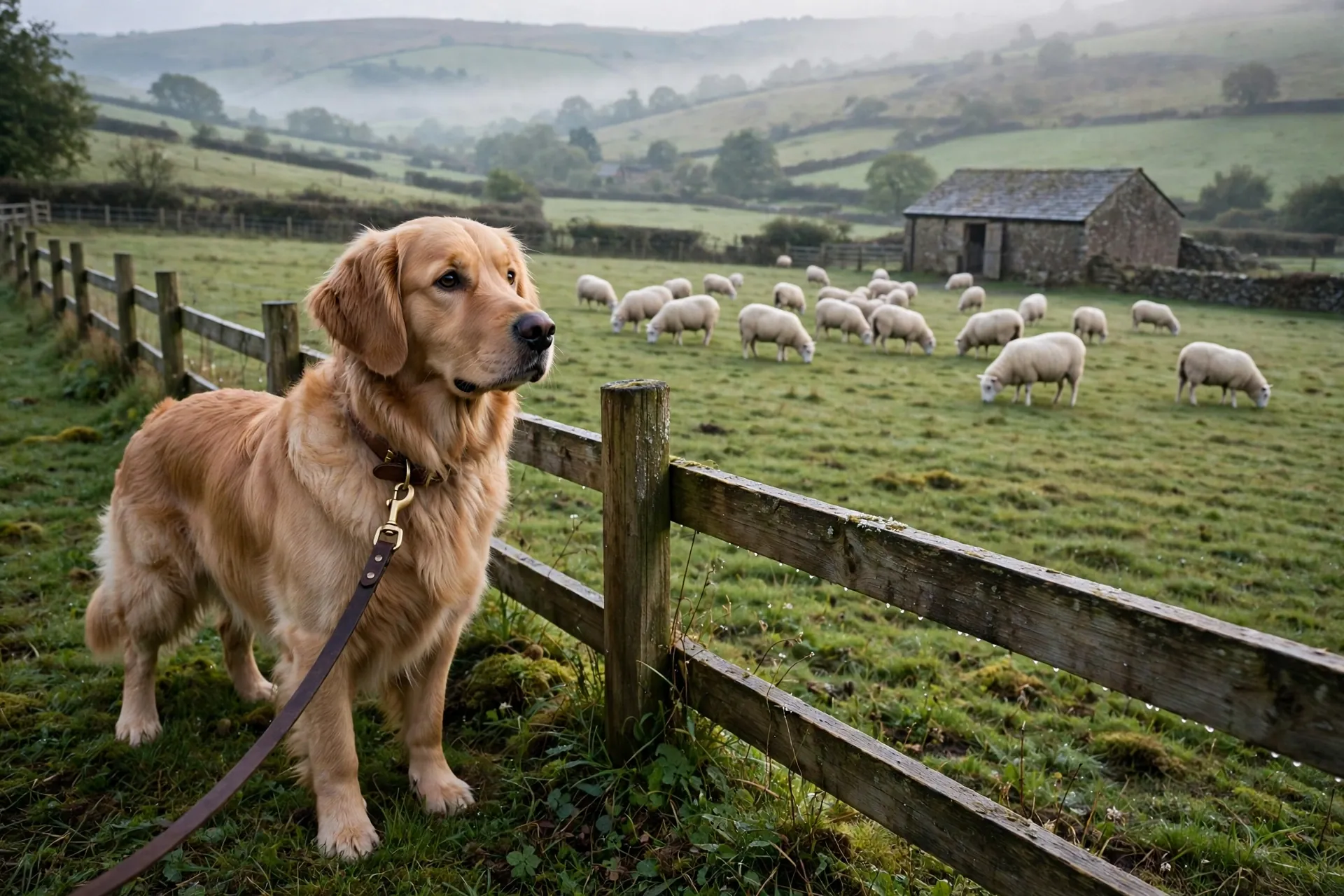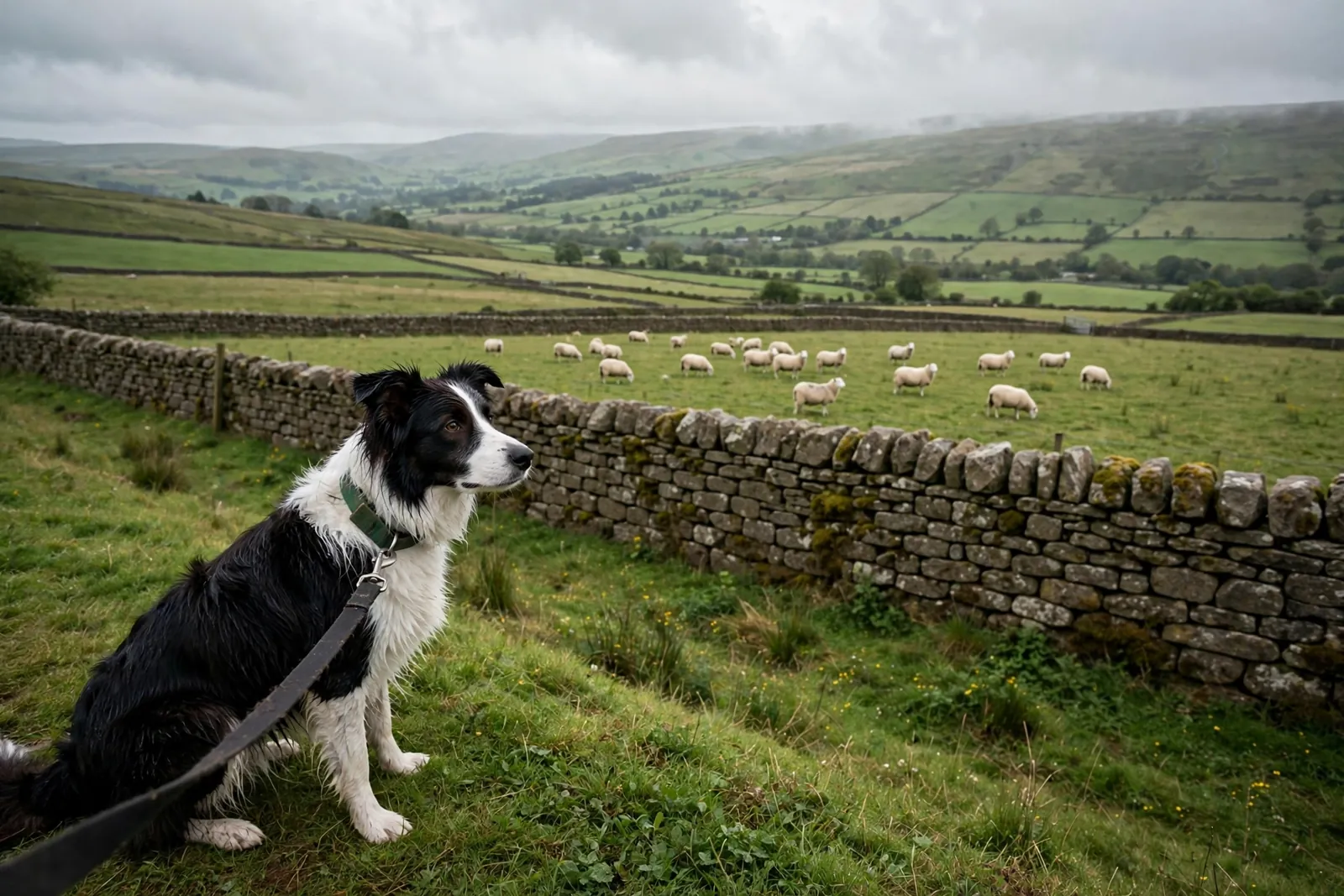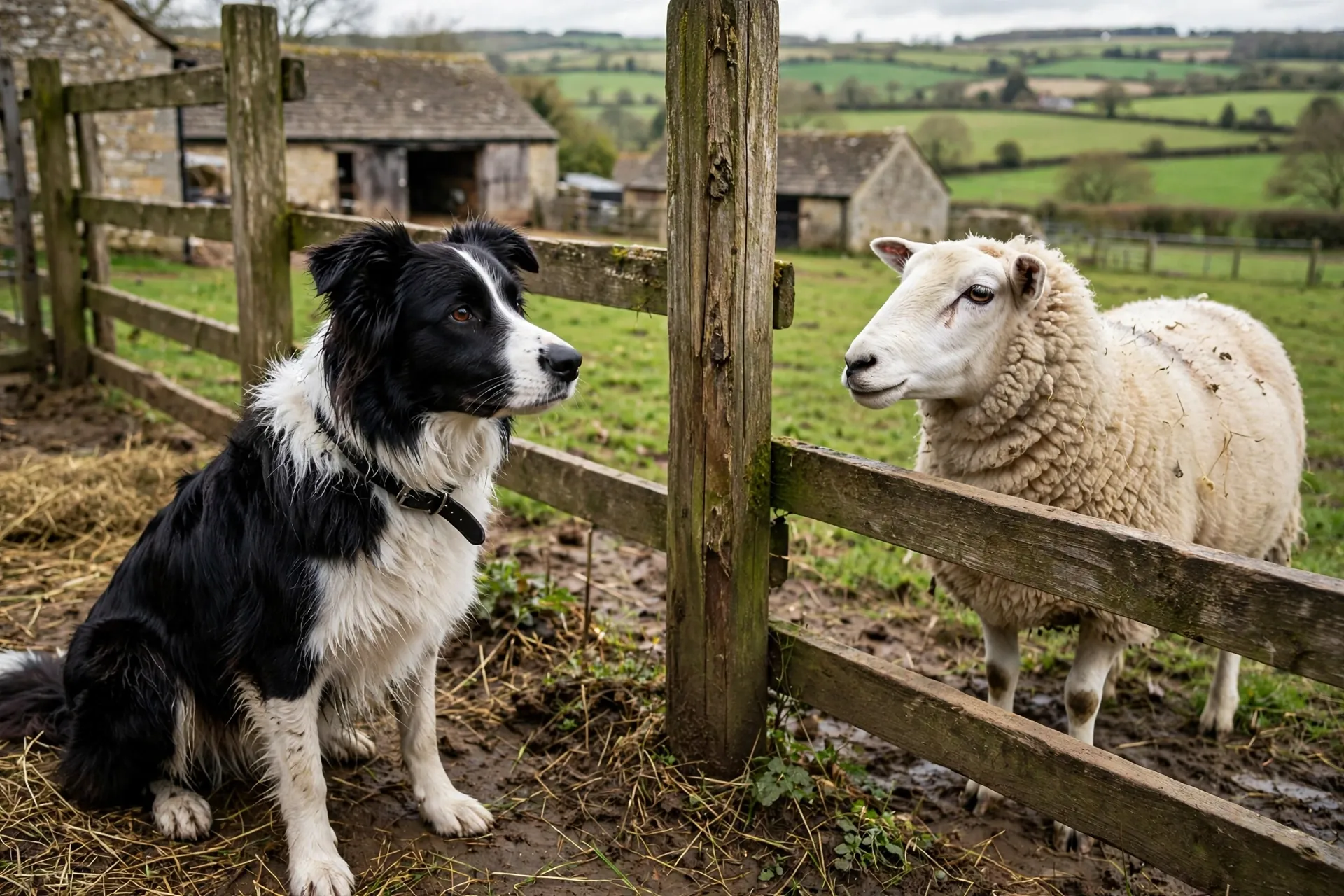
This guide is independent and contains no paid placement. If affiliate links are added later, they will be clearly marked and will not change our editorial checks.
Expect a real working farm: early mornings, machinery, mud, livestock behind fences, and a dog that stays on a lead outside its own garden. Expect also space, quiet, a warm welcome for a well-managed dog, and walks straight from the door. The best farm stays are clear about boundaries, and the best guests respect them.
The different kinds of farm stay
Farm stay is a broad label that covers very different holidays, and the first job is to work out which kind you are booking. A converted barn or cottage on a working farm gives you self-catering independence, a private garden in many cases, and distance from the farmyard, but you still live next to a working business. A farmhouse bed and breakfast puts you in the owner's home, with breakfast together, shared spaces and house rules that matter more. A glamping site, shepherd's hut or lodge on farm land offers a simpler, more outdoorsy stay, often with shared facilities and less privacy. A farm park, by contrast, is a visitor attraction with animals to meet, play areas and cafes, and it follows different rules again.
Each type suits a different dog. A calm, older dog that settles well may love a farmhouse room with a garden, while a young, excitable dog may do better in a separate cottage with an enclosed garden where it cannot practise rushing at every passing person. A reactive dog often needs the separation of a cottage away from shared yards, rather than a farmhouse where farm dogs, guests and children pass through communal areas all day. A dog that is nervous around livestock may cope on a farm where livestock are in distant fields, but struggle on a smallholding where chickens roam the yard. Ask the host to describe the layout in concrete terms: where the accommodation sits, where livestock are kept, where farm dogs live, and where guests walk.
Scale matters too. A large arable farm with hundreds of acres and a cottage down a long drive feels very different from a small family farm where the cottage garden backs onto a sheep field and the farmyard is twenty steps from your door. Neither is better in itself, but they suit different expectations. If you want total peace, ask how many other guest units there are, how close they are, and whether farm work starts early in the morning. If you want to be involved, ask whether guests can watch milking, feeding or lambing, and whether children can help, because some farms welcome that and others, for safety and biosecurity, do not.
Finally, check whether the farm is primarily a farm that also hosts guests, or primarily a holiday business on former farmland. A working farm will have mud, machinery, smells, early starts and occasional disruption, and that is part of the charm for many guests. A holiday business on farm land may be tidier and quieter, with fewer livestock and more facilities. Both can be excellent, but a guest who books a working farm expecting a hotel will be disappointed, and a guest who books a polished holiday park expecting farm life will be equally let down. The listing photos rarely tell you which it is; the host's answers will.
A working farm, not a theme park
A working farm runs on a timetable that does not pause for guests. Tractors move at dawn, feed is delivered, animals are checked, and gates that were open yesterday may be shut today because livestock have moved. Dogs that bark at machinery, chase moving vehicles or react to sudden noise need management, not just good intentions. Keep the dog inside or in its garden during busy yard times, use a lead for every crossing of the yard, and never let a dog approach a tractor, a quad bike or a livestock trailer, even if it seems stationary and harmless.
Smells, sounds and mud are part of the deal. A farm yard in winter is muddy, a lambing shed in spring is noisy and busy, a harvest field in summer is dusty, and a slurry spreader in autumn is unmistakable. Guests who love farm stays accept this as atmosphere; guests who do not should choose a different kind of stay. For the dog, mud is the main practical issue. A dog that has rolled in a yard, paddled in a trough or walked a muddy track needs a towel, a drying coat and a routine for cleaning paws before coming inside, or the cottage floor, the car and the bed will all show it. Pack for mud even if the forecast is dry, because farm yards create mud from troughs, gates and animal traffic regardless of rain.
Biosecurity is a word guests rarely hear but should respect. Some farms ask visitors not to enter certain buildings, not to feed animals without permission, and to clean boots or keep dogs away from feed stores and lambing areas. These rules protect animal health, not just convenience, and they apply to dogs as well as people. Do not let a dog drink from troughs, eat feed, or enter barns unless the host explicitly invites you to, and always ask before offering any food to animals. If you are visiting a farm park rather than staying on a working farm, our guide to dog-friendly farm parks explains lead rules, safe livestock distances and animal contact etiquette for day visits in more detail.
Farm dogs are part of the working team, and they behave differently from pet dogs. They may be collies that work sheep, terriers that patrol yards, or large guardian breeds that live outdoors. They are often friendly, but they may also be territorial in their own yard, protective around livestock, or simply not interested in playing with a guest dog. Never let your dog rush up to a farm dog, never feed a farm dog without asking, and keep your dog on a lead in shared areas until the host tells you otherwise. A calm introduction, at a distance, with both dogs on leads, is far safer than an enthusiastic off-lead greeting in a yard full of machinery and gates.
Livestock rules every guest must know
Livestock rules are the most important part of a farm stay, and they are non-negotiable. Keep your dog on a lead near livestock, at all times, without exception, unless the host gives you a specific, safe area where dogs may be off lead and you are certain no livestock can enter it. This applies to sheep, cattle, horses, pigs, goats and poultry, and it applies even if your dog has never chased anything before. A dog that has never seen a sheep may react completely differently when it actually meets one, and a single chase can cause ewes to miscarry, lambs to be separated, or cattle to panic and injure themselves.
The law reinforces this. In the UK, worrying livestock is a serious matter, and the Dogs (Protection of Livestock) Act 1953 and related law set out offences and penalties, while farmers have legal powers in certain circumstances where a dog is worrying livestock. You do not need to know the statute by heart, but you do need to understand the principle: a dog off lead near livestock is a risk to animals, to the farmer's livelihood, and to your own legal position. Our guide to dog worrying livestock law explains what counts as worrying, the fines involved, farmer rights and lead rules in full, and is worth reading before any farm or countryside stay.
Practical rules follow from the law. Close every gate behind you, even if it was open when you arrived, because an open gate can let livestock into a road or a garden. Do not climb over fences into fields, do not let a dog put its head through a fence to nose sheep, and do not walk a dog through a field of cattle, especially with calves, even if a public footpath crosses it. If a footpath does cross a field with livestock, keep the dog on a short lead, walk calmly and steadily, do not run, and if cattle approach aggressively, let the dog off lead only as a last resort to allow it to escape, as official guidance suggests, while you move calmly to safety. Check the official guidance before you travel for the specific area and season, because lambing, calving and harvest all change the risks.
Teach children the same rules, clearly and before arrival. Children love farm animals and often want to approach, feed or chase them, and a child with a dog on a lead near sheep is a combination that needs adult supervision at all times. Explain that animals are not pets to be cuddled, that fences are boundaries, and that shouting, running and chasing frighten animals even when meant playfully. A farm stay where children and dogs both understand the rules is a farm stay where everyone, including the animals, has a better time.
Cottages, barns and farmhouse rooms
Accommodation on farms varies as much as the farms themselves, and the details that matter for dogs are often not in the listing headline. A cottage may have a private enclosed garden, a shared garden, or no garden at all, just a yard. A barn conversion may have stone floors that are easy to clean but slippery for an older dog, or carpet that shows every muddy paw. A farmhouse room may allow a dog on the bed, on the floor, or only in a crate, and may have a rule about dogs being left alone that is stricter than a cottage's. Ask for these details in writing, not as a general assurance that the place is dog-friendly.
Check the garden and boundaries with the same care you would check a holiday park. How high is the fence, are there gaps under gates, is the garden shared with other guests, and can a dog escape into a field, a road or the farmyard? A garden that looks enclosed in a photo may have a low wall a terrier can jump, a gate that does not latch, or a hedge with a gap where chickens come through. If the garden is not secure, ask whether there is a fenced exercise area elsewhere on the farm, or whether the host can recommend a nearby secure field. An insecure garden does not rule out a farm stay, but it does mean the dog needs a lead and supervision in the garden, and you should plan for that rather than discovering it on arrival.
Inside, think about sleeping, eating and drying. Where will the dog sleep, and is there space for a bed or a crate without blocking a door? Where will food and water bowls go, and will they slide on a stone floor? Is there an outdoor tap or a place to wash muddy paws, and a covered spot by the door for towelling down? Is there heating that can be adjusted for a dog that feels cold, and ventilation for a wet dog that needs to dry? These small details determine whether a farm stay feels comfortable or chaotic, especially in winter when a wet dog and a cold cottage are a poor combination.
Also ask about other guests and noise. A farm stay with several cottages sharing a courtyard will have dogs barking at each other through walls, children playing, and farm dogs passing through. A single isolated cottage will be quieter but may feel remote at night, with no street lighting and a long drive. Neither is wrong, but they suit different dogs. A noise-sensitive dog needs the quieter option, while a sociable dog may enjoy the courtyard life. The host knows which is which, and a direct question will usually get a direct answer.
Questions to ask the host first
Hosts expect questions, and the best hosts welcome them, because a guest who asks the right questions is a guest who will not cause problems. Ask the following before you pay, and keep the answers with your booking confirmation. The answers will tell you more about the stay than any number of photos.
- Where exactly can the dog go, and where is it not allowed? Ask for the accommodation, the garden, the yard, the farm buildings and the surrounding walks, separately, not as a single dog-friendly yes or no.
- Is the garden private and enclosed, and how high and secure is the boundary? Ask about gates, gaps, shared access and escape routes into fields or roads.
- What livestock are kept, where are they, and what are the lead rules? Ask about sheep, cattle, horses, pigs and poultry separately, and about lambing or calving seasons.
- Are there farm dogs, and how are introductions handled? Ask where farm dogs live, whether they roam the yard, and whether guest dogs should be kept apart.
- Can the dog be left alone in the accommodation, and for how long? Ask whether a crate is required, whether barking is monitored, and what happens if a dog is noisy.
- What is the total dog charge, and what does it cover? Ask about per-dog, per-night and per-stay charges, cleaning fees and damage deposits, and get the total in writing.
- What walks are available from the door, and which are safe for dogs? Ask about footpaths, livestock fields, roads, water and secure exercise areas nearby.
- What facilities are there for washing and drying a muddy dog? Ask about outdoor taps, dog showers, towels, drying areas and laundry.
Judge the answers by their specificity, not their warmth. A host who says the garden is fully enclosed with a 1.2-metre fence and a latched gate, that sheep are in the far field and dogs must be on a lead on all farm tracks, and that the dog charge is 30 pounds per stay including cleaning, is giving you information you can plan around. A host who says only that they love dogs is giving you a feeling, not a plan. Warmth matters, but it is not a substitute for boundaries, and the farms that are clearest about boundaries are usually the ones where dogs are genuinely welcome.
Arrival, gardens and the first walk
Arrival on a farm needs a slower pace than arrival at a hotel, because the dog is meeting a new place full of new smells, sounds and animals at once. Arrive in daylight if you can, so you can walk the garden boundary, check gates and fences, and find the toilet area before dark. Keep the dog on a lead for the first tour, even if the garden looks secure, and let the dog sniff the boundaries, the yard and the accommodation in stages, rather than all at once. A calm first hour, with water, a familiar bed and a quiet settle, sets the tone for the whole stay.
Walk the farm tracks and the nearest footpath on the first day, with the dog on a lead, and learn where livestock are, where gates are, and where the safe off-lead areas, if any, are. Photograph any existing damage in the accommodation, move cleaning products, feed and chemicals out of reach, and ask the host to show you the yard routine: when machinery moves, when animals are fed, and when it is best to keep dogs inside. This first-day orientation takes an hour and saves a week of guesswork.
Establish a toilet routine that works for the farm. Farm gardens often have a specific area for dogs, or a field edge that is used for that purpose, and using it consistently keeps the rest of the garden clean and the host happy. Take a torch for night-time toilet trips, because farm yards are dark, uneven and full of obstacles, and a dog that is taken out in the dark without a torch is a dog that may step in something unpleasant or wander towards livestock. Keep poo bags in a pocket, not just in the cottage, because a farm walk without a bag is a walk that ends badly.
Finally, settle the dog's routine as close to home as possible for the first evening: same feeding time, same bed, same last walk pattern. Dogs read routine as safety, and a farm stay with its new sounds, from owls to tractors to sheep, is already a lot of novelty. A familiar routine, plus a crate if the dog uses one, helps the dog relax and sleep, which in turn helps everyone else sleep, including the host and other guests.
Food, walks and days out
Food on a farm stay depends on the type of stay. Self-catering cottages need a shop plan, because farm locations are often rural, with the nearest supermarket a drive away, and farm shops, while charming, do not always stock dog food, especially specialist diets. Bring the dog's normal food for the whole stay, plus a few days extra, and check where the nearest vet and pet shop are before you arrive. For farmhouse bed and breakfast, ask whether breakfast is served in a room where dogs are welcome, whether dogs can join you, or whether they need to stay in the room, and plan accordingly.
Walks from a farm are often the highlight, because many farms sit on or near public footpaths, bridleways and quiet lanes. Use them, but use them with farm rules in mind. Stay on marked paths, close gates, keep the dog on a lead near livestock, and do not cut across fields that are not rights of way, even if they look empty. A walk that starts at the farm gate and follows a river, a woodland edge or a hillside can be a wonderful day out, but it needs the same care as any countryside walk: a map, water, a lead, and a plan for what to do if livestock, weather or tiredness change the plan.
Days out from a farm need a car plan, because rural farms are rarely near public transport, and dogs cannot always go into the attractions you want to visit. Check which nearby attractions, pubs, cafes and beaches welcome dogs, and which do not, and plan days where the dog can join you or can be left safely in the accommodation if the host allows it. A day out that leaves a dog alone in a strange cottage for eight hours is not a good day for the dog, and a day out that drags a dog through places it is not welcome is not a good day for anyone. Balance is the key: some days for the dog, some days for you, and many days where both can enjoy the same walk, pub or beach.
Farm produce is a bonus, not a guarantee. Some farms sell eggs, meat, vegetables or preserves, some offer a welcome hamper, and some have a honesty box for fresh produce. Ask what is available, and enjoy it, but do not assume it will replace a supermarket shop, especially for dog food, medication or specialist items. A farm stay that is planned around its rural location, with food, walks and days out all thought through, is a farm stay that feels relaxed rather than improvised.
Seasons, mud and costs
Seasons change a farm stay more than they change a hotel stay, because the farm itself changes. Spring brings lambing, with strict rules about dogs near ewes and lambs, busy yards, and beautiful but muddy walks. Summer brings harvest, with machinery, dust and long daylight, and the best weather for outdoor cottages and glamping. Autumn brings harvest aftermath, mud, and quieter farms, with lower prices and fewer guests. Winter brings cold, short days, mud, and possibly closed facilities, but also log burners, quiet walks and long-stay deals for guests who do not mind the dark.
Costs follow the same pattern. A farm cottage in August can cost two or three times its February price, and dog charges add to that. A typical dog charge is 20 to 50 pounds per stay or per week, but some farms charge per night, and some include one dog free in low season. Always ask for the total, including cleaning, linen, heating and any damage deposit, before you compare prices, because a cottage that looks cheap with a high dog charge and a heating surcharge may cost more than a cottage that looks expensive with everything included. Check cancellation terms too, because farm stays often have stricter terms than hotels, especially for peak weeks and lambing season.
Mud deserves its own budget, in time if not in money. A muddy farm stay needs extra towels, extra laundry, extra time for cleaning paws, and extra patience. Pack two towels, not one, a drying coat, a mat for the door, and a bag for dirty kit. Accept that the car will get muddy, the cottage floor will need sweeping, and the dog will need washing more often than at home. Guests who pack for mud enjoy a farm stay; guests who do not pack for mud spend the stay fighting it.
Finally, book early for peak times and for specific needs. A cottage with a private enclosed garden, a farmhouse room that allows a large dog, or a farm with a secure exercise field will book out months ahead for school holidays, Easter and lambing season. If you need a specific layout for a reactive, elderly or large dog, contact the host directly rather than relying on a booking platform filter, because filters rarely capture garden security, livestock distance or farm dog arrangements. A direct conversation, before booking, is the best investment you can make in a farm stay.
Practical questions
Before you go
Are dogs allowed to roam free on a farm stay?
Almost never, and you should not expect it. Most farm stays allow dogs in the accommodation and in a defined garden or yard, on a lead everywhere else. Free roaming risks livestock, machinery, other guests and the farm dogs, so plan for lead walks and an enclosed area rather than open freedom.
What happens if my dog chases or worries livestock?
Take the dog away immediately, keep it on a lead, and tell the host at once. Worrying livestock is a serious legal matter in the UK, and farmers have legal powers in certain circumstances. Do not try to hide an incident, and check the official guidance before you travel if you are unsure about the law on farmland.
Do farm stays charge extra for dogs?
Many do, and the charge varies widely. Some farms include one dog in the price, others charge 20 to 50 pounds per stay or per week, and some charge per night. Ask for the total dog charge, the number of dogs allowed, and any cleaning or damage terms in writing before you book.
Can dogs stay in the farmhouse with the owners?
Sometimes, but it is less common than a separate cottage, barn or lodge. Farmhouse bed and breakfast rooms vary: some welcome a well-behaved dog in the room, others allow dogs only in a separate annexe or a ground-floor room. Ask exactly where the dog sleeps, eats and toilets, and whether the farm dogs will be in shared spaces.
Is a farm stay suitable for a reactive dog?
It depends on the farm layout and the dog's triggers. A quiet farm with a private enclosed garden, a separate cottage away from livestock, and walks that avoid other dogs can suit a reactive dog well. A busy farm with shared yards, free-ranging chickens and frequent visitors will be much harder. Be honest with the host about your dog before booking.
What should I pack differently for a farm stay?
Pack a long lead, a spare lead, a towel and a drying coat, paw protection for mud and rough ground, and a torch for night-time toilet trips across a yard. Add a familiar bed and a crate if your dog uses one, because a farm stay has more new smells and sounds than a hotel room. Bring the dog's normal food, because farm shops do not always stock it.