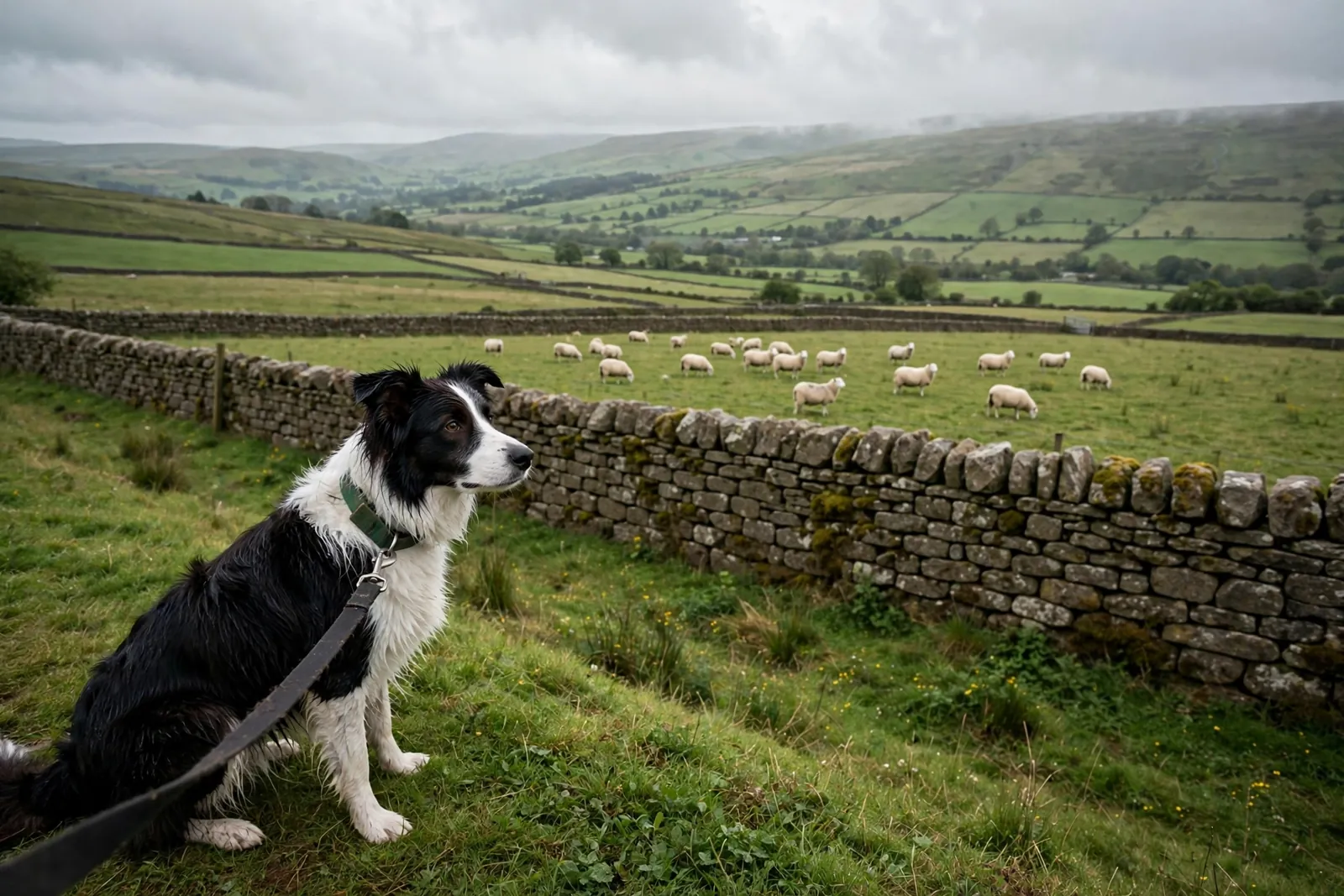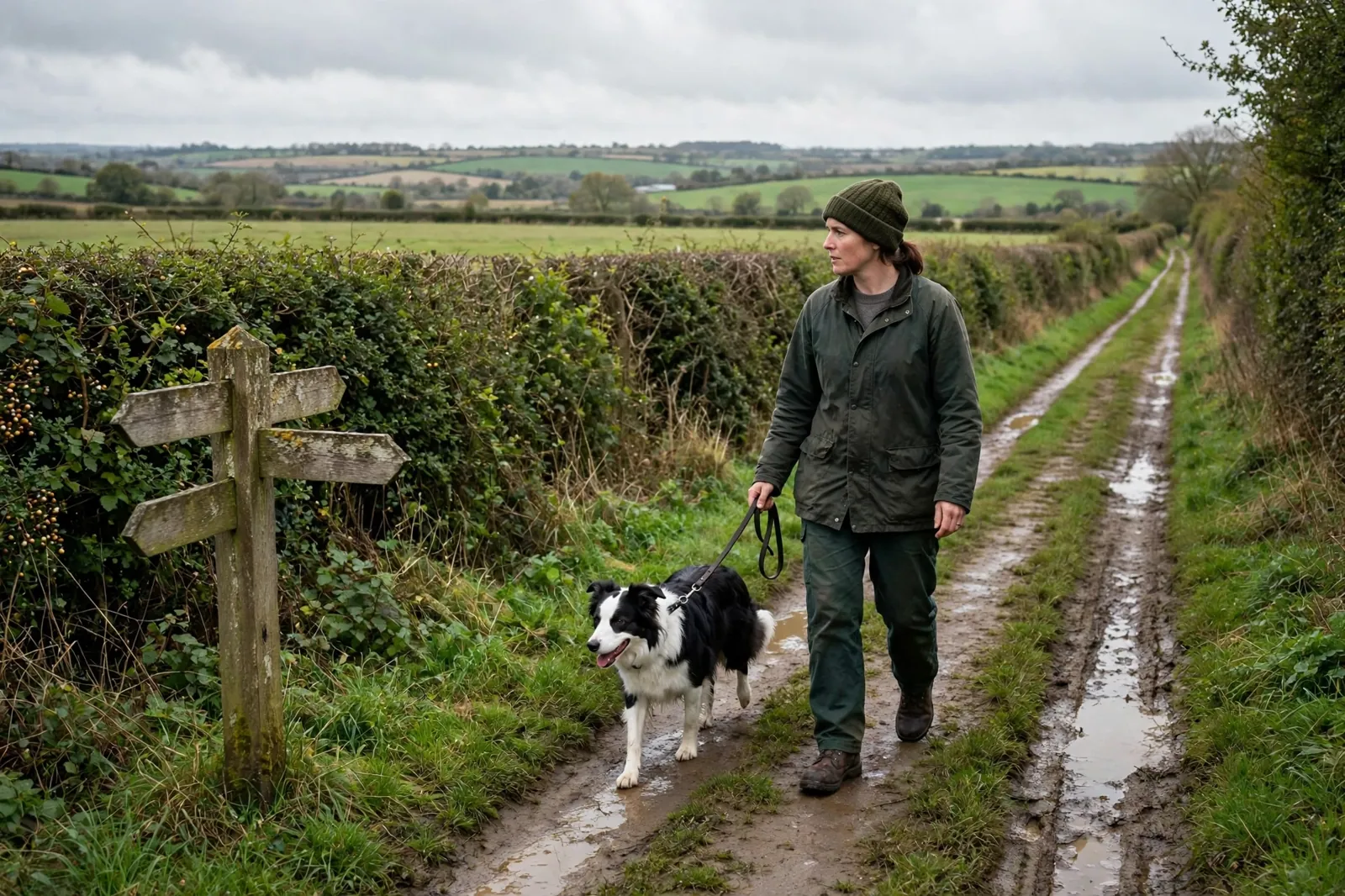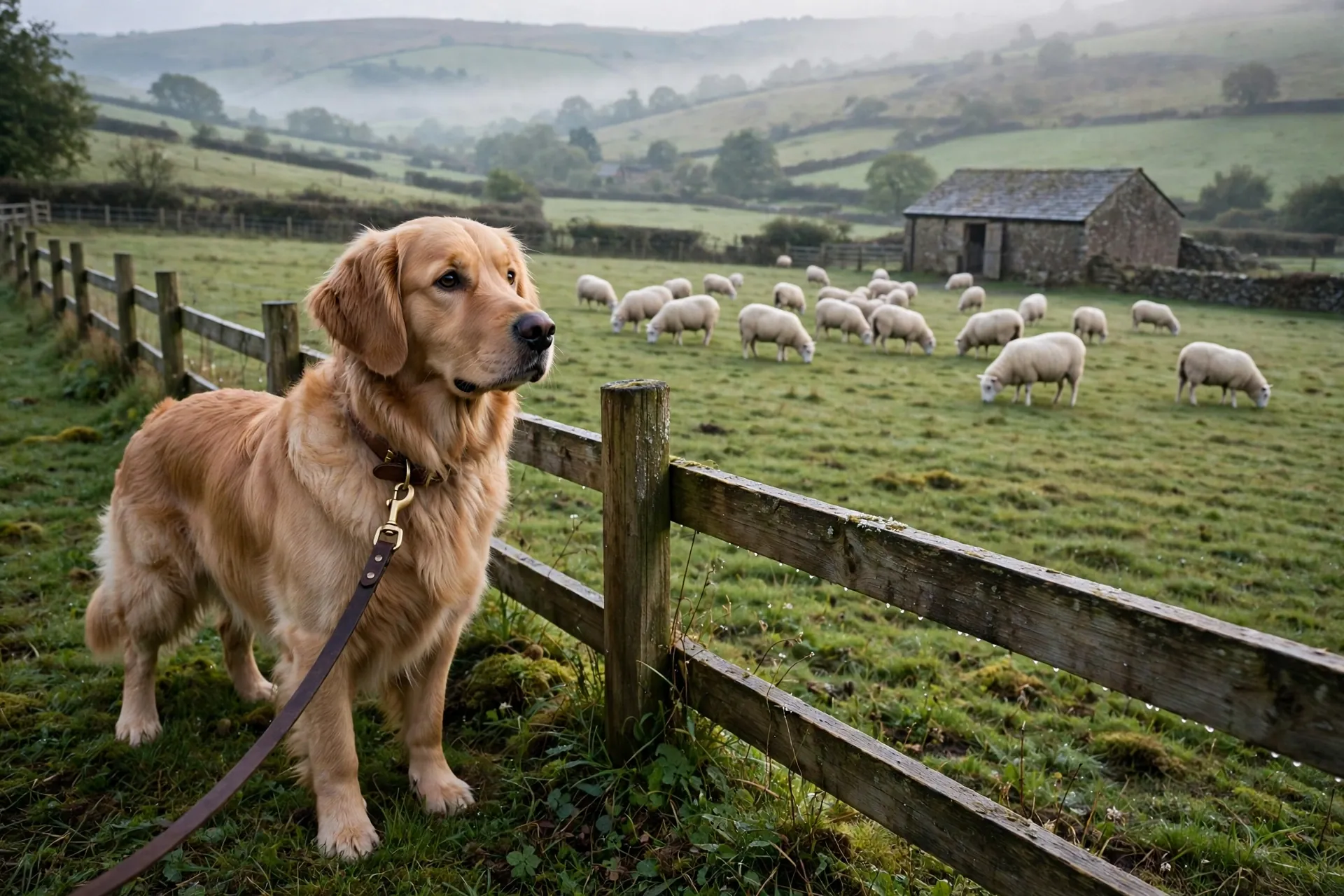
Dog-friendly farm parks welcome dogs on leads in most outdoor areas but bar them from animal contact zones. Keep a short lead everywhere, hold generous distance from sheep and cattle, skip the petting barn with the dog tied up nearby, and always check the park's own dog policy before travelling — it varies more than any other day trip in Britain.
What a farm park actually is (and isn't)
A farm park sits somewhere between a working farm and a family attraction. It keeps real livestock — sheep, goats, pigs, cattle, poultry, often rare breeds — but it also has a ticketed entrance, a café, a play area and the family infrastructure of a day out. Unlike an open farm where you might be walking through active fields, the animal encounters at a farm park are curated: pens, barns and paddocks with viewing corridors, plus staff on hand to answer questions. For a bigger day out, National Trust places that allow dogs vary property by property, so check the pawprint rating before you go.
That curation is what makes farm parks possible with a dog at all. A working farmyard has machinery, dogs of its own, free-moving stock and insurance arrangements that rarely accommodate visitors' pets; a farm park has defined public routes and, increasingly, a written dog policy that spells out exactly where four paws may go. The policy exists because the attraction has thought about it — which is both reassuring and something to read properly, because no two policies are identical.
There are several flavours worth knowing apart. Rare-breed and heritage farm parks tend to be quieter, with spacious enclosures and an emphasis on conservation; they suit calm dogs well because the animals are settled and the crowds are thinner. Large attraction-style parks add soft play, tractor rides and high-energy children's programming — exciting for families, noisier for dogs. City farms are small, urban, intensely social places where space is tight and encounters are close; only a genuinely steady dog will enjoy one. Working-estate visitor farms often combine a park with estate walks, which gives you the rare option of a proper dog walk outside the livestock areas, on the same ticket.
None of these is "the" dog-friendly option. The right fit depends on your dog's temperament, the season and the day's crowd levels. A sociable labrador might love the bustle of a big park; a noise-sensitive lurcher might only thrive at a small heritage park on a rainy Tuesday. Read the description of each attraction like a dog owner, not like a parent — the family review sites will not tell you whether the goat walk is a fenced corridor or an open yard.
Why farm parks are different from every other day trip
At a National Trust garden, a misbehaving dog is an embarrassment. At a farm park, a misbehaving dog can be a legal event. Livestock worrying — the offence of a dog worrying sheep, cattle, pigs, goats and other farm animals — is one of the few areas of British animal law where the consequences arrive fast and hard. Farmers' organisations report thousands of incidents a year, and the pattern is always the same: a normally gentle dog, a moment of excitement, and animals panicking into fences, ditches or each other. Our guide to livestock worrying law sets out exactly what the law says and who pays, and it is worth reading before any farm visit.
The second difference is the animals' own point of view. The sheep in the top paddock are not scenery; they are prey animals hardwired to fear dogs. A dog that stands at a fence barking at sheep — even a friendly dog, even one on a lead — is causing real distress, and it does so in a setting where the whole point is that children are watching and learning. Staff notice this quickly, and so do other visitors. A farm park day out with a dog is, in effect, a three-hour exam in impulse control, held in front of an audience of other people's children.
The third difference is smell. Farm parks concentrate everything that grabs a dog's nose — feed, manure, urine marks from other dogs, animal bedding — into a walkable area. This is wonderful stimulation for a settled dog and a trigger for a reactive one. It also means your dog's focus is under constant challenge: even a dog that heels beautifully through town can turn into a different animal when it smells a lamb shed. Plan for the dog you have on a farm, not the dog you have at home.
The upside is real, though. Few day trips offer this much structured novelty: different surfaces, new sounds, livestock at close range, and usually an off-lead area where the dog can unwind. Many dogs walk out of farm parks tired in a way that a long but monotonous park walk never achieves. The secret is that the day is as much training as recreation — arrive ready for both.
Five questions to answer before you leave home
Dog policies at farm parks change more than at any other attraction in Britain. A park that welcomed dogs in April may restrict them during lambing season; a café that allowed dogs under tables may change management over winter. This is a day trip that repays a ten-minute phone or website check the day before. The five questions below catch almost every problem.
- Where exactly can dogs go? Get specifics, not a yes. You want: allowed on the public paths and viewing corridors; allowed or not in the café and on the terrace; whether any buildings admit dogs; and whether there is a dog exercise area. Ask where dogs must not go: lambing sheds, contact barns and paddocks with young stock are commonly off-limits.
- What is the lead policy in practice? Most parks say "dogs on leads at all times", but the definition of acceptable length and the strictness of enforcement vary. Ask whether the park provides an off-lead field, because that changes what the dog needs from the rest of the day.
- Is there an admission fee or a per-dog charge? Most parks admit dogs free or for a small fee (£2–£5 is common). Some add it silently to online booking — check whether you must declare the dog when you buy tickets, because arriving undeclared with a large dog can mean being turned away at the gate.
- What is closed for the season? Lambing seasons (usually February to April) often bring stricter rules or temporary dog restrictions. Winter openings may run a reduced site with different routes. The rules on the website may describe the summer season; the day you visit is the one that counts.
- What does the weather plan look like? Farm parks are largely outdoors and many are on exposed ground. If the dog hates rain and the forecast is grim, the day is not worth it — unlike a beach or woodland, you cannot just walk faster through a paddock. Have a cancellation alternative.
If the park publishes its dog policy online, print it or save it to your phone. On the day, staff at different gates sometimes give slightly different answers, and having the published policy in hand settles it without argument. Also check official park information for seasonal changes — always confirm against the park's own latest statement before travelling, since policies shift and this guide cannot track every one.
Lead rules: the non-negotiables
Assume the lead stays on for the whole visit. That single assumption makes every other decision simpler: you choose a harness, a lead of manageable length, and a plan for the off-lead exercise field if the park has one. Almost all dog-friendly farm parks require leads at all times around animals and public areas — our overview of dog lead laws in the UK explains the legal backdrop — and farm parks enforce it because livestock is the one thing that turns a lost lead into a crisis rather than an inconvenience.
Short lead or long line? The right answer is both, used at different times. A standard 1–1.5 metre lead is the default around pens, barns, yards and anywhere animals are close. It keeps the dog beside you and gives you the control to walk past a noisy goat pen without incident. A long line (5–10 metres) is the better choice on the open paths between attractions and in any designated off-lead or dog exercise field, where the dog can stretch out and sniff without being genuinely free. Our long line versus lead comparison covers how to handle a long line safely around other visitors — it should never be trailing behind a dog near livestock.
A few practical points that trip people up. Retractable leads are a poor choice at farm parks: the thin cord is hard for other people to see, the locking mechanism fails at the worst moments, and a dog ten metres away on a retractable lead is effectively off lead when it matters. Double-handling is worth practising beforehand — hold the lead with a loop in your dominant hand so the dog cannot bolt if startled. And when you stop to look at animals, shorten the lead deliberately: a dog that has been given six feet of slack is not under control, whatever you believe.
Gate etiquette deserves its own mention. Farm parks are full of gates between paddocks and yards, and most are also working gates that staff and animals use. Never let the dog through a gate first. Check both sides before you pass, keep the dog beside you, and close every gate behind you — even ones you found open. A dog squeezing through a stock gate is how livestock worrying incidents start.
Safe distances and good livestock manners
The core skill of a farm park visit is holding distance. There is no signposted number of metres that is officially "safe", because it depends on the species, the season and the dog. Instead, think in terms of the animals' behaviour: if sheep lift their heads and stare, you are close enough to register; if they bunch together and move away, you are too close; if they are grazing with their backs to you, you are fine. Calm animals mean you are doing it right, and the aim is to keep them calm.
Some situations demand extra room. Cattle with young calves are famously protective, and beef cattle can be curious in a way that a leashed dog finds threatening — give wide berth and never walk between a cow and her calf. Lambing season, usually late winter to early spring, is the highest-tension period: ewes with new lambs are stressed, some parks restrict dogs entirely, and a dog that would ignore sheep in October can trigger a panic in March. Pigs and poultry excite dogs in a different way — squealing and fluttering — so keep well back from their enclosures too, even though they are less fragile than sheep.
Watch your dog for the early signals of over-arousal, because by the time a dog is barking at livestock you are already late. Fixating — a hard, unblinking stare at the animals — is the first sign; freezing, whining and pulling toward the fence are the later ones. The response is always the same: cheerfully turn the dog away, create distance, and give it something else to do (a sniffing game, a treat scattered in the grass). If the dog cannot be redirected, leave that area of the park. There is no version of this where you stand at the fence hoping the dog settles — standing still is what makes it worse.
One more point that catches confident owners: a dog can worry livestock without ever touching them. Chasing along a fence line, repeated barking, and even prolonged staring can legally count as worrying. The fence does not protect you from the law, only from immediate contact. The safest policy is the simplest one — keep moving past livestock areas, keep the dog close, and give the animals a relaxed, boring visit. They owe you nothing; you owe them calm.
Animal contact zones and separation rules
The animal contact zone — the goat walk, the petting barn, the small-animal handling area — is the one part of a farm park where the dog is not welcome, even at parks that are otherwise enthusiastic about dogs. Expect the dog to be barred entirely, and plan around it: this is a rotation visit, not a leave-the-dog-tied-up visit. Never tie a dog outside a contact barn and go in. A tied dog near unfamiliar animals, children and other dogs is a stress scenario, and theft, tangling and fright are all realistic risks.
Work out the family rota in advance. One adult stays with the dog on the path or at the café terrace while the other takes the children into the contact area, then swap. It doubles the time but halves the stress, and it gives the dog a genuine rest instead of an hour of frustration at a barn door. Some parks helpfully position their contact areas so the dog route runs alongside; others put them deep inside the site, which is worth knowing when you plan the day.
Hygiene matters for the dog as well as the people. After children handle small animals, park rules usually require hand-washing — and your dog will be licked, touched and fed scraps by enthusiastic small hands regardless of the rules. Keep the dog's own food away from contact zones (other children will try to feed it animal feed), bring your own water bowl rather than using yard troughs, and give the dog's paws a wipe or rinse after the visit if the dog has walked through yards or around feed areas. Farmyards carry bacteria that are normal for livestock and unwelcome in a dog's gut.
One under-appreciated hazard is the animal feed itself. Sheep and cattle feed, chicken feed and fallen fruit from orchard areas are all intensely attractive to dogs and can cause digestive trouble or worse — some feeds contain additives that are unsafe for dogs. Keep the dog out of feeding areas and bins entirely, watch for spilt feed on paths, and pick up dropped treats from the contact zone before the dog finds them. A farm park is the one attraction where "don't let the dog eat anything off the ground" is a serious instruction, not a preference.
When children and dogs share the day out
Farm parks are built for children, and that changes the dog-owning maths. A park on a school-holiday weekend is full of small, fast, noisy, excitable humans — exactly the stimulus that over-arouses young dogs and frightens nervous ones. Be honest about your dog: a dog that is fine with its own family's children is not automatically fine with thirty strangers' children, one of whom will certainly run straight at it.
The first rule is supervision structure. One adult per dog is the safe ratio when children are in the group too. If there is one adult, two children and a dog, someone is always unsupervised — and at a farm park, the unsupervised thing is usually the dog, briefly, at exactly the wrong moment. Families manage this by the rotation described above or by choosing quieter off-peak days when the park is calmer and one pair of eyes can cover the situation.
Children need briefing before the ticket barrier, not after the first incident. The useful version is short and concrete: walk past the dog rather than running up; ask before touching; never feed the dog without permission; if the dog goes to the café terrace, do not follow it and dangle chips. Parents of visiting children will not brief their own — assume every child you meet is unbriefed and keep the dog in a position where a stranger's child cannot surprise it.
Practical spacing helps. Keep the dog on the outside of the group, away from the paths where children cluster. Choose a café table at the terrace edge rather than the middle, so the dog has one side with no foot traffic. When the group stops to watch animals, place the dog behind the children rather than beside them — a child leaning on a fence is fine, but a child leaning on a fence with an over-excited dog at knee level is how fingers and leads get tangled.
Watch for the dog's signs of social exhaustion. Panting in cool weather, yawning, lip-licking, turning away from approaches and refusing treats are all signals that the dog has had enough stimulation. A farm park day is long by dog standards — four to five hours of novelty is a full day's work — and leaving before the dog is fried is the difference between a fond memory and a fraught car journey home. The best farm park trips end while the dog is still happy.
What dog-friendly farm parks look like across Britain
Farm park culture has a regional character, and knowing the pattern helps you choose. In the dairy and arable counties of the south and east — the Home Counties, East Anglia, the South East — farm parks tend to be large, polished visitor attractions with extensive play infrastructure and clear, professionally written dog policies. They are the easiest to research online, and their policies are the most likely to be specific and stable. The trade-off is crowd density on weekends and the price of a family ticket.
The West Country and Wales lean toward pastoral authenticity: sheep-country parks on real working holdings, often with spectacular settings and a quieter, more rustic feel. These are frequently the parks with the strictest lambing-season restrictions, because the livestock is genuinely at risk rather than decorative — plan visits for late spring onwards. The payoff is space: West Country parks often have more room per visitor, which makes distance-keeping easier.
In the Midlands and the North, you will find a mix of large estates, mining-heritage attractions with farm elements, and city-adjacent parks that draw big weekend crowds. City farms in London, Birmingham, Manchester and other cities are the compact, intense option: brilliant for a half-hour visit with a bombproof dog, overwhelming for anything less confident. Scotland adds the croft-park tradition — small, atmospheric, weather-beaten — where the attraction is the landscape as much as the animals, and where midges and weather demand their own packing list.
Wherever you look, treat named-park policies as time-sensitive. This guide deliberately avoids listing which specific parks allow dogs and where, because those policies change between seasons and even between years. Use park types as your shortlist, then check the current policy on the park's own website or by phone, and always confirm against the park's own latest statement before travelling. A park that allowed dogs in the barn yard last year may have changed the rule after a single bad incident — that is how these policies evolve.
A day plan that keeps everyone happy
The mistake most people make is trying to do everything. A farm park has enough attractions for a full day, but a dog has enough stamina for about half of one. The plan that works is: arrive at opening, do the animal-focused circuit while the dog is fresh and the park is quiet, take the long lunch break the dog needs, then do the play areas and family attractions while the dog rests — or leaves.
Morning is the golden window. Animals are being fed and are most active, the paths are empty, and the dog has its full battery of self-control. Walk the main paddock circuit, visit the enclosures, and get the off-lead field in early if there is one — a dog that has had a good sniff and stretch at 10am is a different animal at noon. Do the contact zone on the rotation system during this window too, when queues are short and the dog can wait with a rested adult.
Lunch is where dogs win or lose the day. Choose a café where dogs are welcome — on the terrace at minimum — and make the meal an unhurried rest for the dog: water, a chew or a snuffle mat, and a chance to lie down. Do not try to push straight through to the afternoon's play equipment with a dog in tow; soft play is loud, bouncy-castle zones are chaos, and none of it needs a dog present. If the group splits — kids to the play barn, dog to the car or a shady bench with one adult — everybody enjoys their half more.
Afternoon is for the low-demand half of the site: woodland walks, farm shops, the viewing corridor along the far paddocks. This is also the sensible window to leave. Watch the dog, not the ticket: if the dog is lying down voluntarily, walking slowly, or losing interest in food, the day's work is done. Leaving at three while the dog is content beats leaving at five with an exhausted, reactive animal and a family that is no longer having fun. A farm park ticket is not a contract to stay until closing.
What to pack (and what to leave behind)
The farm park kit is a day-trip kit with three additions. Beyond the usual — water, bowl, poo bags (take more than you think), treats, a towel — add a long line, a second towel for yard grime, and a chew or snuffle mat for the café rest. A harness the dog cannot slip beats a collar for gate-passing and barn-yard moments, and a fixed short lead plus the long line covers every part of the site.
Leave the retractable lead at home, as noted, and leave anything that squeaks. Squeaky toys at a farm park are a provocation: they excite the dog and unsettle animals and other visitors. Ball-throwing is fine in the off-lead field but not on public paths, where a launched ball plus an open gate is a headline nobody wants. If your dog has a favourite comfort toy for resting, bring it for the café — it signals that the resting phase has begun.
Think about water and mud from the dog's perspective. Farm yards are wet in places a garden never is, and the dog's paws will collect mud, bedding and worse. A boot wash or at least a rinse with your own water at the end of the visit keeps the car tolerable and the dog comfortable; dog boots are overkill for most dogs but a rinse is not. Poo bags are a genuine obligation here, not just politeness — farm parks deal with hygiene inspections and animal health, and dog waste near livestock enclosures is a contamination issue. Bin it, every time, and use the park's dog-waste bins where provided rather than the animal-area bins.
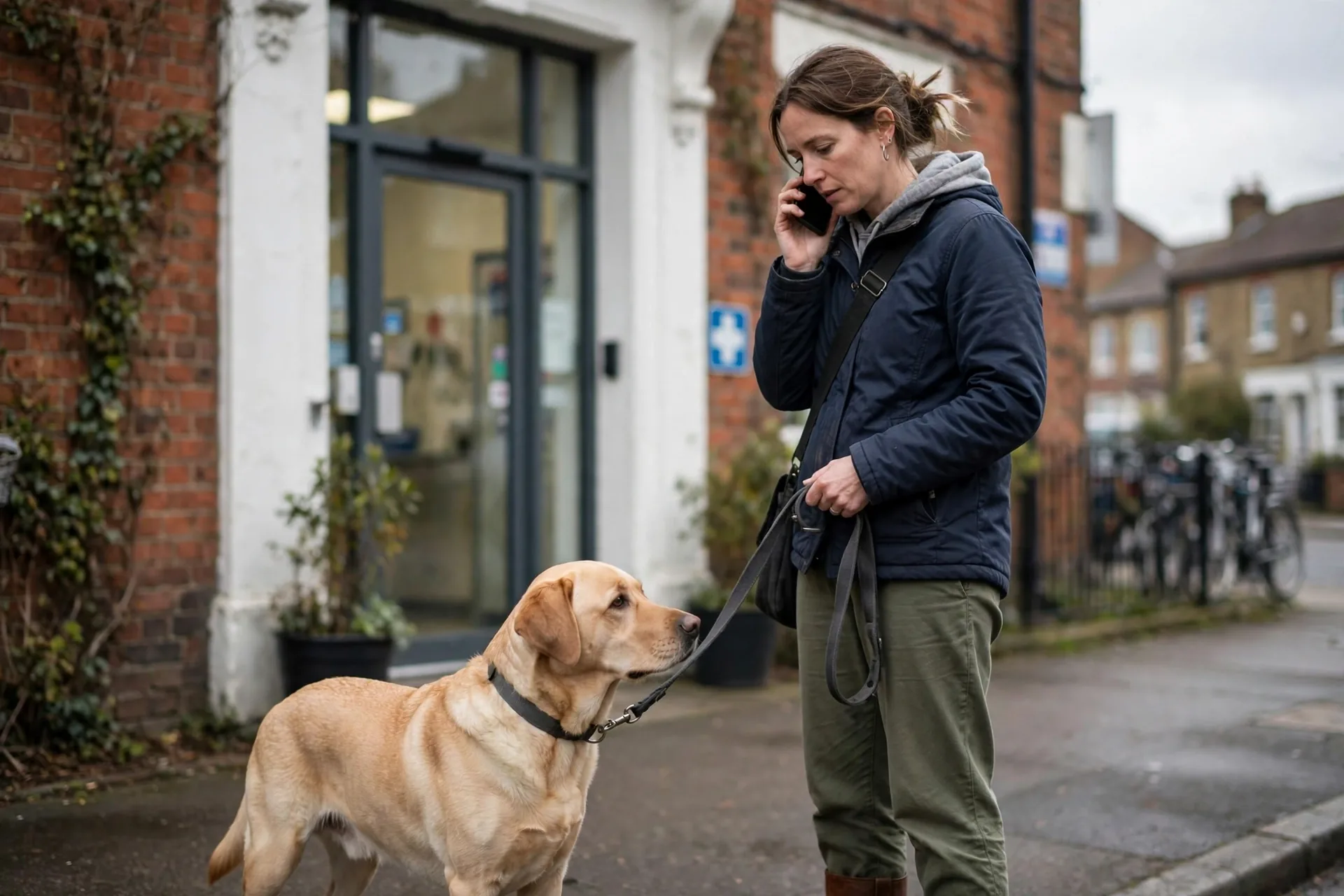
One more category: things for the humans. Hand sanitiser for after the contact areas (your hands too, before you handle the lead), a printed copy of the park's dog policy, and the number of the nearest emergency vet saved before you arrive — rural parks can be a long way from an out-of-hours practice, and tick exposure in pasture and woodland margins is a real thing, so it is also worth knowing the signs covered in our tick guide before you brush the dog down afterwards.
If your dog can't cope: exit strategies that aren't failure
Some dogs will not enjoy a farm park, and knowing that in advance is competence, not pessimism. Dogs that are highly reactive to other dogs, fixated by livestock, terrified of children, or simply unable to settle in busy environments are poor candidates — and puppies in the middle of the fear period (roughly 8–11 weeks) have no business at a crowded attraction. Our puppy's first holiday guide explains why short, controlled outings beat big days out for young dogs. If your dog is on this list, choose a different day trip and try the farm park another year, or not at all.
If you discover mid-visit that the dog is struggling, the exit is the win. Signs to act on: sustained barking at animals, lunging that you have to fight rather than manage, refusal to walk, or a dog that simply shuts down and goes flat. Do not try to train through it in the middle of a working attraction — there is nowhere private, the audience is constant, and the livestock deserve better than being someone's training props. Leave the animal areas calmly, walk the dog out on a quiet route, and either wait at the car with a chew or head home.
A halfway option works for some families: split the day. The dog enjoys the morning circuit and the off-lead field, then one adult takes the dog home or to a nearby dog-friendly walk while the rest of the group finishes the afternoon. This needs two cars or a nearby dog-friendly café, so it is a plan to make at booking, not to improvise at 2pm. It is also worth remembering that farm parks repeat well — a short, successful first visit builds a dog's confidence for a longer one next year, while an over-long disaster sets the dog's opinion of livestock back a long way.
Finally, be ready for the park to make the call. Staff have the right to ask a dog to leave any area — or the site — if the dog is distressing animals or visitors. This is not an insult; it is the park doing its job. Cooperate gracefully, because the alternative is a formal incident and a worse outcome for dog owners generally. Every well-behaved visit makes the next dog's visit more welcome; every argument with staff makes the next dog's visit harder.
Practical questions
Before you go
Are dogs allowed inside animal contact areas at farm parks?
Rarely, and almost never with animals out of their pens. Most farm parks restrict dogs to paths, café terraces and designated exercise fields, and ask owners to keep the dog at a distance while children or others handle small animals. Check the park's published dog policy before travelling, because rules change and on-the-day staff decisions are final.
Should my dog stay on a lead for the whole farm park visit?
In nearly every case, yes. The overwhelming majority of dog-friendly farm parks require leads at all times, with some providing a fenced off-lead area for a safe leg-stretch. Long lines are often the best compromise, keeping the dog exercised without ever risking contact with livestock. Assume the lead stays on unless the park's own signage says otherwise.
How close can my dog safely get to sheep and cattle?
Keep the dog well back: a lead held close, calm behaviour and at least several metres of separation, with far more room around cattle with calves and during lambing season. A dog that barks, lunges or fixates on stock can count as livestock worrying even from outside the fence, so keep moving and create distance at the first sign of excitement.
Can I bring a puppy or a reactive dog to a farm park?
A very young or reactive dog is usually better off elsewhere. Farm parks concentrate livestock, children, other dogs and unpredictable noises in a small area, which is a lot for an unsteady animal. If you do bring one, go at a quiet off-peak time, keep visits short, and be ready to leave early rather than hoping the dog 'gets used to it'.
What happens if my dog barks at or chases farm animals?
Staff can ask you to leave the animal areas or the park itself, and in serious cases farmers have legal protections against dogs worrying livestock, including in visitor settings. Prevention is the only strategy: keep the dog leashed, watch for fixating, and put distance between the dog and any animals showing stress.
Is there anything my dog must not eat or drink at a farm park?
Watch for spilt animal feed, feed bins, sheep or cattle feed, fallen fruit, and standing water in troughs or ponds, which can carry bacteria and, in warm months, blue-green algae. Bring your own water and bowl, keep the dog out of feeding areas, and wash or rinse paws after walks through yards or paddocks.