This guide is independent and contains no paid placement. If affiliate links are added later, they will be clearly marked and will not change our editorial checks.
A good stargazing break with a dog is decided before dark: pick a genuinely dark area, scout the viewing spot in daylight, keep your dog warm and on a reflective lead, use a red torch, and book enough nights that one cloudy evening does not spoil the trip.
The first night out
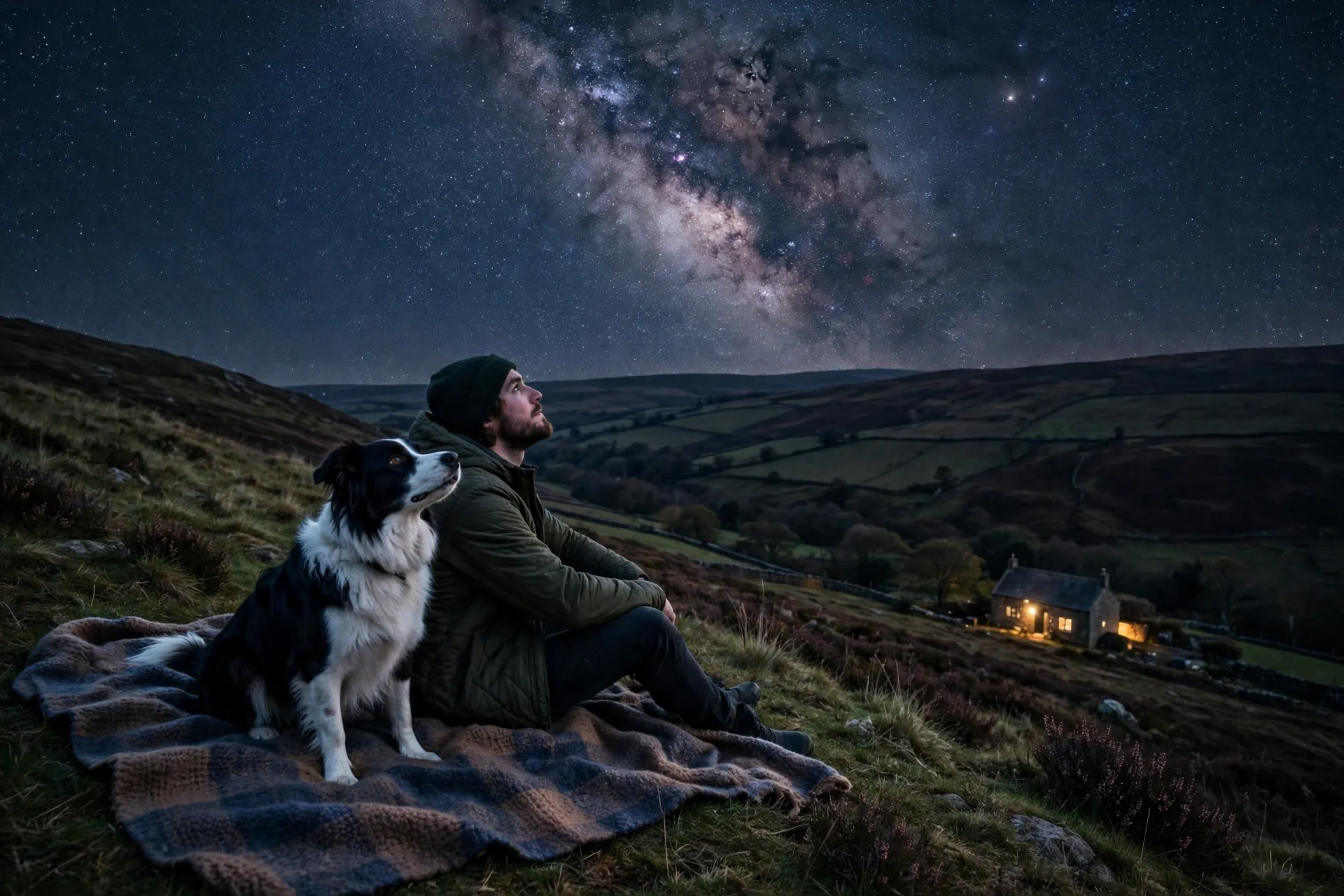
The door of the cottage clicks shut behind you and the night air is colder than you expected. Your dog trots ahead on a short lead, nose working the hedgerow, ears up at every rustle, while you carry the blanket, the flask and the red torch you remembered to pack. A few minutes up the lane, away from the porch light, you stop, spread the blanket on the grass and sit down. Your dog circles once, sighs, and settles against your leg. Then you look up, and the sky does the rest: a pale band of the Milky Way overhead, far more stars than you see from home, and a quiet that feels like it belongs to the night itself.
That first look is the reason to plan the rest properly. Stargazing is one of the few holiday activities where the dog is not an extra to be accommodated but a natural companion. There is no admission queue, no timed entry and no need to leave the dog behind. The dog is simply there, warm beside you, while you watch. But the night also removes the two things dog owners rely on most in the daytime: visibility and warmth. You cannot see the ditch, the sheep or the barbed wire as easily, and the temperature that felt pleasant at supper can fall several degrees in an hour under a clear sky. The breaks that work are the ones where those two problems were thought about in daylight, not discovered at midnight.
This guide follows that logic from start to finish. It begins with choosing a dark place and a forgiving base, then covers the kit that genuinely matters after sunset, the safety rules that keep a night walk calm, and the cloudy-night backup that stops a disappointing forecast from ruining a good break. It is written for ordinary dog owners, not astronomers: you do not need a telescope, and you do not need to know the constellations by name. You need a dark sky, a warm dog, a little patience, and a plan for getting home safely in the dark.
Why dark skies suit dogs
Dogs are often calmer at night than their owners expect, especially after a good daytime walk. The countryside after dark is quieter: fewer cars, fewer people, fewer dogs to greet, and a slower pace that suits older dogs and nervous dogs alike. A dog that pulls towards every daytime distraction may walk beautifully on a night lane, simply because there is less to react to. The darkness itself is not a problem for a dog; dogs see far better in low light than humans do, and they navigate largely by smell and hearing anyway.
There is also a practical advantage. Stargazing happens when most other holiday activities have finished, so it fills the evening without competing with walks, meals or sightseeing. A dog that has spent the day exploring can settle on a blanket while you look up, and the whole outing can last twenty minutes or two hours depending on the dog. Short sessions are perfectly respectable. A relaxed twenty minutes under a clear sky, followed by a warm cottage and a last toilet walk, beats a shivering hour in which the dog has stopped enjoying itself and you have stopped looking at the sky.
Not every dog is a natural night owl, though, and honesty about your own dog matters more than enthusiasm for astronomy. Puppies may be unsettled by unfamiliar sounds in the dark. Dogs that are frightened of fireworks or loud bangs may associate night outings with noise, particularly in November. Dogs with poor eyesight, arthritis or anxiety in new places may prefer a short garden session to a remote hillside. The aim is a break your dog enjoys, not a test of endurance, so let the dog set the length of the evening and treat every early return as a sensible decision rather than a failure.
Where the dark skies are
The darkest skies in Britain are generally found away from towns, motorways and lit coastal resorts, in upland and remote rural areas where street lighting is sparse. Several places carry formal dark-sky recognition, including the Northumberland International Dark Sky Park, the Brecon Beacons (Bannau Brycheiniog) National Park, Galloway Forest Park, Exmoor National Park, the South Downs National Park and the North York Moors, while Snowdonia (Eryri) also has designated dark-sky areas. These designations are useful as a starting point because they signal genuinely low light pollution and often come with marked viewpoints, parking and visitor information, but they are not the only option: any quiet rural area with a clear horizon and little nearby lighting can give a superb night.
When you choose, think about access as much as darkness. A viewpoint at the end of a long, unlit single-track road is a different proposition with a dog than a dark field ten minutes from your cottage. Ask whether there is parking close by, whether the ground is level enough for a blanket, whether there is a fence or drop nearby, and whether the walk back is on a road with traffic. The darkest hilltop is not the best choice if the dog has to cross open moorland in the dark to reach it. A slightly less dark spot that you can reach safely, settle in comfortably and leave easily will give you more enjoyable nights than a famous viewpoint that feels like an expedition.
Scout every viewing spot in daylight before you use it at night. Walk the route, note gates, stiles, livestock fields, water, ditches and uneven ground, and work out where you will sit and where the dog will settle. Daylight scouting also tells you where the horizon is blocked: trees, hills and buildings hide the lowest stars, and a spot that looks open in a photograph may face the wrong way for the Milky Way or the rising Moon. A ten-minute daytime visit saves a cold, confused night and turns the evening outing into something you can enjoy rather than navigate. Check the official guidance before you travel for any access rules, seasonal restrictions or livestock notices that apply to the specific place.
Moon, cloud and light pollution
Three things decide whether a night is worth going out: the Moon, the cloud and the light around you. A full Moon is beautiful, but it washes out faint stars and the Milky Way almost as effectively as a streetlight, so the darkest nights fall in the week around new Moon, when the Moon is absent or only a thin crescent. If your dates are fixed, a bright Moon is not a reason to stay in: the Moon itself, bright planets and the brighter constellations are all splendid under moonlight, and moonlit walks with a dog can be magical. But if you can choose your dates, aim for the darker half of the lunar month and you will see far more.
Cloud is the great spoiler of British stargazing, and it deserves respect rather than optimism. A general weather forecast is not enough: you need a cloud forecast, ideally one that shows low, medium and high cloud separately, because thin high cloud dims the stars while low cloud hides them entirely. Check the forecast in the late afternoon, not the morning, since evening cloud often differs from the daytime picture, and look at the hours after midnight as well as the evening. Clear skies are also the coldest skies, because cloud acts like a blanket; the best stargazing nights are often the ones when you need the warmest coat.
Light pollution is the third factor, and it is more local than people think. A single security light, a lit farmyard or a village hall can spoil an otherwise dark spot, while a hedge, a dip in the ground or a short walk away from the road can hide it. Give your eyes time to adapt: full dark adaptation takes twenty to thirty minutes, and a single glance at a bright phone screen resets much of it. That is why the red torch matters, and why sitting quietly for a while before judging the sky is part of the technique. Your dog, incidentally, will adapt far faster than you, and will probably be watching the hedgerow long before you can see it.
Choosing a place to stay
The best base for a stargazing break is one where you can step outside into darkness without driving. A cottage with a garden, a field edge or a quiet lane nearby beats a town-centre flat every time, even if the flat is smarter. Ask the host directly whether the garden or the immediate surroundings are dark at night, whether there are security lights that stay on, and whether there is somewhere safe to sit outside with a dog. Hosts in dark-sky areas often know the answer already and may even suggest the best local spot, which is worth more than any listing photograph.
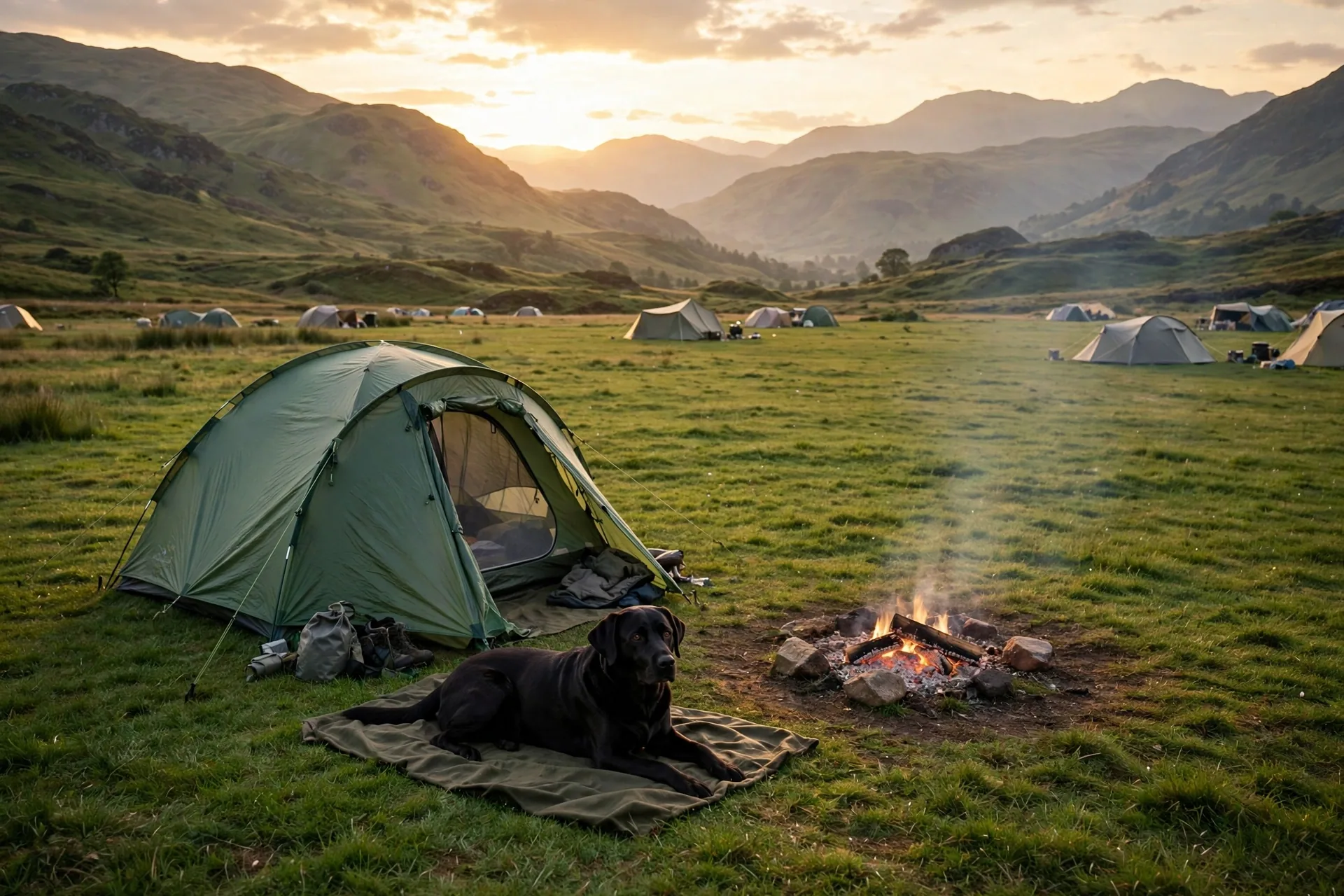
Camping and glamping suit stargazing particularly well, because the tent or pod is already outside and the sky is overhead the moment you unzip the door. Our guide to camping with a dog in the UK covers site choice, tent setup and sleeping arrangements that matter just as much on a night-sky trip, and a campsite with a dark field and a sensible dog policy is an excellent stargazing base. Hotels can work too, especially rural ones with grounds and a quiet garden, and our guide to booking dog-friendly hotels explains the room and dining questions worth asking before you commit. Whatever you choose, confirm the dog rules for the evening: some places ask dogs to be indoors after a certain hour, and a stargazing plan that breaks the house rules is not a plan at all.
Book more nights than you think you need. Two nights give you one real chance at a clear sky; three or four nights give you a reasonable chance of at least one excellent night and leave room for a cloudy evening without disappointment. This matters more than any single piece of equipment. Stargazing breaks are weather-dependent by nature, and the travellers who enjoy them most are the ones who treat the sky as a bonus on top of a good walking and eating break, not as a single-night gamble. A comfortable base, good daytime walks and a dog that is happy to be there are the trip; a clear sky is the reward.
Keeping your dog warm
Warmth is the single most important comfort issue on a stargazing break, and it catches people out because the evening often starts mild. Under a clear sky, heat radiates away from the ground, the air temperature falls steadily after sunset, and damp grass or cold stone draws warmth from anything sitting on it. A dog lying still on a blanket loses heat faster than a dog walking, which is exactly what stargazing asks the dog to do. The solution is insulation from below first: a closed-cell foam mat, an insulated dog bed or a folded blanket underneath the dog matters more than a coat on top, because cold ground is the fastest way to chill a settled dog.
Coats help particular dogs most. Short-coated breeds such as whippets, greyhounds, boxers and many terriers, small dogs with little body mass, lean dogs, puppies, older dogs and any dog recovering from illness will benefit from a well-fitting, waterproof coat that covers the chest and belly without restricting movement. Double-coated breeds such as huskies, malamutes and many collies usually manage well without one, and an overheated dog in an unnecessary coat is no happier than a cold one. Fit matters: a coat that slips, rubs or covers the tail awkwardly will distract the dog all evening, so try it at home first and check the fit after a walk, not just in the shop.
Watch for the signs that your dog is getting cold and act on them early. Shivering is the obvious one, but also look for tucking the tail, lifting paws, curling tightly, seeking shelter behind you, restlessness after settling, or a reluctance to lie down at all. A cold dog should be walked gently to warm up, wrapped in a dry blanket, or taken back indoors; none of these is a defeat. Bring a dry towel as well as a blanket, because a dog that has walked through wet grass will chill far faster than a dry one, and a quick towel-down before settling makes a real difference. If you are unsure whether your dog is warm enough, shorten the session: the sky will still be there tomorrow, and a dog that associates night outings with comfort will happily come out again.
Red torches and night vision
A red torch is the stargazer's most useful small purchase, and it costs very little. Human eyes adapt to darkness using rod cells that are relatively insensitive to red light, so a dim red beam lets you see your footing, your dog and your belongings without destroying the dark adaptation you have spent twenty minutes building. A white torch, by contrast, floods the area with light, startles other skywatchers, disturbs wildlife and sends your own night vision back to the start. Head torches with a red mode are ideal because they leave your hands free for the lead and the blanket, but a small hand torch with a red filter or a red-light setting works just as well.
Use the red light sparingly and point it downwards. The habit to build is short bursts at the ground in front of you, not a continuous beam sweeping the field. Check the lead for tangles, check the dog is settled, check the flask has not tipped over, then switch it off and let your eyes work. Keep the brightness as low as you can manage: most red modes have several levels, and the lowest that lets you walk safely is the right one. Avoid shining any light, red or white, directly at another person's face or telescope, and never point a laser pointer at the sky, which is both dangerous for aircraft and deeply unpopular with other skywatchers.
Phones need the same discipline. A phone screen at full brightness is the modern equivalent of a white torch, and checking a star chart or a message every few minutes will keep your eyes from ever adapting properly. If you want to identify constellations, use a star-chart app in its night mode with the screen dimmed to minimum, or better still, learn two or three constellations before you go and enjoy finding them without a screen at all. Keep the phone in a pocket while you watch, and if you take photographs, accept that long exposures and night photography are a separate hobby: a phone held up for a picture is a bright rectangle in a dark field, and the dog will have moved on long before the exposure finishes.
Night safety on the lead
Night safety starts with the lead. A reflective lead and a reflective harness or collar make your dog visible to drivers, cyclists and other walkers, and they make the dog much easier for you to follow in the dark. Reflective stitching catches a torch beam from a surprising distance, and a small clip-on light on the harness or collar helps you spot the dog instantly when it moves behind a hedge or into a dip. Choose a light that is steady rather than flashing if you are near other skywatchers, since a flashing light is distracting, and remember that a light on the dog does not replace a lead: it tells you where the dog is, not whether the dog is safe.
Keep the lead short near roads, livestock, water and unfamiliar ground, and use a longer lead only on open, safe ground you have already scouted in daylight. Night walking changes risk in ways that are easy to underestimate. A dog that would never chase sheep in daylight may react to shapes and sounds it cannot identify. A familiar path can hide a new hazard after rain: a flooded dip, a fallen branch, a broken fence. Barbed wire is almost invisible at night, and a dog running on a long lead can reach it before you see it. Near cliffs, quarries, rivers and reservoirs, keep the dog close and the lead short, and if you are not certain the ground is safe, stay on the lane and enjoy the sky from there.
Think about your own visibility too. Wear something light or reflective, carry the red torch, and walk facing oncoming traffic on roads without pavements, with the dog on the side away from the road. Let someone know roughly where you are going and when you expect to be back, especially on remote sites, and carry a charged phone even if you keep it in your pocket. A whistle can be useful for recall in the dark, and a dog that has a reliable whistle recall at home is a much safer night companion than one whose recall depends on being seen. If the dog does slip the lead, stay calm, crouch, use a familiar call and a treat rustle rather than chasing, and remember that most lost dogs are found close to where they were lost, often by retracing their steps.
Settling a dog in the dark
A dog that settles happily is the difference between stargazing and dog-wrangling, and settling is a skill worth practising before the trip. At home, teach or refresh a simple settle on a mat: the dog lies on its own mat, gets a chew or a scatter of treats, and learns that the mat means rest. Bring that same mat on the break, use it in the garden on the first evening, and then take it to the viewing spot. Familiarity does most of the work: the same mat, the same blanket, the same quiet voice and the same routine tell the dog that this strange dark field is just another place to rest.
Time the outing to suit the dog, not the astronomy timetable. A dog that has had a good walk, a meal and a toilet break will settle far better than one that is still full of energy or needs the toilet. Arrive at the viewing spot in the last light if you can, so the dog can sniff around and settle while it is still possible to see, rather than arriving in full darkness to a completely unfamiliar place. Give the dog a long-lasting chew or a stuffed Kong for the first ten minutes, then let it doze while you watch. Some dogs prefer to lie against your leg; others prefer their own space a lead-length away. Either is fine, provided the lead is not tangled around the blanket or the flask.
Night sounds will test some dogs, and preparation helps. Owls, foxes, sheep, distant farm machinery and the wind in trees are all normal countryside sounds, but a dog hearing them in the dark for the first time may bark or startle. A calm, boring response from you is the best training: no fuss, no scolding, just a quiet word and a treat for settling again. If barking becomes persistent, or if the dog is clearly distressed rather than merely alert, pack up and go back. Other skywatchers will thank you, neighbouring cottages will sleep better, and the dog will learn that night outings end when they stop being fun, which is a far better lesson than being forced to endure them.
When the cloud wins
Cloud is not a failure of planning; it is the normal British weather, and a good stargazing break is built around it. The first defence is duration, as already noted: three or four nights give the sky several chances. The second is flexibility within each evening. Cloud often clears for an hour or two after midnight, or breaks into patches that reveal bright stars and planets even when the Milky Way is hidden, so a late check from the cottage door is worth more than giving up at nine o'clock. Keep the kit by the door, the dog's coat and mat ready, and a flask filled, so a sudden clearing can be used without a half-hour preparation.
The third defence is a genuine backup plan, not a grudging alternative. A night walk with red torches along a quiet lane is enjoyable in its own right, and dogs often love it. A pub that welcomes dogs by the fire, with a good meal and a local ale, is a perfectly good use of a cloudy evening. Some dark-sky areas have planetariums, observatories with public evenings, or visitor centres with exhibitions that run regardless of weather, and these are worth checking before the trip rather than discovering at the last minute. A slow morning after a late night is also a legitimate plan: sleep in, take a long brunch walk, and try again the next night with a rested dog.
It also helps to reframe what counts as a successful night. A bright Moon rising over the hills, a planet shining steadily through thin cloud, a shooting star caught by chance, or the simple pleasure of sitting outside with a warm dog in a quiet place are all real rewards, even if the sky never becomes perfectly clear. Stargazing is one of the few hobbies where doing nothing is the activity, and dogs understand that better than their owners. If the cloud never lifts, you have still had a walking break in a beautiful, quiet place with your dog, and that is a holiday worth having. Check the official guidance before you travel for any observatory or visitor centre opening times, since these change seasonally.
Daytime on a night-sky break
A stargazing break still needs good days, and the daytime plan should be built around the night, not in spite of it. Give the dog a proper walk in the morning or early afternoon, when the light is good and the dog can run, sniff and explore properly. This is what makes the evening settle possible, and it is also the best time to scout the night's viewing spot if you have not already done so. A tired, contented dog is a settled dog, while a dog that has spent the day indoors will be restless at exactly the moment you want quiet.
Protect the afternoon nap. Dogs that are allowed a long, undisturbed rest in the afternoon cope far better with a late evening than dogs that are kept busy all day, and owners who nap too will enjoy the night far more. Avoid scheduling a long drive, a busy attraction or a late meal on a night you hope to stargaze, because a tired, hungry owner with an overstimulated dog is unlikely to enjoy an hour on a cold hillside. Instead, keep the evening meal early and simple, lay out the night kit before supper, and treat the outing as a gentle extension of the day rather than a second expedition.
Daytime is also the time to handle the practical jobs: charging torches and phones, checking the cloud forecast, drying the dog's coat and blanket from the previous night, and confirming the next evening's plan with your host or campsite. If you are staying near the coast, our guide to UK beach dog rules is worth reading before a daytime beach walk, since seasonal restrictions and fines vary by beach and council. A well-run day makes the night feel effortless, and a night that feels effortless is one you will want to repeat, which is the real measure of a successful break.
The stargazing packing list
Packing for a stargazing break is mostly about warmth, light and visibility, with the usual dog kit underneath. Start with the dog: an insulated mat or bed, a coat if your dog needs one, a dry blanket, a towel, a reflective lead and harness, a clip-on light, water and a bowl, a chew or long-lasting treat for settling, poo bags, and any medication the dog needs. Add a spare lead, because a lead dropped in the dark is surprisingly hard to find, and a familiar toy or comfort item for nervous dogs. Keep all of this in one bag by the door so a sudden clearing can be used without hunting through cases.
For yourself, pack a warm, windproof coat, a hat and gloves even in summer, waterproof trousers if the ground is wet, sturdy shoes with grip, a red torch with spare batteries, a flask with a hot drink, a blanket or sitting mat for yourself, and a charged phone kept in a pocket. A simple star chart, printed or in an app with night mode, is useful for the first few outings, and binoculars are a surprisingly good investment: they reveal star clusters, the Moon's craters and the brighter nebulae without the weight, cost or setup of a telescope, and they are easy to use while a dog sits beside you. A telescope is optional and, for most first breaks, an unnecessary complication.
Finally, pack for the cottage as well as the field. A dog that has been out in the cold and damp needs a warm, dry place to recover: its own bed in a draught-free corner, a dry towel, fresh water and a quiet hour before bedtime. Wet bedding from the night before should be dried properly, not left damp in a corner, and muddy paws need a towel by the door every time, not just after the big walk. These small routines are what keep a multi-night break comfortable, and they are the difference between a dog that is keen to go out on the third night and one that hides when the lead appears.
Practical questions
Before you go
Do I need a special torch for stargazing with a dog?
A red torch is the best choice. Red light disturbs your night vision far less than white light, and it lets you check on your dog, your footing and your lead without flooding the area with glare. Keep the beam low, pointed at the ground, and use it only when you need it rather than leaving it on.
Will my dog be cold during a night of stargazing?
Possibly, even on a mild evening, because clear skies radiate heat away and the temperature drops after sunset. Bring an insulated mat to lift your dog off cold ground, a well-fitting coat for short-coated, small, older or lean dogs, and a blanket for the return to the cottage. If your dog shivers, paces or seeks shelter, cut the session short.
Should my dog be on a lead at night?
Yes, in almost every stargazing spot. Darkness hides livestock, fences, drops, water and other walkers, and a dog that would recall perfectly in daylight may chase a shape it cannot identify. Use a reflective lead and harness, keep the lead short near roads and livestock, and never tie a dog to a fence post and walk away.
What happens if it is cloudy on my stargazing break?
Treat cloud as a normal part of the plan, not a ruined trip. Book at least two or three nights so one clear night is likely, check the forecast each afternoon, and keep a backup evening ready: a night walk with torches, a cosy pub that welcomes dogs, a planetarium visit, or a slow morning after a late night. Flexibility is what turns a cloudy break into a good one.
Are dark-sky reserves good places to take a dog?
They can be, provided you respect the same rules as any countryside visit: dogs under control, waste bagged and binned, no disturbance to wildlife or livestock, and no bright lights pointed at other skywatchers. Some viewpoints are beside busy roads or unfenced drops, so scout the spot in daylight first and choose a viewing place your dog can settle in.
When is the best time of year for stargazing with a dog in the UK?
Autumn and winter offer the longest, darkest nights, but they are also the coldest, so warmth and waterproofs matter most. Spring and summer nights are shorter and warmer, which suits dogs that dislike the cold, though true darkness arrives late. The best season is the one your dog can enjoy comfortably, with a moon phase and forecast to match.