This guide is independent and contains no paid placement. If affiliate links are added later, they will be clearly marked and will not change our editorial checks.
During an amber or red weather warning, do not walk the dog outside: exercise indoors instead. In milder bad weather, keep the walk short, keep the dog on a lead, avoid trees, coast paths, rivers and flood water, and turn back the moment conditions worsen. A wet dog is a cold dog, so dry and check the dog thoroughly when you get home.
Go or stay home? The first decision
Every storm walk starts before you open the front door, with a decision that matters more than anything you do on the route. A dog that misses one walk is a dog that has a boring afternoon. A dog taken out into a serious storm can be injured by a falling branch, swept into flood water, or panicked by thunder into running across a road. The walk is never worth that risk, and dogs do not keep score the way their owners do. A single skipped walk, replaced by indoor play and training, costs nothing. A bad decision in a storm can cost a great deal.
Start by separating ordinary British rain from a storm. Rain on its own is not dangerous: millions of dogs are walked in drizzle every day, and a healthy adult dog with a decent coat handles a wet walk without difficulty. A storm is different because it adds wind, and wind is what turns a walk into a hazard. Gusts bend trees, tear branches loose, throw bins and garden furniture across paths, and push spray and waves over sea walls. Add thunder, lightning, hail, or rising water and the walk becomes something else entirely. The question is therefore not "is it raining?" but "what else is happening, and how bad is it expected to get while we are out?"
A practical rule helps. If the forecast carries a yellow wind or rain warning for your area, you can usually still walk, but only with a plan: a short route, a lead, no trees, no coast, and a clear turn-back point. If the warning is amber, the default answer is to stay home, with only a brief garden or pavement toilet trip. If the warning is red, the answer is always to stay home; red means a risk to life, and that applies to dogs as much as to people. Storms also change while you are out, so check the forecast again just before you leave rather than relying on what you saw in the morning. A walk that starts in a lull can end in the worst of the weather, and the walk home is often when people get caught out.
Consider the dog in front of you as well as the weather. A fit, confident adult dog copes far better than a puppy, a senior dog, a small or very light dog, or a dog that is already anxious about noise. Small dogs can be lifted off their feet by a strong gust. Older dogs with arthritis struggle on slippery, wind-blown ground. Dogs that fear thunder may bolt at the first rumble, and a dog on a long line in a storm is a dog that can be dragged into a road or a flooded ditch before you can react. If any of those descriptions fits your dog, lower your threshold for staying in: what is a manageable walk for a sturdy collie can be a genuinely frightening one for a nervous terrier.
Finally, think about the humans. If you are unwell, tired, or walking alone with a strong dog that pulls, a storm is the worst day to test your grip. A lead wrapped around a gloved hand in a gust can burn or pull you over, and a fall on a wet pavement can leave both of you stranded. If you would not want to walk the route alone in those conditions, do not take the dog either. The indoor alternatives are better than most people think: ten minutes of scent games, a stuffed food toy, a short training session and a toilet trip in the garden will tire most dogs out more honestly than a miserable forty minutes being blown sideways.
Reading UK storm warnings before you leave
The United Kingdom has one of the best warning systems in the world, and it costs nothing to use. The Met Office issues weather warnings in three colours: yellow, amber and red. Yellow means be aware: weather may disrupt travel and outdoor plans, and you should check the details for your area. Amber means be prepared: there is an increased likelihood of bad weather disrupting daily life, with a risk of damage and travel delays. Red means take action: dangerous weather is expected, and you should change your plans and avoid travelling. For dog walking, translate these into a simple rule: yellow means walk with care, amber means stay home except for a toilet trip, and red means stay home, full stop.
Named storms are worth taking seriously. When the Met Office names a storm, it means the weather is expected to be severe enough to cause disruption, and the name is a signal that the event has been assessed as a genuine risk rather than routine bad weather. Named storms in the UK have brought gusts above 90 mph in exposed places, widespread fallen trees, power cuts, coastal overtopping and flooding. Do not assume a named storm will be milder where you live than the headlines suggest: gusts vary enormously with local geography, and a sheltered valley can still see a tree come down across a footpath. Check the official guidance before you travel if you are heading to a different part of the country, because conditions a hundred miles away can be far worse than at home.
Use more than one source, and read the details rather than the headline. The Met Office app and website give warnings by region, with expected wind speeds, rainfall totals and timings. Flood alerts come from the Environment Agency in England, Natural Resources Wales, and the Scottish Environment Protection Agency in Scotland, and they tell you whether water is expected to flood low-lying land near rivers and the coast. Local council and police social media accounts often post about closed paths, fallen trees and flooded roads in real time. Tide times matter on the coast: a storm surge at high tide is far more dangerous than the same surge at low tide, and the tide timetable is published in advance. Put these together before you decide, and remember that warnings are updated as a storm develops, so a yellow warning can be raised to amber while you are out.
Timing is part of the decision. Storms often arrive in bands, with a calm gap before the worst of the wind. A walk in that gap feels safe and can tempt you further from home than you should go, because the return leg is when the band arrives. Plan the walk backwards: decide when you need to be home, then choose a route that keeps you within ten minutes of the front door at every point. If the forecast shows the worst weather arriving in the next hour, do not start a forty-minute loop. Do the garden, do a short pavement circuit, and save the proper walk for the calmer spell afterwards. Dogs do not mind a delayed walk; they mind being cold, frightened and far from home when the weather turns.
Keep a charged phone and a simple plan for getting help. Tell someone where you are going if you walk alone in bad weather, and carry your phone in a waterproof pocket rather than an open jacket pocket. Save your vet's number and the number of your local emergency vet, because a storm-day injury is more likely to need urgent attention and more likely to happen when your usual practice is closed. None of this is overkill: it is the same preparation hill walkers use, scaled down to a dog walk, and on a storm day the gap between a normal walk and a mountain walk is smaller than it looks.
Fallen trees, broken branches and power lines
Trees are the single most common cause of storm injuries outdoors in the UK, and they are the hazard most dog walkers underestimate. A healthy-looking tree can lose a heavy limb in a gust, and a tree weakened by disease, drought or previous storm damage can come down without warning. The danger is not limited to woodland: park trees, garden trees overhanging a pavement, and single trees beside a footpath all shed branches in high wind. The risk is highest at the start of a storm, when the first strong gusts hit trees that have not yet shed their weakest wood, and again after heavy rain, when saturated soil loosens roots and whole trees can topple.
The rule for dog walking is simple: in high wind, stay out of woodland and away from tree-lined routes. A woodland path that is delightful on a calm day becomes a corridor of falling timber in a storm, and the canopy that shelters you from rain also hides the branch that is about to fall. The same applies to avenues of trees along a road or a park edge: a branch does not need to be large to injure a dog, and a falling limb that would bruise a person can seriously hurt a small dog. Choose open ground instead — a playing field, a paved promenade away from trees, or a short pavement loop — and accept that the walk will be less scenic. Scenery is a fair-weather luxury.
Learn to read the trees you do pass. A tree leaning noticeably, with lifted soil or cracked ground at its base, is a tree that may be about to fall; give it a wide berth and do not stop beneath it. A large branch hanging at an angle, caught in the branches below, is called a widow-maker for good reason: it can drop in the next gust. Cracks, splits or fungal growth on a trunk are signs of weakness, and a tree that creaks and groans in the wind is telling you to move on. Dogs, of course, notice none of this, and they will happily sniff at the base of the most dangerous tree on the route. Keep the dog on a short lead near trees and keep moving.
Power lines deserve the same respect. A fallen tree can bring a power line down with it, and a live cable on wet ground is lethal to a dog that steps on it or sniffs it. If you see a fallen cable, a leaning pole, or a sparking wire, do not approach it and do not let the dog approach it: turn back, keep at least ten metres away, and report it to your electricity network operator. The number is printed on your electricity bill and is also available online, and the operator would rather hear about a fallen line ten times than have someone walk into it once. After a storm, treat any wire on the ground as live until the operator says otherwise. Wet ground conducts electricity further than dry ground, so the safe distance is larger than you might think.
After the storm has passed, the danger does not end immediately. Branches weakened by the storm can fall hours or even days later, especially in the next gust of wind, and trees that were damaged but did not fall can shed limbs for weeks. When you return to a woodland route after a storm, walk it first without expecting the dog to run ahead, keep the dog close for the first visit, and look up as well as ahead. Report dangerous trees to the landowner or the local council, and check the official guidance before you travel if you are visiting a managed woodland or park, because some sites close their tree-covered paths after a storm until they have been checked.
Coast paths, cliffs and storm surges
Coastal walks are where storm danger is most visible and most often ignored. A storm surge — a rise in sea level driven by low pressure and strong onshore winds — can push waves over sea walls, flood promenades and car parks, and turn a familiar cliff path into a place where the sea is suddenly much closer than it was yesterday. Add high tide and the combination can overtop defences that have held for years. The danger is not only the water itself: waves carry stones, debris and broken timber, and a wave that knocks a person over can sweep a dog off a promenade before the owner can react.
Never walk a coast path, a sea wall or a harbour arm during a storm. Stay well back from the edge of the water, and do not stand on sea defences, piers or breakwaters to watch the waves — the waves that look spectacular from a distance are the ones that kill people who stand too close. The Royal National Lifeboat Institution advises staying away from exposed areas during storms, and that advice applies to dog walkers just as much as to sightseers. A dog that is off the lead near a storm sea is at particular risk: dogs chase waves, run towards the waterline, and do not understand that a wave can be followed by a much larger one. Keep the dog on a lead, keep the lead short, and keep a sensible distance from the water.
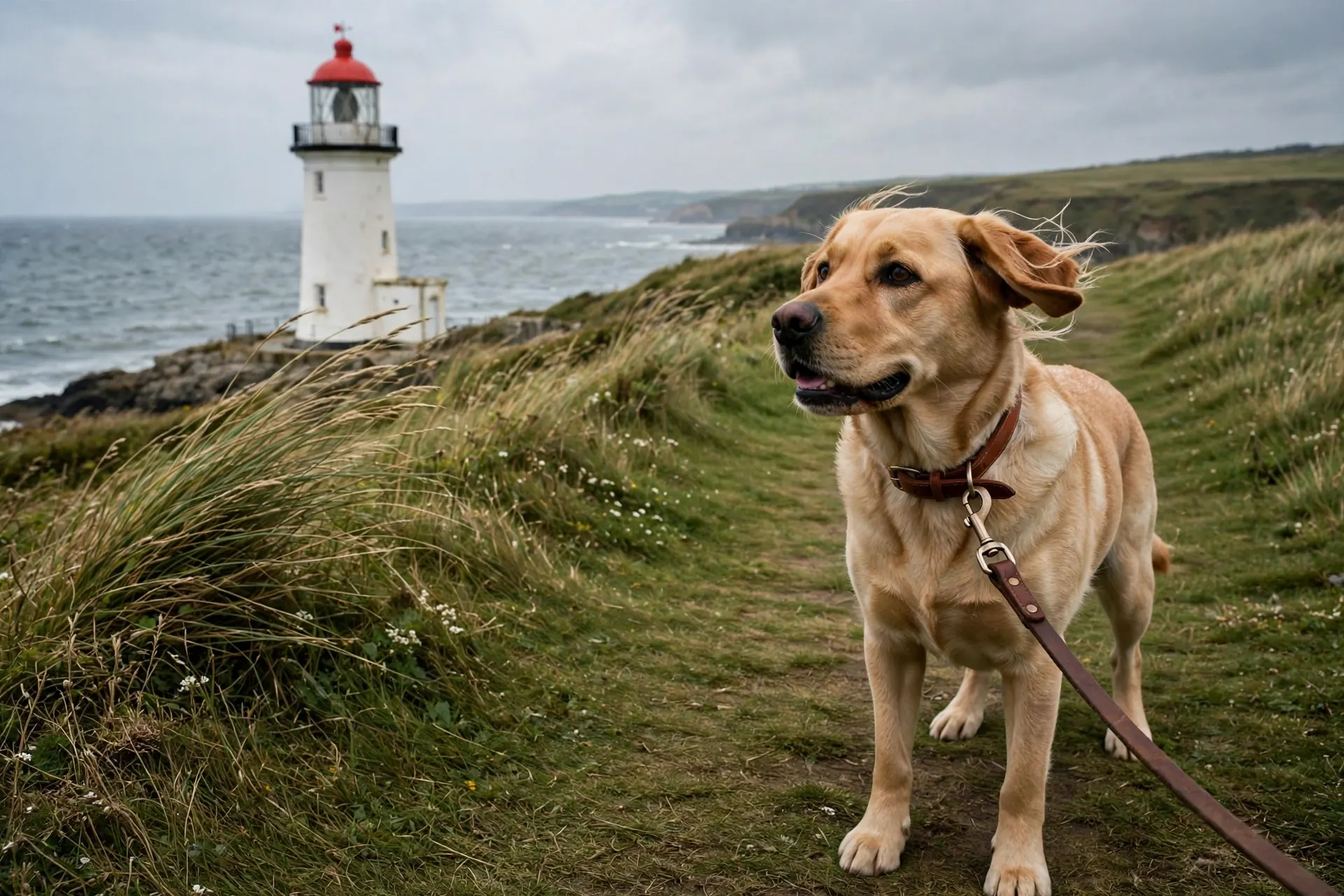
Cliff paths add a second danger. Saturated soil and heavy rain make cliff edges unstable, and sections of path can collapse without warning after a storm. Wind gusts at a cliff edge are stronger and less predictable than inland, and a gust that catches a dog — or its owner — at the wrong moment can push them towards the edge. Stick to inland routes during and after storms, and do not use a coast path until you have checked that it is open. Our guide to dogs at lighthouses in the UK covers tower rules and headland walking in ordinary weather, but the safety advice in it matters even more in a storm: the headlands around lighthouses are among the most exposed places in the country, and they are the last place to take a dog when the wind is up.
Beaches change after a storm as well. A beach that was safe yesterday can have a new cut in a sandbank, a deeper channel, or debris washed up by the tide, including broken glass, fishing gear and sharp metal. Strong currents and a bigger surf make paddling and swimming dangerous, and a dog that swims after a ball in a storm sea can be carried out faster than its owner can follow. If you do visit a beach after a storm, keep the dog on a lead until you have walked the area yourself, check for debris, and do not let the dog swim. If the tide is coming in, leave well before the water reaches the path: cut-off tides trap walkers every year in the UK, and a dog that will not come back when called makes the situation worse.
If you arrive at the coast and find the sea already overtopping the promenade, the car park flooded, or the path closed, turn around and go home. Do not try a different coastal route in the hope that it will be calmer: conditions are usually similar along the whole stretch of coast, and the next cove is as exposed as the one you just left. Drive inland to a sheltered park or a short pavement walk, or simply go home and exercise the dog indoors. The coast will still be there tomorrow, and it will be far more enjoyable when the wind has dropped.
Rivers and flood water
Flood water is the most deceptive hazard a dog walker can meet, because it looks harmless and acts like a trap. Six inches of fast-moving water can knock a person off their feet, and far less can sweep a small dog away. Flood water is also dirty: it carries sewage, chemicals, broken glass, sharp metal and animal waste, and a dog that drinks it or walks through it can pick up infections such as leptospirosis. A dog that swims in flood water is at risk of being carried into a drain, a culvert or a submerged fence, where it can be trapped out of sight in seconds.
The rule is absolute: never let a dog enter flood water, and never walk through flood water yourself. Do not try to judge the depth by looking at it, because flood water hides dips, open drains, missing manhole covers and submerged obstacles. Do not drive through flooded roads either, even if the water looks shallow: many rescues every year involve drivers who thought the water was only a few inches deep. If your usual route crosses a ford, a riverside path or a low bridge, assume it is impassable during and after heavy rain until you have checked. A riverside walk that is pleasant in summer can be under a metre of fast water in winter, and the water often rises faster than people expect, especially in a steep catchment after a downpour.
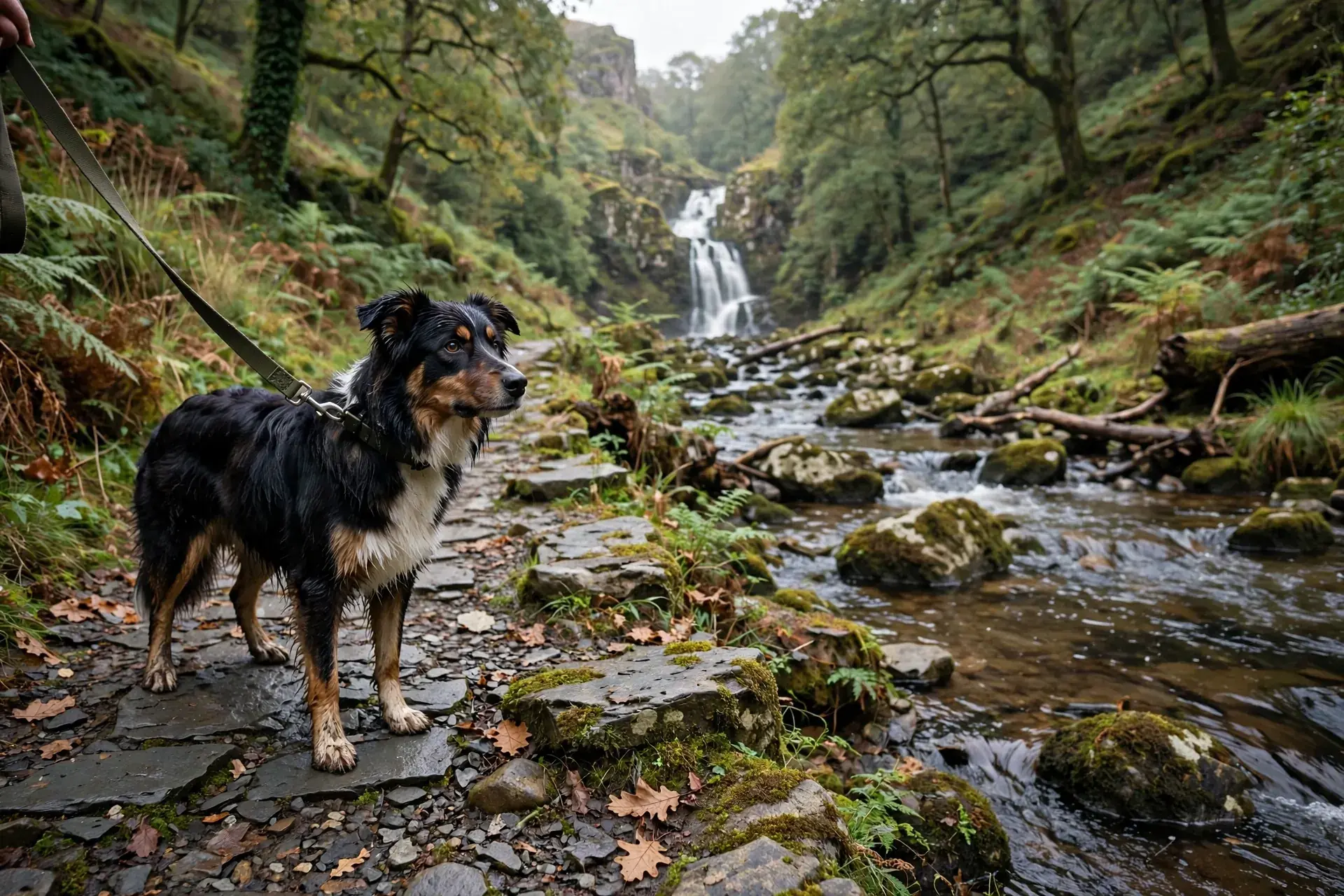
Rivers themselves change character in a storm. A gentle stream can become a torrent within an hour of heavy rain upstream, even if it is not raining where you are standing. Water levels rise, currents strengthen, and the bank becomes slippery with mud. Dogs that normally paddle safely can be pulled in by a current they cannot fight, and a dog that falls in may not be able to climb back out of a steep, muddy bank. Keep the dog on a lead near any river in wet weather, and keep well back from the edge. Our guide to dogs at waterfalls in the UK explains why slippery rocks and rising water make waterfall paths risky in ordinary conditions; after heavy rain, those risks are multiplied, and waterfall viewpoints are best avoided until the water drops.
Watch for the signs that water is rising. If the river is brown and fast, if debris is floating past, if the path beside the water is wet when it was dry an hour ago, or if you can hear the river roaring from a distance, the water is rising and you should move to higher ground immediately. Do not wait to see how high it gets. If you are caught by rising water, head uphill and away from the river, and do not try to cross a flooded path to get home faster: take the longer, higher route. Keep the dog close and on a short lead, because a frightened dog in rising water is unpredictable.
After a flood, the ground stays dangerous. Paths can be undercut by the water, fences can be damaged, and the mud left behind hides sharp objects. Wait until the water has fully receded and the path has been checked before returning, and wash the dog's paws and belly in clean water if they have been in contact with flood water or flood mud. If the dog develops vomiting, diarrhoea, a fever or unusual lethargy in the days after contact with flood water, tell your vet about the exposure, because early treatment matters for water-borne infections. Check the official guidance before you travel if you are visiting a river valley after a storm, because flood warnings and path closures are updated as the water moves downstream.
Lightning and thunder
Lightning is rare in the UK compared with many countries, but it is not rare enough to ignore. The UK sees hundreds of thousands of lightning strikes a year, and thunderstorms often arrive with the heaviest rain and the strongest gusts of a storm system. A lightning strike can kill a person or a dog directly, or cause injury through the ground current spreading from the strike point. A wet dog standing on wet ground is a good conductor, and a metal lead, a metal fence or a wet tree can carry a strike to the animal. The risk is low in absolute terms, but the consequences are so severe that the correct response is simple: if there is lightning, get indoors.
The old "30-30 rule" is a useful guide. If the time between seeing lightning and hearing thunder is less than thirty seconds, the storm is close enough to be dangerous, and you should already be heading for shelter. Wait at least thirty minutes after the last thunder before going back outside. Do not try to time the storm by counting and carrying on: the count tells you the storm is near, and near is too close. If you are caught out in the open, move away from isolated trees, water, metal fences, hilltops and open high ground. Crouch low in a hollow if you cannot reach a building or a car, keeping your feet together and the dog close, but understand that this is a last resort, not a plan. A car with a metal body is a reasonable shelter; a bus shelter, a beach hut and a tent are not.
Never shelter under an isolated tree in a thunderstorm. Trees attract lightning, and a strike can travel down the trunk and through the ground, injuring anyone sheltering beneath. A group of trees in a wood is safer than a single tree in a field, but the safest place is a substantial building with plumbing and wiring, or a hard-topped car. Do not use a mobile phone in the open during a thunderstorm if you can avoid it, and do not hold a metal umbrella: a metal umbrella is effectively a lightning rod held above your head. Put the umbrella away, keep the dog on a short lead, and move steadily towards shelter rather than running, because running on wet ground in a storm is how people fall.
Thunder affects dogs even when lightning does not strike nearby. Many dogs are frightened by thunder, and the fear can be severe: panting, drooling, shaking, pacing, hiding, trying to escape, and in extreme cases injuring themselves by crashing through doors or fences. A thunder-phobic dog that bolts during a walk can run into a road or get lost, and a dog that is already anxious is far more likely to bolt than a calm one. If your dog has shown fear of thunder before, do not take them out when thunder is forecast. Stay home, close the curtains, and let the dog choose a safe spot. A dog that is frightened indoors is a dog you can comfort; a dog that is frightened a mile from home is a dog in danger.
For dogs with repeated severe thunderstorm fear, preparation is better than improvisation. Speak to your vet well before the storm season about behaviour work, desensitisation recordings, and whether medication is appropriate for the worst events. Some owners find a snug-fitting pressure wrap or a familiar blanket helps, while others use background noise to mask the sound. What does not help is punishing the dog for being frightened, or forcing the dog to face the storm in the hope that it will get used to it: fear does not work that way, and forced exposure usually makes it worse. Keep the routine calm, keep the dog indoors, and treat thunder fear as a genuine welfare issue rather than a quirk.
Wind-blown debris, gates and garden furniture
Wind is the hazard that turns ordinary objects into projectiles. A wheelie bin, a garden chair, a fence panel, a roof tile, a loose sign or a broken branch can all be picked up and thrown across a path in a strong gust. Dogs are low to the ground and cannot see these objects coming, and a dog that is sniffing a hedge or investigating a bin has no chance of dodging a fence panel that arrives from the side. The risk is worst in built-up areas, where there are more loose objects, and in gardens and allotments, where furniture and equipment are often left out unsecured.
Walk with your eyes up as well as ahead. Look for loose fencing, scaffolding, hoardings, shop signs and tree branches overhanging the pavement, and give them a wide berth. Be especially careful near building sites, where debris and loose materials are common, and near walls and fences that are already leaning. A gate that swings freely in the wind can slam shut on a dog's tail or paw, or swing open and let a dog out onto a road, so hold gates firmly and keep the dog close when passing through. If you hear something rattling or banging overhead, move away from the building: a loose roof tile or a piece of guttering can fall without warning, and a dog standing below it is in the direct path.
Keep the dog on a short lead in built-up areas during a storm. A short lead gives you control if the dog startles at a sudden bang or a flying object, and it stops the dog from running into the road when a gust catches it by surprise. A long line or an extendable lead is a liability in high wind: the line can tangle, the dog can be blown sideways into traffic, and you cannot reel the dog in quickly if something goes wrong. Use a flat collar or a harness with a secure clip, and check the clip before you leave, because a clip that has been weakened by wear can fail under a sudden pull. If the dog is strong, consider a double-ended lead or a lead with a waist belt so that a sudden lunge does not pull the lead from your hand.
Hail is a separate problem that often arrives with the strongest gusts. Small hail is unpleasant; large hail can bruise and frighten a dog, and a dog that is hit by hail may panic and run. If hail starts, head for the nearest shelter — a shop doorway, a bus shelter, a car — and wait for it to pass rather than pushing on. Cover the dog with your coat if you have to cross open ground, and keep the dog close. Do not let the dog eat hailstones or drink from puddles full of hail, and check the dog's ears and paws afterwards, because hail can cause small cuts and bruising that are easy to miss under wet fur.
Finally, watch the ground as well as the air. Storms wash grit, broken glass and sharp debris onto paths, and a dog walking through it can cut a paw. Puddles hide potholes and broken paving, and a dog that steps into a hidden hole can twist a leg. After the storm, pavements and paths may be covered in leaves and mud that hide the surface underneath, so keep the pace slow and watch where the dog puts its feet. If you find a route blocked by debris, do not climb over it with the dog: turn back and take another route, because the debris may be hiding a fallen cable, a broken fence or a hole in the ground.
Raincoats, leads and boots that actually help
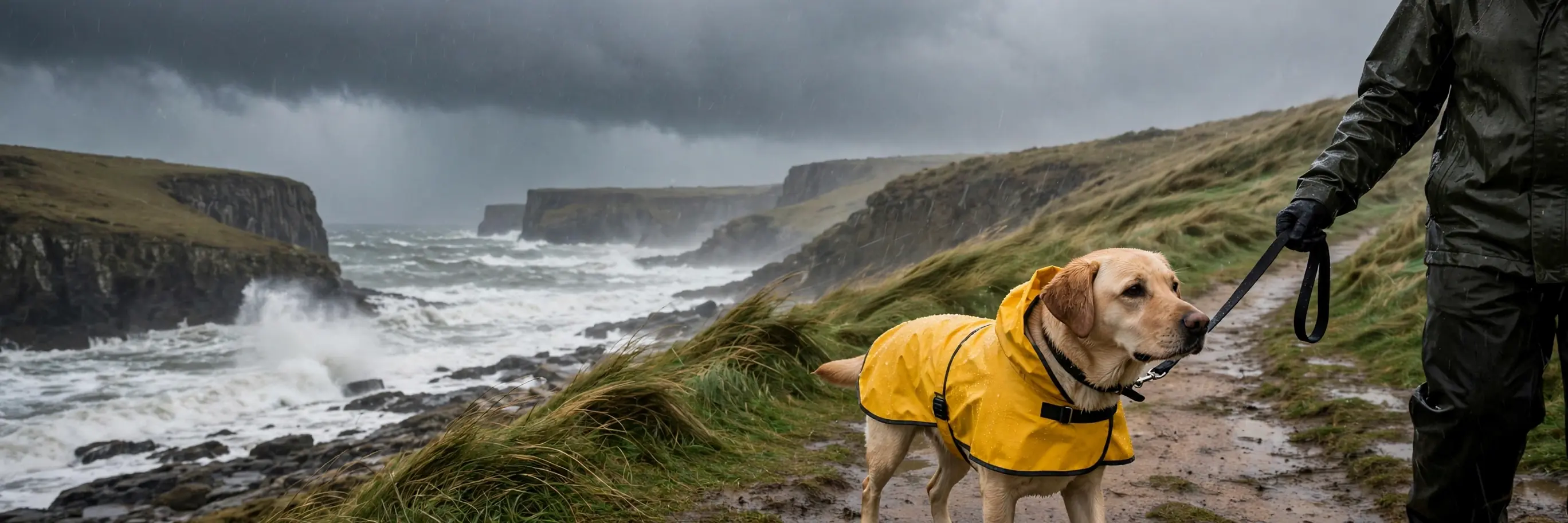
The right kit does not make a storm walk safe on its own, but the wrong kit can make a manageable walk miserable. A waterproof coat is the most useful item for most dogs, and it is worth choosing carefully. Look for a coat that covers the back and the belly, fastens securely with straps or a zip, and allows the dog to move its legs freely. The coat should be genuinely waterproof rather than merely water-resistant: a showerproof coat soaks through in sustained rain, and a wet coat is heavier and colder than no coat at all. Short-coated breeds such as greyhounds, whippets and boxers benefit most, as do small dogs, lean dogs, older dogs and puppies, all of which lose heat faster than a thick-coated collie or spaniel.
Fit matters more than fashion. A coat that is too tight restricts movement and can chafe, while a coat that is too loose flaps in the wind, catches on branches, and can frighten a nervous dog. Measure the dog's back length, chest and neck before ordering, and try the coat on at home before the storm arrives: a dog that has never worn a coat will not enjoy learning in a gale. Look for reflective strips or a bright colour, because visibility drops sharply in heavy rain and a bright coat helps drivers and other walkers see the dog. A coat with a harness hole lets you attach the lead to the harness underneath without the coat riding up, which is worth having in windy weather.
Choose the lead for the conditions. A short, strong lead of about one to one-and-a-half metres is the right choice for a storm walk: it keeps the dog close, gives you control in a gust, and cannot tangle the way a long line can. Avoid extendable leads in high wind, because the thin cord can snap under a sudden pull, the locking mechanism can fail when wet, and the dog can be several metres away — and out of your control — when a branch falls or a car passes. A lead with a padded handle is easier to hold with cold, wet hands, and a lead with a traffic handle, a second loop near the clip, lets you pull the dog in close when you need to pass a hazard. Keep a spare lead in your pocket, because a clip that fails in a storm leaves you with a loose dog in the worst possible conditions.
Boots divide opinion, and the honest answer is that they help some dogs and hinder others. A dog that has worn boots before and tolerates them will benefit from the protection against sharp debris, salt and cold water, especially on a route with broken glass or rough ground. A dog that has never worn boots will spend the walk high-stepping and distracted, which is the last thing you want in a storm. If you want to use boots, introduce them at home over several days, in short sessions with treats, and only use them on a storm walk once the dog moves normally in them. For most dogs, the practical alternative is simpler: keep the walk short, avoid debris-covered ground, and wash and dry the paws thoroughly when you get home.
Do not forget your own kit. Waterproof trousers and a hooded waterproof jacket keep you warm and dry, and warm hands hold a lead properly: cold, numb fingers lose their grip. Wear shoes with a good grip, because wet pavements, muddy paths and wooden bridges are slippery in a storm, and a fall can injure you and leave the dog loose. Carry a small towel in a waterproof bag for the dog, a spare bag for picking up waste, and your phone in a waterproof case. A head torch is useful if the storm darkens the afternoon, and a small first-aid kit — a bandage, some gauze and a pair of tweezers — weighs almost nothing and can make the difference between a minor cut and a vet visit. If you are staying somewhere unfamiliar, our guide to dog-friendly holiday parks in the UK includes drying and wet-weather checks that are worth reading before you book a storm-season stay.
Choosing a safer storm-day route
A storm-day route should be designed backwards from safety, not forwards from scenery. The best route is short, close to home, on firm ground, away from trees, water and cliffs, and with a sheltered way back at every point. A twenty-minute loop on pavements near your house is a better storm walk than a two-hour hike through a wood, however much the dog usually enjoys it. The dog does not know the difference between a famous trail and a quiet housing estate; it knows whether it is cold, wet, frightened or comfortable. Choose comfort.
Start by listing the routes you normally use and crossing out the ones that become dangerous in a storm. Cross out any route through woodland, any route along a cliff or a sea wall, any route beside a river or a stream that can flood, any route across open moorland or a ridge, and any route that depends on a footbridge over water. What remains is usually a small set of pavement loops, playing fields, and short paths through open parkland. Pick the one with the best shelter — a route that passes a shop, a bus shelter or a friend's house gives you somewhere to duck into if the weather worsens suddenly. Avoid routes that cross busy roads, because rain and wind make drivers slower to see a dog, and a dog that is blown sideways on a crossing is in real danger.
Think about the ground underfoot. Tarmac and paving are the safest surfaces in a storm: they drain reasonably well, they do not turn to mud, and they do not hide holes. Grass becomes slippery and waterlogged, and a waterlogged field can hide ditches and drains. Woodland paths turn to mud and are littered with fallen branches. Coastal paths become slick with spray and salt. If you must cross grass, keep the dog on a lead and walk slowly, and avoid steep slopes where a slip can send both of you tumbling. Avoid cattle grids and metal bridges in wet weather, because they are slippery for dogs, and avoid any path that runs beneath a cliff or a steep bank, where rain can loosen stones and soil.
Plan an escape at every point on the route. Before you leave, know where the nearest shelter is from each part of the walk, and know the shortest way home from each point. A loop route is better than an out-and-back route in a storm, because a loop gives you two ways home and you can cut across the middle if the weather turns. If you walk a linear route, make sure you can turn back at any point without crossing a bridge, a ford or a flooded dip. Tell someone which route you are taking if you walk alone, and keep your phone charged and dry. If the route takes you past a vet practice, note its opening hours: a storm-day injury is easier to deal with if you already know where the nearest help is.
Finally, be willing to abandon the plan. If you set out and the wind is stronger than you expected, if a tree has come down across the path, if the river is higher than it was yesterday, or if the dog is clearly unhappy, turn back. There is no prize for finishing a storm walk, and the dog will not think less of you for cutting it short. A walk that ends early with a dry dog and a calm owner is a successful walk. Save the long route for a calm day, and use the storm day for the short loop, the indoor games, and the warm towel waiting at home.
During the walk: pace, recall and when to turn back
Once you are out, the walk itself needs a different style from a normal day. Slow down. A storm walk is not a fitness walk: the dog is working harder against the wind, the ground is slippery, and both of you are using energy to stay warm. A slow, steady pace with frequent pauses is safer and more comfortable than a brisk march, and it gives you time to look around for hazards. Let the dog sniff and toilet, but keep the dog moving gently rather than standing still in the wind, because standing still in driving rain chills a dog quickly. If the dog starts to shiver, lag behind, or try to turn for home, listen: the dog is telling you the walk is over.
Keep the dog on a lead for the whole walk. This is not the day for off-lead running, however reliable the dog's recall is in normal weather. A dog that is frightened by a sudden gust, a falling branch or a clap of thunder can bolt, and a dog that bolts in a storm can run into a road, into flood water, or a long way from home before it stops. A dog that is off lead near a cliff, a river or a road is in danger the moment something startles it. Keep the lead short, keep the dog on the side away from the road, and keep your eyes on the dog rather than your phone. If the dog pulls, slow down and shorten the lead further rather than letting the dog drag you towards a hazard.
Watch the weather as you walk, not just the dog. Look at the sky behind you as well as ahead: storms often approach from behind, and the weather ahead can look calmer than the weather that is catching up with you. Watch for the warning signs that conditions are worsening — the wind picking up, the rain becoming heavier, the light dropping, hail starting, or thunder in the distance. Any one of these is a reason to turn back, and two together are a reason to turn back immediately. Do not wait for the weather to become dangerous before you act: by the time it is dangerous, you are already in it. The decision to turn back should be made early, when it is still easy, not late, when it is already difficult.
Know your turn-back triggers in advance and stick to them. Useful triggers include: thunder heard or lightning seen, a tree or large branch falling nearby, water appearing on a path that was dry when you set out, a gate or fence blown across the route, hail starting, or the dog refusing to walk, shaking, or trying to hide. Any of these means the walk is over. Do not try to complete the loop "because you are nearly there": the last ten minutes of a storm walk are often the most dangerous, because the weather is at its worst and you are at your coldest and most tired. Turn back, get home, dry off, and call it a day.
If the weather catches you out despite your planning, stay calm and act methodically. Move away from trees, water and open high ground, and head for the nearest building or car. Keep the dog close and talk to it in a calm voice: your calm is the dog's anchor, and a panicking owner makes a frightened dog worse. If you have to wait out a squall, find a sheltered spot — a shop doorway, a bus shelter, a porch — and wait for the worst to pass rather than pushing on through it. A ten-minute wait in a doorway is a small price for a safe walk home. When you do move again, walk steadily rather than running, keep to the pavement, and go straight home by the shortest safe route.
After the walk: checks, drying and warming up
The walk does not end when you reach the front door. A dog that has been out in a storm needs a proper check and a proper dry-off, and the ten minutes you spend on this are as important as anything you did on the route. Start by drying the dog thoroughly with a towel, paying attention to the belly, the legs, the ears, and between the toes, where water and grit collect. A drying coat or a second towel helps, but the key is to get the dog dry rather than merely less wet: a damp dog left in a draught will keep losing heat long after the walk is over. If the dog is very wet, use a hair dryer on its lowest, coolest setting, held at a distance, and only if the dog tolerates it; many dogs hate dryers, and a towel and a warm room are usually enough.
Check the dog systematically, from nose to tail. Look at the paws first: check between the toes for grit, thorns, broken glass and small cuts, and look at the pads for cracks, swelling or bleeding. Rinse muddy paws in clean lukewarm water rather than cold water, and dry them carefully. Check the ears for water, debris and redness, especially in floppy-eared breeds, where trapped moisture can lead to infection. Run your hands over the body and legs, feeling for cuts, swelling, thorns and ticks, and part the fur to look at the skin underneath, because a cut hidden by wet fur is easy to miss. Check the eyes for grit or redness, and watch the dog's movement: limping, stiffness, flinching or reluctance to put weight on a leg all need attention.
Watch for signs of cold. A dog that is shivering, hunched, lethargic, or seeking warmth is a dog that is too cold, and small, short-coated, lean, very young or very old dogs are most at risk. Warm the dog up gradually: a warm, draught-free room, a dry blanket, and a warm drink of water are enough for most dogs. Do not use a hot water bottle directly against the skin, and do not put a cold dog in a hot bath: gradual warming is safer than sudden heat. Offer fresh water and a small meal, because a cold, wet walk uses energy, and a dog that has been out in a storm may be hungrier and thirstier than usual. If the shivering does not stop within twenty minutes of being warm and dry, or if the dog is unusually lethargic, vomiting or unsteady, call your vet.
Clean up the kit as well as the dog. Rinse the lead and collar in clean water and hang them to dry, because salt water and mud corrode clips and stiffen webbing. Wash the raincoat according to its instructions and hang it to dry rather than leaving it in a damp heap, where it will smell and lose its waterproofing. Check the harness and lead clips for damage before the next walk, because a clip weakened by salt and grit can fail at the worst moment. Empty and dry your own pockets, recharge your phone, and put the towel in the wash. A storm walk creates a surprising amount of wet laundry, and dealing with it now means you are ready for the next one.
Keep a note of what happened. If the dog was frightened by thunder, if a route was blocked, if the dog cut a paw on debris, or if a particular path flooded, write it down: these notes are the basis for better decisions next time. A route that floods in one storm will flood in the next, and a dog that was frightened by thunder this winter will probably be frightened again next winter. Share useful information with other dog owners — a blocked path, a fallen tree, a flooded ford — because the local dog-walking community is often the fastest way to learn what has changed. And if the dog was injured, even slightly, keep the vet's advice and the details of what happened, because a small cut that heals slowly may need a second look.
Dogs that need extra care in storms
Not all dogs face the same risk in a storm, and the dogs that need the most care are often the ones whose owners are most tempted to take them out. Puppies are the most obvious group: they lose heat quickly, they are easily frightened by noise, they have not yet learned to cope with strange weather, and their immune systems are still developing, which makes them more vulnerable to infections from dirty water. A puppy's walk in a storm should be a brief toilet trip in the garden, followed by indoor play and training. The socialisation that matters for a puppy is positive experience, and a frightening storm walk is the opposite of that.
Senior dogs need similar care for different reasons. Older dogs often have arthritis, which makes slippery, cold, wet ground painful, and they may have weaker hearts, poorer circulation, or reduced vision and hearing, all of which make a storm walk harder. A senior dog that is chilled by a wet walk can take hours to warm up, and a fall on a slippery path can cause an injury that takes weeks to heal. Keep a senior dog's storm walk to a short, level, sheltered route, use a coat, and dry the dog thoroughly afterwards. If the dog has a long-term condition such as heart disease, kidney disease or diabetes, ask your vet for specific advice about cold and wet weather, because the general guidance in this article cannot replace advice about an individual dog's health.
Small and very light dogs face a physical risk that larger dogs do not: they can be lifted or blown sideways by a strong gust, and they lose heat faster because of their higher surface-to-volume ratio. Breeds such as Chihuahuas, Italian greyhounds, miniature dachshunds and toy poodles need a coat in cold rain, a short walk, and a lead held firmly. Brachycephalic breeds — pugs, French bulldogs, English bulldogs and similar dogs with flat faces — struggle to breathe in cold, damp air and can become distressed more quickly than other dogs. If a brachycephalic dog is panting heavily, wheezing or struggling in a storm, end the walk immediately and get the dog warm and calm indoors.
Anxious and noise-sensitive dogs are a welfare issue rather than a fitness issue. A dog that fears thunder, fireworks or sudden loud noises can panic in a storm, and a panicking dog is a danger to itself: it can bolt, injure itself trying to escape, or run into traffic. Do not try to "toughen up" an anxious dog by taking it out in a storm. Stay home, use the coping strategies described in the lightning section, and work on the fear gradually with your vet or a qualified behaviourist. A dog that is frightened is not being difficult; it is asking for help in the only way it can.
Dogs with medical conditions deserve a mention too. Dogs with skin conditions can flare up after contact with dirty water or mud, dogs with ear infections can worsen if water gets into the ear canal, and dogs on medication may be more sensitive to cold. If your dog is recovering from surgery, has a wound, or has a dressing or a bandage, do not take it out in rain at all unless your vet has said it is safe: a wet dressing is a useless dressing, and a wound exposed to dirty water can become infected. When in doubt, the answer is always the same: stay home, keep the dog warm and dry, and wait for a better day. The walk can wait; the dog's health cannot.
Practical questions
Before you go
Is it safe to walk my dog in a storm?
It depends on the warning level and the route. A light rain shower with no wind warning is very different from an amber or red weather warning with gusts above 50 mph. During amber and red warnings, stay home and exercise the dog indoors. If you do go out in milder conditions, keep the walk short, stay on a lead, avoid trees, coast paths and flood water, and turn back at the first sign of worsening weather.
What wind speed is too strong to walk a dog?
As a rough guide, gusts above 40 mph make walking unpleasant and risky for most dogs, and gusts above 50 mph can knock a small dog off balance and throw debris across a path. Check the official guidance before you travel: the Met Office issues yellow, amber and red wind warnings, and an amber or red warning is a clear signal to stay indoors. Even below those speeds, avoid woodland and exposed ridges where gusts are stronger.
Can dogs be struck by lightning on a walk?
Yes, although it is rare. Lightning can strike the ground, a tree or a fence near a dog, and a wet dog on a lead is not protected by being small. If you hear thunder or see lightning, end the walk immediately, move away from trees, water, fences and open high ground, and head for a building or a car. Do not shelter under an isolated tree, and do not wait to see whether the storm passes.
Should my dog wear a raincoat in a storm?
A well-fitting waterproof coat helps most dogs stay warmer and drier, especially short-coated, small, older or lean breeds. Choose a coat that covers the back and belly without restricting leg movement, fastens securely, and has no loose flaps that flap in the wind. A coat is not a substitute for a shorter walk, and a dog that hates wearing one is better off with a quick toilet trip and indoor play instead.
What should I do if my dog is scared of thunder?
Do not take a thunder-phobic dog out during a storm. Stay home, close the curtains, put on background noise such as the radio or television, and let the dog choose a safe spot, ideally an interior room away from windows. Stay calm and nearby without fussing over the dog. For repeated severe fear, speak to your vet about behaviour work and medication options well before the next storm season, and check the official guidance before you travel if you are away from home.
How do I check my dog after a storm walk?
Dry the dog thoroughly, including the belly, paws, ears and between the toes, then check for cuts from debris, thorns, broken glass or sharp twigs. Look for limping, flinching, swelling or blood, and rinse muddy paws in clean lukewarm water. Offer fresh water and a warm, draught-free place to rest. If the dog is shivering, lethargic, vomiting, coughing, or has a wound that will not stop bleeding, contact your vet the same day.