This guide is independent and contains no paid placement. If affiliate links are added later, they will be clearly marked and will not change our editorial checks.
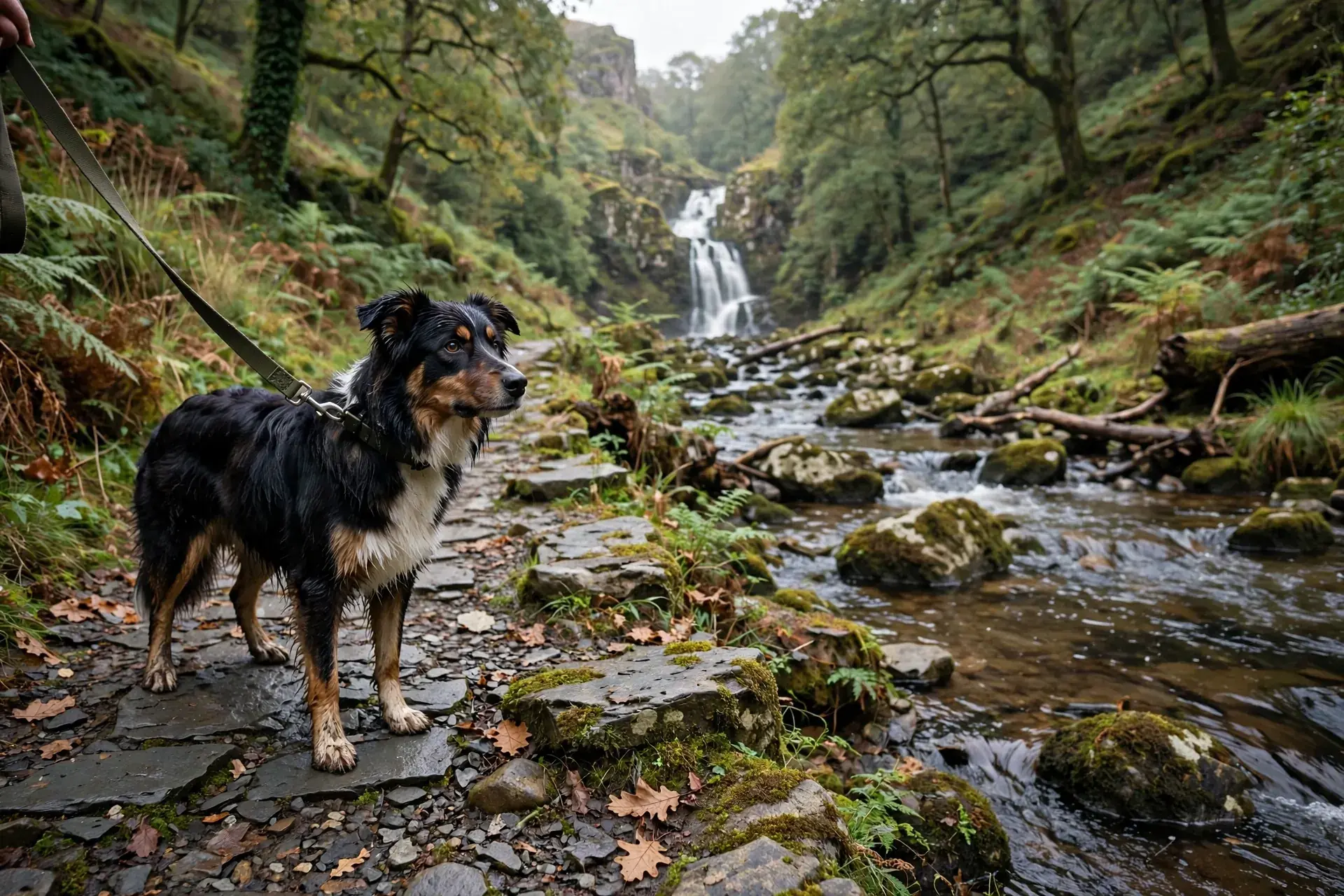
Keep the dog on a short lead near drops and fast water, stay off wet rock, and treat every waterfall as a viewing stop rather than a swimming spot. Pick a route that matches your dog's fitness, check the water level after rain, and plan your exit before you arrive.
Three risks at every waterfall
Almost every waterfall accident involving a dog comes back to one of three things, and they usually arrive together. The first is slippery rock. Stone that sits in permanent spray grows algae and moss, and it stays treacherous long after the rain stops. A dog that trots confidently across a dry pavement can slide on a single wet slab, and a sliding dog often panics, scrambles sideways and ends up closer to the edge or the water than where it started. The danger is not only the fall itself: a dog that lands awkwardly on rock can break a leg or cut a paw badly, and the owner who rushes in after it can be hurt in exactly the same way.
The second risk is the water itself. Falling water looks playful from a distance, but it hides force. A stream that is ankle-deep and gentle a hundred metres downstream can be deep, fast and full of submerged boulders right below a fall. Dogs are strong swimmers in still water and surprisingly poor judges of current, and a dog swept a short distance downstream can be pinned against rocks or pulled under by a recirculating current at the base of the fall. Currents also change with rainfall in hours, so a pool that was calm on a previous visit may not be calm today. If you cannot see the bottom, cannot judge the depth and cannot see a safe exit for the dog downstream, treat the water as out of bounds.
The third risk is steep ground. Waterfall paths climb, descend and narrow, often with steps cut into rock, wooden boardwalks and unfenced viewpoints. A dog on a long lead can pull its owner off balance on a descent, and a dog that lunges at a squirrel or another dog near a drop has no margin for error. Older dogs, puppies, very small breeds and dogs recovering from injury are all more vulnerable on steep, uneven ground, and the return climb is usually harder than the way down because tired legs and wet paws make every step less certain. Planning around these three risks, rather than hoping they do not apply to your dog, is the whole skill of a waterfall walk.
It helps to think of the walk in zones. There is the approach, usually a woodland or moorland path where the main concerns are mud and other walkers. There is the viewing zone, where paths narrow, ground gets wet and the drop appears. And there is the water zone, the rocks and pools at the base, which is where most of the serious risk lives. A good waterfall day keeps the dog firmly in the first two zones and treats the third as scenery. This matters most with excitable dogs: the moment a dog is allowed to scramble over boulders at the base of a fall, you have handed control to terrain that gives no second chances.
Difficulty grades and choosing a route
Waterfall routes are rarely graded for dogs, so it pays to build your own simple scale before you set off. An easy waterfall walk is short, under two miles, on a surfaced or well-compacted path, with a viewing platform or a flat area set back from the edge and no river crossing deeper than a puddle. These are the right choice for puppies, older dogs, dogs with arthritis and any first waterfall outing. A moderate route adds uneven ground, some steps, a climb of a hundred metres or more and perhaps a shallow stream crossing on stepping stones. These suit fit adult dogs with good recall and owners who are steady on their feet. A hard route involves sustained steep gradients, scrambly rock, multiple crossings, exposed drops or a long distance of five miles or more, and it should be reserved for fit dogs and experienced walkers in good conditions.
Distance is a poor guide on its own. A one-mile waterfall walk with two hundred stone steps and a steep gorge descent can tire a dog more than a flat three-mile riverside stroll, and the climb back out is where most dogs flag. Read route descriptions for gradient words such as steep, gorge, scramble, steps and exposed, and treat any of them as a reason to downgrade your plan rather than a challenge to accept. If a guide says a route is not suitable for pushchairs or wheelchairs, assume it is also hard work for a small or elderly dog, and look for an alternative viewpoint that reaches the same fall by a gentler path.
Route choice also depends on who else is on the path. Narrow gorge paths leave no room to pass safely when another dog approaches, and a dog that is fine on a wide moorland track can become reactive when squeezed against a fence with a drop on one side. Where a route is known to be busy, go early, keep the dog on a short lead through the narrow sections and step aside at a wide spot rather than trying to squeeze past. If your dog is nervous around other dogs, a waterfall with a single narrow approach is a poor choice on a bank holiday weekend, however beautiful the photographs look.
Finally, always plan the exit before you need it. Waterfall paths are often one-way in practice: you walk down into a gorge and the only way out is back up the same steps. If the dog is tiring, the weather is turning or the water is rising, the time to turn around is while the dog still has energy in reserve, not when it is already exhausted halfway up a slippery staircase. A shorter walk that ends with a happy, dry dog beats a longer one that ends with a carry.
Waterfall water by season
Waterfalls change character through the year, and the safest way to understand a fall is to think in seasons rather than in single visits. Spring is the classic waterfall season in Britain. Winter rain and snowmelt feed the streams, so falls run full and loud from March into May, and the surrounding woodland is at its greenest. The trade-off is that paths are at their muddiest, stream crossings are at their deepest and spray makes viewing platforms slippery. Spring is a wonderful time for fit dogs on easy and moderate routes, but it is the season when the water zone deserves the most respect, because a fall in full spate is a genuinely powerful piece of water.
Summer brings lower water, drier paths and longer days, which makes it the easiest season for dogs. Many smaller falls shrink to a trickle in a dry July or August, and some upland streams slow to a chain of pools. That is good news for footing and for paddling at a calm edge, but it also brings crowds, and the most photogenic falls can be busy by mid-morning. Summer has one hidden hazard: after a thunderstorm, a dry gully can fill astonishingly fast, so a summer storm is a reason to leave a gorge, not to shelter in it. Heat is the other summer factor, and a shaded gorge walk is a gift on a hot day, provided the dog is not then tempted into fast water to cool off.
Autumn is many dog walkers' favourite waterfall season. Rain returns, falls pick up again, woodland colours are superb and visitor numbers drop after the school holidays. Paths are leaf-covered, which hides mud and wet rock, so footing needs extra care, and shorter days mean you should start earlier than you think. Autumn is also the season when a dog's coat starts to thicken, which helps with cold spray but also means a wet dog takes longer to dry on the drive home, so pack an extra towel. For dogs that overheat in summer, autumn offers the best balance of full water, cool air and quiet paths.
Winter is the most serious waterfall season and the one to approach with the most caution. Falls are at their fullest, daylight is short, paths ice over, and a wet dog loses body heat fast. That does not mean winter waterfall walks are off limits: a short, easy, well-surfaced route on a mild, dry winter day can be superb, with few other visitors and dramatic water. But hard routes, gorge descents and any path with rock steps should be left alone in icy or stormy conditions, and you should carry a drying coat and a towel even for a short outing. If in doubt about local conditions, check the official guidance before you travel.
Judging water after rain
Rain is the single biggest variable on a waterfall walk, and learning to read it is more useful than any single route recommendation. The key point is that the rain that matters may not be the rain you can see. A fall fed by high moorland can be in spate from rain that fell ten miles away and hours earlier, while the valley where you are standing stays dry. Check the forecast for the catchment area, not just the car park, and look for river level information where it is published. If a local river gauge shows a sharp rise, or if a normally gentle stream is running brown and fast at the trailhead, the fall upstream will be stronger still.
There are simple checks you can make on arrival before committing to a gorge path. Look at the first stream crossing: if the water is above your ankle, fast enough to push against your boot, or carrying debris such as leaves and twigs at speed, turn back or choose a higher viewpoint route. Look at the colour: clear, slow water is one thing, but milky-brown, turbulent water means the stream is carrying sediment and force. Listen too: a fall that sounds like a roar from the car park is a fall in spate, and the spray zone around it will be wider and slicker than usual. None of these checks requires equipment, and together they give a reliable picture.
Timing matters as well. Water levels usually peak some hours after heavy rain, not during it, so a morning of rain can make an afternoon walk more dangerous than the wet morning itself. Conversely, a fall that looks alarming at midday after a storm may settle by the following morning. If you have flexibility, waiting a day after heavy rain is the simplest safety measure available, and it often gives you a better walk too, because the paths have had time to drain. When you are on a fixed holiday date, choose your easiest waterfall option on the wettest day and save the ambitious gorge route for the drier one.
Crossings deserve special attention. Never carry a dog across a fast stream, because a slip puts you both in the water, and never let a dog swim a crossing you would not wade yourself. Stepping stones that are dry in summer can be submerged or coated in algae after rain, and a dog that jumps from stone to stone can misjudge a gap that looks trivial to a human. If a crossing looks doubtful, treat it as the end of the walk: the waterfall on the far side is not worth a soaked, frightened dog and a difficult rescue.
Leads and paw care
Lead choice at a waterfall is a safety decision, not a training debate. A short, fixed lead of about one to two metres gives you control on narrow paths, at viewpoints and near drops, and it stops the dog from lunging into trouble. Extending leads are a poor choice in gorge terrain: the cord can wrap around rocks, snag on fences and, worst of all, give a dog several metres of running start towards an edge before you can react. A hands-free waist lead can work well on the approach path, but switch to a hand-held short lead for the viewing zone, and keep a second person holding the dog if you stop for photographs.
Recall matters even on a lead, because leads fail, clips break and gates get left open. A dog that comes back reliably on a first call is a dog you can recover quickly if something goes wrong, and waterfall walks are a good reason to refresh that training on flat ground before you attempt a gorge. It is also worth teaching a solid wait at gates and stiles, since many waterfall paths pass through farmland where livestock may be grazing nearby. Local lead rules vary: some nature reserves require dogs on leads at all times, others ask for leads only near livestock or during bird nesting season, so read the signs at the trailhead rather than assuming the rules from a previous visit.
Paws take more punishment at waterfalls than on ordinary walks. Wet rock is abrasive, algae is slippery, and repeated scrambling over boulders wears pads faster than grass or pavement. Before the walk, a thin layer of paw balm can help, and on very rocky routes, boots are worth considering for dogs with sensitive pads, for puppies whose pads are still soft, and for older dogs whose pads have thinned. Boots need to be fitted and practised at home first: a dog wearing boots for the first time on a steep path will walk oddly and may be less sure-footed, not more.
After the walk, rinse paws in clean water and check between the toes for grit, small cuts and thorns. Waterfall paths are often littered with sharp slate and broken branches washed downstream, and a small cut that goes unnoticed can become sore by the next morning. Dry the paws thoroughly, especially in winter, and watch for limping over the following day. If a pad is cut deeply, bleeding heavily or the dog will not bear weight, seek veterinary advice promptly rather than waiting to see if it improves. A dog that has had a good, safe waterfall walk should come home tired and happy, not footsore.
Photography at a safe distance
Waterfalls photograph beautifully, and dogs photograph beautifully, but combining the two safely takes a little discipline. The best photographs are usually taken from a marked viewpoint or a flat area set back from the edge, with the fall in the background and the dog in the foreground on a lead. A second person is invaluable: one holds the dog and keeps it settled, the other takes the photograph, and nobody is trying to do both jobs while standing near a drop. Treats and a favourite toy will get a dog looking at the camera far more reliably than calling its name repeatedly from behind the lens.
There are shots that are never worth taking. A dog perched on a wet boulder at the edge of a pool, a dog on a bridge parapet, a dog on a ledge above a drop, or a dog held up in front of a fall with no ground beneath its feet are all accidents waiting for a photograph. Dogs do not understand the composition you are trying to achieve, and a dog that shifts its weight at the wrong moment can fall from a position that looked stable. The same applies to children: keep children and dogs together, on the path, behind any barrier, and never let a child hold a lead near an unfenced edge.
Spray and light are practical photography problems too. Waterfall spray coats lenses and makes dogs blink, so wipe the lens, shoot from slightly further back than you think you need, and accept that a slightly wider shot with the dog clearly on safe ground is better than a dramatic close-up that required risky positioning. Early morning and late afternoon give softer light and fewer people, which means the dog is calmer and the path is quieter. If the viewpoint is crowded, wait for a gap rather than edging the dog into a tight spot for a quicker shot.
One more point about photographs: do not let the camera distract you from the dog. It is easy to spend five minutes framing a shot while a dog on a long lead wanders towards an edge, or while a puppy chews something unpleasant at your feet. Take the photograph, put the camera away, and then enjoy the waterfall with your full attention on the dog. The best waterfall memories are rarely the photographs themselves; they are the walk, the cool air and a dog that comes home safe.
Plunge pools: currents and cold water
The pool at the base of a waterfall looks inviting, especially on a warm day when the dog is hot and tired, but it is the most dangerous part of the whole walk. Falling water creates a recirculating current at the base of the fall: water plunges down, rolls back upstream along the bottom and rises again, and anything caught in that circulation can be held under the surface. This is not a theoretical risk; it is the same hydraulic feature that makes weirs dangerous for people, scaled down to dog size. A dog that swims strongly in a lake can still be trapped by a plunge-pool current, because the water is moving in a direction the dog cannot read and cannot fight for long.
Cold is the second hazard, and it acts more quietly. Upland streams in Britain are cold even in summer, often well below the temperature of a lake or a lowland river, and a dog that plunges into cold water after a long, hot walk can suffer cold shock, cramping or rapid exhaustion. Smaller dogs, puppies, older dogs and lean breeds such as whippets and greyhounds lose heat fastest, and a dog that is already tired from a steep descent is in the worst possible state to cope with cold water. Signs of trouble include frantic paddling that does not move the dog forward, a head held low in the water, whimpering and a sudden loss of coordination.
That does not mean a dog can never touch the water at a waterfall. A calm, shallow edge well downstream of the fall, where you can see the bottom, where the current is slow and where the dog can walk in and out under its own power, is a reasonable place for a paddle. Keep the lead on or within arm's reach, let the dog choose whether to enter, and limit the time in the water on cold days. After any swim, towel the dog dry, put on a drying coat in cool weather, and watch for shivering on the walk back. If you are unsure whether a pool is safe, the answer is no: there will be another walk, another stream and another day.
There is also a health consideration that has nothing to do with currents. Standing water near waterfalls can carry bacteria after heavy rain, and dogs that drink from stagnant pools or chew washed-up debris can pick up stomach upsets. Carry fresh drinking water for the dog and offer it regularly, so the dog is not driven to drink from the stream out of thirst. If the dog does drink a lot of stream water and later develops vomiting or diarrhoea, mention the walk to your vet, since the timing can help with diagnosis.
Rainy season and winter warnings
Britain's wettest months are also, for many walkers, the most atmospheric time to visit a waterfall, and there is nothing wrong with that provided the plan changes with the conditions. In sustained wet weather, choose routes with surfaced paths and raised viewpoints, avoid gorge descents and river crossings, and accept that the walk may be shorter than planned. Waterproofs matter for the dog as well as the owner: a dog coat keeps a short-coated dog warm and reduces the drying job at the end, while a drying coat for the car journey home prevents a wet dog from chilling on the drive.
Winter adds three specific hazards. The first is ice: spray freezes on rock, boardwalks and steps, and a path that was merely wet in November can be a skating rink in January. The second is daylight: a winter afternoon closes in fast, and a gorge walk that felt easy at midday can become a torch-lit scramble by four o'clock, so start early and carry a head torch even for a short route. The third is the dog's own temperature: a wet dog in a cold wind loses heat rapidly, and a dog that stops moving, for example while you take photographs, cools faster still. Keep winter waterfall walks short, keep the dog moving, and dry it thoroughly before the drive home.
Storms deserve a rule of their own: do not walk a gorge in a storm. High winds bring down branches, heavy rain raises water levels, and lightning in open moorland above a fall is a genuine risk. If a storm arrives while you are already on a waterfall path, leave the gorge by the highest, driest route available and do not shelter under trees near the water. A waterfall will still be there next week; a storm is not a backdrop, it is a reason to go home. If local conditions are uncertain, check the official guidance before you travel.
Finally, remember that winter and wet-season paths deteriorate. Boardwalks rot, handrails loosen, steps wash out and signs disappear, and the damage is often worst at exactly the point where a path is steepest. If a handrail is broken, a step is missing or a path has been closed by a fallen tree, treat that as information rather than an obstacle to climb around, and choose another route. Local walking groups and park authorities often publish path condition updates, and a quick check before you leave can save a wasted journey.
Car parks, toilets and tea rooms
Waterfall walks are much easier when the practicalities are sorted before you arrive, and the first of those is parking. Popular falls have small car parks that fill by mid-morning at weekends, and the overflow is often a narrow lane where parking blocks farm access and earns everyone a bad reputation. Arrive early, use the official car park even if it costs a few pounds, and never park in a passing place or across a field gate. Some car parks are pay-and-display with no card machine, so carry coins as well as a card, and check whether there is a height restriction that affects a van or a roof box.
Toilets are the next question, and the honest answer is that many waterfall trailheads have none. Village halls, pubs and visitor centres near the start of a walk sometimes have facilities, but remote falls may have nothing for miles. Plan accordingly: use facilities in the nearest village before you set off, carry bags and a small trowel kit for emergencies, and always clean up after the dog, including on remote paths. Dog waste left on a waterfall path washes straight into the stream, which is unpleasant for everyone downstream and harmful to water quality.
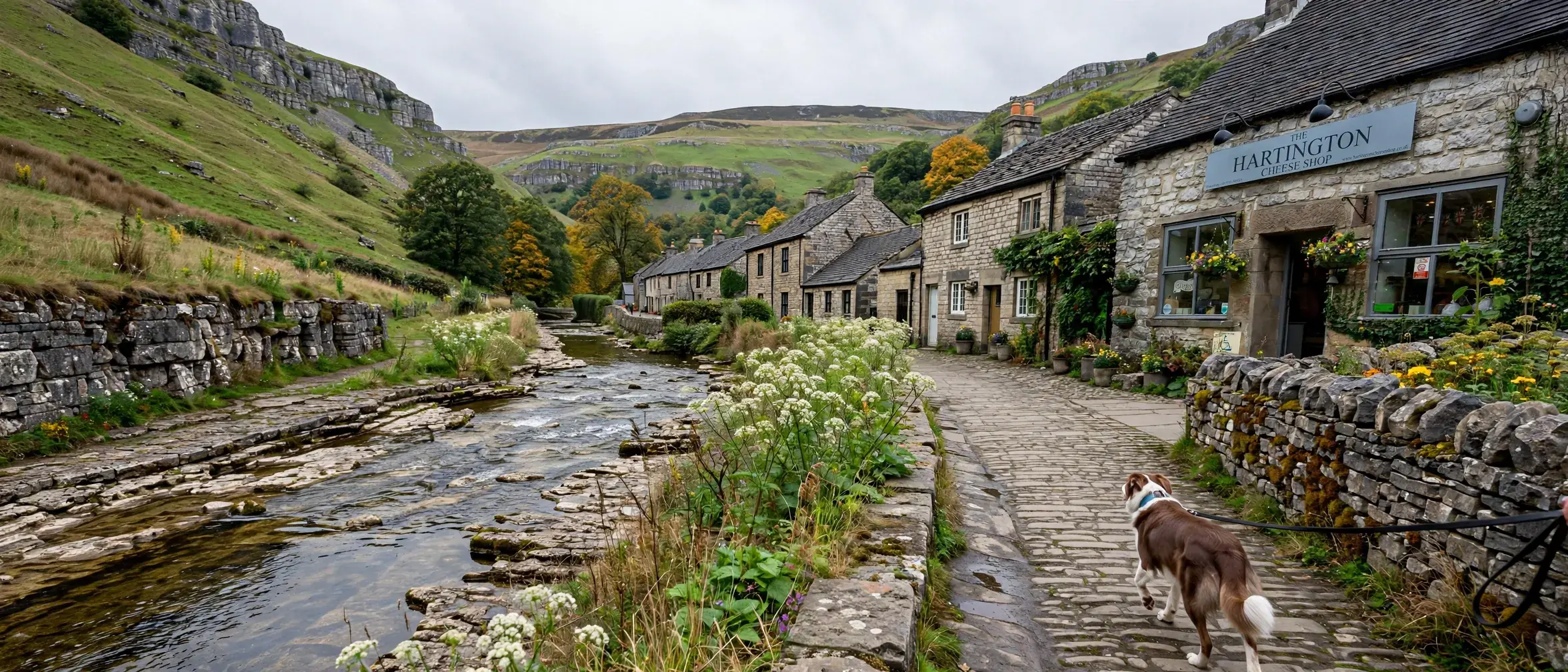
Tea rooms, cafes and pubs are one of the great pleasures of a waterfall day, and they are also the practical reward that makes a long walk work for the dog. A dog-friendly cafe near the trailhead gives you somewhere to dry off, warm up and feed a hungry dog before the drive home. Check dog policies in advance, because a cafe that welcomes dogs in the garden may not welcome them indoors in wet weather, which is exactly when you need it most. If you are staying overnight, our guide to dog-friendly holiday parks in the UK can help you find a base with drying facilities and nearby walks, and the Peak District village of Hartington with a dog is a good example of a walk-and-tea-room combination, with limestone dales and village cafes close to waterfall country.
One more facility worth planning is the nearest vet. Waterfall walks are remote by nature, and a cut paw or a swallowed stone is much easier to deal with if you already know the nearest practice and its opening hours. Save the number before you set off, and note that rural practices may close early or run on an emergency-only basis at weekends. A small first-aid kit for the dog, including a bandage, saline wash and a tick remover, weighs almost nothing and turns a worrying incident into a manageable one.
What to pack for a waterfall walk
A waterfall walk needs slightly more kit than a park stroll, and the extra items are all cheap and light. Start with the lead: a short, fixed lead for the viewing zone and a longer training lead for the approach if your dog's recall is reliable. Add a harness rather than a collar for gorge paths, because a harness spreads the load if the dog pulls on a descent and gives you something secure to hold if you need to steady the dog quickly. A dog coat for wet or cold days, a drying coat for the journey home, and two towels rather than one will cover most weather.
Water and food are next. Carry fresh water for the dog even though you are walking beside a stream, because stream water is not always safe to drink, and offer it at every rest stop. A collapsible bowl weighs nothing and is easier than trying to pour from a bottle into cupped hands. Bring the dog's normal treats for recall and for photographs, plus a small meal or a larger snack if the walk runs over lunchtime, since a hungry dog is a less attentive dog. A spare lead, a spare poo bag roll and a small torch round out the essentials, and a phone charger is worth carrying on longer routes because a phone is both your map and your emergency call.
Footwear for the owner matters as much as kit for the dog. Waterfall paths demand proper walking boots with grip, not trainers, because wet rock and mud defeat smooth soles quickly. Walking poles help on steep descents and give you a third point of contact when steadying a dog, and gaiters keep mud and water out of boots on boggy approaches. Dress for spray as well as rain: a waterproof jacket with a hood is better than an umbrella, which is useless in a gorge and dangerous in wind.
Finally, pack for the possibility that the walk does not go to plan. A lightweight emergency blanket for the dog, a whistle, and a written note of the route and the car park location are all sensible on remote routes. Tell someone where you are going and when you expect to be back, especially for a winter or solo walk. Waterfall country is beautiful precisely because it is wild, and a little preparation is what lets you enjoy that wildness with a dog rather than worry through it.
Practical questions
Before you go
Can I let my dog off the lead near a waterfall?
Only where the ground is flat, fenced or set well back from the edge, and where local signs allow it. Near drops, fast water and slippery rock, a short lead is safer even for a well-trained dog, because a single slip or a sudden lunge after wildlife can end at the water.
Is it safe for my dog to swim in a waterfall plunge pool?
Often not. Plunge pools can hide strong currents, submerged rocks and very cold water, and a dog that swims happily in a lake can still struggle in churning water. Let a dog paddle only at a calm, shallow edge you have checked first, and keep the lead on or within reach.
What should I do if my dog slips on wet rock?
Stay calm, keep your own footing first, and guide the dog back with a steady voice rather than lunging after it. Check paws, legs and belly for cuts and swelling once you are on safe ground, and cut the walk short if the dog limps, refuses to bear weight or seems distressed.
Are waterfalls more dangerous after rain?
Yes. Rain raises flow, deepens crossings, makes rock and boardwalks slick, and can turn a gentle stream into a force that knocks a small dog off its feet. After heavy rain, choose a higher viewpoint route instead of a riverside path, and be ready to turn back.
Do dogs need boots or paw protection at waterfalls?
Not always, but rough, wet stone wears pads quickly, especially on long descents. A paw balm before the walk, a rinse afterwards, and boots for dogs with sensitive pads or for very rocky routes all help. Check paws at every rest stop on longer waterfall walks.
Can I photograph my dog at a waterfall safely?
Yes, from a marked viewpoint or a flat area set back from the edge, with the dog on a lead and a second person holding it if you want a posed shot. Never place a dog on a ledge, a wet boulder or a bridge parapet for a photograph, and keep children and dogs away from unfenced drops.