This guide is independent and contains no paid placement. It compares tracker types generically rather than naming one product as best, because the right choice depends on your dog, your walks and your local signal.
For most owners who walk in open countryside, a true GPS collar tracker with a mobile subscription is the only type that can show a live location at distance. Bluetooth tags are cheap and light but only help nearby, and radio trackers suit specialist use. Whichever you choose, rural signal gaps, battery life and fit matter more than the longest range printed on the box — and no tracker replaces a microchip, ID tag or recall training.
GPS, Bluetooth or radio? The three types explained
The word tracker covers three quite different technologies, and mixing them up is the most common buying mistake. A GPS collar tracker uses satellite positioning to work out where the dog is, then uses the mobile phone network to send that position to an app on your phone. That two-step process is why it can, in the right conditions, show your dog on a map from miles away. It is also why it needs a battery that does real work, a SIM or built-in mobile plan, and a subscription in most cases.
A Bluetooth tag is much simpler and much smaller. It talks to nearby phones over a short-range radio link, typically tens of metres in open space and far less through walls, trees or a busy campsite. Some tags can also use networks of other people's phones passing nearby to report a rough location, which helps in towns and on busy paths but is unreliable in empty countryside where nobody passes for hours. Bluetooth tags are light, cheap and usually need no subscription, and they are genuinely useful for finding keys, a bag, or a dog hiding in the house or garden. They are not a way to follow a dog that has bolted across farmland.
Radio trackers, sometimes called telemetry trackers, use a dedicated handset and a directional signal from the collar. They do not need mobile coverage, which is their big advantage in remote ground, and handlers who work dogs or follow hounds have used this approach for years. The trade-offs are cost, bulk and effort: you follow signal strength and direction rather than watching a dot move on a map, and you need to learn the technique before you need it in a panic. For a typical family holiday, radio is usually more kit than you need; for regular work in deep valleys with no signal at all, it deserves serious thought.
A practical way to decide is to picture the moment you fear most. If it is your dog slipping a gate at a holiday cottage and heading for the lane, GPS with a geofence alert gives you the fastest warning. If it is losing sight of your dog in woodland on your usual walk, GPS live tracking helps if there is signal, while Bluetooth almost certainly will not. If it is a dog ranging a long way in upland country with no coverage, be honest that no phone app can magic signal into a dead zone, and plan around prevention — lead, long line and recall — first.
Rural signal in Britain: the part adverts skip
Britain looks small on a map, but mobile coverage in the places people love to walk dogs is patchy in a very specific way. Valleys, wooded combes, limestone gorges, the far side of a hill and the bottom of a coastal path can all be blackspots even when the village a mile away shows full bars. Parts of the Highlands, mid-Wales, Dartmoor, the North York Moors, the Pennines and rural Cumbria and Northumberland are well known for gaps, but there are dead pockets in the South Downs, the Shropshire Hills and deep Cornish lanes too. Coverage also varies by network: a tracker that uses one network well at home may struggle where you holiday, and multi-network or roaming SIM arrangements, where offered, can help but never guarantee a signal.
Remember what the tracker is doing. The GPS part listens to satellites, so it generally needs a reasonably open view of the sky; dense tree canopy, steep-sided valleys and travelling in a car boot or under a metal roof can slow or weaken a fix. The mobile part then has to send that fix to you. If either step fails, most apps show the last known position and the time it was recorded — useful, but not live. Some devices store the route on board and upload it when they reconnect, which is comforting afterwards and no help at all while you are standing in the rain trying to decide which path to search.
Before you rely on any tracker for a trip, do three boring checks. Look at the coverage maps for the specific postcode and walking area, not the county headline, and treat all coverage maps as optimistic. Walk your key route once with the tracker in the mode you actually intend to use and see where updates stall. Finally, save an offline plan: tell someone your route, keep the dog's description and a recent photo on your phone, and know the steps in our guide to what to do if your dog is lost on holiday, because the first hour matters more than any gadget. Check the latest position, then search calmly and systematically rather than chasing a jumping map pin around a hillside.
Battery life, honestly: days in standby, hours live
Battery claims cause more disappointment than any other tracker feature, because the longest figure on the packaging almost always assumes the gentlest settings. A tracker that checks its position every few minutes, or only when it senses movement, sips power and can last several days between charges. Switch to live tracking — updates every few seconds, a light or sound switched on, constant searching in weak signal — and the same battery can be gone in a matter of hours. Neither figure is a lie; they are just answers to different questions, and you need the figure for the mode you will use when it matters.
Weak signal is a hidden battery drain. A device straining to find a network in a valley will use far more power than the same device in town, and cold weather reduces battery performance on a frosty morning walk just as it does for your phone. Age matters too: a battery that lasted a long weekend when new may need nightly charging a year or two later. For a holiday, build a routine around it. Charge the tracker at the same time as your phone each evening, carry the correct cable or charging base in the car, and never start a big walk on a low battery warning and hope for the best.
Think about what happens when the battery dies mid-search. The app will usually freeze on the last reported point, which could be old by the time you notice. Set up low-battery alerts if the app offers them, and teach everyone who walks the dog what the tracker looks like when it is switched on, correctly attached and charging properly — a tracker left on the kitchen counter, or clipped on flat, is worse than none because it gives false confidence. If your dog is walked by a dog walker, a family member or a holiday pet sitter, show them the charging routine in person rather than assuming the app makes it obvious.
Subscription costs: price the whole two years
Most GPS collar trackers are sold as a device plus an ongoing plan, because sending data over the mobile network costs money. Plans are commonly sold monthly, annually or over two years, sometimes with a discount for paying ahead and sometimes with an activation or SIM fee on top. Monthly rolling plans offer flexibility for a single trip or a growing puppy you may rehome kit from; longer prepaid plans usually work out cheaper per month but tie you in if the device is lost, outgrown or replaced. Always check what happens if you cancel, pause or move the plan to a replacement device.
Compare total cost, not device price. A cheap tracker with a pricier plan can overtake a more expensive tracker with a cheaper plan within a year, and a bargain second-hand device is no bargain if its battery is tired or its plan cannot be transferred. Check roaming terms if you travel: some plans cover use across the UK and parts of Europe, others treat travel differently or throttle updates abroad. Because prices and plan structures change, treat any figure you see in an older review as out of date and check the maker's current terms before you pay — if a deal seems unusually cheap, read the renewal price, not just the introductory one.
Bluetooth tags sit at the other end of the cost scale: no subscription in most cases, low device cost, but that saving buys you short range, not equivalent performance. Radio systems tend to cost more upfront with no subscription, which can suit long-term specialist use. The honest question is not which is cheapest, but which failure you can accept: paying monthly for a chance of live help at distance, paying nothing and accepting nearby-only help, or paying more upfront for a handset system you must learn to use well.
Weight, size and collar fit for small dogs
A tracker that suits a Labrador can be completely wrong for a 4kg terrier or a miniature breed. Start with two numbers from the maker: the weight of the device itself, including its mount or holder, and any minimum dog weight or neck size the maker states. Then weigh or compare honestly. There is no single universal percentage rule that suits every dog, so if your dog is small, elderly, has a neck or breathing condition, or seems bothered by the device, ask your vet rather than guessing. A dog that scratches at the collar, shakes its head repeatedly or changes how it walks is telling you the fit or weight is wrong.
How the tracker attaches matters as much as how much it weighs. Some thread directly onto the collar, some clip or strap around it, and some attach to a harness. A threaded mount is harder to knock off in brambles but may make the collar stiff or bulky; a clip is easy to swap for charging but must be checked for a positive, secure hold. The device should sit snugly against the collar without spinning to hang under the chin, dangling where it can catch, or pressing on the throat. Whichever style you choose, do a shake, roll and scratch test in the garden before trusting it on a cliff path.
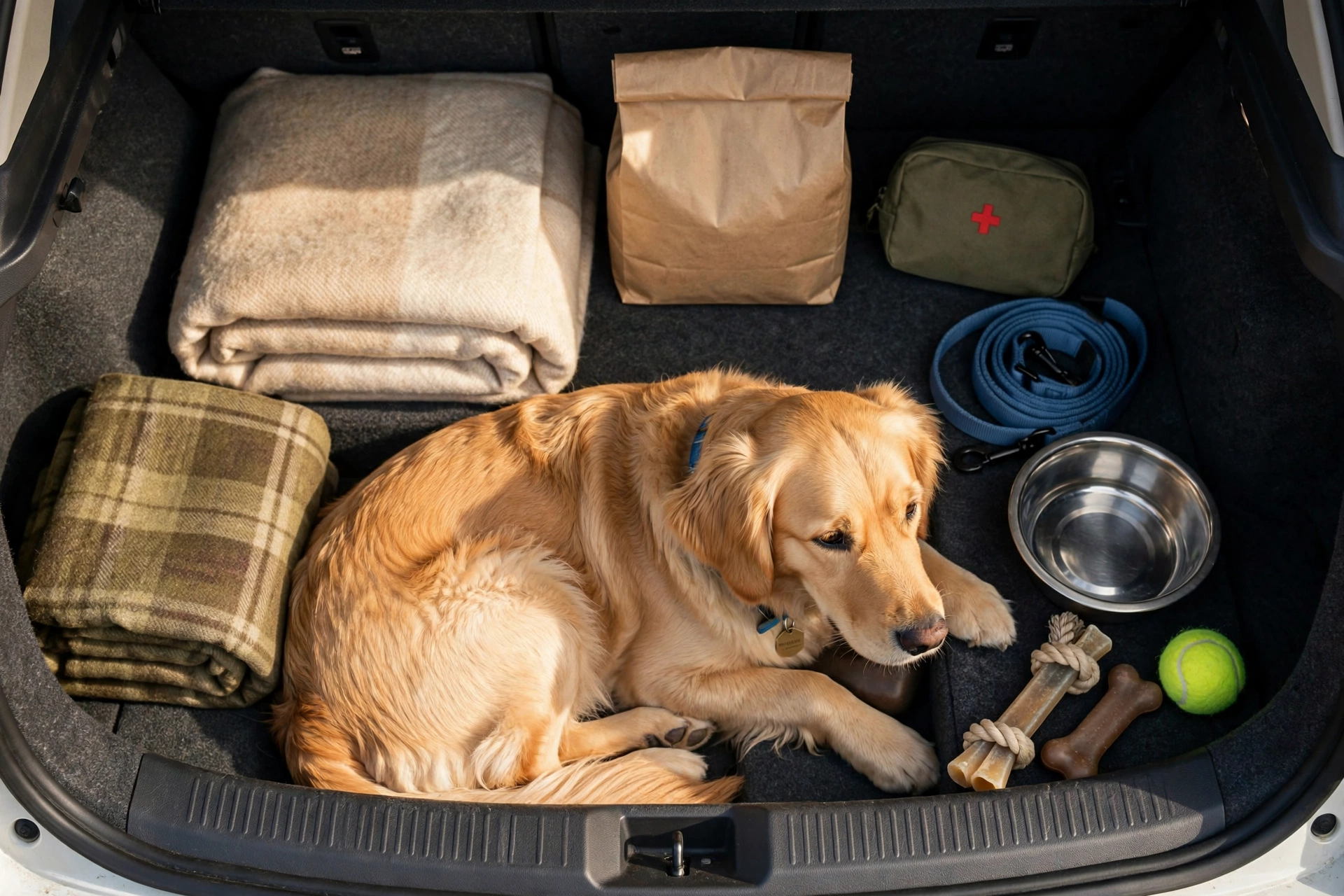
The collar itself still has to fit properly with the tracker on. You should be able to slip two fingers comfortably between collar and neck — snug enough that it cannot slip over the head, loose enough that it never restricts breathing — and you should recheck that fit after adding the tracker, after a haircut, and as a young dog grows. Keep the ID tag on as well; a tracker is not a substitute tag, and a flat battery helps nobody who finds your dog. Add the tracker and cable to your dog travel packing checklist so it is charged and packed alongside the lead, tag and microchip details, not remembered at the motorway services.
Virtual fences and geofencing: useful, not magic
A virtual fence, or geofence, is a boundary you draw in the app — around a garden, a cottage, a campsite pitch or a caravan — so your phone alerts you if the tracker leaves that area. Used well, it is the feature many holidaymakers value most, because it can warn you while a dog is still nearby rather than after a long search. Set the boundary generously, test it with the dog safely on a lead inside the area, and expect some delay: the alert depends on the next position update and on mobile signal, so it is a prompt to check, not an instant alarm bell.
Geofences have well-known quirks. GPS positions can drift by several metres, especially near buildings, under trees or in a steep valley, so a boundary drawn tight against a cottage wall can trigger false alerts when the dog is asleep inside — and an owner who gets ten false alarms learns to ignore the eleventh, real one. Draw the zone around the whole safe area with a sensible margin, use any safe-zone or Wi-Fi-based home setting the app offers for indoor accuracy, and remember that a geofence does nothing physical: it cannot close a gate, mend a fence or stop a dog chasing a deer. It buys you minutes, and minutes only help if someone is awake, nearby and able to act.
On holiday, redraw the fence at every new stay and delete old zones so alerts stay meaningful. Check that everyone in the party who should receive alerts has the app, is logged in and has notifications switched on, with phones not silenced overnight if a night-time escape would worry you. For dogs that are already anxious away from home, combine the geofence with the physical basics — a checked boundary, a door routine and a long line in an unfamiliar garden — in the same spirit as our advice for holidays with reactive dogs: layers of calm prevention beat any single device.
Using a tracker on holiday in Britain
Holidays are when trackers earn their keep, because almost every risk factor rises at once: an unfamiliar garden with a gate that does not latch the way yours does, new smells and wildlife, doors left ajar while cases are carried in, and walks where a dog that recalls perfectly at home decides a strange wood is more interesting. Fit and charge the tracker before you travel, not on arrival, and keep it on for the first full day and night even if your dog seems settled — many escapes happen in the first twenty-four hours, and again on the last morning when routines slip around packing.
Adapt your settings to the trip. Use a power-saving mode for ordinary lead walks around a town or site, and switch to live tracking for off-lead time in open country, for a dog walker exploring with your dog, or the moment you are worried. Tell your accommodation host and anyone sharing the stay that the dog wears a tracker, so nobody removes it for a swim, a bath or bedtime without realising. Check water resistance claims carefully if your dog swims: a device rated for splashes and rain is different from one happy with repeated full immersion in the sea, and salt water and sand demand a rinse and a careful check of seals and mounts afterwards.
Keep the non-tech kit alongside it. A tracker works best as one layer in a simple holiday system: secure ID tag with a mobile number you will actually answer on holiday, microchip details confirmed up to date before you leave, a recent clear photo of your dog, the local vet and out-of-hours number saved, and a lead and long line packed even for a dog who is usually off lead. If the tracker shows your dog moving along a road or across farmland with livestock, do not run blindly after the dot — note the location, call and whistle only if that normally works for your dog, and get help locally. Chasing can push a frightened dog further and faster.
Limits you must know before you rely on one
No tracker prevents a dog getting lost. It does not fix a broken fence, hold a lead, train a recall or slow a dog chasing wildlife across a road. Location is also never perfectly exact: apps smooth and estimate positions, updates arrive in intervals, and a pin on the map can lag behind or jump around a real dog in a gully or wood. Treat the map as strong guidance for where to search, not as a precise dot to walk to with your eyes on your phone — look up, call, listen, and watch for movement, especially near water, roads, cliffs and livestock, where a careful approach matters for everyone's safety.
The legal basics still come first in the UK. Dogs must be microchipped and the keeper's details kept up to date on an approved database, and dogs in public places must wear a collar with the owner's name and address on a tag or plate — check the current official guidance before you travel, as details and enforcement are set out there. A tracker helps a finder or an owner act faster; it gives no legal protection by itself, and a dog found without a chip or tag is harder, not easier, to reunite. If your dog is found by someone else, the tag and chip are what they can use without your app, your login or your battery.
Finally, protect the account behind the device. Use a strong, unique password and any two-step sign-in the app offers, keep sharing limited to people who genuinely walk your dog, and remove old users when arrangements change — a tracker account shows where your dog walks and, often, where you live and when you are away. Check the maker's privacy terms for how location history is stored and how long it is kept. Bought with clear eyes, set up carefully and checked daily, a GPS tracker is a worthwhile safety net for many British dog holidays. Bought as a promise that a dog can never be lost, it will let you down at exactly the moment you needed honesty most. Prevention, identification and training remain the plan; the tracker is the backup.
Practical questions
Before you go
Does a GPS tracker replace a microchip or ID tag in the UK?
No. Microchipping is a legal requirement for dogs in the UK and an ID tag with your contact details is also required in public places. A tracker can fall off, run flat or lose signal, so it is an extra layer of help for finding your dog quickly, never a replacement for the chip, tag and up-to-date register details.
Will a dog GPS tracker work where there is no mobile signal?
A standard GPS collar tracker needs mobile coverage to send its position to your phone, even though it finds its position from satellites. In a mobile blackspot it may record the route and update later, or show the last known position, but it cannot send a live location until it reconnects. Check coverage for your walking area before relying on live tracking.
How long does the battery on a dog tracker really last?
It depends on how often the device reports its position. Battery-saving modes that update every few minutes can last several days, while live tracking that updates every few seconds can drain a battery in hours. Cold weather, weak signal and frequent live tracking all shorten battery life, so charge before a big walk and treat headline claims as best-case figures.
Do I have to pay a subscription for a dog GPS tracker?
Most collar GPS trackers use the mobile network, so they need a subscription or built-in SIM plan to send locations to your app. Costs, contract length and roaming terms vary, so check the total cost over one or two years, not just the device price. Bluetooth tags usually have no subscription but have a much shorter range.
Is a GPS tracker too heavy for a small dog?
It can be. Check the device weight and the maker minimum dog weight or neck size, and weigh the tracker against what your dog already comfortably wears. A tracker should sit snugly without spinning, dangling or rubbing, and the collar must still pass the two-finger fit check. If in doubt, ask your vet and choose the lightest suitable model.