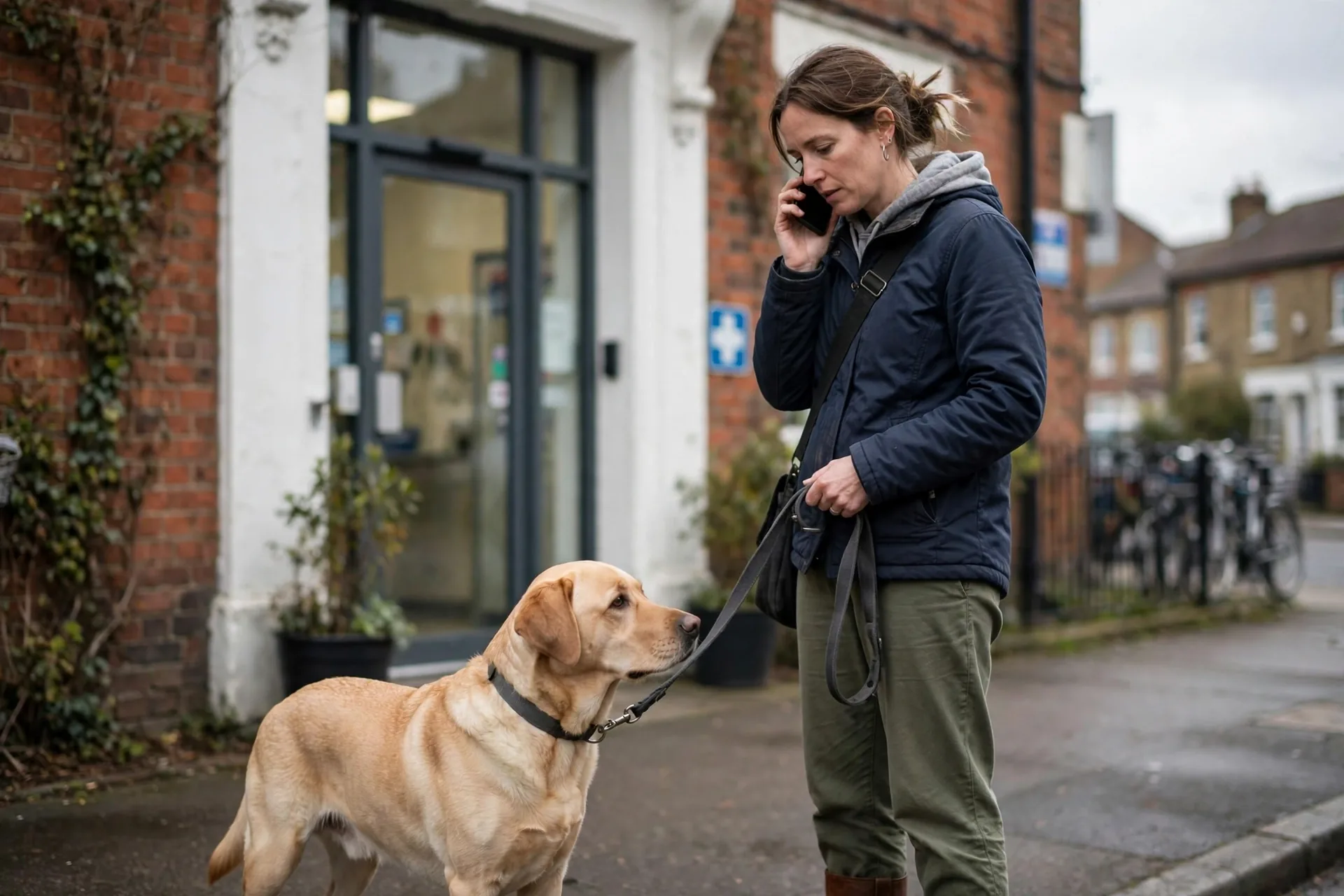
This guide explains how UK pet insurance typically treats pre-existing conditions. It is general information, not financial advice. Policy definitions differ between insurers, so check the wording of any policy you consider and, before buying, confirm the latest terms directly with the insurer.
Yes, sometimes — but a standard policy usually excludes the condition itself. A pre-existing condition is anything your dog showed signs of, was investigated for or was treated for before cover started, diagnosis or not. Specialist policies may cover some conditions after a symptom-free period, with a lower limit or a higher excess. Chronic conditions such as diabetes or arthritis are rarely covered on a new policy. Declare everything: insurers request the full vet history at claim stage, and non-disclosure risks far more than a higher premium.
The disclosure decision: one form, three very different outcomes
Picture the moment most owners actually face this question. You are not sitting with an adviser. You are on a comparison site at ten in the evening, your spaniel is asleep with one ear still red from last month's infection, and the form asks whether the dog has ever had any illness, injury or veterinary treatment other than routine care. You hesitate — not because you intend to deceive anyone, but because the ear cleared up, the bill was small, and ticking yes seems to open a door to higher prices, exclusions and phone calls. Ticking no feels cleaner. That single hesitation is the subject of this entire guide, because the consequences of each choice only become visible months or years later, at the worst possible time: when you are claiming.
There are broadly three outcomes. Declare fully and accurately, and you may pay more, accept an exclusion, or be directed to a specialist policy — but the rest of your cover stands on solid ground. Declare partially, remembering the big operation but forgetting the two visits for limping, and you create a grey area that an insurer can reopen at claim stage. Declare nothing that should have been declared, and you risk a declined claim, a cancelled policy and difficulty getting cover elsewhere. The uncomfortable truth is that honesty at application stage is not mainly about the condition itself. It is about protecting cover for everything else your dog might need.
This guide stays deliberately narrow. It is only about pre-existing conditions: how UK insurers define them, why symptoms matter even without a diagnosis, how bilateral clauses extend an exclusion to the other leg, eye or ear, the difference between a condition that has genuinely cured and one that will need management for life, how waiting periods and symptom-free periods work, what full disclosure actually involves in practice, how insurers obtain and read your dog's medical history, what specialist pre-existing cover can and cannot do, and what happens if something is not declared. For the wider picture — policy types, levels of cover and travel-specific benefits — read our main guide to dog travel insurance in the UK alongside this one. Use this page for the medical-history question that sits underneath every policy.
What insurers count as pre-existing: the definition is wider than you expect
Most owners picture a pre-existing condition as a named, diagnosed disease: diabetes, epilepsy, arthritis, a heart condition. Insurers use a far wider definition. Wording varies, but a typical UK definition covers any condition, illness, injury, symptom, sign or clinical finding that occurred, was noticed, was investigated or was treated before the policy start date, or during any initial waiting period — whether or not it was formally diagnosed, and whether or not you claimed for it at the time. Some definitions also capture conditions you, as the owner, should reasonably have been aware of, even if you never took the dog to a vet.
Unpack that sentence, because every phrase does work. Occurred is not the same as diagnosed. Investigated means the blood test, X-ray, scan, swab or referral counts, not just the conclusion it reached. Treated includes a single course of medication, an ear cleaner prescribed once, a diet change recommended for loose stools, and physiotherapy after a strain. Noticed can include a note in the clinical record that you mentioned stiffness after walks, even if the vet decided simply to monitor it. A condition does not need a label, a large bill or a previous insurance claim to qualify.
Timing matters as much as the event itself. The same illness can be covered under one policy and pre-existing under the next, purely because of dates. If symptoms began before a new policy started, that new insurer will generally treat the condition as pre-existing even if diagnosis and treatment happened afterwards. If symptoms began genuinely after cover started and after any waiting period ended, the condition is normally treated as a new condition under that policy, subject to its limits. This is why switching insurers is never a neutral act for a dog with any medical history at all — a point covered in more detail below.
Also note that pre-existing is judged per insurer and per policy, not as a single universal status attached to your dog. One insurer may exclude a condition permanently, another may review it after a symptom-free period, and a specialist may offer limited cover for it from the start. The dog's history is fixed; how a policy responds to that history is a product decision. That distinction is hopeful, because it means a refusal or exclusion from one provider does not automatically mean no provider will help — but it also means you must compare definitions, not just premiums.
Symptoms count without a diagnosis: the limping, itching and vomiting problem
The most common disclosure mistakes are not operations or major diseases. They are small, ordinary visits that owners genuinely forget or dismiss as too trivial to mention. A dog was lame for two days after a long walk and the vet prescribed rest. A puppy had three episodes of diarrhoea and a stool test that came back clear. A spaniel scratched through one summer and received anti-itch medication without anyone settling on an allergy diagnosis. A senior dog's routine blood test showed a borderline value and the vet advised rechecking in six months. None of these produced a tidy diagnosis to write on a form. All of them can matter.
Insurers and veterinary records work in signs as well as diagnoses. Clinical notes record what was presented — lameness in the left hind leg, otitis in the right ear, intermittent vomiting, a grade two heart murmur, a 1-centimetre skin mass — and what was done about it. When a claim later arrives for cruciate disease, ear surgery, pancreatitis, heart failure or removal of a lump, the first thing an assessor looks for is an earlier record of the same sign, in the same system of the body, before the policy began. If that earlier sign exists and was not disclosed, the argument about whether it was the same condition begins, and it begins at the moment you least want a dispute.
Practical rule: if a vet has ever written it down, assume it is disclosable. That includes telephone advice recorded in the notes, out-of-hours visits, second-opinion consultations, breeders' vet checks for a puppy you later bought, and treatment received while your dog was in rescue or foster care if records were transferred to you. If you are unsure whether an old episode counts, disclose it with dates and a plain description — intermittent soft stools, March 2024, stool test negative, no ongoing treatment — and let the insurer decide how to treat it. An insurer can ignore something irrelevant far more easily than you can explain an omission later.
Keep your own simple timeline as you go. One page, kept with vaccination records, listing date, practice, presenting sign, any test and its result, treatment given, and when signs resolved, will save hours when you apply, switch or claim. For older dogs, whose histories span several practices, building that timeline early is especially valuable — our guide to senior dog travel covers gathering health information for older dogs in a similarly methodical way, and the same folder serves both purposes.
Bilateral conditions: when one leg excludes the other
Bilateral conditions catch owners out more than almost any other clause, because the logic feels unfair until it is explained. A bilateral condition is one that can occur on both sides of the body. Insurers reason that if a dog has shown the condition on one side, the underlying anatomy, conformation or disease process usually exists on the other side too — so the second side is not a new, unrelated risk, but part of the same pre-existing picture. Many policies therefore state that if a bilateral condition existed on one side before cover, the same condition on the other side is also excluded.
The list of commonly treated bilateral conditions is long. Cruciate ligament disease in the stifles is the classic example: one knee operated on before a policy starts can mean the other knee is excluded under a new policy, even though it has never been lame. Hip and elbow dysplasia, luxating patellas, cataracts and other eye conditions, ear disease, skin disease affecting both ears or paws, and some dental and joint conditions are also frequently handled bilaterally. Some wording goes further and groups related conditions — for example treating different manifestations of allergic skin disease, or arthritis in multiple joints, as one condition rather than several.
Why does this matter so much financially? Because bilateral conditions are often the expensive, symmetrical ones. A second cruciate repair, a second cataract operation or lifelong treatment for both ears can each run into thousands of pounds. An owner who discloses one-sided disease honestly but does not read the bilateral clause may believe the other side is fully covered, budget accordingly, and discover the exclusion only at authorisation stage. Read the clause before you buy, find it in the policy wording rather than a sales summary, and if your dog has any one-sided history in a paired structure, ask the insurer in writing how the other side would be treated.
Bilateral wording also interacts with condition limits. On some time-limited or maximum-benefit policies, both sides may share a single condition limit rather than each having its own. That means treatment for the first leg consumes part of the pot available for the second. Lifetime policies handle limits differently, usually by an annual overall limit that refreshes, but exclusions still apply within them. The question to ask is never simply is it covered — it is covered on which side, up to what limit, and for how long.
Cured, curable and chronic: three categories with very different prospects
Not all pre-existing conditions are treated alike, and the single most useful distinction is whether a condition can genuinely end. Insurers tend, in effect, to sort history into three groups, even if their wording uses different labels. Understanding which group your dog's condition falls into tells you whether to expect a temporary exclusion, a reviewable exclusion or a permanent one.
The first group is one-off incidents that have fully resolved with no expected recurrence: a cut pad that healed, a single episode of gastroenteritis with a clear cause, a minor strain that settled with rest, a grass seed removed from an ear. Many insurers will either disregard these after a period of time, or exclude them only for a set symptom-free window. The key evidence is completeness — signs gone, treatment finished, no related visit since, and no vet note suggesting monitoring for recurrence.
The second group is curable or episodic conditions that can recur: ear infections, urinary infections, skin flare-ups, conjunctivitis, mild lameness episodes. These sit in the middle ground. A standard policy may exclude them, a more flexible policy may cover them again after, say, 12 or 24 months without symptoms or treatment, and a specialist policy may cover them sooner with conditions attached. The detail that decides the outcome is usually the definition of symptom-free — whether a single maintenance ear clean, a prescription diet or a routine recheck resets the clock. Never assume; ask how that specific condition is timed.
The third group is chronic, ongoing or degenerative conditions: diabetes, epilepsy, hypothyroidism, inflammatory bowel disease, atopy, arthritis, heart disease, kidney disease and most cancers under active management. By definition these do not cure, so standard new policies almost always exclude them permanently, and specialist cover, where it exists, tends to be limited, expensive or capped at a lower amount. That does not make insurance pointless for such dogs — accidents, injuries and unrelated illnesses can still be covered, which for an older dog may be exactly where the financial risk lies — but it does mean you should buy with clear eyes about which bills the policy will never pay.
One caution applies across all three groups. A condition described by a vet as cured should be supported by the record: discharged, no further treatment required, or resolved. If the record instead says stable, managed or monitor, an insurer will read it as ongoing. If you believe a condition has truly ended and the notes are ambiguous, you can ask your vet to clarify the record factually at a review appointment — vets will not rewrite history, nor should they, but an accurate update noting resolution and discharge is legitimate and helpful. For older dogs, where chronic conditions are the norm rather than the exception, see our guide to pet insurance for older dogs before you renew.
Waiting periods and symptom-free periods: two clocks that are not the same
Owners often merge two different time periods into one, and the confusion causes real disappointment. The first clock is the initial waiting period at the start of a new policy. Accidents may be covered immediately or after a few days, while illnesses are commonly excluded for the first 10 to 14 days, sometimes longer for specific conditions. Anything showing signs during that window is usually treated as pre-existing, even if the policy technically began before the vet visit. This prevents buying a policy on Monday for a dog who started limping on Sunday.
The second clock is the symptom-free or treatment-free period required before a declared pre-existing condition becomes coverable, or becomes coverable again. Periods of 12 to 24 months are common in reviewable arrangements, counted from the last symptom, treatment, medication, investigation or vet advice relating to that condition — whichever was most recent. A single related prescription, a recheck appointment that mentions the condition, or a repeat of the same sign can restart the count. Some specialist policies reduce this to a shorter period for selected conditions, or offer cover from day one at a reduced limit; others keep the long clock but guarantee review rather than permanent exclusion.
Work an example through, because dates decide real claims. Suppose a dog had an ear infection treated in June 2025, a recheck in July 2025 confirming it had cleared, and no ear problems since. A policy bought in August 2026 with a 12-month symptom-free requirement measured from last treatment might treat a new ear infection as coverable; the same policy bought in May 2026 would not. Now suppose the dog also received prescription ear cleaner every month through the winter as preventive care. Some insurers would count that as ongoing treatment and keep the clock running; others would treat routine cleaning differently. Same dog, same ears, different answer — which is why the only safe method is to give the insurer the dates and ask for their position in writing before you rely on it.
Finally, do not confuse a waiting period ending with a condition limit resetting. Even when a condition becomes coverable, a time-limited policy may cover it for only 12 months from first treatment, and a maximum-benefit policy only up to a fixed sum, after which that condition is exhausted even though the policy continues for other things. The clock that lets a condition in is not the clock that keeps paying for it.
Full disclosure and medical history requests: what actually happens behind the scenes
Full disclosure means answering every application question accurately and completely, to the best of your knowledge, with the information a reasonable owner would understand to be relevant. In practice that means naming conditions you know, describing symptoms that were never diagnosed, listing investigations even when results were normal, and giving approximate dates when exact dates are unknown rather than leaving a gap. If a question asks about any treatment other than routine vaccinations, neutering and parasite control, treat that literally — it is designed to be broad.
Many owners are surprised to learn that insurers do not usually read the full veterinary history before selling a policy. Underwriting at application stage often relies on your declarations plus targeted questions. The full history typically enters the picture when you claim, or when a claim for one condition prompts a check for related history. At that point the insurer will ask for consent to contact your current vet, and often every previous vet, and will request complete clinical records, referral reports, laboratory results and imaging. This is normal industry practice, not a sign your claim is in trouble — but it is the reason undisclosed history surfaces so reliably.
Assessors read those records chronologically and clinically. They look for the first mention of the claimed sign, earlier similar episodes under different descriptions, notes of owner-reported symptoms, and treatments that suggest a condition existed before a diagnosis was named. They also check continuity: a dog registered at a new practice with no transferred history will usually be asked where it was treated before. Gaps are followed up, not ignored. None of this requires suspicion or bad faith on anyone's part; it is simply how a contract based on declared risk gets verified.
You can make this process smoother, and protect yourself, with three habits. First, keep copies of referral letters, discharge notes and test results in your own folder rather than relying on practices retaining or transferring everything quickly. Second, when you change vets, ask for the history to be transferred promptly and confirm it arrived. Third, when you apply for insurance, save or screenshot exactly what you declared, with the date. If a dispute ever arises about what was disclosed, that contemporaneous record matters far more than recollection.
If your dog came from a rescue, breeder or previous owner with an incomplete history, say so plainly on the application and declare everything you do know, including any paperwork you received. An honest unknown is treated differently from a concealed known. Insurers can still apply exclusions based on whatever records exist, but declaring the limits of your knowledge at the outset is both the ethical and the strategically sound position.
Specialist pre-existing cover: what exists, and how to judge it
A standard policy that excludes a condition is not the end of the market. In recent years UK providers have developed several models aimed at dogs with medical history, and they differ enough that the label pre-existing cover on an advertisement tells you very little on its own. Always translate the marketing into four concrete questions: which conditions are included, from when, up to how much, and at what extra cost.
One model offers cover for declared conditions after a symptom-free period, sometimes shorter than mainstream policies require. Another covers certain pre-existing conditions immediately but with a separate, lower monetary limit and a higher excess for those conditions, while unrelated conditions enjoy the full policy limit. A third model, sometimes described as medical-history disregarded within limits, assesses the dog on current health and covers past curable conditions while still excluding named chronic conditions listed at application. A fourth approach is not a different policy at all, but a standard lifetime policy bought with open eyes, accepting the exclusion and valuing the policy for accidents and new illnesses.
Judge any specialist offer on specifics. Check whether the pre-existing limit is per condition or shared across all pre-existing conditions, whether the excess for those conditions is fixed or a percentage of the claim, whether complementary treatment, referral fees and out-of-hours charges count towards the smaller limit, and whether cover for the condition continues in later years or expires after 12 months. Check also what happens at renewal: premiums for dogs with claimed chronic history can rise substantially, and a policy that was affordable in year one may not be in year three. Ask for the renewal principles in writing.
Alternatives deserve honest consideration alongside specialist insurance. For a chronic condition with predictable costs — a stable diabetic dog, for instance, whose insulin, monitoring and routine checks fall within a foreseeable monthly range — some owners decide to self-fund that condition from a dedicated savings pot while insuring against accidents and new illnesses. Others discuss staged treatment plans and cost ceilings with their vet in advance. Neither choice is a failure of care. The mistake is not choosing self-funding deliberately; it is assuming insurance covers a condition it excludes and discovering the gap mid-treatment. If cost would ever force a treatment decision in an emergency, plan that conversation early — our guide to finding an emergency vet on holiday shows how quickly those decisions arrive away from home, and the same principle applies at your own practice.
If you do not declare: declined claims, added exclusions and void policies
The consequences of non-disclosure are graduated, and it helps to understand the scale rather than imagine a single punishment. At the mildest end, an insurer who discovers an innocent, unrelated omission may simply note the history, add an exclusion for that condition from the original start date, and continue the policy. The related claim, if there is one, will usually not be paid, because the insurer would never have covered that condition had it been declared — but cover for other things may survive.
Further along the scale are declined claims with wider effects. If the undisclosed history is closely related to the claim — undisclosed lameness followed by a claim for joint surgery is the obvious example — the claim fails, and any treatment costs already authorised may be recovered or refused. If the insurer can show it would have charged a higher premium or imposed different terms had it known the truth, it may apply those terms retrospectively or reduce a payout proportionately, depending on the circumstances and the applicable consumer protections. Deliberate or reckless misrepresentation sits at the far end: the insurer may treat the policy as if it never existed, decline all claims under it and retain premiums in some cases, and future applications elsewhere will ask whether you have ever had a policy cancelled or voided — a disclosure problem that follows you.
UK consumer insurance law does give policyholders protections, and insurers must act fairly and consider whether a mistake was innocent, careless or deliberate. But relying on fairness arguments after the event is a poor substitute for accuracy before it. The practical point for dog owners is simpler than the legal one: non-disclosure is rarely a successful gamble, because the verification mechanism — the full vet history at claim stage — is built into the product. The condition you omitted is written down, dated and held by a third party. A strategy that depends on that record never being read is not a strategy.
If you realise, after buying, that you made a genuine mistake on an application — and this happens often, usually an old episode remembered later — contact the insurer promptly, explain what was omitted and when you realised, and keep a record of the conversation. Voluntary correction before any claim is viewed very differently from a discovery during one. The insurer may add an exclusion or adjust the premium, but you will have restored the certainty that the rest of your cover means what you think it means.
Switching insurers with a medical history: the reset you cannot undo
Switching deserves its own warning, because it is the most common way owners accidentally lose cover they already had. Under your current policy, a condition that began while you were insured may be covered — on a lifetime policy, potentially for years, within the annual limit. The day you move to a new insurer, that same condition becomes pre-existing for the new insurer, because it began before their policy started. Loyalty is not the point; chronology is. A cheaper premium can therefore be the most expensive decision you make, if it trades away active cover for a chronic condition in exchange for a small monthly saving.
Before switching, list every condition your dog has been treated for since your current policy began and ask the prospective insurer, in writing, how each would be treated. Compare that answer against what your current policy would still pay. Only then compare premiums. If the new insurer excludes a condition your current insurer covers, quantify the likely annual treatment cost of that condition and add it to the new premium for a true comparison. In many chronic cases the existing policy wins easily, even at a higher renewal price.
There is one legitimate switching scenario worth noting: moving deliberately to a specialist pre-existing policy that offers better terms for a condition your current insurer excludes anyway, or restructuring cover when a current policy has exhausted a condition under a maximum-benefit limit. Even then, sequence matters. Do not cancel the old policy until the new one is confirmed in force, note any waiting period on the new policy during which illness cover is limited, and expect a window where neither policy fully covers a new illness if timing is careless. Overlap and gaps both need managing, not discovering. The same warning applies with extra force to senior dogs — see pet insurance for older dogs for age limits and co-payments.
Why this matters for travel: claims do not pause because you are on holiday
Pre-existing conditions follow your dog on holiday in two ways. First, the medical risk itself travels: arthritic dogs stiffen after long car journeys, dogs with skin disease flare in new environments, and a condition managed at home can need treatment a hundred miles from your usual vet, at out-of-hours prices. Second, the insurance position travels unchanged. An excluded condition is excluded in Cornwall as surely as at home, and a holiday claim triggers the same history check. Our overview of dog travel insurance in the UK explains how accident, illness and third-party cover interact on a trip; this guide adds the warning that travel-specific benefits never override a medical exclusion.
Prepare accordingly. Carry a one-page summary of diagnoses, current medication with doses, allergies and your usual vet's contact details. Tell any treating vet about relevant history immediately rather than presenting a problem as brand new — apart from the insurance implications, it is better medicine. Keep receipts and discharge notes from any holiday treatment, check whether your policy requires pre-authorisation for referral or out-of-hours care, and be aware that cancellation cover linked to your dog's illness may itself distinguish between new illness and a pre-existing condition deteriorating. If a known condition worsening would force you to cancel, check that specific scenario before you book non-refundable accommodation.
Step-by-step application checklist for a dog with medical history
Use this sequence in order. It takes longer than a quick comparison-site application, and that is precisely its value — each step removes a reason a future claim could be argued over.
- Build the timeline. List every vet visit other than routine care, across every practice, with dates, signs, tests, results and treatment. Include episodes that resolved and investigations that found nothing.
- Separate the history into the three groups. Mark each item as resolved one-off, curable or episodic, or chronic and ongoing. Note any condition affecting a paired structure — legs, eyes, ears, joints — and flag it as potentially bilateral.
- Request the clinical history if you do not have it. Your vet can provide a copy of your dog's records. Read it before applying, not after; the form should be completed from the record, not from memory.
- Shortlist by definition, not price. For each policy, find the definition of pre-existing, the bilateral clause, the initial waiting period and any symptom-free review mechanism. Discard any policy whose wording you cannot locate.
- Declare in writing and keep the evidence. Complete declarations fully, describe undiagnosed symptoms plainly with dates, and save the submitted answers, the insurer's response and any exclusions imposed.
- Ask the four specialist questions. For each condition that matters: is it excluded, reviewable or covered; from what date; up to what limit; and with what excess? Get answers for your dog, not for a generic dog.
- Compare against staying put. If you already have cover, price the value of conditions your current policy still pays for before switching for a cheaper quote.
- Diarise review dates. If an exclusion is reviewable after a symptom-free period, note the date, what evidence will be needed, and what event would reset the clock — then protect that clock by reporting new symptoms honestly as they arise.
None of this guarantees a low premium, and it is not meant to. Its purpose is certainty: a policy whose exclusions you can list from memory, whose limits you have tested against realistic vet bills, and whose declarations you could defend line by line from the clinical record. For a dog with a medical history, that certainty is the product you are actually buying.
Quick comparison: what is covered, what is not, and the hard limits
The short version, condition by condition. Every row depends on the exact policy wording — check the insurer's current wording before you rely on it.
- Resolved one-off (healed cut, single stomach upset, minor strain): often ignored after a time, or excluded only for a set symptom-free window. Evidence needed: signs gone, treatment finished, no related visit since.
- Curable or episodic (ear infection, urinary infection, skin flare-up): may be covered again after 12 to 24 months with no symptoms or treatment; some specialist policies cover sooner at a lower limit or higher excess. Ask what resets the clock — a repeat prescription or recheck can restart it.
- Chronic or ongoing (diabetes, arthritis, epilepsy, heart disease): standard new policies almost always exclude permanently. Specialist cover, where offered, is usually limited or capped. Accidents and unrelated new illnesses may still be covered.
- Bilateral (one knee, one ear, one eye affected): many insurers treat the other side as pre-existing too, even with no symptoms there. Check the bilateral clause before you buy or switch.
- Symptoms with no diagnosis (limping, itching, vomiting noted by a vet): can still count as pre-existing. Declare symptoms, not just named diseases.
- Signs during the waiting period: usually treated as pre-existing even though the policy had started.
- Flare-up on holiday: a flare-up of a pre-existing condition on holiday is excluded in the same way as at home — see dog travel insurance in the UK for how holiday cover works around exclusions.
Five hard limits to check before you buy
- The definition: what counts as pre-existing, including symptoms and investigations.
- The bilateral clause: whether the other side is excluded too.
- The symptom-free period: how long, and what restarts it.
- The limit for that condition: separate lower limit, higher excess, or time cap.
- The renewal position: whether cover for the condition continues, shrinks or ends at renewal.
If any of these five is unclear in the wording, ask the insurer in writing before you buy — and check the latest terms directly, as they change.
Practical questions
Pre-existing conditions, answered
What counts as a pre-existing condition for dog insurance in the UK?
Any illness, injury, symptom, sign or investigation your dog had before the policy started or during its waiting period. A formal diagnosis is not required. A vet noting limping, itching, vomiting, a heart murmur or a lump, and any test, scan or treatment linked to it, can all make the condition pre-existing for that insurer, so declare symptoms as well as named diseases.
Can I get cover for a condition my dog has already been treated for?
Sometimes. Standard policies usually exclude it, but specialist pre-existing-condition policies may cover a condition after a symptom-free period, cover it with a higher excess or a lower limit, or cover curable conditions once they have fully resolved. Chronic, ongoing conditions are harder to cover and may only be insurable with a specialist provider, so compare the exact wording rather than the headline.
What is a bilateral condition and why does it matter?
A bilateral condition is one that can affect both sides of the body, such as cruciate ligament disease, hip dysplasia, ear disease, cataracts or patella problems. If one side was affected before cover started, many insurers treat the other side as pre-existing too, even if it has never shown symptoms. Check the bilateral clause carefully before you buy or switch.
What happens if I do not declare a pre-existing condition?
The insurer can decline a related claim, add an exclusion retrospectively, cancel the policy or, in serious cases of misrepresentation, treat the policy as void. Because insurers routinely request full veterinary history when you claim, an undeclared condition is very likely to be found. Declaring honestly, even if it raises the premium or adds an exclusion, protects cover for everything else.
How long are waiting periods for pre-existing conditions?
It varies by insurer and condition. New policies commonly have an initial illness waiting period of around 10 to 14 days, while cover for a declared pre-existing condition may require the dog to have been symptom-free and treatment-free for 12 to 24 months. Some specialist policies shorten or waive that period for certain conditions. Always check the specific period in the policy wording before relying on it.
Can I insure a dog with diabetes or arthritis in the UK?
Sometimes, but rarely on a standard new policy. Diabetes, arthritis, epilepsy and similar chronic conditions are usually excluded permanently when you take out a new policy, because they are ongoing by definition. A specialist provider may offer limited cover for some chronic conditions, often with a lower limit or a higher excess. If your dog is already insured on a lifetime policy, staying put usually preserves cover for conditions that began while that policy was in force. Check the exact wording for your dog's condition, and get any cover confirmed in writing before you rely on it.
How much does dog insurance with a pre-existing condition cost?
There is no fixed price. Premiums vary widely by insurer, by the condition, by your dog's age and breed, and by the limit and excess you choose. A declared condition can raise the premium, add an exclusion, or both, and specialist cover is usually priced higher than a standard policy. The only reliable way to know the cost for your dog is to get quotes that declare the full history and compare the total cost — premium plus excess plus any co-payment — against the limit. Never cancel an existing policy for a cheaper quote until the replacement has started.
Does pet insurance cover a pre-existing condition on holiday in the UK?
No, not the condition itself. A pre-existing condition is excluded on holiday exactly as it is at home, and a flare-up while you are away is treated as the same condition. New, unrelated illnesses and accidents on a trip may still be covered, subject to the policy's limits and exclusions. Tell any holiday vet about the relevant history straight away, keep all receipts and discharge notes, and check whether your policy needs pre-authorisation for referral or out-of-hours care.