This guide is independent and contains no paid placement. Insurance wording changes often; treat the figures here as typical ranges and check the current policy document before you rely on any limit or exclusion.
Third-party liability insurance pays compensation and legal costs when your dog injures another person, damages someone else's property or worries livestock — it pays nothing towards your own dog's vet bills. Most owners get it bundled inside pet insurance, but standalone liability policies and charity membership cover exist too. Typical limits run from £1 million to £3 million, and the exclusions — family members, paid walkers, banned types — matter as much as the headline limit.
Thirty seconds at the field gate
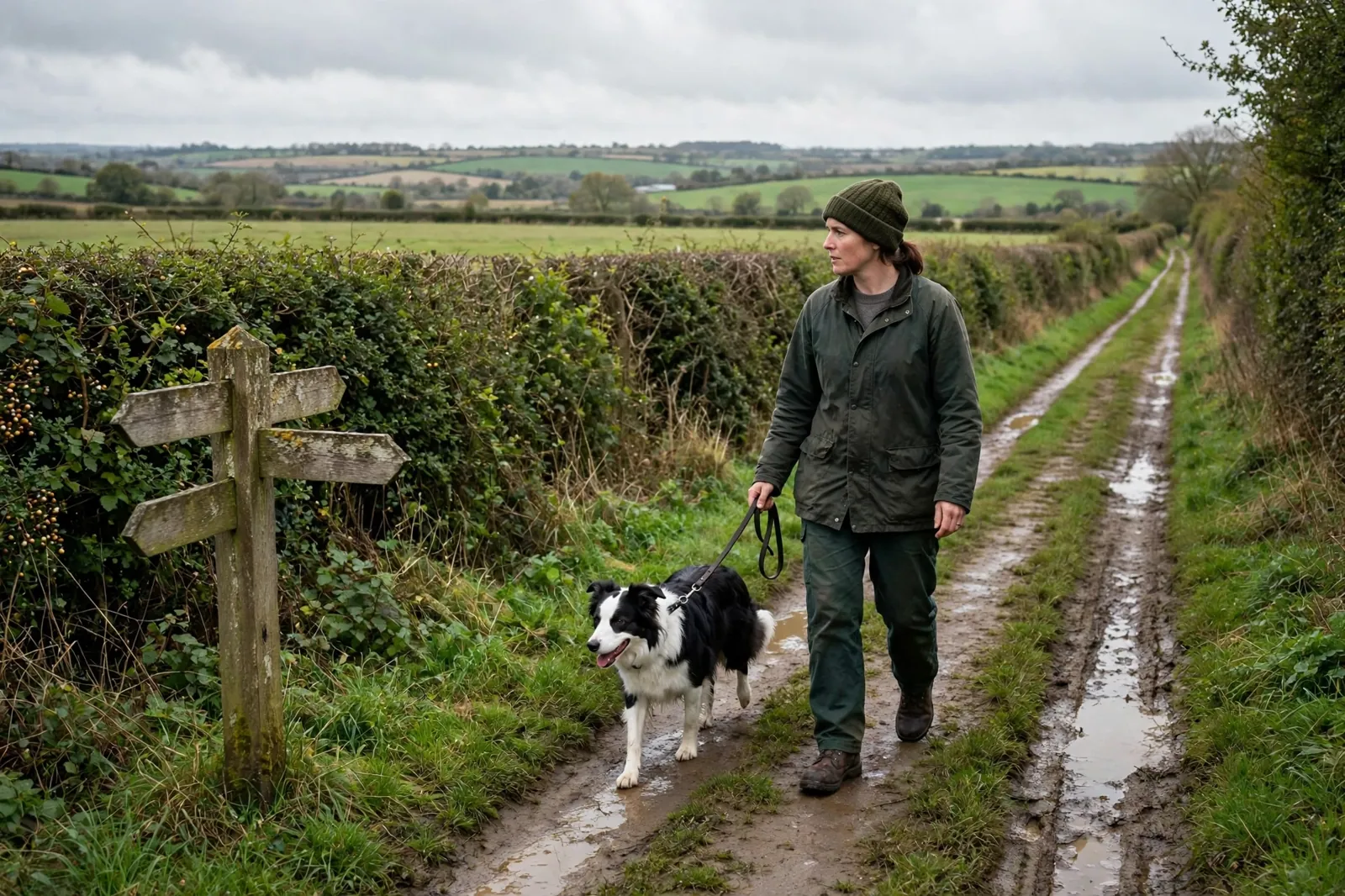
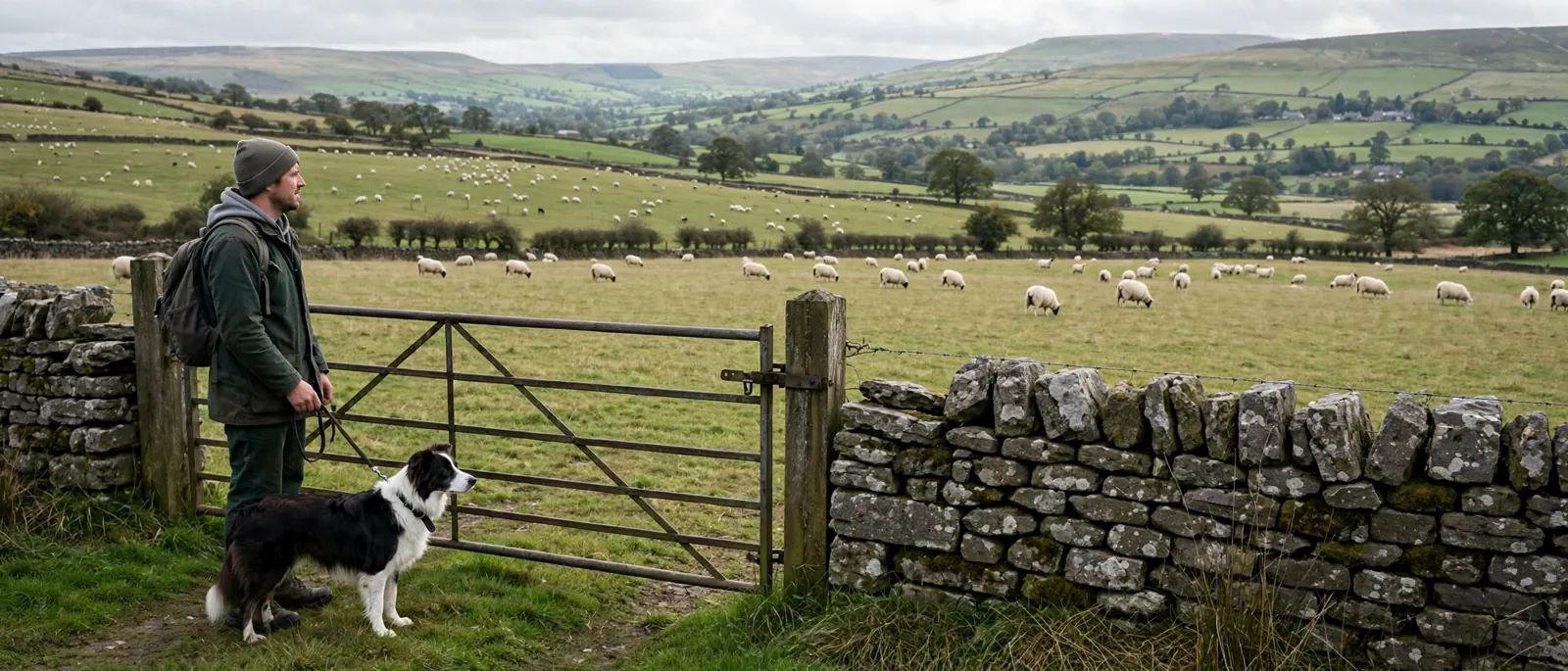
Picture the most ordinary moment in British dog walking. You reach a field gate, clip the lead shorter because there are sheep beyond the hedge, and your dog lunges at a pheasant bursting out of the ditch. The lead wraps around your wrist, you stay upright — but the dog swings wide, knocks a passing cyclist off balance on the lane, and then careers through a gap in the hedge after the flock. The cyclist has a fractured wrist and a buckled wheel. Two ewes are lame, one has aborted lambs, and the farmer is entirely within his rights to be furious. Nobody set out to cause harm. Nobody was reckless in any dramatic way. And yet, within a fortnight, there can be a letter setting out a claim for the cyclist's lost earnings, private treatment and damaged bike, and a second claim from the farm for veterinary fees and lost lambs.
That is the territory this guide covers. Not vet fees, not cancellation, not lost-dog posters: only the money you can become legally responsible for when your dog hurts somebody else or damages what belongs to them. Third-party liability insurance exists for exactly these thirty seconds — rare, unplanned, and far more expensive than most owners guess. A modest claim for a bitten hand and ruined clothing might settle for a few thousand pounds. A serious injury involving surgery, time off work and lasting effects can run into six figures, and catastrophic injury claims with long-term care needs can exceed a million pounds once legal costs are counted. You do not need to own a dangerous dog to face a claim; you need an ordinary dog, a public place and one bad moment.
The good news is that this is one of the cheapest risks in dog ownership to insure, and many owners already hold cover without realising it, because liability is bundled into most pet insurance policies and some memberships. The catch is that bundled cover is easy to overlook, easy to let lapse, and written with exclusions that only become visible after an incident. So this guide works through what liability cover pays for, how much is enough, the three routes to buying it, the exclusions that most often void a claim, and the practical steps to take in the first 48 hours after something goes wrong.
What liability cover actually is
Start with the legal position, because the insurance only makes sense against it. In the UK, a dog owner can be liable for damage their dog causes under the Animals Act 1971, as well as under ordinary negligence. Liability can arise without anyone proving you were careless: if your dog has characteristics or habits that make damage likely — chasing, guarding, lunging at wheels — the law may treat resulting harm as your responsibility even on a first incident. Alongside civil claims sit criminal laws: the Dangerous Dogs Act 1991 makes it an offence for a dog to be dangerously out of control in any place, and livestock worrying is a separate offence under the Dogs (Protection of Livestock) Act 1953. Our guide to the livestock worrying law explains what counts as worrying and why a dog does not have to bite a sheep to cause serious loss.
Third-party liability insurance steps into the civil side of that picture. If a third party — someone other than you and your household — is injured, or their property is damaged, and you are legally liable, the insurer pays the compensation and, usually, the legal costs of defending the claim. Two boundaries define the cover. First, it never pays for harm to you, your family or your own property: if your dog knocks you down the stairs or chews your own sofa, that is your problem or your vet-and-accident cover's problem, not a liability claim. Second, it does not pay criminal fines or penalties. If an incident leads to prosecution, liability insurance may fund legal defence where the policy allows, but a fine imposed by a court is yours to pay personally.
It also helps to separate liability cover from the rest of a pet policy. A standard pet insurance policy is really several covers stitched together: vet fees for your own dog, liability to third parties, sometimes death, theft and straying benefits. When owners compare policies on vet fees alone, the liability section gets ignored — yet for a healthy young dog, liability is statistically the section most likely to produce a claim larger than the owner's savings. For the wider picture of how holiday and pet cover divide up, see our guide to dog travel insurance in the UK; this page deliberately goes deep on the liability slice only.
What it pays for: injury, property and livestock
Injury to people is the claim that matters most. Bites are the obvious case, but a large share of dog-related claims involve no teeth at all: a friendly dog jumping up and knocking an elderly passer-by over, a lead stretched across a pavement tripping a jogger, a dog darting into a cycle lane, or a recall failure that sends a horse rider to the ground. Compensation can include medical and rehabilitation costs, lost earnings, care costs, damaged clothing and a sum for pain and loss of amenity. Where an injury is life-changing, courts award accordingly, which is why liability limits are counted in millions rather than thousands.
Damage to property covers the everyday catalogue of canine destruction visited on other people's things: a scratched car door where a dog jumped up at a window, a smashed greenhouse, a neighbour's fence brought down, a holiday cottage's carpet and sofa ruined during a stay, or another dog's expensive harness — and note that injury to another dog is treated in law as damage to property, so vet bills for a dog yours attacked commonly form part of a liability claim. Individually these sums look manageable; combined with an injury in the same incident, they climb quickly.
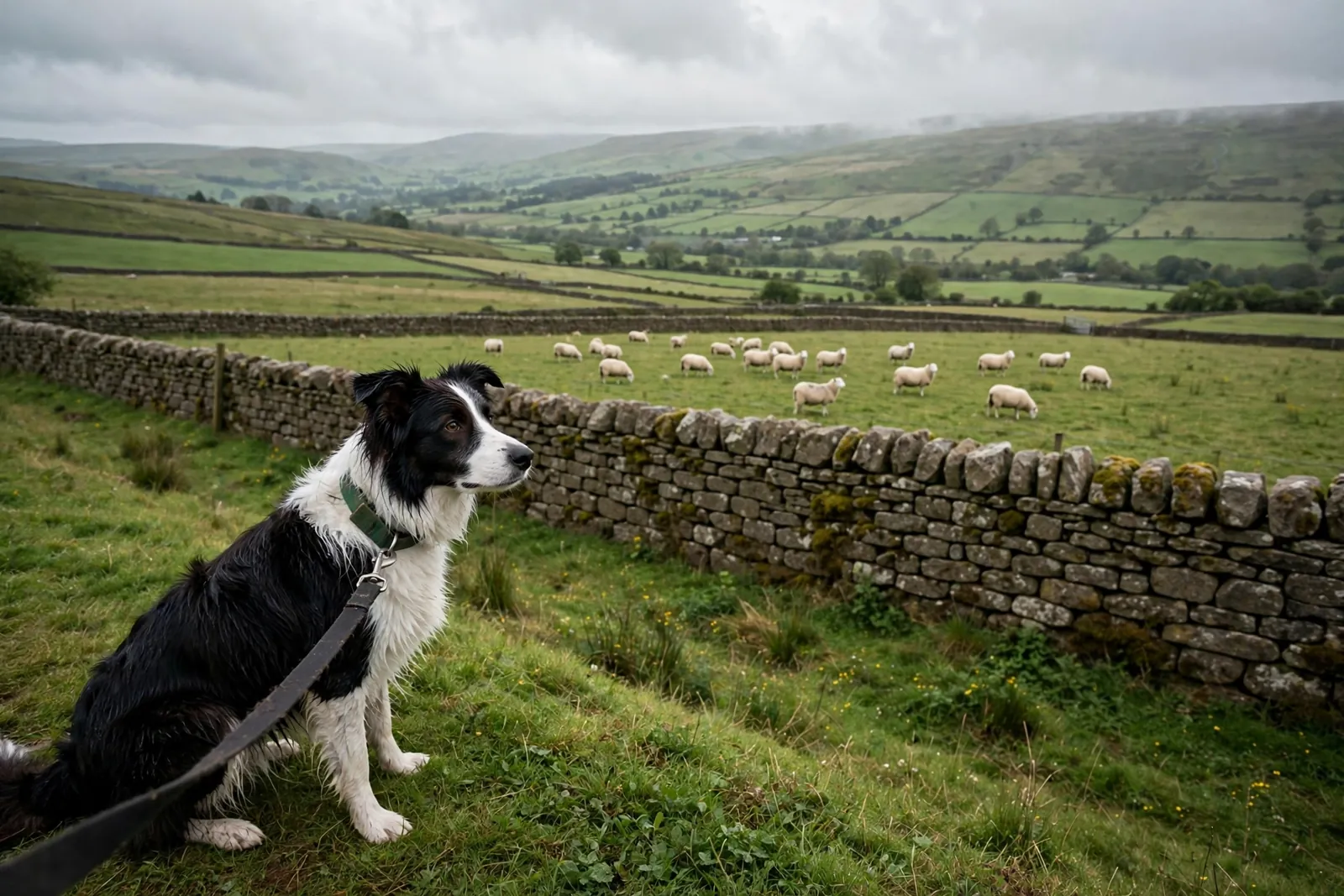
Livestock worrying deserves its own paragraph because British dog culture is built around farmland footpaths. Worrying includes attacking livestock, chasing them in a way likely to cause injury, suffering or loss of young, and simply being at large off the lead in a field with sheep. Losses are real money: aborted lambs, injuries needing veterinary treatment, animals that die of stress or misadventure while fleeing, and in the worst cases a flock driven into a road or river. A farmer can also, in defined circumstances, lawfully shoot a dog that is worrying livestock and cannot be controlled — a reminder that prevention outranks insurance. Whether your dog is covered for a livestock claim depends on the policy wording; some insurers exclude incidents where the dog was off lead around livestock contrary to the policy's reasonable-care conditions, so the countryside code habits in our guide to dogs on leads law are part of managing this risk, not just good manners.
Most policies also pay legal defence costs — solicitors to respond to a claim, negotiate settlement or defend a civil action — and many pay the claimant's legal costs if you lose or settle. Whether defence costs sit inside the cover limit or are paid in addition is a small-print detail with large consequences, covered in the next section.
Limits, excesses and defence costs: reading the numbers
Three numbers decide how good a liability policy really is. The first is the indemnity limit: the maximum the insurer will pay for claims. Bundled pet policies commonly include £1 million to £3 million of liability cover; standalone policies and membership arrangements commonly start at £1 million and may offer more. Given that a single serious injury claim can approach or exceed £1 million with costs included, the practical advice is simple: take the highest limit you can sensibly get, because the premium difference between £1 million and £3 million of cover is usually small compared with the difference in protection.
The second number is the excess, the amount you contribute towards each claim. Liability excesses are often around £100 to £250, and some policies apply a higher excess to property damage than to injury, or a special excess for certain breeds or previous claims. An excess is not a reason to avoid reporting a small incident: insurers normally require prompt notification of anything that might become a claim, and a grazed knee reported today can become an infected wound and a solicitor's letter next month.
The third is how defence costs are treated. If legal costs are paid inside the limit, a long dispute eats into the money available for compensation; if they are paid in addition to the limit, your protection is effectively larger. Also check whether the limit applies per incident or as an annual aggregate — two unrelated incidents in one policy year can test an aggregate limit — and whether cover is limited to the UK or extends to trips abroad, which matters if you take your dog to Europe and is usually time-limited, commonly to a set number of days per trip or per year. Before relying on any figure in this section, check the current policy wording, as limits and conditions change; if the wording is unclear, ask the insurer in writing and keep the reply.
Three routes to cover: bundled, standalone and membership
Route one: bundled pet insurance. Most accident-and-illness and lifetime pet policies include third-party liability as a standard section, which makes this the default route for owners who insure vet fees anyway. Its strengths are convenience and typically generous limits. Its weaknesses are easy to miss: accident-only policies may include a lower liability limit, some budget policies sell liability as an optional add-on rather than a standard feature, and cover ends if the policy lapses — a real risk when a renewal is missed during a house move or a bank card expires. If your dog's vet cover is with an insurer, open the schedule today and find the liability limit in writing rather than assuming it is there.
Route two: standalone liability-only insurance. A small market of specialist policies covers liability without vet fees. This route suits owners who have decided to self-fund veterinary treatment, owners of older dogs whose vet-fee premiums have become very expensive, and owners whose dogs are refused full cover for other reasons. Premiums are generally modest because the insurer is taking on a low-frequency risk. Read standalone wording with extra care: without a vet-fee section there is no other part of the policy to fall back on, so exclusions, territorial limits and conditions about leads, muzzles and control carry the whole weight of the contract.
Route three: membership cover. Some dog charities and membership organisations include third-party liability insurance as a member benefit — the best-known model is Dogs Trust membership, which has historically included liability cover for members' dogs. This can be remarkably good value and supports a charity at the same time. The checks are the same as for any policy: confirm the current limit, confirm which dogs are covered (membership cover may apply to dogs owned by the member and living at the member's address), confirm the exclusions, and confirm the cover is still a live benefit before relying on it, because membership packages change. Never stack assumptions: if you hold both membership cover and a pet policy, tell both insurers, because policies usually contain rules about other insurance and double-claiming is not permitted.
Whichever route you choose, keep one document where a partner, family member or dog sitter can find it: insurer name, policy number, claims phone number and the liability limit. In the stress of an incident, the person holding the lead may not be the person who bought the policy.
Exclusions that catch owners out
Exclusions are where liability cover succeeds or fails, and they follow a consistent pattern across the market. Learn these before you need them.
- Your own household. Claims by people who live with you are almost always excluded, and many policies extend the bar to family members generally, plus anyone employed by you. A dog that injures a visiting stranger is a claim; the same injury to your spouse usually is not.
- Paid handling. Incidents while the dog is in the care of a paid dog walker, boarder, groomer or sitter are commonly excluded, because that professional should hold their own business liability insurance. Unpaid help from friends and family, with your permission, is more often covered — but wording varies, so regular arrangements should be declared.
- Banned types and undeclared dogs. Dogs of types banned under the Dangerous Dogs Act 1991 can only be kept under exemption conditions that require liability insurance, and mainstream insurers approach them through specific arrangements; an undeclared dog, or a dog of a type the insurer does not cover, can void the whole policy. The same applies to dogs kept for guarding, racing or commercial breeding where the policy is written for pets.
- Deliberate acts and known risk. Setting a dog on someone, encouraging it to act aggressively, or ignoring a known pattern — a dog that has already bitten, that a court has made subject to a control order, or that the insurer has imposed conditions on — can remove cover. Previous incidents and claims must be disclosed when asked.
- Work and organised activities. Dogs working as assistance animals, therapy visitors, performers or competitors may need the activity declared or separately insured; some policies exclude incidents at shows or events unless declared.
- Territory and time limits. Cover abroad is usually capped at a fixed number of days, and some policies are UK-only. A claim arising on day forty of a thirty-day overseas limit is not a claim.
Finally, most policies impose a general duty to take reasonable care: keeping the dog under control, complying with lead and muzzle requirements, and following any conditions the insurer has set. Breaching a court order or a local rule does not automatically void every policy, but it hands the insurer an argument at exactly the moment you can least afford one. If an exclusion looks ambiguous for your circumstances, get the insurer's position in writing before an incident, not after.
Countryside, beach and holiday scenarios
The footpath through grazing land. This is the scenario liability cover was made for, and the one where prevention and paperwork meet. Keep the dog on a short lead around livestock, even if your dog is normally steady: pregnancy, lambing and unfamiliar flocks change dog behaviour. If cattle approach and you feel threatened, received countryside advice is to let go of the lead so you can reach safety and the dog can run clear — the dog's safety and yours come before property considerations, and you should check current official guidance before you travel. A claim after a genuine emergency is judged very differently from a claim after a dog was left to chase sheep for photographs.
The beach and the promenade. Summer dog restrictions push owners onto promenades, piers and shared paths where the trip hazards live: extending leads across cycle lanes, dogs shaking seawater over a stranger's shopping, a wet dog cannoning into a toddler at the water's edge. None of these feel serious until someone falls badly. Liability cover responds to the injury claim; your job is the boring prevention — short lead on shared surfaces, no extending lead near bikes, and recall practised somewhere emptier than a bank-holiday beach.
The holiday cottage and the holiday park. Away from home, your dog meets delivery drivers at unfamiliar doors, cleaners entering on changeover day, and neighbours a fence away rather than a street away. Damage to the property itself — scratched doors, chewed furniture, a ruined carpet — is claimed by the owner as property damage, and your liability section, not your deposit alone, may be what answers it; check whether holiday accommodation damage is excluded or subject to a higher excess. Tell your insurer if you take the dog abroad or on extended trips, and keep the claims number saved in your phone alongside the booking confirmations.
The pub garden and the café. A lead under a chair leg, a dog lying across a walkway, a startled lunge at a dropped tray: hospitality settings generate a steady trickle of small claims that occasionally become large ones when an older person falls. Choose the corner table, keep the lead short and off the thoroughfare, and treat any incident — however minor it seems — as reportable to your insurer within the policy deadline.
After an incident: the first 48 hours
What you do at the scene and in the two days after shapes both the human outcome and the insurance outcome. Work through it in order.
- Secure the dog and help people first. Get the dog on a short lead, into a car or behind a gate. Help anyone injured, call emergency services if needed, and stay calm and courteous even if tempers flare.
- Swap details, not arguments. Exchange names, addresses and phone numbers with the injured person, the property owner and any witnesses. Do not admit legal liability, apologise in terms that accept fault, or offer cash settlements at the scene — a simple expression of concern for someone's welfare is human; a signed acceptance of blame is evidence. Let the insurer handle fault.
- Record everything. Photograph the scene, the gate, the lead, the ground, injuries and damage. Keep the lead and collar exactly as they were if equipment failure is involved. Write your own account the same day, with times, weather, who was present and what was said.
- Report promptly. Notify your insurer within the deadline in your policy — often between 30 and 90 days, sometimes sooner for serious injury — and notify the police or local authority where the law or the situation requires it, for example where someone needed hospital treatment after a dog incident. A dog warden report may also be appropriate for livestock incidents, alongside informing the farmer directly if it is safe to do so.
- Do not settle privately afterwards. If a letter, email or solicitor's claim arrives, forward it to your insurer unanswered and let them respond. Agreeing payments, signing documents or corresponding about fault without the insurer can breach policy conditions.
- Fix the cause. A muzzle for specific situations, a different lead, a training plan, a vet check for pain-related behaviour changes: insurers may impose conditions after a claim, and a second incident with the same cause is far harder to defend — legally, financially and morally.
Keep every document: the claim form, reference numbers, correspondence and receipts. Claims can take months, and the owner with a tidy file is the owner whose version of events carries weight.
Choosing and checking a policy: a short routine
Set a diary note once a year — renewal week works — and run through five checks. First, find the liability limit on your current schedule and confirm it is at least £1 million, ideally more. Second, read the exclusions against your real life: who walks the dog, whether anyone is paid, where the dog travels, and whether any activity needs declaring. Third, confirm the excess for injury and for property damage, and how defence costs are treated. Fourth, check the territorial limits against any planned trip with the dog. Fifth, make sure the claims phone number and policy number are saved in your phone and in the household document a sitter could find.
If you discover you have no liability cover at all, fix it the same week rather than at renewal: a bundled policy, a standalone policy or a membership arrangement can usually be started immediately, and cover does not work backwards — an incident last month cannot be insured today. If you are comparing fresh quotes, compare the liability sections explicitly rather than treating them as identical boilerplate; limits, excesses and the treatment of paid walkers differ more than marketing suggests. And keep the perspective this guide started with: the cyclist, the sheep and the field gate were nobody's plan for the day. Liability insurance is the small, dull purchase that stops thirty bad seconds from becoming the most expensive walk of your life.
Practical questions
Before you go
Is third-party liability insurance for dogs legally required in the UK?
No. For most pet dogs there is no legal duty to hold liability insurance, unlike car insurance. You are still personally liable if your dog injures someone or damages property, and owners of types banned under the Dangerous Dogs Act 1991, including XL Bully types, must hold third-party liability cover as a condition of their exemption. Compulsory or not, the financial risk sits with you either way, so most owners treat cover as essential rather than optional.
How much third-party liability cover does my dog need?
Most bundled pet policies include between £1 million and £3 million, and standalone or membership cover commonly offers £1 million or more. Serious injury claims involving long-term care can exceed £1 million once legal costs are added, so a higher limit is usually worth the small price difference. Check whether the limit applies per incident or per year, and whether legal defence costs sit inside or on top of the limit.
Does liability cover pay if my dog injures a member of my own family?
Usually not. Most policies exclude claims by people who live in the same household, and many also exclude other family members, employees and anyone handling the dog for payment. The cover is designed for claims from genuine third parties: strangers, neighbours, visitors and other members of the public. Read the exclusions list rather than assuming, because the wording varies between insurers.
Is my dog covered if a dog walker or friend is walking them?
It depends on payment and permission. Many policies extend cover to someone walking your dog with your permission as a favour, but exclude incidents while the dog is with a paid professional, who should carry their own business liability insurance. If you use a walker, boarder or sitter regularly, tell your insurer, confirm the position in writing, and ask the professional for proof of their own cover.
What should I do straight after my dog causes an injury or damage?
Secure the dog, help anyone who is hurt and swap names, addresses and phone numbers without admitting legal liability or arguing about fault. Photograph the scene, keep the lead, collar and any damaged items, and write down what happened while it is fresh. Notify your insurer within the time limit in your policy, often 30 to 90 days but sometimes sooner, and do not agree payments or sign anything before speaking to them.