This guide explains general rules for orientation and is not legal advice. Local orders change and signage varies, so check the latest official guidance before you travel and follow on-site signs where they are stricter.
No single law requires a lead everywhere, but leads are required or expected in specific settings: beside roads, around livestock, on some access land in set seasons, in places covered by local orders, and anywhere a person with authority directs it. Everywhere else, the legal standard is proper control — which your dog either has in that situation, or does not.
Why there is no single lead law
Owners often go looking for one clean rule — a statute, a distance, a yes or no — and are unsettled to find a mosaic instead. The mosaic exists because dog control in Britain grew up in layers. Nineteenth-century concerns about sheep worrying produced farmland rules. Twentieth-century traffic produced road rules. Modern councils gained powers to write orders for individual parks and promenades because a play area in Leeds and a grazing common in Devon simply do not present the same problem. Layered law feels untidy, but it is deliberately local: the rule follows the risk of the place.
Practically, this means your question should never be “are leads required in the UK?” but “are leads required here, today, for this activity?”. A beach may allow off-lead dogs in winter and require leads, or ban dogs entirely, on the same sand in July. A footpath crossing one field may be lead-optional while the next field, holding lambs, triggers strict duties. The skill this guide builds is reading a new place quickly: signs at entrances, stock in view, ground-nesting season, children and sports in progress, and your own dog’s reliability that day.
One more layer catches holidaymakers out: landowner and venue rules that are not criminal law at all. A holiday park, a heritage site or a café garden can require leads as a condition of entry, and can ask you to leave for ignoring it, without any statute being involved. Our guide to UK dog beach rules shows how often the operative rule on a trip turns out to be a local or venue rule rather than a national one.
Under control: the duty underneath everything
Underneath every specific rule sits a general expectation that runs through several laws: the person in charge of a dog must keep it under proper control in public. Control is judged on behaviour, not equipment. A dog on a four-metre extending lead lungeing at cyclists may be less controlled than a dog off lead walking quietly at heel. Conversely, a dog whose recall evaporates near other dogs is not under control off lead in a busy park, whatever its owner believes, and an incident will be judged on what happened rather than on intentions.
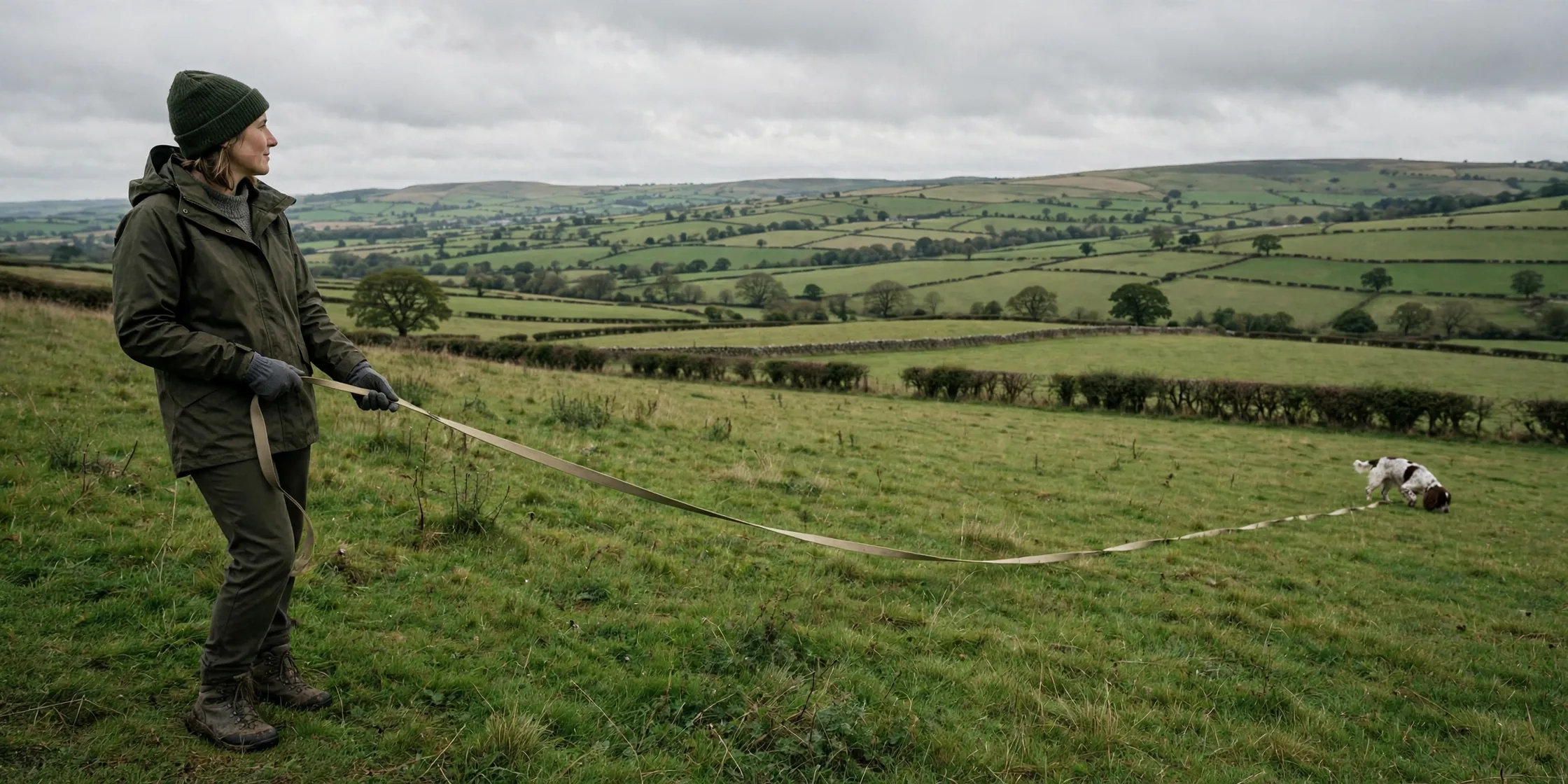
Trainers break control into testable pieces, which is a useful self-audit before you unclip. Does the dog return promptly on the first call, including away from other dogs, food and interesting smells? Does it stay within a sensible distance without drifting toward roads, picnics or livestock? Can it walk past people without jumping up, and leave wildlife alone entirely? If any answer is “usually, but not when…”, then in the situation named, the dog is not yet under control and a lead or long line is the correct equipment. Our comparison of long lines versus standard leads explains how a long line bridges exactly this gap during training.
Control also includes the unglamorous parts: carrying a lead even when you plan to walk off lead, being able to clip it on quickly, and having a plan when something unexpected appears — deer on a woodland path, a pony herd on open moor, a football match spilling across your route. Wardens and courts alike respond far better to owners who visibly managed their dog than to owners who had a perfect recall story and no lead in their pocket.
Roads, pavements and town centres
The clearest lead expectations cluster around traffic. Dogs should be kept on a short lead on and beside roads, and many councils reinforce this with local orders covering named streets and pedestrianised areas. The Highway Code advises a short lead on roads and paths shared with cyclists and horse riders. Even where no order applies, an off-lead dog stepping into a carriageway exposes its owner to serious consequences if a crash follows, and “he never does that” has never been a defence to physics.
Short matters as much as on. A lead at full extension across a pavement is a trip hazard for pedestrians and puts the dog at kerb distance from traffic while technically attached. In built-up areas, hold the dog close on the building side, shorten further at crossings and bus stops, and treat café seating, market stalls and school gates as lead-shortening triggers automatically. Extending leads have their place in open parks where local rules allow them; in town centres they cause a steady share of the incidents that get blamed on dogs generally.
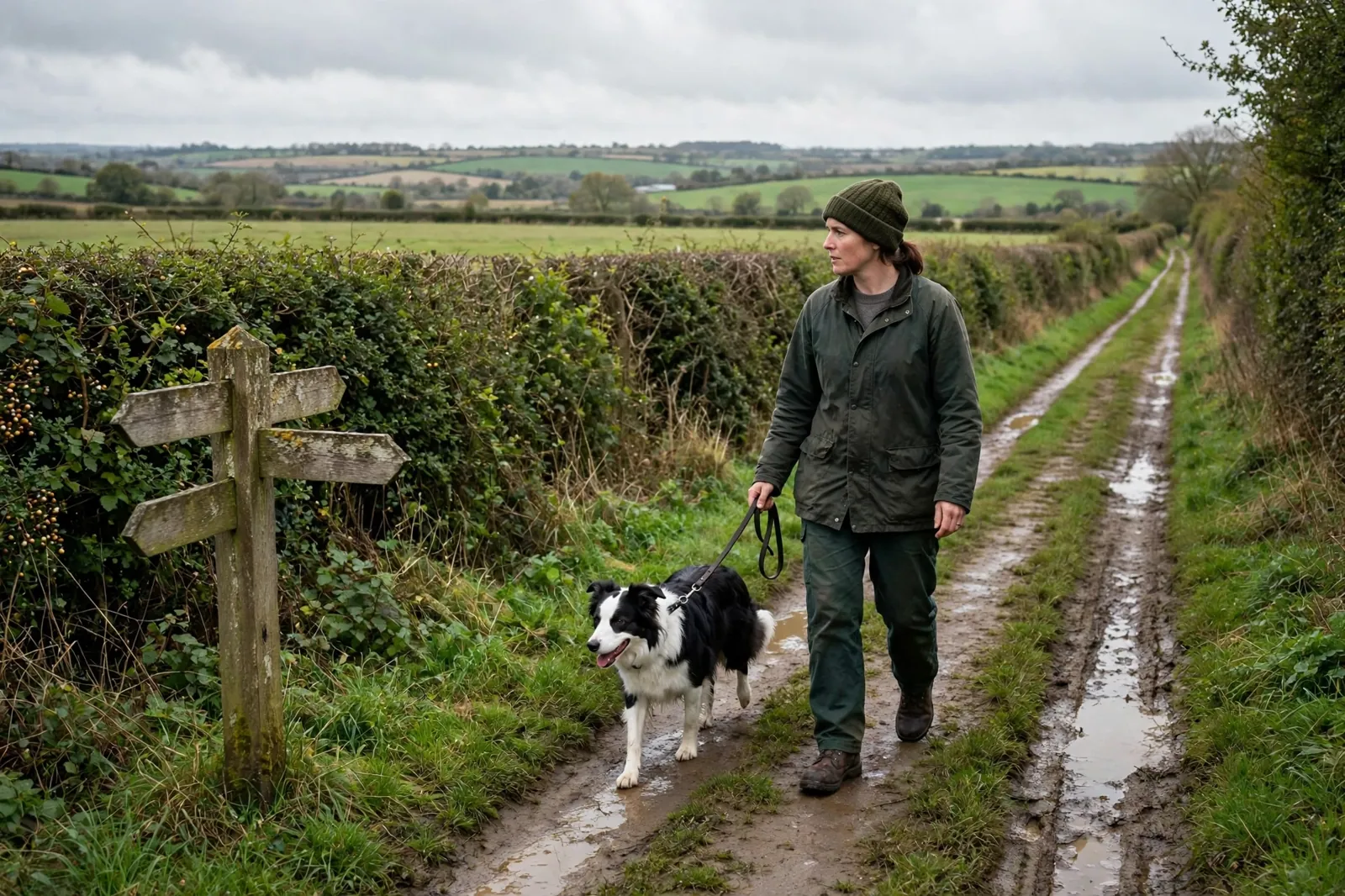
Travellers meet this rule most often in unfamiliar villages: the pretty lane with no pavement, blind bends and faster traffic than it looks. Walk facing oncoming traffic where there is no footway, keep the dog on the verge side on a short lead, and step in together at gateways for passing vehicles. It feels fussy for the first ten minutes of a holiday and completely normal by the second day — which is roughly when most near-misses would otherwise happen, as everyone relaxes.
Farmland, livestock and access land
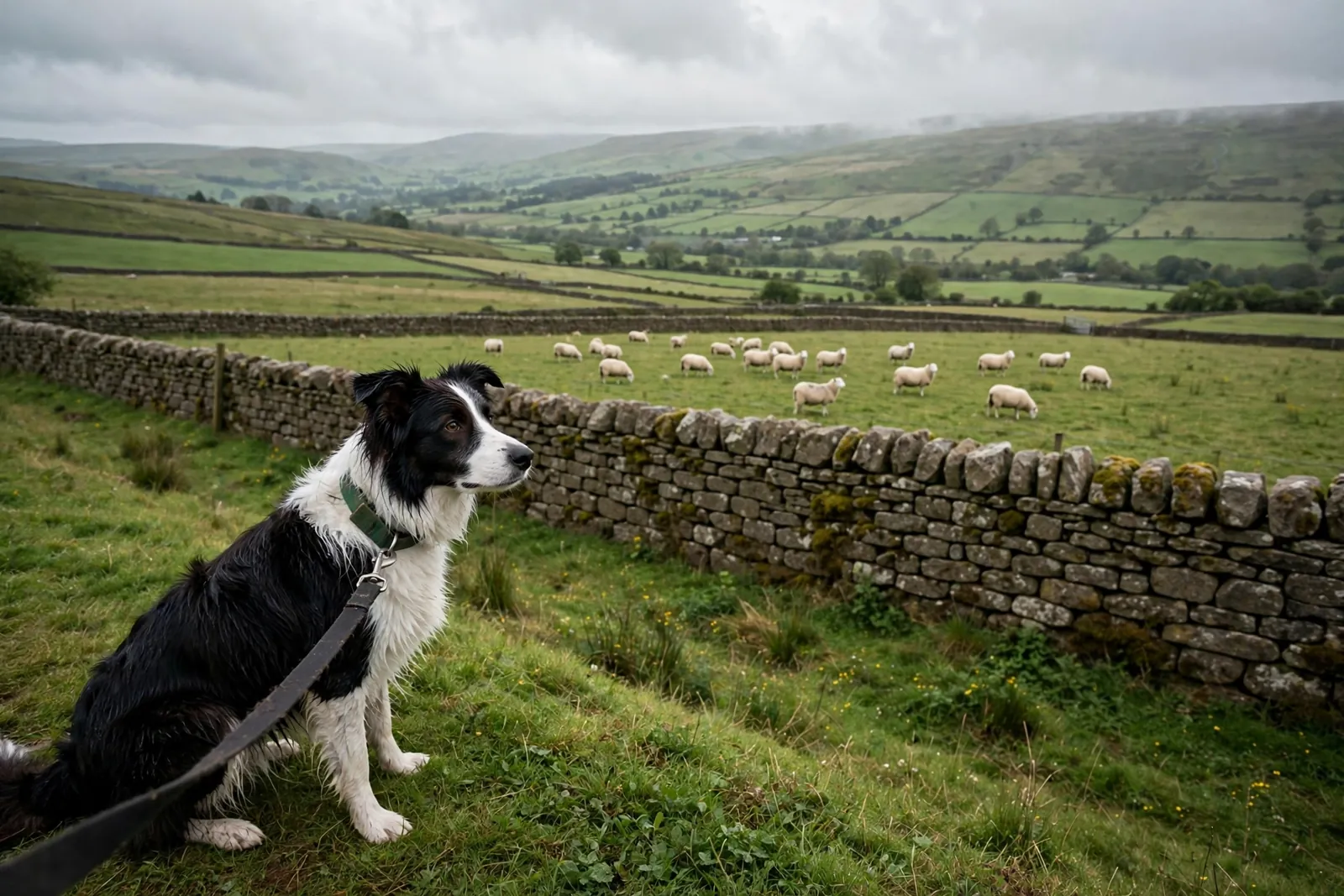
Farmland is where lead law has real teeth. Dogs must be kept under close control around livestock, and on much open access land in England and Wales a short lead is specifically required near livestock and during the spring and early summer period each year, because of lambing and ground-nesting birds. The Countryside Code asks for a lead or close control around farm animals at all times and reminds walkers that a farmer may legally act against a dog that is worrying stock. Our detailed explainer on the law on dogs worrying livestock sets out offences and penalties properly, and it deserves a full read by anyone who walks rural footpaths.
“Worrying” is broader than most owners assume. Chasing is worrying, but so is being at large among sheep in a way that causes distress, and an incident does not require a bite or a caught animal. Sheep can abort lambs or injure themselves in fences after being chased by a dog that never touched them. That is why the only defensible routine near stock is boring consistency: lead on before the gate or stile, dog close through the field, no exceptions for “he ignores sheep”, because the day he does not ignore them will involve someone else’s animals and livelihood.
Cattle deserve a separate note, because the advice reverses in one specific emergency. Walk quietly around herds, especially with calves, keeping the dog close and quiet. If cattle charge and the dog is the focus, received safety advice is to let go of the lead so you can both escape — a dog can outrun cattle and will usually return to you — rather than being pulled down holding on. This is an emergency exception described in official countryside guidance, not a general permission, and check the latest official guidance before you travel for current wording.
Local orders: parks, beaches and PSPOs
Most day-to-day lead rules owners actually meet come from local orders, in England and Wales commonly Public Spaces Protection Orders. A PSPO can require leads in a named park, exclude dogs from play areas and sports pitches, limit the number of dogs one person may walk, and require a person to put a dog on a lead when directed by an authorised officer anywhere in a wider area. Breaching a PSPO typically brings a fixed penalty of around £100, rising substantially if the case goes to court. GOV.UK's official guidance on controlling your dog in public confirms the figures: a £100 fixed penalty notice on the spot, and up to £1,000 if the case goes to court — and that letting a dog be dangerously out of control is against the law anywhere.
Because orders are hyper-local, the park across a council boundary may run opposite rules to the one you use at home, and orders expire and are renewed or altered every few years. The reliable sources are the signage at the park itself and the council’s own web page for dog control orders — searching the council name plus “dog PSPO” usually reaches it in one step. Photographing entrance signage on a first visit is a humble habit that settles most later arguments with yourself about what the rule was. For the kinds of places these orders commonly cover, see our guides to dog-friendly beaches in Scotland, secure off-lead dog parks and Dartmoor dog walks.
Beaches run on the same principle with a seasonal twist: many resorts restrict dogs or require leads on the main bathing beaches roughly from late spring to early autumn, while leaving other stretches open year-round. Arrive at the slipway, read the sign before unclipping anything, and identify which stretch you are actually on — promenade rules and sand rules often differ, and the boundary is usually a groyne, steps or a lifeboat station rather than anything you would guess. Pair this with our guide to fouling fines, because the same orders usually carry the clean-up duties and penalties too.
Wildlife, seasons and protected places
Some lead requirements protect wildlife rather than people or stock. Nature reserves, protected coastal sites and moorland breeding areas can require leads for all or part of the year under site bylaws or access conditions, and wardens actively patrol the well-known ones during nesting season. Ground-nesting birds such as curlew, lapwing and skylark nest in exactly the rough grass dogs love to quarter, and a dog need not catch anything to cause a nest to fail — repeated flushing is enough.
Seasonal awareness is the practical skill. Late winter through mid-summer is the sensitive window for most breeding birds; seal pupping seasons bring their own local restrictions on some beaches; deer parks ask for special care during the autumn rut and the late-spring birthing season, when normally placid animals become defensive and dogs must be kept close or out of particular areas. Signs at these places are unusually specific because the underlying designations are legal ones. Treat an unexplained lead request from a reserve warden as information, not interference: they are usually telling you about something nesting ten metres from the path that you cannot see.
Protected landscapes add one more habit worth building: checking the destination page before the trip, not at the gate. National park and reserve websites publish their dog rules prominently, and a two-minute check at home decides which walks to plan, whether the long line comes too, and whether a different venue suits the dog better that day. Our guide to National Trust visits with dogs shows how one major landowner grades its sites by pawprint rating — a model of the place-by-place variation you will meet everywhere.
How the four nations differ
England and Wales share much of their framework, including access land rules and PSPOs, though Welsh councils administer their own orders and bilingual signage is standard in Wales. Scotland works differently at the foundation: its outdoor access rights are broader, and with them comes a responsibility-based code rather than a list of permitted places. Under that code dogs should never be off lead in ways that worry livestock or wildlife, leads are expected around farm animals and in lambing fields, and the same functional duties apply even though the legal machinery differs. Do not import English assumptions about where you may walk; equally, do not assume broader access means looser control — Scottish guidance on dogs near livestock is emphatic.
Northern Ireland uses district council dog control orders under its own legislation, with lead requirements in specified places, dog exclusion areas, and its own fixed penalty structure. Holiday travel there — including cross-border trips combined with the Republic, which has separate rules again — rewards the same entrance-sign routine doubled: rules genuinely change at borders that the landscape does not mark.
The transferable core, valid everywhere in the UK, is short: carry a lead always; use it near roads, stock, wildlife and crowds; obey local signs even when locals seem casual about them, because enforcement falls on the person caught, not the person who got away with it yesterday; and keep your dog’s control honest. Within that core, check the latest official guidance before you travel for the nation and site in front of you, since devolved rules and seasonal orders are exactly the details that change.
Wardens, fines and how enforcement works
Enforcement is mostly human and mostly reasonable. Council wardens, park rangers, police community support officers and authorised site staff can all, depending on the order in force, require you to lead your dog, ask for your details, and issue a fixed penalty for a breach. A direction to put a dog on a lead under a relevant order is itself enforceable — refusing or debating the point converts a minor matter into a documented one. The fastest de-escalation in any encounter is visible compliance first and questions second: clip the lead on, then ask what the local rule is so you get it right for the rest of the walk.
Fixed penalties for order breaches commonly sit around £80 to £100, with prosecution for non-payment or serious cases bringing larger fines. Separately, and far more seriously, a dog that is dangerously out of control enters criminal territory covered by our companion guide on that offence — a different legal world from a park fine. Owners sometimes conflate the two and either panic about a PSPO ticket or shrug about genuinely dangerous behaviour; keeping them separate in your mind is part of understanding this area of law.
Records matter if anything is disputed. If you receive a penalty you believe is wrong — wrong place on the order map, signage missing, mistaken identity of dog walker — the notice itself carries the appeal or representation route, and councils publish their order maps. Take photographs of signage and location at the time, note the officer’s reference, and use the formal channel rather than arguing it out at the park gate. Most errors surface quickly once a map and a photograph are compared calmly.
A lead checklist for unfamiliar places
Holidays concentrate every lead problem into new territory, so run a simple routine at each new walk. At the car park or entrance, read every sign before the dog leaves the car — restrictions are posted where decisions are still easy. Scan for livestock, nesting-season notices, play areas and sports use, and decide your lead plan for the first ten minutes rather than improvising at the first distraction. Keep the default at “on” until the place has shown you it is suitable, not the reverse; unclipping later is a pleasure, while recovering a dog from a sheep field is not a story anyone wants.
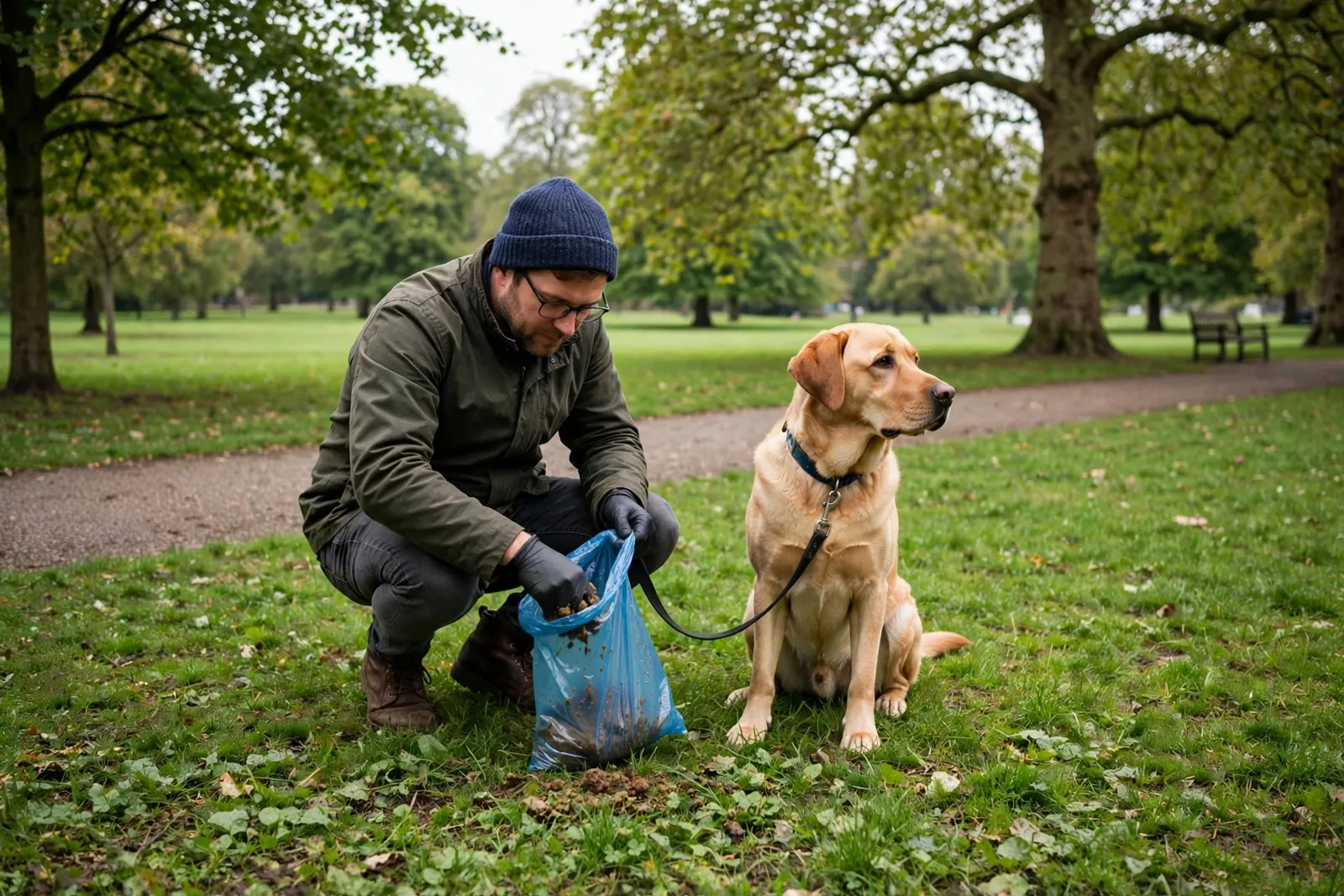
Carry the kit that makes compliance easy: a standard lead you trust, a long line for controlled freedom where allowed, treats that compete with real-world distractions, and bags, because fouling and lead rules travel together in almost every local order. If you walk with children, agree who holds the lead at roads and gates before you set off; the handovers at stiles and car parks are where dogs quietly become nobody’s job for the crucial ten seconds.
Finally, let the dog’s day decide the details. A dog that is hot, tired, over-stimulated by a new place or unsettled by travel will have worse recall than the same dog at home, and the law judges the dog in front of the warden, not the one in your training field. Shorten the lead, shorten the walk, and choose the simpler route. That judgement — unglamorous, situational, repeated daily — is what “responsible owner” actually means in practice, and it will keep you on the right side of every layer of the patchwork.
Lead rules at a glance
The table below summarises the lead expectations described in this guide. It is a summary only — the local sign and the latest official guidance for the exact place always take precedence.
| Scenario | Where it applies | Lead requirement |
|---|---|---|
| Roads and pavements | Across the UK | Short lead, on the building side in built-up areas; the Highway Code advises a short lead on roads and shared paths |
| Farmland and livestock | Across the UK; on open access land in England and Wales a short lead is specifically required near livestock and in the spring and early summer period | Short lead and close control around stock; worrying livestock is an offence |
| PSPO areas (parks, beaches, exclusion zones) | Designated areas set by local councils in England and Wales; district council dog control orders in Northern Ireland | As the local order states: leads in named areas, exclusion from play areas and pitches, limits on dog numbers, and a duty to put the dog on a lead when directed |
| Open access land outside the livestock season | England and Wales | Dog must be under close control; not necessarily on a lead at all times, but loss of control is judged on behaviour |
| Scottish outdoors | Scotland | Responsibility-based code: leads expected around farm animals and in lambing fields, and dogs must never worry livestock or wildlife |
| Nature reserves and breeding seasons | Designated protected sites across the UK | Leads required for all or part of the year under site bylaws or access conditions, as signed on site |
Checked against this guide's own content in October 2026; always confirm the latest official guidance before you travel.
Practical questions
Before you go
Is there a single UK law that says dogs must always be on a lead in public?
No. There is no blanket national rule requiring a lead everywhere in public. Lead requirements come from specific situations and places: roads, farmland with livestock, certain protected land at set times, and local orders covering named parks, beaches and streets. Elsewhere the legal duty is to keep the dog under proper control, which for many dogs still means using a lead.
Must my dog be on a lead near roads?
Dogs should be on a short lead on or beside roads and in many designated pedestrian areas, and local orders frequently make this mandatory in named streets. Beyond the legal point, a lead near traffic is basic safety: even a well-trained dog can react to a sudden noise, cat or dropped lead. Check the latest official guidance before you travel.
What counts as being under control if my dog is off lead?
Control means the dog returns promptly when called, stays reasonably close, does not chase people, dogs, wildlife or livestock, and can be put on a lead immediately when needed. If recall fails around distractions, the dog is not under control in that setting, however good it is in an empty field, and a long line is the honest middle step.
Can a council fine me for walking off lead in a park?
Yes, if that park is covered by a Public Spaces Protection Order or similar local rule requiring leads, breaching it can lead to a fixed penalty notice, commonly around £100, with larger fines if prosecuted. Orders are place-specific, so read park signage and the council website for the exact area rather than assuming the rule from a neighbouring town applies.
Do the lead rules differ in Scotland, Wales and Northern Ireland?
Yes, in detail. Access law and local order systems differ between the nations, and livestock and wildlife protections have their own wording in each. The broad principles travel well — control your dog, use a lead near stock and roads, follow local signs — but always check the rules for the nation and the specific place you are visiting.
Can I be fined for having my dog off lead on a beach?
Yes, where a local order applies — many councils use seasonal dog bans or dogs-on-lead orders on specific beaches, and breaching one can mean a fixed penalty. Check the council's beach rules for that exact beach and date before you let your dog off lead.
How much is the fine for breaching a local PSPO, and where do I check my council's rules?
There is no single national fine, because each council sets its own order. A fixed penalty notice (FPN) is usually £100, although some councils set £80, and some councils halve the fine to £50 if it is paid within 10 days. If the case goes to court, the maximum fine is £1,000. Before you travel, check the PSPO page on your local council's own website for the exact area, dates and lead requirement that apply. See, for example, South Lakeland's guidance on Public Space Protection Orders for how one council explains its orders.