This guide is independent and contains no paid placement. If affiliate links are added later, they will be clearly marked and will not change our editorial checks.
Pack a single folder with your dog's vaccination record, microchip registration confirmation, insurance policy summary, home and holiday vet contacts, booking confirmation with the pet policy screenshot, and a signed letter authorising emergency treatment if you cannot be reached. Photograph everything, keep originals in a waterproof pouch, and run a seven-days-out and a night-before check. This guide is about preparation; if your dog actually goes missing, our step-by-step lost-dog guide takes over from there.
The night-before master checklist
Paperwork is the least exciting part of packing and the one most likely to ruin a trip when it is missing. The pattern is always the same: a holiday park asks for the vaccination book at reception, an emergency vet asks for the insurance policy number before treatment, or a kennel for a day trip wants proof of kennel cough vaccination that you cannot find. None of these are disasters if the folder exists; all of them are stressful if it does not.
Start with the whole list on one page. Tick each item off the night before you leave, and keep the list with the folder so the return journey gets the same discipline.
| Document | What it proves | Keep where |
|---|---|---|
| Vaccination record book | Current boosters, dates, vet stamp | Originals pouch |
| Microchip registration confirmation | Chip number linked to your current phone number | Originals pouch + phone screenshot |
| Insurance policy summary | Policy number, claims line, cover limits | Phone photo + insurer app |
| Home vet contact card | Name, number, out-of-hours line | Phone contacts + paper card in wallet |
| Holiday vet contact | Nearest practice to your stay, emergency number | Phone contacts + paper card in folder |
| Accommodation booking confirmation | Dog registered on the booking, pet fee paid | Email + printed copy |
| Pet policy screenshot | The rules you actually agreed to at booking | Phone album + printed copy |
| Emergency authorisation letter | Named person may consent to treatment up to a limit | Signed original + phone photo |
| Recent photo of your dog | Identification aid if the dog is separated from you | Phone album |
| Medication list with dosages | What the dog takes, how much, when | Originals pouch + taped to medication bag |
| Cross-border paperwork (if leaving Great Britain) | Animal Health Certificate or EU pet passport | Originals pouch, never in checked luggage |
The rest of this guide explains each row: what counts as valid, where to get a replacement, and the mistakes people make with it.
Vaccination records: the booklet that answers everything
The small vaccination book is the single most-requested document on a dog holiday. Holiday parks, campsites, kennels, daycare providers, organised group walks and some activity centres ask to see it at check-in, and they are checking three things: that the core vaccinations are current, that the dates have not lapsed, and that a vet has signed or stamped the entries. A book with a gap of eighteen months and no booster entry will raise questions even if your dog is perfectly healthy.
Keep the record honest about timing. Puppies need their full initial course plus the waiting period your vet advises before mixing with other dogs, and many boarding providers set a minimum age and require the course to be complete. Adult boosters run on your vet's schedule — commonly annual with some components on longer cycles — and the book should show the next due date. If a booster falls due during your trip, get it done a week or two before you travel rather than squeezing it into the holiday; a dog that feels off after a jab is a poor travelling companion, and some providers treat the days immediately after vaccination as a waiting period.
Kennel cough vaccination deserves its own mention because it is the one people forget. It is not always part of the core schedule, yet kennels and many daycare-style holiday providers ask for it specifically, and it usually needs to be given a couple of weeks before boarding to be considered effective. If your plans include any kennelling — even a single day while you visit somewhere dogs cannot go — ask your vet about it at least a month before travel.
Store the book where it cannot be ruined. A waterproof zip pouch inside the main travel folder is enough; the glovebox and the bottom of a rucksack are where booklets go to become unreadable. If the original is ever lost, your home practice holds the vaccination history and can issue a replacement record, which is one more reason to keep the practice's contact details in the same folder.
Microchip registration proof: the chip is only half the job
Microchipping is compulsory for dogs in England, Scotland and Wales, and keepers must keep the registered details up to date — but a surprising number of owners discover on a trip that the chip is registered to an old phone number, a previous address, or in one memorable pattern, to the breeder. The chip only works if the number it points to reaches you now, on this trip, on the phone in your pocket.
Carry proof of registration, not just the assumption that it exists. Most database companies send a confirmation email or letter when a dog is registered or details are changed; keep the latest one, or a screenshot from the database's website or app showing the chip number, your name and the current phone number. Fifteen digits are easy to mistype in a crisis, and having the exact number to read out to a vet or warden saves the fumbling that loses time.
Check the record before every trip, not once a year. Log in to the database a week before you travel and confirm the mobile number is the one you will carry, the address is current, and any second contact is someone who will actually answer. If you changed numbers since the last holiday and forgot to update the database, the chip is effectively anonymous — fix it during the seven-day check described below.
A word on why this matters beyond the law: if a dog is found and scanned, the finder, vet or dog warden calls the number on the database. An outdated number means the dog sits in kennels while you search. Preparation ends where response begins — if the worst happens and your dog is actually missing, our lost-dog guide covers the first-hour search, microchip and DogLost alerts, wardens and vets in order. This checklist exists so that when you make that call, you can read out the right number immediately.
Insurance documents: the policy summary that matters at midnight
You do not need the full policy wording on a trip; you need the one page that answers an emergency vet's questions at midnight. That page — usually the schedule or summary your insurer sends each year — shows the policy number, the insured dog's name and chip number, the vet-fee limit per condition or per year, the excess, the 24-hour claims or authorisation line, and whether third-party liability is included. Photograph it, save it in the insurer's app if there is one, and keep a printed copy in the folder for the person travelling with the dog who does not have your phone.
Know the numbers before you need them. The two figures that shape every decision are the vet-fee limit and the excess: a £4,000 annual limit with a £150 excess plus a percentage co-payment behaves very differently from a £12,000 limit with a flat £99 excess. Out-of-hours emergency treatment is where limits get tested, so check whether your policy treats emergency fees differently and whether it requires the vet to call the insurer for pre-authorisation above a threshold — some do, and a vet who cannot reach the line may ask you to pay upfront and claim later.
Understand what the policy is and is not. Pet insurance covers the dog's veterinary costs and usually third-party liability if the dog injures someone or damages property; your own travel insurance covers your cancellation, your medical costs and your belongings. The two overlap on cancellation — some pet policies include it if the dog falls ill before the trip, some travel policies cover kennel costs if you are delayed — so check both rather than assuming. Our dog travel insurance guide walks through how the two types of cover split vet fees, liability, cancellation and exclusions in detail.
Finally, note the exclusions that surprise people on holiday. Pre-existing conditions are the classic one: a condition the dog was treated for before the policy started is usually excluded or limited, and a flare-up on holiday is still that condition. Bilateral conditions, dental work and routine preventative treatment are commonly excluded too. None of this means travelling uninsured is sensible — it means knowing the boundary before the vet asks, so the authorisation letter below can name a realistic spending limit.
Vet contacts: your home practice and a holiday backup
Two vet contacts belong in the folder: the practice that knows your dog, and a practice near where you are staying that you have never met. The home practice matters because they hold the full history and can reissue records, confirm a dosage over the phone, and advise a holiday vet who calls them. Save the main number and the out-of-hours line as separate contacts with clear names — “Home vet — daytime” and “Home vet — emergency” — so nobody has to think at 2am.
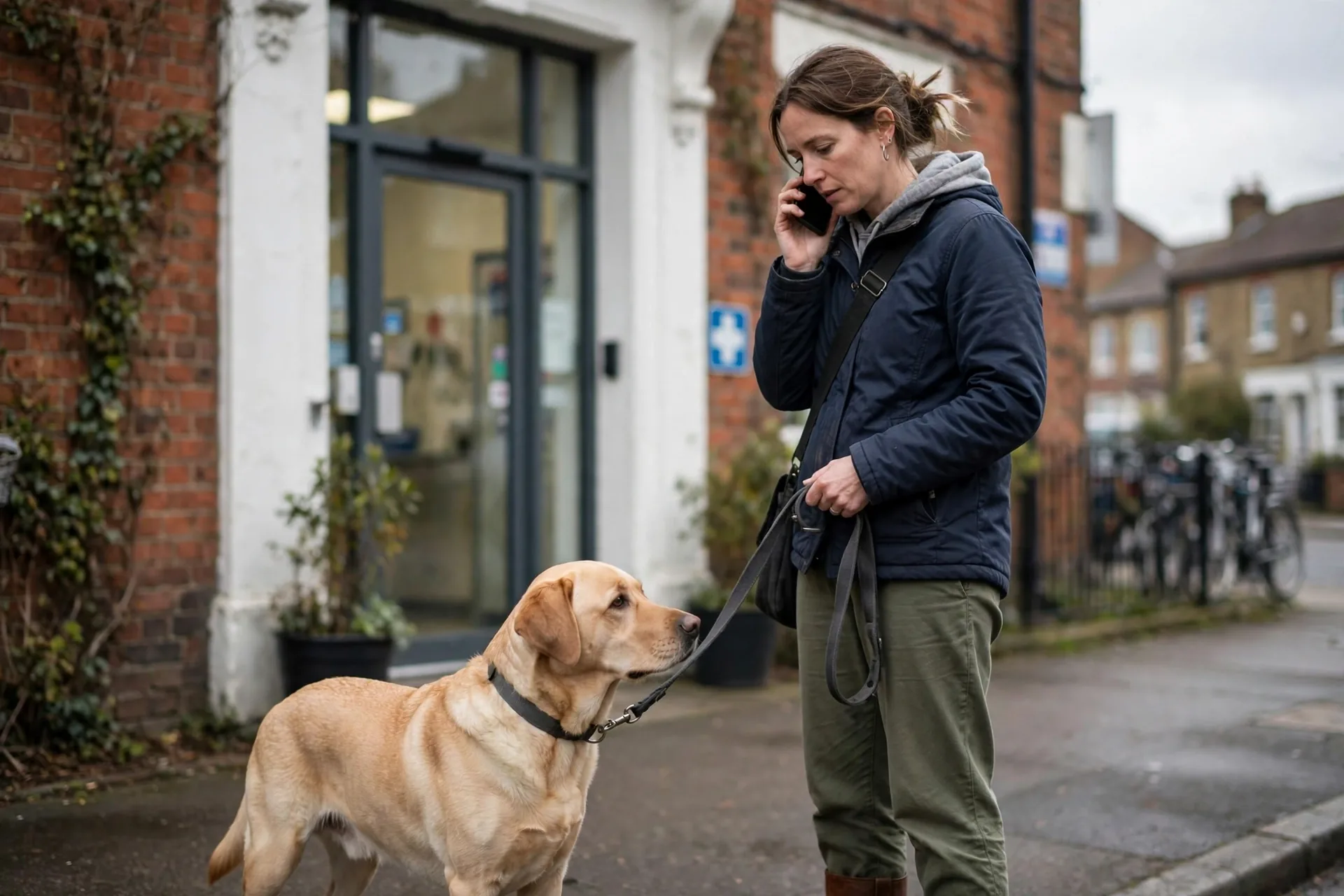
Find the holiday vet before you travel, not when you need one. Search for the nearest practice to your accommodation and check its opening hours, then find the dedicated emergency or out-of-hours provider for that area — rural practices often hand over to a regional emergency clinic twenty or thirty minutes away after closing. Save both numbers in your phone and write them on a card in the folder. Our emergency vet guide explains how to spot a true emergency, what to say when you call ahead, and how costs and insurance work at the practice door.
Add the details that make a call productive. A vet who has never seen your dog needs the breed, age, weight, current medication with dosages, known allergies, and the insurance policy number — all of which are elsewhere in this folder. Tell the practice at booking if your dog needs special handling, such as a muzzle for examinations or a fear-free approach; it is written in the notes before arrival rather than discovered in the consult room. If anyone else will be with the dog during the trip, make sure they have the same card, not just you.
Booking confirmations and the pet-policy screenshot
The booking confirmation is your proof that the dog is part of the deal. Check that it names the dog — or at least the number of dogs — shows any pet fee as paid or itemised, and states the correct dates and accommodation type. If you booked by phone, ask for written confirmation by email; a verbal “yes, dogs are fine” is worth nothing at a reception desk staffed by someone who was not on that call.
Screenshot the pet policy on the day you book. Policies change: the page that said two dogs welcome when you booked may say one dog maximum by the time you arrive, and the version that governs your stay is the one you agreed to. Save the screenshot with the date visible, and keep the confirmation email alongside it. Also capture the practical arrival details — check-in window, key-box code location, parking instructions, and the property's contact number — because these live on the same pages and are equally annoying to hunt for in a layby with no signal.
Note any conditions you agreed to. Common ones include dogs not left unattended in the accommodation, dogs kept on leads in shared grounds, and extra cleaning charges for excessive mess. Knowing them in advance means you can plan around them — booking the terrace table rather than the restaurant, or packing the crate — instead of discovering them in the welcome pack. If the confirmation and the website contradict each other, email the property before you travel and keep the reply; the written answer wins.
Paper, phone and cloud: the triple backup system
One copy of anything important is a hope, not a system. Documents get wet, phones run out of battery, and rural signal disappears exactly when you need to open an email. The reliable setup has three layers, each covering the failure of the others.
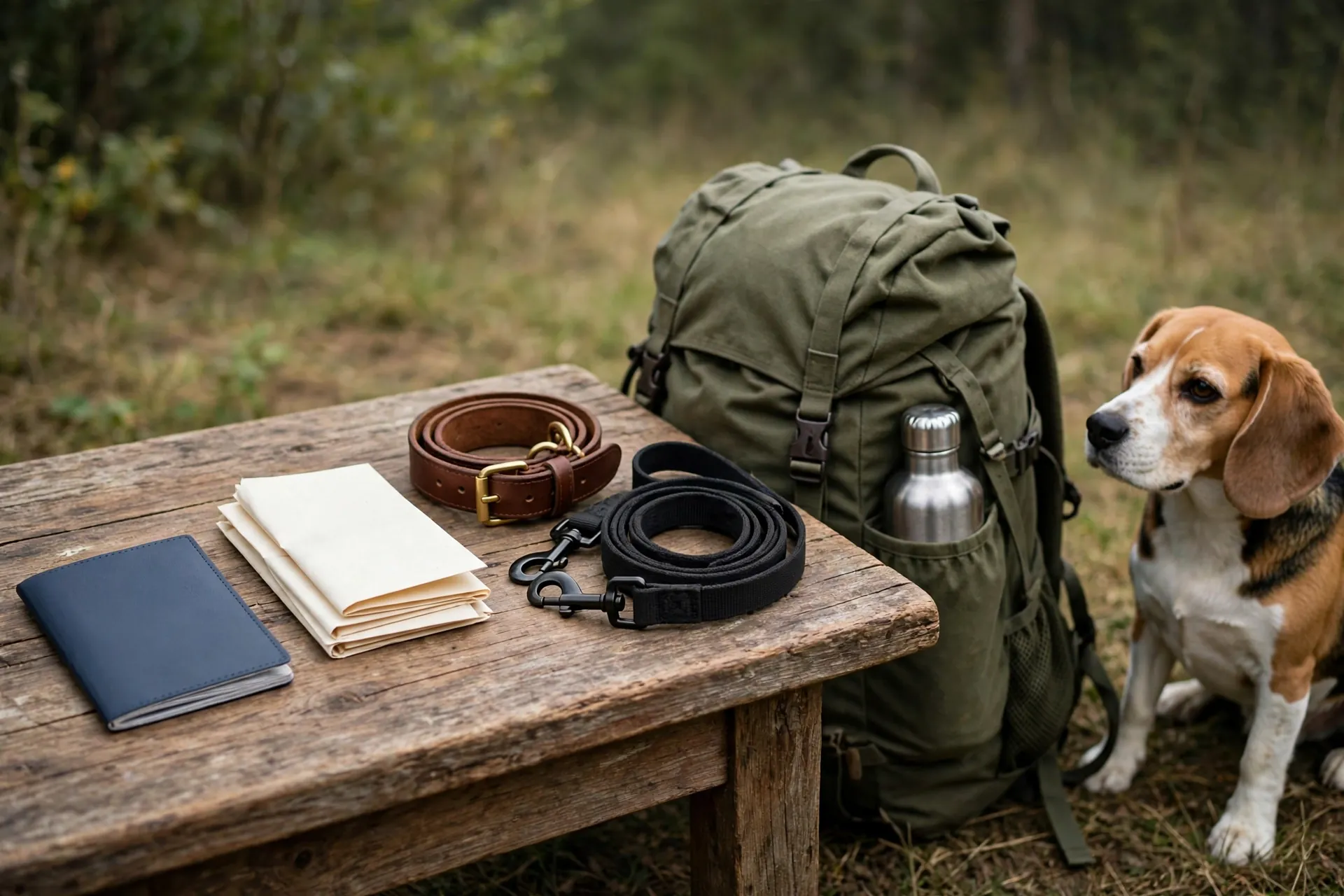
Layer one is paper originals in a waterproof pouch. The vaccination book, the signed authorisation letter, the printed insurance summary and the booking confirmation live here. Paper works with no battery, no signal and no password, and some providers and officials specifically want to see an original with a stamp on it. Keep the pouch in the same bag every trip — the travel folder becomes a habit, not a packing decision.
Layer two is the phone. Photograph or scan every document into one dedicated album — call it “Dog travel” — so it is findable without scrolling through holiday photos. Include the microchip registration screenshot, the pet policy screenshot, the recent photo of your dog, and the vet contact cards. Make sure at least one other person on the trip has the key photos too, because the phone with everything on it is the one that gets left in the cottage.
Layer three is the cloud. Email the full set to yourself, or save it in whatever cloud storage you already use, before you leave home. This is the layer that rescues the other two: a lost folder and a dead phone are both survivable if the documents exist online. It also speeds up every replacement process below, because you can forward the exact policy number or chip number to whoever needs it instead of guessing.
One caution: keep the cloud set in a private account, not a shared family album, since it contains your phone number, address and insurance details. And when the trip is over, the folder goes back on its shelf — but the phone album stays, because the next trip starts from the same set.
Cross-border extras: when the trip leaves Great Britain
Everything above covers travel within Great Britain. If the journey crosses a border — to the EU, or between Great Britain and Northern Ireland — extra paperwork applies, and the rules in this area change often enough that you should check the official guidance before you travel rather than relying on any guide, including this one.
For travel from Great Britain to the EU, dogs currently need an Animal Health Certificate issued by an official veterinarian, normally within ten days before travel. The certificate is per trip rather than per dog lifetime, and it requires the dog to be microchipped and vaccinated against rabies, with the vaccination given at least the required waiting period before travel. Keep the original certificate in the pouch — never in checked luggage — and keep a phone photo of every page. Returning to Great Britain adds a tapeworm treatment, which must be given by a vet a set number of days before entry and recorded in the certificate or passport.
An EU-issued pet passport is the alternative for frequent travellers: if your dog holds one issued in the EU, it can be used for onward travel instead of a fresh certificate each time. The passport must be correctly completed and kept current, and the same rabies and tapeworm rules apply. Whichever document you use, check the expiry and the recorded treatments well before the travel date — discovering a lapsed rabies entry at the port is not fixable there.
Travel between Great Britain and Northern Ireland has had its own changing regime in recent years, with different documentation and declaration requirements introduced and adjusted more than once. Do not assume the EU rules and the Northern Ireland rules are the same, and do not rely on what a friend did last year. Check the current official guidance for your specific route a month before travel, because this is the paperwork with the longest lead time to fix.
When documents go missing: the replacement playbook
Even a good system loses things. The difference between a lost document and a ruined trip is knowing exactly who to call, which is why the replacement routes below are worth reading before you need them.
A lost vaccination book is the easiest to fix: your home practice holds the full vaccination history and can issue a replacement record, often the same day if you call during opening hours. This is one of the reasons the home vet's number is in the folder — the practice that vaccinated the dog is the practice that can re-certify it.
Microchip details are recovered through the database company, not the vet. Keep the company's name in your phone contacts; with your name, address and the dog's details they can confirm the chip number and update the phone number on the spot. If you cannot remember which database holds the record, your vet can scan the chip and identify the company from the number format.
Insurance documents are replaced through the insurer's app, website or helpline — the policy number from your cloud backup makes this a five-minute call. For a lost Animal Health Certificate abroad, contact the official veterinarian who issued it; they hold the records and can advise whether a duplicate or a new certificate is required, and your phone photo of the certificate speeds the whole process up. Booking confirmations and policy screenshots live in your email and cloud album already, which is the entire point of layer three.
The pattern is consistent: every replacement is faster with the cloud backup and the right phone number. The folder's real job is not just holding paper — it is holding the map to every replacement.
The two-round check: seven days out and one day out
Document preparation fails in two ways: things that take time to fix are left too late, and things that are ready get forgotten on the shelf. Two rounds, a week apart, defeat both.
Seven days out is the fixing round. Log in to the microchip database and confirm the phone number. Check booster due dates against the trip dates and call the vet if anything lapses mid-trip. Order anything missing — a replacement vaccination book, a printed insurance summary, the authorisation letter signed. Find and save the holiday vet's numbers. Screenshot the pet policy and check the booking confirmation names the dog. If the trip crosses a border, verify the Animal Health Certificate appointment or passport entries now, because this is the paperwork with the longest lead time.
One day out is the packing round. Run down the master checklist table at the top of this guide and tick every row. Put the waterproof pouch by the door with the leads, not buried in a bag you will pack at midnight. Charge the phone, confirm the “Dog travel” album is complete, and check the cloud backup exists. Make sure everyone travelling with the dog knows where the folder is and what the authorisation letter says.
Then enjoy the trip. The whole point of this checklist is that paperwork becomes a ten-minute routine twice per holiday, instead of a crisis at the worst possible moment.
Practical questions
Before you go
Do I legally have to carry my dog's documents on a UK holiday?
There is no general legal requirement to carry papers when travelling with a dog inside Great Britain, but microchipping is compulsory and the registered details must be kept up to date. In practice, holiday parks, kennels, daycare providers and some activity operators ask to see vaccination records at check-in, so carrying them avoids a difficult conversation on arrival. Think of the folder as optional in law and essential in practice.
Is the microchip itself enough, or do I need the registration paperwork?
The chip is only useful if the number is registered to you with current contact details. Carry the database confirmation — an email, letter or app screenshot showing the chip number and your name — because a scanned chip with an unregistered or outdated record can delay a reunion by days. Log into the database before you travel and confirm the phone number listed is the one you carry on the trip.
What should I do if my dog's Animal Health Certificate is lost before returning to the UK?
Contact the official veterinarian who issued the certificate as soon as possible; they hold the records and can advise whether a replacement or a new certificate is needed. An Animal Health Certificate is issued per trip, so a fresh one from a local official veterinarian may be the fastest route if you are already abroad. Keep a photo of the certificate on your phone so the vet can locate the record quickly, and check the official guidance before you travel in case rules have changed.
Should I carry original documents or are copies enough?
Carry originals of the vaccination record and any cross-border paperwork such as the Animal Health Certificate, because some providers and border officials want to see the stamped original. For everything else — insurance summaries, booking confirmations, vet contact cards — a clear phone photo plus a cloud backup is usually accepted. The practical answer is both: originals in a waterproof pouch, and a full digital set in a dedicated phone album as insurance against loss.
What documents does a holiday park actually ask to see at check-in?
The most common requests are the booking confirmation showing the dog is registered on the booking, proof of current vaccinations, and occasionally evidence of flea and worming treatment. Some parks also ask about pet insurance, though few demand the policy itself. Screenshot the pet policy from the park's website at booking time as well, because policies are updated and the version you agreed to is the one that matters.
Can a family member authorise veterinary treatment for my dog if I cannot be reached?
Most practices will treat an emergency first and sort out consent afterwards, but for anything beyond immediate first aid they need the owner's consent — and a bill has to be paid by someone. A short signed authorisation letter naming the person with your dog, stating they may consent to treatment up to a stated spending limit, removes the delay. Include your phone number and your insurer's claims line so the practice can reach you directly.