This guide is independent and contains no paid placement. If affiliate links are added later, they will be clearly marked and will not change our editorial checks.
A squeeze bottle with a flip-out drinking tray suits most British walkers and most dogs. Carry 500 ml for a medium dog on a two-hour walk in mild weather, more in heat or on long routes, and offer water every 20 to 30 minutes rather than waiting for heavy panting. Buy for a watertight seal and one-handed operation first; style is secondary.
Start with heat: the signs that come first
Dehydration and heatstroke are the two reasons a water bottle matters more than any other piece of walking kit. Dogs lose heat almost entirely through panting, and panting loses water — a lot of it. On a brisk uphill walk with a rucksack of kit and a dog pulling towards every interesting smell, your dog can be running a water deficit long before they look tired. Waiting until the dog is lying in the shade panting hard means you are already behind.
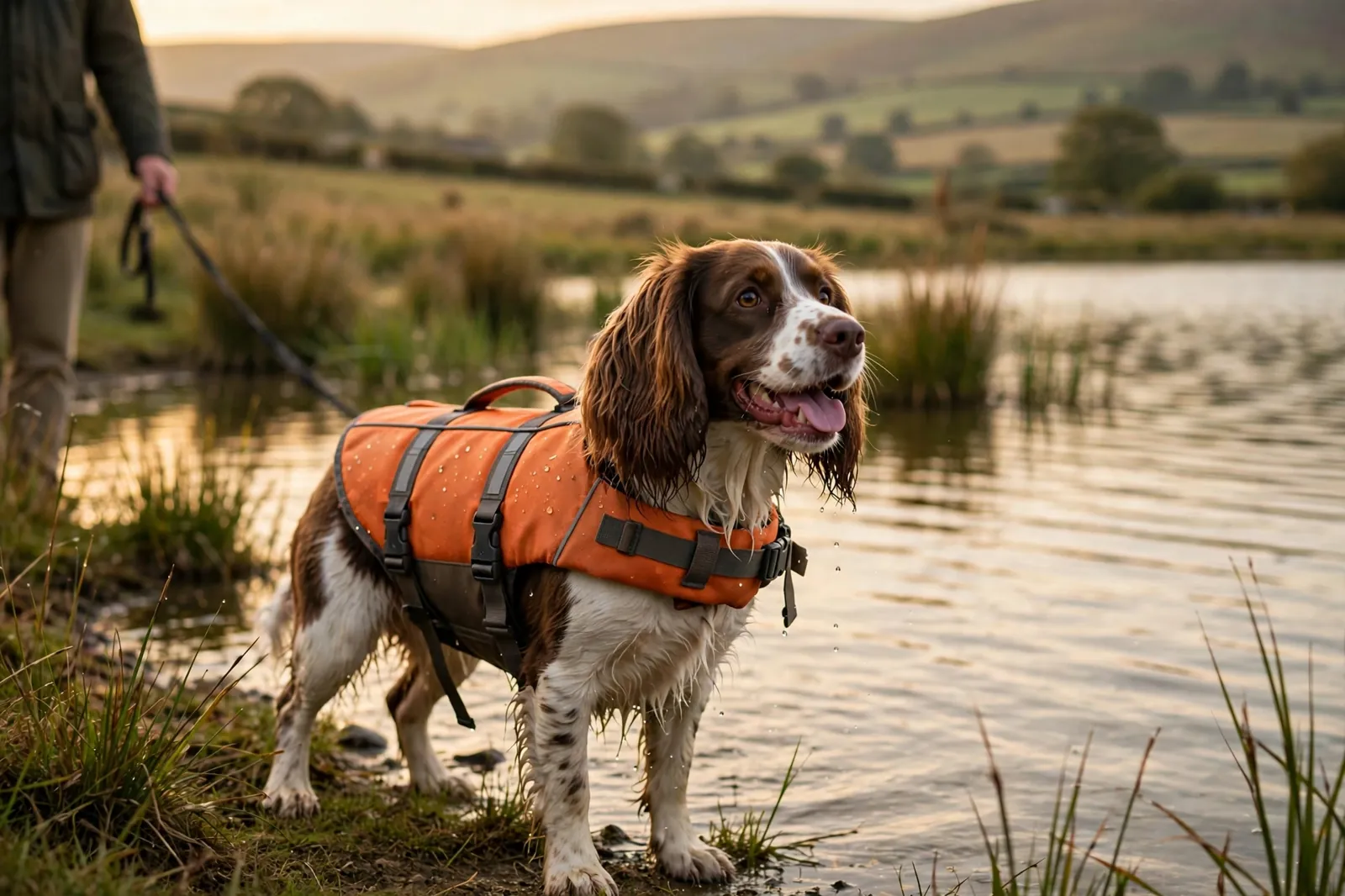
Learn the early warnings. Excessive, rapid panting that does not settle quickly when the dog stops is the first sign. Thick, sticky drool, a glazed or unfocused look, and gums that are dry to the touch or an unusual bright red all mean the dog needs water and shade now, not at the next planned stop. Vomiting, wobbling, disorientation or collapse are emergencies: cool the dog with tepid water (never ice-cold), get them into shade, and call a vet. Dogs do not have to be in blazing sunshine to overheat — a humid July day on a sheltered valley path, or an unseasonal warm spell in April, catches out owners every year.
Some dogs are at higher risk and need more frequent water stops. Flat-faced breeds such as bulldogs and pugs cool themselves inefficiently; very young puppies, older dogs, overweight dogs and any dog with heart or breathing problems are all more vulnerable. Dark-coated dogs absorb more solar heat. If your dog falls into any of these groups, halve the intervals below: offer water every 10 to 15 minutes in warm weather and plan your route around shade and known water sources rather than hoping one appears.
It is worth understanding why a water stop beats a puddle. Dogs will happily drink from ditches, stagnant ponds and farm troughs, but that water can carry blue-green algae toxins, sheep-drench chemicals and other contaminants that clean tap water does not. A bottle of fresh water is both hydration and an excuse to walk past the risky green pond. Train the habit on every walk and the dog learns that the bottle means a drink is coming, which makes them easier to call away from water you do not trust.
The three designs, honestly compared
Almost every portable dog water bottle sold in the UK falls into one of three designs. They differ in how the water reaches the dog, how much spills, how easy they are to clean, and how quickly you can operate them while holding a lead. None is perfect; the best one is the one that fits your dog's size, your walking style and your patience for fiddly parts.
1. Squeeze bottle with a flip-out tray
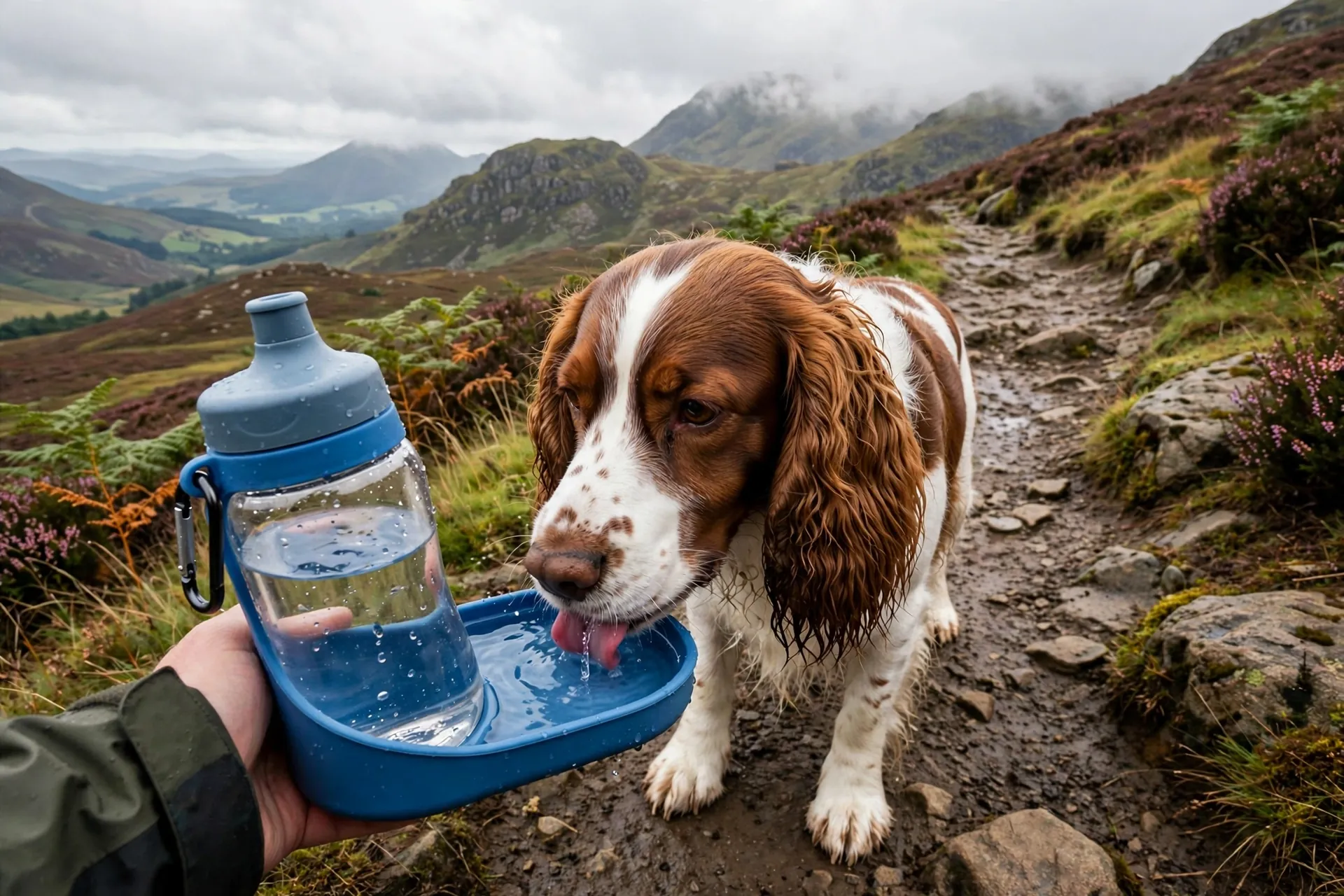
This is the design most walkers picture: a plastic bottle with a trough or tray folded against its side. You flip the tray out, squeeze the bottle, and water flows up into the tray for the dog to lap. Release the squeeze and the flow stops. It is the lightest option, usually the cheapest, and by far the easiest to find in high-street outdoor shops and pet aisles.
The strengths are practical: one-handed operation once you have the knack, a drinking surface a nervous dog can see and sniff before committing, and compact packing when the tray folds flat. The weaknesses are the seal and the hinge. The tray joint is the first place to leak, especially on cheap models where the silicone gasket wears or the locking catch weakens after a few months in a rucksack. Larger dogs with broad muzzles can find narrow trays awkward — watch a mastiff try to fit a dinner-plate nose into a soup-spoon tray and you will see why tray size matters. Some models claim unused water drains back into the bottle; in practice this only works cleanly on designs with a proper two-way valve, and as the FAQ below explains, it is a habit best avoided for hygiene reasons.
2. Wide-mouth bottle plus a separate collapsible bowl
The simplest system of all: a normal screw-top bottle (or any bottle you already own) and a silicone bowl that folds flat in a pocket. At a water stop you unfold the bowl and pour. Nothing about this design can surprise you, because there are almost no moving parts to fail.
This combination wins on cleaning and on dog acceptance. A collapsible silicone bowl rinses clean in seconds, has no valve or hinge to harbour biofilm, and presents the dog with an open bowl — the shape almost every dog already understands. It also lets you pour as much or as little as the dog wants, with the bowl doing the holding. The costs are convenience and bulk: you are carrying two items, you need a free hand to pour, and the folded bowl, though slim, is one more thing to remember. For multi-dog households this system scales well — one large bottle and a bowl each — and for fussy dogs that distrust tray bottles, it is often the design that finally works. The silicone bowl doubles as a food bowl at lunch, which no tray bottle can claim.
3. Trigger or sports-cap squeeze bottle
These borrow the design of human sports bottles: squeeze or press and a stream of water comes from a spout or a small dish built into the cap. Some have a tiny integrated cup; others are meant to be aimed at the dog's mouth or poured into a cupped hand. They look sleek and they pack well, but this is the design with the most divided opinions among walkers.
The problem is geometry. Dogs do not drink from streams the way people do; they lap. A jet aimed at the muzzle mostly wets the chin, and dogs that will not hold still while you fiddle with a spout end up half-drunk and half-wet. Models with a small attached cup work better, but the cup is often too small for medium and large dogs, meaning repeated squeezes per drink. Where this design earns its place is with small dogs that drink delicately, and with owners who want the lightest possible bottle clipped to a belt for short local walks. If you go this route, choose a model with a lockable cap — an unlocked sports spout in a rucksack will empty itself into your spare socks.
One category to treat with caution is the "all-in-one" bottle with built-in food storage. The idea of water below and kibble above sounds clever until the food compartment traps crumbs against the seal, the extra bulk makes the bottle unwieldy in one hand, and the dog never needed its water and its lunch in the same object. Separate containers, each doing one job well, beat a compromised gadget on almost every walk.
Material matters across all three designs. Food-grade, BPA-free plastic dominates the market: it is light, affordable and available everywhere. Stainless steel bottles are heavier and pricier but resist the internal scratching where bacteria settle, keep water cooler on hot days, and survive years of being dropped on rocks. Silicone parts — bowls, seals, folding trays — are generally dishwasher-safe and withstand more abuse than hard plastic. Whatever you choose, avoid bottles with narrow necks you cannot fit a brush into; if you cannot reach the inside, you cannot clean it, and an uncleanable bottle is a disposable one.
How much water your dog actually needs
The bottle is only half the answer; the other half is knowing when to stop and offer it. A widely used veterinary rule of thumb is that a dog needs roughly 50 to 60 ml of water per kilogram of body weight per day at rest. A 20 kg spaniel therefore needs about a litre a day just living quietly at home. Walking uphill in warm weather pushes that well above the resting figure, because panting is water leaving the body with every breath.
Translating that into bottle sizes gives a practical starting point. For dogs under 10 kg — terriers, dachshunds, small cockapoos — a 350 to 500 ml bottle usually covers a walk of one to two hours. Medium dogs of 10 to 25 kg, which covers most spaniels, border collies and staffies, want 500 to 750 ml for the same length of walk. Large dogs of 25 to 40 kg — Labradors, German shepherds, standard poodles — realistically need 750 ml to a litre, and giant breeds of 40 kg and above can empty a litre bottle on a single warm afternoon. If you are choosing between two sizes, take the larger one: the weight penalty of an extra 250 ml of water is trivial, and the penalty of running dry on a ridge with no streams is not.
Walk length changes the maths more than most people expect. On a local loop of under an hour in cool weather, a half-full bottle as backup is plenty — the dog will probably drink at home afterwards. Two to three hours on mixed terrain is where carrying water becomes non-negotiable: offer small amounts every 20 to 30 minutes rather than one big drink at the end, because a hot dog offered a full bowl will gulp, and gulping large volumes quickly can cause vomiting or, in deep-chested breeds, raise the risk of bloat. On full-day routes of five hours or more, think in terms of a litre per medium-to-large dog as a minimum, topped up from trustworthy sources — farm taps where permission is given, village shops, or cafés that fill bottles — rather than gambling on streams. Streams in summer can be low, fenced off for livestock, or carrying the algal risks mentioned above.
Weather is the great multiplier. As a rough guide, add half as much again on warm days (above about 22°C) and double the frequency of stops rather than the size of each drink. Puppies dehydrate faster than adults because of their higher surface-area-to-weight ratio and their habit of charging about; older dogs may drink less readily but need it just as much, so offer on a schedule rather than waiting for them to ask. Nursing bitches and dogs recovering from illness need veterinary guidance rather than a walker's guess — check the official guidance before you travel if your dog has a health condition.
One habit worth building is the pre-walk top-up. A dog that drinks well at home before leaving starts the walk hydrated, which delays the point where the bottle becomes essential. Keep a full bowl available for an hour before you set off, and plan the first water stop at around 30 minutes rather than pushing to an hour because "we only just left". Dogs are terrible at pacing themselves; that is the owner's job.
What to check before you buy
With the design and size settled, the remaining checks separate a bottle that lasts three seasons from one that lives in the back of a drawer. Run through these before you spend money, whether in a shop or scrolling reviews.
- The seal, tested not promised. Fill the bottle, close it as you would on a walk, and leave it upside down in the sink for an hour. Any dampness around the tray hinge, the cap or the valve means it will leak inside your rucksack — and water finds its way into packed lunches with depressing reliability. Silicone gaskets seal better than hard-plastic-on-plastic joins, and a bottle with a replaceable seal ring will outlast one where the seal is moulded in.
- One-handed operation. On the trail one hand holds the lead. Flip the tray, squeeze, and lock it again with a single hand before you buy, or practice the motion the day it arrives and return it if it needs two hands and a flat surface. A bottle you cannot use while managing a pulling dog is a bottle you will stop carrying.
- Tray or bowl size against your dog's muzzle. Narrow trays frustrate broad-muzzled breeds and spill-prone drinkers. If you cannot test with your dog in the shop, measure: the drinking surface should be at least as wide as the dog's muzzle. This single check eliminates most of the bad reviews online.
- Mouth width for cleaning. If a standard bottle brush cannot reach the bottom, or the tray assembly does not come apart, walk away. Residue you cannot reach becomes biofilm you cannot remove, and biofilm becomes a bottle the dog sniffs and refuses.
- Materials and certifications. Look for food-grade, BPA-free plastic or 304-grade stainless steel. Vague claims like "eco plastic" or "safe materials" without specifics are marketing, not assurance. Avoid strong chemical smells on unboxing — a new bottle should smell of nothing.
- Carry options. A strap long enough to sling over a shoulder, a carabiner loop for a belt or rucksack, or a shape that fits a standard bottle cage all make the bottle more likely to come on the walk. The best bottle in the world does no good left by the front door because it was awkward to carry.
- Spare parts. Valves, seals and tray hinges are wear items. Brands that sell replacements are telling you the product is meant to last; brands that do not are telling you it is meant to be re-bought.
Price is a weak guide to quality here. Some of the cheapest tray bottles are perfectly serviceable, while some premium designs add features — built-in poo-bag dispensers, LED lights, food compartments — that complicate the core job of delivering water. Spend for seal quality, materials and cleanability, not for gadgets. If the product page shows the bottle surviving a drop onto concrete, that is a more useful claim than a list of colourways.
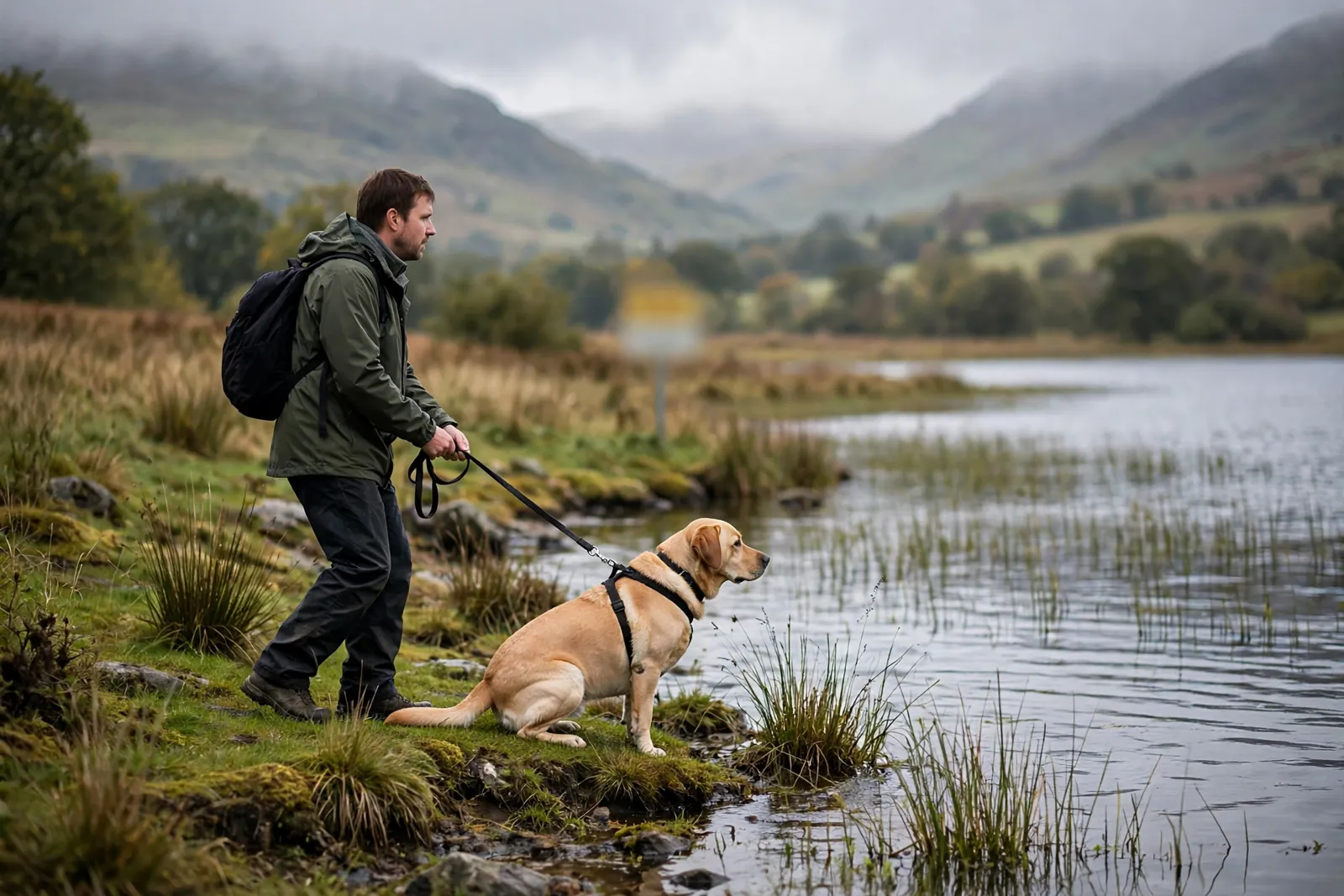
Finally, consider having two. A small tray bottle for short local walks and a larger bottle-plus-bowl setup for hill days covers more situations than one compromise bottle, and a spare in the car means a forgotten bottle does not cancel the walk. Our broader dog water safety guide covers what to do when the walk ends at a river or lake instead of the car park.
Summer rules and winter rules
The same bottle needs different handling in August and in January. Summer is the obvious season: dogs overheat faster than people expect, and British walkers are regularly caught out by the first hot spell of the year because the dog has not acclimatised either. On days above about 22°C, offer water every 15 to 20 minutes and plan shade stops — a wall, a tree line, a bridge — rather than marching through the midday heat. Water in the bottle warms up fast in a black rucksack in the sun; an insulated bottle or a light-coloured cover keeps it palatable, and dogs will reject water that is uncomfortably warm, so check it before offering.
Do not try to be clever with temperature. Tepid water cools a dog fine; ice-cold water poured over a panting dog can cause shock, and gulping very cold water on a hot stomach often comes straight back up. The classic car rule belongs here too: no bottle excuses leaving a dog in a car, because a car's interior can reach lethal temperatures in minutes even on a mild day, and a bottle cannot fix that. If the walk involves a drive at either end, the dog travels with ventilation and never waits alone in the vehicle.
Winter brings the opposite trap: assuming the dog does not need water because it is cold. Cold dry air still pulls moisture from panting lungs, and dogs working hard through snow or frost lose water all the same. The difference is that the bottle itself freezes — a half-frozen bottle with an icy valve is useless when you need it. Carry the bottle inside your jacket or in an insulated sleeve rather than in an outer rucksack pocket, and check the valve flows before the first stop. Snow is not a water substitute: eating snow lowers the dog's core temperature and can carry grit, salt from treated paths, or antifreeze from roadsides.
Seasonal routes change what the bottle is for. In summer it is the main water source because ponds may be algal and streams low; in winter it is the reliable backup when every puddle is frozen and the tap at the trailhead car park is turned off. Pack the bottle for the season's failure mode, not the season's average, and you will rarely be caught out.
Carrying it on the walk
Where the bottle rides matters almost as much as which bottle it is. The commonest failure is not a bad bottle but a bottle buried at the bottom of a rucksack under the waterproofs, the lunch and the first-aid kit — by the time you excavate it, the water stop is over and the dog has moved on to the interesting puddle. Keep the bottle accessible: an outer mesh pocket, a belt holster, a carabiner clipped to a strap, or a shoulder sling on short walks.
For runners and fast walkers, a belt-mounted bottle beats a rucksack one because it does not bounce and is reachable without stopping. For multi-dog households, one bottle per dog is overkill on short walks but sensible on long ones — two dogs sharing one small tray means one dog waits, and waiting dogs knock trays over. A small dry bag or zip pouch holding the bottle, a spare seal and a pack of poo bags turns the whole water system into one grab-and-go unit by the front door, which is the real secret of actually bringing it every time.
Train the dog to the routine before you need it. At home, offer water from the tray or bowl in the garden a few times so the bottle is familiar, not a strange rattling object produced on a stressful hill in the rain. Dogs that have learned "bottle out means drink" settle faster at stops, and a settled dog drinks more calmly — which means less spilled, less gulped, and fewer upset stomachs on the walk home.
Cleaning and disinfecting routine
A water bottle is a warm, damp, dog-saliva-coated container carried through the countryside: it is a perfect culture medium. The cleaning routine does not need to be elaborate, but it does need to happen. Rinse the bottle and the drinking tray with fresh water after every outing, shake out the excess, and leave everything disassembled to air-dry. Trapped moisture under a closed cap is how the pinkish slime — biofilm, a colony of bacteria — gets its start.
Twice a week in regular use (daily in hot weather), wash properly: warm water, a drop of washing-up liquid, and a bottle brush that reaches the bottom. Take the tray apart if it detaches, and scrub the valve area, the hinge and the silicone seals — the crevices are where residue hides. A monthly deeper clean keeps things fresh: soak the parts in a solution of one part white vinegar to four parts warm water for 20 minutes, scrub, rinse thoroughly and dry. Vinegar handles limescale and mild biofilm; for a bottle that has developed a stubborn smell, a teaspoon of bicarbonate of soda in warm water left overnight usually clears it. Rinse well either way — dogs notice off-tastes and will refuse a bottle that smells of chemicals.
Know when to retire a bottle. Deep scratches inside a plastic bottle are bacterial harbours that no brush can clean; a tray hinge that no longer seals is a leak you cannot fix; a valve that sticks is a frustration that will make you leave the bottle at home. Dishwasher-safe parts can go through a hot cycle, but check the manufacturer's guidance — high heat warps some plastics and ruins silicone seals. And keep the system dog-only: sharing the bottle with human drinking water is unhygienic in both directions, so if you carry your own water, carry it in a separate bottle.
Practical questions
Before you go
How much water should I carry for a two-hour walk with my dog?
For a medium-sized dog (around 20 kg) on a moderate two-hour walk in mild weather, 500 to 750 ml is a sensible starting point, plus a margin for warm days. Small dogs often manage with 350 to 500 ml, while large or very active dogs may need a full litre. Always carry more than you expect to use, because there is no reliable water source on many trails.
Can I pour unused water from the drinking tray back into the bottle?
Only on designs with a genuine two-way valve that lets water flow back, and even then most vets recommend against it. Saliva, food particles and trail dirt collect in the tray, and returning them to the bottle contaminates the clean supply for later in the walk. Treat tray water as single-use: offer it, let the dog drink, and tip the rest away.
Are stainless steel dog water bottles better than plastic ones?
Each has trade-offs. Stainless steel resists scratches where bacteria hide, keeps water cooler in summer and is easier to sanitise, but it is heavier and usually costs more. BPA-free plastic is lighter, cheaper and widely available with tray designs, though it scratches more easily and should be replaced once the inside is worn. For long hot walks, steel wins; for light day walks, plastic is usually fine.
How often should I clean a portable dog water bottle?
Rinse and air-dry it after every outing, and wash it properly with warm soapy water and a bottle brush at least twice a week in regular use — daily in hot weather. Pay attention to the tray, the valve area and any silicone seals, which are the usual biofilm hotspots. If you see pink or orange slime, soak the parts in a vinegar solution and scrub before the next walk.
Is it safe to add electrolytes or water flavouring for dogs?
Do not use human electrolyte drinks, sports drinks or flavoured water: they can contain xylitol (birch sugar), caffeine or far too much salt and sugar for a dog. There are dog-specific rehydration products, but most healthy dogs on ordinary walks do not need them — plain fresh water offered regularly is the right choice. If your dog is ill, recovering or severely dehydrated, speak to a vet rather than improvising.
My dog will not drink from the bottle tray. What helps?
Start at home where the dog is relaxed: pour familiar water into the tray and let them investigate without pressure, rewarding any sniff or sip. Some dogs distrust the movement of the tray or the plastic smell, so try a collapsible bowl with the same water, or let a confident dog demonstrate first. A few days of low-key practice usually solves it; do not force the issue on a hot walk when the dog is already stressed.