This guide is independent and contains no paid placement. If affiliate links are added later, they will be clearly marked and will not change our editorial checks.
Dogs usually want novelty, walks and company; cats usually want territory, routine and quiet. Book a place that accepts both animals by name, zone the car so the cat travels in a carrier and the dog is restrained separately, and give the cat its own room, food, water and litter tray on arrival. Plan the days in three phases — before you leave, on the road, and during the stay — and the trip stops feeling like a compromise.
Plan separately, then combine
Most multi-pet trips go wrong for the same reason: the plan is written for the dog, and the cat is expected to fit around it. The dog gets the walks, the pub garden and the beach, while the cat gets whatever room is left, a bowl moved at the last minute, and a litter tray squeezed behind a door. That imbalance is not a character flaw in either animal. It is a planning flaw, and it is easy to correct once you name it. A dog is a social traveller that generally copes with new places by moving, sniffing and staying close to its people. A cat is a territorial traveller that generally copes with new places by hiding, watching and waiting for the world to become predictable again. Both responses are normal. They simply pull in opposite directions, and a good holiday plan respects both.
Start with two separate briefs, written on two separate pieces of paper or in two separate notes. For the dog, record exercise needs, lead behaviour around other animals, recall, toilet routine, alone-time tolerance, noise sensitivity, and any medication or dietary rule. For the cat, record hiding behaviour, appetite under stress, litter habits, carrier tolerance, reaction to dogs and strangers, and any medication, including whether it needs to be given at a fixed time of day. Then read the two briefs side by side and look for clashes before they happen in a cottage hallway. A dog that needs an hour of open running before breakfast and a cat that needs absolute quiet until mid-morning can both be satisfied, but only if the morning is sequenced deliberately: dog out first while the cat stays in a closed, quiet room, then a calm return, then breakfast in separate places.
The same separation-first logic applies to the relationship between the two animals. Some dogs and cats live together peacefully, share sofas and ignore each other with great dignity. Others tolerate each other at home because home is large, familiar and full of escape routes, and that tolerance may not survive a small holiday cottage, a long car journey and a week of disrupted routine. Be honest about which category yours fall into. If the dog chases the cat at home, even playfully, do not assume a holiday will improve matters. If the cat has never met a dog, or has only met one through a window, do not make a holiday cottage the first introduction. A trip that works for both animals is built on the relationship you actually have, not the one you hope a change of scenery will create.
Once the two briefs are written, merge them into a single day plan with three phases: before you leave, on the road, and during the stay. This three-phase structure is the backbone of the rest of this guide. Before you leave, you sort accommodation, veterinary cover, packing and practice. On the road, you protect the car journey with zoning, breaks and a strict rule about never opening the cat carrier outside a closed vehicle or room. During the stay, you run two routines in parallel: an active routine for the dog and a quiet, predictable routine for the cat, with separate feeding, sleeping and toilet arrangements. When a decision is unclear, ask which phase it belongs to and which animal it serves. If it serves neither, it probably does not need to happen.
Finally, agree the non-negotiables as a household before you book anything. Who walks the dog in the rain while the other person stays with the cat? What happens if the cat refuses to eat for a day? At what point do you cut a trip short? These conversations are much easier at the kitchen table than in a car park at midnight. Write the answers down, even briefly, and keep them with the booking confirmation. A multi-pet holiday is not harder than a single-pet holiday in any mysterious way. It is simply a holiday with twice as many needs to track, and tracking them on paper is what keeps the trip enjoyable for the humans too.
Before you leave: two checklists
The week before departure is when most multi-pet problems are either prevented or created. Begin with health and identification. Both animals should be microchipped, with contact details up to date, and both should wear identification if they normally do so. Check that vaccinations are current and ask your veterinary practice about anything specific to the destination, such as local parasite risks or a cat that becomes travel-sick. If either animal takes regular medication, pack more than you need for the trip, keep it in its original packaging, and note the dose and timing in your phone. If you are unsure about any health requirement, check the official guidance before you travel, and ask your own veterinary practice rather than relying on a general article, including this one.
Next, rehearse the parts of the trip that cannot be improvised. For the cat, that means carrier training. Leave the carrier open at home for days before departure, with a familiar blanket inside and treats placed in it, so the carrier stops being a signal that something unpleasant is about to happen. Take at least one short practice drive, even just around the block, so the first car journey of the holiday is not also the first car journey in months. For the dog, rehearse the car restraint you will actually use, whether that is a harness, a crate or a boot guard, and rehearse settling on a mat in a new room. Dogs that can settle on a mat on command are far easier to manage in a cottage where the cat needs the hallway kept calm.
Book veterinary cover before you need it. Save the number of a veterinary practice near your destination, check its opening hours, and note the nearest out-of-hours service. Rural practices may close early, and a cat that stops eating or a dog that eats something unfamiliar on a walk can both turn into evening problems. Keep both animals' records accessible: microchip numbers, insurance details, medication lists and any known allergies. A single note on your phone, shared with everyone travelling, is enough. This is not pessimism. It is the multi-pet equivalent of packing a phone charger: unremarkable until the moment it matters.
Also confirm the practical details of the booking in writing, twice if necessary. Confirm both animals by species, size and number, confirm the exact room or cottage, confirm any pet fee for each animal, and confirm the rules about leaving animals unattended, using the garden, and cleaning up afterwards. Keep the written reply with your confirmation. Verbal reassurance at the booking stage has a habit of evaporating when a different member of staff is on duty at check-in. If a property cannot confirm both animals in writing, treat that as information, not as a challenge to overcome by turning up and hoping.
Finally, prepare the home end of the trip. If you have houseplants, food left in bowls, or a neighbour feeding other animals, sort those arrangements early so departure day is not a rush. A rushed departure is felt by both animals: the dog picks up on hurried packing and raised voices, and the cat picks up on the carrier appearing suddenly and the house emptying. Pack the animals' bags the night before, load the car in daylight where possible, and keep the morning routine as close to normal as you can. The calmer the departure, the calmer the arrival.
Finding a stay that accepts both
Here is the central scarcity of multi-pet travel in the UK: accommodation that accepts dogs is common, accommodation that accepts cats is much rarer, and accommodation that explicitly accepts both, in the same room or cottage, is rarer still. Many listings use the phrase pet-friendly without specifying which pets they mean, and in practice the word pet often means dog. A cottage that welcomes two Labradors may have no policy for cats at all, and a hotel that allows a cat in principle may only allow it in certain room types, on certain floors, or with a separate charge. The search therefore needs to be slower and more specific than a dog-only search, and the shortlist needs to be longer.
Filter in stages. First, search for places that mention cats explicitly, not just pets or dogs. Then read the pet policy in full, looking for the cat clause: is there a limit on the number of cats, a room restriction, a requirement that the cat stays in a carrier when unattended, or a cleaning charge that applies per animal? Then contact the property directly with a short, specific message naming both animals, their sizes and temperaments, and asking for confirmation of the exact room, the total pet charge, and the rules about leaving the cat alone and using outdoor space. A property that answers all three points clearly is worth more than three properties that reply with a generic welcome.
Room layout matters as much as policy. The ideal multi-pet room or cottage has at least two spaces that can be closed off from each other, so the cat can have a genuine retreat while the dog is elsewhere. A studio flat with a single open room and no internal door is a poor fit, however welcoming the host, because there is nowhere for the cat to retreat and nowhere to separate feeding areas. A two-bedroom cottage, a hotel suite with a separate living area, or a lodge with a bedroom that closes properly will serve you far better. Look at the floor plan, not just the photographs, and ask where the litter tray can go without blocking a walkway or sitting next to the dog's bed. If you are comparing hotels, our guide to dog friendly hotels in the UK explains room types, pet fees and dining rules in detail, and the same questions apply with twice the force when a cat is involved.
Outdoor space needs the same scrutiny. Dogs need a secure garden or a nearby walk, and cats need a room that does not open directly onto a busy road or an unfenced garden where a frightened cat could bolt. Check whether windows open only a crack or can be secured, whether doors self-close, and whether the garden is enclosed. A ground-floor cottage with a garden that the dog can use is convenient, but it also means the cat's room needs a door that stays shut and windows that cannot be pushed open by a determined animal. Balconies deserve special attention: a cat on an unfamiliar balcony is a fall risk, and many properties do not consider this in their pet policy at all.
Charges deserve a line-by-line check. Some properties charge per pet, some per stay, and some charge a higher cleaning fee when a cat is involved because of litter and hair. Ask for the all-in total for both animals, including any refundable deposit, and ask what the deposit covers. Also ask about cancellation terms for a multi-pet booking, because a scarcer room type may have stricter terms. Price is not the only consideration, but a surprise charge at checkout sours a trip that was otherwise going well, and it is entirely avoidable with one email before payment.
Finally, have a backup. Because dual-pet accommodation is scarce, keep a second and third choice warm until the first is confirmed in writing. For peak dates, start months ahead rather than weeks. If your first choice falls through, a backup that you have already checked for cat policy and room layout will save a frantic evening of searching, and it will save the animals from a last-minute compromise that suits neither of them.
On the road: zoning the car
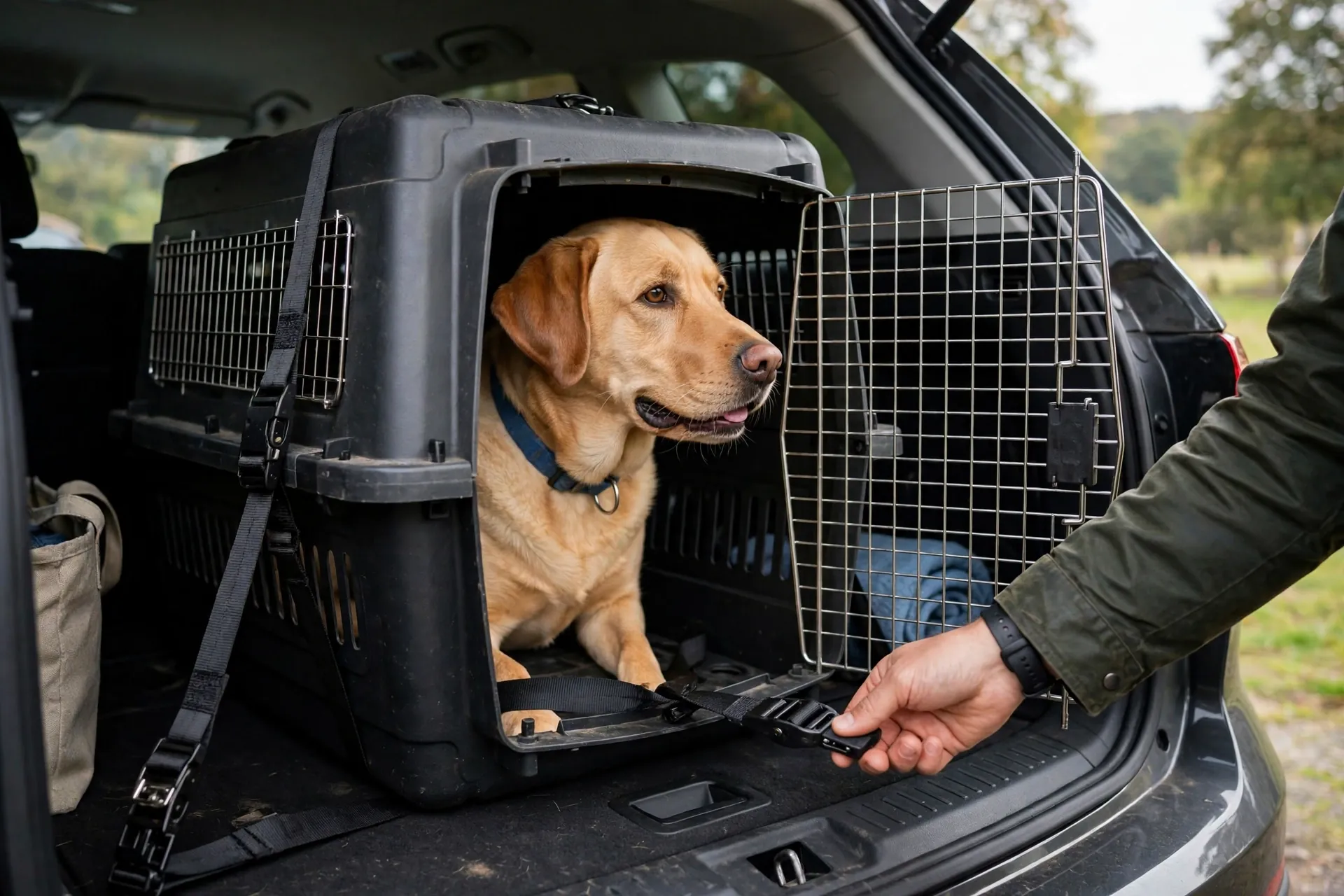
The car journey is the most concentrated part of a multi-pet trip, because two animals with different needs are confined in a small, moving space for hours. The solution is zoning: divide the car into clearly separated areas, assign each animal its own zone, and keep those zones fixed for the whole journey. The cat travels in a secure, well-ventilated carrier, placed on a flat surface and secured so it cannot slide. The dog travels restrained separately, whether by harness, crate or boot guard, in a different part of the car. The two zones should not allow nose-to-nose contact through bars or gaps, because even a friendly dog leaning towards a carrier can terrify a cat that cannot escape.
Carrier choice and placement deserve care. Choose a carrier the cat can stand, turn and lie down in, with a familiar blanket that smells of home and a leak-proof base. Secure it with a seat belt or a strap, on the back seat or in a flat boot area, and cover it lightly with a breathable cloth to reduce visual stimulation. Do not place the carrier in a position where luggage can fall onto it, and do not put it on a seat without securing it. A carrier that slides at the first roundabout teaches the cat that the car is unsafe, and that lesson lasts the whole holiday. For the dog, the equivalent discipline is a restraint that has been fitted and practised at home. Our guide to a dog travel crate in car covers sizing, ventilation and fitting in detail, and the same principle applies here: the restraint must fit the car, fit the animal, and be familiar before departure day.
Plan breaks for the dog, and plan non-breaks for the cat. Dogs need toilet stops, water and a chance to stretch, ideally every two hours on a long journey. Cats, by contrast, generally do best if the journey is kept as short and uninterrupted as possible, and the carrier is never opened outside a closed vehicle or a closed room. That means the break routine is split: one person stays with the car and the cat while the other walks the dog, or the dog is walked at a quiet service area while the cat remains secured in the locked car for a short period in safe weather. Never leave either animal in a car that is too hot, too cold, or unattended for longer than a brief, safe interval, and never open the cat carrier in a car park to offer water. A frightened cat that escapes in an unfamiliar car park is extremely hard to recover, and the risk is not worth the reassurance of a drink that can wait until the next secure stop.
Temperature, noise and smell all matter in the car. Keep the car cool rather than warm, avoid strong air fresheners, and keep the radio or conversation at a normal level rather than silent or loud. Some cats travel better with a pheromone spray applied to the carrier blanket well before departure, following the product instructions, while others show no obvious difference. There is no universal calming product, and any product that sedates an animal should only be used on veterinary advice, with a trial dose at home first. The most reliable calming measures are unglamorous: a familiar blanket, a covered carrier, a smooth driving style, and a driver who is not rushing.
Loading order also helps. Load the cat last, so the carrier spends the least time waiting in a stationary car while bags are packed, and unload the cat first at a secure stop or at the destination, carrying the carrier directly into a closed room before any doors are opened. Keep the dog restrained until the cat is safely inside. This sequence sounds fussy, but it prevents the single most common multi-pet car problem: a door opened at the wrong moment, a dog lunging with excitement, and a cat bolting into an unknown garden. A fixed loading order, repeated every time, turns a risky moment into a routine.
For very long journeys, consider breaking the trip overnight rather than pushing through. An overnight stop doubles the accommodation problem, because the stop must also accept both animals, but it halves the car stress. If you do break the journey, apply the same arrival routine at the overnight stop as at the final destination: cat into a closed room first, litter tray and water set out, dog settled second. A long journey with a calm middle is usually kinder than a shorter journey that ends with two exhausted, overstimulated animals.
Cat stress, hiding places and routine
Cats show stress differently from dogs, and the signs are easy to miss if you are watching the dog. A stressed cat may hide for hours, eat less or not at all, avoid the litter tray, over-groom, or become unusually clingy or unusually withdrawn. None of these signs, on its own, proves a serious problem, but a pattern over a day or more deserves attention. The first response to cat stress on holiday is not to coax the cat out, but to make hiding safe and easy. A cat that can hide properly will usually emerge sooner than a cat that is repeatedly encouraged, lifted or followed.
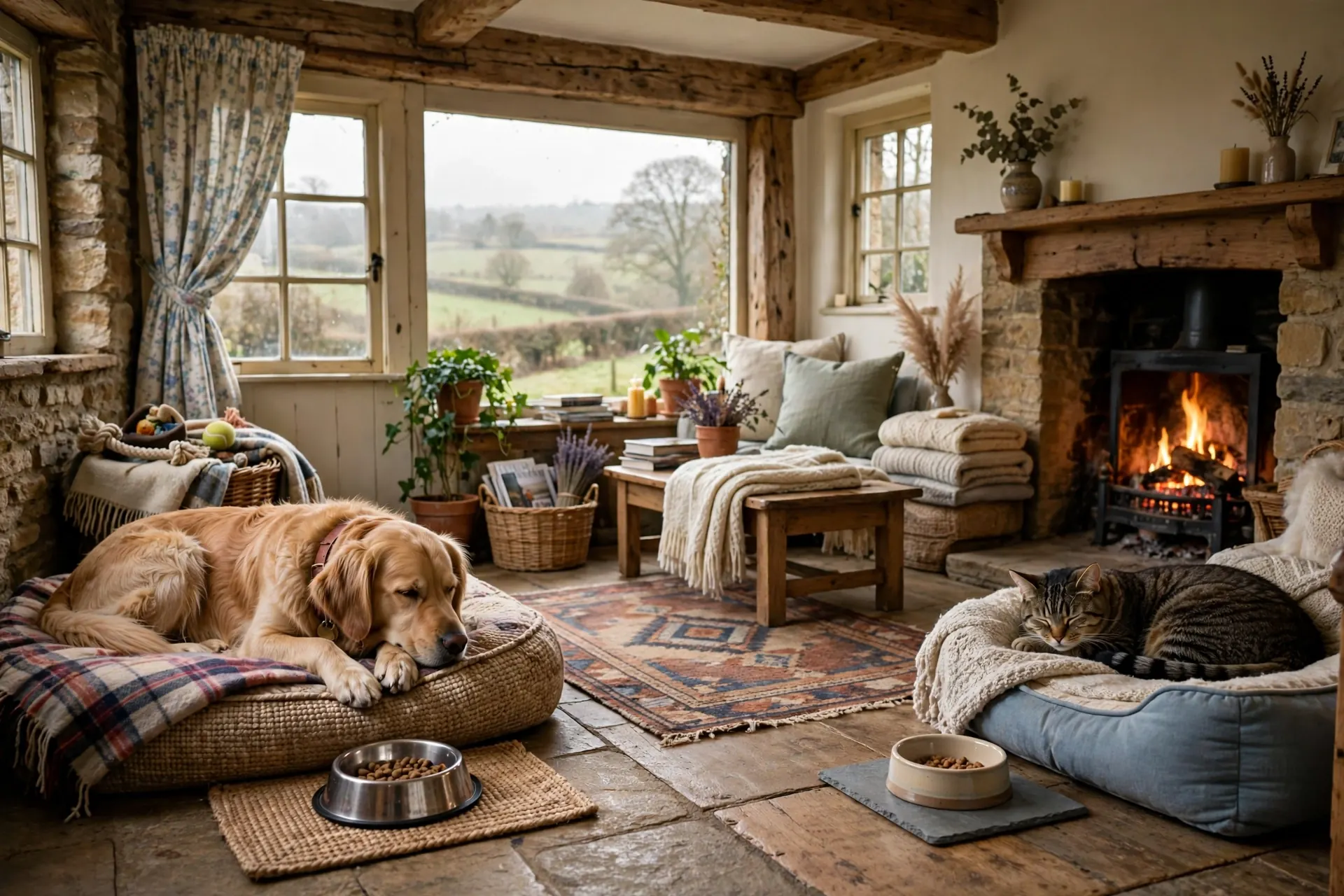
Build the cat a base camp on arrival, before the dog explores the property. Choose a quiet room with a door that closes, preferably away from the entrance and the dog's main area. In that room, set out the litter tray, fresh water, food, a familiar blanket or bed, and at least two hiding options: the carrier with its door open and a cover over it, and a cardboard box or a space under or behind furniture that the cat can reach without crossing open floor. Keep the room as it is for the first hours. Do not rearrange furniture repeatedly, do not invite visitors into the base camp, and do not let the dog wander in to investigate. The cat needs to learn the room's smells, sounds and escape routes before it learns anything else about the property.
Routine is the cat's anchor. Feed at the same times as at home, keep the same food where possible, and change nothing else about the diet during the trip. A new food plus a new place plus a car journey is a recipe for an upset stomach, and an upset stomach in a cat that is already hiding can be hard to monitor. Keep water fresh and in more than one place if the room allows, because some cats drink more readily from a bowl away from their food. Clean the litter tray at least once a day, and keep it in the same place throughout the stay. Cats are creatures of location as much as of habit, and a litter tray that moves every day is a litter tray that may be ignored.
Introduce the rest of the property gradually, and only when the cat is eating, drinking and using the tray normally in its base camp. Open the base camp door for short periods while the dog is out or in another closed room, and let the cat explore at its own pace. Do not carry the cat into new rooms to show it around. Exploration that the cat chooses is reassuring; exploration that is imposed is stressful. If the cat retreats to its base camp, that is success, not failure. The base camp remains available for the whole stay, as a permanent retreat, even after the cat has explored more widely.
Watch appetite and toileting as your main health indicators. A cat that eats nothing for more than a day, that has not used the litter tray, that vomits repeatedly, or that hides without emerging at all for a full day should be assessed by a veterinary practice. Keep the number you saved before departure close at hand, and do not wait until the end of the holiday to call. Most holiday cat problems are minor and resolve with quiet, routine and time, but the ones that need help need it promptly, and a day of watchful waiting is different from a day of hoping the problem will disappear.
Children and visitors need a brief too. Explain that the cat's room is not a playroom, that the cat should not be chased or cornered for a photograph, and that a hiding cat is a cat doing its job, not a cat being rude. This matters more than it sounds, because well-meaning attention is one of the commonest sources of holiday cat stress. A short, friendly explanation at the start of the trip prevents repeated corrections later, and it teaches everyone in the group to read the cat's behaviour rather than their own expectations.
Feeding and litter, kept apart
Feeding two species in one holiday property is a logistics exercise, and the rule is simple: separate everything. Separate bowls, separate places, separate times where possible, and a litter tray that is nowhere near either animal's food. Dogs will eat cat food given half a chance, and cat food is richer and more likely to upset a dog's stomach. Cats, meanwhile, may refuse food placed too close to a dog's bowl, a busy walkway or a washing machine. The feeding plan therefore needs its own map, drawn before arrival, not improvised at the first mealtime.
Set the cat's feeding station inside its base camp, away from the litter tray and away from the door. Cats prefer to eat in a quiet, sheltered spot where they can see the room without feeling exposed, and many will eat more reliably if the bowl is not beside the water bowl. Set the dog's feeding station in a different room, or at the opposite end of a large room with a clear barrier, and feed the animals at the same time so neither is distracted by the other's meal. Remove bowls after a reasonable period, rather than leaving food down all day, because food left down attracts the other animal, attracts insects in warm weather, and makes it harder to tell how much each animal has actually eaten.
The litter tray deserves the same planning as the beds. Place it in the cat's room, away from food and water, in a spot that is accessible at all times, including at night, and that does not require the cat to pass the dog's bed or a busy hallway. If the property has hard floors, put a washable mat under the tray to catch litter, and bring a small dustpan and brush. If the property has carpet, the mat matters even more, because litter tracked across carpet is difficult to clean and may affect a cleaning deposit. Take a spare bag of the cat's usual litter, and do not switch litter type for the holiday. A cat that rejects unfamiliar litter in an unfamiliar room may choose the carpet instead, and that is a problem that is much easier to prevent than to resolve.
Water needs attention too. Dogs drink a lot after walks, especially in warm weather, and a single shared bowl will be emptied, knocked over or guarded. Provide at least two water stations: one in the dog's area and one in the cat's room, plus a portable bottle and bowl for walks and car journeys. Check water bowls morning and evening, and refill them as part of the daily routine rather than waiting until they are empty. In a cottage with hard water or an unfamiliar taste, some cats drink less, so a familiar bowl from home can help. Small details like this sound trivial until a cat that is already stressed stops drinking, and then they matter a great deal.
Store food securely. Keep both animals' food in sealed containers, out of reach, and labelled if the containers look similar. Holiday cottages often have low cupboards, open shelving and gaps behind appliances that a determined dog will explore. A dog that helps itself to a bag of cat food overnight may face a stomach upset the next day, and a cat that finds an open bag of dog treats may eat something unsuitable. Pack enough food for the trip plus a day or two extra, in case of delays, and keep a note of where the nearest pet shop or supermarket is, in case you need to top up. Running out of the cat's usual food in a rural area is a surprisingly common holiday problem, and it is solved by packing a little extra rather than by improvising with a new brand.
Finally, think about treats and rewards. Keep the dog's treats and the cat's treats separate, and be careful about giving the dog a long-lasting chew in a room where the cat is trying to settle. Chewing is noisy, smelly and exciting for the dog, and it can be deeply unsettling for a cat that is already on edge. Save high-value chews for walks or for times when the cat is safely in its own room with the door closed. The feeding plan, like the rest of the trip, works best when each animal can eat, drink and rest without having to negotiate the other animal's presence.
At the destination: one out, one in
The daily rhythm of a multi-pet holiday is best described as one out, one in. While the dog is out on a walk, a beach trip or a pub garden visit, the cat stays in its base camp, undisturbed, with the door closed and the routine intact. While the cat is exploring the property or settling in the evening, the dog is resting, preferably in a different room or on its mat, not patrolling the cat's territory. This rhythm is not a restriction. It is what allows both animals to enjoy the holiday in their own way, without either one spending the week in a state of alert.
Plan dog activities with the cat's absence in mind, not as an afterthought. Choose walks that suit the dog's energy and lead behaviour, check beach and countryside access rules for the season, and carry water, bags and a lead that works for the terrain. If you visit a pub, cafe or attraction, check in advance whether dogs are welcome and whether the visit will be enjoyable for the dog, not merely tolerated. A dog that is welcome but miserable, tied to a table leg in a noisy room, is not having a holiday. The best dog days on a multi-pet trip are often the simplest: a long morning walk, a quiet afternoon rest, and an evening stroll, with the cat's routine undisturbed throughout.
Plan cat time with equal seriousness. The cat's day does not need activities, but it does need protected quiet. Keep the base camp door closed during the busiest parts of the day, avoid vacuuming or rearranging the cat's room unnecessarily, and give the cat access to a window perch or a sunny spot where it can watch the world safely. Play, if the cat wants it, should be short, gentle and on the cat's terms, with a familiar toy rather than a new one. A cat that plays, eats and sleeps in a predictable pattern is a cat that is coping well, even if it never leaves its base camp for the whole trip. That is a successful holiday for a cat, and it should be celebrated as such rather than treated as a disappointment.
Evenings need a plan too. If you go out for dinner, decide in advance what happens to both animals. Many properties do not allow animals to be left unattended, and even where they do, a dog left alone in a new place may bark, while a cat left alone may hide and refuse food. The safer pattern is often to eat in, eat at a dog-friendly venue where the dog can come along, or take turns staying in. If you do leave the animals, leave them in separate rooms, with the dog's needs met first: a walk, a toilet break, water and a settled bed. Leave the cat with its base camp intact and a familiar blanket. Keep the absence as short as you reasonably can, and return to a calm house rather than a noisy reunion that excites the dog and alarms the cat.
Weather changes the rhythm, and British weather will change it often. Rain means the dog needs drying and the cottage needs ventilation, while the cat needs its room kept calm despite wet towels, muddy boots and extra foot traffic. Heat means the dog needs shade, water and shorter walks, while the cat needs a cool room and fresh water, and the car must never be used as a waiting room. Wind and storms may unsettle both animals, and fireworks season can be particularly difficult for noise-sensitive dogs and cats alike. Have a wet-weather and noisy-evening plan ready: a quiet room, a familiar bed, a closed door, and no pressure on either animal to behave as if nothing is happening.
Finally, keep a simple daily check. Each evening, note whether both animals ate, drank, used their toilet arrangements, and rested normally. This takes a minute, and it turns vague worry into concrete information. If a pattern changes, you will spot it early, and if you need to call a veterinary practice, you will have a clear account of what changed and when. A multi-pet holiday is not about constant vigilance. It is about a few small, repeated checks that let everyone else relax.
When things go wrong: conflict handling
Conflict between a dog and a cat on holiday usually follows a pattern: a chase, a cornering, a swat, a frightened retreat, and then a period of avoidance. The immediate response matters more than the explanation. Separate the animals calmly, without shouting, chasing or grabbing either animal in a way that could cause a bite or scratch. Put a door between them, check both for injury, and give each animal space and water. Do not punish either animal after the event. Punishment after a fright does not teach an animal to be calmer next time; it teaches the animal that the other animal's presence predicts trouble.
After separation, let both animals settle before any reintroduction, and do not force a reintroduction the same day if the incident was serious. The cat should return to its base camp, with its familiar smells and hiding places, and the dog should be walked, settled and given a calm activity elsewhere. When you do reintroduce them, do it gradually and at a distance, with the dog on a lead and the cat free to retreat, and end the session before either animal becomes aroused. If the cat chooses not to approach, that is information, not defiance. The goal of reintroduction is not a photograph of the two animals together. It is a household in which both animals can move without fear.
Some conflicts are not about the animals at all, but about the property. A cat that is cornered in a room with no escape route, a dog that guards a doorway, or a feeding station placed in a narrow hallway can all create conflict that would not happen in a better layout. If conflict keeps happening in the same place, change the place before you blame the animals. Move a bowl, open a second exit route, add a hiding box, or keep a door closed that was previously left open. Small layout changes often solve problems that behaviour advice cannot, because they remove the trigger rather than asking the animals to tolerate it.
Know when to change the plan. If chasing is frequent, if the cat stops eating or using the litter tray, if either animal is injured, or if the household is spending the holiday managing conflict rather than enjoying it, the kindest option may be to cut the trip short, move to accommodation with genuinely separate spaces, or arrange for one animal to be cared for elsewhere for the rest of the trip. This is not a failure. It is a responsible decision, and it is easier to make if you discussed it before departure, as suggested earlier. A holiday that ends a day early with both animals safe is a better holiday than a full week that ends with a veterinary visit and a frightened cat.
Also plan for non-animal problems: a property that turns out to be unsuitable, a booking error, a broken lock on the cat's room, or a neighbour's dog in a shared garden. Keep the property's contact details and your booking confirmation accessible, photograph any problem promptly, and raise it calmly and in writing. Most hosts would rather solve a problem early than deal with a complaint later, and a clear, factual message is more effective than a frustrated one. If a property cannot be made safe for both animals, the backup plan you kept warm during booking becomes valuable again.
Finally, keep perspective. A single hiss, a single chase that ends quickly, or a cat that hides for an afternoon is not a disaster. Animals, like people, have bad moments on holiday, especially in new places. The measure of a good multi-pet trip is not the absence of any tension, but the speed and calmness of the response, and the willingness to adjust the plan when the animals tell you, clearly, that it is not working. Listen to them early, adjust early, and the trip will usually recover.
Packing for two species
Packing for two species is an exercise in labelling and separation. Use separate bags or boxes, labelled by animal, so that a tired arrival does not turn into a search through a shared suitcase. The dog's bag should contain food, treats, a lead and harness, a long line if you use one, a mat or bed, towels, a drying coat if you use one, bags, a portable water bowl, any medication, and a familiar toy. The cat's bag should contain food, its usual litter plus a tray if the property does not provide one, a carrier with a familiar blanket, bowls, any medication, a brush if the cat tolerates grooming, and a familiar toy or scratcher. Keep both bags accessible in the car, not buried under luggage, so the arrival routine can start immediately.
Bring spares of the things that are hard to replace in a rural area: the cat's usual food and litter, the dog's usual food, and any medication. Bring cleaning supplies too: a roll of kitchen paper, a pet-safe cleaner, a small dustpan and brush, and spare bedding. Holiday properties vary in what they provide, and a property that provides a dog bed may not provide a cat litter tray, or vice versa. Assume you need to provide everything for both animals, and treat anything the property provides as a bonus rather than a plan.
Documents and numbers should travel with the animals' bags, not in a separate suitcase. Keep microchip numbers, insurance details, veterinary numbers for home and destination, and the property's contact details in a single note on your phone, and share it with everyone travelling. Also keep a photograph of each animal on your phone, in case one goes missing and you need to show neighbours or a local practice what you are looking for. These preparations take minutes and are easy to forget in the excitement of packing, which is why a written checklist, used every time, is worth more than a good memory.
On departure day, do a final check of the property before you leave. Check that the cat's room is as you found it, that the litter tray is clean, that no food has been left in a place the next guest's pet might find, and that the dog's area is tidy. Leave the property in a condition that makes a future multi-pet booking more likely, not less. Hosts remember guests whose animals were well managed, and a good reputation for multi-pet guests helps everyone who travels with two species after you.
When you get home, give both animals time to readjust. The dog may be tired and clingy, the cat may hide for a day or patrol the house as if checking that nothing has changed. Restore the home routine promptly: same feeding times, same beds, same litter tray in the same place. Watch appetite and toileting for a day or two, and keep the veterinary number handy if anything seems off. A calm return home is the last phase of the holiday, and it deserves the same care as the departure. If the trip worked well, note what worked: the property, the room layout, the car zoning, the feeding plan. That note becomes the starting point for the next multi-pet holiday, and the next one will be easier because this one was planned properly.
Practical questions
Before you go
Can a hotel that welcomes dogs also welcome cats?
Not automatically. Many places that welcome dogs have a separate cat policy, a different room type, or no cat policy at all. Always ask about both animals by name, confirm the room type, and get the answer in writing before you pay.
How do I keep a cat calm in the car?
Use a secure carrier the cat already knows, cover it lightly, keep the car cool and quiet, and avoid opening the carrier during the journey. Short practice trips at home, a familiar blanket, and a calm routine help more than any single product.
Should the cat and dog share a room at night?
Only if they already share space peacefully at home and the room allows real separation. Otherwise give the cat a closed room of its own at night, with its litter tray, water and a hiding place, and let the dog sleep elsewhere.
What if my dog chases the cat?
Separate them at once, calmly and without shouting. Put a door between them, check both animals for injury, and do not force a reintroduction the same day. If chasing is a regular pattern at home, choose a stay with genuinely separate rooms or reconsider travelling with both animals together.
How far ahead should I book a stay for two pets?
Book earlier than you would for one pet, especially for school holidays and weekends. Dual-pet rooms and cottages are scarce, so start several months ahead for peak dates and be ready with a shortlist rather than a single favourite.