This guide is independent and contains no paid placement. If affiliate links are added later, they will be clearly marked and will not change our editorial checks.
Measure the dog standing, sitting and lying down, then measure the boot or back seat at its narrowest points. Choose a rigid crate that lets the dog stand, turn and lie flat without sliding around, fix it so it cannot move in braking, and build up car time gradually. Plan breaks at least every two hours.
Start with a tape measure
The most useful tool for choosing a car crate is not a review site. It is a tape measure, a willing dog and five quiet minutes on the kitchen floor. A crate bought by breed label alone is a gamble: two Labradors can differ by several centimetres in height and length, a long-backed dachshund needs a very different shape from a tall, narrow whippet, and a puppy bought for today will outgrow a too-small crate within months. Measure the dog you have, allow for the dog it will become, and only then look at product dimensions.
Take three measurements with the dog standing squarely on a flat floor. First, height from the floor to the top of the head, or to the ear tips for prick-eared breeds, whichever is higher when the dog stands naturally. Second, length from the tip of the nose to the base of the tail, then add a few centimetres so the dog can stretch its neck without pressing against the door. Third, width across the widest point, usually the shoulders or hips. Then watch the dog lie down: a dog that sleeps stretched out needs more floor length than a dog that curls into a tight ball, and a dog that changes position often needs room to turn without climbing over its own bedding.
Translate those numbers into crate dimensions with a simple rule. The crate should be long enough for the dog to lie flat, tall enough for the dog to stand with a few centimetres of headroom, and wide enough for the dog to turn around without effort. It should not be much larger than that. A cavernous crate feels generous to a human shopper, but in a car it gives the dog room to be thrown sideways during braking, to slide on a bend and to build up speed before hitting a wall. Snug is safer, provided snug still means comfortable. If the dog must duck, crouch, fold its legs awkwardly or sleep with its nose against the mesh, the crate is too small.
Next, measure the car, and measure it honestly. Boot openings are almost always smaller than boot interiors, and a crate that fits inside may not pass through the tailgate. Measure the opening width and height, the depth from the tailgate to the back of the rear seats, and the width at the narrowest point, which is often between wheel arches. For a back-seat crate, measure the seat width, the height from seat to roof, and the door opening, because a rigid crate must go in through a door. Write all the numbers down before ordering. Returns are far more annoying than a minute with a tape measure, and a crate that almost fits is a crate that does not fit.
Consider growth, coats and bedding before finalising the size. Puppies grow fast, so check the expected adult size with the breeder or vet and consider a crate with a divider panel that keeps the space snug now and expands later. Thick bedding, a raised crate mat and a travel bed all eat into headroom, so measure with the bedding in place rather than on a bare floor. A dog in a thick winter coat, or one that wears a harness inside the crate, needs the same allowance. If you are between sizes, the larger size is usually right only when the car can hold it securely and the dog still cannot slide far; otherwise, look for a different shape, such as a lower, longer crate designed for a specific boot.
Finally, test the fit in the real car before a long journey. Put the dog in the crate, close the door, and watch for a few minutes. The dog should enter without squeezing, turn without hitting its head, lie down without folding, and settle without constant repositioning. If the crate rocks, the door rattles or the dog immediately tries to escape, something is wrong with size, placement or training, and it is better to find out on the driveway than on the motorway.
Materials, doors and ventilation
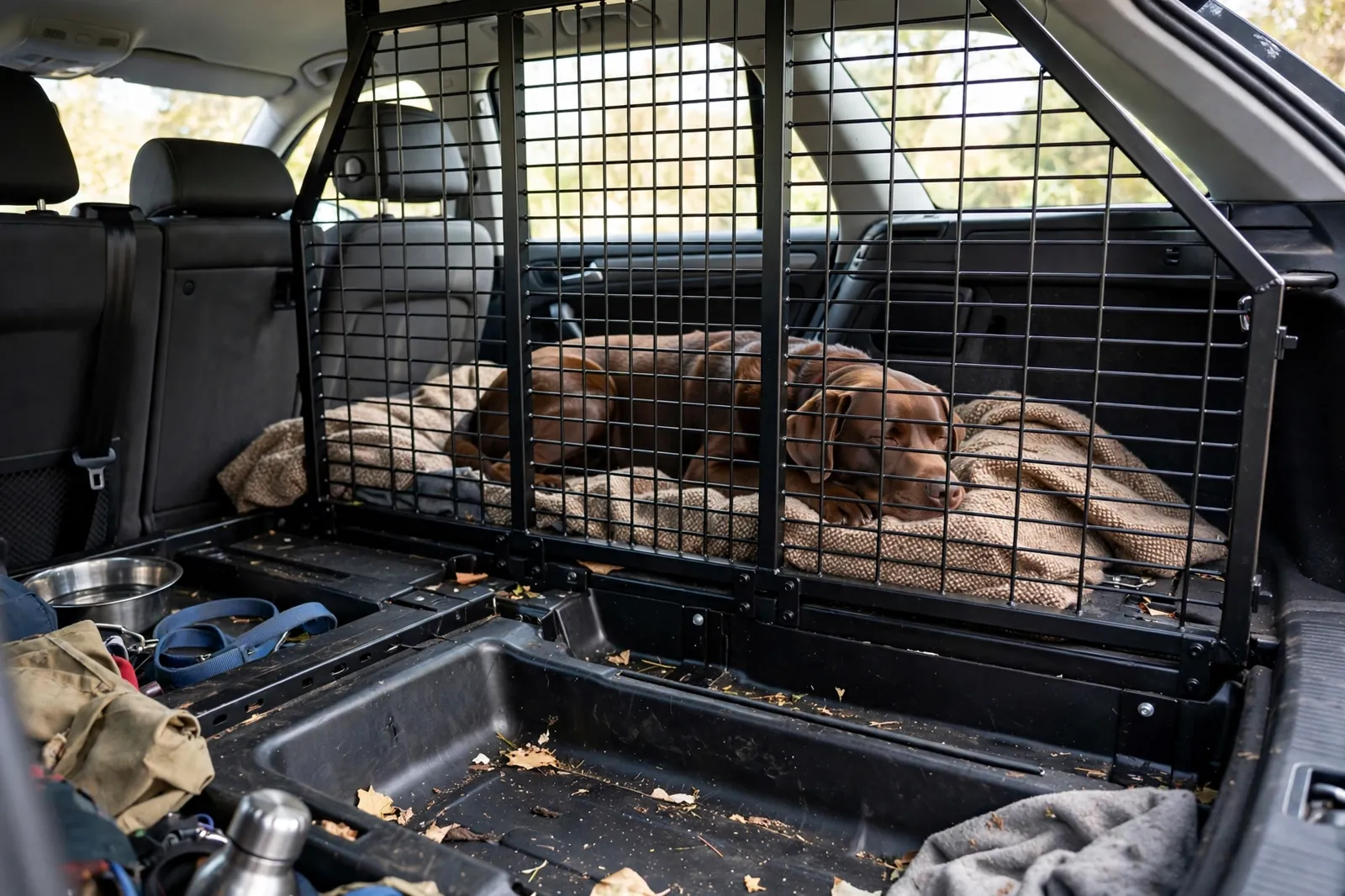
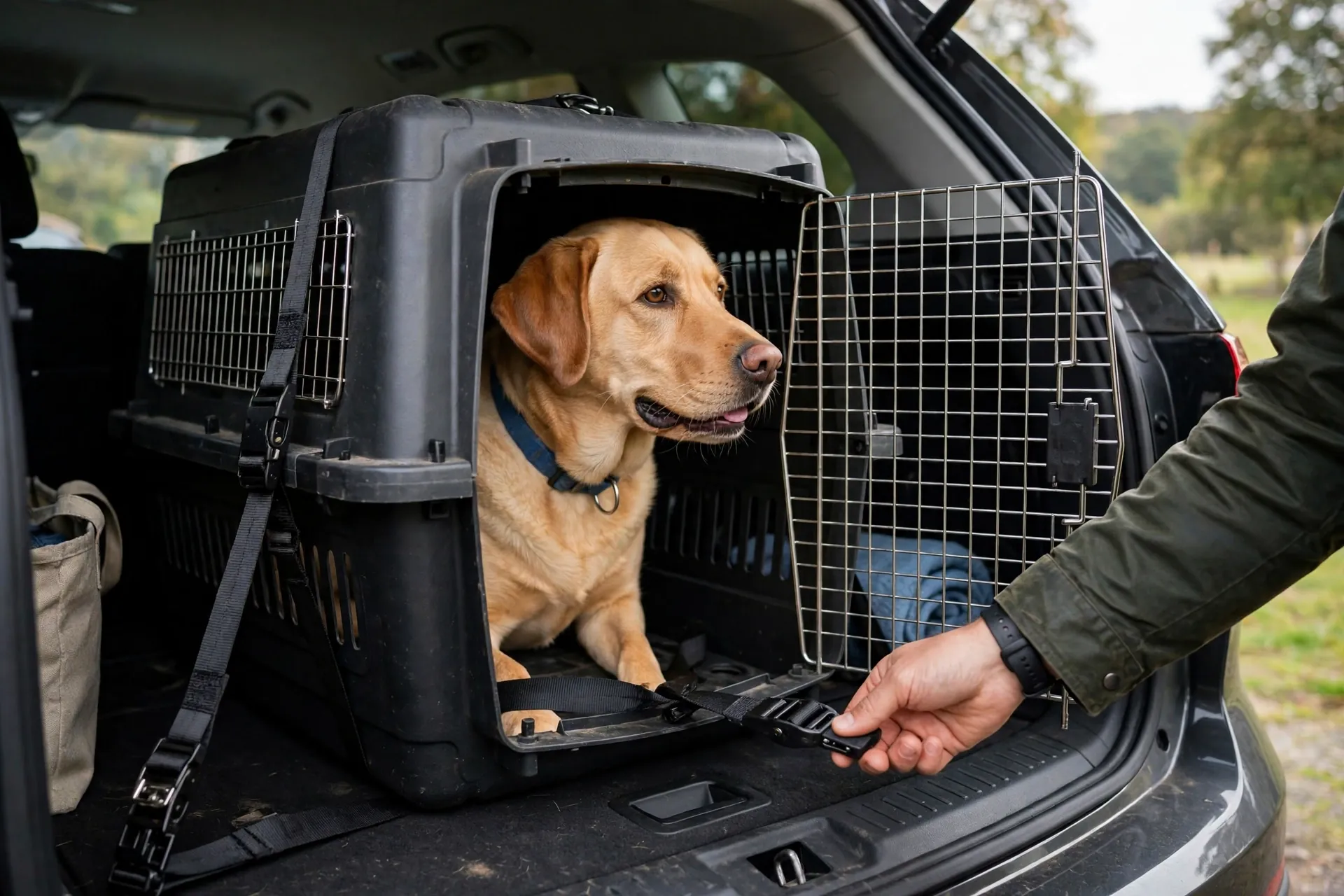
Car crates come in four broad families, and each suits a different kind of dog and journey. Rigid plastic crates are light, easy to clean, reasonably priced and widely available, with ventilation slots on the sides and a metal-barred door. Metal wire crates fold flat, give excellent airflow and visibility, and let a nervous dog see its owner, but they can rattle, flex under load and feel less protective in a collision unless they are a sturdier, crash-rated design. Purpose-built metal car crates, often made for a specific estate or SUV boot, are heavier and more expensive but fit tightly, waste little space and are the closest thing to a fitted piece of car equipment. Soft fabric crates are light and packable, best for calm dogs, short trips and use as a familiar den at the destination.
Ventilation matters more than most buyers expect, and it is not simply a matter of counting holes. Air must move through the crate, not just into it, so look for ventilation on at least two sides and a door that does not block airflow. In summer, a crate tucked against a boot wall with its vents covered by luggage can heat up quickly, even with the air conditioning on, because cooled air may not reach the back. In winter, the opposite problem appears: a wire crate in a draughty boot can feel cold, so a breathable cover over part of the crate, kept well clear of vents, can help without suffocating the dog. Never cover a crate completely, and never rely on a fan alone to fix a hot boot; check the official guidance before you travel if you are unsure about safe temperatures.
Doors deserve as much attention as walls. A single front door is fine when the crate sits across the boot with the tailgate behind it, but a side door can be essential if the crate loads from a rear passenger door or if the tailgate opens onto a busy road. Two-door crates give you an emergency exit option if one side is blocked after a shunt, and they make loading a reluctant dog far easier. Check the latch with one hand, in the dark, wearing gloves, because that is how you will use it at a rainy service station. A latch that needs two hands, a fiddly clip or a sharp tug will be cursed daily and may be left half-closed one tired evening.
Look closely at the details that cause daily friction. Smooth, rounded internal edges prevent scraped noses and torn bedding. A removable tray or a washable base makes cleaning after mud, water or sickness far simpler than a crate with a fixed floor. A door that opens flat against the crate, rather than swinging into the boot space, leaves more room for loading. Handles should be strong enough to lift the crate with the dog out of it, not with the dog inside, because carrying a crate with a dog in it is awkward and stressful for both. If the crate folds, check that the folding mechanism locks positively and cannot collapse if the dog leans against a side.
Crash testing is worth understanding before paying a premium for it. Some manufacturers test their crates with weighted dummies in simulated collisions, and some test only that a crate stays in place under braking. A genuine test result should state the test standard, the dummy weight and the fixing method, because a crate that performs well when strapped down may behave very differently when left loose. A crash-tested crate is a strong choice, but it is not a substitute for correct fitting. An untested crate that is wedged tightly and strapped properly may be safer than an expensive tested crate that slides freely across the boot. If a seller cannot explain what was tested, treat the claim with caution.
Boot or back seat?
Where the crate goes is decided by the car first and by preference second. Estates, SUVs and hatchbacks with a flat, enclosed boot are natural homes for a boot crate, because the space is low, stable and separated from passengers. Saloons with a separate, enclosed boot are a different case: the boot may be dark, poorly ventilated and hard to reach in an emergency, so a back-seat crate is often the better option. Small hatchbacks may only fit a crate on the back seat, and that is perfectly workable if the crate is secured properly and does not block the driver's view or the seat-belt buckles.
A boot crate has clear advantages. The dog is low in the car, which lowers the centre of gravity and reduces the distance it can be thrown. Luggage can be kept separate, the dog is less likely to distract the driver, and a dog boot guard can add a second barrier between the dog and the passenger compartment. The disadvantages are access and temperature: reaching a dog in a deep boot takes longer, and some boots heat up in sun or cool down quickly in winter. A boot crate also needs a flat floor. If the boot floor slopes, has a lip, or sits over a spare-wheel well, the crate may tilt or rock, and a levelling board or a crate designed for that model is worth considering.
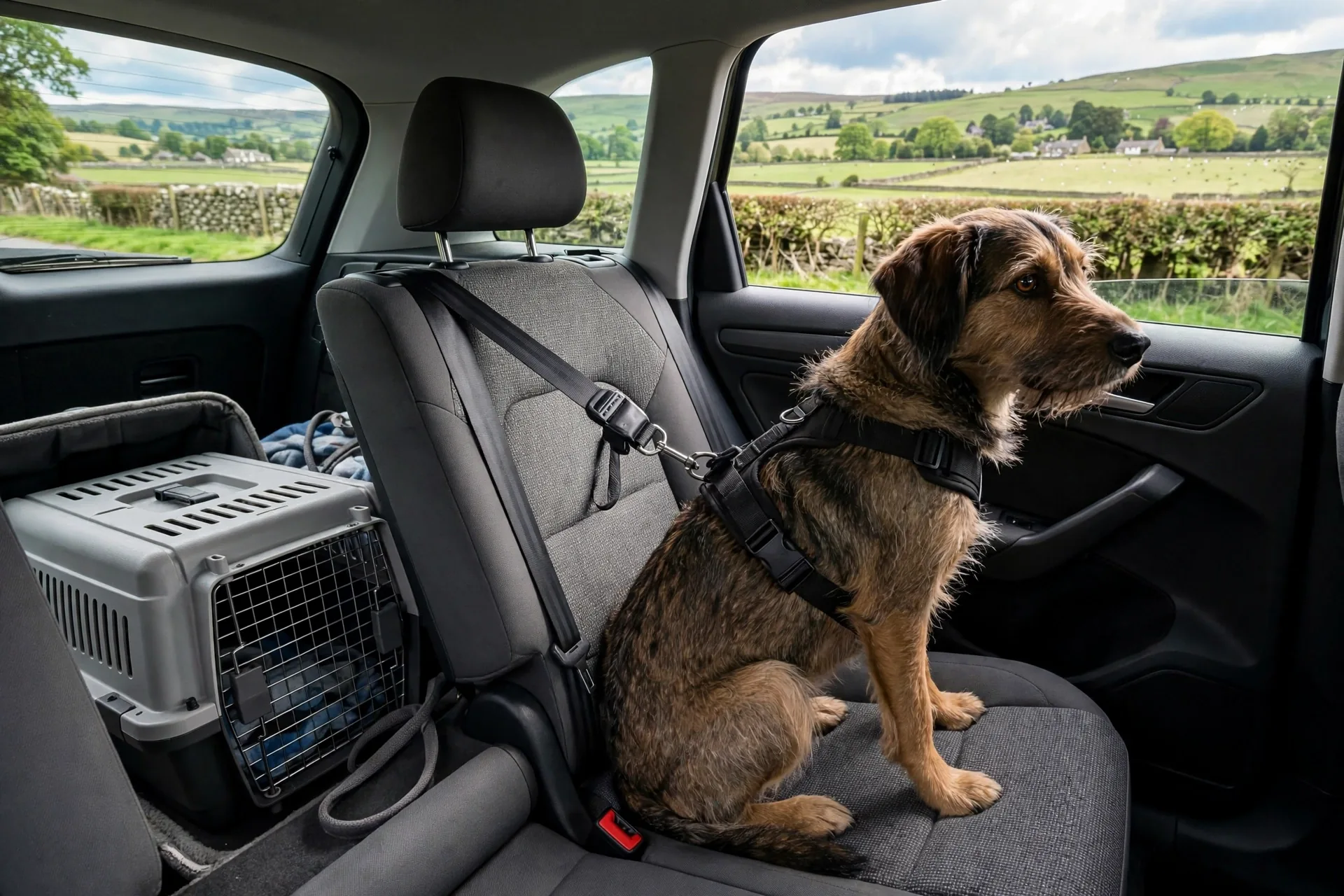
A back-seat crate suits smaller dogs, cars without a usable boot, and owners who want to see and reassure the dog. The crate sits higher, so it must be secured against tipping, and it must not interfere with airbags, seat belts or the driver's mirror. Measure the seat carefully: a crate that overhangs the seat edge will rock, and a crate that presses against the front seats may transmit every bump. Some owners place a non-slip mat under the crate and run straps around the seat back, while others use a seat-belt strap through dedicated anchor points. Whichever method you use, test it by pushing the crate firmly from several directions before the dog gets in.
Think about loading and unloading as part of the decision, not an afterthought. A large dog that struggles to jump into a high SUV boot may need a ramp, and a ramp changes the crate position because the dog must walk straight in without turning sharply at the door. An older dog, a dog recovering from surgery, or a small dog that must be lifted in, may be easier to load on a back seat at hip height. Equally, a dog that bolts when a door opens is safer loaded into a boot, where the tailgate can be closed quickly, than onto a back seat beside an open road. Choose the location that gives the calmest, most controlled loading, because a stressful loading routine will undo good crate training over time.
Multi-dog households face a further choice: one large crate or two smaller ones. Two crates usually win, because each dog gets its own space, arguments over bedding are avoided, and one dog can be settled while the other is loaded. Two crates also let you separate a nervous dog from a boisterous one. The cost is space, and two crates may not fit in a smaller boot, in which case a single divided crate, or a crate plus a harness for the second dog, may be the compromise. Whatever the arrangement, never stack crates in a car, and never place a crate where it blocks the driver's rear view or access to the spare wheel and warning triangle.
Straps, anti-slip and fixing checks
A crate that is not fixed is luggage with a passenger inside. In sudden braking at motorway speed, an unsecured crate can slide forward, tip sideways or become a projectile, and a dog inside it will be thrown against the walls with considerable force. Fixing the crate is therefore not an optional extra; it is the step that makes the rest of the system work. The goal is simple: the crate should not move more than a centimetre or two when pushed hard from any direction.
Start with the floor. A non-slip mat under the crate, cut to size, prevents sliding on smooth boot carpet and protects the car from claws and mud. Rubber-backed mats, boot liners with a grippy surface and dedicated crate mats all work, provided they are flat and do not bunch up under the crate. Inside the crate, a non-slip base or a fitted mat stops the dog sliding on a smooth plastic tray, which matters most for older dogs, dogs with joint problems and any dog that stands during cornering. Avoid loose towels as the only bedding, because they bunch, slide and can trap a paw; a fitted crate mat with a washable cover is a better starting point, and a familiar travel dog bed can be added on top if it fits without reducing headroom.
Straps are the main fixing method for most crates. Ratchet straps and heavy-duty cargo straps, passed through the crate's anchor points or around its frame and attached to the car's lashing points, are far stronger than bungee cords, which stretch and can snap back. Boot lashing points are usually found in the corners of the boot floor or on the sides; check the car handbook for their load rating and location. Run at least two straps, in different directions if possible, so the crate is held against both forward movement and sideways movement. Tighten them until the crate is firm, then check them again after the first few miles, because straps settle and mats compress.
For back-seat crates, use the fixing method the crate maker recommends. Some crates have seat-belt guides that let the belt pass through the frame; others need straps around the seat back or a dedicated carabiner system. Never run a seat belt across the crate door, because it will block emergency access, and never rely on the weight of the crate alone to hold it in place. If the crate has no anchor points, consider a different crate or a boot location, rather than improvising with rope or elastic. A fixing that looks clever but cannot be explained to another driver in thirty seconds is probably not reliable enough.
Build a fixing check into every journey. Before setting off, push the crate forward, backward and sideways, tug each strap, check that the door latch is fully closed, and confirm that nothing heavy is stacked on top of the crate or leaning against its vents. After the first stop, check again, because vibration loosens straps and dogs shift bedding. At the end of a long trip, remove the straps and inspect them for fraying, cracked buckles and stretched webbing; a strap that has done several years of service in sun and mud deserves replacement before it fails. Keep a spare strap in the car, alongside the lead, water and a torch, so a broken fixing never forces a choice between driving unsecured and abandoning the trip.
Gradual crate training for the car
A crate bought on Friday should not be expected to carry a dog calmly to Cornwall on Saturday. Dogs that love their home crate may still object to a car crate, because the car adds movement, noise, vibration and a confined space that moves. Dogs that have never used a crate need even more time. The training plan below is deliberately slow, because a rushed introduction creates a dog that dreads the car, and undoing that dread takes far longer than the training itself. For a fuller home plan, see our guide to crate training a dog for travel.
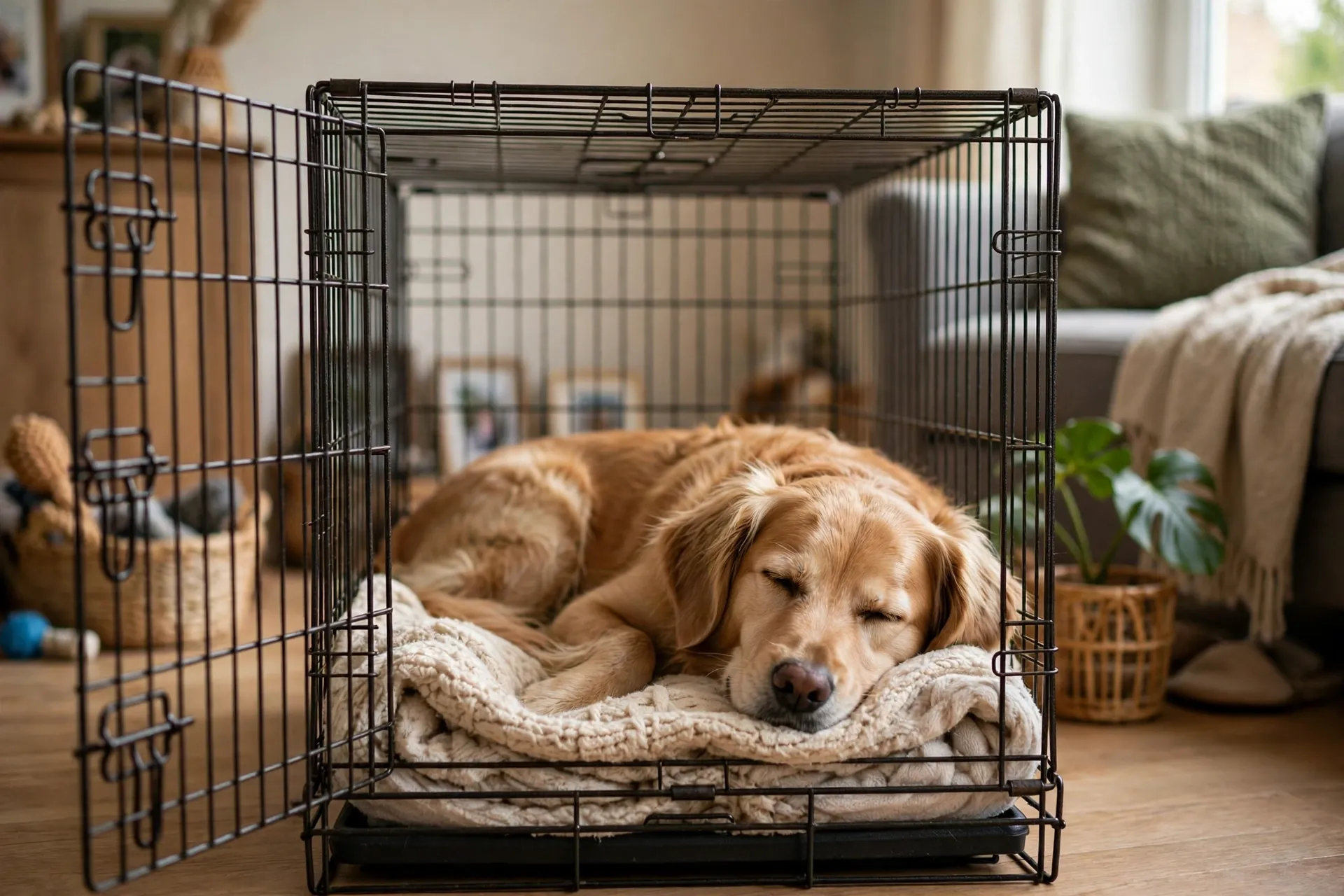
Begin at home, with the car crate in the living room and the door open. Put a familiar blanket inside, scatter a few treats near the entrance, and let the dog investigate without pressure. Feed meals just inside the door for a few days, then gradually move the bowl further back, always leaving the door open. When the dog walks in happily, close the door for a few seconds, then open it before the dog asks to come out, and reward calm behaviour. Build the closed-door time slowly, from seconds to minutes, and always end on a success rather than pushing until the dog protests.
Next, move the crate to the stationary car. Place it in its final position, fix it in place, and repeat the home steps: treats at the door, meals inside, brief closed-door periods with you sitting nearby. Start the engine without driving, so the dog learns that engine noise and vibration are normal and boring. Then drive around the block, then to the end of the street, then on a five-minute trip to somewhere pleasant, such as a quiet walk. Keep early drives short, end them with a walk or a play session, and avoid pairing the first car-crate trips only with vet visits, because the dog will quickly learn the association.
Watch for signs that the pace is too fast. Panting, drooling, whining, barking, scratching at the door, trembling and attempts to escape are all signals to step back a stage, not to push through. Some dogs settle with a familiar-smelling blanket, a safe chew or a calming routine, such as the same cue word and treat every time they enter the crate. Others need a vet or behaviour professional to rule out nausea, pain or anxiety before training continues. Car sickness is common in puppies and often improves with age, but it should not be ignored: short, frequent trips on smooth roads, a cool and well-ventilated car, and advice from a vet are more useful than hoping the dog will simply get used to feeling ill.
Make the crate a normal part of daily life, not a special event. Leave it open at home between trips, let the dog nap in it voluntarily, and keep the bedding clean and familiar. Avoid using the car crate as a punishment, and avoid dragging a reluctant dog inside, because both teach the dog that the crate is a place to fear. With patience, most dogs learn that the crate means a walk, a visit or a holiday is coming, and they will walk in willingly. That willing entry is the real test of training: a dog that chooses the crate is a dog that will travel calmly in it.
Long trips, breaks and parked cars
Long journeys need a plan that treats the dog's needs as part of the route, not as an interruption to it. Plan a break at least every two hours, and sooner for puppies, older dogs, dogs with medical conditions and dogs that are new to crates. A break means more than opening the tailgate for a minute: it means water, a toilet stop, a short walk on a lead, and a chance to stretch, sniff and reset. A dog that has been still for two hours in a crate will benefit from ten to fifteen minutes of movement, even if the humans would prefer to press on.
Choose stops with the dog in mind. Motorway services vary widely: some have dedicated dog areas, grass and water bowls, while others offer only a busy car park beside a road. Research stops before departure, and favour quieter service areas, country parks and lay-bys with grass away from traffic, where the dog can toilet safely on a lead. Keep the lead on before opening the crate door, because a dog released into an unfamiliar car park can bolt in any direction. Carry water and a collapsible bowl, and offer water at every stop, even if the dog seems uninterested, because dogs in cars can dehydrate without obvious signs.
Feeding on travel days needs thought. A large meal immediately before departure increases the risk of sickness, especially in puppies and dogs prone to nausea, so feed a smaller meal a few hours before setting off and plan the main meal for after arrival. Keep treats small and familiar, and avoid new foods on a travel day. If the dog takes medication, check the timing against the journey and carry the medication in the cabin, not in luggage in the boot, so it is accessible at stops. For dogs with known travel sickness, ask a vet about options well before the trip, rather than experimenting on the morning of departure.
Parked cars are the most dangerous part of any dog journey, and the rule is stark: never leave a dog in a parked car in warm weather, even for a short stop, even with a window open, even in shade. Cars heat up far faster than most people expect, and a crate can trap heat around the dog. If you must stop where dogs are not allowed, take turns staying with the car, or choose a different stop. In cold weather, a parked car cools quickly too, and a dog in a crate cannot move to keep warm. Check the official guidance before you travel if you are unsure about the law, and remember that bystanders and police may intervene if they believe a dog is in distress.
Finally, plan for the unexpected. Carry a spare lead, water, a towel, cleaning supplies and a basic first-aid kit, and know the location of a vet near your destination before you leave. Save the vet's number in your phone, and note the nearest emergency vet for a long route. If the car breaks down, keep the dog in the crate or on a lead, well away from the carriageway, and call for help from a safe position. A journey that goes smoothly is usually a journey that was planned for the dog as carefully as for the driver.
Weekly and pre-trip safety checks
A crate is equipment, and equipment wears out. Build a short check into your routine, ideally weekly for regular travellers and before every long trip for everyone else. Inspect the frame for cracks, bent bars and loose joints, and check that wire crates have no sharp ends where a weld has broken. Test the door latch several times, and replace a latch that sticks, slips or needs force. Look at the tray for cracks and warping, and check that the crate still sits flat on the car floor without rocking.
Check the fixing system separately. Straps should be free of fraying, cuts and sun damage, buckles should close cleanly, and lashing points in the car should be free of rust and debris. Non-slip mats should be flat, clean and still grippy; a mat that has gone smooth with wear is no longer doing its job. Wash bedding regularly, because a dirty crate smells of stress to a dog and harbours bacteria after sickness or muddy trips. A clean, familiar-smelling crate is far more inviting than one that smells of the last wet walk.
Re-measure the dog at least twice a year, and after any major change in weight, coat or condition. Puppies outgrow crates, older dogs lose muscle and change shape, and a dog that has put on weight over winter may find a previously comfortable crate tight in spring. If the dog has grown, adjust the divider, change the bedding, or replace the crate before the next long trip. A crate that fitted perfectly a year ago is not guaranteed to fit today.
Also check the car itself. Boot seals, tailgate struts and rear door locks all affect crate safety, because a tailgate that drops unexpectedly or a door that sticks can turn a calm loading routine into a stressful one. Keep the boot area clear of heavy objects that could fall onto the crate, and never stack luggage on top of a soft crate. A tidy boot is not cosmetic: it is the difference between a crate that stays ventilated and a crate that is slowly buried under bags.
Common mistakes that undo a good crate
The most common mistake is buying on price or appearance rather than fit. A stylish crate that is too tall for the boot, too wide for the door or too long for the dog is a poor purchase at any price. The second mistake is leaving the crate unsecured, even for a short trip, because most accidents happen close to home on familiar roads. The third is overfilling the crate with toys, bowls and thick bedding until the dog has no room to turn, or under-filling it so the dog slides on a bare tray.
Another frequent error is using the crate only for long, stressful journeys. A dog that only sees the crate before a vet visit or a five-hour drive will soon dread it, while a dog that naps in the crate at home and takes short, pleasant car trips will accept it calmly. Similarly, forcing a dog into the crate, closing the door on a panicking dog, or leaving a distressed dog to cry it out can create lasting anxiety. Patience in the first two weeks saves months of retraining later.
Temperature mistakes are common too. Owners sometimes assume that air conditioning in the front reaches the boot, or that a cracked window cools a parked car, and both assumptions are unsafe. Check the temperature where the dog actually sits, not where the driver sits, and adjust vents, covers and stops accordingly. Finally, do not ignore the law: in the UK, drivers must ensure dogs are suitably restrained so they cannot distract the driver or injure themselves or others if the vehicle stops quickly. A crate is one way to meet that duty, but only when it is fitted and used properly, so check the official guidance before you travel if you are unsure.
Buying checklist
Use this checklist in the shop or before ordering online, and do not skip a step because the crate looks right. First, confirm the dog's measurements and the car's measurements, including the boot or door opening. Second, choose the material for your dog and your journeys: rigid plastic for everyday use, a fitted metal crate for a regular boot setup, wire for airflow at home and short trips, or soft fabric only for a calm dog and light use.
Third, check the door: does it open on the side you need, latch with one hand, and give you an emergency exit if one side is blocked? Fourth, confirm ventilation on at least two sides and that luggage will not cover the vents. Fifth, confirm the fixing method and buy straps and a non-slip mat at the same time, rather than discovering on the driveway that the crate has no anchor points. Sixth, check the crash-testing claim, if any, and what fixing method it assumed.
Seventh, test the crate at home before the first real journey, with bedding in place, and run through the training steps in this guide. Eighth, plan the first month of trips: short and pleasant before long and necessary. Finally, keep the receipt and the manufacturer's instructions, note the crate's weight limit and cleaning guidance, and set a reminder to re-check straps, latches and the dog's measurements in a few months. A crate chosen this way is not just a purchase; it is a travel system that should last for years of safer journeys.
Practical questions
Before you go
Should a dog travel crate be big or snug?
Snug, but not tight. The dog should be able to stand, turn around and lie down comfortably, with a few centimetres of headroom when standing. A crate that is far too large lets the dog slide around in braking and corners, which defeats much of the point of using one.
Is a crate safer in the boot or on the back seat?
It depends on the car and the crate. A well-fitting boot crate in an estate or SUV is often the most stable option, while a smaller crate secured with a seat belt or straps can work well on a back seat. What matters most is that the crate cannot slide, tip or become a projectile, and that the dog has air and a door you can open quickly.
Do I need a crash-tested crate?
It is not a legal requirement in the UK, but a crate that has passed recognised crash testing is a stronger choice than an untested lookalike. Check exactly what was tested, including the weight of the test dummy and the fixing method used, because a test result only applies when the crate is installed the same way.
How long can a dog stay in a travel crate on a long trip?
Plan a break at least every two hours for water, a toilet stop and a short walk, and sooner for puppies, older dogs and dogs that are new to crates. Never leave a dog in a parked car in warm weather, even for a short stop, and check the official guidance before you travel if you are unsure about the law.
My dog hates the crate. Should I still use one in the car?
Do not start with a long car journey. Go back to short, reward-based sessions at home, then brief periods in the stationary car, then very short drives. If the dog panics, drools heavily, tries to escape or becomes distressed, stop and seek advice from a vet or qualified behaviour professional before continuing.
Can I use a soft crate in the car?
A soft crate can be useful for a calm dog that already settles well, for short journeys and as a familiar den at the destination. For motorway driving and for dogs that scratch, chew or push hard, a rigid crate or a properly fitted metal crate is usually the safer and longer-lasting choice.