This guide is independent and contains no paid placement. It is general information, not veterinary advice: vaccine schedules vary by product, age and health, so your registered vet's advice for your own dog always comes first.
Start eight weeks before departure. Check every vaccine due date, book the vet visit early, sort worming and flea treatment, and carry proof of vaccination in both paper and phone form. Most pre-holiday vaccine problems are not medical at all — they are dates discovered too late, certificates left at home, or a kennel rule nobody read.
The countdown: 8 weeks to departure day
Vaccination planning rewards an early start more than almost any other part of holiday preparation. A booster given the week before departure may not have had time to build full protection, a restarted vaccine course can take several weeks, and a kennel that rejects an out-of-date certificate cannot be argued with at the gate. The countdown below turns a vague intention — "sort the jabs before we go" — into a sequence with a clear job at each stage.
Eight weeks before departure is the moment to open the vaccination book and read it properly, not just glance at the cover. Check the date of every vaccine, the product name and the vet's stamp, and compare the due dates against your travel dates. If anything expires during the trip, or within a week or two after it, bring it forward now. Many owners discover at this point that a booster they thought was annual is actually due every three years, or the reverse — and that the kennel cough vaccine, which is often annual and sometimes given separately, has quietly lapsed. Photograph every page of the book while you are at it, so a lost booklet is an inconvenience rather than a crisis.
At eight weeks you should also book the vet appointment itself, because popular practices fill up weeks ahead, especially before school holidays and bank-holiday weekends. When you book, say explicitly that it is a pre-holiday check: the practice can then allow enough time, prepare any blood tests, and flag anything that needs a follow-up visit. Mention the destination and the type of trip too. A walking holiday in sheep country, a beach break, a stay near standing water and a kennel stay each carry slightly different parasite and disease risks, and a vet who knows the plan can tailor the advice rather than giving generic reassurance.
Four weeks before departure is the main action point. This is when boosters should ideally be given, when worming and flea treatments are timed to cover the trip, and when any blood test or titre test is taken so results arrive in good time. It is also when you should send vaccination records to any kennel, daycare provider or hotel that has asked for them, rather than assuming you will hand them over on arrival. If a provider spots a gap at four weeks, there is still time to fix it; at four days, there usually is not.
Two weeks before departure is the checking point, not the starting point. Confirm that every vaccine is recorded, that the dates cover the whole trip, that worming and flea treatments are within their protection window, and that any medication for the trip has been dispensed with enough supply for a few extra days. This is also the moment to locate the nearest vet to your destination and save the number in your phone, along with your own practice's out-of-hours number. If your dog is on regular medication, ask your vet for a short written summary of the condition and dose — it helps an unfamiliar vet enormously if something goes wrong far from home.
On departure day, the health jobs are small but worth doing deliberately. Give any medication at the usual time, pack the vaccination book where you can reach it without unpacking the car, and do a quick once-over of your dog: bright eyes, normal appetite, no new lumps, no limping, no diarrhoea. A dog that is slightly off on departure morning deserves a phone call to the vet before a long drive, not a hope that fresh air will fix it. Travel stress can worsen a mild illness, and a vet seen at home is far easier than one found in an unfamiliar town.
- 8 weeks out: read the vaccination book in full, check every due date against the trip, book the vet visit, tell the practice where you are going.
- 4 weeks out: boosters given, worming and flea treatment timed, records sent to kennels or hotels, blood tests taken if needed.
- 2 weeks out: confirm all dates cover the trip, find the destination vet, arrange extra medication, pack the health kit.
- Departure day: medication on schedule, vaccination book accessible, quick health once-over before you set off.
The countdown is deliberately front-loaded because vaccine immunity is not instant. After a booster, the immune system needs days to weeks to respond, and after a first course the wait is longer. Building that waiting time into the plan is the single most useful thing this checklist does — everything else is detail.
Core vaccines and booster timing
Most UK vets describe a set of "core" vaccines that nearly every dog should have: distemper, parvovirus, infectious hepatitis (adenovirus) and leptospirosis. These protect against diseases that are serious, sometimes fatal, and still circulating in the UK. Distemper attacks the respiratory, digestive and nervous systems; parvovirus causes severe vomiting and diarrhoea, and is especially dangerous for puppies; infectious hepatitis affects the liver; leptospirosis is a bacterial infection spread through contaminated water and rat urine, and it can also affect people. None of these is a disease you want to meet on holiday, and all of them are preventable.
Puppies usually receive a primary course of two or three injections, starting at around eight weeks of age and finishing at around sixteen weeks, depending on the product and the practice. Immunity is generally considered established a week or two after the final puppy injection — which is why a puppy's first holiday needs careful timing, covered in more detail below. Adult dogs then receive boosters, but the interval is not the same for every vaccine. Distemper, parvovirus and hepatitis boosters are often given every three years after the first annual booster, while leptospirosis is usually annual, because immunity to it fades faster. Your dog's book, not a general rule, is the authority for your dog.
That difference in intervals is exactly where confusion creeps in. An owner who remembers "the jabs are every three years" may let leptospirosis lapse for two years without realising it; an owner who assumes everything is annual may pay for unnecessary boosters. Read the book line by line. If the practice uses a reminder system, check that your address, email and phone number are current — reminders sent to an old address are the most common cause of a quietly overdue booster.
Kennel cough is the other vaccine holidaymakers meet most often, and it is not usually part of the core set. It protects against Bordetella bronchiseptica and sometimes parainfluenza, the main causes of infectious tracheobronchitis — the harsh, honking cough that spreads quickly where dogs mix. Kennels and daycare providers commonly require it, and many also require it to have been given at least two weeks before admission, because the intranasal or oral vaccine needs time to work and because a recently vaccinated dog can shed the vaccine strain briefly. If your dog will spend even one day in daycare during the trip, or stay in kennels while you are away, ask the provider exactly which vaccines they require and by what date, then work backwards from there.
Other vaccines are situational rather than routine. Rabies is covered in the next section. Vaccines against canine herpesvirus are used in breeding bitches, not holidaymakers. Some practices offer vaccines for diseases such as Lyme disease or canine influenza in specific circumstances, but these are decisions for your vet based on local risk, not items to add to a holiday checklist by default. If a provider or a fellow owner suggests an extra vaccine, ask your own vet whether your dog actually needs it — over-vaccination is not a harmless precaution.
What if a booster is overdue? Do not panic, but do not ignore it either. Depending on how long the delay has been and which vaccine is involved, your vet may give a single booster or restart the primary course. A restarted course takes weeks, which is why the eight-week check matters so much. Some owners ask about titre testing — a blood test that measures antibody levels — as an alternative to routine boosters. Titre testing is a legitimate discussion to have with your vet, particularly for distemper, parvovirus and hepatitis, but it is not accepted by every kennel or insurer as proof of protection, and leptospirosis cannot be assessed this way. If you rely on titre testing, confirm in writing that your kennel, hotel and insurer accept it before you travel.
Side effects deserve a calm, honest paragraph. Most dogs show nothing at all, or mild tiredness, a slightly reduced appetite or a small tender spot at the injection site for a day or two. These are normal signs of an immune response. Serious allergic reactions — facial swelling, vomiting, collapse or breathing difficulty — are rare but real, and they usually appear within minutes to a few hours. That is one reason not to vaccinate on departure morning: if your dog does react, you want to be near your own vet, not on a motorway. Tell your vet about any previous reaction before the next dose, because the approach may change — a different product, pre-treatment, or a longer observation period after the injection.
Rabies and travelling abroad
For a holiday that stays entirely within the UK, rabies vaccination is not routinely required. The UK has been free of rabies in its terrestrial animal population for many years, and domestic travel does not involve a rabies check. That simple fact is worth stating clearly, because rabies is the vaccine owners worry about most and understand least — and because the rules change completely the moment a trip crosses a border.
If your holiday involves leaving the UK — even for a short trip to France, Ireland or elsewhere in Europe — rabies vaccination becomes central, and the timetable is strict. The dog must be microchipped before the rabies vaccine is given, the vaccine must be recorded in an animal health certificate or pet passport as applicable, and there is typically a waiting period of at least 21 days after the primary vaccination before travel. Booster timing matters too: if a rabies booster lapses, the waiting period may apply again. These rules are set by governments, not by vets, and they change from time to time — check the official guidance before you travel rather than relying on a blog post, including this one, for border requirements.
Re-entering the UK has its own requirements, which have historically included tapeworm treatment given by a vet within a specific window before arrival, recorded and timed precisely. Again, the details depend on where you have travelled from and the current rules, so confirm them with your vet and the official guidance well before departure, not at the port. A missed tapeworm treatment window is one of the most common reasons pets are delayed at the border, and it is entirely avoidable with an eight-week plan.
Owners who live near a border, or who travel frequently, sometimes keep rabies vaccination permanently up to date even when the next trip is not yet planned. That is a reasonable conversation to have with your vet: it removes the 21-day waiting period from future plans and turns a border crossing from a project into a booking. It is not necessary for a purely domestic holiday, but for a household that crosses borders even once a year, it is often the simplest option.
One more rabies-adjacent point: bats. The UK has a very low risk of rabies-like viruses in bats, and the advice is simple — do not handle bats, and if your dog picks one up or is bitten, contact your vet promptly. This is not a reason to vaccinate every domestic-travel dog against rabies, but it is a reason to keep dogs on a lead around roosting sites and to take any bat contact seriously.
Worming and flea prevention
Vaccines get the attention, but parasites cause more ruined holidays. Roundworms, tapeworms, lungworm and fleas are all common in the UK, and a holiday — new ground, new water, new dogs, new wildlife — raises exposure. A dog that picks up lungworm from slugs and snails on a damp Cornish lane, or fleas from a holiday cottage carpet, can go from fine to seriously ill or miserably itchy within days. Prevention timed to the trip is cheap; treatment mid-holiday is not.
Routine worming usually follows a schedule of every one to three months depending on the product and the dog's risk, and your vet can advise on the right interval. Before a holiday, check when the last dose was given and whether cover extends through the trip. If it runs out mid-trip, give the next dose before departure rather than carrying tablets and hoping you remember on a beach. Tapeworm treatment deserves specific attention after any trip involving hunting, scavenging or eating raw meat, and it is a formal requirement for re-entering the UK from many countries, as noted above.
Lungworm deserves its own mention because it is easy to underestimate. Angiostrongylus vasorum is spread by slugs and snails and by their slime trails on grass, bowls and toys. Dogs that eat grass, drink from puddles or play with sticks can ingest infected slugs without anyone noticing. Signs include coughing, tiring easily, bleeding or bruising, and in severe cases clotting problems — but early infection can be silent. Not every wormer covers lungworm, so ask your vet explicitly whether your dog's product does, especially before a wet-weather walking holiday in the south-west or south-east where the parasite is most established. Monthly prevention is available and is worth discussing for dogs that graze or scavenge.
Flea prevention is equally trip-specific. A treatment applied the week before departure should cover the whole stay, but check the product's duration — some last four weeks, others twelve, and a treatment applied six weeks before a month-long trip may run out halfway through. Treat all dogs in the household together, because fleas move between animals, and wash bedding before departure so you are not transporting eggs to a new home. If your dog stays in kennels, the provider may require flea treatment within a specific window and may check for fleas on admission; a dog turned away for fleas is an avoidable disaster, so treat early and keep the receipt or packaging.
Ticks are the other holiday parasite, and they are increasingly common across the UK, especially in grassland, bracken and deer country from spring to autumn. Check your dog daily on a walking holiday — ears, armpits, groin, between toes and around the tail base are favourite spots — and carry a tick remover. Remove ticks promptly with the tool, twisting as instructed, and watch the bite site for redness or swelling over the following days. If your dog becomes lethargic, loses appetite or develops a fever after tick exposure, contact a vet: tick-borne diseases such as babesiosis and Lyme disease are uncommon but real, and early treatment matters. Ask your vet whether a tick-preventive product suits your trip, particularly for a long walking holiday in tick country.
A final parasite point: water. Standing water, slow rivers and farm ponds can carry leptospirosis bacteria and blue-green algae, and both are holiday hazards that no vaccine or wormer fully removes. Leptospirosis vaccination reduces risk but does not eliminate it; blue-green algae has no vaccine at all and can kill quickly. Keep dogs out of water with visible algal scum, and if your dog swims in rivers or lakes, watch for vomiting, diarrhoea or lethargy afterwards and contact a vet promptly if anything seems wrong.
The pre-travel vet check
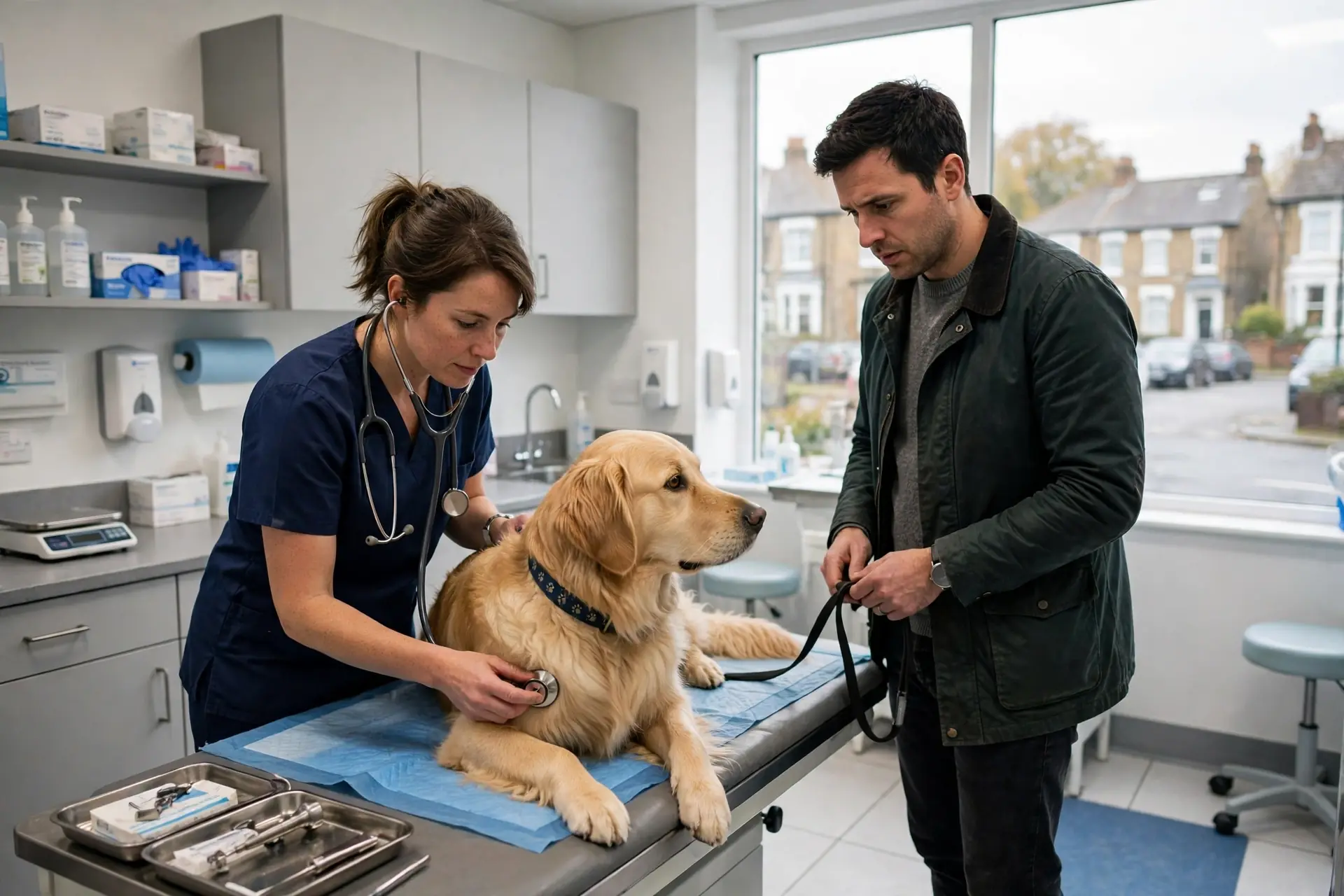
The pre-holiday vet visit should be more than a jab and a goodbye. Used properly, it is a full health review that catches the small problems a holiday would turn into big ones: a sore tooth that makes chewing painful, an ear infection that a wet holiday would worsen, a weight gain that makes long walks harder, or a heart murmur that changes what exercise is sensible. Book a proper appointment, not a nurse-only vaccination slot, if you want this broader check — and say so when you book.
A good pre-travel check usually covers weight and body condition, teeth and gums, ears, eyes, skin and coat, heart and lungs, abdomen, joints and mobility, and a discussion of appetite, drinking, toileting and behaviour. Mention anything you have noticed, even if it seems trivial: drinking more than usual, slowing down on walks, stiffness after rest, or a change in stool. Vets would much rather investigate a small change at home than receive a panicked call from a holiday cottage, and many conditions are far easier to manage when caught early.
Medication needs a specific conversation. If your dog takes regular medication, confirm the dose, the supply for the trip plus a few days' spare, and what to do if a dose is missed or vomited. Ask whether the medication needs refrigeration — a surprising number of owners discover mid-trip that a drug must stay cold — and how to store it in a car or cottage. If your dog is on a controlled drug, check the rules for carrying it and whether a letter from the vet is advisable. For dogs that suffer travel sickness, discuss medication options at this visit, not the night before departure: some anti-sickness drugs need a trial dose at home first.
Travel anxiety is also a vet topic, not just a training topic. If your dog panics in the car, paces all night in new places, or becomes distressed when left alone, raise it at the pre-travel visit. Your vet can discuss behavioural strategies, and in some cases short-term medication, but these need time to trial — another reason the eight-week window matters. A sedative tried for the first time on departure day is a gamble; the same drug trialled at home two weeks earlier is a plan.
Finally, ask your vet to confirm fitness to travel in plain terms. Most dogs are fine, but a dog recovering from surgery, a bitch in season or recently mated, a dog with uncontrolled epilepsy or advanced heart disease, or a dog with a contagious condition should not travel until the vet agrees. A vet who says "wait" is not ruining your holiday; they are preventing a much worse one.
Health records and the vaccination book
Paperwork is boring until it is the only thing standing between your dog and a kennel place, a hotel room or a border crossing. The vaccination book — sometimes called a vaccine card or health record — is the core document. It should show your dog's microchip number, each vaccine given, the date, the product and batch, and the vet's stamp and signature. Keep it with the travel documents, not buried in a drawer at home, and photograph every page before departure as a backup.
Microchip details deserve a check of their own. A microchip is only useful if the registered details are current: your mobile number, your email and your address. If you have moved house or changed numbers since the chip was implanted, update the database before you travel — a found dog with an out-of-date chip is a distressingly common story, and our guide to a lost dog on holiday explains why the first hour after a dog goes missing matters so much. Ask your vet to scan the chip at the pre-travel visit to confirm it still reads correctly; chips can migrate or, rarely, fail.
Insurance paperwork belongs in the same folder. Carry the policy number, the insurer's claims phone number and any exclusions that matter on holiday — some policies exclude certain activities, or require the dog's vaccinations to be up to date for a claim to succeed. If your dog has a pre-existing condition, carry a short summary from your vet: diagnosis, medication, dose and what to do in an emergency. An unfamiliar vet treating your dog at 10pm in an unfamiliar town will be grateful for one clear page.
For trips abroad, the paperwork multiplies: animal health certificates, pet passports where applicable, rabies records, tapeworm treatment entries and sometimes import permits. Each document has its own validity window, and a certificate issued too early can expire before travel while one issued too late misses the departure. Your vet, and the official guidance, are the authorities here — build the paperwork timetable into the eight-week plan and double-check every date before you leave the practice.
Digital backups are worth the five minutes they take. Photograph the vaccination book, the insurance certificate, the microchip number and any medication labels, and store them in a phone folder you can find without signal — a note or an album, not only in an email that needs connectivity. Share the folder with your travelling companions too, so the documents survive a lost phone as well as a lost booklet.
Kennels, daycare and hotel requirements
If your dog will spend any part of the trip in kennels, daycare or a hotel's pet-sitting service, their vaccination rules become your rules — and they are often stricter than your own vet's schedule. A provider that houses many dogs together has to protect all of them, so it will require proof of core vaccines, usually kennel cough as well, and sometimes a minimum interval since vaccination. Read the provider's terms when you book, not when you arrive, and ask for anything ambiguous in writing.
The most common reason dogs are turned away is not a missing vaccine but a date problem: a booster that expired last week, a kennel cough vaccine given only three days before admission when the provider requires fourteen, or a certificate that shows the vaccine but not the date. Send the records in advance and ask the provider to confirm in writing that they are acceptable. That single email exchange prevents almost every admission-day dispute, and it gives you time to fix a gap while your vet can still help.
Hotels vary far more than kennels. Some ask for nothing beyond a declaration; others require the same proof as a kennel, and a few require flea treatment evidence as well. The variation is the point: never assume that because one hotel did not ask, the next will not either. When you book a dog-friendly room, ask the question directly — "What vaccination or health proof do you need, and by when?" — and keep the answer with the booking confirmation.
Trial stays are an underused tool. If your dog has never been in kennels, a short trial day or overnight stay a few weeks before the holiday tests both the dog and the paperwork. The provider checks the records, the dog experiences the environment, and any problem — a missing vaccine, a stressed dog, a medication routine that needs explaining — surfaces while there is still time to solve it. Many providers recommend trials for first-time dogs, and some require them.
Finally, remember that your dog's behaviour and health on arrival matter as much as the certificate. A dog arriving with diarrhoea, a cough or fleas may be refused even with perfect paperwork, because the provider must protect the other dogs. If your dog is unwell in the days before a kennel stay, tell the provider early and ask your vet's advice — an honest conversation beats a refused admission at the gate.
Puppies and older dogs
Puppies and older dogs sit at opposite ends of the vaccination story, but both need extra thought before a holiday. A puppy's immune system is still learning, and an older dog's is slowing down — and both are more vulnerable to the infections and stresses that travel brings.
For puppies, timing is everything. The primary course is usually complete by around sixteen weeks, with immunity developing a week or two after the final injection. Until then, your vet will usually advise keeping outings low-risk: short garden visits and quiet pavements rather than busy dog parks, beaches full of unknown dogs, or kennel environments. That does not mean a puppy cannot travel — a quiet cottage holiday with a garden, carried outings and careful socialisation can be ideal — but it does mean the trip should be designed around the puppy's protection level, not the other way round. Our guide to a puppy's first holiday covers packing, car practice and settling in for exactly this stage.
Puppy socialisation still matters during this window, and it should not stop entirely while vaccination is incomplete — it should just be managed. Meeting calm, known, healthy, vaccinated dogs in clean environments, and experiencing new sights, sounds and surfaces from your arms or a clean blanket, all build confidence without the disease risk of a busy dog area. Ask your vet what is appropriate for your puppy's age and local disease risk, because the advice varies by area and season.
Older dogs bring a different set of checks. Immunity can wane with age, and chronic conditions — arthritis, kidney disease, heart disease, dental disease — change what a holiday should look like. The pre-travel vet check matters more, not less, for a senior dog: blood tests may be suggested, medication may need adjusting for a more active week, and the vet may advise shorter walks, more rest days or a cooler destination. Vaccination itself is not usually a problem for older dogs, but the vet may discuss whether every booster is still appropriate, or whether titre testing makes sense for a dog with a complex medical history.
Practical adjustments help senior dogs enormously. A ramp for the car, a non-slip mat, an orthopaedic bed, raised food bowls and a familiar blanket all reduce the strain of a new environment. Keep the routine close to home — same feeding times, same medication times, same last-outing pattern — and build rest days into the itinerary rather than filling every day with walks. An older dog that enjoys a holiday is one that comes home rested, not exhausted.
Both puppies and seniors also need a closer eye on temperature. Puppies chill quickly and overheat quickly; older dogs regulate temperature less well and may struggle in heat or cold. Never leave any dog in a parked car, plan shade and water on warm days, and carry a coat for a cold or wet senior. If your dog seems unusually tired, shivery or reluctant to walk, shorten the outing and rest — a holiday is not a fitness test.
Packing the health kit
A small health kit, packed before departure and kept accessible, turns most minor holiday health problems into minor inconveniences. It does not need to be elaborate: the vaccination book and insurance details, regular medication plus a few days' spare, a tick remover, a basic first-aid kit, and your vet's and the destination vet's numbers. Add anything your own dog specifically needs — a muzzle if your dog wears one at the vet, a spare lead, or a calming aid your vet has recommended.
The first-aid kit deserves a moment of thought. Include saline for flushing eyes or small wounds, gauze and a bandage, blunt-ended scissors, tweezers, a digital thermometer if you know how to use one, and any wound-cleaning solution your vet recommends. Know roughly how to use each item before you need it, and know what you should not do: never give human painkillers such as ibuprofen or paracetamol to a dog without veterinary advice, as some are toxic to dogs. A phone call to a vet is always better than a well-meaning guess.
Food and water planning is health planning too. A sudden change of food on holiday commonly causes diarrhoea, so take enough of your dog's usual food for the whole trip plus a few days, and transition gradually if a change is unavoidable. Carry water for car journeys and long walks, and a collapsible bowl — dehydration and heatstroke are holiday emergencies that are almost entirely preventable. If your dog has a sensitive stomach, pack a small supply of the bland food your vet recommends for upset stomachs, and know the signs that mean a vet visit rather than a bland diet: blood in vomit or stool, repeated vomiting, lethargy, or diarrhoea lasting more than a day.
Finally, pack for the return journey as well as the outward one. A dog that has swum, hiked and socialised for a week may come home tired, muddy and carrying fleas or ticks picked up on the last day. Check for ticks before the drive home, wash bedding on return, and keep an eye on appetite, stool and energy for a few days afterwards. If anything seems off in the week after travel — a cough, diarrhoea, lethargy or a skin problem — mention the trip to your vet, because travel history changes the list of likely causes.
Done properly, the vaccination checklist is not really about injections at all. It is about removing the avoidable problems from a holiday so that the unavoidable ones — weather, traffic, a dog that finds mud at every opportunity — are the only surprises left. Start eight weeks out, read the book properly, book the vet early, and travel with proof in your pocket. Your dog will not thank you in words, but a healthy, relaxed dog on a good walk is thanks enough.
Practical questions
Before you go
How far in advance should I book a pre-holiday vet visit?
Book eight weeks ahead if you can, and no later than four weeks before departure. That leaves time for blood tests, booster vaccines to take effect, worming and flea treatments to be applied, and any paperwork to be corrected before you travel.
What happens if a booster is overdue when we travel?
An overdue booster can mean your dog is not considered protected, and some kennels, daycare providers and insurers will refuse admission or cover. Your vet may need to restart the course, which takes weeks, so check the due date early and never assume a short delay does not matter.
Does my dog need a rabies vaccine for a holiday inside the UK?
Rabies vaccination is not routinely required for travel within the UK, but it is essential for most trips abroad and for re-entering the UK afterwards. If your trip crosses a border at any point, check the official guidance before you travel and allow at least three weeks after vaccination.
Do kennels and daycare providers really check vaccination records?
Most reputable kennels and daycare providers do, and many will turn a dog away without proof. They usually require core vaccines and kennel cough vaccination, and they check the dates, not just the certificate. Send the records in advance so a problem is found while there is still time to fix it.
Can a puppy travel before its vaccination course is finished?
A puppy is not fully protected until its primary course is complete and immunity has had time to develop, which is usually a week or two after the final puppy injection. Until then, keep outings low-risk, avoid busy dog areas, and ask your vet what is safe for your puppy's age and stage.
What should I do if my dog reacts badly to a vaccine?
Mild tiredness or a small sore spot for a day or two is common, but swelling of the face, vomiting, collapse or breathing difficulty needs urgent veterinary help. Tell your vet about any previous reaction before the next dose, and never give a vaccine on departure morning if a reaction would ruin the trip.