This guide is independent and contains no paid placement. If affiliate links are added later, they will be clearly marked and will not change our editorial checks.
Many UK cheese dairies welcome dogs in the farm shop and outdoor areas, but dogs are normally kept out of production rooms, cheese stores and food preparation areas for hygiene reasons. Check the individual dairy's policy before you go, keep the dog on a short lead, bring your own treats for tastings, and buy cheese last so it stays cold on the way home.
What "dog-friendly" usually means at a cheese dairy
A cheese dairy is not one single space. It is usually a working farm, a production building, a shop, and sometimes a cafe or a tasting room, all sharing the same yard. That mix is exactly why the dog rules feel confusing: a dairy can be genuinely welcoming in one area and strictly closed in the next, and both answers can be correct at the same time. The phrase "dog-friendly" on a website or a listing rarely tells you which rooms it covers, so the useful question is always more specific. Ask where the dog may go, on what kind of lead, and what happens during a tour or a tasting, rather than accepting a single yes or no.
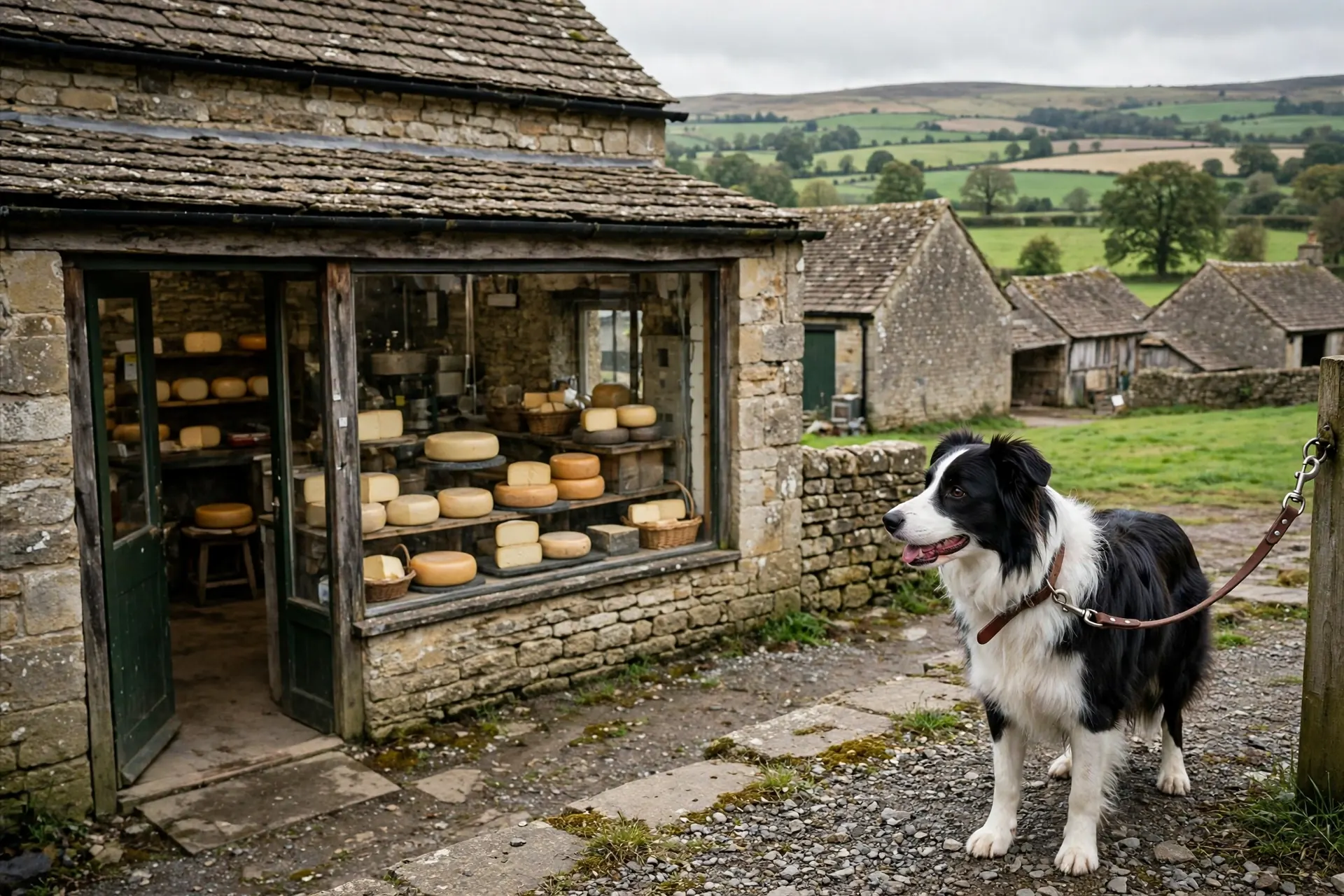
Most small and medium-sized dairies in the UK fall into a familiar pattern. Dogs on a lead are often welcome in the farm shop, in the yard, and in an outdoor seating area. Dogs are usually not allowed in the rooms where cheese is made, matured, cut, or packed, and they are often not allowed in an indoor cafe or tasting room where food is served and eaten. Some dairies have a viewing window or a gallery where visitors can watch production from a corridor, and the dog policy for that corridor depends on whether food is handled nearby. Other dairies keep the whole visit outdoors, with a shop counter under a canopy and a farm walk, which makes the dog question much simpler. Because the layout varies so much, two dairies ten miles apart can have completely different rules, and a policy that worked at one should never be assumed at the next.
The size of the dairy matters too. A large creamery that supplies supermarkets will have formal visitor routes, protective clothing, and strict hygiene controls, and dogs will almost certainly be limited to a car park, a shop, or an outdoor area. A small family dairy that makes cheese by hand may be more flexible in the shop, but it still has to protect its production rooms, and the owners may be working with open vats, hot water, and heavy trolleys in a small space. Farm diversification has added another layer: many dairies now run cafes, play areas, farm trails, and seasonal events, and the dog policy can change between the shop, the cafe, the trail, and the event field. Reading the dairy's own visitor page, and checking the official guidance before you travel, is the only reliable way to know the current position, because policies change when a dairy extends its cafe, starts a new tour, or changes its insurance.
It also helps to think about the visit from the dairy's point of view. Cheese is food, and food businesses have to control contamination, pests, and allergens. A dog is not a hygiene problem in a farmyard, but a dog in a room where unwrapped cheese is being cut is a risk the business cannot take. Staff also have to think about other visitors, including people with allergies, children, and visitors who are nervous around dogs. A calm dog on a short lead in a spacious shop is easy to welcome. A large, excited dog weaving between display tables in a small shop at a busy weekend is much harder to accommodate, even when the owners love dogs themselves. Planning a quieter visit, keeping the dog close, and being ready to step outside are the habits that keep doors open for the next dog owner.
Finally, remember that assistance dogs are treated differently from pet dogs. Under UK equality law, assistance dogs are generally allowed in places where pet dogs may be refused, including many food premises, although working farm areas and some production zones can still have safety restrictions. If you travel with an assistance dog, contact the dairy in advance, explain what you need, and ask for the access arrangements for the shop, the tour, and the cafe separately. That conversation protects both sides: the dairy can plan a safe route, and you can arrive knowing exactly what to expect instead of negotiating at the door.
The farm shop: where dogs can go
The farm shop is usually the most dog-friendly part of a cheese dairy, and it is often the reason for the visit in the first place. Many shops are set up as a retail room with a counter, chilled cabinets, and shelves of local produce, and a well-behaved dog on a lead can browse that space without touching the food. Some shops have a separate entrance from the production area, a wide aisle, and a tiled or concrete floor that is easy to clean, which makes dogs a straightforward yes. Others are small, with narrow gaps between counters, baskets of bread or cakes at dog height, and a queue that forms close to the till. In those shops the policy may be dogs outside, dogs in a porch, or dogs allowed only at quiet times, and the answer can change with the season and the crowd.
Before you travel, look for the specific wording on the dairy's website or social media. Phrases such as "dogs welcome in the shop", "dogs welcome outside", "dogs on leads in the yard", and "assistance dogs only indoors" mean very different things, and a listing site may shorten them into a single misleading tick box. If the wording is vague, send a short message or make a quick call and ask three questions: can the dog come into the shop, is there a covered waiting area if not, and is there an outdoor seating area where the dog can sit while you eat or drink. Keep the reply, or at least note the name of the person who answered, because weekend staff may not always know the policy as well as the person who runs the shop during the week.
On arrival, read the signs at the gate and the shop door before you unclip the lead or walk in. Farm shops often put the current dog policy on a board by the entrance, and that board is more up to date than a third-party listing. If the sign says dogs are welcome, go in calmly, keep the lead short, and keep the dog on the side away from the chilled cabinets and low displays. If the sign says dogs wait outside, do not argue the point at the till; the staff member on duty is applying a rule set by the business, and a polite question about where the dog can wait comfortably will get you further than a debate. Some shops have a hook, a shaded bench, or a water bowl by the door, and using those facilities properly is part of being a good guest.
Think about the practical layout of a cheese shop before you bring the dog inside. Chilled cabinets are often at nose height for a medium or large dog, and a wet nose on the glass is a small problem that staff notice quickly. Open displays of crackers, chutneys, and baked goods are tempting for a dog that can reach them, and a lead that stretches across an aisle becomes a trip hazard for other shoppers. A short lead, a dog that can settle at your feet, and a visit that does not try to do the weekly shop with a restless puppy will all help. If your dog is reactive, excitable, or simply having a bad day, it is kinder to take turns: one person shops while the other walks the dog around the yard, and then you swap. The cheese will still be there, and the dog will be calmer for the shorter, quieter visit.
Payment and packing deserve a moment of planning too. Cheese counters can be slow at busy times, with tasting, cutting, weighing, and wrapping all happening at the same counter. A dog that has already waited through a queue may get restless just as you reach the front, so consider asking for your cheese to be wrapped while you wait outside, or buying the pre-cut and pre-packed cheeses first and only joining the counter queue if you need a special cut. Keep the dog away from the counter while cheese is being handled, hold the lead in the hand away from the till, and ask staff to place the bag in your hand rather than on the floor where a dog might investigate it. These small courtesies are noticed, and they are the reason many farm shops keep welcoming dogs year after year. If you are combining the dairy with a longer break, our guide to dog-friendly holiday parks in the UK can help you plan a base with a fridge, a garden, and walks nearby.
Food hygiene zones explained
The most important rule at a cheese dairy is also the least negotiable: dogs do not go into food production areas. That includes the make room where milk is heated and curd is cut, the maturing rooms where cheeses sit on shelves for weeks or months, the cutting and packing room, and any store where unwrapped cheese is kept. These rooms are controlled environments. Staff wear protective clothing, wash their hands, and follow cleaning routines designed to keep unwanted bacteria out of food. A dog, however clean and well groomed, brings hair, outdoor dirt, and bacteria from paws and coat into a space where cheese is exposed, and no responsible dairy can accept that risk.
The rules are not just a matter of preference. Food businesses in the UK work under food hygiene law, and local authority environmental health officers inspect dairies and expect to see controls that prevent contamination. A dairy that allowed dogs into a production area could face serious problems at inspection, and its customers would rightly expect better. That is why the boundary is usually a physical one: a door, a step, a change of flooring, or a sign that says staff only beyond this point. Visitors should treat that boundary as absolute, even if a door is open and the room looks empty. The room may be between batches, or cheese may be maturing on racks that are easy to miss at a glance.
Cheese itself explains why the controls are so careful. Soft and semi-soft cheeses, washed-rind cheeses, and blue cheeses have moist surfaces and active cultures that are sensitive to contamination. Hard cheeses are more robust once they are waxed or clothbound, but they still pass through cutting and packing stages where the cut face is exposed. Milk is also a sensitive raw material: raw milk cheeses in particular depend on careful handling, and a dairy that makes them will guard its make room closely. None of this means a dairy visit is dangerous for a dog owner. It simply means the dog stays on the retail side of the line, where cheese is already wrapped, chilled, and safe to buy.
Allergens are another reason for the boundary. A cheese dairy may handle milk, nuts, gluten, mustard, and other allergens in its shop and cafe, and staff need to control where those ingredients go. A dog that has been walking through fields, or that has eaten a treat containing an allergen, can carry traces on its coat and paws. That is a minor issue in a yard and a real issue on a food preparation surface. Keeping dogs out of preparation areas protects people with allergies as well as the cheese, and it is one of the reasons staff may be firm even when a dog looks clean and calm.
There are a few grey areas worth understanding before you visit. A viewing gallery with a glass wall is usually fine for visitors, but the dog policy for the gallery depends on whether the corridor is also used for moving unwrapped cheese or for staff in protective clothing. A cheese store with a tasting table may look like a shop, but if cheese is being cut to order at that table, the room may count as a food handling area and dogs may be excluded. A cafe kitchen is closed to dogs even when the cafe seating area welcomes them. When in doubt, ask a member of staff where the line is, and accept the answer. If you are unsure about a specific dairy's layout, check the official guidance before you travel, and plan for the dog to wait in the shop or outside while you look at any restricted area.
Hand hygiene matters for visitors too. Farm yards, animal areas, and cheese dairies all carry bacteria that are normal outdoors but unwelcome in food areas. Wash your hands after touching animals, gates, or farm equipment, and before handling unwrapped food or tasting samples. Use the handwashing facilities provided, and keep children and dogs from touching surfaces in the shop that are used for food. If the dairy provides boot cleaning or a foot dip near an animal area, use it as directed. These habits are part of farm visiting in general, and they are especially important where food is made and sold on the same site.
Tours and tastings with a dog
A guided tour is the part of a dairy visit where dog owners most often need a plan B. Many tours take visitors through the make room, the maturing store, and the packing area, which are exactly the rooms where dogs are not allowed. Other tours stay on a viewing route, with windows into the production rooms and a talk in a separate room, and dogs may be welcome on that route if the dairy says so. A third type of tour is mostly outdoors: a walk around the farm, a look at the milking parlour from outside, and a tasting back in the shop or a barn. Each type has a different dog policy, and the booking page does not always spell out which type you are buying.
When you book, ask the tour operator to describe the route in plain terms. Useful questions include: does the tour enter any room where cheese is made or stored, is there a viewing gallery or a window instead, how long does the tour last, is there seating during the talk, and where can the dog wait during the indoor parts. If the tour is an hour or more, a dog waiting outside needs shade, water, and a person to stay with it, or the visit needs to be split between two adults. A dog left in a car while the group tours the dairy is not an option, even on a cool day, because a parked car can heat up quickly and a dairy yard is not a safe place to leave a dog unattended.
Tastings need the same careful thinking. A cheese tasting is a food event: samples are cut, handled, and served on boards, and the table is a food contact surface. Dogs should not be at the tasting table, and they should not be offered samples from the board. Some cheeses are simply unsuitable for dogs, because they are high in salt and fat, and blue cheeses and cheeses with added ingredients such as garlic, onion, or alcohol can be harmful. A small piece of plain hard cheese is sometimes given to dogs as a treat at home, but a tasting is not the place to test that, and the dairy staff are not there to advise on your dog's diet. Bring the dog's own treats, keep them in a sealed pouch, and reward the dog away from the tasting table.
If the tasting is outdoors, the rules may be more relaxed, but the same principles apply. Keep the dog on a short lead, keep the dog's nose away from the serving board, and do not let the dog take food from the ground, where crumbs, dropped samples, and packaging can be a hazard. If the dairy offers a tasting flight with several cheeses, take your time and ask questions about each cheese, but keep one eye on the dog. A dog that is lying quietly at your feet is welcome at most outdoor tastings; a dog that is pulling towards the table, barking at other visitors, or trying to steal food will shorten the visit for everyone.
Some dairies offer a self-guided option that works much better with a dog. A farm trail, a shop tasting of pre-packed samples, or a short film in a visitor room can give you the story of the cheese without the constraints of a guided group. Ask whether there is a shorter visit option, or whether you can split the group so one person takes the tour while the other walks the dog, and then swap notes over a coffee outside. Many dairies are happy to arrange this if you ask in advance, because it keeps the tour group together and the dog comfortable. If you are planning a day with several stops, our guide to dogs at fishing lakes in the UK shows how the same split-the-group approach works at another kind of waterside venue.
Children and dogs together on a tour deserve a mention. A tour group with excited children, a dog on a lead, and a guide talking about hot vats and heavy equipment is a lot to manage at once. If you are visiting as a family, decide in advance who holds the lead, who holds the children's hands, and who carries the bags. A dog that is comfortable in a group, that can settle during a talk, and that is not startled by machinery noise will cope well. A young puppy, a nervous rescue, or a dog that has never been in a group setting may be better off with a shorter outdoor visit and a walk afterwards, rather than a full indoor tour.
Leads, livestock and farmyard safety
A cheese dairy is a working farm as well as a shop, and the farmyard has hazards that a town park does not. Tractors, delivery lorries, milk tankers, forklifts, and reversing vehicles move through the yard, often with limited visibility and on a timetable that does not pause for a dog on a long lead. Keep the dog on a short lead from the moment you leave the car, walk on the marked pedestrian route if there is one, and keep the dog on the side away from moving vehicles. A long line or an extendable lead is a poor choice in a farmyard: it can wrap around a gatepost, catch on a pallet, or let the dog step into the path of a vehicle before you can react.
Livestock is the other major safety issue. Dairy cows, calves, sheep, and goats may be visible from the yard or the farm trail, and they are working animals, not pets. Cows with calves can be protective, bulls must be treated with great respect, and even a calm herd can be startled by a barking or chasing dog. Keep the dog on a lead near all livestock, keep a sensible distance, and never let the dog approach a fence, a gate, or a field where animals are grazing. If a sign says to keep dogs on a lead, or to keep out of a field, follow it exactly. Farmers have the right to protect their livestock, and a dog that worries sheep or cattle can face serious consequences under UK law, including being shot in extreme cases where livestock are at risk. That is a stark warning, but it is the reality of farm visiting, and it is why lead discipline matters so much.
Farm dogs are part of the picture too. Many dairies have their own working collies, terriers, or farm cats, and those animals may be loose in the yard or around the buildings. Your dog may want to greet them, chase them, or guard you from them, and a farm dog may be equally keen to investigate a visitor. Keep your dog close, do not let it approach a working dog that is busy with stock, and ask the farmer or a member of staff before allowing any greeting. A short, calm hello on a lead is fine if both owners agree; an off-lead chase across a yard full of machinery is not.
The ground underfoot deserves attention as well. Farmyards can have slurry, mud, sharp stones, metal gratings, cattle grids, and puddles that hide deep holes. A dog that runs across a cattle grid can injure its paws, and a dog that drinks from a farmyard puddle can pick up bacteria. Keep the dog on paths where possible, avoid letting it drink from troughs or standing water, and check its paws after a walk on rough ground. In wet weather, the yard can be slippery for people as well as dogs, so wear sturdy footwear and take your time on slopes and steps.
Electric fences are a common hazard on farm trails. They are usually marked with warning signs, but a dog on a long lead can touch a fence before the owner notices it. Keep the dog on a short lead near fences, teach a reliable recall and a leave command before the visit if you can, and do not let the dog push through hedges or gates into fields. Gates should be left as you find them: if a gate is closed, close it behind you; if it is open, leave it open, unless a sign says otherwise. That simple rule protects livestock, keeps fields secure, and shows the farmer that visitors can be trusted.
Finally, think about the dog's temperament in a farm setting. A herding breed may become overexcited by the sight and smell of cattle or sheep. A terrier may be drawn to rats and mice around barns. A scent hound may follow a smell into a building or a field. None of those reactions makes a dog badly behaved, but they do mean the owner needs to be alert and to keep the lead short. A short, calm walk around the farm, with plenty of sniffing time on a short lead, is usually enough for most dogs. Save the long off-lead run for a proper dog field or a beach later in the day, where it is safe and allowed.
Booking, seasons and opening hours
Cheese dairies do not all keep the same hours, and the difference between a farm shop and a visitor attraction matters for planning. A farm shop may be open six or seven days a week, with longer hours in summer and shorter hours in winter. A tour, a tasting, or a cafe may run only on certain days, or only from spring to autumn, and may stop altogether during lambing, calving, or harvest, when the farm is at its busiest. School holidays, bank holidays, and Christmas are peak times for many dairies, and the shop can be crowded, the car park full, and the dog policy tighter than on a quiet weekday. Checking the official guidance before you travel, and confirming the opening times for the week of your visit, will save a wasted journey.
Booking ahead is usually a good idea for tours and tastings, even when the shop itself does not need a booking. Tour numbers are often limited to ten or fifteen people, and a popular dairy can sell out weeks ahead in summer. Booking also gives you a written record of the time, the price, and any conditions, and it gives you a natural moment to ask about the dog. When you book, mention the dog in the same message: how many dogs, what breed and size, whether the dog is comfortable in a group, and whether you need step-free access. The dairy can then tell you whether the tour route suits your dog, whether there is a waiting area, and whether a different time would be quieter. If the booking form has no space for a note about a dog, send a separate message or call the shop.
Seasons change the experience in practical ways. Spring brings lambs, calves, and muddy farm tracks, and some dairies limit access to certain fields during lambing to protect ewes and newborn lambs. Summer brings longer days, warmer weather, and more visitors, which means more shade, more water, and more care about heat. Autumn is a good time for cheese, because many dairies release seasonal cheeses and the shop is quieter after the school holidays, but farm tracks can be wet and slippery after rain. Winter brings shorter days, early closing, and cold yards, and some dairies close their visitor facilities altogether from November to February, while the shop stays open for local customers. A dairy that is a delight in May can be a very different place in January, so treat the season as part of the plan, not an afterthought.
Christmas deserves a special note. Many cheese dairies do their biggest trade in the weeks before Christmas, with hampers, gift boxes, and orders for the festive table. The shop may be busy, the counter queue long, and the car park difficult, and staff may ask dogs to wait outside simply because there is no room inside. If you want a Christmas cheese, consider ordering online or by phone and collecting at a quiet time, or visiting in November before the rush. If you do visit in December, keep the visit short, bring a second person to stay with the dog, and have a plan for keeping the cheese cold on the way home, because a festive shop can be warm and crowded.
Cancellations and changes are worth checking too. Tours are sometimes cancelled if numbers are too low, if a member of staff is ill, or if farm work takes priority. A dairy may also change its dog policy at short notice if it is hosting a school group, a filming crew, or a private event. Keep the dairy's phone number with you on the day, check for any message before you set off, and have a backup plan nearby, such as a dog-friendly walk or a cafe, so a cancelled tour does not spoil the day. If you have paid in advance, ask about the refund or rebooking terms when you book, and keep the confirmation email until after the visit.
Parking is a practical detail that is easy to overlook. Farm car parks are often grass or gravel, with no marked bays, and they can be uneven, muddy, or sloping. Park considerately, leave room for farm vehicles, and do not block a gate, a barn door, or a milk tanker route. On a hot day, choose a shaded spot if you can, but never leave the dog in the car while you go inside. If the car park is full, do not park on a verge or a narrow lane where you block traffic. A short wait for a space, or a visit at a quieter time, is better than a parking dispute with a farmer who is trying to work.
Buying cheese and keeping it cold
Buying cheese at the dairy is one of the pleasures of the visit, and it is also the part that needs the most practical planning when a dog is with you. The shop will have cheeses at different stages of ripeness, in different sizes, and with different storage needs, and the staff can advise on each one. A hard cheese such as a mature Cheddar or a farmhouse Lancashire will travel well and keep for days in a fridge. A soft cheese such as a Brie-style cheese, a washed-rind cheese, or a fresh goat cheese is more delicate, needs to stay cool, and should be eaten sooner. A blue cheese needs careful wrapping to keep its smell from spreading to other food in a cool bag. Ask the staff how long each cheese will keep, how it should be stored, and whether it should be eaten at room temperature, because the answer varies from cheese to cheese.
The golden rule is to buy cheese last. Do the tour, the tasting, and the browsing first, and only buy the cheese just before you leave. That way the cheese spends as little time as possible out of the chilled cabinet, and you are not carrying a bag of soft cheese around a warm farmyard while the dog explores. If you are visiting several places in one day, buy the cheese at the last stop, or keep a cool bag in the car and return to the car to store the cheese between stops. A cool bag with frozen ice packs is the single most useful item for a cheese-buying trip, and it costs very little. Bring it even on a cool day, because a car in sunshine can warm up quickly, and a boot can be much warmer than the outside air.
Packing matters too. Ask the shop to wrap each cheese separately, especially strong-smelling cheeses, and to double-wrap soft cheeses that may leak. Keep the wrapped cheeses upright in the cool bag, and do not put heavy items on top of them. If you are buying a whole cheese or a large wedge, ask whether it needs to be kept flat, and whether the rind should stay on during storage. Some cheeses are sold in wooden boxes or in waxed paper, and the packaging is part of the storage, so do not unwrap everything to look at it in the car. When you get home, put the cheese in the fridge straight away, and note the use-by date or the eat-within guidance on the label. Most farmhouse cheeses are best eaten within a few days of opening, and they taste best when brought back to room temperature for half an hour before serving.
Quantity is worth thinking about before you buy. It is tempting to buy a little of everything at a tasting, but a fridge full of open cheeses can be hard to finish, and soft cheeses do not improve with a long stay in a domestic fridge. Buy a smaller amount of each cheese you loved, and ask the staff which cheese is at its best right now, rather than buying the one that looked best on the tasting board. If you are buying for a gift, ask about hampers, gift wrapping, and whether the dairy can post cheese, because many dairies offer a postal service that keeps the cheese cold in transit. That can be a better option than carrying a large order on a long journey with a dog in the car.
Food safety on the journey home is straightforward if you plan ahead. Keep the cool bag out of direct sunlight, keep it away from a hot exhaust or a heated seat, and do not leave it in a parked car while you stop for lunch. If you are stopping for a meal on the way home, take the cool bag with you or choose a shaded, cool place to park for a short stop. If the journey is more than two hours, consider adding extra ice packs, or asking the shop for advice on which cheeses travel best over a longer distance. Hard cheeses are the safest choice for a long journey, while soft and fresh cheeses are best bought when the journey home is short. If you are unsure about a specific cheese, check the official guidance before you travel, and ask the shop staff on the day.
Diet and allergies are another reason to ask questions at the counter. Cheese contains milk, and some cheeses are made with raw milk, which is not suitable for everyone. Other cheeses may contain nuts, alcohol, herbs, or other allergens, and the shop should be able to tell you what is in each cheese. If you are buying for someone else, note the ingredients and the milk type, and ask whether the cheese is vegetarian, whether it is made with animal rennet, and whether it is pasteurised. The staff at a small dairy usually know their cheeses in detail and are happy to explain, and that conversation is part of the pleasure of buying direct from the maker.
What to pack for a dairy visit
A short packing list makes a dairy visit much smoother, and most of the items are things a dog owner already carries. Start with the lead: a short, sturdy lead is better than a long line or an extendable lead in a farm shop and a farmyard. Bring a water bowl and a bottle of water for the dog, because farm shops do not always have a dog bowl outside, and a dog that has walked around a farm in warm weather will need a drink. Bring the dog's own treats in a sealed pouch, so you can reward calm behaviour without offering cheese from the tasting table. Bring poo bags, a towel for muddy paws, and a blanket or a mat for the dog to settle on if you are sitting outside.
A cool bag and ice packs belong on the same list, because they are the difference between cheese that arrives home in good condition and cheese that arrives warm and spoiled. Freeze the ice packs the night before, and keep the cool bag in the car, not in the boot if the boot is hot. A small insulated bag is enough for a few wedges, while a larger box is better if you plan to buy a whole cheese or a hamper. Bring a carrier bag or a reusable bag for the cheese, and a separate bag for any other shopping, so the cheese does not get crushed under bread, chutney, or a plant from the farm shop.
Clothing and footwear matter on a farm. Wear sturdy, closed shoes with a good grip, because farmyards can be muddy, slippery, and uneven. A waterproof jacket is wise even on a dry forecast, because British weather changes quickly and a farm visit often involves standing outside. Bring a hat and sunscreen in summer, and a warm layer in winter, because the yard and the farm trail are exposed. If you are visiting with children, bring a change of clothes for them as well, because farm visits and children usually involve mud.
For the dog, consider a drying coat or a towel coat if the weather is wet, and a spare lead in case the first one gets muddy or tangled. A familiar blanket or a travel bed can help a nervous dog settle outside a cafe or a shop, and a chew or a lick mat can keep a dog occupied while you queue or taste cheese, provided the dog can use it without making a mess. Do not bring a dog toy that squeaks loudly in a quiet shop, and do not bring a long-lasting chew that the dog will drop on the floor of a food shop. Keep the dog's kit in one bag, so you can find the water bowl, the treats, and the poo bags without rummaging at the shop door.
Finally, bring the practical information you need. Save the dairy's address, phone number, and opening times on your phone, and keep a map or a satnav route that avoids narrow farm lanes if you are driving a large vehicle. Note the location of the nearest vet, in case of an emergency, and keep a first-aid kit for the dog in the car. Bring cash as well as a card, because some small farm shops have a minimum card spend or a poor signal for card machines. A little preparation before you leave home means the visit itself can be relaxed, and the dog can enjoy the farm without the owner worrying about the next problem.
If your dog cannot go inside
Even at a welcoming dairy, there will be times when the dog cannot go inside, and a good plan for those moments makes the visit work for everyone. The simplest plan is to take turns. One person goes inside to shop, taste, or tour, while the other stays outside with the dog, and then you swap. That way the dog is never left alone, nobody has to rush, and both people get to enjoy the visit. If you are travelling alone, the plan is different: keep the visit short, use the shop rather than the tour, and ask the staff whether they can serve you at the door or bring a selection to the outdoor area. Many farm shops are happy to do that if you ask politely and the shop is not too busy.
Waiting outside needs a suitable spot. Look for shade in summer, shelter in rain, and a place where the dog can lie down without blocking a path or a doorway. A bench under a canopy, a picnic table in a garden, or a grassy area away from the car park can all work, provided the dog is on a lead and has water. Avoid waiting in direct sun, near a busy road, or in a spot where delivery vehicles reverse. If the dairy has a cafe terrace, that is often the best waiting area, because the dog can settle while you have a drink. If there is no suitable waiting area, treat the dairy as a quick stop: buy the cheese, take a photograph outside, and move on to a walk or a cafe where the dog is welcome.
Never leave a dog alone in a car at a dairy, even for a few minutes. A car can heat up to dangerous temperatures quickly, even on a mild or cloudy day, and a dairy car park is not a safe place to leave a dog unattended. The same applies to leaving a dog tied up outside a shop: a tied dog can become tangled, frightened, or stolen, and it can be a hazard for other visitors. If you cannot stay with the dog, do not bring the dog into the situation in the first place. Leave the dog at home for a long indoor tour, or choose a dairy with a fully outdoor visit instead.
Weather changes the waiting plan. On a hot day, a dog waiting outside needs shade, water, and a cool surface to lie on, and the wait should be as short as possible. On a cold or wet day, the dog needs shelter, a dry mat, and a coat if it is a short-coated or older dog. In heavy rain, a short visit with the dog waiting in the car with a person is better than a long wait outside. If the weather is extreme, consider postponing the visit or leaving the dog at home. A cheese dairy will still be there next week, and a dog that is comfortable is more important than a cheese that can wait.
If the dairy is part of a longer day out, plan the order of stops around the dog. Visit the dairy first, when the dog is fresh and the shop is quiet, and then go for a walk or a pub lunch where the dog is welcome. Or walk the dog first, let it burn off energy, and then visit the dairy when the dog is ready to settle. Either order works, but visiting a busy dairy with a dog that has already been in the car for two hours and has not had a proper walk is a recipe for a restless visit. A short walk before the dairy, a toilet break in the car park, and a drink of water will all help the dog cope with the shop and the queue.
Etiquette that keeps dairies welcoming dogs
Dog-friendly policies at small businesses survive because dog owners behave well, and they disappear when a few visits go badly. The etiquette is simple, but it is worth stating clearly, because a cheese dairy is a food business and a working farm, not a dog park. Keep the dog on a lead at all times, unless a sign says off-lead exercise is allowed in a specific field. Keep the lead short indoors, and keep the dog close to you, not wandering between displays or greeting every stranger. Clean up after the dog immediately, in the car park, the yard, and on any farm trail, and take the bag with you. Do not let the dog urinate on shop displays, on cheese boxes, or on a neighbour's car.
Noise matters more than many owners realise. A barking dog in a small shop can startle other visitors, upset a child, and disturb the staff, and a dairy that has had complaints about barking may change its policy to keep dogs outside. If your dog barks at strangers, at other dogs, or at farm animals, work on that behaviour before the visit, and choose a quiet time for the first trip. If the dog starts barking in the shop, step outside calmly, let the dog settle, and only go back in if the dog is quiet. Do not shout at the dog in the shop, and do not drag the dog through a crowded space. A calm exit is better than a noisy scene.
Respect the staff and the other visitors. Ask before letting your dog greet a child, another dog, or a farm animal, because not everyone wants a greeting, and some people are allergic or nervous. Keep the dog away from food displays, tasting tables, and the counter, and do not feed the dog from the shop's food. If the staff ask you to move the dog, wait outside, or use a different entrance, do so politely, even if you disagree. The staff are protecting the food, the farm, and the other visitors, and a polite response keeps the door open for the next dog owner. A thank-you to the staff, and a mention that the dog was welcome, also helps: small businesses remember kind visitors.
Think about the next dog owner as well. The way you behave on a dairy visit affects whether the next person with a dog is welcomed or turned away. Pick up after your dog, keep the dog under control, and leave the farm as you found it. If you see another dog owner struggling, offer a kind word or a practical tip, but do not take over their dog or criticise them in front of staff. The dog-owning community is small, and a reputation for considerate behaviour travels quickly among farm shops, cafes, and visitor attractions.
Finally, share what you learn. If a dairy welcomes dogs in the shop, say so in a review, and mention the details that matter: where the dog can go, whether there is a water bowl, whether the cafe terrace is dog-friendly, and whether the tour allows dogs. If the policy has changed, update the listing or tell the dairy so it can update its website. Accurate, up-to-date information helps other dog owners plan, and it helps dairies attract the right visitors. A short, honest review that says "dogs welcome in the shop on a lead, not on the tour, water bowl outside" is far more useful than a vague "dog-friendly" tick, and it is the kind of detail that makes a guide like this one possible.
Planning a longer food-themed day? Our guide to dogs in charity shops in the UK covers another kind of browsing stop, with the same lead, aisle and doorway etiquette that works well in a busy farm shop.
Practical questions
Before you go
Can dogs go inside a cheese dairy farm shop in the UK?
It depends on the individual dairy. Many farm shops welcome well-behaved dogs on a lead in the retail area, while others ask dogs to wait outside or in a covered area. Production rooms, cheese stores and food preparation areas are normally closed to dogs for hygiene reasons. Always check the dairy's own policy before you travel, because a general "dog-friendly" label does not guarantee indoor access.
Are dogs allowed on cheese dairy tours?
Most guided tours of production areas do not allow dogs, because visitors pass through food handling zones where hygiene rules apply. Some dairies run viewing-gallery tours or outdoor farm walks where dogs on a lead are welcome. Ask when you book whether the tour route includes any restricted area, and plan for one person to stay with the dog if the tour goes indoors.
Can my dog try cheese samples at a tasting?
Dogs should not be given cheese samples at the tasting counter. Tasting areas handle food for people, and many cheeses are salty, fatty or made with ingredients that do not suit dogs. Bring your dog's own treats instead, and keep the dog away from the counter so samples, crumbs and serving boards stay clean.
Do I need to book a cheese dairy visit in advance?
Farm shops are often open to walk-in visitors, but tours, tastings and seasonal events usually need advance booking, and numbers are often limited. Booking ahead also gives you a chance to ask about the dog policy, parking, step-free access and whether dogs are welcome in the cafe or only outside. Check the official guidance before you travel, as times and booking rules change through the year.
How do I keep bought cheese cold on the journey home?
Bring a cool bag or insulated box with ice packs, and buy cheese last, just before you leave. Hard cheeses travel better than soft, ripe cheeses on a warm day. Keep the bag out of direct sun and away from a hot car boot, and refrigerate the cheese as soon as you get home. If you are travelling for several hours, ask the shop about the best wrapping and storage for each cheese you buy.
What should I do if my dog is not allowed inside the dairy?
Take turns with your travelling companions so one person stays with the dog outside, use a shaded waiting spot with water, and keep the visit short. Never leave a dog alone in a car, even on a mild day. If there is no suitable waiting area, treat the dairy as a quick shopping stop rather than a long visit, and combine it with a nearby dog-friendly walk or cafe where the dog is welcome.