This guide is independent and contains no paid placement. If affiliate links are added later, they will be clearly marked and will not change our editorial checks.
Keep the dog on a lead near the water, scan the bank for hooks and line before you settle, never let the dog eat bait or swim near pegs, and check the water for blue-green algae before any paddling. Most fishing lakes welcome dogs, but the rules change from lake to lake, so confirm them before you travel.
Hooks and bait: the danger you cannot see
A fishing lake is one of the few places in Britain where a small piece of sharp metal can be lying almost anywhere on the ground, and where the ground itself is the attraction. Anglers lose hooks. They snap off in bankside grass, they drop from a tackle box while a rig is being tied, and they wash up along the margins after a line breaks. A dog that sniffs the ground as it walks, as most dogs do, can pick one up in a paw, a lip, a tongue or an ear before anyone notices anything is wrong. That is why hooks, rather than deep water or other dogs, are the most realistic everyday hazard at a fishing lake, and why this guide starts with them instead of with scenery.
The risk is not only the point of the hook. Modern hooks are barbed, which means they resist being pulled back out along the path they went in. A hook in a pad can therefore turn a short walk into a vet visit, and a hook swallowed with bait can become an emergency. Treble hooks, used with some lures and dead baits, are worse again: three points instead of one, and a shape that catches on lips, tongues and fur. Even a hook that looks small, such as a size 18 or 20 used for small coarse fish, is large enough to injure a dog, and a hook that has been in mud or water carries bacteria that make prompt cleaning and veterinary advice important even when the wound itself looks minor.
Bait is the second half of the same problem. Maggots, worms, sweetcorn, boilies, pellets and luncheon meat are all interesting to dogs, and some of them are actively harmful. Maggots bought for fishing are not the same as a dog treat, and a mouthful of them can cause stomach upset; boilies and pellets are dense, salty or high in protein and can upset a sensitive stomach in quantity; luncheon meat is very salty. Dead fish baits, used on some predator waters, can carry bacteria and parasites, and a dog that grabs one may also swallow the hook attached to it. Groundbait, the crumbly mix anglers throw into the water to attract fish, is less dangerous but still not food for a dog, and it often contains fishmeal that a dog will find irresistible. The practical rule is simple: if it came out of an angler's bag, it is not for the dog, and the dog should not be close enough to reach it.
Prevention starts before you leave the car. Walk the peg or the stretch of bank yourself first, without the dog, and look for the signs of recent angling: small pieces of line glinting in the grass, discarded bait tubs, spilled maggots near a seat box, and the short offcuts of line that anglers trim when tying rigs. Check the margins where dogs like to sniff, the path edges, and any flat grassy spot that looks like a good place to sit, because those are exactly the spots where a dropped hook is most likely to be. If you find tackle, pick it up with care, wrap it in a tissue or a bag, and put it in a bin rather than leaving it for the next dog. This five-minute scan is the single most useful habit in this whole guide, and it costs nothing.
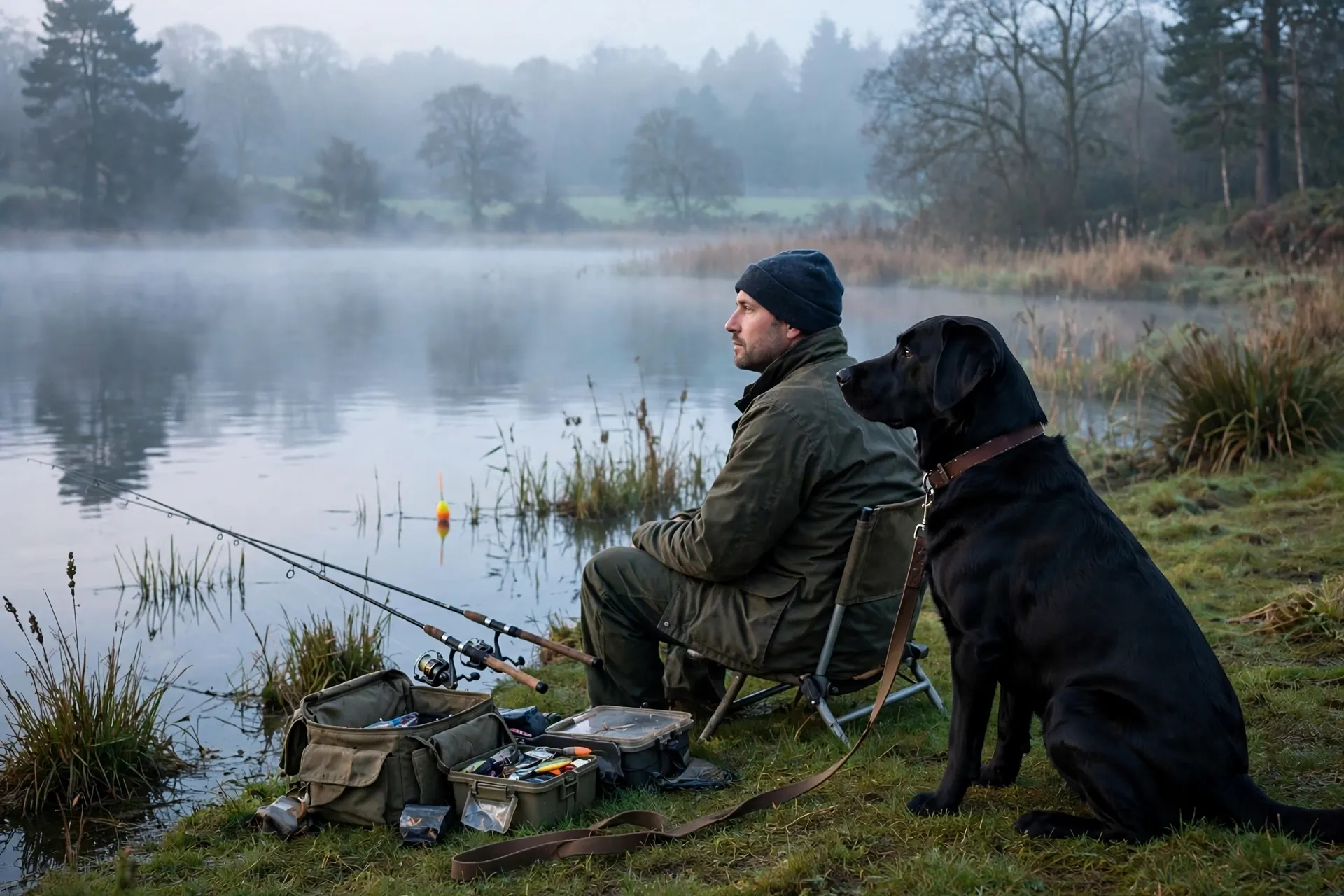
Choose where the dog sits with the same care. A dog on a mat or blanket a few metres back from the water, with its own water bowl and a chew or a settled toy, is far less likely to go exploring than a dog left to wander a peg while its owner watches a float. Keep the dog on a short lead near other anglers, and keep its nose out of tackle boxes, bait buckets and keepnets. If you are the angler, set up your own tackle on a mat or a tray rather than on open grass, and put every used hook straight into a safe container, such as a small lidded tub, instead of into a pocket or onto the ground. Anglers who fish with a dog soon learn that tidy tackle is dog safety, not fussiness.
Puppies and young dogs deserve extra caution. They explore with their mouths, they have not yet learned a reliable leave command under distraction, and they are small enough that a hook injury is proportionally more serious. Older dogs have a different vulnerability: stiff joints and slower reactions make them more likely to step awkwardly on uneven bank ground, and a dog with poor eyesight may not see line lying across a path. Dogs that scavenge habitually should be kept further from the water and on a shorter lead at a fishing lake than they would be on an open field walk, because the temptation is concentrated and the consequences are sharper.
If a hook goes in: first aid step by step
Stay calm, keep the dog still, and keep the lead on. A dog in pain will try to run, chew at the injury or pull away, and every one of those reactions makes a barbed hook worse. If you have a second person with you, ask them to hold the dog gently and speak quietly while you look. If you are alone, sit the dog down, loop the lead around something solid if it is safe to do so, or kneel with the dog between your knees so it cannot bolt. Do not chase a loose dog around a lake bank to look at a hook: a frightened dog running through pegs, lines and water is in more danger than a dog sitting still with a hook in its paw.
Look before you touch. A hook caught only in fur can often be eased out by parting the coat, and a hook resting on the surface of a pad without going in is a different matter from a hook that has gone through the pad or into a lip. If the hook is barbed, deeply embedded, in the mouth, tongue, ear or eye, or if the dog is in obvious distress, do not try to pull it out. Barbs catch on tissue, and pulling can tear the wound wider and leave part of the hook behind. Cover the area loosely with a clean cloth or a piece of gauze if the dog will tolerate it, stop the dog from licking or chewing at it, and phone a vet straight away. Note the name of the lake and the nearest access point so you can direct someone to you if needed, and if you are driving to a vet, keep the dog settled on a blanket rather than letting it hop around the car.
For a shallow hook that is clearly only in the outer skin or the very surface of a pad, and only if you are confident, you can snip the line or any attached trace free first so the dog cannot drag it, then leave the hook itself for the vet if there is any doubt at all. Some first-aid guides describe pushing a barbed hook through and cutting the barb off, but that is a technique for a calm patient in a clinic, not for a distressed dog on a muddy bank, and it risks a bigger wound and a bite. The safer course on the bank is always to stabilise and seek professional help. Even after a hook is removed, watch the wound for swelling, heat, discharge or lameness over the next few days, because hooks that have been in soil or water can seed infection, and a vet may want to prescribe antibiotics or check that no fragment remains.
Swallowed hooks are an emergency. If you see your dog swallow bait with a hook attached, or if you suspect it has, do not try to make the dog sick and do not feed it in the hope of cushioning the hook. Keep the dog calm, prevent it from eating or drinking further if a vet advises that by phone, and get to a vet as quickly as you safely can. Tell the vet what type of hook it may have been, if you know, and whether it was a single hook or a treble, because that affects the treatment. The same advice applies if the dog has eaten a large quantity of maggots, boilies or dead bait: phone the vet, describe exactly what was eaten and how much, and follow their advice rather than guessing at home remedies.
Your lakeside first-aid kit should reflect these realities rather than being a generic kit copied from a walking list. Pack tweezers for removing line or a surface hook from fur, a small pair of scissors, gauze and a bandage for covering a wound loosely, a torch for checking paws in poor light, and the phone number of the nearest vet saved in your phone before you arrive, not searched for in a panic afterwards. Add a muzzle or a makeshift muzzle, such as a soft lead loop, for use only if the dog is in pain and at risk of biting while you help it; a dog that has never been muzzled will resist one, so practise at home first. Check the official guidance before you travel if you want to confirm local veterinary arrangements, and keep the kit in the same bag as the dog's water and bowl so it is always to hand.
Tangled line and discarded tackle
Fishing line is almost invisible on grass and in shallow water, and that invisibility is what makes it dangerous. Monofilament line is thin, strong and hard to see, especially when it is wet or lying across a path in dappled light. A dog running through it can get a leg wrapped, and the more it struggles, the tighter the line pulls. In shallow margins, line left in the water can wrap around a paddling dog's legs or neck. Braided line is thinner still and can cut skin when pulled tight. Discarded line is also a wildlife hazard: birds and small mammals become entangled in it, which is one more reason to pick up every piece you find and to carry a small bag for litter on every lakeside walk.
The places where line collects are predictable once you know what to look for. Check the edges of pegs, the gaps between wooden platforms, the bases of reeds, overhanging branches where a cast has gone wrong, and the tideline of debris along the bank after wind or rain. Line often hangs from trees where an angler has snagged a cast, and a jumping dog can catch a dangling loop. After a busy weekend or a match, the ground near popular pegs deserves a closer look than a quiet weekday bank. If you find a tangle, do not pull it free with bare hands if it is tight or snagged: cut it carefully, gather the whole length, and bin it, because a half-removed tangle is still a trap for the next animal.
If line wraps around your dog, stop the dog first. Hold it still, speak calmly, and work the line off gently rather than yanking it. Check all four legs, the neck and the tail, because a dog that has been running may have picked up more than one loop. Look for redness, swelling or a thin cut where the line has pulled tight, and rinse the area with clean water if you can. A leg that stays swollen, a dog that keeps licking one spot, or any sign of a cut that is deeper than a graze deserves a vet check, because line can cut circulation or leave a wound that is easy to miss under fur. Keep the dog on a lead for the rest of the visit after a tangle, and walk it well away from the water before letting it run again.
Other discarded tackle deserves the same attention. Lead weights, known as split shot, are small, shiny and poisonous if swallowed, and they are easy for a dog to pick up from the ground. Feeder weights and method feeders are larger but still a hazard if a dog chews them. Plastic bait tubs, groundbait bags and food wrappers attract dogs and can cause blockages if chewed and swallowed. Swivels, beads and small metal clips are choking hazards for small dogs. The habit that protects against all of these is the same: scan the ground, keep the dog on a lead near pegs, and teach a reliable leave command at home, practised with boring items first and then with more tempting ones, before you rely on it at a lake.
Anglers can reduce the problem a great deal, and if you fish with a dog, you are in the best position to do so. Take a small bag for offcuts and broken line, and use it every time you tie a rig, not just when you remember. Dispose of line in a proper bin or take it home, because line left on the bank or dropped in the water persists for years. If you snap off in a tree or in the margins, make a reasonable effort to recover the line rather than leaving it, and warn nearby dog walkers if a snagged line is hanging where a dog could reach it. A lake where anglers and dog walkers look out for each other is a safer lake for everyone, including the wildlife.
Leads, swimming and bank rules
The lead rule at a fishing lake is usually stricter than on a country walk, and there are good reasons for it. A loose dog can run through a line of pegs, bark at bite alarms, splash into a swim where an angler has been quietly feeding fish for hours, steal bait, and knock a rod into the water. Any one of those is enough to spoil someone's day; together they explain why many fisheries insist on leads at all times, and why some ban dogs from the pegs entirely during matches. The default to adopt, even where the rules seem relaxed, is a short lead near the water and a longer walk somewhere else for exercise.
That longer walk matters. A dog that has had a proper run and a toilet break before it reaches the lake is far easier to settle on a mat than a dog that arrives full of energy and is immediately asked to lie still beside a float. Plan the visit so the energetic part happens first: a field, a woodland path or a quiet track away from the pegs, on a long line if the area is not secure, and then a calm arrival at the water. This also solves the toilet problem, because a dog that has already been will be less likely to foul a peg or a path, and you will have bags ready for the inevitable. Always carry more poo bags than you think you need, and bag and bin every deposit, including on grass that looks unused, because anglers kneel and sit on that grass.
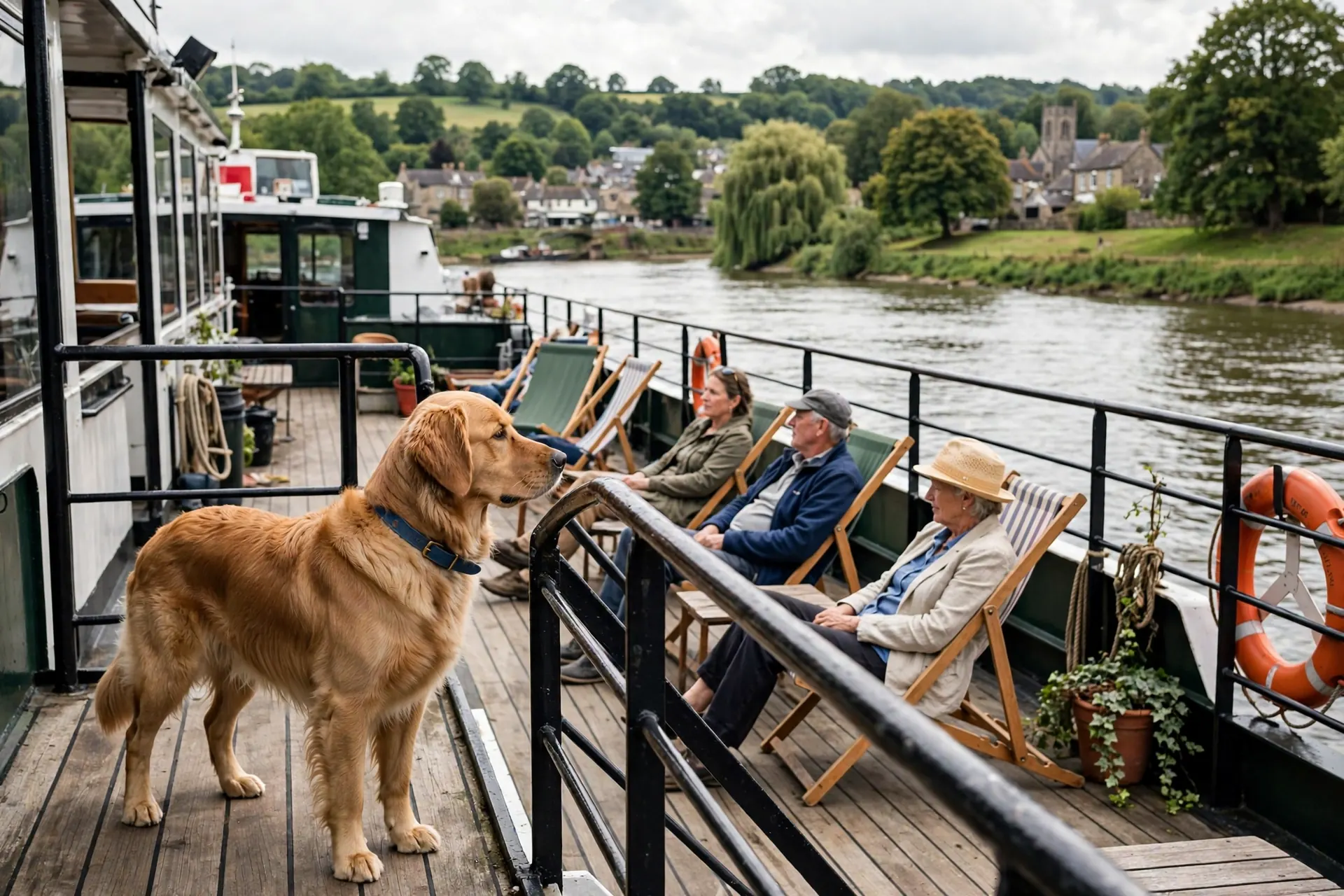
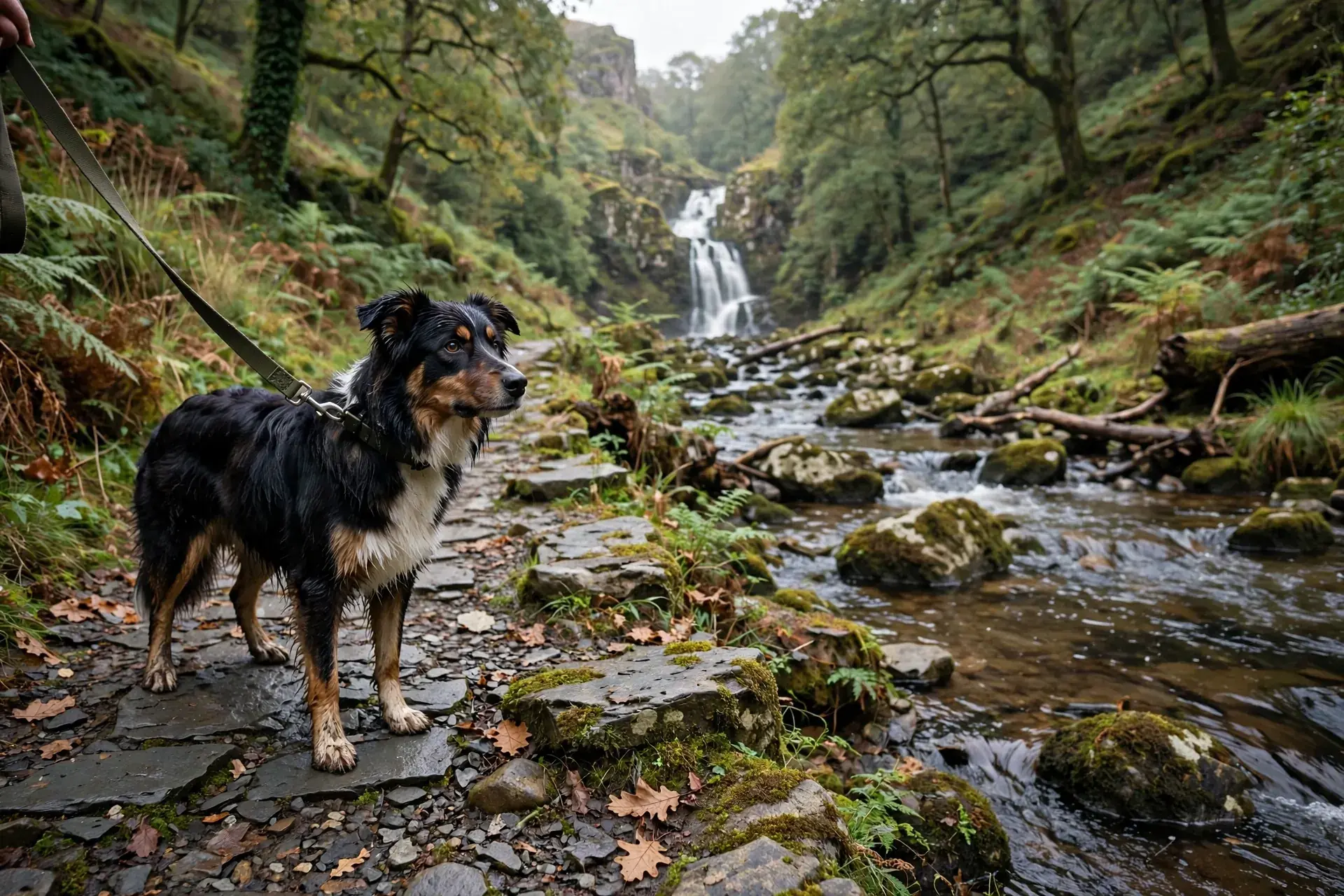
Swimming is the question most visitors ask, and the answer is that it depends entirely on the lake. Many commercial fisheries ban dogs from swimming because it disturbs the fish, muddies the water and risks tangles with lines and keepnets. Some natural lakes allow swimming in designated areas but not near fishing pegs. A few places tolerate a quick paddle at the margins but not a full swim. Never assume: ask the fishery, read the signs at the entrance, and if the answer is unclear, keep the dog out of the water. A dog that swims where it is not welcome can also pick up a hook or line in the margins on the way in or out, which brings the risk full circle. For a broader look at moving water, our guide to dogs on river cruises in the UK covers deck rules and life jackets, while the guide to dogs at waterfalls in the UK explains slippery rocks and safe viewing distances that also apply at steep lake outflows.
Bank rules beyond leads are worth reading in full, because they are often specific to the lake. Common conditions include dogs on leads at all times, dogs not allowed on wooden platforms or jetties, dogs not allowed in the water, dogs not allowed during matches, a maximum number of dogs per angler, and dogs to be kept away from other anglers' pegs. Some fisheries require dogs to be kept in the car during matches or in a designated area near the cafe. Others welcome dogs but ask that they are kept quiet, which is a real condition for a dog that barks at every bite alarm. If your dog barks persistently at water, birds or other dogs, a fishing lake may simply be the wrong venue for that dog on that day, and choosing a different walk is kinder than a stressful visit for everyone.
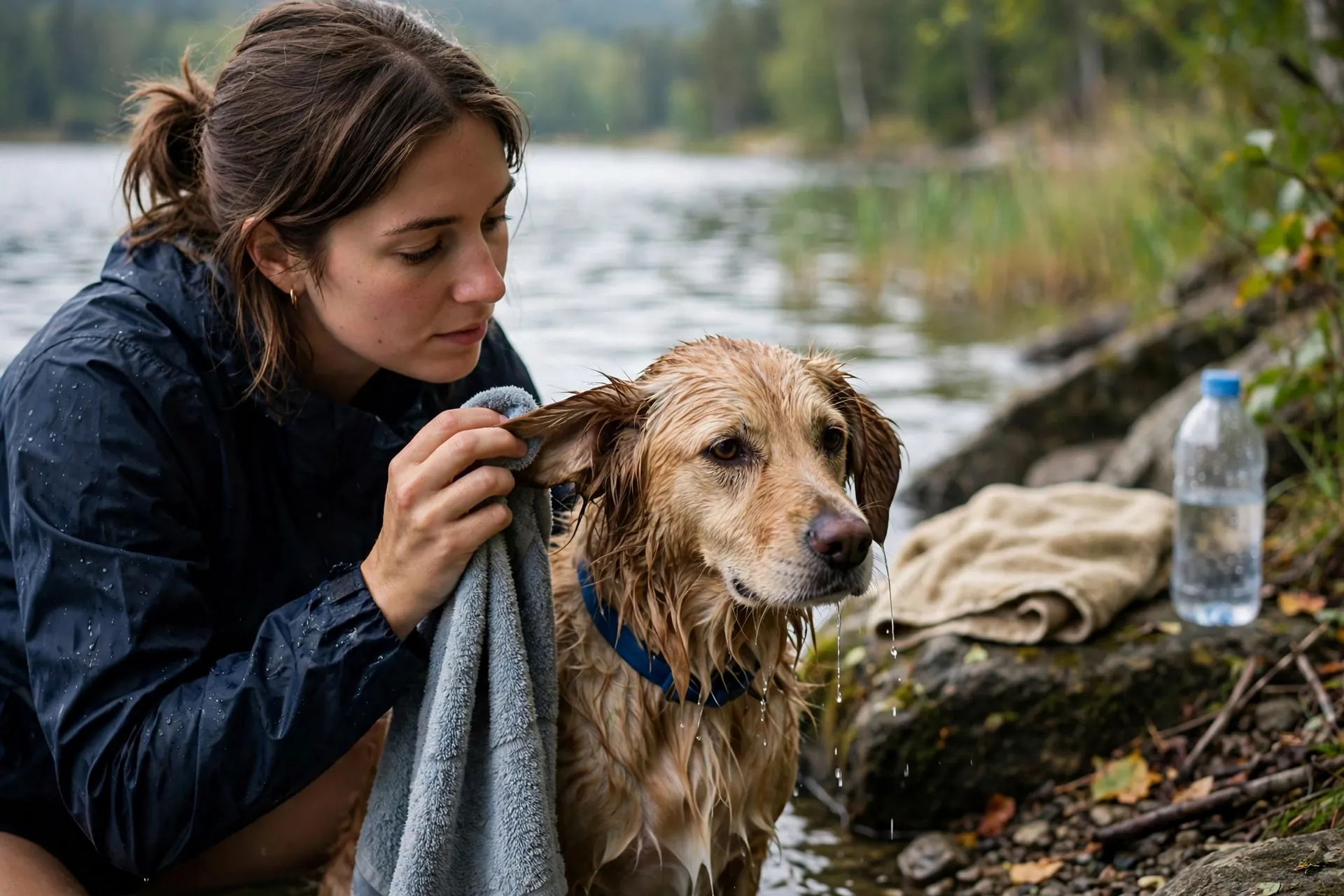
Consider the dog's own swimming ability and temperament honestly. Not every dog is a strong swimmer, and cold water, steep banks and soft mud at the exit point can trap even a confident one. A dog that cannot climb out of a lake on a steep or slippery bank can panic quickly, and a person who wades in to help can get into difficulty too. If swimming is allowed, choose a gently shelving entry, stay with the dog, keep the session short in cold weather, and towel the dog dry afterwards. A well-fitting buoyancy aid helps a dog that swims often or that tires easily, but it is not a substitute for supervision, and it should be introduced at home before it is relied on at a lake.
Blue-green algae and seasonal water risks
Blue-green algae, properly called cyanobacteria, is the water-quality risk that most concerns dog owners, and fishing lakes are not exempt from it. Blooms tend to appear in warm, calm, nutrient-rich water, often in late spring and summer and into early autumn, and they can appear and disappear quickly. The water may look like green paint, pea soup or a blue-green scum, and there may be streaks, clumps or foam along the bank. The toxins some blooms produce can cause vomiting, diarrhoea, drooling, weakness, breathing difficulty and, in severe cases, seizures or liver damage, and dogs are at particular risk because they drink from the water and then lick their coats dry, swallowing whatever was on them.
The rule for suspected algae is absolute: keep the dog out of the water, do not let it drink from the lake, and if it has already been in, rinse it with clean fresh water as soon as possible and stop it from licking its coat. Then phone a vet for advice, describing what the water looked like and how long the dog was in it, because early treatment matters and the signs can develop quickly. Do not wait for symptoms to appear before calling. If a lake has a warning sign about algae, treat it as current even if the water looks clear that day, because blooms move with wind and weather and a sign may be the most recent information available. Check the official guidance before you travel during warm spells, and be extra cautious after a hot, still week.
Algae is seasonal, but it is not the only seasonal water risk. After heavy rain, runoff can carry pollutants, fertiliser and animal waste into a lake, and the water near inflows and field drains is the most affected. In autumn, decaying leaves and low oxygen can change the water, and in winter, cold water itself is a risk for a dog that swims for too long. In summer, shallow margins warm up fastest and are where blooms often start, which is exactly where a dog wants to paddle. Spring brings nesting birds, and a dog that swims after waterfowl can disturb nests and may also be chased or pecked. Each season changes the lake, and the careful visitor checks the water on the day rather than relying on how it looked last time.
Drinking water is a separate but related point. A dog that has a bowl of fresh water available is much less likely to drink from the lake, so carry more water than you think you need and offer it often, especially on warm days. Collapsible bowls are light and easy to pack, and a bottle of water for the dog should be part of the standard kit, not an afterthought. If your dog insists on drinking from the lake despite a bowl being offered, keep it on a lead away from the margins and give it a drink before you reach the water, so thirst is not driving the behaviour. Dogs that have had stomach upsets after lake visits in the past should be kept out of the water altogether, and any vomiting or diarrhoea after a lake visit should be reported to a vet with the lake visit mentioned, because the connection is easy to miss.
Fishing etiquette: not disturbing the pegs
Angling is a quiet pursuit, and much of fishing etiquette is about protecting that quiet. A bite alarm, a splash, a shout or a dog barking at a passing duck can all break concentration, and on a match day the stakes are higher because people are competing. The basic courtesies are easy to follow: keep voices low near pegs, walk behind anglers rather than between them and the water, do not shine torches across the water at night, and never touch another angler's tackle, keepnet or catch. If an angler is playing a fish, give them space and keep the dog still until the fish is landed, because a loose dog at that moment is a recipe for a tangled line and a lost fish.
Distance is the simplest form of politeness. Do not set up your mat, picnic or dog right beside someone else's peg when there is open bank elsewhere, and do not let the dog wander from peg to peg saying hello. If you need to pass an angler, pass quietly on the landward side, keep the dog close, and avoid casting a shadow over the water or stepping on the bank edge where vibrations travel into the water. Fish are sensitive to bankside vibration, and a heavy footfall or a dog running along the edge can spook fish in the swim. On a busy lake, this also keeps your dog away from the greatest concentration of hooks and bait.
Noise deserves a special mention because dogs and bite alarms interact badly. A bite alarm is designed to be heard, and a dog that has never heard one may bark at it, try to investigate it, or become anxious. A dog that barks at every alarm on a lake with twenty pegs will not be popular, and an owner who cannot settle the dog should move further away or choose a different venue. Practise at home with recordings of unfamiliar sounds if your dog is noise-sensitive, and bring a chew or a lick mat to give the dog something calm to do while you sit. A settled dog is also a safer dog, because a dog lying on a mat is not exploring the bank for hooks.
Photographs and children need the same care. Ask before photographing another angler's catch, and keep children and dogs together under supervision rather than letting them roam the pegs independently. Children who want to see the fish should be taken to an angler who is happy to show them, not sent to peer into a keepnet uninvited. Keepnets themselves are a hazard: a dog that noses a keepnet can stress the fish, damage the net and get a mouthful of fish and hooks. Teach children, as well as dogs, that a keepnet is not to be touched, and keep both well away from it.
Finally, remember that anglers were there first in a practical sense: they may have paid for a day ticket, arrived at dawn and spent hours preparing a swim. Dog walkers are often welcome, but the welcome depends on behaviour. A walker who keeps a dog on a lead, picks up litter including line, keeps noise down and thanks an angler for local advice will be welcomed back. A walker who lets a dog swim through a match, bark at alarms and foul a peg will be remembered for the wrong reasons, and may contribute to a lake tightening its dog rules for everyone. Good etiquette is therefore not just politeness; it protects future access for all dog owners.
Picnics, parking and facilities
A fishing lake picnic works best when it is set back from the water and away from the pegs. Choose a flat spot on grass or a designated picnic area if the lake has one, lay out a blanket for people and a mat for the dog, and keep food in sealed containers until it is eaten. Dogs that can smell a picnic from ten metres away will try to reach it, and a dog that begs at other people's picnics is as unwelcome as a dog that begs at other people's pegs. Keep the dog's own food and water on its mat, and clear away every scrap afterwards, because food waste attracts rats and birds and can contain bones, foil or packaging that harm wildlife and dogs alike.
Parking at fishing lakes varies from a proper surfaced car park with a cafe and toilets to a rough field with a honesty box. Check before you go whether there is a parking charge, whether the car park is locked at a certain time, and how far the walk from the car to the water is, because a long walk with a dog, a picnic and fishing gear is a different trip from a short one. Never leave a dog in a car at a lake car park on a warm day, even for a short time, and remember that a car parked in sun near water can heat up fast while the owner is out of sight at a distant peg. If the car park is busy, keep the dog on a lead from the car onwards, because cars, reversing vehicles and excited dogs are a poor combination.
Facilities are worth checking in advance, especially for longer visits. Some fisheries have a cafe or a lodge that welcomes dogs, some have toilets and a tap for drinking water, and some have nothing at all beyond the lake and a car park. A tap for fresh water is valuable for both drinking and rinsing a muddy or algae-exposed dog, so note its location on arrival. Toilets matter for the people, and a lack of them changes how long a visit with children can comfortably last. If there is a cafe, ask whether dogs are welcome inside or only on a terrace, and respect the distinction, because a cafe that has had dogs inside may change its policy after one bad experience.
Access and mobility are part of the same planning. Many lake banks are flat and surfaced near the car park but become rough, muddy or steeply shelving further round, and wooden platforms can be slippery when wet and may have gaps that trap small paws. If your dog is older, very small or unsteady, choose a peg or a bank section close to the car park with a gentle slope, and avoid platforms with wide gaps unless the dog is comfortable on them. If you use a wheelchair or a pushchair, the same logic applies, and a phone call to the fishery about surfaces and gradients will save a wasted journey. Check the official guidance before you travel if access details are not published, because lake websites do not always describe the ground accurately.
Rain, mud and slippery banks
Rain changes a fishing lake more than it changes a field walk, because the ground that matters is the narrow strip between grass and water, and that strip is often clay, chalk or bare earth that becomes treacherous when wet. After rain, banks can be slick underfoot, platforms can be coated with algae or mud, and grassy slopes that were easy in dry weather can slide a dog straight into the water. A dog that slips into a lake from a steep bank may struggle to climb out, especially if the bank is undercut or the margins are deep, and a person who reaches in to help can slip in too. Treat wet banks as a different venue from dry banks, not as the same venue with worse weather.
Footwear and paws both need attention. Sturdy boots with good grip for the people, and a towel and a paw check for the dog, are the minimum. After a wet walk, check the dog's paws for cuts from stones, thorns or discarded tackle hidden in mud, and for mud packed between the toes, which can cause soreness and limping if left. Dogs with long fur between their toes collect mud and ice in cold weather, and a trim by a groomer can help, but do not cut matted fur at the lakeside with blunt scissors. A drying coat after a wet visit keeps the dog warm on the journey home and protects the car, and a second towel for the car boot is rarely wasted.
Mud also hides hazards. A hook lying in wet mud is harder to see than one on dry grass, and line in muddy water is invisible. After rain, do the bank scan even more carefully, and keep the dog on a lead near the water until you have checked the ground. Avoid the steepest sections altogether in wet weather, and choose a flatter, grassier part of the bank if one exists. If the whole bank is slippery, a shorter visit, or a different walk that day, is a sensible choice rather than a test of nerve. Dogs do not mind a shorter visit; they mind a fall into cold water.
Water levels rise after rain, and that brings its own changes. Inflows become faster, margins that were shallow become deep, and paths near the water can flood. A dog that paddled happily at a margin last week may find the same spot deep and fast-flowing this week, and a path that was dry may now be under water with a hidden drop. Keep the dog well back from inflows and outflows after rain, and do not let it swim in a lake that is visibly in spate or where the water is brown and fast. If you are unsure about conditions, ask the fishery or check the official guidance before you travel, and remember that a lake can look calm on the surface while the margins are dangerously soft underneath.
Commercial fisheries
Commercial fisheries are purpose-built still waters, usually stocked with carp, tench, bream, roach and similar coarse fish, and they are the most common type of fishing lake a dog walker will meet. They are also the most rule-bound, because they are businesses with day tickets, matches and regular anglers whose expectations are clear. Dog rules at a commercial fishery are typically written down on the website or on a sign at the entrance, and they are worth reading in full rather than assuming from another fishery. A fishery that welcomes dogs will usually say so explicitly, and will often specify leads, pegs and swimming in the same paragraph.
The layout of a commercial fishery shapes the dog visit. Pegs are numbered and often spaced regularly around the lake, with wooden platforms at many of them, a car park nearby, and sometimes a lodge, a cafe and toilets. The paths between pegs are usually maintained, which helps with pushchairs and older dogs, but the platforms themselves can be a problem: gaps between planks, slippery surfaces when wet, and a drop into the water at the front. Keep a small dog off platforms unless you are sure of the footing, and keep any dog on a lead on a platform, because a dog that steps off the front is in the water among lines and keepnets before anyone can react.
Matches change the rules temporarily, and this catches visitors out. On a match day, a fishery may be fully booked, may restrict dog walkers to certain areas, or may ask that dogs are kept in cars or away from the lake entirely. Match anglers are fishing to a time limit and a weigh-in, and a loose dog is a serious disruption. Check the fishery's match calendar before you go, and if you arrive to find a match in progress that you did not expect, be gracious about moving to a different part of the lake or a different venue. The fishery's regulars will remember the courtesy, and the fishery is more likely to stay dog-friendly.
Day tickets, memberships and prices also affect the dog visit, because a dog walker who is not fishing may still need to pay for parking or may be asked to stay to public paths. Some fisheries allow non-angling visitors free of charge, some charge a small fee, and some restrict access to ticket holders only. If you are accompanying an angler, confirm whether you and the dog are covered by their ticket or need a separate arrangement. If you are only walking the dog, confirm that walkers are welcome at all, because some fisheries are fishing-only and a dog walker may be asked to leave, which is an awkward end to a planned day.
Natural lakes and meres
Natural lakes, meres and lochs are wilder than commercial fisheries, and the dog visit is wilder too. The banks may be reed-fringed, uneven and unmaintained, the water may be deeper close to the edge, and the rules may be set by a landowner, a nature reserve or a local authority rather than by a fishery business. Some natural lakes are in nature reserves where dogs must be on leads during bird breeding season, or where dogs are excluded from certain areas altogether to protect ground-nesting birds. These restrictions are not anti-dog; they protect wildlife that has nowhere else to go, and they are often seasonal, so a lake that is restricted in May may be open in October.
The hazards of a natural lake overlap with those of a commercial fishery but add a few of their own. Reeds and rushes hide hooks and line just as effectively as grass, and they also hide deep mud and soft ground that can trap a dog's legs. Waterfowl, including swans, geese and ducks, are more numerous and more defensive during breeding season, and a dog that chases them can be attacked or can disturb a nest. Adders bask on sunny banks in spring and summer in some areas, and a dog that noses into warm grass or under a bankside stone can be bitten. Ticks are common in lakeside vegetation, so check the dog after every natural lake visit and remove any ticks promptly with a proper tick remover.
Access to natural lakes is often by public footpath or permissive path, and the right of way may run along only part of the bank. Respect signs, keep to paths where they are marked, and do not assume that because you can reach the water you are welcome to let the dog swim there. Some natural lakes are drinking water sources or have conservation designations that restrict swimming for people and dogs alike. If the lake is part of a nature reserve, look for the reserve's own guidance, which will usually cover dogs, leads, seasonal restrictions and swimming in more detail than a general walking guide, and check the official guidance before you travel if the reserve's rules are not clear.
The reward of a natural lake, when the rules allow it, is a quieter and more varied walk than a commercial fishery can offer. Reed beds, open water, woodland edges and meadows in a single circuit give a dog far more to sniff and explore, and the birdlife is a genuine attraction for the people too. The best visits combine the two: a careful, lead-controlled circuit of the lake for exercise and interest, and a settled stop at a safe, flat spot for a picnic and a rest. Keep the dog out of reed beds during breeding season, keep it on a lead near nesting areas, and leave the lake as you found it, including any line or litter you find on the way round.
Reservoirs and large still waters
Reservoirs are the largest still waters most dog walkers will meet, and they bring scale, wind and water-company rules that smaller lakes do not. Many reservoirs have well-maintained circular paths, car parks, cafes and visitor centres, and they are popular for family walks, cycling and running as well as fishing. Dogs are usually welcome on the paths, often on leads, but swimming is commonly banned, both for safety and because the water is a public supply. A reservoir that looks like a lake is not necessarily managed like one, and the rules may be set by the water company rather than by a fishery, so check them specifically.
Wind and waves are a real factor on a large reservoir. A dog that paddles happily on a small lake may face waves, a stony shore and a long fetch on a reservoir, and a dog that swims out in wind can tire quickly and struggle to return. Steep, concrete or rip-rap banks, common on reservoirs, are difficult for a dog to climb out on, and the water can be deep very close to the edge. For these reasons, even where swimming is not explicitly banned, it is often unwise, and a lead-controlled walk around the reservoir with a paddle only at a gently shelving, designated spot is the safer choice. Keep the dog away from dam walls, overflow structures and intake towers, which are dangerous and usually fenced for a reason.
Reservoir paths are often shared with cyclists, runners and horse riders, so lead control and awareness matter in a different way from a quiet fishery. Keep the dog on a short lead on busy sections, step to the side for cyclists, and be ready for a cyclist appearing silently from behind. Some reservoirs have designated dog-off-lead areas or nearby fields where a dog can run, and using those for exercise before a lead-controlled circuit is the same good practice as at a fishery. Check for seasonal restrictions, such as lambing or bird breeding closures on surrounding land, and for algae warnings, which apply to reservoirs just as they do to smaller lakes.
Fishing on reservoirs is often by permit or by club water, and the fishing areas may be separate from the main walking paths. If you walk a dog through a fishing area on a reservoir, the same etiquette applies as at a commercial fishery: keep the dog on a lead, keep noise down, do not disturb pegs, and do not let the dog swim through a fished area. Some reservoir fisheries allow bank fishing only at certain times or in certain bays, and a dog walker who strays into a fished bay during a competition will be as unwelcome as at any other match. A quick check of the reservoir's fishing information before you go prevents that awkwardness.
The lakeside packing checklist
A fishing lake visit is easier when the dog's kit is packed the night before, because the things you forget are usually the things you need on the bank. Start with the lead: a short lead for pegs and paths, and a long line for a safe run away from the water. Add a harness if your dog pulls, because a harness gives better control on a slippery bank than a collar, and a dog that lunges after a duck is harder to hold on a collar. Pack a mat or blanket for the dog to settle on, a chew or a lick mat for calm occupation, and a familiar toy that is not so exciting that it causes barking or chasing.
Water and food come next. Carry a bottle of fresh water for the dog and a bowl, plus a small amount of the dog's normal food or treats if the visit will span a mealtime, but keep treats in a sealed container so the dog cannot smell them constantly. Pack poo bags in generous numbers, a small bag for litter including line, and a towel for muddy paws and wet coats. A drying coat is valuable in cold or wet weather, and a spare lead is a small item that saves a ruined day if the first one breaks or gets tangled beyond repair. For summer, add a shade cloth or a pop-up shelter if you will be sitting in open sun, because a dog on a mat in direct sun overheats faster than its owner.
First aid and safety complete the kit. Tweezers, scissors, gauze, a bandage, a torch and the nearest vet's number are the core, as described earlier, and a tick remover is a wise addition for natural lakes and reed-fringed banks. Add any medication the dog normally takes, in its original packaging, and a copy of the dog's vaccination record if you are visiting a fishery or a venue that asks for it. A phone charger or a power bank is practical for a long day, because a phone with a dead battery cannot call a vet or find the nearest practice. Finally, pack a change of clothes or at least a dry top for yourself, because a lakeside day with a dog often ends with someone muddy, wet or both, and the journey home is pleasanter when the mud stays in the boot.
Before you leave, run through the visit in your head: car park and access, the bank scan, the dog's settling spot, the toilet walk, the water check, and the journey home. If any part of that plan depends on a rule you have not confirmed, such as swimming, off-lead exercise or cafe access, confirm it before you set off. A fishing lake is a wonderful place for a dog when the hazards are understood and the rules are respected: still water, open skies, long sniffs along the bank and a settled afternoon beside the rods. The work that makes it wonderful is small, unglamorous and mostly done before you reach the water, which is exactly why it is worth doing.
Practical questions
Before you go
Can dogs swim in fishing lakes in the UK?
Sometimes, but never assume it. Many commercial fisheries ban swimming outright because it disturbs fish and anglers, while some natural lakes allow it in places. Ask before you go, keep the dog on a lead until you have a clear answer, and never let a dog swim near lines, keepnets or other anglers.
What should I do if my dog steps on a fish hook?
Keep the dog still, keep the lead on, and do not pull the hook out if it is barbed or deeply embedded. Cover it loosely, stop the dog from chewing at it, and call a vet for advice straight away. If the hook is only caught in fur or in the very surface of a pad, you may be able to snip the line free, but a vet visit is still wise because hooks carry bacteria.
Are dogs allowed at commercial fisheries?
Many are, but the rules vary a lot. Some welcome dogs on a lead at every peg, others allow them only in the car park or cafe area, and a few ban them entirely during matches. Check the fishery website or phone ahead, and check the official guidance before you travel if anything is unclear.
How do I spot blue-green algae at a lake?
Look for water that looks like green paint, pea soup or a blue-green scum on the surface, especially in warm, still weather. Blooms can also appear as streaks or foam along the bank. If you suspect it, keep the dog out of the water, do not let them drink from the lake, and rinse them if they have already been in.
Should my dog stay on a lead around anglers?
Yes, as a default. A loose dog can walk into a backcast, steal bait, bark at a bite alarm or pull a rod into the water. A short lead near pegs, and a longer walk well away from the water before you settle, keeps everyone calm.
What should I pack for a dog at a fishing lake?
Pack a short lead, a long line for a safe walk away from the pegs, fresh drinking water and a bowl, towels, a first-aid kit with tweezers and a phone number for the nearest vet, poo bags, a mat or blanket for the dog to settle on, and a drying coat for wet or cold days.