This guide is independent and contains no paid placement. If affiliate links are added later, they will be clearly marked and will not change our editorial checks.
There is no single rule for dogs in charity shops in the UK. Most charity shops are run by volunteers and each branch sets its own policy, so read the sign at the door or ask a volunteer before you step inside. Keep the lead short, the visit brief and the dog close, and plan the trip in three parts — before, inside and after — so a refused entry never strands you.
Before you go: read the door first
A charity shop is not like a supermarket or a chain cafe. Most charity shops in the UK are run day to day by volunteers, often in a rented high-street unit that was never designed as a shop at all. The person behind the till may be giving up a morning a week, the stock may have arrived in bin bags that morning, and the floor plan may have grown organically around whatever furniture was donated. That is exactly what makes these shops such good hunting grounds for bargains and odd finds, and it is also why dog rules vary so much from one door to the next. There is no head office memo that covers every branch, and no national sign that tells you, once and for all, whether dogs are welcome.
The practical consequence is simple: never assume. A shop that welcomed your spaniel last month may have a new manager, a new volunteer rota or a new insurance note this month. A shop that turned dogs away last year may have changed its mind after a refit opened up the floor. The only reliable answer is the one at the door on the day. Look for a sign in the window, check for a sticker on the glass, and if there is nothing to read, ask. Volunteers are used to the question and would far rather answer it than deal with a surprised dog tangled in a rail of coats. Asking also sets the tone for the whole visit: you are a guest in a space that other people keep running for free, and a polite question costs nothing.
It helps to understand why the answer varies. Charity shops balance three things that do not always pull in the same direction. First, they want footfall, and dog owners are loyal high-street shoppers who browse slowly and come back often. Second, they have a duty of care to volunteers, many of whom are older, and to customers who may be nervous around dogs, allergic, or unsteady on their feet in a crowded aisle. Third, their stock is fragile and irreplaceable: a single wagging tail can knock a shelf of donated china onto a hard floor, and unlike a chain store they cannot simply reorder the item. Every branch weighs those three things differently, and the balance shifts with the size of the shop, the layout of the floor and the confidence of the people on duty that day.
Assistance dogs sit outside this whole calculation. Under the Equality Act 2010, service providers in England, Scotland and Wales must not refuse entry to an assistance dog without a lawful reason, and that includes charity shops. If you travel with an assistance dog, the door sign for pet dogs does not apply to you in the same way, although a short, calm explanation still helps when a volunteer is unsure. The rest of this guide is written for pet dogs, where the shop has genuine discretion and the right answer is the one the branch gives you.
One more thing to settle before you leave home: the dog you bring matters as much as the shop you enter. A charity shop is a small, busy, scent-rich room full of strangers, hanging clothes at nose height and breakable things at tail height. A dog that can walk calmly on a loose lead, settle at your feet for a few minutes and ignore dropped food is a good candidate. A dog that pulls, jumps up, barks at strangers or marks indoors is not ready for this particular outing yet, and that is fine — charity shops will still be there after a few more weeks of training. Be honest about which category your dog falls into today, not the category you hope they will reach by Christmas.
Chain shops versus independent shops
The big names on the high street — the national health, hospice, animal and children's charities — look uniform from the outside, but their dog policies usually are not. Most large charity retailers give individual branches a great deal of freedom on day-to-day questions like this, because the branches know their own floors, their own volunteers and their own regulars. One branch of a national chain may have a cheerful "dogs welcome" sign in the window, while another branch of the same charity three streets away in a different town asks dogs to wait outside, simply because its shop is half the size and its aisles are half as wide. The chain name is therefore a weak predictor, and anyone who tells you that a particular chain "always" or "never" allows dogs is almost certainly generalising from one or two branches.
That said, there are patterns worth knowing. Larger charity shops, including the big furniture and electrical branches on retail parks, tend to have wider aisles, more open floor space and staff rather than volunteers on the till, which often makes a calm dog easier to accommodate. Bookshops run by charities are a mixed case: the stock is sturdy, but the aisles between tall shelves can be very narrow, and a large dog can block the whole passage. Specialist charity shops — vintage clothing, bridal, music or antiques — tend to be the strictest, because their stock is high value, closely packed and easily damaged. None of this is a rule, only a starting guess to test at the door.
Independent charity shops, which raise money for a local hospice, animal shelter, church or community project, are a different experience altogether. The person who decides the dog policy is often the person standing behind the counter, and the decision is personal rather than procedural. Many independent shops are noticeably more relaxed: the manager knows the regulars by name, the dog may already be a familiar face, and a "well-behaved dogs welcome" sign is as likely to be handwritten as printed. The trade-off is that these shops are usually smaller, sometimes a single narrow room, so the physical space is the limiting factor even when the welcome is warm. A friendly "come in" does not create extra floor space, and a large dog in a tiny shop is still a large dog in a tiny shop.
Independent shops also vary more by mood and moment. A shop that is happy to welcome a dog on a quiet Tuesday morning may ask the same dog to wait outside on a busy Saturday when the till queue reaches the door. That is not inconsistency; it is a volunteer making a judgement about the room in front of them. The sensible response is to accept the judgement gracefully and come back at a quieter time. Regulars have a real advantage here: if the volunteers recognise you and your dog, the conversation starts from trust rather than from scratch, and trust is what turns a one-off "maybe" into a standing welcome.
When you are travelling rather than shopping locally, do not rely on a chain name or a listing site to settle the question. Policies change when shops move premises, refit, or change manager, and third-party listings go stale quickly. If a particular shop matters to your day — perhaps it is the one with the book section you collect, or the vintage shop you have driven an hour to reach — check the official guidance before you travel, and have a backup plan for the dog if the answer is no. A five-minute check before you set off is worth far more than a disappointed dog and a wasted journey.
Before you enter: the two-minute check
Think of every charity shop visit as having three parts — before, inside and after — and the first part takes about two minutes. Start outside, not at the till. Walk the dog past the shop first and look through the window. How wide are the aisles? Is the floor crowded with rails, tables and baskets, or is there a clear path? Are there breakables at tail height near the entrance? Is there a queue at the till that already blocks the doorway? That thirty-second look tells you more than any policy statement, because even a dog-friendly shop can be a bad idea on a day when the floor is packed with new stock.
Next, read the door. Many shops that welcome dogs say so plainly with a sign or a sticker, and many that do not will say so too. If there is no sign, ask. A simple "Is it all right to bring my dog in on a lead?" is enough, and it is worth asking even when you are fairly confident of the answer, because it gives the volunteer a chance to add a condition — "yes, but please keep him away from the china shelf" or "yes, but we are very busy, so just a quick look." Those conditions are useful information, not obstacles. If the volunteer hesitates, treat the hesitation as an answer and offer to wait outside instead. Pressing a reluctant volunteer rarely ends well for anyone.
While you are still outside, settle the dog. This is the part most people skip, and it is the part that makes the difference between a calm five minutes and a chaotic one. Give the dog a toilet break before you go in, not after, and let them sniff the street for a minute so the shop is not the first interesting thing they have met all morning. Offer water if it is warm. Shorten the lead to a length that keeps the dog beside you rather than two metres ahead, and put away anything dangling — a long-line, a retractable lead on full extension and a bag of treats swung at dog height are all hazards in a small shop. If you carry a portable water bowl and a small mat, keep them in your bag until you are settled; you do not need them in your hands at the door.
Finally, decide what you are actually going in for. Charity shops reward browsers, but a dog does best with a short, purposeful visit: one rail, one shelf, one section, then out. If you want a long, slow browse through every rail, that is a visit to make without the dog, or to split between two people. Knowing your target before you cross the threshold keeps the visit short, keeps the dog calm and, paradoxically, makes you a better shopper — you notice the good things faster when you are not also managing a restless animal.
Inside the shop: narrow aisles and fragile stock
Once you are inside, the geography of a charity shop works against dogs in a way that a supermarket or a garden centre does not. The aisles are narrow because the shop is small and the stock is dense. Clothes hang at dog-nose height, which means every rail is a wall of smells. Shelves of glass, china, ornaments and picture frames sit at tail height, often on wobbly tables rather than fixed shelving. Baskets of bric-a-brac sit on the floor. Other shoppers squeeze past with bags and pushchairs, and children dart between rails. None of this is a reason to stay away; it is a reason to move slowly and deliberately, as if you were carrying a tray of glasses yourself.
The single most useful rule is to keep the dog between you and the wall, or between you and the rail, rather than out in the aisle where tails and leads cross other people's paths. Walk the dog on your inside side, close to the stock you are looking at, so the dog is never trailing behind you into the path of someone coming the other way. When you stop to look at something, ask the dog to sit or stand at your feet rather than wandering to the end of the lead. A dog that is settled at your feet is a dog that cannot knock over the shelf behind you, and it is also a dog that other shoppers can step around without a negotiation.
Watch the tail. It sounds trivial until you have seen a happy Labrador clear a shelf of donated mugs with one wag. Large and long-tailed breeds need more space than the aisle offers, so position the dog facing the rail with its tail towards you, or stand in a wider spot — near the till, by the door or at the end of a row — while you look at the fragile things. If a section is entirely glass and china with barely room to turn around, skip it with the dog and come back another time, or ask your companion to hold the dog in the wider part of the shop while you look. Nobody will think less of you for it; volunteers notice careful owners and remember them.
Food is the other quiet hazard. Charity shops do not sell food, but shoppers drop it, children carry snacks, and donated hampers and kitchenware can smell strongly of their previous contents. A dog that scavenges will find something on a charity shop floor eventually, and some of it — chocolate, cooked bones, old sweets — is genuinely dangerous. Keep the dog's nose off the floor with a short lead and a "leave it" you have actually practised, and if your dog is a determined scavenger, a basket muzzle for the duration of the visit is a sensible, unembarrassing precaution. Most volunteers will understand it immediately.
Remember that the shop is also someone's workplace, and often an unpaid one. Do not let the dog jump up at the counter, sniff the till area or lean on the volunteer sorting donations. Keep the dog away from the back room and the sorting tables, which are out of bounds for customers with or without dogs. If the dog has an accident, deal with it immediately, apologise, and offer to pay for anything damaged — volunteers remember owners who take responsibility far longer than they remember the accident itself. A small clean-up kit in your bag — a few bags, a small cloth and a spare wipe — turns a mortifying moment into a thirty-second tidy-up.
Leads, waiting spots and taking turns
The lead is the whole system in a charity shop: it is your steering, your brake and your signal to everyone else that the dog is under control. Use a short, fixed lead, not a retractable one. A retractable lead on a charity shop floor is a trip wire stretched across a narrow aisle at ankle height, and it invites the dog to wander three metres away while you believe you still have them under control. A lead of about a metre, held with the dog beside you, gives you real control and gives other shoppers a clear, readable picture of where the dog is and where it is going.
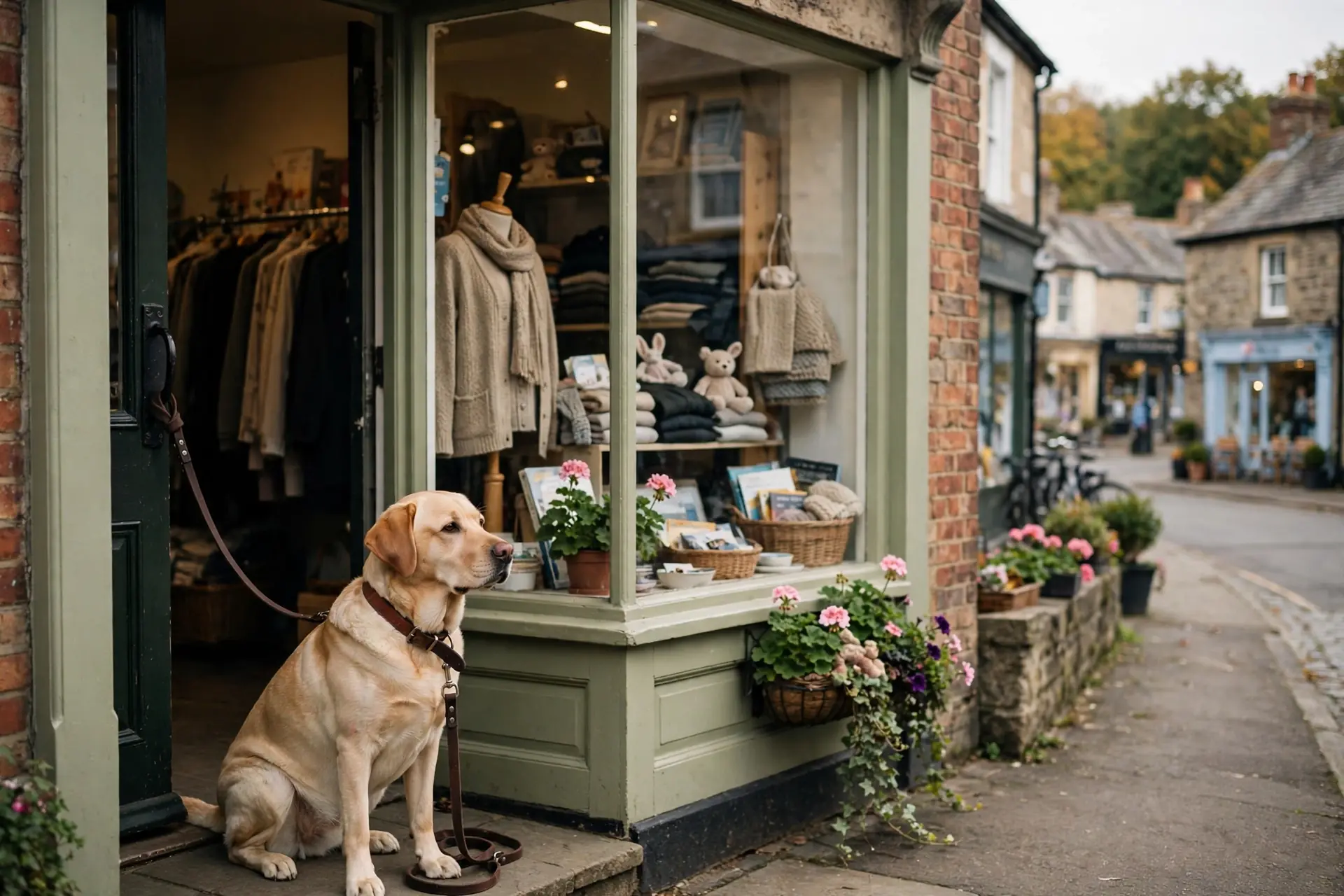
Never tie a dog to anything outside a charity shop and walk away. It is tempting when the shop says no and you only want two minutes inside, but a dog tied outside a shop is a dog that can be stolen, frightened by a passing dog or a loud vehicle, tangled around a drainpipe, or simply distressed while you are out of sight. The same applies to railings, lamp posts, benches and bicycle stands, none of which were designed as dog parking. If the dog cannot come in and cannot wait with a person you trust, the visit does not happen today. That is not a failed trip; it is the trip working as it should.
Taking turns is the method that makes charity shop browsing properly enjoyable with a dog. If you are out as a pair, one person browses while the other waits with the dog, then you swap. The waiting person can sit on a nearby bench, stand in a doorway out of the wind, or wander slowly along the street so the dog keeps moving and sniffing. The browsing person gets the unhurried look through the rails that charity shops deserve, and the dog gets a calm wait rather than a cramped five minutes. Many of the best charity shop finds are made by people who were not also trying to manage a lead.
If you are on your own, keep the visit short and choose your moment. A quiet weekday morning is a different shop from a busy Saturday afternoon, when the aisles are full, the till queue is long and every volunteer is occupied. Mid-morning on a weekday, just after opening, is often the sweet spot: the shop is tidy, the volunteers have time to talk, and there is room to move. Saturday afternoons, school holidays and the days after a big donation drive are the times to leave the dog at home or to plan a different kind of outing altogether.
Waiting spots deserve a little thought too. A good waiting spot is shaded in summer, sheltered in rain, away from the road and out of the main flow of pedestrians. A bench in a side street, the doorway of a closed shop or a quiet corner of a square all work better than the pavement directly outside the charity shop door, where every entering and leaving customer has to step around your dog. If you are waiting with the dog while your companion browses, a short wander is usually kinder than a long sit: a dog that is moving and sniffing is a dog that is occupied, and an occupied dog waits happily for far longer.
Donating items while your dog is with you
Many charity shop visits with a dog start the other way around: you are not going in to buy, you are going in to drop off a bag of donations, and the dog is in the car or on the lead because it is part of the errand run. Donations deserve their own plan, because the drop-off is a different task from browsing and it brings the dog into contact with the busiest, most cluttered part of the shop — the sorting area, the back room and the doorway where bags pile up.
First, check where donations go. Some shops take them at the till, some have a marked donation point by the door, and some ask you to use a side door or a back entrance at certain hours. Do not carry bags through a crowded shop floor with a dog on a lead if there is a simpler route; ask first and follow the volunteer's direction. Keep the dog well away from the sorting tables and the back room, which are working areas full of sharp objects, cleaning products and bags that other people have just handled. A dog that plunges its nose into a donation bag is not being naughty, but it is in the wrong place.
Second, keep the handover quick and contained. Carry the bags yourself rather than trying to manage bags and a lead in the same hand, and if you have a companion, let them hold the dog outside or in the wider part of the shop while you hand the donations over. If you are alone, put the dog in a sit-stay at your feet, hand the bags over, and leave. This is not the moment for a long browse: the dog has already done its waiting, the volunteers are busy with your bags, and the floor behind you is full of other people's donations. Come back another day to browse, when the dog can have your full attention.
Third, think about what is in the bags. Donated clothes, books and household items can carry smells, food traces and small objects that interest a dog far more than they interest you. Keep bags tied or zipped until they are handed over, and do not let the dog investigate an open bag on the pavement while you wait. If you are clearing out a house and the bags contain anything the dog should not eat or chew — medicines, old food, small batteries, cleaning products — keep those bags separate and out of reach entirely. A donation run is a good deed; it should not become a vet visit.
Finally, remember that some shops limit donations at busy times or stop taking them when the sorting area is full. A quick check before you travel saves you carrying bags around the high street with a dog in tow, and it saves the volunteers the awkward job of turning you away at the door. If the shop cannot take your donations that day, ask when would be better, and note it down. Volunteers appreciate donors who ask, and they remember the ones who arrive with a car full of bags at closing time on a Saturday.
Community charity shop etiquette
Charity shops are community spaces in a way that chain stores are not, and the etiquette is closer to visiting someone's front room than to shopping in a supermarket. The volunteers know the regulars, the regulars know each other, and a new face with a dog is noticed. That is not a warning; it is an opportunity. A dog owner who behaves well in a charity shop becomes part of that small community very quickly, and the rewards are real: a volunteer who sets aside the book you collect, a tip about which day the new stock goes out, a chair offered to an older dog on a cold morning.
The etiquette itself is mostly common sense, applied with a little more care than usual. Greet the volunteers when you come in, and say goodbye when you leave. Ask before you let the dog sniff the stock closely, and never let the dog climb onto furniture, lie on a donated rug or nose through a rail of clothes at face height. Keep your voice low and your movements slow; charity shops are quiet rooms, and a loud voice carries further than you think. If another customer is nervous around dogs, give them space without making a fuss about it — a small step to one side and a short "he is friendly, but I will keep him close" is enough.
Children deserve particular care. Charity shops attract families, and a small child at dog-nose height is exactly the person your dog is most likely to greet enthusiastically. Do not assume a child wants to meet your dog, however friendly the dog is, and do not let the dog approach a child uninvited. If a child asks to stroke the dog, check with the parent first, keep the meeting brief, and keep the dog calm and still. A good first meeting with a dog in a charity shop is a memory a child keeps; a bad one is a reason a family avoids the shop.
Buying something matters, even if it is small. Charity shops run on thin margins, and a dog owner who browses for twenty minutes and buys nothing is using volunteer time and floor space for free. You do not need to buy something every time, but if you are a regular, a small purchase now and then — a book, a mug, a scarf — is the simplest way of saying thank you, and it keeps the welcome warm for the next dog owner who comes through the door. If you find something you love, say so; volunteers light up when a donated item finds a good home.
And when something goes wrong, own it quickly and graciously. Dogs knock things over, pull leads at the wrong moment and occasionally choose the worst possible place for a toilet break. Volunteers have seen all of it before, and what they remember is not the accident but the response. Apologise, clean up, offer to pay for damage, and do not argue about whether the shelf was wobbly in the first place. A graceful apology costs nothing and buys a great deal of goodwill, including, very often, an invitation to come back.
Planning a route around a cafe stop
A charity shop crawl works best as part of a wider high-street day, not as a standalone mission. The shops cluster together — a typical market town might have four or five within a few minutes' walk of each other — and the spaces between them are where the dog gets its exercise, its toilet breaks and its sniffing time. Plan the route so that the dog's needs come first and the shopping fits around them, rather than the other way around. A dog that has had a proper walk before the first shop, and a proper break between shops, will behave far better in the third shop than a dog that has been dragged from door to door without a pause.
Start with the walk. Most British high streets sit within a short distance of a park, a riverside path, a churchyard or a green, and a twenty-minute loop before you start shopping changes the whole morning. It takes the edge off the dog's energy, gives them a toilet break and lets them settle into the rhythm of the town. After the walk, work through the shops in a loose order, leaving the dog outside with a companion for the ones that are small or strict, and bringing the dog into the ones with space and a welcome. Keep each in-shop visit short — ten minutes is plenty — and build in a pause on a bench or a green between shops so the dog can rest and reset.
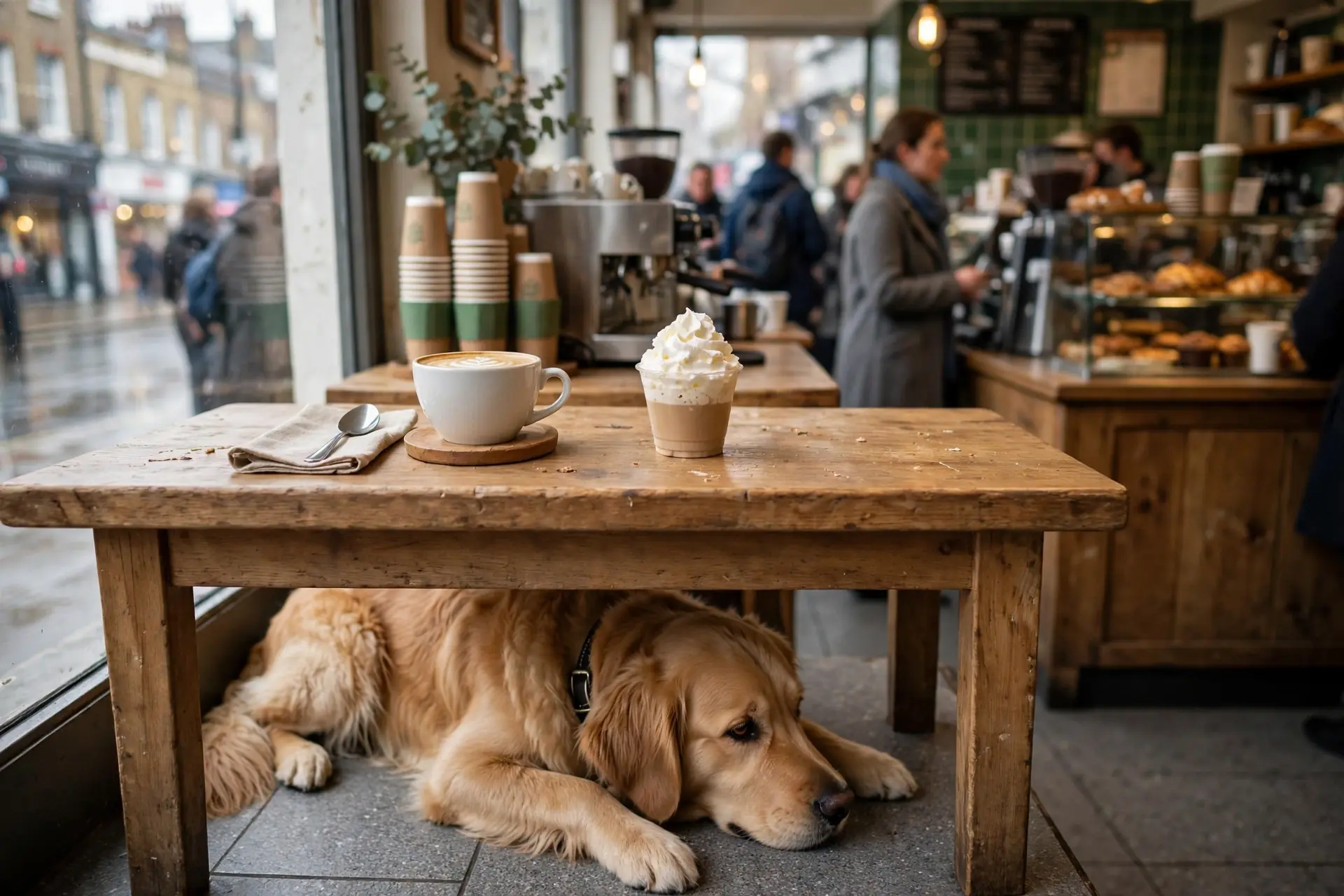
The cafe stop is the hinge of the day. A charity shop morning pairs naturally with a coffee and a sit-down, and it is the moment when the dog finally gets to lie down properly. Our guide to dog-friendly cafes in the UK covers how to find places that genuinely welcome dogs indoors rather than only on the terrace, and our guide to dogs in coffee chains covers the big names, their seating and ordering routines, and the busy-hour tactics that keep a coffee stop calm. Plan the cafe stop for the middle of the route rather than the end: a rested dog with a full water bowl and a biscuit is a much better shopping companion for the second half of the morning than a tired, thirsty one.
Think about timing across the whole day. Charity shops are at their best in the morning, when the stock is fresh from sorting and the volunteers have time to chat. Cafes are at their calmest mid-morning, before the lunch rush. By early afternoon the shops are picked over, the cafes are busy and the dog is tired, which is the natural moment to head for a longer walk or the journey home. A route that respects that rhythm — walk, shops, cafe, more shops, walk home — feels spacious rather than rushed, and it gives the dog a day with a shape to it rather than a series of waits.
Season and weather change the plan more than most people expect. In summer, charity shops are cool, shaded places to duck into between walks, but a dog waiting outside in the sun needs shade and water, so take the shady side of the street and keep waiting times short. In winter, the shops are warm and dry, which makes them attractive, but wet dogs and muddy paws are a real problem on a small shop floor — dry the dog off before you go in, and carry a towel. In rain, a charity shop crawl is one of the best wet-weather outings there is, provided you accept that the dog will need a proper drying session afterwards and that some shops will be busier than usual because everyone else had the same idea.
After you leave: the third part of the trip
The third part of the trip starts the moment you step back onto the pavement, and it is the part most guides forget. First, check what you bought. Second-hand clothes, books, toys and household items should be checked before they go near your dog: wash clothes and soft furnishings before use, wipe down hard items, and check toys for loose parts, old stuffing or small pieces a dog could swallow. A donated dog toy is a lovely find, but it is still a used toy with an unknown history, and a quick check costs a minute. Anything with a smell of cleaning products, mothballs or damp should be aired or washed before it comes into the house.
Second, look after the dog. A charity shop morning is more tiring for a dog than it looks: the concentration of walking slowly, settling on cue and ignoring a hundred new smells is hard work, even if the distance covered is small. Offer water, give the dog a proper toilet break and a chance to move freely, and expect a long nap afterwards. If the dog was restless or stressed in the shops, do not treat it as a failure; treat it as information. Shorter visits, quieter times or a different shop with more space may suit the dog better next time, and there is no shame in a dog that prefers a field to a shop floor.
Third, keep a note of what you learned. Which shops welcomed the dog, and which asked you to wait outside? Which had room to move, and which were too cramped even for a small dog? Which volunteer remembered your dog's name? A short note on your phone — shop name, town, dog policy, one line about the space — builds into a personal guide over a few months, and it is far more reliable than any listing site, because it is based on your dog in that actual shop. Share it with other dog owners if you like; the charity shop community runs on exactly this kind of word of mouth.
Finally, think about what the trip was for. Charity shops exist to raise money for good causes, and every purchase, however small, is a donation with something in return. A morning spent browsing with a calm dog, buying a book or a jumper and chatting with volunteers is a small, ordinary pleasure — and it is also a useful one, keeping money on the high street and keeping goods in use rather than in landfill. The dog does not know any of that, of course. The dog knows that the morning involved new smells, a walk, a cafe biscuit and a nap, which is a very good morning by any dog's measure. Plan the next one the same way — door first, short visits, a cafe in the middle — and the shops will keep welcoming you both back.
Practical questions
Before you go
Can dogs go into charity shops in the UK?
It depends on the individual shop. There is no single national rule for charity shops, so each branch decides for itself. Many welcome well-behaved dogs on a lead, some allow dogs only in certain areas, and some ask dogs to wait outside. Look for a sign at the door and ask a volunteer if you are unsure.
Which charity shop chains allow dogs?
No major chain applies one dog policy to every branch, so a chain name alone does not settle the question. Policies are usually set branch by branch, and they can change when a shop moves, refits or changes manager. Treat each branch as a separate case and check the official guidance before you travel.
What should I do if my dog is not allowed inside?
Do not tie your dog to anything outside and walk away. Either take turns with a companion so one person stays with the dog, come back at a quieter time and ask again, or move on to another shop. If the dog cannot wait calmly and safely with a person you trust, skip the shop entirely.
Can I bring my dog when I drop off donations?
Yes, in many cases, but plan it as a separate task from browsing. Keep the dog on a short lead well away from the sorting area, hand the bags over at the counter or the marked donation point, and do not let the dog follow staff into back rooms. If the drop-off point is cramped, leave the browsing for another visit.
Are assistance dogs allowed in charity shops?
Assistance dogs have a different legal position from pet dogs. Under the Equality Act 2010, service providers in England, Scotland and Wales must not refuse entry to an assistance dog without a lawful reason. If access is refused, ask calmly for the reason in writing and check the official guidance before you travel.
How do I keep my dog calm in a small charity shop?
Visit at a quiet time, keep the lead short, walk slowly, and give the dog a job such as walking beside you or settling at your feet while you look at a rail. Keep visits short, reward calm behaviour, and leave before the dog gets restless. A tired dog that has already had a walk and a toilet break settles far more easily.