This guide is independent and contains no paid placement. If affiliate links are added later, they will be clearly marked and will not change our editorial checks.
Many outdoor UK craft fairs welcome dogs on short leads, but indoor fairs often do not, so check the listing first. Pick a quiet hour, keep your dog on the aisle side of every stall, and leave before stress builds — a short, calm visit beats a long, crowded one.
Are dogs allowed at craft fairs?
There is no single rule for dogs at craft fairs in the UK, and that is the first thing to accept before you set off. A village green fair run by a community group, a monthly makers' market in a town square, a Christmas fair inside a historic hall and a large craft show in an exhibition centre can all have different policies, even when they use the same words on a poster. The phrase "dog-friendly" on a social media post may mean that well-behaved dogs are welcome everywhere on site, or it may mean only that dogs are allowed in the outdoor area while the indoor stalls are off limits. The only reliable answer comes from the organiser or the venue, and it is worth getting it in writing — a short message, an email reply or a line on the official event page — before you load the dog into the car.
Outdoor fairs are usually the most straightforward. A market on a green, in a park, on a farm courtyard or along a closed street normally follows the rules of the open space, and dogs on leads are often welcome as long as they stay under control. Even there, exceptions exist. Some sites are working farms with livestock nearby, some are private gardens where the owner sets stricter terms, and some share space with a food festival where hygiene rules push dogs to the edges. Indoor fairs are more restrictive for practical reasons: narrow aisles, low tables, breakable stock, food stalls and fire exits leave little room for a dog that cannot be kept close. Churches, village halls, school halls, stately homes and museums often have their own building policies, and those policies can override a fair organiser who would otherwise be happy to welcome dogs. If a listing does not mention dogs at all, treat silence as "ask first" rather than "probably fine", and check the official guidance before you travel.
Assistance dogs are in a different category. They are generally allowed in places where pet dogs are not, including many indoor venues, and organisers should not turn them away. That does not remove the practical challenges: a hall full of low tables and trailing tablecloths is still a tight space for any dog, and a crowded aisle is still stressful. If you rely on an assistance dog, a quick message to the organiser helps in another way too — it lets them tell you about the quietest entrance, the widest aisle, a place to sit and rest, and whether there is an accessible toilet nearby. For pet dogs, the honest test is simpler: if you cannot find a clear statement that dogs are welcome, choose another fair rather than hoping the person on the gate will make an exception in front of a queue.
Local bylaws and site rules add another layer. Some town centres and parks have public spaces protection orders that require dogs to be on leads in defined areas, and some have seasonal or event-specific restrictions. A fair that takes over a normally dog-friendly green may still ask visitors to keep dogs on leads for the day, or to keep them out of a roped-off children's area or a food court. None of this is meant to spoil the visit; it is how organisers balance makers who have spent weeks preparing fragile stock, families with small children, food sellers who must meet hygiene standards, and dog owners who want a pleasant morning out. Reading the rules before you go, and respecting them once you arrive, is what keeps fairs willing to welcome dogs next time.
Choose a fair that suits your dog
Not every craft fair is a good fit for every dog, and choosing well matters more than any lead technique you learn at the gate. Start with your dog, not with the fair's poster. A calm older dog that settles quickly beside a chair can enjoy a small village fair for an hour. A young, excitable dog that pulls towards every new smell may find the same fair overwhelming, while a nervous rescue that startles at sudden movement may be happier at a quiet outdoor market with wide grass aisles than at a packed indoor Christmas fair. Write down, honestly, how your dog behaves around crowds, children, other dogs, loudspeakers, food smells and fragile objects at nose height. That short list is your filter for every fair you consider.
Size and layout are the next filter. Small fairs with ten to twenty stalls, held on a green or in a single hall, are usually easier than large shows with a hundred makers spread across several rooms or fields. At a small fair you can see the whole site from the entrance, find the exit quickly, and step out onto grass if your dog needs a break. At a large fair the aisles narrow, the queues lengthen, and the noise builds, which is a lot to ask of a dog that has never been in a crowd. Look at photographs from previous years if the organiser posts them: wide outdoor aisles, stalls spaced apart, grass or hard standing underfoot, and visible open space around the edges are all good signs. A fair photographed as a dense maze of tables under a low marquee, with no open ground in sight, is a fair to visit without the dog, or to skip until a quieter date.
The type of craft on sale changes the risk too. Pottery, glass, ceramics, jewellery on low stands, candles, soaps and textiles are all within easy reach of a dog's nose and tail, and a single wag can do expensive damage. A fair that specialises in large furniture, garden sculpture or outdoor goods may be more forgiving, because the stock is heavier and set further back. Food stalls deserve special thought: a fair where every third stall sells cheese, cakes, fudge or hot food will fill the air with smells that keep a food-motivated dog pulling forward, and dropped crumbs under tables create constant temptation. That does not mean food fairs are off limits, but it does mean they demand a shorter visit, a firmer lead and a dog that can walk past food without lunging. If your dog has a history of grabbing food, choose a craft-only fair for the first visit and build up from there.
Think about the rest of the day as well. A fair near a park, a riverside path or a quiet lane gives you somewhere to walk the dog before and after the browsing, so the fair itself is only a small part of the outing rather than the whole event. A fair in the middle of a busy town, with nowhere to decompress except a crowded pavement, puts more pressure on the visit. Check parking too: a field car park with space to settle the dog before you walk in is far better than a multi-storey car park with echoing concrete, steep ramps and no grass nearby. And if the fair is part of a larger event — a country show, a Christmas market, a food festival — expect the craft section to be busier and noisier than a standalone makers' fair, and plan accordingly. The best first fair for a dog is usually small, outdoor, local, and held on a day when you have nothing else booked, so you can leave early without feeling you have wasted the trip.
Prepare before you leave home
Good preparation takes ten minutes at home and saves a difficult half hour at the fair. Start with the basics: a well-fitting collar or harness, a short lead of about one metre, a water bottle and a collapsible bowl, poo bags, and a few small treats you can deliver calmly without fumbling in a pocket full of shopping. A harness gives you more control than a collar if your dog pulls, and it spreads pressure across the chest if they lunge towards a stall. Avoid retractable leads entirely for a fair — the long line tangles around table legs, tripods, pushchairs and other dogs, and it gives you no way to reel a dog in quickly when a stallholder turns around with a tray of glassware. A lead with a second handle near the clip, or a simple short traffic lead, is ideal because it lets you bring the dog tight to your leg in a narrow gap without wrapping the lead around your hand.
Exercise and toilet first, browse second. Give your dog a proper walk and a toilet break before you arrive, on a quiet route rather than in the fair car park, so they arrive calm and empty rather than bursting with energy and needing the nearest patch of grass. A dog that has already had a good sniff and a run is far more likely to settle beside a stall while you talk to a maker. Feed a normal meal at the normal time rather than a large meal just before the fair, because a full, excited dog in a warm hall can feel unwell, and a hungry dog will be even more fixated on food stalls. If your dog wears a coat in cold weather, put it on at home so you are not adjusting straps in a crowd, and check that any identification tag is secure and that your phone number is legible.
Pack for the dog as well as for the shopping. A small mat or blanket gives your dog a defined place to settle if you stop to chat, and it protects their paws from cold stone or wet grass while you browse. A chew or a stuffed food toy can help in the car or during a rest break, but do not give it in the middle of a crowded aisle where another dog might approach. Bring more water than you think you need, especially at summer fairs, and a towel in the car for muddy paws, wet coats and the inevitable brush against a damp stall. If you plan to buy anything fragile, bring a sturdy bag with tissue or bubble wrap of your own, because juggling a pottery mug, a lead and a pulling dog is how accidents happen. And agree a plan with anyone travelling with you: who holds the dog while the other person pays, who watches the dog while the other looks closely at a stall, and what your signal is for "we are leaving now".
Finally, check the practical details the night before. Confirm the fair's opening times, entry fee, dog policy and whether dogs need to stay on leads throughout, and check the official guidance before you travel if anything is unclear. Look at the weather forecast and the ground conditions: a fair on grass after rain means mud, and a fair in a marquee on a hot day means heat builds quickly under canvas. Charge your phone so you can message the organiser if plans change, and save the address of the nearest vet — a quick search before you leave is far easier than a panicked search with a stressed dog in a field. None of this is over-preparation. It is the difference between a relaxed visit and a visit where every small problem arrives at the same time, in front of a stallholder whose stock you have just knocked over.
Lead length and personal space
The lead is your main tool at a craft fair, and the rule is simple: short, close and predictable. Hold the lead so your dog walks beside you or slightly behind, on the side away from the stalls, with no slack trailing on the ground and no length reaching across the aisle. A dog walking a metre ahead of you on a loose lead will reach every low table before you do, and a dog trailing behind you will be stepped on, tripped over or tangled with the next visitor. Keep the dog on the same side throughout the visit so stallholders and other visitors learn where to expect them, and shorten the lead further whenever you stop, turn, or pass a narrow gap between stalls. If you need both hands to pay or to pick up an item, step to one side, out of the flow of people, and ask your companion to hold the lead — or place your dog in a sit beside a wall or a fence, with the lead looped securely, rather than tying them to a stall.
Personal space works in both directions. Your dog needs room to stand, turn and lie down without being crowded by strangers, and other visitors need room to pass without brushing against a dog they did not expect. At a busy fair, that means choosing the wider aisle when you have a choice, waiting for a gap before you enter a narrow row, and stepping aside to let a pushchair, a wheelchair or a group of children pass rather than squeezing through with the dog at ankle height. It also means not letting your dog approach other dogs nose to nose between stalls. Two dogs meeting in a tight space, with leads tangled and owners distracted by a display, is a classic recipe for a scuffle, and a craft fair is the worst possible place for one — there is nowhere to separate them quickly without knocking over stock. A polite "not today, thank you" and a wide arc around the other dog is always the right call, even if both dogs look friendly.
Children deserve particular care. Craft fairs attract families, and small children move unpredictably, reach out suddenly, and often crouch to dog height without warning. Even a gentle dog can be startled by a child appearing at face level from behind a table, and a large dog's tail at a toddler's eye height is a hazard in itself. Keep your dog on the far side from children when you pass, ask the child to stay still and let the dog come to them only if you are sure the dog is comfortable, and never let a child hold the lead or feed your dog without your explicit agreement. Stallholders, too, may not want a dog close to their work: some are nervous around dogs, some have allergies, and some simply need to protect stock that took hours to make. Watch for body language — a stallholder who steps back, moves goods away from the edge, or looks uneasy is telling you to give them more room, and the polite response is to move on with a smile.
When the aisle is genuinely too narrow for a dog and a person to pass safely, do not force it. Wait at the end of the row, let the flow clear, or skip that row entirely and come back later if it empties. There is no rule that says you must see every stall, and a fair is not a checklist. The makers would rather you return on a quieter day, or browse their online shop afterwards, than have their display damaged in a crush. The same applies to queues: if a stall has a queue three deep, join the end with the dog settled beside you, or ask your companion to hold the dog while you queue alone. A dog standing in a queue for ten minutes, getting stepped on and jostled, is a dog that will be stressed for the rest of the visit. Short, calm, predictable movement — walk, pause, look, move on — is the rhythm that works best for dogs at a fair.
Stall etiquette around fragile goods
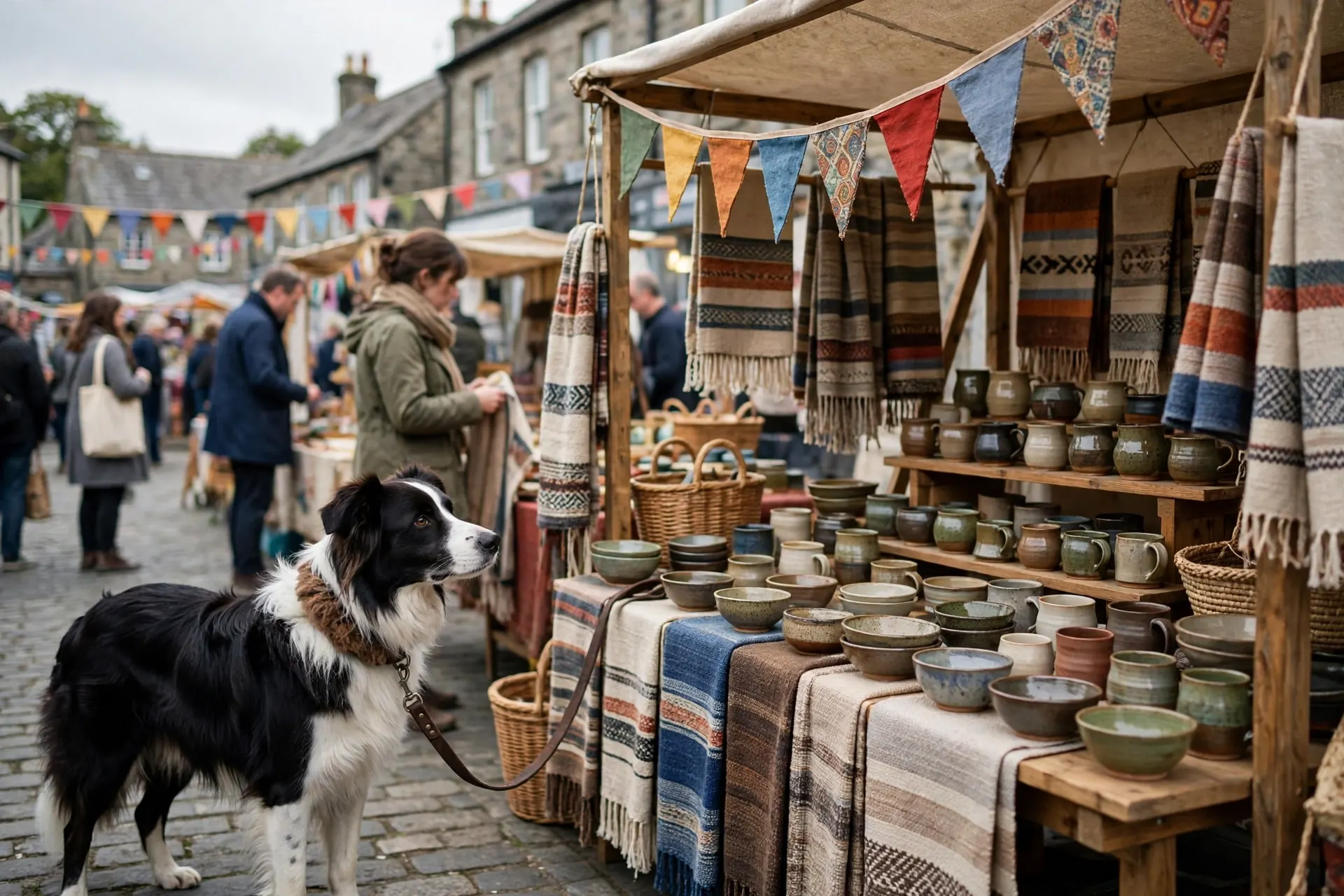
Craft stalls are not shops with shelves bolted to a wall. They are temporary displays built from trestle tables, crates, cloths and lightweight stands, often balanced on uneven grass or a sloping hall floor. A table that looks solid can wobble when a lead catches its leg, and a cloth that hangs to the ground can hide a trip hazard or a stack of boxes behind it. The first rule of stall etiquette is therefore to keep your dog on the aisle side of the table at all times, never behind the stall or under it, and never between the stallholder and their goods. If you want to look closely at something, step in yourself while your dog waits on the aisle side with your companion, or ask the stallholder to bring the item to the front of the table where you can see it without leaning across a display.
Hands, noses and tails all need managing. A dog's nose is at exactly the height of most craft tables, which means pottery, glass, candles, dried flowers, jewellery and small wooden toys are all within sniffing, licking and nudging range. A wet nose on a handmade textile can leave a mark that ruins a sale, a tongue on a soap display contaminates stock, and a single tail wag against a low shelf of ceramics can cause a cascade of breakages that no one can undo. Keep the dog's head away from the table edge, use a calm "leave it" or a gentle lead cue if they fixate, and move on promptly if they cannot settle. Do not let your dog drink from a stallholder's water jug, chew a display item, or pick up anything from the ground near a stall — what looks like a dropped scrap may be part of a display, a sample, or someone else's purchase waiting to be wrapped.
Talking to makers is one of the pleasures of a craft fair, but it needs a little choreography with a dog. Position the dog in a sit or a down beside you, on the side away from the stall, before you start a conversation, so you are not holding a conversation with one hand and a pulling dog with the other. If the dog will not settle, keep the conversation short, thank the maker, and move on — you can always return later, or find them online. When you buy something, pay before you pick it up, keep the item in its bag and the bag in your hand away from the dog, and step clear of the stall before you stop to admire your purchase. If an accident does happen — and with dogs, it occasionally will — own it immediately. Apologise, offer to pay for the damaged item, and help clear up if you can. Stallholders are far more forgiving of an honest accident than of a visitor who pretends not to notice, and a calm, responsible response is what keeps fairs dog-friendly for everyone else.
Some stalls are simply not suitable for a close visit with a dog, and recognising that is part of good etiquette. A stall selling tiny glass ornaments on a low, crowded table, a stall with a floor display of baskets or ceramics, or a stall where the maker is demonstrating a craft with hot tools, sharp implements or open flames, is a stall to admire from a distance. Stand back, look from the aisle, and if you want to buy, ask the maker to bring the item to you or to hold it while your companion moves the dog to open space. The same applies to stalls with animals of their own — some makers bring a shop dog, and two dogs in a small space need careful management. In every case, the principle is the same: the maker's livelihood is on that table, and your dog's visit should not put it at risk.
Food, smells and tempting displays
Craft fairs are a feast for a dog's nose, and that is both the attraction and the problem. Handmade soaps smell of lavender and honey, candles smell of woodsmoke and spice, dried herbs and potpourri fill the air, and food stalls add cheese, bread, cakes, chocolate, fudge and hot drinks to the mix. A dog experiences all of this far more intensely than you do, and a food-motivated dog will pull towards every new smell, fixate on every stall, and try to hoover up anything that falls to the ground. The first defence is a full, calm dog: arrive after a meal and a walk, carry a few high-value treats of your own, and reward the dog for walking past a tempting stall rather than for stopping at it. A treat delivered calmly at your side teaches the dog that ignoring food is more rewarding than chasing it.
Dropped food is the biggest practical hazard. Crumbs, cake, cheese, chocolate, grapes, onion and cooked bones all end up on the ground at a fair, and several of these are toxic or dangerous for dogs. Chocolate, xylitol in sugar-free sweets, grapes and raisins, onions, and cooked bones that splinter are all risks, and a dog that grabs food from the floor gives you no time to check what it is. Keep your dog's head up in food areas, use a short lead and a steady pace, and practise a reliable "leave it" before the visit — not at the fair itself. If your dog does pick something up, do not chase them around a stall; instead, trade calmly with a treat you are carrying, and check the official guidance before you travel if you are worried about what was eaten. If you suspect your dog has eaten something toxic, contact a vet promptly and keep any packaging or a description of the food to show them.
Smells are not only about food. Scented candles, wax melts, reed diffusers, essential oils, soaps and bath products can be strong at close range, and some essential oils are irritating or toxic to dogs if licked or inhaled in a confined space. A dog that sneezes, rubs its face, backs away or tries to leave a stall is telling you the smell is too strong, and the right response is to move on rather than to linger. Stallholders who make scented goods are usually happy to explain what is in their products if you ask, and many will move a display back from the aisle edge if they know a dog is passing. Likewise, keep your dog away from open flames, hot wax, incense burners and cooking equipment, all of which appear at craft fairs more often than visitors expect. A tail near a candle flame or a nose near a hot plate is a burn waiting to happen, and a knocked-over burner can start a fire in a marquee full of textiles.
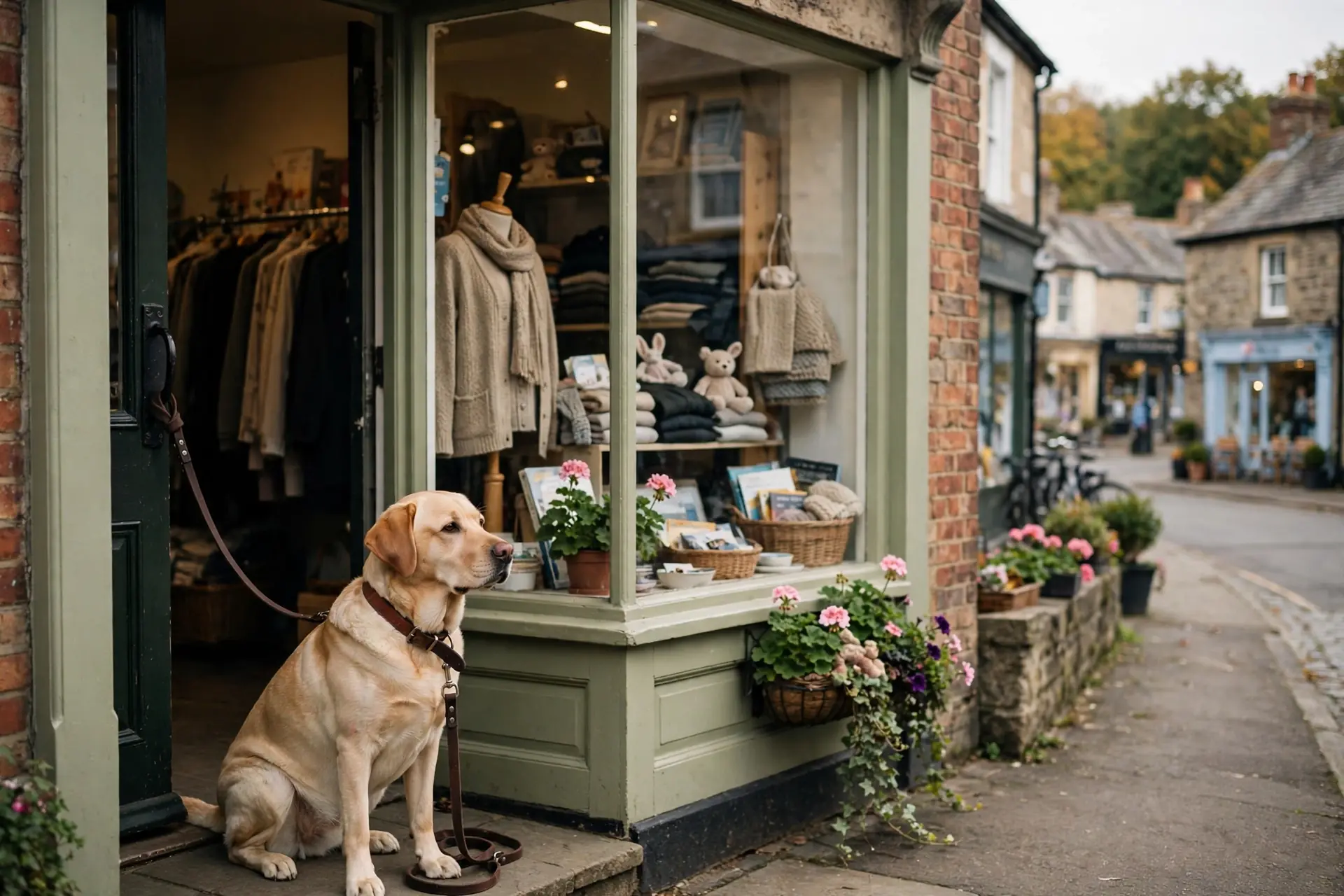
Water and shade matter too, because a dog that is hot, thirsty or tired will be far more reactive to smells and crowds. Carry water and offer it regularly, especially at summer fairs and in warm halls, and look for shade or a cool spot to rest between rows of stalls. If the fair has a food court, do not expect your dog to settle under a table for a long lunch while food is being carried past at nose height — eat quickly, take food away to a quiet bench, or eat in shifts with your companion. And remember that your dog's behaviour around food is information, not disobedience: a dog that cannot walk past a cheese stall without lunging is telling you that this fair, at this time of day, is too much for them, and the kindest response is a shorter visit, a quieter fair, or a different outing altogether. Our guide to dogs in charity shops covers similar narrow-aisle etiquette for indoor browsing, where the same leave-it and short-lead habits keep everyone calm.
Timing: avoid the crush
When you visit matters as much as where you visit. Most craft fairs follow a predictable pattern: a quiet first hour after opening, when stallholders are still arranging displays and early visitors browse slowly; a busy late morning and early afternoon, when families, lunch crowds and tour groups arrive together; and a quieter final hour, when some stalls start to pack up and the aisles clear. For a dog, the first hour is almost always the best choice. The aisles are wide, the stallholders have time to chat, the dog can sniff and settle without being jostled, and you can see the whole fair before the crowds build. The last hour can work too, but some makers will have sold out or packed away, and a tired dog at the end of a long day is not the same as a fresh dog in the morning.
Weekends and special dates change the calculation. Saturday is usually busier than Sunday, and the Saturday of a bank holiday weekend, a Christmas fair in December, or a fair tied to a village fete or a food festival will be busier still. School holidays bring more children, more pushchairs and more noise, which is a lot for a sensitive dog. If you can, choose a weekday fair, a Sunday morning, or a monthly market on a quiet date, and save the big Christmas fair for a visit without the dog — or for a very short visit at opening time, with a clear plan to leave by late morning. Check whether the fair has timed entry, a ticketed session or a quiet hour; a growing number of larger fairs offer an early, calmer session, and that is often the best slot for a dog even if it means an earlier start.
Weather and local events affect crowds in ways that are easy to miss. A fair held on the same day as a nearby football match, a fun run, a farmers' market or a town parade will draw extra visitors, and a fair on the first sunny Saturday after a wet week will be packed. Conversely, a fair on a drizzly morning may be quieter, though the ground will be muddier and the dog wetter. Check the fair's social media on the morning of the visit: organisers often post about queue lengths, parking, and whether the fair is busier than expected, and that information is worth more than any general advice. If you arrive and the queue at the gate is long, the car park is full, or the entrance is already crowded, trust what you see and change the plan — walk the dog somewhere quiet first, come back later, or visit another day. A fair will still be there next month; your dog's confidence, once dented by a bad crowd experience, takes longer to rebuild.
Inside the fair, timing is about pacing as well as arrival. Browse in short bursts with breaks in open space, rather than marching from stall to stall for two hours without a pause. Ten minutes of browsing, five minutes of rest and water on a quiet bench or a patch of grass, then another short burst, works far better than a single long push. Watch the clock as well as the dog: most dogs have a limit of about forty-five minutes to an hour in a busy environment before tiredness turns into reactivity, and puppies and older dogs may have a shorter limit still. Plan your shopping list before you arrive so you can head for the stalls you most want to see, buy what you came for, and leave while the visit is still a success. The makers you miss can usually be found online, and a short, happy visit is worth far more than a long visit that ends with a stressed dog and a broken vase.
Weather, ground and comfort
British craft fairs happen in all weathers, and the weather changes the visit more than most owners expect. A summer fair on a green can be hot under canvas, with little shade, hard ground and no water point, while a winter fair in a stone hall can be cold, draughty and slippery underfoot. Before you go, check the forecast, the ground and the venue: grass after rain turns to mud that cakes paws and coats, gravel can be sharp on paws and hard to walk on for older dogs, and wet stone or wooden floors in a hall become slippery for dogs that are already nervous. A towel, a drying coat and a mat for the dog to lie on are small items that make a large difference, and they weigh almost nothing in a bag.
Heat is the most serious weather risk. Dogs overheat far faster than people, and a crowded marquee on a warm day can be dangerously hot even when the air outside feels pleasant. Signs of overheating include heavy panting, drooling, restlessness, a glazed expression and, in severe cases, vomiting or collapse. Never leave a dog in a car at a fair, even for a few minutes and even with a window open — the temperature inside a parked car rises quickly and can be fatal. At the fair itself, offer water often, seek shade, wet the dog's paws and belly with cool water if they seem hot, and leave immediately if panting does not ease in open air. If you are worried that your dog is overheating, contact a vet without delay and check the official guidance before you travel for the latest advice on heat safety.
Cold and wet weather bring different problems. A small, short-coated or elderly dog can get cold quickly standing on wet grass or a stone floor, especially if they are wet through and there is nowhere to dry off. A waterproof coat helps, but a coat that rubs, slips or restricts movement can make a dog more uncomfortable, so try it at home first and check the fit before the fair. Rain also changes the ground: paths become muddy, grass becomes slippery, and a dog that is already unsure on its feet may refuse to walk or may pull towards the driest route, which is often through a stall. In wet weather, shorten the visit, stick to hard standing or covered aisles where you can, and dry the dog thoroughly in the car before you drive home. A wet dog in a warm car with the heating on can overheat too, so ventilate the car and check on them regularly.
Comfort is not only about temperature. Noise matters: a fair with live music, a loudspeaker, a brass band or a demonstration with power tools will be far louder than a quiet makers' market, and a noise-sensitive dog may find it distressing even if the crowd is small. Smells matter too, as the previous section explained, and so does the ground underfoot: hot tarmac in summer can burn paws, and salted paths in winter can irritate them. Test the ground with your own hand — if it is too hot or too cold for your palm, it is too hot or too cold for paws. And remember that comfort includes rest: a dog that has nowhere to lie down, no water and no break will not enjoy a fair, however beautiful the crafts are. Build rest into the plan, and be ready to cut the visit short if the weather turns. The fair will be there another day; your dog's welfare comes first.
Know when to call it a day
The hardest skill at a craft fair is not browsing or lead handling; it is knowing when to leave. Dogs rarely announce stress loudly at first. The early signs are subtle: yawning when they are not tired, licking their lips, turning their head away from a stall, freezing for a second, tucking their tail, flattening their ears, or pulling gently but persistently towards the exit. These are polite requests for a break, and the best response is to give it immediately — step outside, offer water, let the dog sniff grass and decompress for a few minutes, and then decide whether to go back in for a short while or to call it a day. Ignoring those early signs is how a manageable visit turns into a barking, lunging or shut-down dog in the middle of a crowded hall.
Later signs are harder to miss and harder to recover from: continuous panting, pacing, whining, barking, jumping up at people, snapping at another dog, or refusing to move at all. A dog that has reached this point is not being naughty; they are overwhelmed, and the only helpful response is to leave calmly and promptly, without scolding and without trying to finish the shopping. Do not drag a frozen dog through a crowd, and do not carry a large dog through a fair if you can avoid it — both will increase stress and risk. Instead, wait for a gap in the crowd, walk steadily towards the nearest exit, and keep the lead short and your voice calm. Once outside, give the dog space, water and time, and do not immediately drive to another busy place. A quiet walk or a calm drive home is the right ending to a visit that became too much.
There are also practical reasons to leave early that have nothing to do with stress. If the fair becomes much busier than expected, if a stallholder asks you to move because the aisle is blocked, if your dog has had an accident indoors, or if you realise you have bought more than you can carry while holding a lead, the sensible choice is to go. An accident indoors deserves a quick, honest apology and a clean-up — carry extra bags and wipes for this reason — and then a graceful exit rather than a lingering, embarrassed browse. Similarly, if your dog is clearly tired, thirsty or cold, do not push on because you have not yet seen every stall. The fair is a leisure activity, not a test, and there is no prize for staying longest. The dogs that enjoy craft fairs most are the ones whose owners leave while the visit is still going well, so the dog remembers the fair as a pleasant, manageable outing and is happy to return another day.
Planning your exit in advance makes leaving easier. When you arrive, note the nearest exit, the quietest route back to the car, and a place outside where the dog can decompress. Agree with your companion that either of you can call the visit at any time, without needing to justify it, and that the call will be respected immediately. That agreement removes the social pressure to stay — the feeling that you have paid for entry, driven a long way, or not yet bought the present you came for — and replaces it with a simple rule: the dog's welfare decides. If you leave early, you can still support the makers by browsing their websites from home, ordering online, and following them on social media. That is a better outcome for everyone than a stressed dog, a damaged stall and a fair that decides dogs are more trouble than they are worth.
After the fair: settle and check
The visit does not end at the gate. Give your dog a calm walk after the fair, on a quiet route, so they can sniff, toilet and decompress before the drive home. A dog that goes straight from a crowded hall into a car and then into a busy house will carry the stress of the fair with them, while a dog that has ten minutes of free sniffing on a grass verge or a quiet lane will settle far more easily. Offer water, check paws for mud, gravel, glass or salt, and dry the coat if the weather was wet. Check the lead, harness and collar for mud and damage, and check any purchases before you put them in the car — a pottery mug wrapped in tissue is safe, but a loose candle or a glass ornament rolling around in a bag is not.
Once home, watch your dog for the rest of the day. Most dogs will sleep soundly after a fair, and that is normal. Look out, though, for signs that something was eaten or that the visit was too much: vomiting, diarrhoea, lethargy, limping, excessive licking of paws, or unusual anxiety in the evening. If your dog picked up food at the fair, or you are worried about anything they ate or licked, contact a vet and describe what happened as accurately as you can. Keep any packaging, a photograph of the stall, or a note of what the food was — that information helps a vet assess the risk quickly. If your dog seems unusually stressed or reluctant to go out the next day, give them a quiet day at home rather than another busy outing, and consider whether a smaller, quieter fair would suit them better next time.
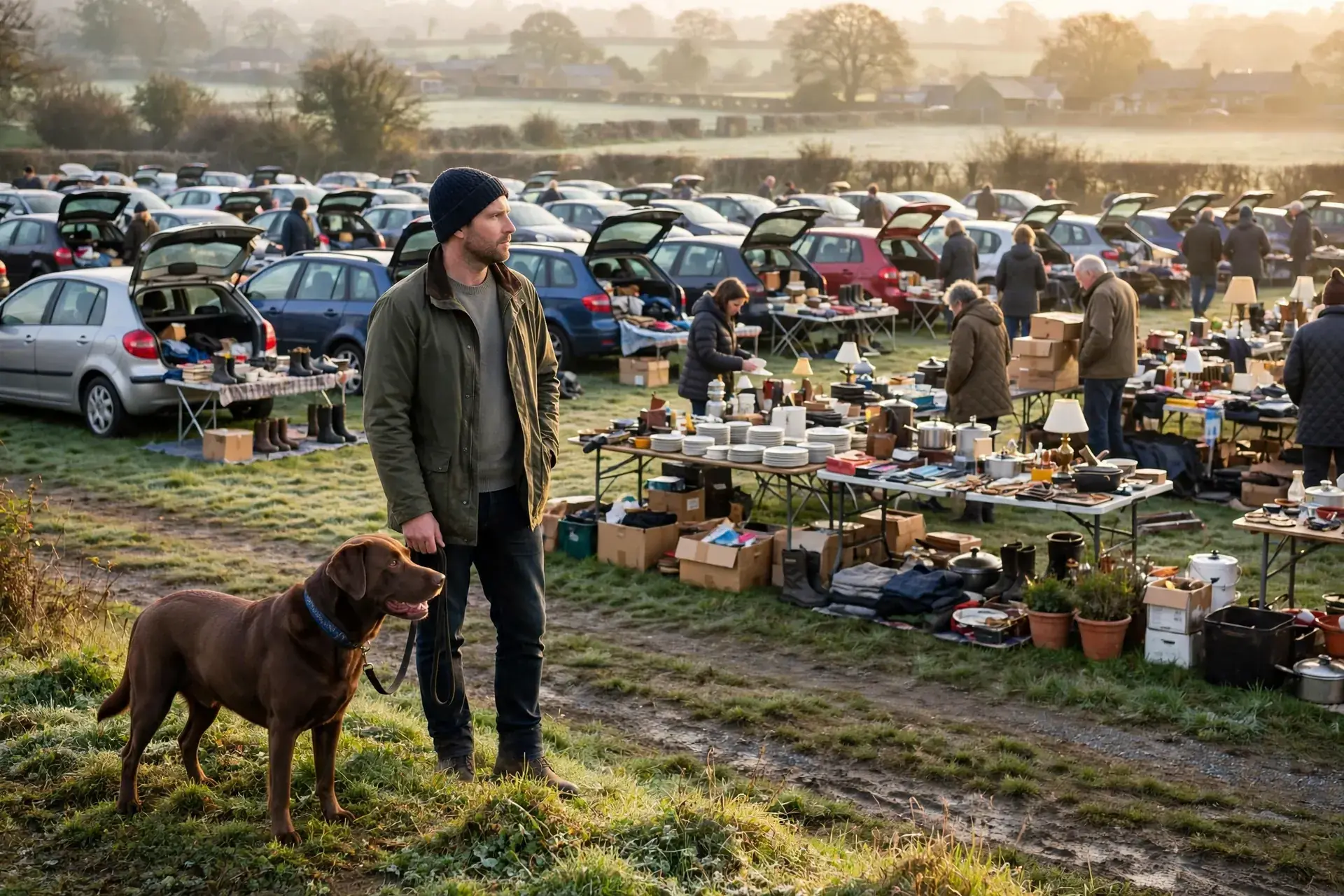
Use what you learned to plan the next visit. Note which fair you went to, what time you arrived, how busy it was, how long your dog settled happily, and what triggered any stress — a particular stall, a narrow aisle, a loudspeaker, a food smell, or a meeting with another dog. That short note is more useful than any general guide, because it describes your dog at a real fair. Share feedback with the organiser if it is constructive: a thank-you for welcoming dogs, a note about a narrow aisle that could be widened, or a suggestion for a water point or a quiet area will be welcomed far more than a complaint. Organisers who hear that dog owners are polite, prepared and appreciative are more likely to keep welcoming dogs, and that benefits every dog owner who wants to browse a craft fair in future. If you enjoyed the day, the next step might be a similar outing in a different setting — our guide to dogs at car boot sales covers another busy, bargain-hunting morning where the same short-lead and timing habits pay off, and a weekend away afterwards could pair well with our dog-friendly holiday parks guide.
Finally, remember that craft fairs are about makers as well as visitors. The potters, weavers, jewellers, woodworkers and bakers at a fair have spent hours, days or weeks making what is on their tables, and a dog-friendly fair is one where visitors respect that work. Buy something if you can, even a small item, because a purchase is the clearest way to support a maker. Talk to them, ask about their craft, and tell them what you like — makers remember friendly visitors, and they remember polite dogs too. A fair where dogs are welcome, well behaved and well managed is a fair that stays welcoming, and that is the outcome worth working towards on every visit.
Practical questions
Before you go
Are dogs allowed at UK craft fairs?
It depends on the fair and the venue. Many outdoor craft fairs welcome dogs on leads, while indoor fairs in halls, churches and historic buildings often restrict dogs to assistance dogs only. Always check the fair listing or ask the organiser before you travel, because the venue rules can be stricter than the fair rules.
Should I use a short lead at a craft fair?
Yes. A short lead of about one metre keeps your dog close to your leg, away from low tables, pottery, glass and textiles, and out of the path of other visitors. Avoid retractable leads and long lines at a busy fair, because they tangle around stalls, tripods and other people.
What is the best time to visit a craft fair with a dog?
Arrive in the first hour after opening or in the last hour before closing, when aisles are quieter and stallholders have time to talk. Late morning and early afternoon are usually the busiest, especially on Saturdays, at Christmas fairs and when a fair shares a site with a food market.
Can my dog sniff the stalls at a craft fair?
A brief sniff at ground level is normal, but do not let your dog nose, lick or nudge goods on a table. Handmade ceramics, glass, candles, soaps and food are easily damaged or contaminated, and a wet nose on a textile can ruin a sale. Keep your dog on the aisle side of the stall and move on if they fixate on a display.
What should I do if my dog gets stressed at a craft fair?
Move to open space, offer water, and give your dog a few minutes to settle away from the crowd. If panting, yawning, lip licking, freezing or pulling continue, leave the fair and try a quieter walk instead. A short calm visit is better than a long visit that ends with your dog overwhelmed.
Are assistance dogs treated differently at craft fairs?
Yes. Assistance dogs are generally allowed in places where pet dogs are not, including many indoor venues. Even so, tell the organiser in advance when you can, keep the dog close and under control, and be ready for narrow aisles and fragile displays, which are a practical challenge for any dog.