This guide is independent and contains no paid placement. If affiliate links are added later, they will be clearly marked and will not change our editorial checks.
Most car boot sales are not designed with dogs in mind: the danger is the car park, where vehicles reverse through crowds on grass with no pavements. Check the organiser's dog rule first, keep your dog on a short lead on the side away from traffic, plan the visit in three parts — before, during and after — and be ready to leave early if the crowds or the heat build up.
Before you go: the organiser decides
There is no single national rule about dogs at car boot sales in the UK. Each sale is run by its own organiser — sometimes a village hall committee, sometimes a charity, sometimes a commercial operator — and each one sets its own terms. One sale may welcome dogs on leads, the next may ban them outright, and a third may allow dogs only in the buyers' car park and not among the stalls. That variation is the first thing to understand, because it means a rule you learned at one sale tells you nothing about the next one. The organiser's word is final on the day, and arguing with a steward at the gate helps neither you nor your dog.
Checking takes five minutes and saves a wasted journey. Look at the sale's own listing first: the website, the Facebook page, or the local noticeboard poster usually states the dog policy in plain language. If the listing says nothing, send a short message or check recent comments from other visitors, because regulars often ask the same question and the answer stays visible. If you still cannot find a clear answer, check the official guidance before you travel and assume the stricter outcome — that dogs may not be allowed — until you know otherwise. A sale that bans dogs will not make an exception for a well-behaved one, and a sale that allows them will still expect you to follow its lead and fouling rules.
Think about timing before you leave the house. Car boot sales usually open early, often between 6am and 8am for sellers and a little later for buyers, and the first hour is the busiest for vehicles: sellers arriving, buyers circling for spaces, and everyone reversing into gaps on grass. Arriving at opening time puts your dog in the middle of that churn. Arriving an hour later, when most cars are parked and the lanes have settled into foot traffic, is usually far calmer — and the bargains are not all gone, despite what regulars say. If your dog is nervous around traffic or crowds, the later arrival is the better trade. If your dog is calm and you want the widest choice, the early slot works, but only if you are confident about the car park.
Pack the dog's bag the night before so the morning is not a scramble. A short lead, not a long or retractable one, is the single most useful item: in a crowded field a long lead wraps around stall legs, other people's ankles and your dog's own legs. Add poo bags, a water bottle and a collapsible bowl, a small towel for paws, and a handful of treats in a pocket you can reach without putting the lead down. A blanket or mat gives a nervous dog a defined place to settle if you stop to browse. If the forecast is warm, pack extra water; if rain is expected, add a drying coat and a second towel. Keep the whole kit in one small bag so your hands stay free, because you will need them for browsing, paying and steadying your dog.
Finally, decide the exit plan before you arrive. Agree with whoever is coming with you who holds the dog while the other person browses a stall, and agree on a signal for leaving early. The most common mistake at a car boot sale is staying too long because one person is still haggling while the dog has clearly had enough. A visit of forty-five minutes to an hour is plenty for most dogs, and a short happy visit makes the next one easier. If you are going alone, accept that you will browse less, move more slowly and leave sooner — and that is a fair price for bringing the dog along.
Car park safety: the riskiest part of the morning
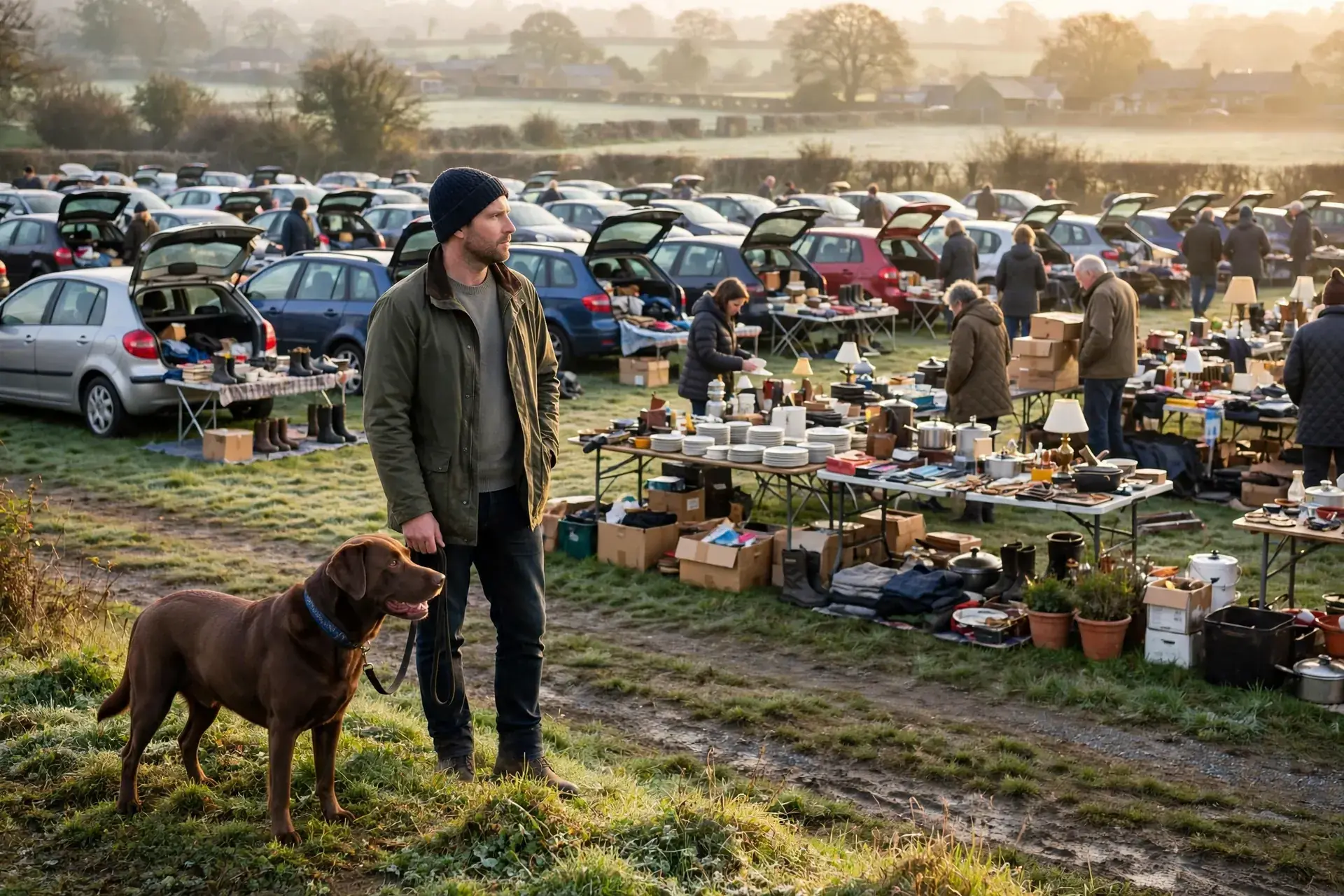
The stalls get the attention, but the car park is where a car boot sale is genuinely dangerous for a dog. Unlike a high street, there are no pavements, no kerbs and no marked crossings. Cars, vans, pedestrians, pushchairs and dogs all use the same grass lanes, and drivers are looking for a gap to reverse into rather than watching for a small animal at ankle height. Visibility is poor in both directions: a driver reversing out of a row cannot see a dog behind the bumper, and a dog cannot judge that a car about to move is a threat. Most incidents at these sales are not dramatic — they are a clipped paw, a frightened bolt, or a lead tangled under a wheel — but all of them are avoidable with a little discipline.
Walk the edges of the lanes, never down the middle. The middle of a lane is where cars travel and reverse; the edges, beside parked cars and stalls, give your dog a buffer and give you a line of sight to approaching vehicles. Keep your dog on your far side from the traffic, so your body sits between the dog and any moving car. Shorten the lead to about a metre in the car park — short enough that the dog cannot dart in front of a reversing car, long enough that the dog is not being dragged. Never let the lead trail on the ground, and never tie it to a car, a stall or a fence while you look at something. A tied dog in a car park is a dog that cannot move away from a vehicle, and a lead tied to a tow bar is an accident waiting for a driver who has not noticed it.
Watch for the specific hazards of a grass field used as a car park. The ground is often uneven, with ruts, rabbit holes and soft patches that twist a small dog's leg or catch a lead. After rain, ruts fill with muddy water that hides broken glass, bottle tops and sharp metal — the debris of a hundred car boots emptied onto the grass. Sellers drop nails, screws, drawing pins and bits of wire without noticing, and a dog sniffing along the ground finds them first. Check the ground where your dog walks, and if you see broken glass or metal, steer around it and, if you can, tell a steward. Wearing a lead and keeping the dog's nose up in the busiest lanes is not over-cautious; it is the practical response to a surface nobody has swept.
Arriving and leaving are the two moments of highest risk, because that is when the most cars are moving. When you arrive, park, get the dog out on the side away from the lane, and clip the lead on before the dog's feet touch the ground. Walk straight to the edge of the field rather than cutting across lanes to reach a stall. When you leave, the same rule applies in reverse: keep the dog close, load your purchases first, and only then bring the dog to the car, with the lead clipped on before you open the boot. Do not let the dog run to the car off lead across a field where other cars are also leaving. The last ten minutes of a sale, when everyone is packing up and reversing out at once, can be busier than the opening hour — so if the departure rush is building, wait five minutes at the edge of the field and let the traffic clear.
One more car park rule deserves emphasis: never leave a dog in a parked car while you browse. Cars heat up far faster than most people expect, even on a mild or cloudy morning, and a car boot sale field offers no shade, no breeze and no one watching your car. If you cannot take the dog around the stalls, leave the dog at home, or take turns with another adult so the dog is always with a person. A dog waiting in a car is also a dog that may bark, pant and scratch at windows, which draws complaints and can bring a steward to your car. The rule is simple and absolute: the dog comes with you, or the dog stays at home.
Crowds, noise and close quarters
Once you are past the car park, the challenge changes from vehicles to people. A busy car boot sale packs hundreds of strangers into narrow gaps between stalls, and every one of them is bending, reaching, carrying and turning without looking down. For a dog, that is a lot of legs, bags, elbows and sudden movements at head height. Large dogs get stepped on and barged; small dogs get trodden on and frightened; nervous dogs of any size find the press of bodies overwhelming. The noise adds to it: haggling voices, car radios, generators, children shouting, and the occasional stallholder calling out prices. None of it is hostile, but together it is a sensory load that most dogs do not meet anywhere else in their week.
Read your dog before you commit to the crowd. The signs of stress are usually visible early: ears pinned back, tail tucked, yawning when not tired, lip-licking, panting in cool air, or a fixed stare at approaching strangers. A dog that keeps pulling towards the exit is voting clearly. If you see two or three of these signs together, do not push on into the densest rows hoping the dog will settle — move to the edge of the field, give water and a few quiet minutes, and then decide. Some dogs recover with a short break; others do not, and the kindest choice is a shorter visit. There is no prize for lasting the whole morning, and a dog that learns car boot sales are stressful will be harder to bring next time.
Space is your best tool in a crowd. Walk the wider gaps between rows rather than the narrowest ones, even if it means a longer route. When a gap is too tight for you and the dog side by side, step the dog behind you and go through single file. At a stall, stand to one side with the dog tucked against your leg or behind you, not in the browsing lane where other shoppers will trip over the lead. If another dog appears, keep both dogs moving past each other rather than letting them stop nose to nose in a bottleneck — a brief pass is far safer than a standoff in a crowd. And if your dog is reactive to other dogs, choose the outer rows and the quieter end of the field, where the gaps are wider and encounters are easier to manage.
Children deserve a special mention, because car boot sales are family outings and children run between stalls. A child who rushes up to pat a strange dog can frighten it, and a frightened dog that snaps will be blamed regardless of who approached whom. Keep your dog close when children are nearby, and be ready to step between them politely. A calm "he is a bit shy, please let him come to you" works better than a sharp warning, and most parents will accept it. If your dog is not comfortable with children, that alone is a good reason to pick a quieter sale, visit later in the morning when families have thinned out, or leave the dog at home. The same applies to dogs that are uncomfortable with pushchairs, wheelchairs and mobility scooters — all common at these sales, all moving at dog height, and all easier to avoid from the edge of a row than from its middle.
Noise management is mostly about distance and duration. Stallholders with loudspeakers, generators and music tend to cluster near the entrance and the food vans; the far end of the field is usually quieter. If your dog startles at sudden sounds, give the noisy stalls a wide berth and do not stand beside a generator while you browse. Keep the visit short on a first trip — thirty minutes of calm browsing teaches a dog far more than two hours of endurance. And build in a decompression stop on the way home: a quiet walk on a familiar path, water, and rest, rather than straight into another busy errand. Dogs process a stimulating morning the way people process a loud party — they need the quiet afterwards, not more of the same.
Stalls, leads and picking up
Stall etiquette is where dog owners earn or lose their welcome at a car boot sale. Sellers lay out fragile, valuable and sometimes irreplaceable items on trestle tables and on the ground, at exactly tail height. A wagging tail can sweep a row of china off a table; a lead looped around a table leg can pull the whole display down when the dog moves; a dog that lifts its leg against a box of books has ended the seller's morning. None of this makes a dog unwelcome, but all of it means the owner has to manage the space actively. The sellers who welcome dogs are the ones who have met owners who do this well.
The practical rules are straightforward. Keep the lead short — a metre or less — whenever you stop at a stall, and keep the dog on the side away from the goods. Do not let the lead trail across the ground where other shoppers will catch it, and never loop it around a stall leg, a table or a chair. If you need both hands to pick something up, step back from the stall, shorten the lead, and put the dog in a sit or a stand at your heel before you reach for the item. If the stall is crowded or the goods are fragile, skip it and come back when there is space, or ask the other adult with you to hold the dog a few steps away. A little patience here is what keeps dogs welcome at the next sale.
Sniffing is natural, but a car boot stall is not a sniffing walk. A dog that sniffs every item on a table is a dog that will knock something over, and a dog that sniffs food stalls will be shooed away by the seller. Teach a simple "leave it" before the visit, and use it early and kindly: reward the dog for walking past a table without investigating, rather than correcting after the dog has already reached for something. Keep the dog's nose off food stalls entirely — hot food, open drinks and uncovered cakes are everywhere, and a dog that grabs food from a stall creates a problem for the seller and a vet bill for you. If your dog is strongly food-motivated, walk the food row quickly and on the far side, or skip it altogether.
Picking up after your dog is non-negotiable, and it is also the single biggest factor in whether dogs stay welcome. Bring more poo bags than you think you need, and pick up immediately, every time, even at the far edge of the field where nobody seems to be watching. Use the bins provided; if there are no bins, or the bins are full, double-bag it and take it home. Never leave a bag on the ground, on a fence post or hanging from a branch "to collect later" — nobody collects it, and the next visitor sees a field full of bags and blames dog owners as a group. Stallholders remember the owners who leave mess behind, and organisers who receive complaints about fouling are the organisers who ban dogs next season. One careless owner can close a sale to every dog owner in the area.
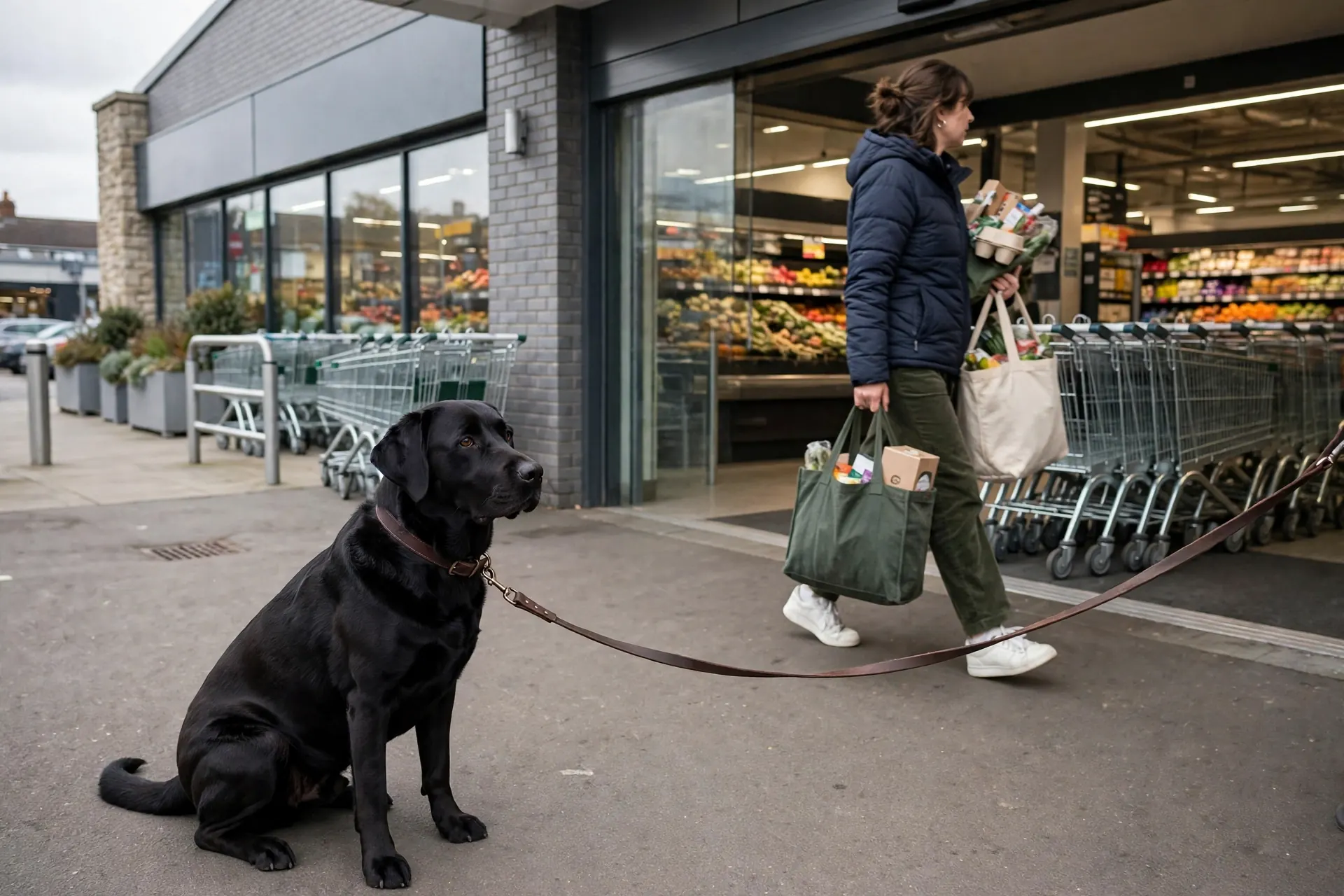
A short note on other dogs at stalls: many owners bring dogs to car boot sales, and encounters in narrow gaps are inevitable. Keep greetings brief and on the move — a two-second sniff while walking past is fine; a long face-to-face meeting in a bottleneck is not. If the other dog is on a long lead or off lead, create distance rather than engaging, and do not let your dog approach a dog that is tied to a stall or a car. A tied dog cannot retreat, so it may react defensively, and the owner may not be nearby. Your dog does not need to meet every dog at the sale; in fact, the calmer visits are the ones with the fewest greetings. For more on reading shop and market rules before you arrive, our guide to dogs in supermarkets explains how different venues set very different policies, and why checking first always beats assuming.
Summer heat, shade and water
Summer is peak car boot season, and it is also the season when a field becomes a heat trap. There is usually no shade on a sale field — no trees, no awnings over the browsing lanes, and nowhere for a dog to escape the sun except under a stall table, which is not a place a dog should be. The ground heats up too: dry grass, bare earth and the tarmac of the entrance road can burn paws by late morning, and a dark-coated dog absorbs heat faster than a light one. Add the excitement of crowds, the effort of walking on a lead, and the stress of noise, and a dog can overheat much sooner than its owner expects.
Water is the first line of defence, and you should carry more than you think you need. Bring a bottle for the dog as well as one for yourself, plus a collapsible bowl, and offer water every fifteen to twenty minutes rather than waiting for the dog to look thirsty. A dog that is panting hard, drooling, or slowing down is already too hot — move to shade immediately, offer small amounts of water, and wet the paws, belly and ears with cool water if you have any to spare. Do not pour a whole bottle over a very hot dog at once, and do not use ice-cold water on an overheated dog; steady cooling and shade work better than a shock. If the dog does not recover quickly, or vomits, staggers or collapses, treat it as an emergency and get to a vet — heatstroke can become life-threatening fast, and check the official guidance before you travel if you are unsure of the nearest emergency vet.
Timing is the simplest heat control you have. On a warm day, arrive as early as you can and leave by mid-morning, before the sun is high and the field is at its hottest. The early slot is also quieter and calmer, which helps on two counts at once. If you can only visit at midday, shorten the trip drastically — twenty minutes of browsing, then home — and consider leaving the dog at home instead. Puppies, older dogs, flat-faced breeds and dogs with thick coats are at the highest risk, and for them a hot-day car boot sale is often a visit to skip entirely. A dog that stays home in the cool is not missing out; it is being looked after.
Shade planning matters more than most owners realise. Before you arrive, look at the field on a map and work out where any shade might be: a hedge line, a building, a row of trees at the boundary. Plan your route so the dog gets a break in shade every few minutes, and carry a light blanket or mat so the dog can lie on something cooler than sun-baked grass. A wet towel draped over a crate or a shady spot helps, but only if you keep it wet. Avoid the temptation to let the dog lie under a stallholder's table or gazebo for shade — that is their selling space, and a dog under it is a tripping hazard and a source of friction. If there is genuinely no shade on the field, that is information: it means the visit should be short, early, and watered often.
Finally, watch the ground under your dog's feet. On a hot day, test surfaces with the back of your hand: if it is too hot for your hand, it is too hot for paws. Stick to grass rather than tarmac or bare earth where you can, and check paws when you get back to the car for redness, limping or licking. A dog that suddenly refuses to walk, or keeps lifting its feet, is telling you the ground hurts. In that case, pick the dog up if it is small enough, carry it to the car on the grass edge, and check the paws properly at home. Paw burns are painful, slow to heal, and entirely avoidable with a hand test and a grass route.
Haggling while holding a lead
Haggling is the heart of a car boot sale, and it is also the moment when most dog owners lose control of the situation. A negotiation takes both hands, both eyes and full attention — exactly the things a dog on a lead also needs. The seller is watching your face, you are watching the price, and meanwhile the dog has wandered three metres to the next stall, wrapped its lead around a chair leg, or started sniffing a box of vinyl records. The answer is not to stop haggling; it is to haggle in a way that keeps the dog managed. The best negotiators at a car boot sale are the ones who pause, settle the dog, and then talk price.
Work as a pair whenever you can. One person holds the dog a few steps back from the stall while the other browses and negotiates, and you swap roles at the next stall. This is the single most effective arrangement at a car boot sale, and it is why couples and families have an easier time with dogs than solo visitors. If you are alone, accept a slower pace: browse first without the dog in the way, decide what you want, then step back, settle the dog in a sit at your heel, and only then start the conversation. A seller who sees a calm dog at your heel is also more likely to be friendly about the price than one who has just had their display nearly pulled over.
Keep negotiations short and clear. Long, drawn-out haggling is where dogs get bored, restless and destructive — they pull, they whine, they lie down in the browsing lane and get stepped on. Decide your top price before you start, make your offer once, and if the seller will not meet it, thank them and walk away. Walking away is a legitimate tactic anyway, and it is much easier to do with a dog than to stand in a crowd for ten minutes arguing over two pounds. If the item is large or heavy — a chair, a bike, a box of books — do not try to carry it and hold the lead at the same time. Pay for it, ask the seller to hold it, and come back for it with the dog settled in the car or with a free hand.
Money handling is a small detail that causes real problems. Fumbling for cash or a card with a lead wrapped around your wrist is how leads get dropped, and a dropped lead in a crowd is how dogs get lost or get into trouble. Keep payment in a pocket or a pouch you can reach with one hand, and pay with the hand that is not holding the lead. If you use a phone to pay, keep the phone in the same hand as the lead hand's opposite side, and do not put the lead down to tap a card reader. A waist-attached lead or a lead clipped to a belt can free a hand, but only if your dog walks calmly on it — a strong puller on a waist lead will pull you off balance in a crowd, so test this at home before relying on it at a sale.
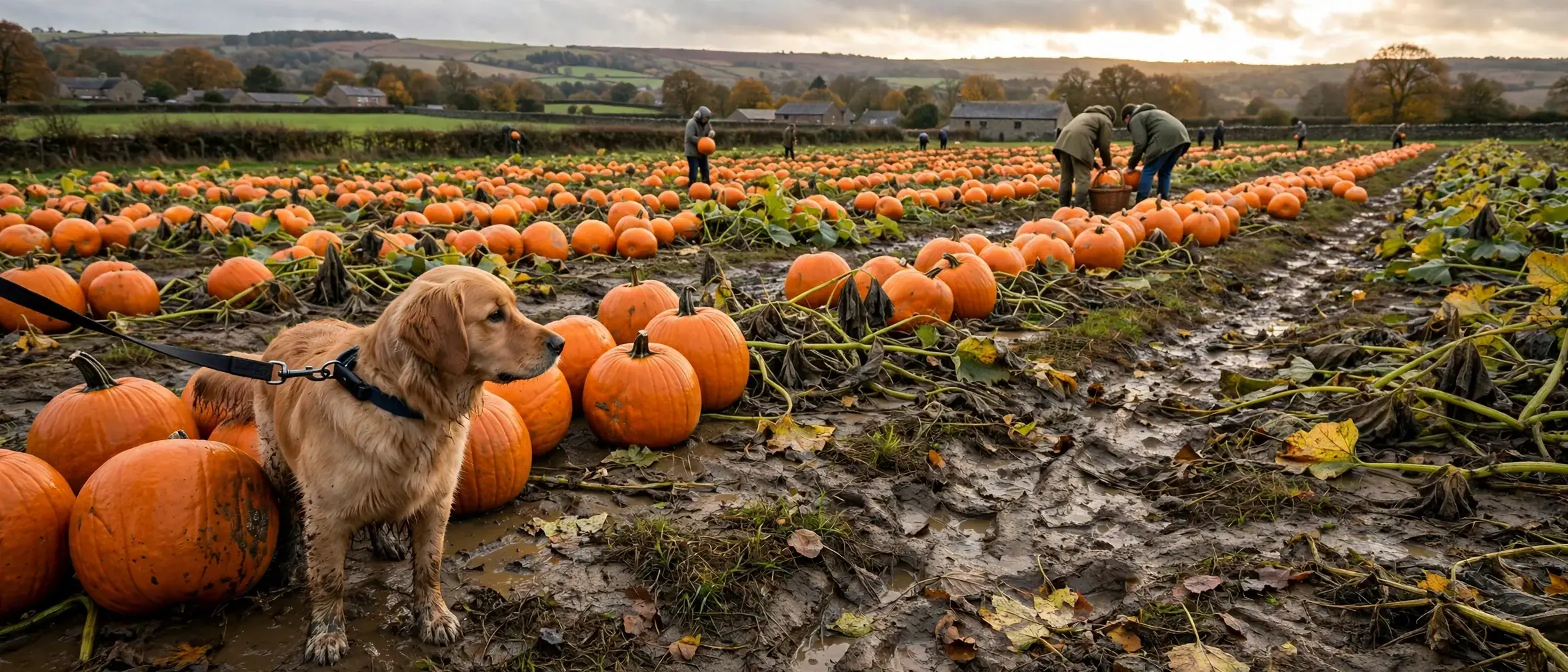
Finally, know when the dog has set the limit. If the dog is lying down, refusing to move, whining or pulling towards the car, the negotiation is over whether or not you have finished browsing. Thank the seller, take the dog home, and return another week — the sale will be there, and the dog will remember a short visit that ended well far better than a long one that ended in stress. The bargain you walk away from is never worth a dog that dreads the next outing. And if you are building a routine of market mornings with your dog, seasonal outings such as our guide to dogs at pumpkin patches show how the same three-part planning — before, during and after — works at farm attractions too, where mud, animals and crowds combine in a different mix.
Rain, mud and paw care
British car boot sales happen in all weathers, and rain changes the whole experience for a dog. A field that is firm grass on a dry morning becomes slippery mud after an hour of rain, with ruts, puddles and churned ground wherever feet and wheels have passed. Dogs slip, owners slip, leads get muddy and heavy, and a dog that falls or is pulled over in mud can be frightened as well as filthy. The mud is not just a nuisance: it hides the same hazards as a dry field — glass, metal, stones — and adds the risk of a twisted leg on a slick slope. If the forecast promises heavy rain, the honest question is whether the visit is worth it at all, especially for an older dog or a puppy.
Preparation makes a wet sale manageable. A drying coat keeps the worst of the rain off and, more importantly, keeps the dog warm — a wet dog in a cold wind chills fast, and a shivering dog is a dog that should be going home. Pack two towels rather than one: the first for the worst of the mud at the car, the second for a proper dry-off at home. A paw-cleaning towel or a small tub of clean water at the car lets you rinse grit and mud off paws before the drive home, which protects both the dog's skin and your car's interior. Booties or paw wax can help on rough or muddy ground, but only if the dog is already used to them — a first attempt at booties in a muddy field will end with the dog kicking them off into a puddle.
Paw care after a wet sale deserves a proper check. Once home, wash the paws in lukewarm water, check between the toes for grit, small stones and cuts, and dry them thoroughly — damp paws left in a warm car or house can develop sore, red skin between the toes. Look for limping, licking or a reluctance to walk the next day, which can signal a small cut or a stone bruise picked up in the mud. Trim the hair between the toes if it is matted with mud, because matted hair holds moisture against the skin. If the field was treated with anything, or if you saw the dog drink from a puddle, watch for stomach upset and check the official guidance before you travel next time — puddle water on a sale field can carry fuel, chemicals and bacteria that a dog should not swallow.
Clothing and kit for the owner matter too, because a wet owner is a distracted owner. Waterproof boots with grip are essential on a muddy field; trainers will slip and soak through within minutes. A waterproof jacket with a pocket for treats and poo bags keeps your hands free and your kit dry. Keep the lead short in mud — a long lead in wet conditions wraps around legs, drags through puddles and becomes a slipping hazard for everyone nearby. And keep the dog off the steepest, muddiest slopes of the field, where cars have churned the ground into a slide; the flat, grassy edges are safer for paws and for footing, even if the stalls there are less interesting.
One last wet-weather point: the drive home. A wet, muddy dog in a car needs a towel on the seat or a blanket in the boot, not just for the upholstery but for the dog's comfort — a cold, wet dog shivering on a leather seat is miserable, and a dog that associates car boot sales with a cold, wet drive home will be reluctant next time. Pack the towels where you can reach them without opening every bag, dry the dog as well as you can at the car, and run the heater gently on the way home rather than blasting cold air. A warm, dry arrival home is the last step of a good wet-weather visit, and it is the part owners most often forget.
Leaving well: the last ten minutes
How a visit ends matters as much as how it begins. The last ten minutes at a car boot sale are often the most chaotic: sellers packing up, cars reversing out, buyers carrying armfuls of purchases across lanes, and stewards directing traffic. This is not the moment to let the lead out, to let the dog wander, or to stop for one last stall in the middle of a lane. Plan the departure as deliberately as the arrival. Decide in advance where you will meet, what you are carrying, and who holds the dog — and then execute it calmly, without rushing.
Load purchases before you bring the dog to the car. Carry bags to the car, load the boot, and check that nothing sharp or fragile is where the dog will sit. Only then bring the dog across the field, on a short lead, on the grass edge rather than through the lanes. If the dog travels in a crate or behind a guard, settle the dog first and then do a final check of the area for anything you dropped — a lead, a poo bag, a water bowl. If the dog travels on a seat, put the towel or blanket down first and clip the dog in before you close the door. Never open the car door and let the dog jump in off lead across a busy field; a dog that bolts for the car can run straight into the path of a departing vehicle.
Do a quick health check before you drive away. Look at the paws for cuts, mud and swelling; check the coat for ticks if the field bordered woodland or long grass; offer water; and watch the dog's breathing for a minute. A dog that is still panting hard ten minutes after leaving the field may be overheated or stressed, and needs shade, water and rest before the journey. If you bought anything for the dog — a toy, a bed, a second-hand lead — check it before you let the dog use it: wash fabric items, check toys for small parts and sharp edges, and discard anything that smells of chemicals or is damaged. Second-hand dog items can carry germs from another household, so a quick wash is worth the effort.
The drive home is part of the visit, not an afterthought. Give the dog a calm, quiet journey — no loud music, no sudden stops if you can avoid them, and a window cracked for fresh air rather than a blast of air conditioning. If the visit was stressful, a short, familiar walk near home before going indoors helps the dog decompress: a few minutes of sniffing on a quiet street does more to settle a dog than going straight from a crowded field into a quiet house. Watch the dog for the rest of the day for signs of delayed stress — restlessness, reduced appetite, extra sleep, or a reluctance to go out — and note what triggered them. That note is the most useful thing you will take home from the sale, because it tells you what to change next time: earlier arrival, shorter visit, quieter rows, or a different sale altogether.
Finally, think of each visit as part of a three-part routine you can repeat and improve. Before: check the rules, pack the kit, plan the timing and the exit. During: keep the lead short, walk the edges, watch the dog, and leave early if needed. After: check paws, offer water, dry off, and decompress. A car boot sale done this way is a pleasant morning out rather than an ordeal — and a dog that enjoys the routine will be a calm, welcome visitor at the next sale, which is how dog-friendly sales stay dog-friendly. The field, the stalls and the bargains will all be there next week; the dog's trust in the outing is the thing worth protecting.
Practical questions
Before you go
Are dogs allowed at car boot sales in the UK?
It depends on the organiser. There is no single national rule, so some sales welcome dogs on leads and others ban them outright. Always check the sale's own listing, social media page or signage before you travel, and have a backup plan if dogs are not allowed.
Is it safe to take a dog into a car boot sale car park?
Car parks are the riskiest part of a car boot sale because cars, pedestrians and dogs share the same lanes. Keep your dog on a short lead on your far side from traffic, walk on the edges of the lanes, and never let the dog wander behind reversing cars. Arriving early or late, when fewer cars are moving, is noticeably calmer.
What should I do if my dog gets stressed by the crowds?
Move to a quiet edge of the field, offer water and a few minutes of calm, and shorten the visit. If your dog keeps pulling, barking, panting heavily or trying to leave, take that as the answer and head home. A short calm visit beats a long stressful one, and you can always return another week.
Can I leave my dog in the car while I browse a car boot sale?
No. Cars heat up far faster than most people expect, even on mild or cloudy mornings, and a dog left inside can overheat quickly. If you cannot take the dog around the stalls, leave the dog at home or take turns browsing with another adult so the dog is never left alone in the car.
What should I pack for a dog at a car boot sale?
Pack a short lead, poo bags, a water bottle and a collapsible bowl, a towel or blanket for muddy paws, and a few treats. In summer add shade planning and extra water; after rain add a paw-cleaning towel and a drying coat. Keep everything in one small bag so your hands stay free for browsing.
Do I have to pick up after my dog at a car boot sale?
Yes. Always pick up immediately and use the bins provided, or take the bag home if there are none. Fouling left on a field is one of the fastest ways for organisers to ban dogs from future sales, so responsible owners protect access for everyone.