This guide is independent and contains no paid placement. If affiliate links are added later, they will be clearly marked and will not change our editorial checks.
Most outdoor farmers markets in the UK welcome dogs, but the visit works only if the dog stays on a short lead, well clear of open food, and out of the thickest crowd. Arrive early, walk the outer edge first, keep food shopping and dog fussing separate, and leave while the trip is still going well.
A Saturday morning between the stalls
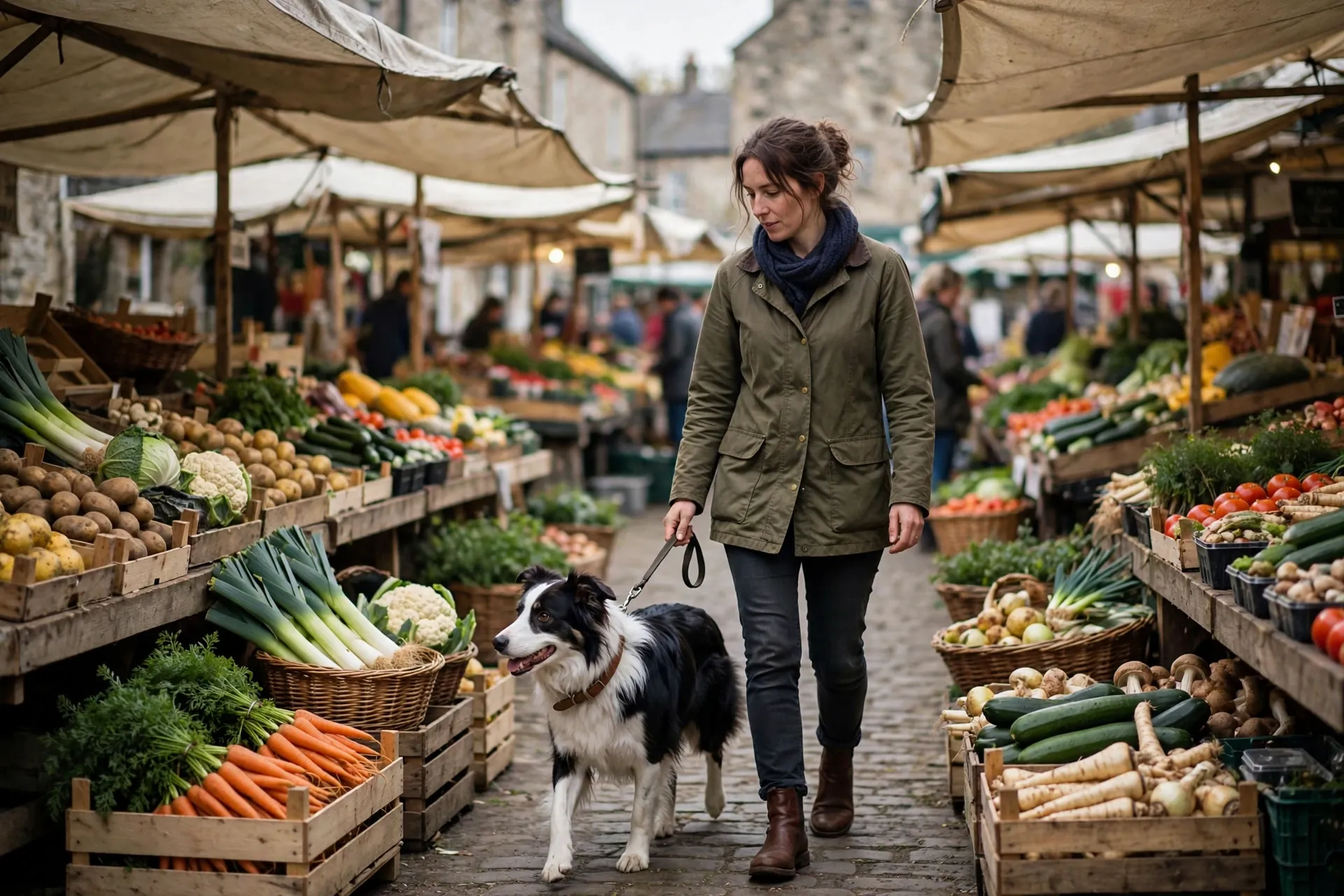
Saturday morning at a farmers market has a rhythm of its own. The first stallholders are still stacking crates when the early shoppers arrive, the coffee stall is already steaming, and the air carries a mix of fresh bread, cut herbs and damp canvas. For a dog, that first walk between the stalls is a flood of information: new smells at nose height, feet moving in every direction, voices overlapping, and food somewhere just out of reach. The way that first ten minutes goes usually sets the tone for the whole visit, so it is worth slowing down on purpose rather than diving straight into the busiest aisle.
Start on the outside edge of the market, not down the middle. Most markets have a perimeter path, a pavement edge or a gap behind the stalls where you can walk the full length once without stopping. That outer loop lets your dog take in the smells and sounds at a distance, gives you a view of the layout, and shows you where the quiet corners, the water points and the exits are before you commit to the crowded rows. It also tells you which stalls draw the longest queues, so you can plan to visit them when the line is shorter or skip them altogether. A dog that has already sniffed its way around the edge is a calmer dog when you turn into the stalls themselves.
When you do turn in, walk with a purpose and keep moving. Markets reward the shopper who pauses in open space, not the one who stops dead in a narrow gap while deciding between two cheeses. If a stall catches your eye, step to one side, shorten the lead, ask your dog to sit or stand beside you away from the counter, and then look. If your dog cannot settle for even a short pause, that is useful information: buy from the quieter stalls, keep the list short, and treat the trip as a walk with shopping attached rather than a full weekly shop. The market will still be there next Saturday, and a short successful visit teaches a dog far more than a long stressful one.
Think of the route as a series of short hops between open spaces. Stall front, open square, stall front, side street, stall front, bench. Dogs cope with busy places in bursts, and a thirty-second breather in a quiet spot between stalls does more good than a long sit in the middle of the flow while shoppers stream past on both sides. Watch for natural pauses: the end of a row, a gap where a stallholder has not yet set up, a patch of grass at the edge of the square. Use them. The goal is not to see every stall. The goal is to come home with good food and a dog that would happily do it again next week.
One more Saturday habit is worth building: decide your shopping list before you arrive. Markets tempt everyone to browse, but browsing with a dog means long stationary waits while you weigh up jams you had not planned to buy. A short list — bread, vegetables, cheese, something for Sunday lunch — keeps the visit focused and the dog moving. If you want to browse properly, do it on a return visit without the dog, or split the trip: one person shops while the other walks the dog around the square, then swap. Many couples and families do exactly this without thinking about it, and it is often the simplest answer to a market that is too busy for a dog at midday.
Why outdoor markets usually welcome dogs
Outdoor farmers markets and indoor food halls are different worlds for dogs, and the distinction explains most of the confusion about market rules. An outdoor market on a town square, a farm yard or a village green is largely open air, with space to step aside, fresh air to dilute cooking smells, and ground that can be hosed down. Stallholders there are used to dogs passing their stalls, many keep a water bowl out, and the market as a whole often advertises itself as dog-friendly because dogs are part of the Saturday crowd. That welcome is real, but it is also conditional: it depends on dogs staying under control and away from food.
Indoor markets are stricter for practical reasons. A covered hall concentrates smells, narrows the walkways and puts food preparation much closer to passing feet and paws. Some indoor markets ban dogs outright, others allow only assistance dogs, and others allow dogs in the general hall but not in the food court area. The same market can also change its rule by season, moving outdoors in summer and indoors in winter, so a market that welcomed your dog in July may have a different policy in January. Check the official guidance before you travel rather than assuming last year's rule still holds, especially for markets held inside historic buildings or shopping centres.
It helps to understand why stallholders care so much about dogs near food. Food hygiene rules require traders to protect open food from contamination, and a dog sniffing a cheese counter, brushing a cake stand with its tail or licking a dropped sample is a genuine hygiene problem for the trader, not just a matter of taste. A trader who asks you to move your dog back is protecting their licence and their customers, and a polite step back costs nothing. Markets that stay dog-friendly are usually the ones where dog owners make that step back without being asked, which is why this guide keeps returning to distance from food as the central habit.
There is also a difference between a farmers market and a general street market, and it matters for planning. A certified farmers market, such as those accredited under schemes run by farming organisations, usually means the stallholder grew, reared or made what they sell, and the stalls are mostly food. A general market may mix food with clothing, crafts and household goods, which often means wider aisles and fewer open-food risks, but also more clutter at dog height. Either type can welcome dogs, but the food-heavy farmers market demands more discipline from the owner, and the craft-heavy market demands more care about low displays, trailing tablecloths and fragile stock.
Finally, remember that "dogs welcome" at market level does not guarantee every stall agrees. A butcher with raw meat on display, a baker with trays at knee height, or a stallholder with a dog allergy or a nervous dog of their own may reasonably ask for extra space. Treat each stall as its own small negotiation: a smile, a short lead and a dog held to the side away from the counter will get you further than any argument about the market's general policy. The wider guide to dog-friendly markets in the UK covers festive and indoor markets in more detail, including the crowd and paw-safety tips that also apply on a busy Saturday.
Check before you go
A two-minute check before leaving home prevents most market-day disappointments. Start with the market's own website or social media page, where the dog policy is usually stated in a line or two. Look for phrases like "dogs welcome on a lead", "well-behaved dogs welcome" or "assistance dogs only", and note whether the policy covers the whole market or only the outdoor part. If the policy is not stated, a short message to the market organiser is worth sending; organisers answer these questions constantly and would rather clarify than deal with a turned-away visitor at the gate.
Next, check the practical details that shape a dog visit: opening hours, whether the market is weekly or monthly, where you can park, and whether there is a toilet stop or green space nearby for a pre-market walk. A dog that has already had a proper walk and a toilet break before entering the market is a different animal from one that arrives bursting with energy and a full bladder. Plan a twenty-minute walk in a nearby park or along a quiet street first, and arrive at the market with a dog that has already burned off the edge. If you are travelling to an unfamiliar town, check the official guidance before you travel for parking and any seasonal road closures around the market square.
Weather deserves its own check, because it changes the market more than most visitors expect. Rain turns market squares slippery and sends shoppers crowding under canopies, which narrows the walkways and puts dogs closer to feet and food. Hot sun turns tarmac and stone into a paw hazard by late morning and makes queues miserable for a dog standing still. Wind lifts tablecloths, canvas flaps and loose packaging into a dog's face. None of these is a reason to cancel, but each is a reason to adjust: a rainy-day visit should be shorter, a hot-day visit earlier, and a windy-day visit kept to the sheltered rows.
Also confirm what you actually need to buy, and whether the market is the right place to buy it with a dog in tow. A farmers market is a poor place for a long, indecisive shop with a young or excitable dog, but an excellent place for a short, purposeful shop with a settled one. If your list is long, consider ordering a veg box or a meat box from a regular stallholder for collection, which many traders offer: you collect a packed box from one stall, pay quickly, and leave, rather than working through a dozen stalls with a dog in tow. Collection schemes like this are worth asking about, and they often build into a regular Saturday routine that suits both dog and owner.
One last pre-trip check is your dog itself. A dog that is unwell, in season, recovering from an operation, or still in the early weeks of lead training is not a good candidate for a busy market, however much you want to bring them along. Markets are stimulating, and stimulation is tiring even for confident dogs. A dog that has had a stressful week, a vet visit or a long journey may be closer to its limit than it looks. When in doubt, leave the dog at home with a comfortable rest and enjoy the market yourself; a missed Saturday is better than a bad experience that makes the next visit harder.
The short lead, used properly
The single most useful piece of market equipment is a short, fixed-length lead, and the way you hold it matters as much as its length. A lead of about one to two metres, held with the dog close beside you, keeps the dog out of the food zone, out of other shoppers' feet and out of the path of trolleys and pushchairs. A retractable lead is the wrong tool here: it lets the dog drift three or four metres ahead into a stall, wraps around table legs and strangers' ankles, and gives you no quick way to gather the dog in when a queue suddenly moves. Leave the long line for the park and bring the short lead for the market.
Hold the lead in the hand furthest from the stalls when you are browsing, so the dog walks on the open side of the pavement rather than between you and the counter. This sounds like a small detail, but it is the difference between a dog standing politely at your side and a dog leaning against a cheese counter with its nose at tray height. When you stop, plant your feet, shorten the lead by gathering a loop in your hand, and give the dog a clear job: sit, stand or lie beside you, facing out towards the open square rather than towards the food. A dog with a job is a dog that is not improvising its own entertainment.
Practice the market stop at home before you need it in public. Stand in your kitchen, shorten the lead, ask for a sit, and hold it for thirty seconds while you pretend to look at a shelf. Reward calm waiting, not just the sit itself, and build up to a minute. Dogs that can wait calmly for a minute at home can usually manage a market stall; dogs that cannot wait at home will not learn how in a crowded square with cooking smells everywhere. The same practice applies to walking past food at nose height: set up a low table with something interesting on it, walk past on a short lead, and reward the dog for keeping moving. Ten minutes of this in the garden saves a dozen awkward moments at the market.
Lead handling in a crowd also means managing your own hands. Markets require shopping bags, a purse or phone, samples to hold, and a lead, all at once, and fumbling is when leads get dropped. A bag with a shoulder strap or a small rucksack frees a hand, and a lead with a loop that goes over your wrist or around your waist as a backup stops a dropped lead becoming a loose dog. If you need both hands to pay or pack a bag, step out of the flow first, stand your dog beside a wall or bench, shorten the lead, and only then deal with money and bags. Never tie a lead to a stall leg, a chair or a signpost while you shop: a tied dog in a crowd is a stressed dog, and other shoppers will trip over the lead or try to fuss a dog that cannot move away.
For two-dog households, the market is a place to be honest about numbers. Two leads in a crowded aisle tangle, two dogs double the nose-height food risk, and one person cannot easily manage two dogs plus shopping bags. If both dogs come, bring two people, one dog each, or take the dogs in turns while one person waits outside the busy rows. A single calm dog is a pleasure at a market; two excited dogs managed by one person in a narrow aisle is how markets end up tightening their dog policy for everyone.
Food stalls: keep a clear distance
The rule at food stalls is simple to state and takes practice to keep: your dog's nose stays at least an arm's length from open food, and the dog's body stays on the open side of you, not pressed against the counter. Open food includes cheese on boards, cakes on stands, cooked meat under heat lamps, bread in open baskets, olives and chutneys in open tubs, and anything offered as a sample. Covered, sealed and packaged food is lower risk, but a dog leaning on a stall still risks knocking a display, so distance is the habit regardless of how the food is presented.
Samples deserve a special warning, because they are designed to be tempting and are often held at exactly dog height. A stallholder holding out a piece of cheese or sausage may be offering it to you, not to your dog, and a dog that lunges for it can knock the tray, swallow something unsafe, or take food meant for the next customer. If you want to taste, take the sample, step back from the stall, and eat it with the dog held short beside you, not leaning over the tray. If a stallholder kindly offers your dog a treat, pause and ask what it is before accepting: a piece of plain cooked chicken is different from a rich sausage, a cheese cube is different from a chocolate brownie crumb, and anything containing onion, garlic, grapes, raisins, chocolate or xylitol must be refused politely. Your dog will not mind missing one sample; a stomach upset on the way home is a worse souvenir.
Certain foods are worth naming because they appear at markets constantly. Cooked bones from a butcher stall can splinter and should never be given to a dog. Rich, fatty foods such as sausages, pork pies and cheese in quantity can trigger pancreatitis in susceptible dogs, which is a painful and expensive emergency, not a minor upset. Raw meat carries bacterial risks and is not a market-day snack. Grapes and raisins, common in chutneys, cakes and trail mixes, are toxic to dogs even in small amounts. Chocolate, especially dark chocolate sold at artisan stalls, is toxic too. Alcohol, including the small measures sometimes offered at gin or cider stalls, is obviously off limits. None of this means markets are dangerous places; it means the food on display is people food, and the dog's food comes from your bag or from a dedicated dog stall.
Dropped food is the other half of the problem. Markets are full of dropped crumbs, fallen fruit and spilled samples, and a dog's nose finds them faster than your eyes do. Train a solid "leave it" before market day, and use it generously: a dropped grape, a piece of onion bhaji, a chicken bone from a street-food stall are all reasons to move the dog away first and clean up second. If your dog does eat something worrying, note what it was, how much, and when, and call your vet for advice rather than waiting to see what happens; for grapes, chocolate and xylitol, speed matters, and a vet would rather take a cautious call than a late emergency.
Street-food stalls inside or beside a farmers market add a further layer. Cooking smells are stronger, queues are longer, and people eat while standing in the flow, which means food at dog height everywhere, not just at counters. If you want street food, buy it, then walk to a bench or a quiet corner away from the stalls to eat it, with the dog settled beside you and not under the table where scraps fall. Better still, eat after the dog has had its own treat and water, so it is less focused on your food. A dog that has just been fed is a dog that can watch you eat a sausage sandwich with far more patience.
Finally, be a good neighbour to the stallholders. If your dog knocks something, tell the trader straight away and offer to pay. If your dog has an accident near a stall, clean it up immediately and apologise; traders remember the owners who deal with problems gracefully, and they remember the ones who walk away. Markets stay dog-friendly because of hundreds of small courtesies like these, and every owner who keeps their dog clear of food is helping to keep the market open to the next dog that comes along.
Crowds, queues and peak hours
Timing is the easiest lever you have, and it costs nothing. Most Saturday farmers markets open between 8am and 9am and run until early afternoon, and the crowd builds in a predictable curve: a quiet first hour, a busy late morning, and a calmer final hour as stalls begin to pack up. The peak, roughly 10:30am to 12:30pm on a Saturday, is when families arrive after breakfast, pushchairs and shopping trolleys fill the aisles, and the cooking smells are at their strongest. If your dog is confident and well trained, the peak is manageable for a short visit. If your dog is young, nervous or reactive, the peak is the time to avoid.
Early visits have practical advantages beyond the thinner crowd. Stallholders have more time to talk, you can ask about ingredients and provenance without holding up a queue, and the dog gets a calmer first impression of the market that you can build on week by week. Late visits have their own charm: some traders discount remaining stock, the atmosphere relaxes, and a dog that arrives when the market is winding down learns that markets are not always intense. Either end of the day beats the middle for a dog, and alternating early and late visits across the month gives you a sense of which slot suits your dog best.
Queues need their own technique. A queue at a popular bread or coffee stall can stand still for ten minutes, which is a long time for a dog to wait in a narrow space with food smells all around. If the queue is long and narrow, consider skipping that stall or sending one person to queue while the other waits with the dog in open space. If you must queue with the dog, stand at the edge of the queue rather than in the middle of it, keep the lead short, and give the dog something to do: a sit, a watch-me, a scatter of its own treats on the ground away from the stall. A dog that is working, even in a tiny way, copes better than a dog that is simply standing and staring at food.
School holidays, bank-holiday weekends and festive Saturdays change the picture again. Markets near tourist towns swell with visitors who may not be used to dogs, children run between stalls, and the aisles fill with people carrying hot food and drinks at dog height. On those days, either arrive at opening time or leave the dog at home and enjoy the market yourself. There is no prize for proving your dog can cope with the busiest day of the year, and a bad experience on a bank holiday can undo weeks of calm Saturday practice. The same logic applies to special market events: a food festival attached to a farmers market is a different, much busier event, and it deserves its own decision rather than being treated as a normal Saturday.
Watch the dog, not the clock, for the decision to leave. A dog that starts pulling towards the exit, panting when it is not hot, yawning repeatedly, licking its lips, or suddenly refusing treats it normally loves is telling you it has had enough. Leaving at that point is not giving up; it is good training. Dogs learn from the ending of a visit as much as from the middle, and a dog that leaves while it is still coping will come back next week more confident than a dog that was pushed until it barked, lunged or shut down. Set a time limit before you arrive — forty-five minutes is plenty for a first market visit — and stick to it even if the shopping is not finished.
Dog treats, water and toilet breaks
Dog treat stalls are one of the pleasures of a farmers market, and they are worth seeking out rather than avoiding. Many markets now have a stall selling biscuits, jerky, training treats or birthday cakes made specifically for dogs, often baked in small batches with short ingredient lists. These stalls are usually happy to talk through ingredients, portion sizes and suitability for puppies, older dogs or dogs with allergies, and many offer a small sample for the dog to try. That is the right place for your dog to taste something new, because the food is made for dogs and the stallholder expects dogs to be there.
Even at a dog stall, a little caution pays off. Read the ingredient list yourself rather than relying on the word "natural" on the label, ask about common allergens such as chicken, wheat or dairy, and check the portion guidance: a treat that is fine as one biscuit can upset a stomach as five samples from five stalls. Dogs with medical conditions, including pancreatitis, kidney disease, diabetes or a weight-management plan, should only have treats their vet has already approved, and a new treat should be tried in a small amount at home first so you can watch for a reaction. Buy a bag to take home, give one or two treats at the market as a reward, and save the rest for training during the week.
Water is the other essential, and it is easy to forget on a cool morning when the dog does not look thirsty. Markets are stimulating, dogs pant more when excited, and a dog that has walked to the market and then spent an hour sniffing will need a drink even in October. Carry a collapsible bowl and a bottle of water, and offer a drink at a quiet spot away from the stalls rather than waiting for the dog to find a communal bowl. Communal bowls are kind, but they can spread kennel cough and stomach bugs, and some dogs guard them; your own bowl is cleaner and calmer. If a stallholder offers water from a jug, accept it into your own bowl rather than letting the dog drink from a shared one, and thank them for thinking of dogs.
Toilet breaks need planning because market squares rarely have a dog toilet area. Walk the dog before you enter, as already described, and plan a mid-visit break if the trip will last more than an hour: step out to a side street, a patch of grass or a nearby park, let the dog relieve itself, and re-enter refreshed. Always carry bags and clean up immediately, including on grass verges and side streets, because a market town remembers the dog owners who leave mess behind. If your dog is a leg-cocker, keep it away from stall legs, tablecloths and shopping bags on the ground; a short lead and a watchful eye prevent the embarrassment that no owner enjoys explaining to a stallholder.
Feeding on market morning also matters. A dog fed its normal breakfast at the usual time is steadier than a dog kept hungry in the hope it will behave for treats, and a hungry dog is a dog that lunges at food stalls. Feed normally, bring a pouch of the dog's usual treats for rewards, and use those familiar treats for training moments at the market rather than relying on rich new samples. The dog stall purchase is a bonus, not the dog's lunch, and the familiar treats in your pocket are what will get a reliable sit when you need one at a busy corner.
Weather, ground and paws
British market weather is part of the experience, and each kind needs a different adjustment for dogs. Rain makes stone and tarmac slippery, sends shoppers under canopies where the walkways narrow, and turns grass edges into mud that dogs track everywhere. A rainy market visit should be shorter, with a towel waiting in the car and a drying coat if your dog wears one. Muddy paws are not just a car-cleaning problem: grit and salt on wet pavements can irritate paws, and a dog that has been standing in cold rain will chill quickly once you stop moving, so keep the visit moving and dry the dog promptly afterwards.
Heat is the more serious risk, and it arrives earlier in the year than many owners expect. Stone squares and tarmac absorb sun from mid-morning, and a dog walking on hot ground will feel it through its pads long before a shod human notices. Use the back-of-hand test on the ground: if you cannot hold your hand on it for five seconds, it is too hot for paws. On warm days, visit at opening time, stick to shaded rows, offer water frequently, and never leave a dog in a car while you "just pop into the market" — a car heats to dangerous levels in minutes even with a window cracked, and market car parks are no exception. Dogs with flat faces, thick coats, heart conditions or older age overheat fastest and should skip hot-day markets entirely.
Cold brings its own considerations, especially for small, short-coated and older dogs. A winter market visit in wind and drizzle chills a small dog quickly, and standing still in a queue is colder than walking. A coat helps, but so does a shorter visit and a warm car or cafe afterwards. Icy patches on market squares are a slip risk for dogs as well as people, and rock salt spread on pavements irritates paws and is toxic if licked off in quantity, so wipe paws after a winter visit and watch for limping or excessive licking. The guide to dog-friendly cafes in the UK is useful here: a warm cafe stop after a cold market is often the kindest end to the trip.
Ground surfaces vary more than visitors realise, and they affect different dogs differently. Smooth stone is easy for most dogs but slippery when wet. Cobbles are charming and hard on older joints and small paws, especially when a dog is pulling. Grass is comfortable but hides dropped food and, after rain, becomes a mud bath. Gravel car parks used for some rural markets can be sharp underfoot. If your dog has arthritis, a recent injury or sensitive paws, choose markets with smoother ground, keep the visit short, and consider dog boots for rough or salted surfaces — introduced gradually at home first, not for the first time at a busy market.
Wind deserves a mention because it changes a market's atmosphere completely. Gusts flap canvas, rattle signs, blow packaging across the square and carry cooking smells in sudden bursts that can startle a nervous dog. On a windy day, keep to the sheltered side of the market, avoid rows where canopies are flapping hard, and shorten the lead a little more than usual. A dog that is startled by a flapping tarp may bolt sideways into a stall or a queue, and a short lead is what turns a startle into a wobble rather than an incident.
Nervous and reactive dogs
Not every dog is a market dog, and that is not a failure. Some dogs find busy, smelly, noisy places genuinely hard, and forcing the issue helps nobody. A dog that barks at strangers, lunges at other dogs, or shuts down and refuses to move in a crowd is telling you that a farmers market, at least at peak time, is beyond its current comfort zone. That does not mean markets are forbidden forever; it means the training plan should start somewhere easier, such as a quiet village shop front, a calm garden centre, or the edge of a market at opening time, and build up in small steps over weeks.
For a dog that is nearly ready, the market can be introduced in stages. Stage one is a walk around the outside of the market without entering, rewarding calm observation from a distance. Stage two is a single pass down one quiet row and straight out again, no shopping, no stopping. Stage three is a short shop at one stall with a planned exit. Each stage should end while the dog is still coping, and any stage that produces sustained barking, lunging or freezing means dropping back a stage, not pushing through. A trainer or behaviourist can help design this plan, especially for dogs with a bite history or a strong reaction to children or other dogs, and their advice is worth taking before a market visit rather than after an incident.
Reactive dogs need extra management even on a good day. Walk on the outer edge of the aisles, keep a generous buffer from other dogs, and cross to the other side of a row rather than passing nose to nose in a narrow gap. A yellow lead, bandana or harness that signals "give us space" helps some owners, though it is not a substitute for distance and control. If another dog approaches off lead or on a long lead, step between the dogs, shorten your lead, and move away calmly rather than getting into a tangled lead negotiation in the middle of the market. Most owners will understand, and the few who do not are not worth an argument in a crowded square.
Signs of stress are easy to miss when you are focused on shopping, so learn your own dog's early warnings. Lip licking when no food is present, yawning out of context, turning the head away, a low tucked tail, ears pinned back, sudden scratching or sniffing the ground intensely, and a refusal of treats the dog normally loves are all early signals. Later signals include panting when it is not hot, pacing, pulling hard in one direction, barking, and freezing completely. The early signals are the time to act: move to open space, offer water, and either settle or leave. Waiting for the late signals means the dog has already had a bad experience.
After a market visit, give a nervous dog a proper decompression period: a quiet walk somewhere familiar, a drink, a chew or a rest in a safe place, and no further excitement that day. Dogs process stressful experiences slowly, and a second busy outing on the same afternoon can tip a dog that coped in the morning into a reaction in the afternoon. This is sometimes called trigger stacking, and it explains why a dog that was fine at the market may bark at a stranger on the walk home. Plan one stimulating outing per day for a sensitive dog, and let the rest of the day be boring on purpose.
Children, trolleys and other dogs
Markets are family places, and children are part of the crowd. Small children move unpredictably, run between stalls, drop food, and often want to stroke any dog they see. A dog that is fine with adults may still be startled by a toddler running up from behind, so keep the dog on the side away from passing children where possible, and be ready to step aside when a family group approaches. If a child asks to stroke your dog, it is perfectly reasonable to say no, especially if your dog is tired or the space is tight; a polite "not today, he is a bit overwhelmed" protects both the child and the dog, and most parents understand immediately.
Teach children in your own party the market rules too: walk, do not run, around the dog; do not feed the dog from stalls; do not pull the lead. Children who understand that the dog has a job — walking calmly beside you — are safer and calmer themselves. If you are shopping with children and a dog, consider whether one adult should hold the dog while the other manages the children at a stall, because a child, a dog and a shopping bag in a narrow aisle is a lot for one person to coordinate, and the dog is usually the one that loses out.
Trolleys, pushchairs, wheelchairs and mobility scooters share the aisles with dogs, and they all move differently from pedestrians. A trolley wheel at ankle height is a trip hazard for a small dog, and a pushchair approaching silently from behind can startle any dog. Keep the dog close and to one side, watch behind you as well as ahead, and step into a gap to let larger wheels pass rather than squeezing through together. Stallholders with trolleys of stock moving between stalls deserve the same courtesy: pause, hold the dog short, and let them through.
Other dogs are the most exciting distraction at a market, and the hardest to manage. Even a friendly dog that wants to greet every other dog will strain, bark and tangle leads if it meets a dozen dogs in an hour. Keep greetings short or skip them entirely in the market: a brief nose-to-nose hello on a loose lead in open space is fine if both owners agree, but a prolonged greeting in a narrow aisle blocks the flow and excites both dogs. If your dog is not reliable with other dogs, do not rely on other owners to keep their dogs away; manage the distance yourself by crossing rows, using side streets, and visiting at quieter times. A market is not the place to practise off-lead social skills, and on-lead greetings between excited dogs are where most market scuffles start.
Assistance dogs deserve a particular note. A guide dog, hearing dog or other assistance dog at a market is working, and distracting it — by calling it, offering food, or letting your dog approach it — can interfere with its owner's safety. Keep your dog well away from working dogs, do not fuss them, and give the handler space in queues and aisles. If your own dog is an assistance dog, you have legal protections that pet dogs do not, but the practical habits in this guide — short lead, distance from food, quiet timing — still make the visit smoother for everyone.
What to pack for market day
A small market kit, kept by the door, turns a farmers market visit from a scramble into a routine. The essentials fit in a pocket or a small bag: a short fixed lead, poo bags, a collapsible water bowl, a bottle of water, a pouch of the dog's usual treats, and a towel or cloth for muddy paws. Add a phone, payment card and a shopping bag with a shoulder strap, and you have everything you need for a short market shop without juggling armfuls of kit. Dogs that wear a coat in cold or wet weather should have it on before you arrive, not wrestled on in the market square.
A few extras earn their place depending on the dog. A portable mat or settle pad gives a dog a defined place to lie while you queue or chat, and dogs that have learned to settle on a mat at home will settle faster on one at a market. A long-lasting chew can occupy a dog during a longer stop, though chews should be given in open space, not in a narrow aisle where another dog might try to take it. A spare lead is worth carrying if your dog chews leads or if the clasp is old; a broken lead at a market is a problem you do not want to improvise around. For puppies, add a spare towel and a few extra bags, because accidents happen and a calm clean-up is part of the training.
What not to bring matters too. Leave the retractable lead, the long line, the ball launcher and the squeaky toy at home: all of them create chaos in a crowded aisle. Do not bring a dog's breakfast bowl or a large bag of food to a market; the dog's food comes in small treat form, and a bowl on the ground in a market square is a magnet for other dogs and dropped food. Avoid strong-smelling treats in your pocket if your dog is food-obsessed, because the smell will keep its nose working overtime; plain, low-odour training treats are a better market choice than fishy or meaty rewards.
Car preparation is part of packing if you drive to the market. Park in shade where possible, leave a window shade or a sunshade in the car, and keep a towel, a spare lead and a bottle of water in the boot for the return journey. Never leave a dog in a parked car while you shop, even for a few minutes and even on a cool day, because car temperatures rise fast and market queues are unpredictable. If the dog cannot come into the market for any reason — a change of policy, an indoor hall, a dog that is unwell — the answer is to leave the dog at home, not in the car.
Finally, pack patience. Markets are slow places, queues form, stallholders chat, and your dog will need toilet breaks, water stops and quiet moments that were not on your list. A market visit with a dog takes longer than the same shop without one, and that is fine. The dogs that enjoy markets most are owned by people who treat the visit as an outing in its own right, not as an errand to be completed as fast as possible. Build in an extra half hour, plan a cafe stop afterwards — the guide to dog-friendly restaurants in the UK can help if you want to turn the market into a longer day out — and come home when the dog is still happy, not when you are exhausted.
A calm market-day plan
Putting it all together, a calm market day looks something like this. The night before, check the market's dog policy and opening hours, write a short shopping list, and lay out the market kit by the door. On the morning, feed the dog normally, take a proper walk with a toilet break, and arrive at the market in its first hour if possible. Walk the outer edge once, then work through the stalls in short hops between open spaces, keeping the dog on a short lead on the open side and well clear of food counters.
Shop in order of importance, not geography. Buy the essentials first — bread, vegetables, the items you actually need — so that if the dog tires or the crowd builds, you can leave with the important shopping done. Save browsing for the end, when you can abandon it without regret if the dog has had enough. Keep food shopping and dog fussing separate: when you are talking to a stallholder and paying, the dog is settled beside you, not being fussed by strangers; when the dog is getting attention, you are standing in open space, not blocking a stall front.
Take a break halfway through. Step out of the market to a quiet street or a bench, offer water, let the dog sniff and settle, and check how it is coping before deciding whether to go back in. This halfway pause is the moment to make an honest judgement: is the dog still relaxed, ears soft, tail neutral, taking treats happily? Then a second half is fine. Is the dog panting, pulling, refusing treats or scanning constantly? Then the visit is over, and that is a good outcome, not a failed one. A dog that leaves happy will be happy to return.
End the visit deliberately. Buy the dog treat from the dog stall as a final reward, walk out through a quiet exit rather than the busiest gate, and give the dog a short decompression walk before the car or the journey home. Wipe paws if the ground was muddy, salty or hot, offer water again, and let the dog rest. At home, put the shopping away, note which stalls were good and which were too busy, and remember the timing that worked. Next Saturday, you will know whether your market suits an 8:30am start or a quiet last hour, which stalls welcome dogs warmly, and which corner is the best place for a breather.
Over a season, these small habits compound. A dog that visits the same market regularly learns its layout, its smells and its rhythms, and becomes calmer each time. Stallholders learn your dog's name and keep a biscuit behind the counter. You learn which traders are worth queuing for and which are better visited late. The market becomes part of the week rather than an event to be managed, and that is the real prize: not a single perfect visit, but a Saturday routine that dog and owner both look forward to. If a particular market never suits your dog, despite early visits and short trips, that is useful knowledge too — try a smaller village market, a farm shop with an outdoor yard, or a quieter weekday market, and keep the busy Saturday market for the days you go without the dog. Check the official guidance before you travel for any market you have not visited before, and enjoy the ones that welcome you both.
Practical questions
Before you go
Are dogs allowed at farmers markets in the UK?
Most outdoor farmers markets welcome dogs, but the rule is set market by market, so check the market website or social page before you travel. Indoor market halls and markets inside food halls are stricter, and individual stalls may ask dogs to stay back from open food. Assistance dogs have separate legal protection and should not be treated as pets.
Can my dog eat samples or food from a stall?
No. Keep your dog away from open food, samples and uncovered cakes, cheese and cooked meat, even if a stallholder offers a taste. Market food is made for people, and ingredients such as onion, garlic, chocolate, grapes and xylitol can be harmful to dogs. Buy dog treats only from stalls that sell food made for dogs, and check the ingredients first.
Should I use a short lead at a farmers market?
Yes. A short, fixed-length lead of about one to two metres gives you control in narrow gaps between stalls and stops the lead wrapping around table legs, pushchairs and other shoppers. Keep the lead in one hand, the dog on the side away from food counters, and pause in open space rather than blocking a stall front while you browse.
When is the best time to visit a farmers market with a dog?
The first hour after opening and the last hour before closing are usually calmest, with wider gaps between shoppers and shorter queues. Late morning on a Saturday is the peak, when families, pushchairs and trolleys fill the aisles and the air smells strongly of cooking food. If your dog is nervous or reactive, choose an early slot and keep the visit short.
What should I do if my dog gets stressed in a crowd?
Move sideways out of the flow, not backwards through it: step into a side street, a quiet corner or the edge of the market square and let your dog sniff and settle. Offer water, keep your voice low and leave if the signs do not ease within a few minutes. Panting, yawning, lip licking, tucked tail and pulling hard towards an exit are all reasons to cut the visit short.
Are dog treat stalls safe for every dog?
Not automatically. Read the ingredient list, ask about allergens and portion size, and avoid treats with chocolate, onion, garlic or artificial sweeteners. Dogs with sensitive stomachs, pancreatitis or a weight plan should stick to treats their vet has already approved, and any new treat should be tried in a small amount at home first, not as a pile of samples at the stall.