This guide is independent and contains no paid placement. If affiliate links are added later, they will be clearly marked and will not change our editorial checks.
Most outdoor UK Christmas markets allow dogs on short leads, but the experience depends almost entirely on timing and crowd density. Visit on a weekday morning early in the season, work the outer stalls, keep the lead short, protect paws from salt and dropped food, plan a warm café or early exit, and check the market's official page before travelling — policies and layouts change every year. Large DIY warehouses work differently again: see our guide to dogs in B&Q before loading a trolley with a dog in tow.
First, the honest picture: markets through a dog's eyes
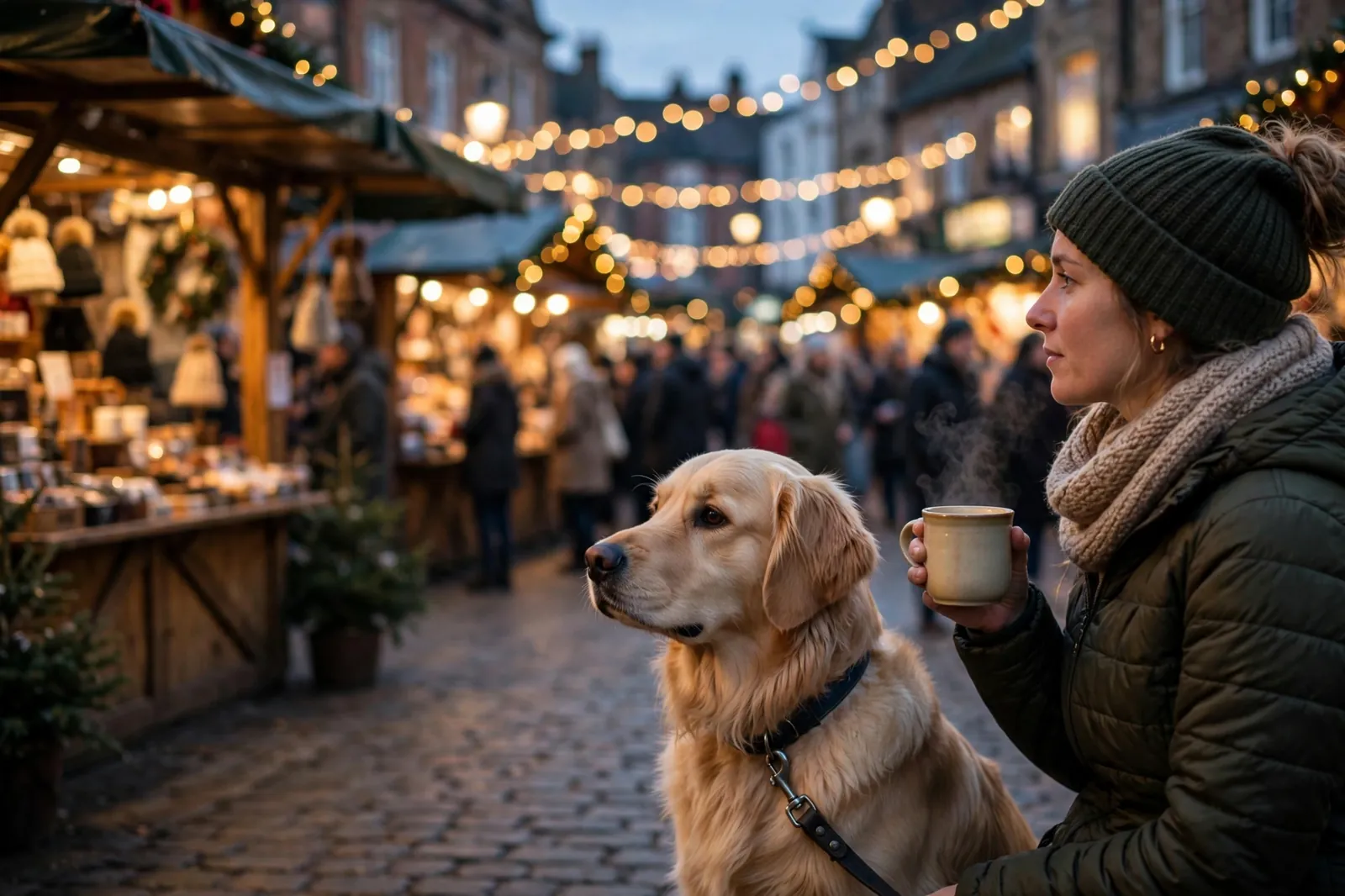
Before choosing a market, spend a moment at dog height. The festive scene you see — lights, rooftops of stalls, a brass band — is not the scene your dog gets. Your dog gets a dense forest of moving legs, pushchair wheels at face level, toddlers at licking distance, the percussion of a thousand footsteps, music from three directions and a river of food smells flowing along the ground where dropped chips, sausage ends and chocolate coins accumulate. For a confident, well-socialised dog this is a rich and interesting hour. For a nervous, elderly, very small or crowd-shy dog it can be an endurance event with tinsel on it, and no photograph is worth that.
This is why the useful question is never "are dogs allowed?" but "will my dog enjoy this, at this time, for this long?" The answer changes with the hour: the same market square that overwhelms at seven on a December Saturday is a pleasant, spacious browse at eleven on a November Tuesday. It also changes with the dog's size in a way owners underestimate. A large dog in a crowd is visible and people route around it; a small dog is underfoot, unseen by people carrying mulled wine and shopping, and far closer to every dropped hazard on the pavement. Small-dog owners should plan more conservatively, use the quietest hours, and be ready to carry the dog through the tightest pinch points.
Set a success definition before you go. For most dogs, a good market visit is forty to ninety minutes of calm interest, ending while they are still relaxed — not a full evening of browsing every stall. Build the trip so leaving early still feels complete: see your priority stalls first, buy the one thing you came for early, and treat everything after that as a bonus. Dogs read their owner's tension through the lead, so a plan with slack in it makes both ends of the lead calmer.
Which markets suit dogs — and which to skip
British Christmas markets fall into three broad types, and they suit dogs very differently. The big-city destination markets — the famous multi-square affairs in places such as Bath, York, Edinburgh, Winchester and Manchester — offer the most stalls and atmosphere but also the densest crowds, timed-entry pressures in some cases, and long stretches with no quiet ground to step onto. They can work beautifully for a steady dog at opening time on a weekday and badly for almost any dog on a peak Saturday. Check each market's official visitor information for its current dog policy, because arrangements for specific zones, ice rinks, indoor halls and Santa attractions vary, and check the latest official guidance before you travel rather than relying on last year's blog posts.
Town and village markets are the sweet spot for most dogs. Smaller footprints mean shorter crowd exposure, stallholders are likelier to know the regular dogs by name, and the surrounding streets offer instant escape routes to quieter ground. Cathedral-city and market-town events often spread stalls along a high street where you can drift in and out of the flow, pausing in doorways and side streets whenever the dog needs a reset. If your dog is new to markets, start here: one successful small market teaches more than three heroic attempts at a famous one.
The third type — markets hosted at stately homes, garden centres, farm shops and heritage sites — often suits dogs best of all. Grounds give you grass, space and somewhere to walk between the stalls, and many such venues explicitly welcome dogs across the site, sometimes with their own festive dog events. Pairing a market with a proper walk on the same site converts the outing from crowd exposure into a balanced day. Our guide to dog-friendly Christmas stays helps you turn a market trip into a full festive break, and our guide to National Trust visits with dogs covers the many Trust places that run Christmas markets and illuminated trails with clear dog rules.
Timing is the whole game
If this guide could only keep one paragraph, it would be this one: with dogs, when you visit matters more than which market you choose. Crowd density follows a predictable curve. The first hour after opening is the calmest of the day, weekday mornings are calmer than afternoons, and the season itself has a shape — mid-November openings are spacious, the final ten days before Christmas are a crush, and the odd market that runs between Christmas and New Year calms down again. Friday evenings, when office parties pour into the stalls, combine maximum density with maximum dropped food and the loosest elbows; with a dog, simply do not.
Weather sharpens the pattern. A cold, crisp weekday keeps crowds moderate and pavements dry — close to ideal. The first dry Saturday after a wet week is the most crowded slot of the season, as every postponed visit lands at once. Rain itself thins crowds wonderfully but brings its own costs: wet dogs, slippery setts and cobbles, and a much longer drying session at home. Many experienced dog owners deliberately choose the showery Tuesday, browse under the stall awnings, and enjoy a market at half capacity.
Plan backwards from your dog's limits rather than forwards from the market's programme. Decide the maximum time on site — an hour is plenty for a first visit — and what "done" looks like: lip-licking, yawning, pulling towards exits, scanning constantly or going quiet and flat are all information, and they outrank your shopping list. A dog that leaves a market relaxed will happily visit ten more across its life; a dog pushed through one overwhelming evening may take a season to forgive crowds. The stalls will be there next year. The dog's confidence is the asset to protect.
Paws, dropped food and other ground-level hazards
Market pavements in December carry a specific hazard set. Councils grit and salt busy pedestrian areas, and salt irritates pads, stings small cracks and upsets stomachs when licked off at home — so rinse or wipe paws when you get back, and consider a paw balm before you set out in heavily treated city centres. Wet leaves on stone, polished setts and metal drain covers are all skating surfaces for dogs being turned quickly in a crowd; walk the turns wide and slow. Around drinks stalls, add broken glass to the watch list, and around every food stall, add the big one: scavenging.
Dropped market food is a genuine veterinary risk list. Chocolate in all its festive forms is toxic to dogs, and markets scatter it — coins, truffles, hot-chocolate spills. Cooked bones from meat stalls splinter; onions and rich gravy upset stomachs; mince pies and Christmas cake contain raisins and currants, which can cause kidney failure even in small quantities; and sugar-free treats may contain xylitol, which is seriously poisonous to dogs. You cannot police a whole pavement, but you can manage exposure: keep the dog on a short lead at your side rather than ranging ahead at nose level through the debris field, practise a "leave it" cue at home with high-value trades, and scan the ground in front of food stalls the way you would scan for puddles. A dog that has grabbed something unknown should have it traded out calmly if safe to do, and any suspected chocolate, raisin or xylitol ingestion is a same-day vet phone call, not a wait-and-see.
Finally, respect the cold from below. Standing on frozen stone while you queue is very different from walking on it, and small, old or thin-coated dogs lose heat during the long stationary stretches that market browsing involves. Keep stops moving, let the dog stand on your feet or a carried mat at café stops, and watch for the paw-lifting dance that means the ground has beaten them — that is the visit's natural end.
Walking the route: edges, exits and reset points
Work a market the way good sheepdogs work a flock: around the edges, with an exit always in view. The outer ring of stalls is where the space is, where stallholders can actually talk to you, and where a dog can see and be seen rather than being pressed between strangers. Cut into the centre only for specific stalls, at the moment the flow allows, and come back out to the ring to travel. Before you start, do one full perimeter pass without buying anything. It maps the layout, shows you the pinch points — the stage front, the bar queue, the photo-opportunity tree — and lets the dog absorb the noise and smell at low intensity before you add browsing.
Identify reset points on that first pass: a side street, a churchyard gate, a quiet square or a bench away from the stalls where you can stand for two minutes while the dog sniffs, drinks and decompresses. Dogs regulate themselves through sniffing; thirty seconds with a nose in a hedge undoes more crowd stress than any amount of stroking. Schedule resets before they are needed, roughly every fifteen to twenty minutes for a less experienced dog, and treat them as part of the visit rather than an interruption to it.
Equipment choices matter more in crowds than anywhere else in dog life. Use a short, fixed-length lead — extending leads in a market are a trip hazard and a loss of control in one package — and a well-fitted harness or collar that cannot slip if the dog startles at a dropped tray or a sudden cheer from the stage. Position the dog on the side away from the main flow, keep your body between the dog and the thickest crowd, and resist the photo stops that plant a confused dog in the middle of a walkway while strangers queue around it. If the crowd compresses to the point where you are being moved by it, leave the flow first and decide second. There is no stall worth a pinned, panicking dog.
Warmth, waiting and the café strategy
Every good market visit has a warm room in it. Build a café or pub stop into the middle of the outing — not as a reward at the end, because by the end you will skip it — and choose it before you arrive. Dog-friendly cafés near market squares fill fast at lunchtime in December, so book if the venue takes bookings and name the dog when you do. Our guide to dog-friendly cafés explains how to spot the places where dogs are genuinely welcome indoors, which is what you need when the temperature drops; a terrace with a heater is a poor second for a wet dog in December.
Dress the dog for standing around, not for walking. A dog that is perfectly warm on the move can chill quickly during ten minutes of queuing and browsing, and the breeds that feel it first — whippets and other fine-coated dogs, small breeds close to cold ground, elderly dogs and puppies — benefit from a fitted coat at markets even if they never wear one on a hike. Waterproof matters more than thickness if rain threatens, because a wet coat against a cold wind strips heat fastest of all. Carry water despite the season; heated crowds, excitement and salty snacks make dogs thirsty, and the dog that drinks from its own bowl is not lapping at puddles of questionable content between the stalls.
Use the café stop as the visit's hinge. Warm up, dry off, check paws, review what is left on your list with fresh eyes, and make the honest call about whether the dog has a second half in them. For many dogs the perfect market day is stalls, café, home — and the owners who accept that shape come back year after year, while the ones who push for the full programme often retire from markets altogether.
Calmer festive alternatives dogs actually enjoy
Suppose the market verdict for your dog is no, or not yet. The festive season still has plenty to share, and several alternatives give a dog more pleasure than a market ever will. Illuminated trails at gardens and heritage sites — booked, spaced-out evening walks through lit grounds — suit dogs far better where dogs are admitted, because the crowd moves in one direction at walking pace with space to pass. Check each trail's dog policy carefully, since some admit dogs only on selected nights. Carol services and outdoor nativity events in village settings offer music at a distance and room to stand back. Charity dog walks, Santa Paws photo events and festive fun runs organised by rescue centres are designed around dogs entirely: the crowd expects dogs, the pace is canine, and your entry fee does some good.
Farm shops and garden centres deserve their own mention. Their Christmas departments deliver most of the sensory pleasure — trees, lights, food halls, gifts — at a fraction of the crowd density, usually with explicit dog welcome, trolleys that keep small dogs off the floor, and a café that takes dogs indoors. A dog can have a thoroughly festive morning at a good garden centre while a city-centre market would have been a trial. Round it off with a proper walk and you have the shape of the ideal dog Christmas outing: somewhere beautiful to walk, somewhere warm to eat, somewhere sparkly to browse briefly, in that order.
And for the dog that wants none of it, there is honour in the home version: a new chew during the tree decorating, a festive bandana tolerated for exactly one photograph, a special walk on Christmas morning while the streets are empty and every other dog in Britain is doing the same. Not every tradition has to include the dog in person. Including the dog's comfort in the decision is the tradition.
Etiquette that keeps markets dog-friendly
Dog access to markets is a privilege renewed annually by public opinion, and every visiting dog is an ambassador whether it applied for the job or not. The behaviours that keep markets welcoming are unglamorous: a short lead, a dog kept out of food-stall counters and displays, instant clean-up of any accident, and no nose in anyone else's shopping, pushchair or dinner. Ask before letting your dog greet another dog in a crowd — there is no room for the usual dance, and many market dogs are working hard on their own composure. If your dog barks at the brass band, move away rather than letting the concert improve; distance is always available at the edges.
Spend money like a welcome guest. Stallholders remember the dog owners who buy things, ask about the products and keep their dogs politely at heel, and that memory becomes next year's policy conversation. If a stallholder says dogs are not welcome at their particular stall, accept it with grace and no debate — food hygiene rules bind them, not you, and the market as a whole remains open to you. Our pub garden etiquette guide covers the same social contract in a different setting, and the principles transfer directly: settle the dog, contain the mess, read the room.
Leave the place ready for the next dog. Take litter — yours and the festive debris your dog investigates — to a bin, report any hazards such as broken glass to a steward if you can, and pass on what you learned. The owner at the gate with a nervous young dog, visibly wondering whether to go in, is who you were last year. Telling them which hour and which entrance worked is how a dog-friendly market culture actually gets built: one honest tip at a time.
Practical questions
Before you go
Are dogs allowed at UK Christmas markets?
At outdoor markets, usually yes on a short lead, because they occupy public streets and squares. Enclosed venues, indoor halls and specific attractions within a market may refuse dogs, and individual stallholders can ask you to keep distance from food displays. Policies change year to year, so check the market's official visitor information before travelling and check the latest official guidance before you travel.
When is the quietest time to visit a Christmas market with a dog?
Weekday late mornings and the first hour of opening are consistently the calmest, while Friday evenings and Saturdays in December are the most crowded. Early in the season, in mid-to-late November, markets are noticeably less packed than in the final fortnight. Cold, bright weekdays reward you twice: thinner crowds and ground that is kinder to paws than a wet Saturday evening.
How do I protect my dog's paws at a winter market?
Watch for gritted and salted pavements, which irritate pads, and wash paws with clean water when you get home. Keep your dog away from dropped food, especially chocolate, cooked bones, onions and anything containing xylitol, and steer around broken glass near drinks stalls. In very cold or heavily salted conditions, dog boots or a paw balm applied beforehand both help, provided your dog has practised wearing them at home first.
My dog dislikes crowds. Can we still enjoy Christmas markets?
Yes, by changing the format rather than abandoning the idea. Visit the edges of a large market at opening time, choose smaller town and village markets, or pick festive events designed for dogs such as charity Santa Paws events and market days at garden centres and farm shops. A short, successful twenty minutes beats an hour of endurance, and you can build distance and duration gradually across the season.
What should I pack for a market trip with my dog?
A short fixed lead rather than an extending one, a warm coat for small, elderly or short-coated dogs, water and a portable bowl, paw wipes or a small towel, poo bags, high-value treats for focus work, and a familiar chew for cafe stops. Add a light or reflective lead clip for dusk visits, and keep ID tags up to date in case of a slip in the crowd.