This guide is independent and contains no paid placement. Port layouts and pet rules change, and operators differ from each other even at the same port — always check your operator and port before travel.
There is no single UK rule for dogs at ferry terminals. Car passengers mostly deal with drive-through check-in booths and wait in their vehicle, so the terminal building rarely matters. Foot passengers face the stricter question — whether a dog on a lead may enter the building at all — and the answer varies by port and operator. Give your dog a proper walk before you enter the port, arrive ahead of the check-in deadline rather than at it, and check your operator and port before travel.
One port, two different terminals
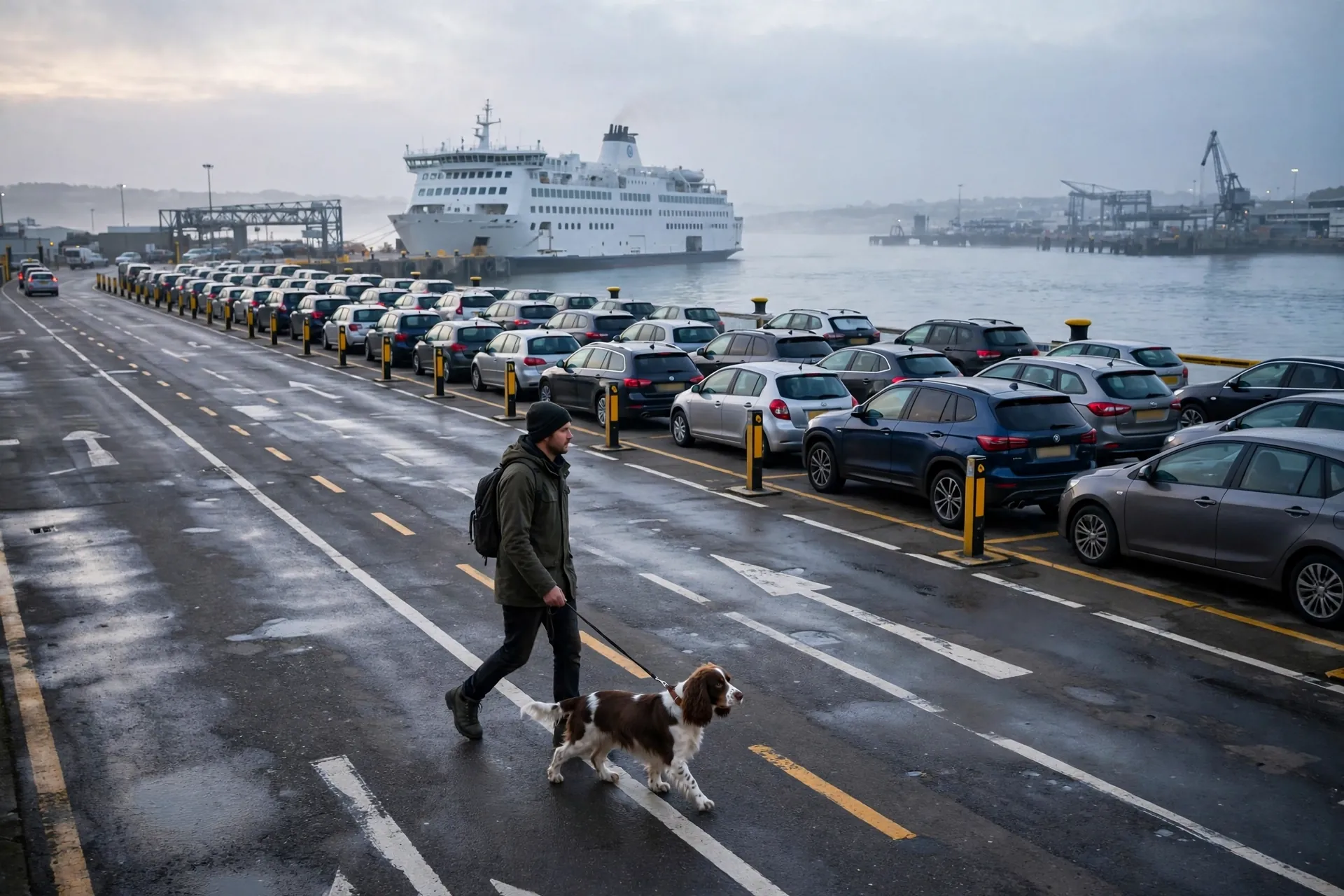
Start by picturing the port not as one building but as two separate systems sharing a fence. On one side is the vehicle operation: approach roads, check-in booths you drive through without getting out, numbered lanes where cars and lorries queue, and the linkspan where vehicles load onto the ship. On the other side is the foot passenger operation: a terminal building with ticket desks, seating, toilets, a café if you are lucky, and a departure gate reached on foot or by a port bus. A dog experiences these two systems completely differently, and most confusion comes from advice written about one being applied to the other. Island trips start at the terminal — for the full island picture, see Isle of Wight with a dog, covering ferries, beaches, walks and attractions.
If you are travelling in a car, your dog may never set paw on terminal tarmac at all. You check in through a window, follow lane directions, wait inside your own vehicle with your own smells, blankets and water bowl, and drive aboard. The building that foot passengers use — with its rules about dogs indoors — is simply not part of your journey. If you are on foot, the building is unavoidable: it is where you check in, where you wait, and where you board, so its dog policy shapes your whole departure.
This is why one traveller reports that a port was “brilliant with dogs” and the next reports being turned away from the door, and both are telling the truth. They used different halves of the same port. Everything in this guide is therefore split by travel mode first and by port second. When you read any operator's pet page — including the route-by-route detail in our guide to dogs on UK ferries — keep asking which half of the port each rule belongs to, because that is the half you will actually meet.
Can dogs go inside the terminal building?
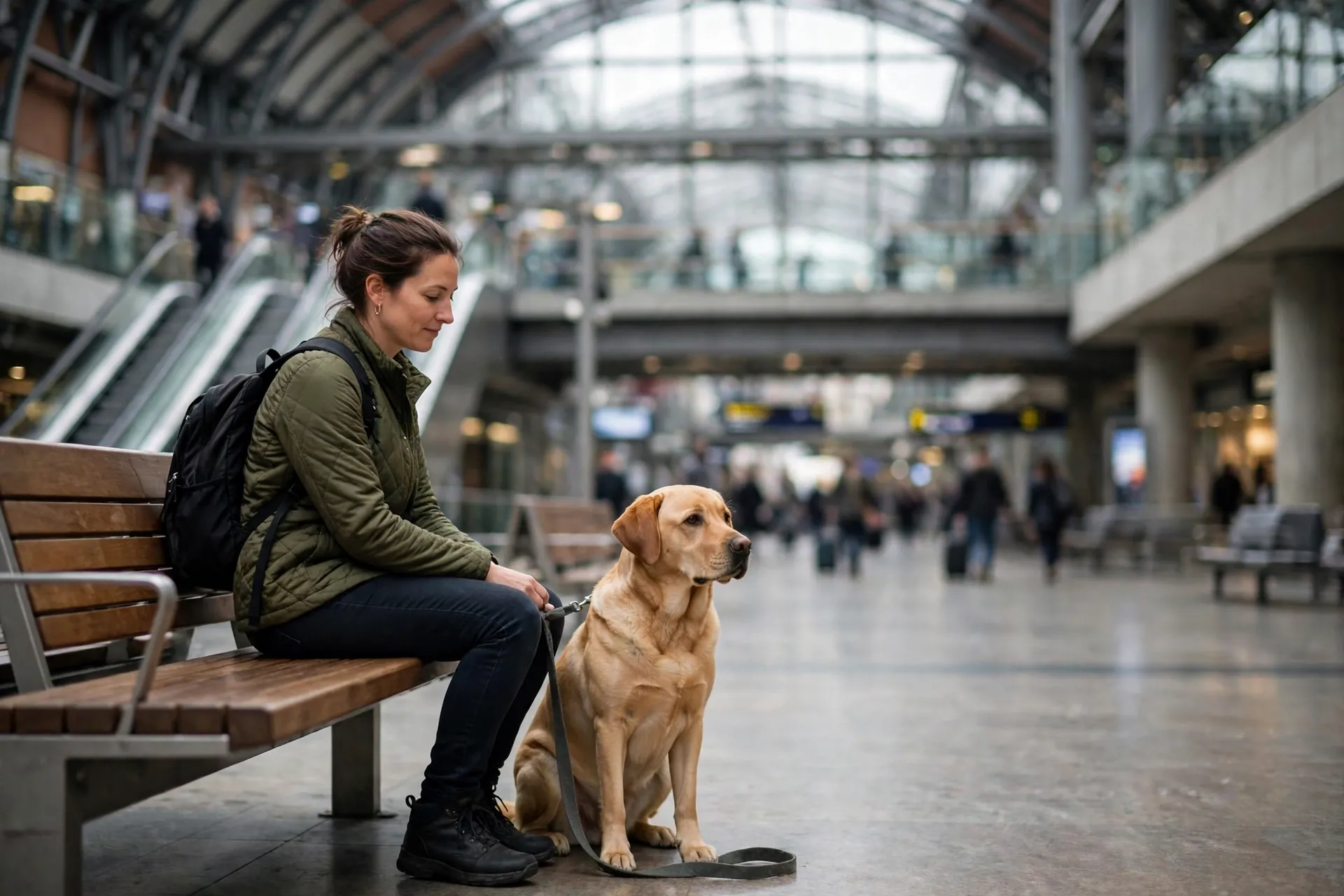
There is no UK-wide rule that dogs may, or may not, enter ferry terminal buildings. Each port authority and each ferry operator sets its own policy, and policies can differ between operators sailing from the same harbour. Some foot passenger terminals allow dogs on a lead in the main hall or in a designated part of it. Others restrict dogs to outdoor areas and ask you to wait outside with them, which matters a great deal on a wet February morning at an exposed port. Assistance dogs are a separate legal category and are not treated as pets for access purposes.
For vehicle passengers, the indoor question mostly disappears — but not quite. If you want a toilet, a coffee or a stretch during a long wait in the lanes, the facilities available to you may be a small block near the lanes rather than the main building, and your dog will usually need to stay in the car or be exercised only in signed areas nearby. Never assume you can take a dog through a terminal building to reach a café; ask staff at the booth when you check in, because they will know today's arrangement, including any temporary changes for building work or security alerts.
The practical approach is to plan for the strictest plausible version. Pack as if you and your dog will wait outdoors or in the car: waterproofs for you, a coat for a thin-coated or older dog, water and a bowl, and enough to do. Then treat any indoor welcome — a hall where dogs on leads are allowed, a sheltered waiting area — as a bonus rather than the plan. Before travel, check your operator and port for the current position; a two-minute look at the operator's pet travel page, or a call to the port, is worth more than any forum thread, because terminal pet policies are exactly the kind of detail that changes without fanfare.
Check-in timing, worked backwards
Ferry check-in deadlines are firmer than most travellers expect. Operators commonly close check-in a set period before departure — often somewhere between thirty minutes and over an hour depending on the route, the port and whether you are in a vehicle or on foot — and a closed check-in does not reopen because the ship is still visibly loading. With a dog, arriving at the deadline is arriving late: you still need a toilet stop for the dog, possibly a document check that involves the dog directly, and a margin for the queue being longer than the one you imagined.
Work backwards from the sailing instead. Take the operator's check-in closing time from your booking confirmation. Add time for the dog's pre-port walk and toilet break — twenty to thirty unhurried minutes at a stop before the port, not inside it. Add a further buffer for peak-season queues at booths, for lanes being held while a previous sailing clears, and for the simple fact that a dog makes every stage slightly slower: leads tangle, water bowls spill, and a nervous dog does not hurry through a noisy marshalling area on command.
Arriving earlier has one genuine cost, and it is fair to name it: more waiting time in the lanes with a dog who has already had their walk and now wants the day to start. That cost is managed with the waiting routine covered below — windows, water, a chew saved for the lanes, a last short lead walk where staff allow it. It is still the right trade. A missed sailing with a dog is not just a rebooking fee; it can mean hours at a port with no plan, a lost night's accommodation at the other end, and on international routes a knock-on problem with any time-sensitive paperwork. Check your operator's current check-in times before travel, because deadlines differ by sailing and are sometimes longer on the busiest holiday departures.
The last proper walk: exercising a dog before boarding
The single most useful habit in ferry travel with a dog is this: the real walk happens before the port. Ports are working freight environments — hard surfaces, diesel fumes, reversing lorries, tannoy announcements and very little grass — and they are designed for throughput, not for a dog to empty its bladder in peace or burn off nervous energy. Some ports provide a small designated dog relief or exercise area, and where one exists it is genuinely helpful for a final toilet break. But its size, location and even existence change as terminals are rebuilt, so treat it as a top-up, never as the walk itself.
Build the proper walk into the journey to the port. On most approaches there is a better option within a short drive of the harbour: a seafront promenade, a country park, a beach where dogs are allowed at that season, or simply a quiet residential area with verges where a dog can sniff for twenty minutes. Aim to arrive at that stop with time to spare, walk until the dog has toileted and settled — sniffing does more for calm than distance does — offer water, and only then drive the final short leg into the port. A dog who boards empty, tired and recently watered copes with hours of waiting far better than one lifted straight from a long car journey into a queue.
Inside the port, follow three rules. Keep the dog on a short lead whenever it is out of the vehicle, and only where staff or signs allow dogs out at all. Never walk a dog between vehicle lanes or across operational areas to reach a promising patch of grass: lanes that look stationary can move without warning, and marshalling staff need vehicles, not pedestrians, in them. And always clear up after your dog, including in designated exercise areas — these facilities survive on goodwill, and ferry ports withdraw small kindnesses quickly when they are abused. If you cannot find a signed dog area, ask at the check-in booth before you get the dog out; staff would far rather point you to the right corner than discover you in the wrong one.
Car passengers versus foot passengers: two different days
In a car, the terminal is largely something that happens around your dog rather than to them. The vehicle is checked in as a unit, the dog is declared as part of the booking where the operator requires it, and you wait in a familiar box that smells of home. The dog's challenges are boredom, heat on a sunny day and noise — all manageable, and all covered in the waiting section below. On many routes the dog then simply stays in the vehicle for the crossing, while on others you may choose or be required to use an onboard kennel or pet-friendly cabin; that onboard half of the decision is covered in our ferries guide, and it is worth deciding before you book rather than at the booth.
On foot, everything is closer and sharper. You will carry or wheel your luggage and manage a lead at the same time, pass through a building full of strangers, trolleys and dropped food, and possibly ride a port bus to the ship. Not every operator carries foot passengers with dogs at all, and those that do may require the dog to travel in a carrier, in an onboard kennel, or under specific size or booking conditions. Some routes that cheerfully take a car full of dogs take no foot passenger dogs whatsoever. This is the first thing to verify when planning a foot crossing — before falling for a cheap foot passenger fare that your dog is not eligible to use.
Foot passenger travel does suit some dogs and some trips: a small, calm dog in a carrier, heading for a short crossing to a city break where you do not want a car, can have an easy day of it. A large, reactive or travel-sick dog, a long route, or a destination where you will need transport at the far end all tilt the balance firmly towards taking the car — or towards a different crossing altogether. If you are comparing a ferry against the train-and-tunnel routes, our guide to dogs on Eurostar and its alternatives explains why pet dogs cannot use Eurostar itself and how the drive-on shuttle compares, so you can weigh the terminal experience as part of the whole door-to-door picture.
Five major ports, one by one — with care
Ports differ in layout, exposure and how much of the process happens outdoors, and arrangements change as terminals are redeveloped. Use the notes below to know what questions to ask, not as guarantees: check your operator and port before travel for the current rules on dogs in buildings, exercise areas and check-in times.
Dover
Dover is the busiest roll-on roll-off port in the country, handling the short Channel crossings to France, and its vehicle operation is a well-drilled sequence of booths, lanes and rapid loading. For car passengers the dog experience is mostly in-car: declare the dog as required, expect document checks on international sailings to involve the dog's paperwork being examined at the booth, and be ready for queues at peak holiday times. The port is exposed and busy, promenade walks in the town or along the seafront before you enter are a better bet than hoping to exercise a dog inside the boundary. Foot passenger options on the Dover–Calais corridor are limited and change over time, so verify the current position before planning around them.
Holyhead
Holyhead serves the Irish Sea crossings to Dublin and is a combined port and rail interchange, which makes it one of the more plausible ports for a genuine foot passenger journey with a dog, subject to the operator's pet rules for foot passengers on that route. The terminal building is a real part of the experience here for foot passengers, so the indoor dog policy matters — check it in advance rather than discovering it at the door. Drivers face a long approach across Anglesey, so plan the dog's last proper walk with that in mind; a break before the final stretch to the port beats arriving with a dog who has been in the car for hours.
Portsmouth
Portsmouth's international port handles longer crossings, including routes to France and Spain where sailings run for many hours and sometimes overnight. Longer crossings raise the stakes on the terminal stage: check-in deadlines are typically more generous in their required earliness, pet documentation for international routes gets proper scrutiny, and your decision about kennels or pet-friendly cabins on board matters more than it does on a ninety-minute hop. Give the pre-port walk extra weight here, because a dog facing a long crossing — and possibly long periods in a kennel or vehicle — needs to board settled, emptied and watered.
Cairnryan
Cairnryan, in Dumfries and Galloway, is the Scottish port for crossings to Northern Ireland, served by two neighbouring terminals for the rival operators on the route, so make sure you navigate to the right one — they are close together and a wrong turn with a closing check-in is a miserable combination. The setting is rural and the approach roads are long and single-carriageway in places, which means journey times vary and the dog's last good stopping opportunity may be some miles before the port. Plan your walk and toilet stop earlier on the route rather than counting on facilities at the end of it, and confirm which terminal your booking uses before you set off.
Fishguard
Fishguard, in Pembrokeshire, serves the crossing to Rosslare in Ireland and has the feel of a smaller, quieter port than the big Channel operations. Smaller does not automatically mean more relaxed about rules — check-in deadlines, foot passenger pet conditions and any exercise provision still come from the operator's current guidance — but queues are generally shorter and the surrounding area offers easier pre-port walking than a big urban terminal. The harbour sits below the town, the A40 approach winds through west Wales, and building in time for a proper stop in or near the town before check-in is straightforward compared with most ports on this list.
Whichever of these ports you use, the pattern is the same: the operator's pet page and the port's own information, checked close to your travel date, outrank any guide — including this one — because terminal arrangements are operational details that ports adjust as works, routes and security requirements change.
Waiting well in the lanes
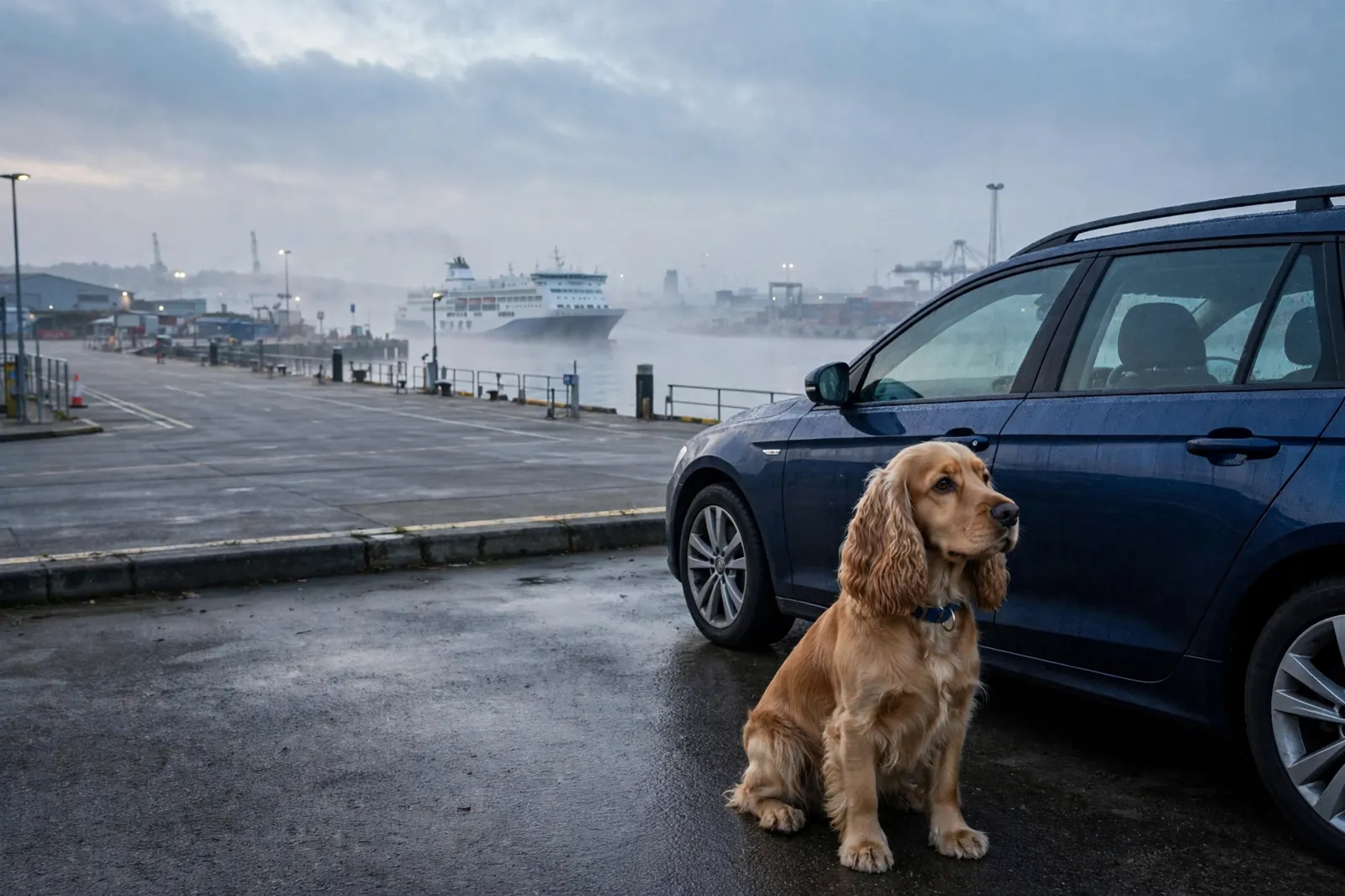
Once checked in, vehicle passengers wait in lanes, and this waiting — sometimes twenty minutes, sometimes well over an hour at peak times or when a sailing is running late — is the part of the terminal experience you can most improve with preparation. Set the car up as the dog's waiting room before you reach the port: a familiar blanket in their travelling spot, water in a non-spill bowl within your reach, ventilation worked out in advance, and a chew or lick mat kept back specifically for the lanes so it still feels like an event rather than the thing they finished an hour ago on the motorway.
Heat is the serious risk. A stationary car in full sun on tarmac warms quickly even on a mild day, and lanes offer no shade to move into. Keep windows or a tailgate arranged for airflow as staff directions allow, offer water little and often, and watch for heavy panting or restlessness. On a genuinely hot day, tell a member of staff if your dog is struggling rather than improvising a solution that involves walking the dog through operational areas. Cold and wet waiting is merely uncomfortable by comparison: a dog coat, a dry blanket swapped for the damp one, and engine-off patience will get you through it.
Noise and novelty unsettle some dogs more than confinement does. Ferry lanes bring reversing alarms, lorry air brakes, tannoys and the rumble of the ship loading. A dog who is worried by noise copes better if the waiting feels routine: keep your own behaviour boring, feed nothing exciting, let them watch the world from the car if watching is what they choose, or draw a blanket over a crate if darkness settles them at home. If your dog may need a toilet break during a long lane wait, ask a lane marshal where you may take them — ports would rather direct you to a verge at the edge of the marshalling area than have you guess, and some will hold your place or move you to a suitable lane if you ask early.
Documents and checks that happen at the port
Domestic crossings within the UK — to the Scottish islands, the Isle of Wight, the Isles of Scilly and across the Irish Sea to Northern Ireland — are comparatively light on paperwork, though operators still require dogs to be booked or declared as their conditions state, and you should carry your booking confirmation with the dog included on it. International crossings to Ireland, France, Spain and the Netherlands are a different matter: pet travel documentation is checked at the port, and a problem discovered at the booth — missing paperwork, a document that does not match the dog being scanned, a detail out of date — cannot be fixed in the lane behind you.
Keep documents with you in the cabin of the car or your hand luggage, never in a hold bag or the bottom of the boot, and keep any medication your dog needs on the same principle. Where a microchip scan is part of the check, expect to be asked to present the dog or to have staff scan them at the vehicle; a dog who is calm being handled around the head and shoulders by a stranger makes this a thirty-second job rather than a wrestling match, and it is worth practising at home before an international trip. The detailed paperwork rules for each destination sit outside this guide's scope, and they change — use the official pet travel guidance and your operator's instructions as your source, checked close to departure.
One further port-side check catches people out: the dog on the booking must be the dog in the car, in number as well as identity. If you booked one dog and arrive with two, or the extra dog belongs to a passenger in another vehicle, expect a fee at best and a refused sailing at worst on a busy day. Amend the booking before you travel, and if your plans involve cost decisions across the whole trip — pet fees, kennels, cabins, paperwork — our breakdown of dog holiday costs in the UK helps you budget the ferry elements alongside everything else, while cover for the trip itself is worth reviewing in our guide to dog travel insurance for Europe before an international sailing.
Delays and cancellations with a dog
Ferries are weather machines, and crossings are delayed or cancelled for wind and sea conditions that would barely register on a flight. Build the possibility into your packing rather than treating it as bad luck: a spare meal portion for the dog, more water than the crossing needs, medication for an extra day kept in your hand luggage, and a blanket that works as a bed if you end up waiting somewhere unexpected. The dog does not know the sailing is cancelled; they only know whether they are fed, watered, warm and near you.
If a long delay develops while you are in the lanes or the terminal, ask staff early about toilet breaks for dogs and about whether you may leave the vehicle area and return. Arrangements differ by port and by how the delay unfolds, and staff generally have a practised answer because dog owners ask on every disrupted sailing. If a sailing is cancelled outright and you are rebooked for the next day, your priority order is dog first, humans second, itinerary third: find somewhere the dog can walk, toilet and settle, then sort accommodation — ideally somewhere you have already identified as dog-welcoming near the port, which is a five-minute piece of research worth doing when you book, not at midnight in a gale.
For foot passengers, a cancellation is more exposed, because you have no car to retreat to. This is another reason to know the terminal's dog policy before you travel: if dogs are not permitted to wait inside the building, a long delay means waiting outside with your dog, and you should have the layers, water and food for that scenario in your bag. Keep the operator's app or text alerts on, keep your phone charged, and register the dog's needs with staff politely and early — “we have a dog, where is the best place for us to wait?” gets practical help far more reliably than waiting until the dog is desperate.
Terminal-day checklist
Run through this list the day before you sail, and again in the car before you enter the port.
- Booking shows the dog: correct number of dogs, correct route and terminal — essential where two terminals serve one port area, as at Cairnryan.
- Check-in deadline checked: taken from your booking or the operator in the last few days, with a buffer added for the dog — see the timing section above.
- Pre-port walk planned: a named stop before the port for a proper walk, toilet break and water, not a hope that the port will provide one.
- Indoor policy checked: you know whether your dog may enter the terminal building at your port, or whether to dress and pack for waiting outdoors or in the car.
- Documents in the cabin: booking confirmation and, for international routes, all pet paperwork with you — plus medication and a spare meal portion in hand luggage.
- Waiting kit ready: water and a bowl, a saved chew, blankets, poo bags, a dog coat and your own waterproofs, all reachable without unpacking the car.
- Delay plan sketched: you know a dog-welcoming option near the port if a cancellation strands you overnight, and the dog's food and medication cover an extra day.
None of this requires the port to be anything other than what it is: a busy working harbour that will happily move you and your dog across the sea, provided you arrive checked, documented and with a dog who has already had the walk the harbour cannot give them. Check your operator and port before travel, arrive earlier than feels necessary, and the terminal becomes the calmest part of the journey rather than the part you tell stories about.
Practical questions
Before you go
Can dogs go inside ferry terminal buildings in the UK?
It depends on the port and the operator, and there is no single UK-wide rule. Foot passenger terminals sometimes allow dogs on a lead in parts of the building, while vehicle check-in areas are usually drive-through booths where the dog simply stays in the car. Some ports keep dogs out of indoor waiting areas entirely. Check your operator and port before travel, and assume outdoor waiting unless you have confirmation otherwise.
Where can I walk my dog before boarding a ferry?
The most reliable option is a proper walk before you enter the port, at a park, beach or service area on your route, because exercise space inside port boundaries is limited and varies by terminal. Some ports provide a small designated dog relief or exercise area, but its location and availability change, so confirm with your operator before travel and never rely on being able to walk a dog between vehicle lanes.
How early should I arrive at a ferry terminal with a dog?
Follow the check-in deadline on your booking as the minimum, then add a buffer for the dog: time for a toilet break before you join the lanes, slower document checks and busy peak sailings. Many operators close check-in well before departure, and arriving at the deadline leaves no slack if your dog needs a break or a document query takes time. Check your operator's current guidance before travel.
Is it easier to take a dog on a ferry as a foot passenger or in a car?
For most dogs, travelling in a car is simpler: the vehicle is a familiar, enclosed space for waiting in the lanes and for the crossing itself where dogs stay in cars. Foot passenger travel suits only some routes and operators, may require the dog to be in a carrier or booked into a kennel, and involves more walking through busy buildings on a lead. Compare the rules for your exact route before booking.
What happens to my dog if my ferry is delayed?
Your dog stays with you or in your vehicle while you wait, so pack for a delay as standard: extra water, a meal portion, poo bags, a blanket and any medication kept in the cabin bag rather than the hold or boot. Ask staff where you may take the dog for a toilet break during a long delay, because access to outdoor areas from the vehicle lanes is controlled and you should not wander between lanes unaccompanied.