This guide is independent and contains no paid placement. Operator pet policies and government animal travel rules change, so where this guide flags a check, please confirm the latest official information before you travel.
No — pet dogs are generally not carried on Eurostar services. You cannot book a pet dog onto a Eurostar train from London to Paris, Brussels or Amsterdam, in a carrier, on a lead or in any ticket class. Recognised assistance dogs are the exception. With a pet dog, cross the Channel by LeShuttle in a car via Folkestone to Calais, or by ferry, get the paperwork right for each direction, and continue by car or French domestic train.
The short answer: Eurostar does not carry pet dogs
Start with the fact that shapes everything else in this guide, because a lot of planning goes wrong by assuming it must be wrong. Eurostar does not accept pet dogs. That applies to the core routes most readers are asking about — London St Pancras International to Paris Gare du Nord, to Brussels and to Amsterdam — and it applies however small, calm or well travelled your dog is. A dog in a soft carrier under a seat, a dog on a lead at your feet and a dog for whom you are willing to buy an extra ticket are all treated the same way: as a pet, and therefore not carried.
There is no workaround hidden in the booking flow. There is no pet supplement to add, no animal carriage to reserve, no hold or luggage service for live animals, and no benefit in arriving early and hoping staff at the station will make an exception on the day. Check-in staff cannot override the policy, and discovering the rule at St Pancras with suitcases packed and accommodation booked in Paris is the worst possible version of learning it. If a website, forum post or video suggests you can simply bring a small dog aboard Eurostar in a bag, treat it as unreliable unless Eurostar's own current pet policy says so in plain language. Policies can change in future, which is why this guide tells you to re-check the operator's official page before any trip, but plan on the basis of the policy as it stands: no pet dogs.
Why the confusion is so common is understandable. Dogs are a normal sight on trains in Britain, where domestic operators generally allow dogs under the conditions covered in our guide to taking a dog on UK trains. Dogs also travel widely on trains in much of mainland Europe, often in carriers or muzzled on a lead depending on the country and operator. It is natural to join those two facts together and assume the train that connects Britain to Europe must do the same. It does not. Eurostar is a cross-border service with its own security, border and tunnel operating rules, and its position on animals has remained restrictive: assistance dogs yes, pets no.
Accepting that early is actually liberating. Once Eurostar is ruled out, you can stop designing a trip around a two-hour direct train that will never carry your dog, and start designing one around crossings that will: driving through the tunnel on LeShuttle, sailing on a ferry, or combining a crossing with trains on either side. Those journeys take longer and need more paperwork, but they are real, bookable and used by dog owners every week. The rest of this guide works through them in the order most readers need: the one exception to the Eurostar rule, the car crossing in detail, ferries, the difficult foot passenger question, paperwork, and finally a complete London to Paris pattern you can copy and adjust.
Assistance dogs: the one Eurostar exception
Recognised assistance dogs are not pets for the purposes of this policy, and Eurostar does allow them to travel with the person they assist. That distinction matters legally and practically. An assistance dog is trained to perform tasks that mitigate a disability, and the dog travels as part of its handler's access to transport, not as a leisure extra. Emotional support, a dog's calming presence on holiday, a well-behaved companion animal and a dog in training with an unaccredited programme should not be assumed to qualify. If you are in any doubt about whether your dog counts, ask Eurostar directly before booking and be ready to describe the training body and documentation involved.
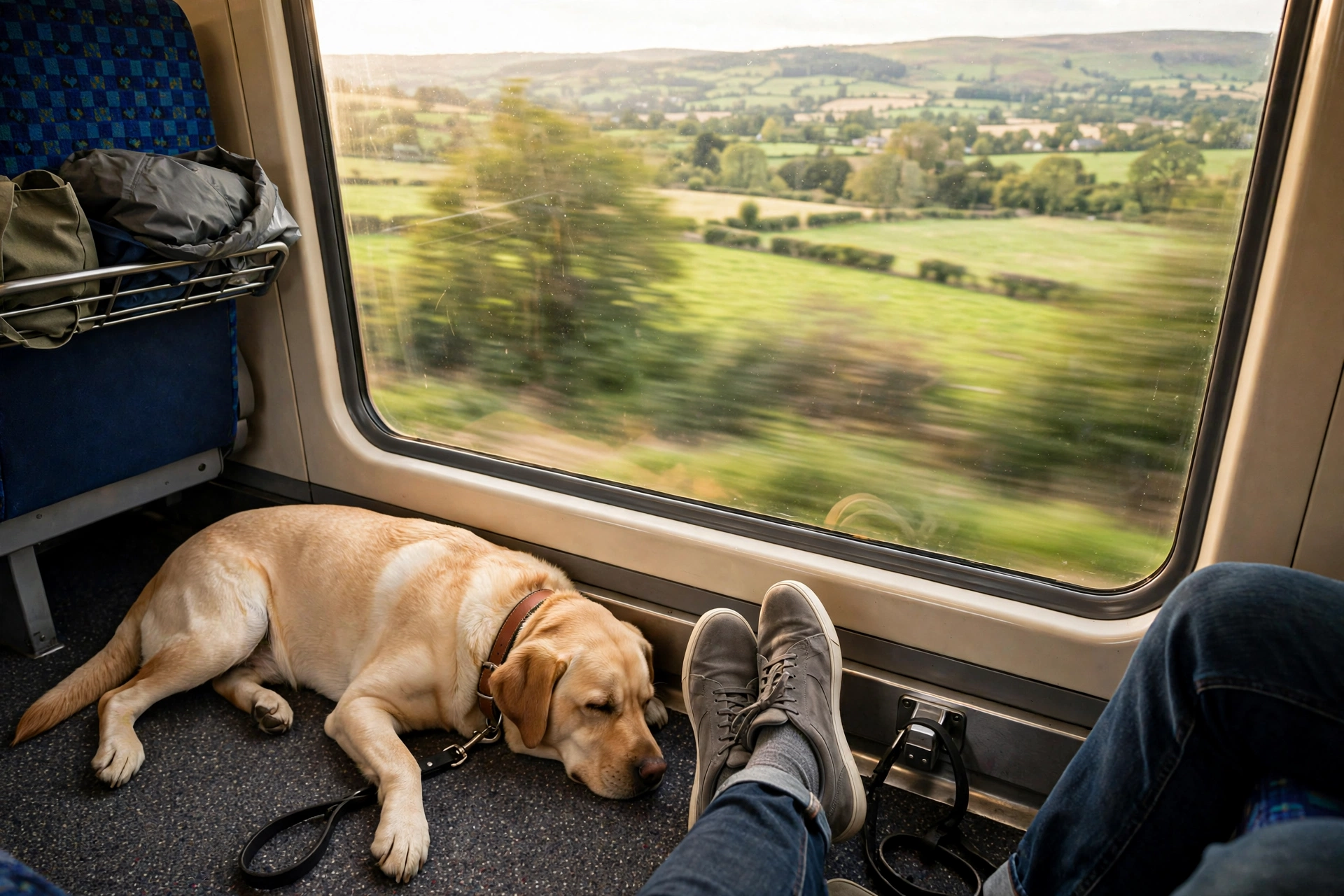
Practically, travelling with an assistance dog on Eurostar is a planned process rather than a turn-up-and-board one. Notify the operator when you book or well before travel, follow its current instructions about documentation, and allow noticeably more time at the station than a standard passenger would. Border and security checks apply to the dog as well as to you, and the paperwork for entering France or returning to Britain still has to be correct — an assistance dog is exempt from the pet carriage ban, not from animal health and border rules. At your seat, the dog normally settles at floor level beside you, so choose seating and luggage arrangements that leave that floor space genuinely clear, and plan toilet breaks around the station stops because there is no opportunity to leave the train for a walk mid-journey.
Two cautions complete the picture. First, recognition criteria are not identical in every country, and a dog recognised in one system may be questioned in another, so carry original documentation, keep copies on your phone, and confirm the requirements for both the outward and return legs. Second, do not use the assistance route as a loophole narrative for a pet. Presenting a pet dog as an assistance dog to board a train it is not entitled to use risks being refused travel, creates problems for genuine assistance partnerships whose access depends on operators trusting the system, and can unravel an entire trip at the departure gate. If your dog is a pet, the honest routes below are the ones to book — and for many dogs they are less stressful than a crowded international train in any case.
LeShuttle by car: Folkestone to Calais, step by step
For anyone with access to a car, LeShuttle — the vehicle shuttle service through the Channel Tunnel, long known as Eurotunnel — is the alternative that most closely replaces Eurostar. It runs between Folkestone in Kent and Calais in France, the crossing itself takes around thirty-five minutes, and the defining advantage for dog owners is simple: your dog stays with you, in your own vehicle, for the entire crossing. There is no separation into a kennel block, no handing your dog to anyone else, and no cargo hold. For nervous dogs, older dogs and dogs who have never travelled, that continuity is worth more than a slightly faster timetable elsewhere.
The process has a specific order, and knowing it in advance removes almost all of the stress. You book the vehicle and declare the dog as part of the booking, paying the pet fee the operator charges per dog per crossing — check the current amount when you book rather than relying on any guide's figure, because fees change. On arrival at the Folkestone terminal you go to pet reception before the main check-in flow. There, staff scan your dog's microchip and check the animal health paperwork against the booking and the dog in front of them. Build time for this into your arrival: pet reception is usually efficient, but queues happen at peak holiday departures, and a paperwork problem is far easier to address in a terminal car park than anywhere else in the system. Arrive earlier than the minimum check-in time the operator gives you, especially on your first crossing with a dog.
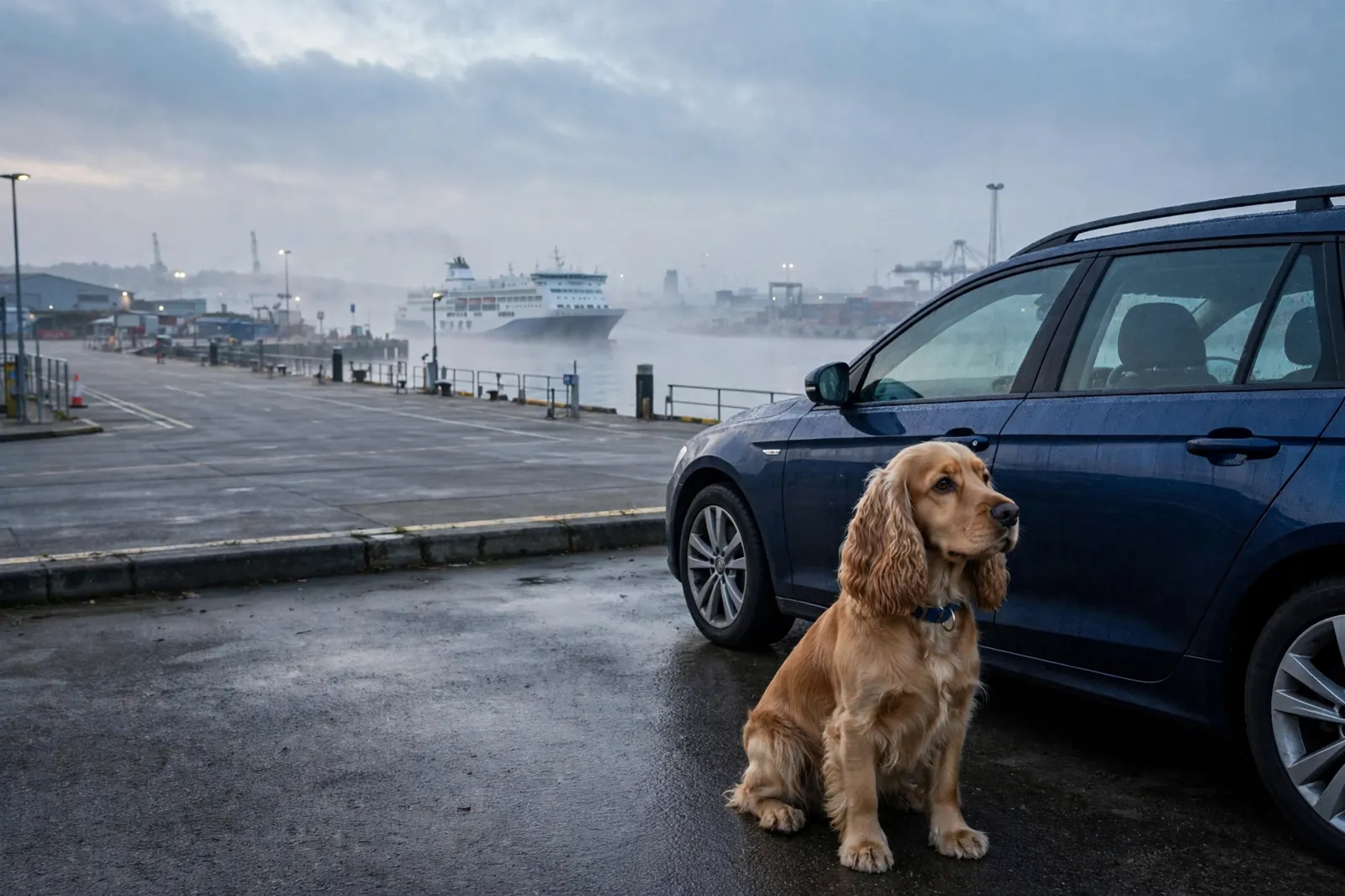
Before boarding, use the dedicated pet exercise area at the terminal. It is one of the most thoughtfully designed parts of the whole crossing: a fenced space where your dog can toilet, stretch and burn off the car-park energy before the shuttle. Take it seriously as part of the journey plan rather than a nice extra. A dog who has toileted, drunk water and had ten minutes of sniffing will settle in the car for the crossing. A dog loaded straight from a long motorway drive into a train carriage in a tunnel may not, and thirty-five minutes is a long time to share a car with a dog who urgently needs the opposite of a tunnel.
Boarding itself is drive-on, drive-off and deliberately uneventful. You drive onto the shuttle, park, apply the handbrake and follow the operator's current instructions about windows, engines and staying with your vehicle. Most passengers remain in or beside their cars for the crossing, which means your dog's environment barely changes: same car, same people, same smells, plus the unfamiliar sounds and motion of the shuttle. Keep water available, keep the car at a comfortable temperature, and settle the dog on familiar bedding with something unexciting to chew if that is part of their routine. Keep the lead and any medication in the cabin with you rather than buried in the boot, and never leave a dog alone in a way that contradicts the crew's instructions for that departure.
On the French side you drive off at Calais and you are immediately on French roads, with motorway connections towards Paris, the rest of France and Belgium. On the return leg the pet check happens at the Calais terminal before boarding, and this is where return paperwork — particularly the tapeworm treatment timing for dogs entering Great Britain, covered in the paperwork section below — is scrutinised. A first crossing teaches the routine quickly: book the dog in, pet reception first, exercise area second, board calmly, drive off. By the second crossing most owners describe it as the easiest part of a European dog trip, and it is the benchmark against which the ferry options should be judged.
Ferries with a dog: the other main crossing
Ferries are the second established way across, and for some destinations they are better than the tunnel. Short Channel crossings from Dover to Calais or Dunkirk compete directly with LeShuttle, while longer routes — from Portsmouth, Poole, Plymouth, Newhaven and other ports to Normandy, Brittany and northern Spain — can cut hundreds of miles of driving off a trip and deliver you much closer to where you actually want to be. The trade-off is that ferry pet arrangements vary far more than the tunnel's stay-in-your-car model, so the detail of your specific operator, ship and sailing matters enormously.
On short crossings, dogs commonly stay in the vehicle during the sailing, which means a separation: you go up to the passenger decks and your dog remains below in the car, usually without access during the crossing. Some operators offer kennels on board, and a smaller number offer pet-friendly cabins or designated dog areas on particular ships and routes. On longer overnight crossings, a pet-friendly cabin, where available, is a completely different experience from a kennel or a car on a vehicle deck, and it books up early for exactly that reason. None of these arrangements should be assumed. Read the pet policy for your exact route, ship and date, and understand before you pay whether your dog will be with you, in a kennel you can visit, or in your car out of reach for the duration.
This guide deliberately does not re-list every route and operator rule, because that detail changes frequently and deserves its own dedicated treatment. Our full guide to dogs on UK ferries works through ferry travel route by route, including kennels, cabins, vehicle rules and booking tactics, and it is the right next read once you have decided a ferry might suit your trip. Use this section to decide whether a ferry is your crossing type at all: choose one for a destination that shortens your drive, for an overnight sailing that replaces a hotel night, or because you prefer being at sea to being in a tunnel — and then verify the pet arrangement for that sailing with the seriousness you would give to the ticket itself.
Whichever ferry you choose, the dog's preparation is similar. Exercise and toilet thoroughly at the port before boarding, feed a light meal well in advance rather than a full dinner immediately before sailing if your dog travels queasily, and leave familiar bedding and water arrangements exactly as the operator's rules for your pet option allow. Dogs who stay in vehicles need a car that will stay cool and ventilated as instructed, and dogs using kennels settle better with a familiar-smelling blanket that you accept may come home smelling of kennel. If your dog is a poor sailor, talk to your vet before a long crossing rather than experimenting with remedies in a port car park, and consider the short tunnel crossing as the kinder option for that dog, even if it means a longer drive in France.
If you have no car: the foot passenger problem
This is the part of Channel travel with a dog that surprises people most, and it deserves plain speaking. The fast, simple, car-free journey that Eurostar offers human passengers has no true equivalent for a human travelling with a pet dog. LeShuttle is a vehicle service: you cannot walk onto the shuttle with a dog, cycle on with a dog in a trailer as a standard foot booking, or present yourself at Folkestone on foot and expect to be carried. If you do not have a car, your crossing options narrow immediately, and they need researching route by route rather than assuming.
The realistic option is a ferry that accepts foot passengers travelling with dogs. Some operators do, on selected routes and sailings, but the conditions vary widely. A foot passenger dog may need to be booked in advance as part of the reservation, may travel in an on-board kennel or designated pet area rather than beside you on deck, and may only be accepted on daytime sailings or specific ships. Some routes that happily carry dogs in cars do not accept dogs with foot passengers at all. That means the correct research question is never does this company allow dogs, but does this company allow a foot passenger with a dog, on this route, on this sailing, and where exactly will the dog be during the crossing. Get the answer in writing in the booking confirmation if you can.
There are three other patterns worth considering before abandoning a car-free trip. First, travel as a passenger in someone else's car: if friends or family are driving to France, joining their LeShuttle booking with your dog properly declared can be the simplest crossing of all, provided the vehicle's booking, insurance and return plans genuinely include you both. Second, hire a car for the crossing and the French leg if licences, deposits and cross-border hire terms allow it — check the hire company's rules on both international travel and dogs before relying on this. Third, split the journey differently: cross without the dog is not an option if the dog is the point of the trip, so instead consider whether a UK holiday serves you better this time, or whether a longer ferry route that does accept foot passenger dogs gets you close enough to continue by French train.
Onward travel in France is the brighter part of the foot passenger story. French domestic trains have historically been more accommodating of dogs than Eurostar, with rules that depend on the dog's size and the service: smaller dogs typically in a carrier, larger dogs typically on a lead and muzzled, with a dog ticket or fare supplement to buy and conditions to follow. Those rules are the operator's to set and to change, so confirm them for your specific trains before you travel rather than generalising from past trips. The planning principle is to secure the Channel crossing first, because that is the scarce and restrictive leg, and build the more flexible French train legs around it — the reverse of how a Eurostar passenger would plan, and the single most useful mindset shift in this whole guide.
Paperwork in both directions: the part to get right early
Every route above depends on the same foundation: your dog's paperwork must be correct, in date and in the right time windows, and the rules are not symmetrical. Travelling from Great Britain into France is governed by the entry rules of the European Union for animals arriving from a third country. Returning to Great Britain is governed by British entry rules. A document or treatment that satisfies one direction does not automatically satisfy the other, and the timings interact — a treatment given for the return has a validity window measured in days and hours, not in holiday weeks — so paperwork is a project to start weeks before departure, not a form to think about the night before.
For travel from Great Britain into the EU, the standard picture for a pet dog is this. The dog must be microchipped, with the chip readable and recorded correctly. The dog must be vaccinated against rabies, with the vaccination valid under the rules that apply — including the waiting period after a first vaccination — and the record must tie the vaccination to that microchip. Most owners travelling from Great Britain will then need an animal health certificate, issued by an authorised vet within a short window before travel, for each trip: Great Britain-issued pet passports are no longer valid for EU travel in the way they once were, while a pet passport issued in the EU or Northern Ireland may be treated differently. Because the certificate has an issue window and the issuing vet needs to see records and the dog, book that vet appointment as soon as your travel dates are fixed, and tell the practice it is for EU travel so the correct vet and paperwork are scheduled.
For the return to Great Britain, add the tapeworm requirement for dogs firmly to the plan. Dogs entering Great Britain must have received an approved tapeworm treatment administered by a vet within a specific window before arrival — commonly described as no less than twenty-four hours and no more than one hundred and twenty hours before entry — and it must be recorded correctly in the dog's travel documentation. In practice that means booking a vet appointment in France, timed backwards from your crossing, and keeping the appointment even when the last day of a holiday tempts you to skip admin. Miss the window at either end and the return crossing can be refused. Also check the rules for your exact return route and for any country you transit, because a drive back through more than one country can add its own requirements.
Three habits protect every trip. First, treat official sources as the final authority: the British government's pet travel pages, the French and EU official guidance, and your crossing operator's pet pages override any guide, forum or social post, including this one, wherever they differ. Rules, accepted documents and time windows do change, and this guide's instruction to check the latest official guidance before you go is not a disclaimer ritual — it is genuinely how experienced owners plan. Second, carry paper copies as well as phone copies of everything: certificate, vaccination record, microchip number and vet details. Third, protect the trip financially as well as administratively. A refused boarding or a vet emergency abroad is expensive, so review what cover you actually have before you travel; our guide to dog travel insurance for Europe explains what to check in a policy for a continental trip, and your own travel insurance should be checked for pet-related disruption at the same time.
London to Paris with a dog, without Eurostar
With the pieces in place, a London to Paris trip with a dog stops looking impossible and starts looking like what it is: a longer, more deliberate journey that needs building in legs. The most straightforward version uses a car throughout. Drive from London to Folkestone, complete pet reception and the exercise area, cross on LeShuttle to Calais, and drive on to Paris. The Calais to Paris motorway drive is a substantial leg in its own right, so plan fuel, tolls, rest stops and the dog's breaks into it rather than treating arrival in Calais as nearly there. French motorway rest areas vary in how pleasant they are for a dog walk, so a planned stop in a town or village slightly off the route often gives a better walk than the first services you reach. Check Paris itself before you set off: your accommodation's exact dog rules, the nearest green space for morning and evening walks, and the current rules for dogs on the Paris Metro and local trains, which are restrictive and size dependent and should never be assumed from experience in another city.
The mixed version — train, crossing, train — suits owners who do not want to drive in Paris. Take a domestic train from London to a station convenient for your crossing, remembering that dogs are generally welcome on British domestic services under the conditions in our trains guide linked earlier, then cross by the route you have verified. The awkward join in this version is almost always between the British station and the port or terminal, and between the French port and the French station: taxis and local transport have their own dog rules, distances are not always walkable with luggage and a dog, and a missed connection has bigger consequences when a booked pet crossing is involved. If you build this version, build in generous buffers at both joins, pre-book any transfer that can be pre-booked with the dog declared, and carry a backup local taxi number that has confirmed it takes dogs.
On the French side, a train from Calais area stations or Lille towards Paris can complete the journey without a car in the capital, but only if you have confirmed the dog's eligibility, carrier or muzzle requirements and ticket for those exact services. Lille is worth understanding as a hub in its own right: it is a major rail interchange close to the tunnel's French side, and many workable itineraries pass through it even though the Eurostar service that calls there will not carry your pet. Do not let a journey planner's fastest result mislead you — planners optimise for humans and will happily route you back onto a Eurostar leg. Check every leg's operator and pet policy individually, and screenshot or save the confirmations, because a trip built from three operators has three separate sets of rules and no single ticket that guarantees them all.
Finally, plan Paris for the dog you have, not the dog in the brochure. Paris rewards walking, and many of its pleasures — riverbanks, neighbourhood streets, market squares and café terraces — are experienced outdoors at dog height. Its challenges are equally specific: busy pavements, restrictions in many formal gardens and parks, hot pavements in summer, and public transport rules that may mean walking or using dog-accepting taxis more than you expected. Dogs are not generally able to join you inside most museums and major indoor attractions, so use the same honest split-visit thinking as any great house visit in Britain: pairs can take turns, solo travellers should build the trip around outdoor Paris and not feel they have had the lesser version. A dog who has crossed a channel, a motorway and a capital city with you has had a major adventure. Build rest into the Paris days as deliberately as you built the crossings.
Costs, timing and comfort: choosing your crossing honestly
No alternative matches Eurostar's headline city-centre to city-centre speed for a human travelling alone, and pretending otherwise helps nobody. What you are choosing between is real crossings with different balances of time, money and dog comfort, and the best choice depends on the whole trip rather than the crossing in isolation. LeShuttle usually wins on crossing time and on dog continuity: the tunnel leg is short, the dog never leaves your car, and departures are frequent. Its costs are the vehicle fare plus the per-dog pet fee, plus fuel and French motorway tolls if Paris or beyond is the destination. For a short break where the dog's stress is the main concern, that package is hard to beat.
A short ferry crossing can be cheaper for the vehicle, especially booked early or at unpopular times, but adds sailing time, port time and, for many dogs, the separation of staying in the car below deck or using a kennel. A long ferry reverses the logic in an interesting way: it costs more and takes far longer on the clock, yet if it sails overnight to a port near your destination it can replace a night's accommodation, remove a long day's driving, and leave both you and the dog more rested than the faster route would. Judge it on door-to-door outcome, not on the crossing time printed in the timetable. In every case, add the costs that Eurostar passengers never meet: the animal health certificate vet fee for each trip, any pet fare or kennel or cabin supplement, the return tapeworm vet appointment in France, and fuel and tolls for the longer surface journey.
Comfort deserves its own honest ranking, because dogs do not read timetables. For a dog who settles in your car and dislikes strangers, LeShuttle's stay-with-you model is usually the kindest crossing available. For a dog who loves people and novelty but hates the car, a ferry with a proper pet-friendly cabin or accessible kennel visits may suit better, if your route offers one. For a dog who is frightened by motion, noise or confinement in general, the shortest overall exposure — normally the tunnel, with a well-timed exercise break before it — is the priority, and a long sailing is the wrong kind of adventure. Puppies, elderly dogs and dogs with medical conditions need their vet's view folded into this choice before booking, not after, and any dog's first Channel crossing should ideally be a short one on a trip that does not also demand a marathon drive on the same day.
Timing discipline ties it together. Book the crossing and any pet-friendly cabin or limited pet spaces early in peak season, because dog capacity is smaller than human capacity and sells out first. Sequence the vet appointments around the fixed crossing times, not the other way round. Leave home with a buffer that assumes one delay — traffic to Folkestone or the port, a queue at pet reception, a slow boarding — because the cost of an hour's buffer is a coffee in a terminal, while the cost of a missed pet check window can be the trip. And keep the return crossing's tapeworm window in your diary from the day you book, not from the day you start packing to come home.
Checklist before you book anything
Before money changes hands, run this sequence in order, because each step can change the answer to the next. First, confirm your dog's status honestly: pet or recognised assistance dog. If pet, remove Eurostar from the plan entirely and choose LeShuttle or a ferry as the crossing. Second, choose the crossing by destination and dog, not by habit: tunnel for speed and continuity, short ferry for price or preference, long ferry to cut driving or travel overnight, and a verified foot passenger ferry only if you have no car and the exact sailing accepts your dog. Third, read the operator's pet policy for that exact booking — where the dog will be, what it costs, what documents are checked and when — and keep a copy.
Fourth, start the paperwork clock. Verify microchip details are correct and your contact information is current, confirm rabies vaccination validity with your vet, and book the animal health certificate appointment inside its required window before departure. Put the return tapeworm appointment in the diary at the same time, timed from your return crossing, and identify a vet near where you will be staying in France if you have not booked the appointment in advance. Fifth, verify onward travel leg by leg: every train, transfer and taxi, with the dog declared, and no leg assumed from another operator's rules. Sixth, verify the stays at both ends and in between, with dog numbers, size, charges and leaving-alone rules confirmed in writing where it matters.
Pack for the crossing you have chosen, not a generic trip. Lead and spare lead, familiar bedding, water and a travel bowl, food measured for delays as well as for the plan, medication in hand luggage or the car cabin, waste bags, a towel, paper copies of all documents, and the vet and insurance details saved offline on your phone. If your dog uses a carrier or muzzle on any leg, practise with it at home in the weeks before so the equipment is boring by travel day. Then do the final check this guide has repeated deliberately: re-read the operator's current pet page and the official government guidance for both directions in the week you travel. If anything has changed, the new official version wins. That habit, more than any single booking trick, is what separates owners who cross the Channel with their dogs routinely and calmly from owners who have a story about a terminal car park they tell for years.
Practical questions
Before you go
Can I take my dog on Eurostar from London to Paris?
No. Eurostar does not carry pet dogs on its services between London and Paris, Brussels or Amsterdam, regardless of size, carrier or ticket class. There is no pet supplement, hold service or bookable dog space to request. Recognised assistance dogs are the exception and travel under a separate policy. If you are travelling with a pet dog, plan to cross the Channel by LeShuttle with a car or by ferry instead, then continue by train or car on the French side.
Are assistance dogs allowed on Eurostar?
Yes. Recognised assistance dogs are allowed to travel on Eurostar with the person they assist, and they are treated differently from pet dogs. You should notify Eurostar in advance, carry the documentation the operator asks for, and allow extra time at the station for checks. The dog normally travels at floor level beside you rather than in a carrier. Because recognition criteria and paperwork can change, confirm the current assistance dog requirements with Eurostar directly before you book.
What is the best alternative to Eurostar for travelling with a dog to France?
For most people travelling with a car, LeShuttle through the Channel Tunnel between Folkestone and Calais is the closest alternative, because your dog stays with you in your vehicle for the short crossing and there is a dedicated pet reception and exercise area before departure. If you do not have a car, a ferry that accepts foot passengers with dogs may work better, although availability varies by route and sailing. The right choice depends on your destination, your dog's temperament and whether you want to continue by train or car on the French side.
Can I travel as a foot passenger with a dog across the Channel?
Sometimes, but options are limited and route specific. Some ferry operators accept foot passengers travelling with dogs on selected routes and sailings, often requiring the dog to stay in a kennel, a pet-friendly cabin or a designated area during the crossing. Channel Tunnel crossings by LeShuttle are for vehicles only, so you cannot walk on with a dog. Always check the exact route, sailing and pet conditions with the operator before booking, and have a backup plan if a sailing does not accept foot passenger pets.
What paperwork does my dog need to travel from the UK to France and back?
The rules differ by direction, so check the latest official guidance before every trip. For travel from Great Britain into the EU, dogs generally need to be microchipped, vaccinated against rabies and accompanied by an animal health certificate issued shortly before travel, unless they hold a valid EU pet passport issued in the EU. For the return to Great Britain, tapeworm treatment timing and documentation are also important for dogs. Requirements, time windows and accepted documents change, so use official government and operator guidance as the final source.