This guide is independent and contains no paid placement. Flowering dates and farm rules vary by year and by site, so check the official guidance before you travel.
Go in July, early in the day, with water and shade planned. Keep the dog on a lead on the paths, away from the rows where bees work, and never let the dog eat lavender or chew stems. The shop and cafe rules vary, so check them before you promise anyone a cream tea.
The season, the harvest and the window
English lavender flowers in a short, glorious window, usually from late June to early August, with the peak colour and scent in July. The exact dates depend on variety, altitude and weather: lavandin, the taller hybrid grown for oil, flowers slightly later and more vigorously than true lavender, while a cold spring can push the whole season a week later and a hot June can bring it forward. Harvest usually begins in late July or August, when the flowers are cut for oil and dried bunches, and a field that was purple one weekend can be cut to stubble the next, which is why a lavender visit needs a check in the week before you travel, not a diary entry made in spring.
Farms usually publish a flowering report, often as a simple statement on their website or social media: "just coming into flower", "in full flower" or "harvest has started". Those phrases are the ones to trust, because they are written by people standing in the field, whereas a national article from last year tells you nothing about this year's weather. If you are travelling a long way, choose a farm with other attractions, such as a cafe, a garden or a nearby walk, so the day is worthwhile even if the flowers are a week past peak. A lavender field is a highlight, not a whole day, and a plan that treats it as one stop will survive a slightly faded field far better than a plan that stakes everything on perfect purple.
Time of day transforms a lavender visit. Early morning offers cooler air, softer light, fewer visitors and bees that are still warming up, which is the kindest combination for a dog. Midday in July brings heat, glare and the full force of the scent, plus the largest crowds, and a dog that is already warm will struggle to enjoy a field with no shade. Evening visits, where a farm offers them, can be beautiful, with low sun and long shadows across the rows, but they also bring tired dogs, closing-time pressure and, in some areas, midges as the light fades. For a first visit with a dog, a weekday morning in July is the obvious choice, and it is worth rearranging a week to get it.
Weather in July is not reliably kind. A heatwave turns a lavender field into a sun trap, with reflected heat from dry soil and no shade between rows, while a summer thunderstorm can turn paths to mud and send visitors running for the shop. Check the forecast for the farm's area, and have a threshold in mind: above a certain temperature, or in a thunderstorm warning, the dog stays home or the visit shortens to a quick look and a shop stop. Lavender will still be there on a cooler day, and a dog that overheats in a field is a dog that will not enjoy the next summer outing either. The season is short, but it is not worth a distressed dog.
Choosing a farm that suits a dog
Lavender farms in Britain range from large commercial growers with a shop, cafe, distillery tour and miles of rows, to small family fields with a honesty box and a single path. Both can welcome dogs, but they offer very different days. A large farm usually has clearer signage, a marked dog route, water points and staff to ask, but it also has crowds, queues and a cafe that may restrict dogs. A small farm may be quieter and more flexible, but it may have no shade, no water point and no toilet area for the dog, and its paths may be narrow tractor tracks rather than visitor paths. The farm's website, and a direct message if the website is silent, will tell you which kind you are dealing with, and the answer should shape your packing list.
Ask the same three practical questions you would ask any seasonal attraction: may the dog walk the field paths on a lead, is there shade and water for the dog, and may the dog join you in the shop or the outdoor cafe seating? A farm that answers all three clearly has thought about dogs, while a farm that answers only the first has thought about dogs in the field but not about the rest of the visit. If the cafe excludes dogs, plan for one person to wait outside with the dog while others order, or bring a picnic to eat in a shaded spot, rather than discovering the rule with a hungry group and a thirsty dog. A little planning turns a restriction into a non-event.
Consider the surrounding area as part of the choice. A lavender farm near a woodland walk, a river path or a village with a dog-friendly pub gives the dog a proper outing to balance the field visit, which is mostly standing, sniffing and waiting in the sun. A farm in the middle of open farmland, with no shade and no nearby walk, leaves the dog with only the field and the car park, which is a thin day for an energetic dog. The best lavender days pair a short field visit with a longer, shaded walk, and the farm's location should allow that pairing. If it does not, choose a different farm, or plan the walk for the morning and the field for a brief evening visit.
Distance and timing interact here too. A lavender farm an hour away, visited on a weekday morning, is a pleasant half-day out, while the same farm two hours away, visited on a crowded Saturday, is a long day for a short field visit. If the famous farm is far and busy, a smaller local field may give the dog a calmer, happier experience, with the same colour and scent on a smaller scale. Dogs do not measure a field in acres, and a quiet row of lavender with room to walk beats a famous expanse with no room to move. Save the famous farm for a weekday, or enjoy it without the dog and give the dog a woodland walk instead.
Bees: the real residents of the field
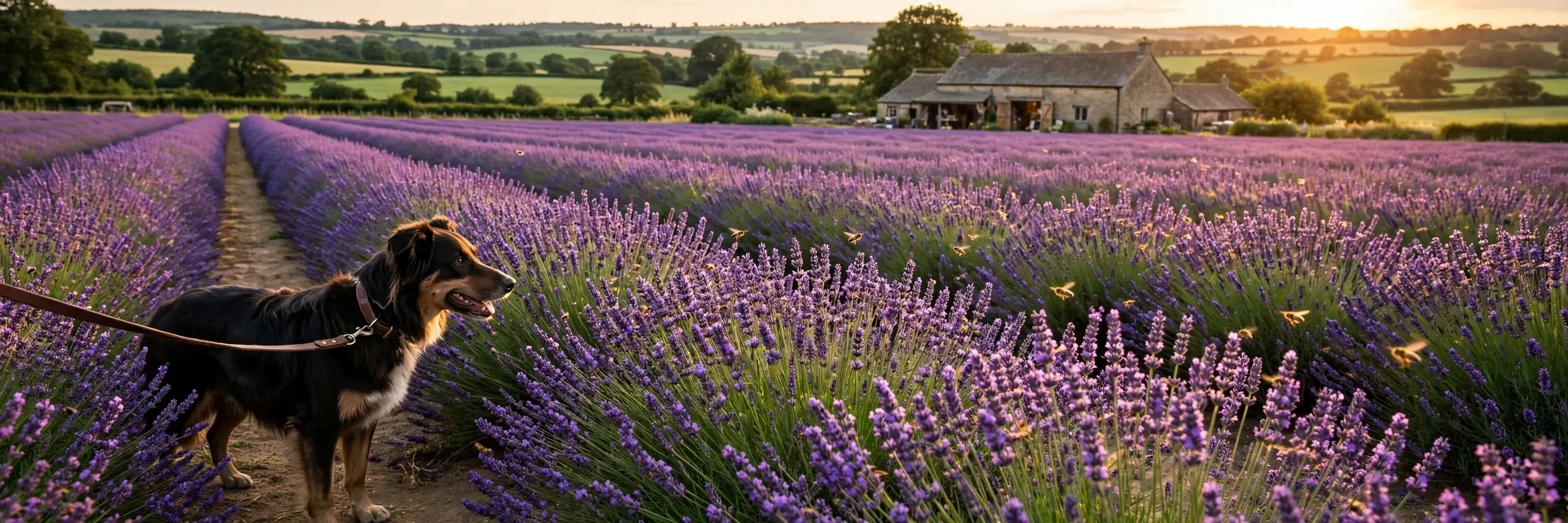
A lavender field in flower is, first and foremost, a bee workplace. Honeybees, bumblebees and solitary bees work the rows from morning to evening, and a dog walking through the field is walking through their flight paths. Most dogs ignore bees, and most bees ignore dogs, but the combination deserves respect, because a dog that snaps at bees, chases them or blunders into a dense patch of flowers can be stung on the nose, mouth or paw, and a sting in the mouth can swell quickly. The answer is not to avoid lavender fields but to manage the dog's position: stay on the paths and headlands, keep the dog away from the densest flower heads, and keep moving through the rows rather than standing still among them while bees work around you.
Different dogs react differently to bees. Some are fascinated and snap, some are indifferent, and some are frightened by the humming, which in a large field can be loud enough for a person to hear from the path. A dog that snaps at bees needs a firm "leave it" practised at home, and a short lead that prevents lunging into the rows, because a snap that connects with a bee is painful for the dog and distressing for the owner. A dog that is frightened by humming needs a shorter visit and a route along the field edge, where bee density is lower, rather than a walk down the middle of the rows. Either way, watch the dog's body language: fixating on bees, whining, or repeatedly snapping are signals to move away, not to persist.
If a sting does happen, stay calm and act promptly. A bee sting on the nose or paw usually causes local swelling and discomfort that settles within hours, and a cold compress, if available, helps. Remove a honeybee sting by scraping it away rather than squeezing it, because squeezing can release more venom. Seek veterinary advice urgently if swelling spreads to the face or throat, if the dog has difficulty breathing, vomits, collapses, or has been stung multiple times, because allergic reactions, though uncommon, can be serious. Keep the farm's location and the nearest vet's number in your phone before the visit, so a sting does not become a panicked search for help in a field with poor signal.
Bees also explain why farms ask visitors to stay on paths. A person or dog standing in the rows crushes flowers, disrupts foraging and risks stings, while a person on the path enjoys the same colour and scent without any of those problems. The path rule at a lavender farm is therefore about bees, crop and visitors together, not about spoiling photographs. Respect it, and the bees will do their work undisturbed, the crop will survive for harvest, and your dog will avoid the most likely sting. It is a rare rule that benefits everyone it touches.
Heat, sun and shade planning
Heat is the main risk of a lavender visit, and it is easy to underestimate because a field looks gentle and a dog looks happy. Lavender fields offer almost no shade: rows of low plants, wide paths of dry soil, and a big sky, with the only shade at the field edge, under a tree, or in the shop. A dog in a field at midday in July is a dog in direct sun with reflected heat from the ground, and brachycephalic breeds, older dogs, overweight dogs and very young puppies are at particular risk. Plan the visit for the morning, keep it short, and have a shade plan before you arrive: know where the nearest tree, hedge or building is, and be ready to retreat to it.
Water is the second part of heat planning, and it needs to be more than a bottle in the car. Carry water and a bowl into the field, offer it frequently, and watch for the early signs of overheating: heavy panting that does not settle, drooling, a bright red tongue, wobbliness or a refusal to walk. If you see them, move the dog to shade immediately, offer water, wet the belly and paws with cool water, and seek veterinary advice if the dog does not recover quickly. Never leave a dog in a car at a lavender farm, even for a few minutes, because a car in July sun heats to dangerous levels astonishingly fast, and a shop queue is not an excuse. If the group must split for the shop, the dog stays with a person in the shade, not in the car.
Cooling gear helps, but it is not magic. A cooling coat, soaked in water before the visit, can help a dog that tolerates wearing one, and a damp towel draped over the dog in the shade gives evaporative cooling, but neither replaces shade, water and a short visit. Test cooling gear at home before the field, because a dog that fusses at an unfamiliar coat in a hot field is a dog under extra stress. Pavement and path temperature matter too: dry soil and gravel paths in July can be hot on paws, so check the ground with your hand, keep the dog on grass verges where possible, and check paws after the visit for soreness or cracking.
Finally, plan the journey home with heat in mind. A car that has sat in a farm car park in July sun is an oven, so shade the car if you can, ventilate it before loading the dog, and offer water before the drive. A dog that has had a hot field visit needs a cool, calm journey home, not a further stop in a sunny car park. If the day is genuinely hot, the kindest plan may be a very short field visit, a shop stop in the shade, and a longer walk in the evening when the air has cooled. Lavender is beautiful, but it is not worth a heat-stressed dog, and a shorter visit on a hot day is a better memory than a long one that ends badly.
Scent, sneezing and sensitive noses
Lavender scent in an open field is strong, and dogs, whose sense of smell is far more acute than ours, experience it intensely. Most dogs cope perfectly well, sniffing curiously and moving on, but some sneeze repeatedly, shake their heads, rub their faces or show a desire to leave the densest rows quickly. Those signals are worth respecting: a dog that sneezes in a flower row is telling you the scent is overwhelming, and a brisk walk to the field edge or to open air usually settles it. Do not insist on lingering in the strongest scent for a photograph if the dog is clearly uncomfortable, because the photograph is not worth the dog's distress.
There is an important distinction between outdoor scent and concentrated products. Lavender plants in a field, in open air, are a normal part of a dog's world, and the scent disperses quickly. Lavender essential oil, concentrated diffusers, potpourri and strongly scented sachets indoors are a different matter, because the concentration is far higher and the air is enclosed, and dogs with respiratory sensitivity can be irritated by them. In the farm shop, therefore, keep the dog away from open oil displays and diffuser demonstrations, and do not buy a strongly scented product and then carry it in a closed car with the dog for hours. A dried bunch, wrapped in paper, is a gentler souvenir, and it will scent a room at home without overwhelming the dog.
Eating lavender is a separate question from smelling it. Lavender plants are not a dog food, and a dog that chews stems, flowers or leaves can develop stomach upset, vomiting or diarrhoea, particularly if it eats a large amount. Keep the dog away from fallen stems and from cut bunches left on the ground during harvest, and trade any stem the dog picks up for a treat, rather than chasing the dog to retrieve it. Lavender oil, if ingested, is more concerning than the plant itself, so keep shop-bought oils out of the dog's reach, in a closed bag, and seek veterinary advice if a significant amount is swallowed. The field rule, once again, is simple: look and smell, do not eat.
Dogs with existing respiratory conditions, such as brachycephalic breeds or dogs with chronic bronchitis, deserve extra care in a strongly scented field. A shorter visit, a route along the edge where scent is lighter, and a prompt retreat to open air if breathing becomes laboured are sensible precautions, and a veterinary discussion before the season is wise if your dog has a known condition. Most dogs, however, will enjoy a lavender field without any scent problem at all, and the scent that overwhelms a person in a shop is, in the open air, simply part of a summer walk. As with heat and bees, the answer is observation and moderation, not avoidance.
Picking rules and what you can take home
Some lavender farms offer pick-your-own, some sell pre-cut bunches, and some allow no picking at all, because the crop is destined for oil distillation and every stem counts. The farm's own signs and staff are the authority, and the rule can change during the season: a farm that allows picking in early July may stop once harvest begins, and a farm that sells bunches may still forbid cutting from the rows. Ask before you cut anything, and do not assume that a pair of scissors in the shop means picking is allowed in the field. A cut stem, taken without permission, is theft from a crop, and a dog owner who cuts without asking undermines the farm's trust in visitors generally.
Where picking is allowed, it usually works like this: buy a bag or a bunch allowance at the shop, use the scissors provided, cut only from the marked picking rows, and keep the dog on the path while you cut, rather than letting the dog wander among the rows. Cut stems cleanly, above a leaf node, and do not pull plants up or break stems, because a broken plant is damaged for the rest of the season. Keep the bunch away from the dog on the journey home, wrapped in paper, because a dog that chews a fresh bunch can develop stomach upset, and a bunch left loose in the car will shed flowers everywhere. A picked bunch, dried upside down in a cool, airy room, keeps its scent for months and makes a lovely souvenir, provided it is stored out of the dog's reach.
What you can buy in the shop is often more interesting than what you can pick. Lavender farms sell dried bunches, oils, soaps, food products and plants, and the shop is worth a browse, with the dog's rules in mind. Keep the dog on a short lead in the shop, away from open oil bottles and food tastings, and do not let the dog investigate baskets of dried flowers at nose height, because a knocked-over display is embarrassing and a chewed sachet is a stomach upset waiting to happen. If the shop is crowded, one person can browse while another waits outside with the dog in the shade, which is kinder to the dog and to other shoppers than a dog weaving between displays.
Plants for the garden are a popular purchase, and they deserve a dog-aware thought. A lavender plant bought at a farm and planted at home will attract bees to your garden, which is wonderful for pollinators and a consideration for a dog that snaps at bees. Plant it away from the dog's main toilet area and play space, where bees and dogs are less likely to collide, and let the dog investigate it on a lead when it first flowers. A garden lavender, like a field lavender, is best enjoyed by a dog that can sniff it from a path, not by a dog that eats it, so a little garden planning now saves a stomach upset later.
Shop, cafe and the waiting game
The shop and cafe are where a lavender visit often succeeds or fails for a dog owner, because the field visit is short and the refreshment stop is long. A farm with outdoor seating that welcomes dogs, shade over the tables, water bowls and a relaxed attitude to a settled dog under a table is a farm that understands dog owners. A farm whose cafe excludes dogs, whose outdoor seating is in full sun, and whose queue is long is a farm that requires a plan: split the group, take turns ordering, eat in shifts, or bring a picnic to eat in a shaded spot away from the cafe. None of these plans is difficult, but all of them need to be made before the group is hungry, thirsty and tired.
Food is a particular temptation at a lavender farm, because cafes often sell lavender ice cream, lavender shortbread, lavender cakes and lavender drinks, all of which smell interesting to a dog and none of which are dog food. Keep the dog away from the table edge while food is served, and do not share lavender-flavoured products with the dog, because they contain sugar, fat and sometimes ingredients that are unsuitable for dogs. A dog chew or a stuffed Kong, given under the table while humans eat, keeps the dog happily occupied and prevents begging, which is the behaviour that most often leads to a cafe asking a dog owner to leave. A settled dog under a table is a welcome dog; a begging, barking dog is not.
Queues in a farm shop in July can be long, hot and crowded, and a dog that queues well is a dog that has been taught to wait. Practise short waits at home before the visit, and on the day, keep shop queues short by splitting the group, so the dog is never in more than one queue. If the shop is air-conditioned, the dog may enjoy the cool air, but a crowded shop with narrow aisles is no place for a large dog on a long lead, so keep the lead short and the dog close. If the dog is struggling, leave the shop, wait outside in the shade, and let another group member finish the shopping. A souvenir is not worth a stressed dog, and the shop will still be there on a quieter day.
Toileting and water at the farm deserve a final check. A farm that provides a dog water point and a bin for waste is a farm that has thought about dogs, and using those facilities, rather than improvising, keeps the site pleasant for everyone. If no water point is provided, your own bottle and bowl are essential, and if no bin is provided, carry waste home rather than leaving it. These small courtesies are what keep farms welcoming dogs, and they are noticed by staff far more than a thank-you. A lavender farm that feels respected by dog owners will keep its dog policy generous, and that generosity benefits the next dog owner who visits.
Paths, access and quiet corners
Lavender farm paths are usually wide, flat tractor tracks or mown grass headlands, which suit most dogs, including older ones, far better than a woodland trail. The challenge is not roughness but exposure: wide paths mean wide sun, and a dog walking a long, straight path between rows has no shade until the end of the row. Plan the route to include shade breaks: walk a row, retreat to a tree or a building, offer water, then walk another row, rather than marching the whole field in one go. If the farm has a garden, a woodland edge or a picnic area, use it as a shade base, and treat the field as a series of short excursions from that base rather than a single long walk.
Accessibility varies, and it is worth checking before you travel if your dog, or a member of your party, has mobility needs. Most lavender farms are level, because the crop is grown on flat ground, but paths can be rutted after rain, and some farms have steps or narrow gates between the car park, the shop and the field. A farm that can describe its paths, gates and seating will help you plan, and a farm that cannot may still be accessible, but you will discover it on arrival. For a dog that struggles with distance, a short field visit with a shaded seat nearby is better than a long walk around a large farm, and the flowers are just as purple from a bench at the field edge.
Quiet corners exist even at busy farms, and they are worth seeking out. The far end of the field, away from the shop and the main viewpoint, is often empty, with the same rows and the same scent but room to walk at a dog's pace. A field edge beside a hedge, where bees are fewer and the air moves, can be a calm spot for a dog that finds the centre of the field overwhelming. Ask staff where the quietest rows are, because staff walk the field daily and know which areas visitors ignore. A quiet corner, found deliberately, turns a crowded farm visit into a peaceful one, and it is the difference between a dog that enjoys lavender and a dog that endures it.
Other visitors in a lavender field are usually relaxed, photographing flowers and browsing, rather than rushing, which makes the atmosphere gentler than at a pumpkin patch or a beach in high summer. That gentleness helps dogs, but it also means a barking or lunging dog stands out, and other visitors will notice. Keep the dog's behaviour in mind as part of the visit's success: a calm dog that walks quietly between rows is a pleasure for everyone, while a dog that barks at every passer-by will make the visit stressful for its owner. If your dog is reactive, a quiet weekday morning, a far row and a short visit are the right choices, and there is no shame in a brief, happy visit over a long, difficult one.
Photography in purple
Lavender photography is famously flattering, and a dog among purple rows, in low summer light, makes a beautiful picture, provided the photograph is taken from a path and the dog is comfortable. The best light is early morning or late afternoon, when the sun is low and the rows cast long shadows, while midday sun flattens the colour and makes both dogs and people squint. An overcast day, though less dramatic, gives soft light that is kind to purple and to dogs, so do not be disappointed by cloud. Keep the camera low, at the dog's eye level, with rows leading into the distance behind the dog, and take the photograph quickly, while the dog is fresh, rather than after an hour of waiting.
Respect the crop in your photography, as in your walking. Do not step into the rows for a photograph, do not bend stems towards the camera, and do not place the dog among the plants for a posed shot, because a photograph taken inside the crop normalises trampling for everyone who sees it. A dog photographed from the path, with rows behind it, looks just as beautiful, and the photograph tells a truer story: a dog enjoying a farm, not a dog placed in a crop for effect. The same applies to picking a stem to hold in a photograph: a stem picked for a picture is a stem lost from the crop, and a photograph that shows it encourages others to do the same.
Other photographers in a lavender field are usually patient and friendly, but paths can still block, and a tripod across a narrow path is inconsiderate. Take your photograph, move on, and leave the viewpoint for others, because the field belongs to everyone and the light will not wait. If you want a quiet photograph, walk to the far end of the field, where the crowds thin and the rows are just as purple, rather than waiting for a famous viewpoint to empty. And keep the camera safe from heat and dust: a phone left in direct sun on a path overheats quickly, and a camera strap around the neck is safer than a hand-held phone while also holding a lead.
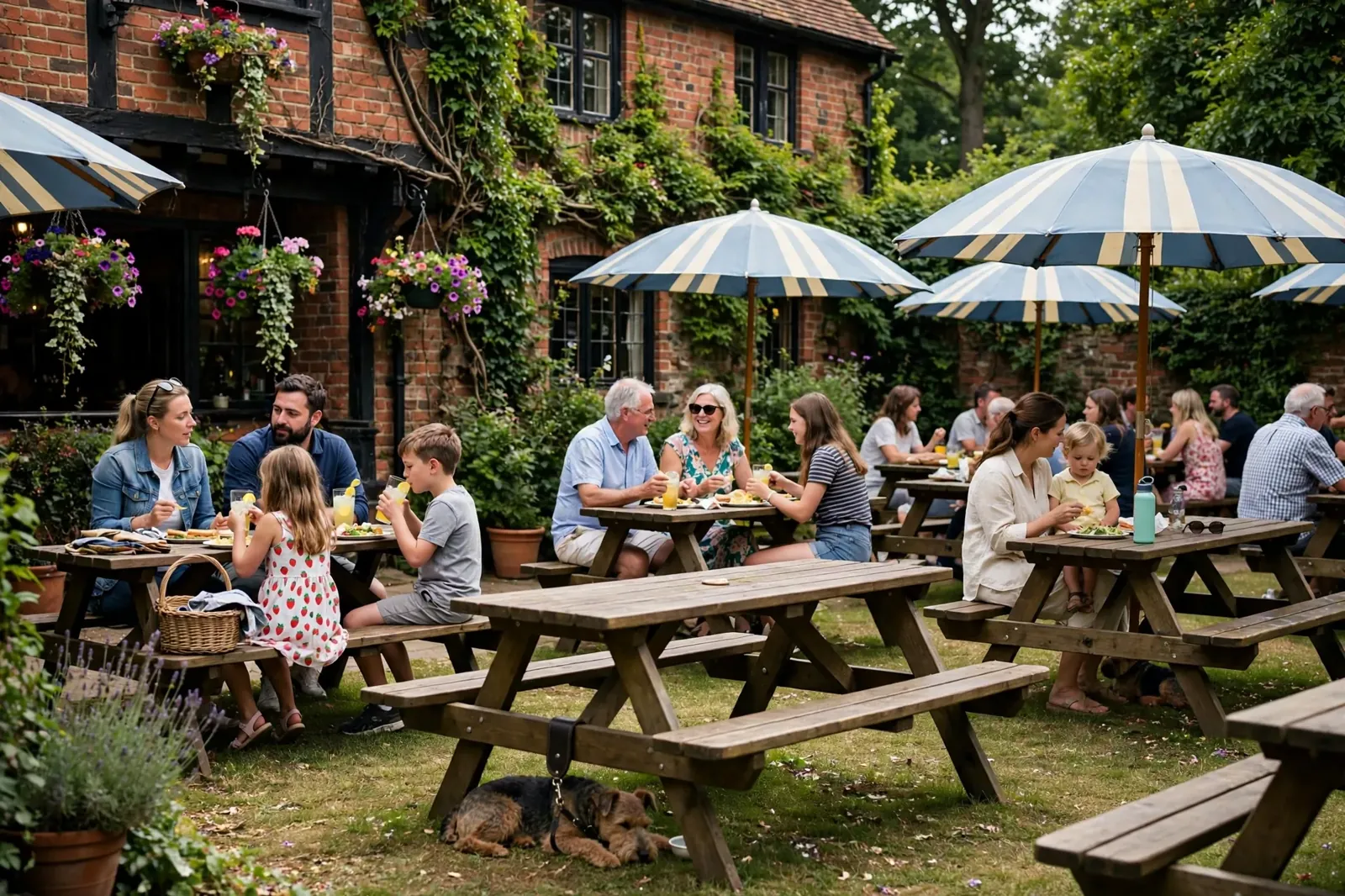
After the visit, a lavender field pairs naturally with a calm end to the day. A shaded walk, a pub garden with water for the dog, and a quiet evening at home, with the dog settled and the dried bunch in a vase, is the right ending to a summer field visit. Our guide to dogs in pub gardens covers the etiquette of that stop, and our guide to weekend breaks with dogs helps turn a single field visit into a relaxed two-day break, with the field as one highlight among several. A lavender day, planned around heat, bees and shade, is a summer memory worth keeping, and the dog, settled at home with a cool drink, will agree.
Practical questions
Before you go
When do lavender fields flower in the UK?
Usually from late June to early August, with the peak in July. Harvest often starts in late July or August, so check the farm's flowering report before you travel.
Are lavender fields safe for dogs with bees around?
Mostly yes, if the dog stays on the paths and does not snap at bees. A sting on the nose or mouth is painful but usually minor; seek veterinary advice if swelling spreads or breathing is affected.
Can dogs walk between the lavender rows?
Usually not. Most farms ask visitors to stay on paths and headlands, because the plants are a crop and the rows hold bees. Follow the farm's own signs on the day.
Is lavender scent harmful to dogs?
Outdoor scent in an open field is not normally a problem, but concentrated lavender oil and strong diffusers indoors can irritate dogs. In the field, watch for sneezing and move to open air if needed.
What should I pack for a hot lavender field visit?
Pack water, a bowl, a shade plan, a cooling coat or damp towel for warm days, poo bags, and a lead that keeps the dog close on narrow paths between rows.
Do lavender farms allow dogs in the shop and cafe?
It varies. Many allow dogs in outdoor seating and some in the shop, but food areas may be restricted, so check before you travel and plan for one person to wait outside if needed.