This guide is independent and contains no paid placement. Sailing conditions, harbour rules and veterinary advice change, so check the official guidance before you travel if anything here touches a decision that affects safety.
A first sail with a dog should be short, calm and close to shore, with the dog in a fitted life jacket, clipped to a safe point or supervised on a non-slip mat, and with a toilet stop ashore planned before and after. If the wind is gusty, the sea is lumpy or the dog is already anxious on the pontoon, postpone: a good first sail is boring in the best sense.
A sailing boat is not a river boat
It is tempting to treat all boats as the same, and that is exactly where first-time sailing with a dog goes wrong. A river cruiser or a canal boat moves slowly on flat water, stays level, and can usually stop at a bank within minutes. A sailing boat at sea does none of those things reliably. It heels, which means it leans to one side under sail, so the deck your dog walks on is suddenly a slope. It pitches and rolls as waves pass underneath, so the floor moves in two directions at once. And once you have left the harbour, the nearest patch of grass may be an hour or more away, with no way to shorten the trip just because the dog needs a toilet break or feels unwell.
The difference is not only about motion. On a calm inland waterway, the main risks are a dog slipping on a wet step or jumping off at a mooring. At sea, the risks stack: a dog can slide across a heeling deck, get caught by a swinging boom, step on a rope that suddenly comes under load, or fall overboard in water that is cold, deep and moving. None of this means sailing with a dog is reckless. It means the preparation is different, and the margin for improvisation is much smaller. The skipper is also busier at sea than on a river: sails need trimming, other vessels need watching, and tides and wind shifts need constant attention. A dog that needs continuous handling therefore competes for the one resource a sailing crew cannot spare, which is attention at the wrong moment.
That contrast also changes what counts as a good day. On a river, a long, lazy afternoon afloat is the point. On a first sea sail, a short outing that ends with a relaxed dog is a far better result than a long passage that ends with a frightened, seasick animal and a crew that will not try again. Keep the ambition small on purpose. A dog that enjoys a one-hour sail in light airs will learn that boats are safe, while a dog that endures four hours in a chop will learn the opposite lesson, and unlearning it takes far longer than the sail itself. If your only boating experience so far is inland, read this guide as a reset rather than an extension: most of what felt easy on a canal needs rethinking once the boat can heel and the shore is out of easy reach.
There is also a social difference worth naming early. A hire boat on a river is usually your own space for the day. A sailing boat is often shared with a skipper, an instructor or other crew, and everyone aboard has a job when manoeuvres happen. Tell the skipper before you book that a dog is coming, how the dog behaves around strangers and noise, and whether the dog has ever been on a boat. A skipper who knows in advance can choose a suitable boat, a sheltered route and a crew brief that includes the dog. A skipper who discovers a nervous, unprepared dog at the pontoon has far fewer good options, and the dog will feel that tension immediately.
Choosing the right first outing
The best first outing is not the most scenic one. It is the most controllable one: a short sail in sheltered water, with an experienced skipper, in settled weather, close enough to the harbour that turning back is always an easy decision. Sheltered water matters more than sunshine. A sunny day with a strong, gusty wind and a short, steep chop can be far harder on a dog than a grey, calm day in a flat estuary. When you look at possible trips, ask where the boat will actually sail, not just where it starts. A harbour entrance, an exposed headland and a stretch of open coast can all be rough even when the marina itself looks glassy.
For most beginners, a skippered day sail or a taster session with a sailing school is a better first step than chartering a bareboat or borrowing a friend's yacht. The skipper handles the sailing decisions, so you can focus entirely on the dog, and the boat will already be set up with the safety gear a beginner might forget. Ask direct questions before booking: is the boat dog-friendly in practice or only in principle, where will the dog sit, is there shade and a non-slip area, and what happens if the dog is sick or distressed mid-sail? The answers tell you a great deal. A provider that has a clear dog routine, including a pre-sail toilet walk and a plan for cutting the sail short, is a far better bet than one that simply says dogs are allowed and leaves the rest to you.
Think carefully about who else is aboard. A first sail with a full crew of strangers, children running on deck and a dog that has never heard a winch is a lot of novelty at once. A quieter trip, with fewer people and a patient skipper, gives the dog a chance to learn the sounds and movements one at a time. Similarly, avoid combining too many firsts: a first sail is not the day to also try a new harness, a new life jacket and a new travel routine all at once. Fit the jacket at home, walk the dog in it, and let the boat itself be the only genuinely new thing. If the dog has never travelled well by car, sort that first too, because a stressed journey to the marina will still be in the dog's system when you step aboard.
Finally, be honest about your own sailing experience, because it shapes the dog's experience. If you are also new to sailing, you will be learning where to stand, what to hold and when to move, all while watching the dog. That is a lot to carry. A skippered trip removes that conflict, and a short shore-based introduction to the boat, done the day before or at the pontoon, helps enormously. Walk the dog around the marina first, let it sniff the pontoon and hear the rigging, and board only when the dog is calm. A rushed boarding, with bags, ropes and a wriggling dog arriving together, sets a frantic tone that the whole sail then has to undo.
Deck safety: grip, edges and moving gear
Start with grip, because it decides almost everything else. A fibreglass deck that feels fine in dry shoes can be treacherous for paws, especially when it is wet with spray and tilted by heel. Give the dog a defined, non-slip place to be: a rubber-backed mat or a piece of non-slip deck matting in the cockpit, where the dog can lie low and brace. Low matters. A dog lying down has a far lower centre of gravity than a dog standing and trying to surf the motion, and lying down also keeps the dog out of the way of feet and ropes. Teach the dog at home that the mat is a place to settle, with treats and rest, so that on the boat the mat is already a familiar island in a moving world.
Next, map the hazards before the sails go up. The boom swings across the cockpit when the boat tacks or gybes, and it does so at head height for a standing dog and sometimes for a crouching person. The dog's place must never be in the boom's arc, and the dog should be held or settled well clear whenever a manoeuvre is called. Winches wind ropes under considerable load, and a paw, tail or lead caught near a winch drum is a serious injury risk. Sheets, the ropes that control the sails, run across the deck and tighten suddenly; a lead trailing across a sheet can drag a dog across the cockpit in an instant. Keep leads short, keep them out of the working area, and never tie a lead to a winch, a sheet or anything that moves.
Falling overboard is the risk every sailing dog owner pictures, and prevention is a system rather than a single gadget. It starts with guardrails and lifelines, which are not dog-proof: many dogs can duck under a lifeline or squeeze through a gap at a gate, especially smaller breeds. Check the gaps on your specific boat rather than assuming the rails will hold the dog. It continues with supervision: on a sailing boat, a dog should never be left alone on deck, not even for a quick trip below to fetch a jacket. And it ends with a tether used correctly. If you clip the dog on, clip to a strong, fixed point designed for the job, such as a dedicated jackstay or a cockpit strong point, using a short tether and a harness, never a collar. A long tether lets the dog build up speed before it hits the end, and a collar attachment risks serious neck injury if the dog is stopped suddenly or goes over the side. Ask the skipper to show you the safe clipping points before departure, and test the arrangement while the boat is still moored.
Below deck has its own hazards, and the companionway is the most important one. Those steep steps down into the cabin are a fall risk for dogs in both directions, and a dog that panics below may bolt up them at exactly the wrong moment. Many owners block the companionway with a washboard or a board while under way, keeping the dog in the cockpit where it can be seen, and carry smaller dogs up and down rather than letting them scramble. Inside the cabin, secure anything that could slide: a heavy bag, a toolbox or a loose stove kettle becomes a projectile when the boat heels suddenly. Keep the dog's water bowl in a non-spill design, stow food out of reach, and remember that engine spaces, batteries and flares are not places for curious noses. A quick below-deck tidy before casting off is not fussiness; it is the sailing equivalent of putting the dog's lead on before opening the car door.
Finally, plan the man-overboard drill for a dog before you need it, and say it out loud with the skipper. Who shouts, who keeps eyes on the dog, who slows and turns the boat, and how will the dog be lifted back aboard? A dog in the water, even a strong swimmer, tires fast in cold, moving water, and a wet, panicking dog is extremely hard to haul over a high freeboard by hand. That is why the life jacket handle matters so much, and why a boarding ladder or a swim platform, rigged and ready, should be part of the plan rather than an afterthought discovered in an emergency. Rehearsing the words takes two minutes at the pontoon and removes the worst part of a real incident, which is everyone trying to decide what to do at the same time.
The life jacket and the lift back aboard
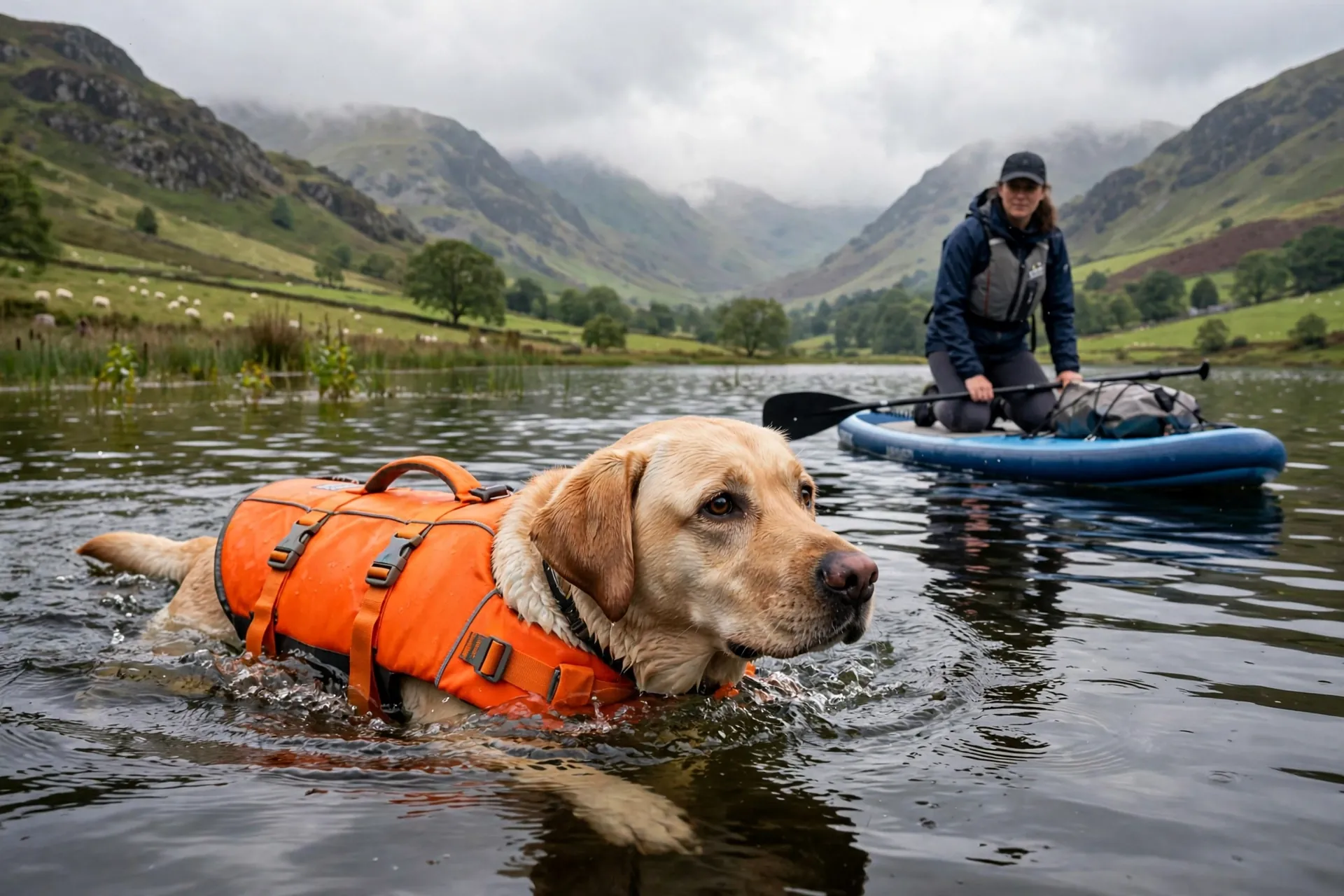
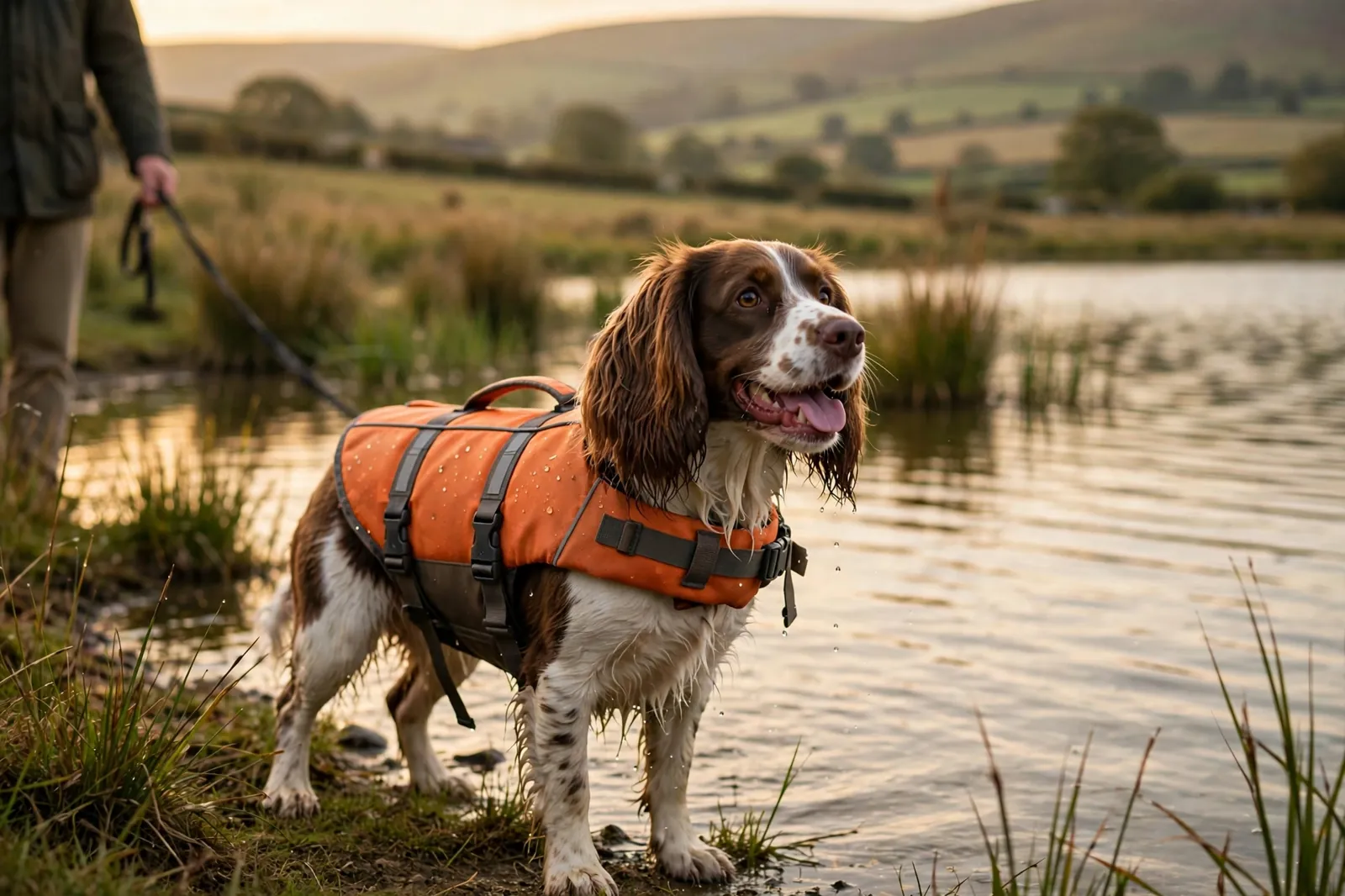
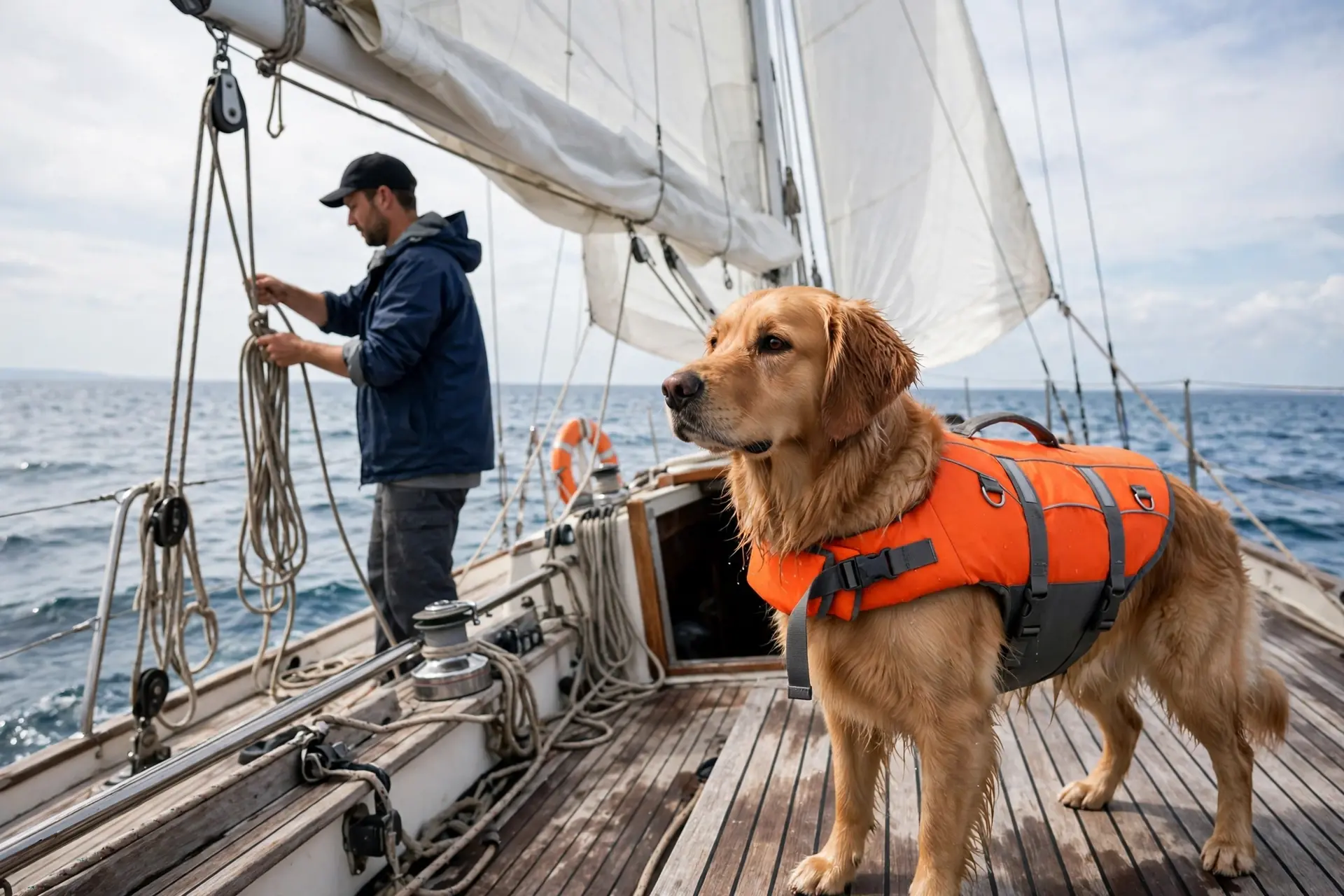
A canine life jacket is not a swimming aid for a dog that already swims well. It is buoyancy, visibility and, above all, a handle. On a sailing boat, where the side of the boat may be a metre or more above the water and the boat itself is moving, that handle is the difference between a recoverable incident and a dangerous one. Choose a jacket with a strong top handle, a bright colour, a chin or neck float that helps keep the head up, and a belly panel that keeps the jacket from riding up when the dog is lifted. Fit it at home, well before the sail, and adjust every strap: you should be able to fit two fingers under the straps, but not pull the jacket off over the dog's head or slide it sideways with ease.
Test the jacket in the way you will actually use it. Put it on, let the dog wear it around the house and on a walk, then practise lifting the dog by the handle while the dog is standing on a stable surface, and again while the boat is moored. Many dogs freeze, wriggle or panic the first time they are lifted by a handle, and discovering that at the pontoon is far better than discovering it over open water. Check the fit again once the jacket is wet, because wet straps can loosen, and recheck after the dog has been lying on it for a while. A jacket that was perfect in the shop can become a slipping, twisting nuisance after an hour of wear, so build a fit check into the routine at each stop, just as you would check your own life jacket.
Not every dog needs the same level of buoyancy, but on a first sea sail, err on the side of using one. Strong swimmers, brachycephalic breeds, older dogs, puppies and any dog that has never swum in the sea all benefit, and the sea is not a lake: cold water, currents, waves and the distance to a safe landing all make swimming back to the boat far harder than swimming in a pond. If your dog will not tolerate a jacket at all, that is information, not a detail to push through on the day. Work on jacket acceptance at home over days or weeks, with short, rewarded sessions, and postpone the sail until the dog accepts it. For a fuller discussion of buoyancy, handles, sizing checks and care, see our guide to dog life jackets in the UK.
Human life jackets matter here too, and for a reason directly connected to the dog. If the dog goes overboard and you lean over the side to help without your own buoyancy, you can quickly become a second casualty. Wear your own life jacket whenever the dog is on deck, clip on in rough conditions if the skipper advises it, and keep a throwable float or a heaving line where you can reach it without leaving the dog unattended. The safest rescue is always the one where the rescuer stays aboard and the boat is brought back to the dog, rather than a person jumping in after it.
Seasickness: prevention and what to do
Seasickness in dogs is common, under-discussed and, mercifully, often temporary. The inner ear senses motion that the eyes do not match, especially below deck, where the dog can feel the boat moving but cannot see the horizon. Puppies are the most susceptible, because their balance systems are still maturing, and many grow out of it with gradual exposure. Adult dogs that have never been on a boat can also be sick on a first sail, and anxiety makes it worse: a dog that is already stressed by noise, heel and unfamiliar people is more likely to vomit than a calm dog in the same sea. That is one more reason to keep the first sail short and calm, rather than hoping a dog will simply get used to a rough day.
Learn the early signs, because vomiting is a late one. Watch for drooling, lip licking, yawning, restlessness, whining, a glazed or worried expression, and a dog that suddenly wants to lie flat or, conversely, will not settle at all. If you see these signs, act early: move the dog into fresh air if it is below, let it look at the horizon, keep it cool, and offer small sips of water rather than a large drink or a meal. Do not feed a large meal just before sailing. A light meal several hours beforehand, and small, plain treats during the sail only if the dog is settled, is a safer pattern. Keep the dog's place stable and low, avoid letting it stare at moving water close to the hull, and resist the urge to fuss constantly, which can add to the dog's arousal without reducing the nausea.
If the dog is sick, stay calm and practical. Clean up promptly, because the smell can make the next bout worse and distress other dogs aboard. Offer water little and often once the vomiting has settled, keep the dog warm and sheltered from wind and spray, and consider cutting the sail short. There is no prize for pushing on through repeated vomiting, and a dog that associates boats with hours of misery will be far harder to bring back next time. Note what happened: the sea state, the duration before sickness, whether the dog was below or on deck, and what it had eaten. That record is genuinely useful, both for your own planning and for a vet, because it separates a one-off rough day from a pattern that needs a plan.
For dogs with a known history of motion sickness, talk to your vet before the trip, not on the morning of it. Some vets prescribe anti-nausea medication for boat travel, but timing, dose and suitability depend on the individual dog, and over-the-counter human remedies are not automatically safe for dogs. Our guide to dog motion sickness remedies in the UK explains the general options and the questions to ask, but it does not replace veterinary advice for your dog. If medication is prescribed, do a trial run on land or on a very short sail first, so you know how the dog responds before committing to a longer outing. And if seasickness happens despite all of this, treat it as information about pacing, not as failure: shorter sails, calmer days and a slower training ladder are the usual answer.
Toilet stops and the ashore plan
Toilet planning is the least glamorous part of sailing with a dog and the one most likely to ruin a day if it is ignored. Most dogs will not toilet on a moving boat, and many will not toilet on deck at all, even on a mat, until they have learned to do so over many outings. That means the sail must be built around the dog's bladder and bowels, not the other way round. Give a long, unhurried last outing ashore before boarding, in a place where the dog normally toilets, and allow time for both a wee and a poo. A rushed five-minute dash around a car park is not a substitute, and a dog that boards already needing to go will spend the whole sail distressed and distracted.
Plan the return stop before you leave, and build slack into it. Know which marina, harbour or pontoon you will come back to, whether dogs are allowed ashore there, and where the nearest grass is once you step off. On a longer day, plan an intermediate stop: a harbour where you can moor or anchor, go ashore by dinghy if the boat carries one, and give the dog a proper break. Be realistic about what a dinghy transfer involves, though. A dog that has never been in a dinghy, being lifted from a moving yacht into a small inflatable, is a separate challenge, and it should be practised in calm water before it becomes part of a toilet plan. If there is no realistic intermediate stop, keep the sail short enough that the dog is comfortable throughout.
Some owners do train a deck toilet, usually a patch of artificial grass or an absorbent mat in a sheltered corner of the cockpit, introduced gradually at home and then on a moored boat. It can work, particularly for smaller dogs and for longer passages, but it takes patience and it should never be the only plan on a first sail. Introduce the surface at home first, reward use, then move it to a moored boat, then to a boat under engine, and only then expect it to work under sail. Clean up immediately, every time, because a soiled deck is a hygiene problem, a slipping hazard and deeply unfair to other crew. Carry more bags, wipes and fresh water than you think you need, and have a sealed bag system for waste, since harbour rules on disposal vary and leaving waste on a pontoon is never acceptable.
Think about the night, too, even on a day sail that runs late. A sail that was planned to finish at five but finishes at eight, after a slow beat against the wind, can leave a dog desperate. Tell the skipper about the dog's normal toilet interval before departure, agree a latest return time, and be willing to motor back or cut a leg short to meet it. The same logic applies in reverse at the start of the day: if the dog normally toilets first thing, do not let a long drive to the marina and a slow boarding eat into that routine. A dog that starts the sail comfortable is a dog that can actually enjoy it, and comfort, for a dog, begins with the basics.
Reading wind, waves and weather
You do not need to become a meteorologist to take a dog sailing, but you do need to understand enough to know when to postpone, and to understand why the skipper has postponed. Start with the forecast for your exact area, not a national summary. Coastal forecasts differ sharply over short distances: a headland, an estuary mouth and a sheltered bay can have different winds on the same afternoon. Check the wind speed, the gusts, the direction and the sea state together, because any one of them alone misleads. A moderate wind blowing against a strong tide can produce a short, steep chop that feels far worse than the wind speed suggests, while the same wind blowing with the tide over a longer fetch can produce a smoother, rolling sea.
Learn the shape of the day, not just a single number. Is the wind forecast to build through the afternoon, to shift direction, or to drop and leave a residual swell? Gusts matter more for a dog than average wind speed, because a sudden gust heels the boat sharply, slides everything across the cockpit and startles a dog that had just settled. A forecast that says light winds with strong gusts is a poor first-sail forecast, even if the headline number looks gentle. Similarly, a swell left over from yesterday's wind can make a boat roll uncomfortably even on a calm-looking morning. Ask the skipper what the sea state is expected to feel like, not just what the wind is, and listen for words like lumpy, confused or steep, which all mean a harder ride for a dog than a clean, regular swell.
Weather judgement also includes the sky, the temperature and the time you have. Thunderstorms are a hard stop for a dog sail: lightning, sudden gusts and heavy rain combine danger with distress, and a noise-sensitive dog will suffer even if the boat itself is safe. Cold wind and spray chill a wet dog fast, especially a small, short-coated or older dog, so pack a drying coat and a towel even on a warm day, and watch for shivering. Heat matters too: a cockpit in strong sun, with no shade and a dog in a dark life jacket, can overheat quickly, so rig shade, offer water often and never leave a dog in a closed cabin in the sun. Tide times deserve a line of their own, because they decide whether you can enter or leave a harbour at all, and a missed tide window can turn a short sail into a long wait. If you are unsure about any of this, check the official guidance before you travel and let the skipper's local knowledge carry the detail.
Finally, agree the abort criteria before you cast off. What wind speed, sea state or dog behaviour will end the sail early, and who can call it? The answer should include the dog explicitly: repeated vomiting, panic that does not settle, a fall or a near-fall, or a dog that cannot find a safe place to lie down are all valid reasons to turn back, even if the humans aboard are enjoying themselves. A skipper who welcomes that conversation is a skipper you can trust with your dog. A trip where turning back feels like letting the side down is a trip where a dog's distress will be endured far longer than it should be.
A gradual training ladder
The kindest way to introduce a dog to sailing is a ladder, not a leap. Each rung should be easy enough that the dog succeeds, and short enough that the dog still wants the next one. Start on land: let the dog wear its life jacket at home, practise the mat settle, and rehearse being lifted by the jacket handle. Then visit the marina without sailing. Walk the pontoon, let the dog hear halyards tapping masts and smell the harbour, and reward calm behaviour. Pontoons move underfoot, ramps are steep and gaps between pontoon and boat can worry dogs, so practise boarding a moored boat with the dog on a short lead, lifting smaller dogs aboard rather than letting them jump a gap.
The next rung is time aboard a moored boat. Sit in the cockpit with the dog on its mat, run through the normal sounds, open and close lockers, and let the dog explore below deck while the boat is still. Feed a meal or give a long-lasting chew aboard if the dog is relaxed enough to eat, because eating is a good sign that the dog feels safe. Then add engine motion: a short motor out of the marina and back, with no sails up, so the dog experiences movement, engine noise and gentle wash without heel. Keep it to twenty or thirty minutes, end with a toilet stop and a walk ashore, and repeat until the dog boards eagerly rather than reluctantly.
Only then add sail, and add it gently. A short sail in light airs, on a flat sea, close to the harbour, with the dog settled on its mat and you beside it, is the right first sail. Keep the first few sails under an hour of actual sailing, avoid tacking every few minutes, and do not try to teach the dog anything else at the same time. Watch the dog more than the sails, and end on a good note even if that means motoring back early. Over successive outings, you can lengthen the sail, try a slightly livelier sea, and practise the routines that matter: settling during a tack, staying clear of the boom, waiting while you handle ropes, and toileting ashore promptly on return. Dogs learn boats the way they learn everything else, by repetition without fear, and a ladder that feels almost too slow is usually about right.
Between rungs, watch for the signs that the dog is ready to move up, and the signs that it is not. Readiness looks like loose body language, voluntary boarding, eating and drinking aboard, and settling on the mat without constant reassurance. Not-readiness looks like refusal to board, panting and pacing that does not settle, drooling or sickness on a calm day, or a dog that hides below and will not come out. If you see the second set, stay on the current rung for another outing or two, and check whether something else changed, such as a new jacket, a busier crew or rougher water than planned. Progress is not linear, and a dog that loved a calm motor trip may still dislike its first heel under sail. That is normal, and it is why the ladder exists: you can always step back a rung without losing the progress already made.
When to stay ashore
Knowing when not to sail is as much a sailing skill as knowing how to sail, and it protects the dog more than any single piece of gear. Stay ashore if the forecast is gusty, the sea state is rough for your boat, thunderstorms are possible, or the skipper has any doubt at all. Stay ashore if the dog is already anxious on the pontoon, has been sick in the car on the way, has diarrhoea or is off its food, or has an injury that a fall could worsen. Stay ashore if the crew is short-handed, if there is no safe place for the dog during manoeuvres, or if the trip has grown, through enthusiasm or optimism, into a passage far longer than the dog's toilet interval or comfort range. None of these decisions is a failure. They are the decisions that keep sailing available for the next, better day.
There are also subtler stay-ashore signals worth learning. A dog that will not drink, will not settle and watches every movement with wide eyes is telling you that the novelty has tipped into stress, even if nothing dramatic has happened. A boat that is already crowded, with gear everywhere and no clear dog space, is a boat that will become harder to manage once under way, not easier. A plan that depends on everything going right, with no sheltered alternative and no early return option, is a plan with no room for a dog that needs a break. In each case, a walk ashore, a harbour-side lunch and a short moored visit to the boat can still be a good day, and it keeps the dog's association with boats positive rather than anxious.
Use stay-ashore days well. They are ideal for the unglamorous preparation that makes the next sail work: fitting the jacket properly, practising the mat settle in a new place, walking the marina so the dog knows the route to the grass, and checking where the nearest vet is. Harbours and marinas often have dog-friendly cafes and walks nearby, and a day spent ashore in the sailing area still teaches the dog that the harbour is a good place. If you are staying in the area, a walk along the coast can also help you read the sea state for yourself: watch how the water moves at a harbour entrance, how boats heel in a gust, and how long the chop takes to settle after the wind drops. That observation, done from solid ground with a dog beside you, is excellent preparation for the day you do sail.
Packing for a day sail
Pack for the dog as if you might not be able to get ashore for longer than planned, because at sea that is always possible. The core list is short: a fitted life jacket, a harness and a short lead, a non-slip mat, fresh water and a non-spill bowl, the dog's normal food if the sail spans a mealtime, any prescribed medication, poo bags and wipes, a towel and a drying coat, and a familiar blanket or bed for below deck. Add a spare lead, because leads go overboard more often than anyone admits, and a torch if there is any chance of returning after dark, since pontoons are unforgiving in poor light. Keep the dog's gear in one bag that you can carry in a single trip, so boarding does not become a juggling act with a dog on a lead.
Beyond the core list, pack for the specific dog in front of you. A short-coated dog needs warmth after spray; an older dog needs a ramp or a plan for lifting; a dog that gets cold easily needs a coat even in summer; a dog on medication needs the medication in its original packaging with the vet's instructions, not loose in a pocket. Bring a long-lasting chew or a lick mat for calm periods aboard, but only if the dog can enjoy it without guarding it from other crew, and avoid anything that could be a choking risk if the boat lurches. A small first-aid kit for the dog, including saline for eyes, a bandage and the number of a local vet, is worth its weight, and it should live with the dog's bag rather than buried in a locker.
Finally, pack for the humans' attention as well. If you are the dog's person aboard, you need your hands free, your own life jacket on, and your phone or radio accessible without leaving the dog. Stow your own bag before the dog boards, agree with the skipper where you will sit and where the dog will settle, and keep treats in a pocket or a waist pouch rather than in a bag below. The smoothest first sails are the ones where the dog's routine is already set before the ropes are slipped, and where nobody has to go below to fetch something essential while the dog is unsettled on deck. If you have sailed inland before, for example on the Norfolk Broads with a dog, notice how much of this list still applies and how much changes: the mat, the jacket and the toilet plan matter far more at sea, and the margin for forgetting them is far smaller.
Practical questions
Before you go
Do dogs get seasick on sailing boats?
Yes, many dogs do, especially on their first sails. Motion sickness is most common in puppies and in dogs that are new to boats, and it often improves with short, calm, repeated outings. Keep the first sails short, let the dog see the horizon, offer fresh air and water, and talk to your vet before the trip if sickness is a known problem, because medication and timing need veterinary advice.
Does my dog need a life jacket on a sailing boat?
In most cases, yes. A well-fitted canine life jacket adds buoyancy, gives you a strong handle for lifting the dog back aboard, and makes the dog easier to see in the water. Fit matters more than brand: check the chest and belly straps, the neck support and the handle before every sail, and practise lifting the dog while the boat is moored.
Can my dog toilet on board during a sail?
Most dogs will not, at least at first. Plan the sail around toilet stops ashore, give a long last outing before casting off, and keep the first outings short enough that the dog is not forced to hold on for hours. Some dogs learn to use a mat or a patch of artificial grass on deck, but treat that as a bonus, not a plan, and clean up immediately.
How windy is too windy for a first sail with a dog?
For a first sail, aim for light, steady winds and a flat or nearly flat sea, and avoid gusty conditions, a large swell or a forecast that is changing fast. There is no single safe number that fits every boat, crew and dog, so follow the skipper's judgement and the forecast for your exact area, and postpone if anyone on board, human or canine, is unsure.
Is a sailing boat safe for a puppy or an older dog?
Both can sail, but both need extra care. Puppies are more prone to seasickness, need frequent toilet breaks and must not be left near open companionways or moving ropes. Older dogs may struggle with steep companionway steps, slippery decks and long periods without a toilet stop, so choose short, calm sails, add non-slip mats and a ramp or a lift where needed, and check the official guidance before you travel if you are unsure about age or health limits.