This guide is independent and contains no paid placement. If affiliate links are added later, they will be clearly marked and will not change our editorial checks.
Check the pier's own rules before you go, keep your dog on the solid centre of the boardwalk, and watch for gaps, metal grates, dropped food, fishing tackle and sudden crowds. Piers are wonderful with dogs when the paw hazards and the busy sections are planned around, and miserable when they are discovered mid-walk.
The paw problem first: gaps, grates and worn boards
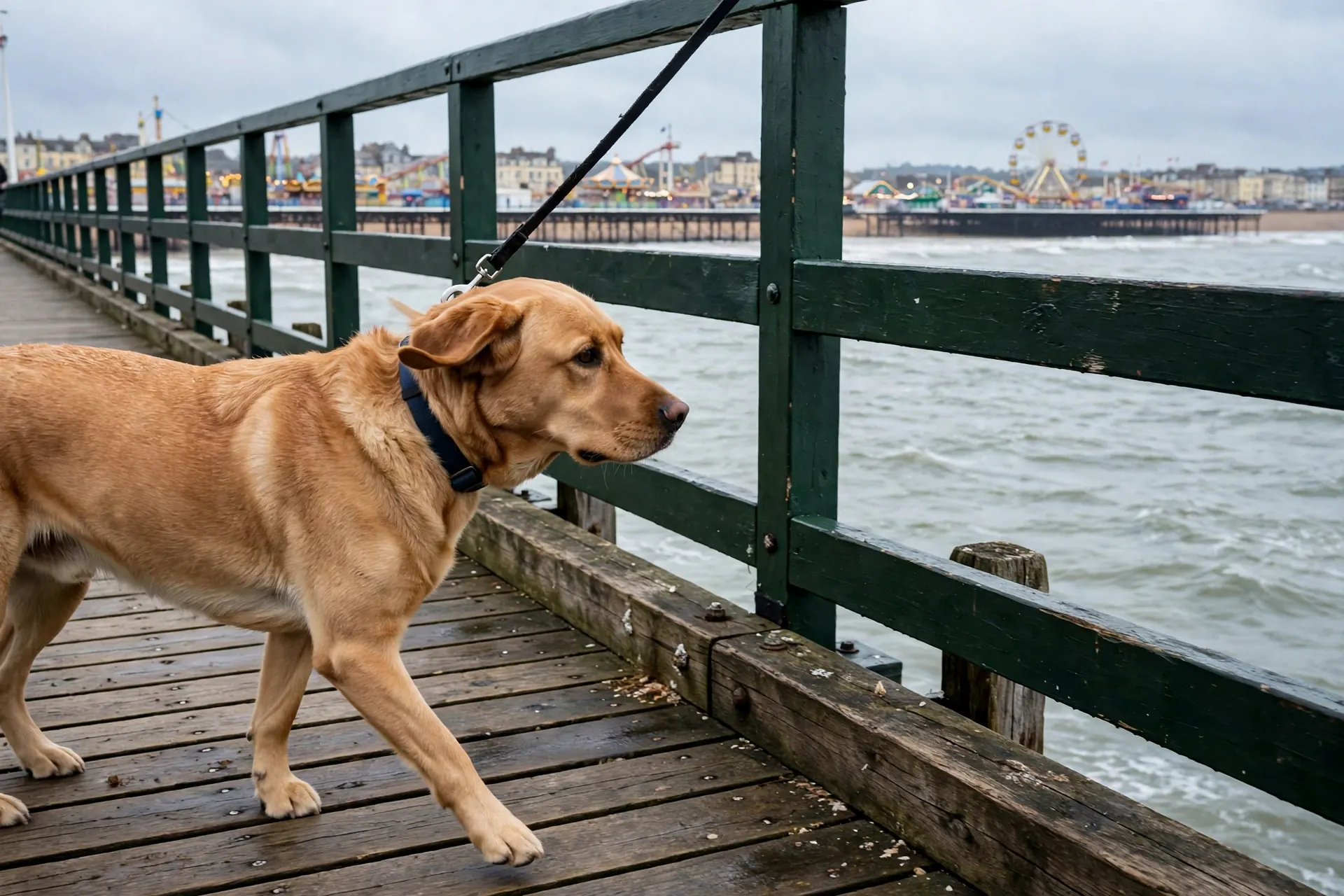
Most pier problems start underfoot. A traditional pier deck is made of long timber boards laid with small gaps for drainage and movement, and those gaps are exactly the width to catch a toe, a claw or a small pad. The risk is not dramatic; it is the ordinary moment when a dog trots happily, plants a foot at a slight angle, and yelps as a nail catches. Larger dogs usually pull free with nothing worse than a fright, but small dogs, puppies and older dogs with stiff joints can twist a toe, split a nail or panic and scramble, which is worse than the original snag. Metal grates add a second hazard: drainage covers, service hatches and the open mesh sections found on some modernised piers can pinch pads, feel slippery when wet, and look like solid ground to a dog that cannot see the holes. Add worn boards with raised splinters, loose fixings and patches of algae near the seaward end, and the deck becomes a surface that deserves more attention than the view.
The practical response is simple and unglamorous. Walk slowly, especially for the first fifty metres while you learn what this particular deck feels like. Keep the dog on the centre of the walkway where boards are usually best maintained and foot traffic has worn them smooth, rather than at the edges where boards meet railings, kiosks and drainage channels. Use a short lead rather than a long line, because a dog ranging three metres to either side will cross every grate and gap on the pier while you are still admiring the horizon. At transitions, where timber meets concrete, metal or a ramp, slow down and let the dog choose its footing instead of pulling it across. If you spot a long grate section, steer around it where the deck allows, or carry a small dog across. None of this ruins the walk; it just turns the first few minutes into a surface check, the same way a sensible walker checks a beach for broken glass before letting a dog off lead.
Watch the dog, not just the deck. A dog that suddenly shortens its stride, starts picking its feet up high, stops to chew a paw, or pulls towards the railing may be reacting to a sore spot, a splinter or a hot patch of board. Stop, check all four paws, and look between the toes as well as at the pads. Splinters are common on weathered timber and are usually easy to remove with tweezers if the dog will stay still, but a deep splinter, a bleeding nail or a pad cut needs proper attention rather than a field improvisation. Carry a small paw kit: tweezers, a clean cloth, a couple of adhesive bandages sized for paws, and a spare sock or boot to protect a sore foot on the way back. If the dog is limping, do not push on to the end of the pier to complete the walk; turn around, keep weight off the sore foot where you can, and check the official guidance before you travel for the nearest veterinary practice, just as you would for any seaside day out.
Weather changes the deck more than most visitors expect. Rain makes timber and painted metal slippery, and a dog that normally trots confidently can skid at a ramp or a painted section. Strong sun heats dark boards and metal fittings, and a surface that feels warm to a bare hand can be uncomfortable for a dog standing still while its owner queues for ice cream. Frost and sea spray can leave a thin, invisible slick. The rule of thumb used by many dog owners works well here: press the back of your hand to the deck for five seconds, and if it is too hot or too cold for your hand, it is too much for bare paws for long. Shade breaks, a drink and a move to a cooler section solve most heat problems before they become paw problems.
Rules vary from pier to pier: all year, seasonal, or deck only
There is no single national rule for dogs on piers in the United Kingdom, and that is the first thing to accept. Each pier is run by its own operator, often under a lease or a local arrangement, and each sets its own policy. Some piers welcome dogs all year on the open deck. Others allow dogs only outside the peak summer months, typically restricting them during school holidays or from around Easter to September, when crowds are thickest. Others allow dogs on the deck but not inside any building, which matters when the cafe, the arcade and the toilets are all indoors. A few restrict dogs to certain sections, such as the landward half, or require dogs to be carried through particular areas. The only reliable source is the pier's own published information, and if the website is vague, a phone call or message before you travel settles it. Rules can also change between seasons, so a pier that welcomed dogs last autumn may have a different policy this summer; check the official guidance before you travel rather than relying on a previous visit.
Seasonal restrictions usually have a practical reason rather than a dislike of dogs. Peak-season piers are crowded with children, pushchairs, ice-cream queues and people carrying hot food, and a dog on a long lead in that mix is a trip hazard for everyone. Some operators also point to hygiene rules in food areas and to the difficulty of cleaning a busy deck. Understanding the reason helps you plan: a seasonal ban often means the pier is delightful with a dog in October and genuinely difficult in August, even if dogs were allowed. Shoulder seasons, weekdays and early mornings are usually the sweet spot, with thinner crowds, cooler boards and staff who have time to answer a question. If you must visit in peak season, go early, keep the visit short, and have a backup plan, such as the promenade or a nearby beach, so a refused entry does not wreck the day.
Read the small print of a "dogs welcome" sign carefully, because it often comes with conditions. Common conditions include dogs on a short lead at all times, dogs not left tied up outside shops, owners cleaning up immediately, and dogs kept off furniture and out of food preparation areas. Some piers ask for muzzles for larger dogs in crowded indoor areas, though this is less common on open decks. Assistance dogs are treated separately under equality law and should not be subject to the same restrictions, but it is still worth confirming access arrangements for indoor areas in advance so staff are prepared. If you are unsure about any condition, ask before you arrive; a polite question is always easier than a confrontation at the gate with a disappointed dog and a queue behind you.
Keep a note of what you were told, especially if the policy is given by phone. A screenshot of the pier's dog policy page, or the name of the person who confirmed it, can resolve a disagreement at the entrance. Policies posted at the pier entrance override a third-party travel article, including this one, so treat on-site signs as final. If a sign contradicts what you were told, follow the sign and raise it politely afterwards; arguing at the gate rarely helps the dog. Finally, remember that a pier's dog policy is separate from the beach beside it, the promenade, and any boat trips from the pier head. Each has its own rules, and our guide to dog-friendly beaches in the UK explains how beach restrictions and fines work, so the beach leg of your day needs its own check.
Boardwalk paw care and boots: choosing well and breaking them in
Good paw care on a pier starts before you leave home. Trim the hair between the toes so it does not mat with salt and sand, check nails are not overlong, and look for any existing cracks or sore spots that a long walk on rough timber will aggravate. A paw balm applied the night before can help pads stay supple, though it is not a substitute for checking the surface. On the day, a quick paw check at the pier entrance, another at the pier head, and a final check before the drive home will catch most problems early. Rinse paws with fresh water afterwards, because salt dries pads and can sting small cuts, and dry between the toes to prevent irritation.
Boots are the most debated piece of pier kit, and the honest answer is that they help some dogs enormously and hinder others. They protect against splinters, hot boards, sharp grate edges and the salt-and-grit mix that collects on a deck, and they give an older dog with worn pads more grip on smooth timber. They are worth considering for small dogs whose paws are closest to grate holes, for dogs with existing pad injuries, and for long pier walks in hot or cold weather. But boots only work if the dog has practised wearing them at home. A dog introduced to boots for the first time on a busy pier will often freeze, high-step comically, chew at the straps or refuse to move, which is stressful for the dog and embarrassing for the owner, and it does not protect paws if the dog keeps kicking a boot off. Break boots in over a week or more: short indoor sessions with treats, then garden walks, then a quiet pavement walk, checking fit each time. A well-fitted boot stays on without cutting circulation, allows the toes to spread, and has a sole flexible enough for the dog to feel the ground.
If boots are not right for your dog, there are other options. Paw wax provides a thin protective layer against salt and rough surfaces and is better tolerated by most dogs, though it wears off and needs reapplying. A pair of baby socks secured loosely can protect a single sore paw for the walk back to the car, and a dog buggy or sling is a dignified solution for a very small or elderly dog on a long pier, allowing it to enjoy the outing without walking every metre of board. Whatever you choose, test it before the pier day, not on it. Also pack water and a bowl: piers offer little shade and no natural drinking water, and a dog panting in sea wind still needs to drink. A collapsible bowl, a bottle of fresh water and a few treats for rewarding calm behaviour around crowds are as important as any boot.
After the walk, the care continues. Rinse paws, check for splinters, redness between toes, or a nail that has caught and bent, and watch how the dog walks for the rest of the day. A dog that was fine on the pier but limps that evening may have a small splinter working its way out or a pad bruise from a grate edge. Most minor issues settle with rest and a clean rinse, but persistent limping, swelling, bleeding that will not stop, or a dog that will not put weight on a foot deserves veterinary advice. Keep a record of which pier and which section caused the problem; it helps you choose differently next time and helps other dog owners when you share the tip.
Three kinds of pier, three different dog days
It helps to sort piers into three broad types, because the dog experience changes completely between them. Traditional amusement piers, the classic Victorian structures with arcades, rides, candy stalls and theatres, are the busiest and the most rule-bound. Fishing harbour piers, often shorter, working structures attached to a harbour wall, are quieter but carry tackle, bait and boat traffic. Viewing piers, built or rebuilt mainly for strolling, sightseeing and cafes, sit somewhere in between, with calmer decks and fewer indoor restrictions but still plenty of foot traffic at weekends. Knowing which type you are visiting tells you what to expect before you arrive, and it stops you comparing a quiet harbour arm with a fairground and wondering why one felt easy and the other felt chaotic.
On a traditional amusement pier, expect noise, flashing lights, music, the smell of hot food, and children running between stalls. Dogs that are sound-sensitive or easily over-aroused by movement may find this overwhelming, and the deck will be at its worst here: dropped chips, sticky patches, and the highest concentration of grate covers and service hatches. The strategy is to go early, keep to the edges of the main flow where the dog has space, and treat the amusement section as a short pass-through rather than a destination. Many dogs enjoy the first stretch and the pier-head view far more than the arcade middle, so plan the walk as a there-and-back with a calm stop at the end, rather than lingering in the loudest section. If the dog shows stress signals, such as yawning, lip-licking, tucked tail or trying to pull away, leave the amusement section promptly; pushing through rarely improves the dog's opinion of piers.
Fishing harbour piers are a different world. The pace is slower, the visitors are fewer, and the dog hazards are practical rather than social: tackle boxes, bait buckets, fish guts, discarded line and hooks, wet and slippery stone, and boats moving in and out. Dogs often love these piers because there are interesting smells and fewer people, but the smells are exactly the problem, since fish bait and discarded catch are tempting and can be harmful. Keep the dog on a short lead, keep it away from buckets and cleaning stations, and watch for monofilament line, which is almost invisible and can tangle paws or be swallowed. The reward for this care is a calmer, more authentic seaside walk, often with a harbour cafe that welcomes dogs on its terrace and a view of working boats that no amusement pier can match.
Viewing piers are usually the easiest introduction for a first pier visit with a dog. They tend to have smoother, better-maintained decks, wider walkways, seating areas and a cafe at the pier head, and fewer indoor attractions to argue about. The main hazards are crowds at weekends, cyclists or mobility scooters sharing the deck, and wind exposure at the pier head, which can be much stronger than on the promenade. A viewing pier is a good place to teach a young dog that piers are calm and rewarding: short visit, plenty of treats, a sit and watch the sea, and home before the dog tires. Whichever type you choose, the same rule applies: check the official guidance before you travel, because even two piers of the same type in the same town can have different dog policies.
Rides, arcades and crowds: keeping a dog calm in the busy middle
The busy middle of an amusement pier is where most dog visits go wrong, and it is rarely the dog's fault. The combination of loud music, sudden ride noises, flashing lights, crowds moving in unpredictable directions, children at dog-head height carrying food, and the smell of sugar and frying creates a high-arousal environment. Some dogs cope beautifully, especially confident, well-socialised adults that have met crowds before. Others become over-excited and start pulling, jumping or barking, while nervous dogs may shut down, tremble or try to bolt. Neither reaction is a training failure; it is information about what this dog finds manageable. The kindest approach is to treat the amusement section as optional. If the dog is relaxed, walk through slowly with treats and praise. If the dog is struggling, skip it and enjoy the quieter stretches instead.
Crowd management is mostly about positioning and timing. Walk on the side of the deck with the most space, keep the dog on your landward side away from the main flow where possible, and avoid stopping in bottlenecks such as doorways, kiosk queues and the entrances to rides. A short lead, held with slack rather than tension, gives the dog guidance without constant correction. Avoid retractable leads on piers entirely: they allow a dog to dart across the deck into a grate, a food queue or another dog's space before you can react, and they are a trip hazard for other visitors. If you need to stop, step to the side, against a railing or a quiet corner, so the dog is not surrounded on all sides. Reward calm behaviour frequently in the busy section, and do not ask the dog to hold a long sit-stay in the middle of a crowd; a moving walk with regular short pauses is easier than a static wait.
Children deserve special attention on piers, because they are everywhere, they move unpredictably, and they often want to stroke a dog without asking. Teach children in your own party to ask before approaching any dog, and be ready to body-block politely for your own dog if a stranger reaches out without asking. A simple "sorry, she is nervous with strangers" is enough, and most people accept it gracefully. If your dog is friendly with children, still supervise closely, because a child offering food, a sudden hug or a dropped ice cream can create a snatch-and-swallow moment. Dogs that are uncomfortable with children are better walked early in the morning or on quieter piers, and there is no shame in that choice; a calm dog on a quiet pier is a happier day than a stressed dog on a famous one.
Other dogs are the other crowd factor. Piers concentrate dogs in a narrow space, and two dogs meeting head-on in a corridor with no room to arc around each other can escalate quickly, even between normally friendly animals. Keep greetings brief or skip them, cross to the other side of the deck where possible, and do not let a long lead tangle around another dog's legs. If your dog is reactive, a pier at peak time is a poor training ground; choose a quiet harbour pier at an off-peak hour instead, and build up gradually. Finally, plan your exits: know where the nearest quiet section, bench or side area is, so you can step out of the crowd without having to push back through it. A dog that knows its owner will remove it from overwhelm learns to trust piers rather than dread them.
Fishing zones, hooks and bait: the hazards you cannot see
Anglers are part of pier life, and most are considerate, but fishing gear creates hazards that are easy to miss. Hooks are small, sharp and often barbed, and a hook left on a deck, dropped from a tackle box or tangled in discarded line can pierce a pad in an instant. Bait, including lugworm, ragworm, squid, mackerel strips and fish heads, is powerfully attractive to dogs and can cause stomach upsets, while some bait additives and discarded fish parts may be harmful. Monofilament line is the hidden danger: it is almost invisible, it does not break easily, and a loop around a leg or a swallowed length can cause serious injury. Keep dogs well away from anyone actively fishing, from tackle boxes left open on the deck, and from bait buckets, cleaning tables and bins where fish waste is discarded.
Teach a strong "leave it" before a fishing pier visit, and use it early, before the dog reaches the bait, not after it has already grabbed something. If the dog does pick up bait or a fish head, do not chase or wrestle it out of the mouth, which can cause swallowing or a bite; trade for a high-value treat if you can, and check the mouth afterwards for hooks or bone fragments. If you suspect the dog has swallowed a hook, line or a large fish bone, keep the dog calm, do not induce vomiting, and seek veterinary advice promptly, noting what was swallowed and when. For a hook in a paw, keep the dog still, prevent it from chewing the hook, cover the paw loosely with a clean cloth, and get veterinary help; do not pull a barbed hook out yourself, because the barb can tear tissue on the way back. Small, unbarbed hooks in the skin are still a veterinary matter if the dog is distressed or the hook is deep.
Discarded line deserves its own warning. Anglers sometimes leave tangled line on the deck, wrapped around railings or floating near the pier head, and dogs can step into a loop without noticing. Check the deck ahead where you can, lift a tangled loop away from the dog's path, and bin any line you find safely, because it also harms seabirds and marine life. If line wraps around a leg, cut it carefully away from the skin rather than pulling it tight, and check for cuts afterwards, since thin line can cut like a wire under tension. The same care applies on the beach beside the pier, where line washes up with the tide. A short lead, a watchful eye and a willingness to turn around when a section looks like a tackle yard will prevent almost all fishing injuries, and anglers will generally appreciate a dog owner who keeps their dog clear of rods, lines and catch.
Sea wind, sun and salt: comfort at the pier head
The pier head is usually windier, colder and more exposed than the promenade, and the difference can be surprising. A sheltered town centre can feel mild while the end of the pier is battered by a wind that flattens ears, dries eyes and chills a small or short-coated dog quickly. Bring a windproof layer or a dog coat for small, elderly, short-coated or lean dogs, and watch for shivering, hunching or reluctance to walk further, which are signs to turn back. Long-coated dogs cope better with wind but still suffer from salt spray matting their fur and irritating eyes, so a rinse and a brush after the visit helps. On hot days the opposite problem appears: there is little shade on a pier, the sun reflects off the water and the boards, and a dog can overheat faster than its owner expects. Carry water, offer it frequently, watch for heavy panting, drooling or wobbliness, and retreat to shade or indoors promptly if the dog shows heat stress.
Sun protection for dogs is often overlooked on piers because the sea breeze feels cool even when the ultraviolet level is high. Dogs with pink noses, thin coats, light-coloured fur or exposed bellies can sunburn, particularly on the nose and ears, and a pet-safe sunscreen on those areas is worth considering for a long, bright visit. Never use human sunscreen on a dog, since some ingredients are toxic if licked. Salt is the other quiet irritant: salt spray dries on coats, salt water swallowed while drinking from puddles or licking wet boards can cause stomach upsets, and salt crystals between toes can sting. A fresh-water rinse after the pier, a drink of fresh water before the dog gets thirsty enough to lick puddles, and a towel-down in the car all help. If the dog vomits, has diarrhoea or seems unwell after drinking sea water, seek veterinary advice and mention the sea water.
Noise and motion add to the pier-head experience. Some dogs are unsettled by the movement of a pier in a swell, the creaking of timber, the sound of waves underneath, or the vibration of rides. Most dogs adapt quickly, but a dog that freezes, pants or tries to pull back towards land is telling you it is uncomfortable; do not force it to the pier head for a photograph. Sit with the dog partway along, let it watch the sea from a comfortable distance, and try again another day. Similarly, gulls are a pier fixture and a temptation: dogs that chase gulls can lunge towards railings or into other visitors, and gulls defending nests or chicks can be aggressive. Keep the dog on lead near gull colonies, reward ignoring gulls, and move on promptly if a gull starts dive-bombing. The pier head should feel like a reward, not an endurance test, for both of you.
Linking a pier to a beach walk: two sets of rules, one good day
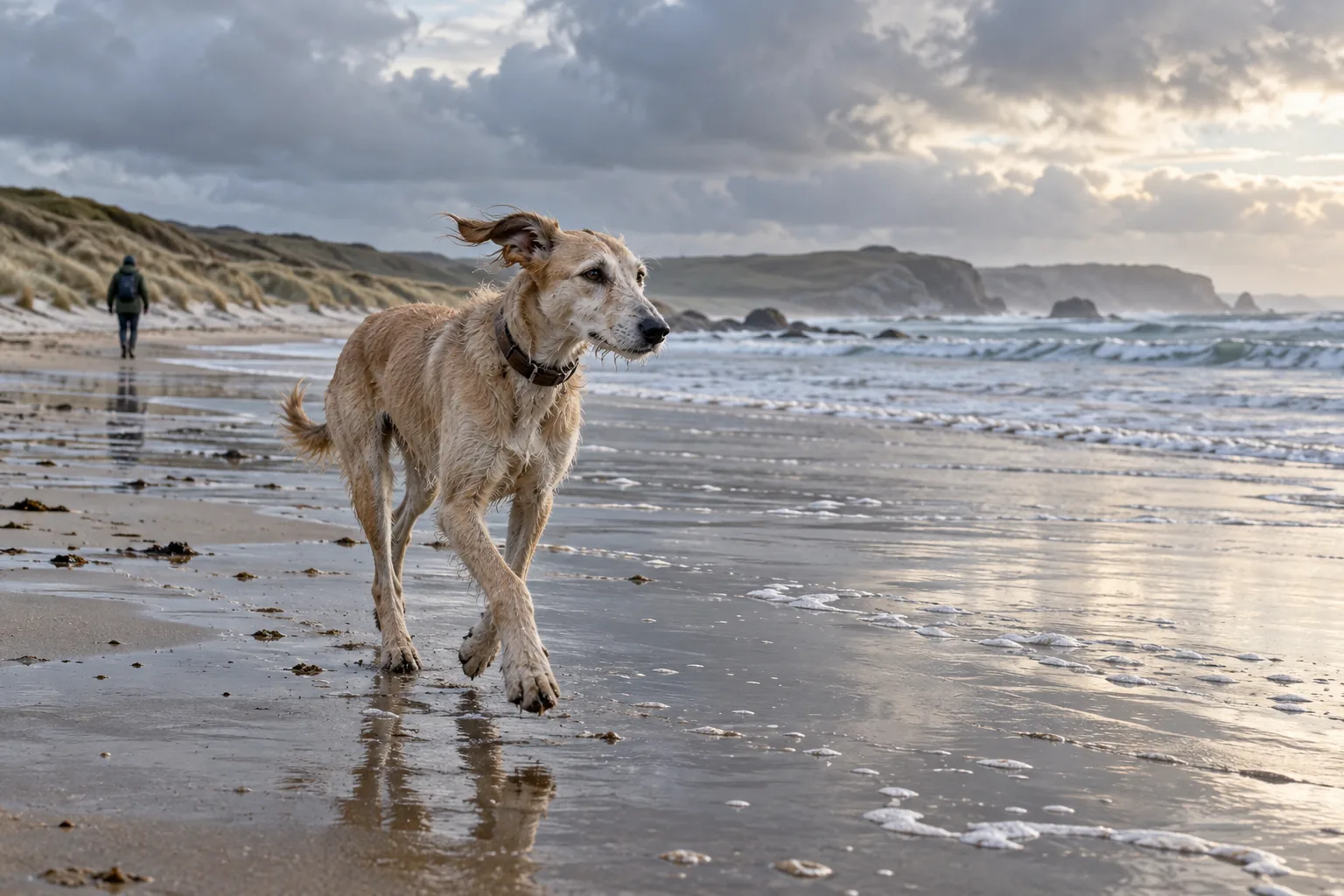
A pier visit pairs naturally with a beach walk, but the two need separate planning, because a dog-friendly pier does not guarantee a dog-friendly beach beside it. Beach rules in the UK are often set by the local council through a Public Spaces Protection Order, with seasonal bans on certain stretches, year-round bans on others, and lead requirements that change by zone. The beach beside a pier is frequently the busiest stretch and therefore the most likely to have restrictions, while a quieter stretch a short walk away may welcome dogs all year. Check the beach rules for the exact stretch you plan to use, not just the town name, and check the official guidance before you travel if anything is unclear. Our guide to dog-friendly beaches in the UK explains seasonal bans, fines and assistance-dog exceptions in detail.
Think about the physical link as well. Many piers connect to the beach via steps from the promenade, a slipway, or a ramp that may be steep, slippery with algae, or closed at high tide. A dog that coped well on the pier may struggle with steep, open steps down to sand, and an elderly dog may need carrying or a different access point. Check tide times before you plan a beach leg: a beach that is broad and inviting at low tide can disappear entirely at high tide, leaving you walking the promenade with a disappointed dog. Also consider the order of the day. Many owners find a beach walk first, when the dog has energy to burn, followed by a calm pier stroll and a cafe stop, works better than a pier walk first, which can leave a dog over-aroused or footsore before the beach. Either way, build in a rest: a pier and a beach in one outing is a lot of stimulation, salt and sand for one dog.
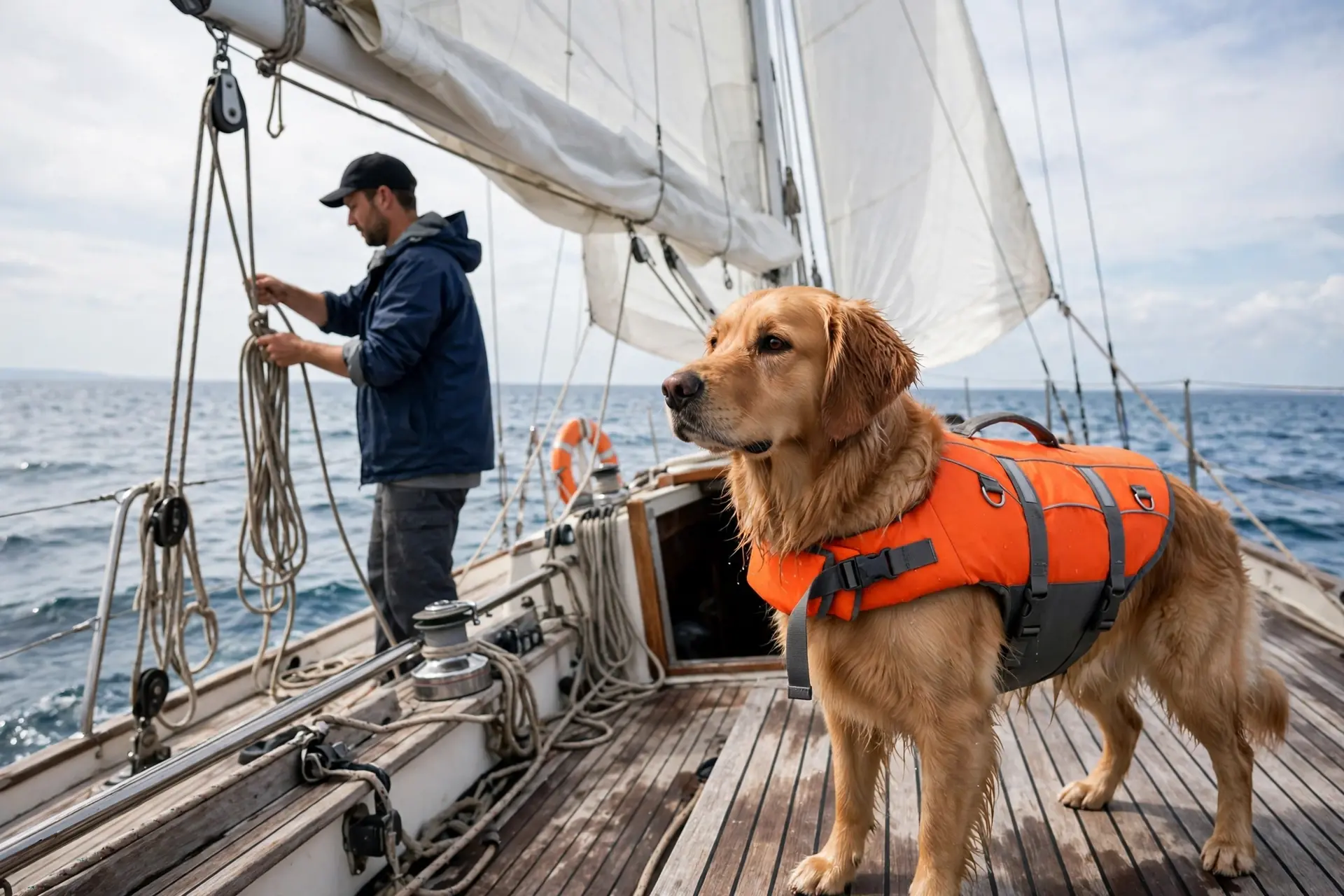
The journey home deserves a plan too. A sandy, salty dog in a car needs a towel, a blanket for the seat, and ideally a rinse before loading, if the pier or promenade provides a dog wash or a tap. Check paws once more, offer water, and keep the car cool and ventilated. If the day included a boat trip from the pier, the planning extends further: dogs on boats need life jackets, shade and toilet stops ashore, and our guide to dogs on sailing boats in the UK covers first sails, deck safety and seasickness. Combining a pier, a beach and a boat in one day is ambitious for most dogs; two of the three, done well, usually makes a better day than all three done in a rush.
A pier-day plan that works: packing, timing and backup options
A good pier day is mostly decided the night before. Pack a short lead and a spare, a collapsible bowl and fresh water, treats, poo bags, a towel, a paw kit with tweezers and a cloth, and any boots, coat or sunscreen your dog needs. Add a copy of the pier's dog policy or a note of who confirmed it, the address of the nearest veterinary practice, and a phone charger, because a dead phone at a busy pier is an avoidable problem. If you are combining the pier with a beach, add a long line for the beach leg, a ball or toy for a controlled game, and a change of clothes for yourself, since sea spray and sand are inevitable. Keep the kit in one bag by the door so the morning is calm rather than a scramble.
Timing matters more than most visitors realise. Early morning is usually the best pier time for dogs: thinner crowds, cooler boards, quieter arcades, and staff with time to help. Late afternoon can also work once day-trippers thin out, though the light and wind change quickly at the pier head. Midday in school holidays is the hardest slot, with the hottest boards, the thickest crowds and the longest queues, and it is worth avoiding with a nervous or elderly dog. Weekdays beat weekends, and a showery weekday beats a sunny Saturday for a dog that dislikes crowds. If you arrive and the pier is far busier than expected, use your backup plan without guilt: the promenade, a harbour walk, or a quieter beach nearby can be just as enjoyable, and a dog does not know it missed a famous pier.
Finally, end the day kindly. A pier walk, even a short one, is a lot of new sights, sounds, smells and surfaces for a dog, and many dogs sleep deeply afterwards. Give the dog a quiet evening, fresh water, a comfortable bed and a final paw check, and note what worked: which pier, which time, which surface, and what the dog enjoyed or avoided. That note becomes your personal guide for the next pier, and it is worth more than any general article, including this one, because it describes your dog. Piers reward preparation and punish improvisation, but with the rules checked, the paws protected and the busy sections planned around, they offer some of the best seaside walking in Britain: sea air, a view from the water's edge, and a dog trotting happily along the boards beside you.
Practical questions
Before you go
Are dogs allowed on all UK piers?
No. Rules vary by pier and by season, and some piers restrict dogs in peak months or inside buildings. Check the official guidance before you travel, and confirm whether the rule covers the whole pier or only parts of it.
Why are boardwalk gaps and metal grates a problem for dogs?
Gaps between boards can trap toes and claws, and open metal grates can pinch paws or feel unstable underfoot. Keep dogs on the solid centre of the walkway, slow down at transitions, and consider boots or a carry plan for small dogs on grate sections.
Should my dog wear boots on a pier?
Boots help on hot boards, rough or splintered timber, and metal grates, but only if the dog has practised wearing them at home first. A dog that freezes, chews or panics in boots is worse off than a dog walked carefully on a short lead.
What should I do if my dog steps on a fish hook?
Keep the dog still, keep the lead short, and do not pull a barbed hook out yourself. Cover the paw loosely if you can, carry the dog if it is small enough, and get veterinary help promptly. Prevention matters more: keep dogs away from tackle boxes, bait buckets and discarded line.
Can dogs go into pier arcades, cafes and theatres?
Often no. Many piers allow dogs on the open deck but not inside arcades, cafes or entertainment buildings, and rules differ from one pier to another. Plan for one person to stay outside with the dog, and check the official guidance before you travel.
How do I link a pier visit with a beach walk?
Check the beach rules separately, because a dog-friendly pier does not guarantee a dog-friendly beach beside it. Seasonal beach restrictions, tide times and steps down from the promenade all affect the route, so plan the beach leg as its own part of the day.