This guide is independent and contains no paid placement. Farm rules vary by site and by weekend, so check the official guidance before you travel.
Choose a farm that explicitly welcomes dogs, go on a weekday morning if you can, keep the dog on a short lead at all times, and pack for mud. The pumpkins are the easy part; the ground, the crowds and the farm animals are what need planning.
Choosing a patch that suits a dog
Not every pumpkin patch is a dog patch, and the difference is rarely obvious from a photograph of orange fields. Some farms welcome dogs throughout the site, some allow them in the field but not in the cafe, shop or maize maze, and some exclude them entirely during the October peak because the site is simply too busy. The farm's own website is the only reliable source, and the wording matters: "dogs welcome" is a promise, "dogs welcome on leads in the pumpkin field" is a precise promise, and silence is not a promise at all. Where the page says nothing, email or message the farm with a direct question before you travel, and save the reply, because the person on the gate on a busy Saturday may apply a stricter rule than the person who answered your message.
Size and layout matter as much as policy. A small family farm with one field, a short walk from the car park and a clear path back to the car suits most dogs far better than a sprawling attraction with a maze, a fairground, a stage and a mile of muddy track between zones. Look at the farm map if one is published, and ask three practical questions: how far is it from parking to the field, is there a toilet area for the dog away from the picking rows, and is there somewhere to sit with the dog while others queue for food or tickets? A farm that can answer all three clearly has thought about dogs properly. A farm that cannot answer any of them may still welcome dogs, but your visit will involve more improvisation than you probably want on a wet October day.
Consider the kind of farm, too. A pick-your-own field on a working arable farm is a different experience from a purpose-built Halloween attraction with actors, sound effects and darkness. The first is usually calmer, cheaper and more dog-friendly; the second may be thrilling for teenagers and miserable for a noise-sensitive dog. If the farm advertises scare attractions, haunted trails or fireworks, assume the dog should not be there at all, or should visit only during a daytime, scare-free session if one is offered. The same applies to farms that run evening pumpkin lantern events: atmospheric lighting and crowds after dark are a poor combination for most dogs, however pretty the photographs look.
Distance is a final filter that people forget. A pumpkin patch two hours away, visited on the busiest weekend of the year, can mean four hours of driving for one hour of picking, with a dog that has spent most of the day in a car or on a lead in a queue. A smaller patch within half an hour, visited on a quiet morning, gives the dog a proper sniff around the field, a calm car ride and energy left for a walk afterwards. If you are choosing between a famous patch and a local one, the local one usually wins for the dog, and the pumpkins are just as orange. Save the famous patch for a year when you can go on a weekday, or go without the dog and enjoy the crowds at leisure.
When to go, and when to stay away
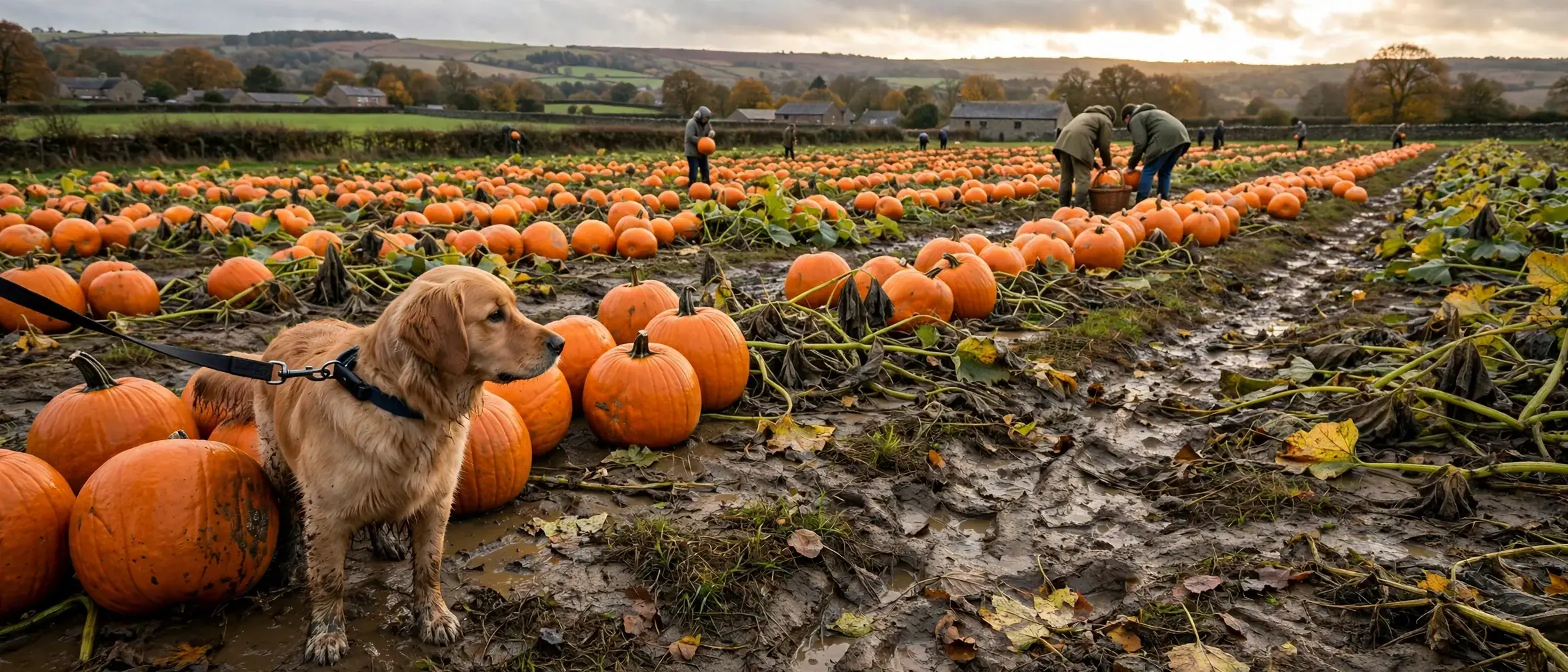
The pumpkin season in Britain runs roughly from late September through to Halloween, with most farms opening their fields in the first weekend of October. Early October is the sweet spot for a dog visit: the fields are freshly stocked, the ground is usually firmer than it will be after three weekends of foot traffic, and visitor numbers are lower, especially on weekdays. By the weekend before Halloween, the same field can be churned to mud, picked over for the largest pumpkins, and packed with families, which is exciting for children and exhausting for a dog that dislikes crowds. If your diary allows only the final weekend, go as early in the day as the farm opens, and accept that you are choosing atmosphere over calm.
Time of day matters as much as the date. A farm that opens at nine or ten in the morning offers a different visit from the same farm at two in the afternoon, when school groups, birthday parties and queueing families have filled every path. Morning visits also give you the best light for photographs, the firmest ground before the day's footfall, and the easiest parking, which matters when you are unloading a dog, a wheelbarrow and a camera. Late afternoon visits can be lovely in low autumn sun, but they also run into tired children, closing-time pressure and, in late October, fading light on a muddy field. For a first visit with a dog, morning wins every time.
Weather is the third variable, and October weather is reliably unreliable. A dry week produces firm, dusty paths and happy dogs; a wet week produces the kind of clinging mud that fills boots, coats dogs to the belly and turns a wheelbarrow into a workout. Check the forecast for the farm's area, not just your home town, and check the farm's social media on the morning of the visit, because farms do post about waterlogged fields, changed parking and early closures. If the forecast is for heavy rain all day, consider postponing: a dog that hates mud will not enjoy the visit, and a dog that loves mud will enjoy it far too much for the sake of your car. Either way, the visit is better on a day when you can manage the ground.
There are also days to avoid outright. Halloween itself, and the Saturday before it, are the peak crowd days at most farms, and some farms switch to ticket-only entry with timed slots that leave little room for a slow dog. Fireworks displays, if the farm hosts them, are an obvious no for most dogs, and should be checked separately from the daytime picking policy. If your dog is noise-sensitive, reactive to children, or uncomfortable in crowds, a quiet weekday in early October is not just preferable but necessary, and there is no shame in choosing it. The patch will still be there, the pumpkins will still be orange, and your dog will remember a calm field far more fondly than a chaotic one.
Lead rules and field manners
Every pumpkin patch that welcomes dogs expects a lead, and most expect a short one. This is not a rule to negotiate on the day, because a field full of pumpkins is also a field full of tripping hazards: vines across the paths, wheelbarrows, small children darting between rows, and other dogs on leads of varying lengths. A long line or a retractable lead is a hazard here, because it wraps around pumpkins, stalls and legs, and it gives a dog enough range to reach another dog before either owner can react. Use a standard short lead, keep it in one hand, and keep the dog beside you rather than ranging ahead through the rows. If your dog pulls strongly, a front-clip harness or a head collar that the dog already knows will make the whole visit easier.
Field manners go beyond the lead. Keep the dog out of the picking rows except where the farm clearly allows dogs between the plants, because trampling vines damages the crop and a dog that steps on a pumpkin can ruin it for sale. Stay on the paths and the headlands where the farm directs visitors, and do not let the dog dig, chew vines or drink from irrigation ditches or puddles that may hold fertiliser run-off. Clean up promptly and use the bins provided, carrying spare bags, because a farm that finds dog mess in its field is a farm that may stop welcoming dogs next year. These courtesies sound small, but they are the reason farms keep saying yes to dogs, and every dog owner at the patch benefits from them.
Other dogs are part of the picture, and a pumpkin patch is a poor place for an on-lead greeting. Dogs on short leads in narrow rows cannot perform the normal curved approach that polite dogs prefer, so greetings in a picking row often turn tense even between friendly dogs. Keep your dog moving past other dogs with a cheerful voice and a treat, rather than stopping for a nose-to-nose meeting in a bottleneck. If your dog is reactive, choose a quieter time, keep to the edges of the field, and be ready to step into a gap between rows to let others pass. A reactive dog can absolutely enjoy a pumpkin patch, but only with an owner who manages space proactively rather than hoping other visitors will.
Children deserve a mention, because a pumpkin patch is primarily a children's attraction and children will approach your dog. Most approaches are friendly, but small children move unpredictably, carry food, and may grab at ears or tails before a parent intervenes. If your dog is uncomfortable with children, position yourself so the dog is on the far side from passing families, and be ready with a polite "please don't stroke him, he is a bit shy" before the child reaches the dog. If your dog loves children, still manage the interaction: a jumping dog and a toddler holding a pumpkin are a collision waiting to happen. A calm dog that has been taught to sit for greetings is a joy at a pumpkin patch, and it is worth practising that skill before October, not during it.
Livestock, fences and other animals
Pumpkin patches sit on working farms, and working farms have animals, even when the animals are not part of the attraction. Sheep may graze a neighbouring field, chickens may roam near the shop, and a farm dog may be working around the yard. The legal and practical rule is simple: keep your dog on a lead, keep it away from livestock, and never let it chase, even playfully. Farmers have the right to protect their stock, and a dog worrying sheep is a serious matter under the law, not a minor embarrassment. If a field boundary is a low fence or a hedge with a gap, do not assume it is stock-proof, and do not let the dog investigate it. Stay on the visitor paths, and treat every fence as if there were animals behind it.
Some farms add animal attractions to the pumpkin season: a petting area, a goat pen, a pig enclosure or a small animal corner. These are tempting for children and stressful for dogs, because the animals are close, the smells are strong, and the pens are often crowded. Check whether dogs are allowed near the animal area at all, and if they are, keep a generous distance and watch your dog's body language. A dog that fixates, whines or lunges at penned animals is telling you the area is too much, and the kindest response is to walk away rather than to insist on a closer look. The same applies to farm cats, which often patrol the shop and cafe: a dog that chases cats should be kept well away from the shop entrance, however tempting the cafe smells.
Wildlife is a quieter hazard in October. Field edges hold pheasants, rabbits and rats, all of which can trigger a chase instinct in a dog that is otherwise perfectly behaved. A short lead solves most of this, but it helps to know your dog's triggers before the visit, so you are not surprised by a sudden lunge towards a hedgerow. Fallen apples, horse chestnuts and acorns are also worth watching: conkers and acorns are toxic to dogs if eaten in quantity, and a dog that scavenges along a hedgerow can pick them up quickly. Keep the dog's nose out of the leaf litter where you can, and carry a treat to trade for anything the dog picks up, which is far more effective than chasing the dog around a field.
Finally, remember that the farm is someone's workplace and home. Tractors move between fields, gates are opened and closed for vehicles, and staff may be moving stock while visitors are present. Give farm vehicles a wide berth, close gates behind you, and follow staff instructions promptly, even if they seem to interrupt a photograph. A farm that feels respected by its dog-owning visitors is a farm that keeps welcoming them, and a single incident with livestock or machinery can change a farm's policy for a whole season. The dog's lead is the simplest way to show that respect, and it costs nothing.
The mud kit that saves the car
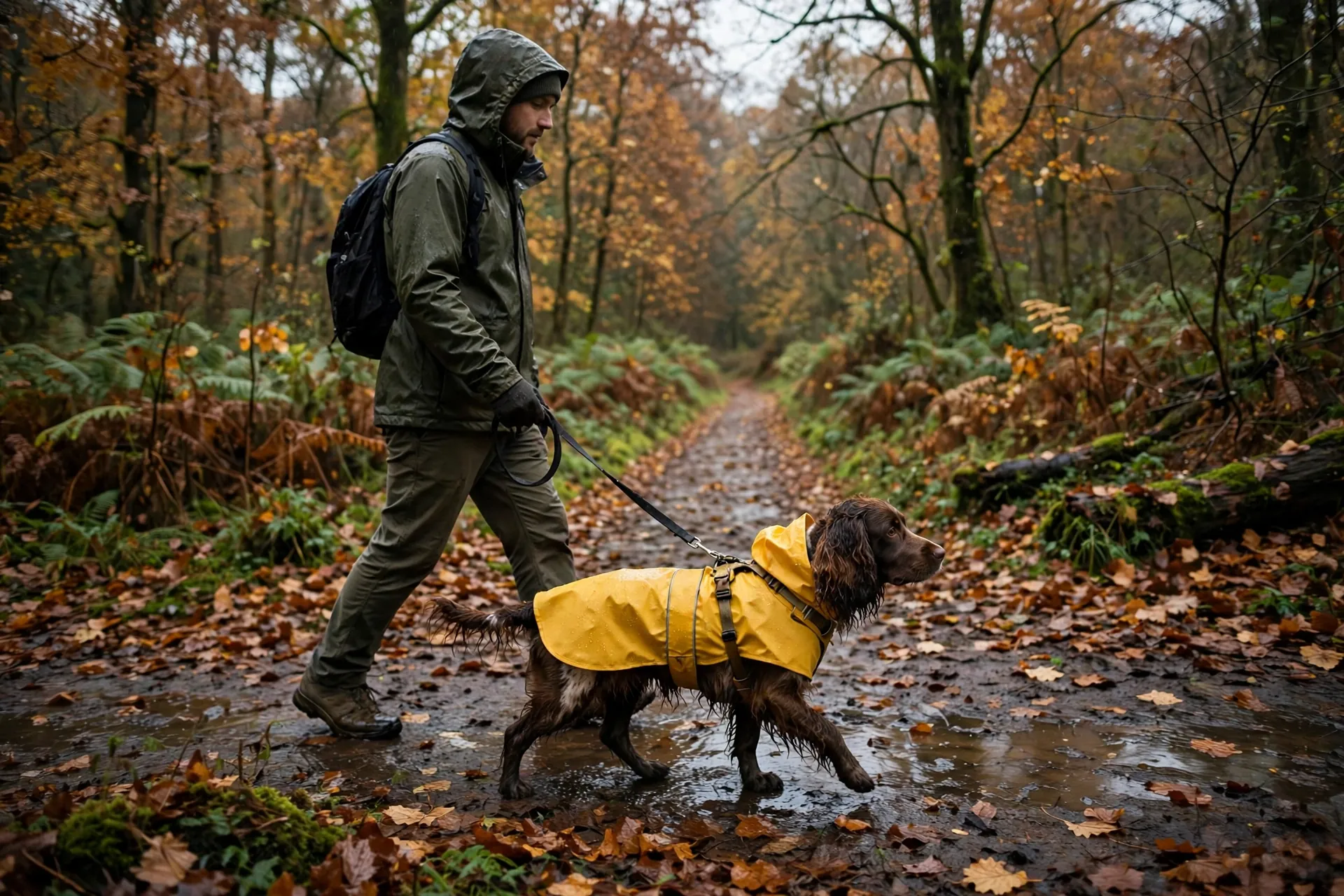
October mud is the defining feature of a pumpkin patch visit, and the right kit turns it from a disaster into a story you laugh about later. Start with yourself: wellies, not walking boots, because wellies rinse clean and boots do not, and an old waterproof jacket you do not mind getting splashed. For the dog, a drying coat is worth its weight in gold, because it absorbs mud and water while the dog is still in the field, rather than transferring all of it to your car. Pack two towels as well, one for the field and one for the car park, and a waterproof sheet or old blanket for the boot. A collapsible bowl and a bottle of water are essential, because farms do not always have a dog water point, and a muddy dog is also often a thirsty dog.
The car deserves as much preparation as the dog. Line the boot with a waterproof liner or an old shower curtain, add a towel on top of it, and keep a bag for muddy leads, harnesses and wellies so they do not migrate onto clean seats. If the dog travels on the back seat, a hammock-style cover is the minimum, and a second towel for the dog's paws before it jumps in saves the upholstery. Bring a spare lead, because a muddy lead is unpleasant to handle and a wet one can slip through cold hands, and bring poo bags in a dispenser you can reach without digging through a bag. None of this is glamorous, but it is the difference between arriving home tired and happy and arriving home facing an hour of cleaning.
Think about the dog's paws specifically. Muddy fields hide stones, broken stalks and ruts, and a dog that runs through a rutted field can twist a foot or cut a pad on a sharp stalk. Check paws before you leave the farm, wipe them with a damp cloth, and look for cuts, swelling or a stone lodged between toes. Paw balm, applied before the visit if your dog tolerates it, can reduce cracking, but it is not a substitute for checking afterwards. If your dog limps after the visit, rest it, check again in the morning, and seek veterinary advice if the limp persists, because field injuries are easy to miss under mud. A short lead and a steady pace through the worst ruts prevent most of these problems in the first place.
Finally, pack for the weather you might get, not the weather you hope for. A waterproof coat for the dog is sensible for small, short-coated or older dogs, and a spare dry coat for the journey home keeps the dog warm in the car. Gloves for the handler matter too, because holding a muddy lead in cold rain with bare hands is miserable, and miserable handlers make impatient decisions. A flask of something hot for the humans, kept in the car for the end of the visit, is a small luxury that makes the whole day feel planned rather than endured. October rewards the prepared, and punishes the optimistic, so pack as if it will rain even when the forecast says it will not.
Picking, weighing and paying
Picking a pumpkin with a dog in tow is a two-handed job made harder by a lead, so plan the mechanics before you enter the field. Many farms provide wheelbarrows or carts, which are a blessing, but steering a barrow with one hand while holding a lead with the other takes practice, so agree who holds the dog and who pushes the barrow before you start. Some farms charge by size, some by weight, and some by a flat rate per pumpkin, so check the pricing board at the field entrance rather than assuming the largest pumpkin is the best value. A medium pumpkin that you can actually carry, carve and cook from is usually a better buy than a monster that needs two people and a car boot to itself.
Choosing a pumpkin is a skill worth a few minutes. Look for a firm skin with no soft spots, a sturdy stalk, and a flat base so it sits steady for carving. Avoid pumpkins with cuts, mould or a stalk that wobbles, because they will rot quickly, and avoid the temptation to pick the first huge specimen you see, since the best pumpkins are often further into the field where fewer visitors have been. Let children choose their own, within a size you can carry, because a pumpkin a child chose is a pumpkin a child will carve with enthusiasm. Keep the dog out of the choosing huddle, on a short lead beside you, rather than letting it wander between pumpkins that other families are considering.
Payment is usually at a field exit or a farm shop, and queues can be long at peak times. Keep the dog close in the queue, and be ready for the dog to be bored, because a queue with no sniffing opportunities is hard work for a dog. A chew or a long-lasting treat, given only in the queue, can turn waiting into a positive experience, and a quick toilet break before joining the queue prevents mid-queue emergencies. If the farm offers a separate dog-friendly till or an outdoor payment point, use it, even if the queue looks longer, because the outdoor air and space are kinder to the dog. Once paid, load the pumpkins into the car before the final dog walk, so you are not carrying a pumpkin, a lead and a camera at the same time.
Remember that a pumpkin is heavy, perishable and awkward, and that the dog still needs a walk after the picking. Do not stack pumpkins on top of the dog's space in the car, and do not leave a dog in a car with a boot full of pumpkins on a warm October afternoon, because cars heat up quickly even in autumn sun. Plan the journey home with a stop for the dog to stretch its legs, and arrive home with time to unload pumpkins, towel the dog and settle everyone before dark. The picking is the highlight, but the hour after the picking decides whether the day ends well.
Children, crowds and queues
A pumpkin patch in October is, above all, a children's event, and a dog owner who plans for children will have a better day than one who is surprised by them. Expect running, shouting, costumes, wheelbarrows used as racing cars, and small hands reaching for your dog. None of this is badly behaved; it is simply what a pumpkin patch is. The practical response is to manage space: keep to the edges of the field where there is room to step aside, avoid the narrowest rows at peak times, and use the quieter corners for photographs rather than the main display area. If your dog is elderly, deaf or easily startled, the edges of the field are not a compromise but a necessity, and you should seek them out deliberately.
Queues deserve their own plan, because a pumpkin patch has queues for entry, for food, for the shop and for payment, and a dog that queues well is a dog that has been taught to wait. Practise waiting calmly at home before October, in short sessions with rewards, so the farm queue is not the first time your dog has been asked to stand still for ten minutes. On the day, keep queues short by splitting the group: one person queues for food while another walks the dog, then swap, so the dog is never in more than one queue. If the farm uses timed entry slots, arrive at the start of your slot rather than the end, because the queue is shortest then and the field is least crowded.
Costumes are a specific October factor. Children in witch hats, capes and masks look different from ordinary children, and some dogs find them alarming, especially masks that hide faces. A dog that barks at a costumed child is not being naughty; it is responding to a confusing visual signal. Keep a greater distance from costumed groups, reward calm looking, and move away promptly if the dog fixates or barks. The same applies to adults in costume and to farm staff in Halloween dress: a friendly wave from a safe distance is better than a close encounter that frightens the dog. If your dog is very costume-sensitive, a weekday visit before the Halloween dressing-up peaks will be far easier.
Noise is the final crowd factor. Music, tannoy announcements, generators, bouncy castles and excited shouting combine into a soundscape that some dogs find exhilarating and others find exhausting. Watch for the signs of overload: panting, yawning, lip licking, pacing or a sudden refusal to walk. If you see them, take the dog to the car park or a quiet field edge for ten minutes of calm, and decide whether to continue. There is no prize for staying until closing time, and a dog that leaves happy after an hour has had a better day than a dog that stays miserable for three. Our autumn checklist covers the wider seasonal preparation, including lights and wet-weather gear, in our autumn dog holiday checklist, which is worth reading before any October outing.
Photographs without the chaos
Everyone wants the photograph: the dog among the pumpkins, the family with the wheelbarrow, the golden October light. The trick is to take it without creating chaos, because a photograph that requires a dog to sit still among pumpkins while children run past is a photograph that takes ten minutes and frays everyone's patience. Choose a quiet corner of the field, preferably at the edge where the background is still pumpkins but the foot traffic is thin, and set the dog up quickly: one person holds the lead out of shot, another takes the photograph, and the dog is rewarded immediately. Two minutes of calm photography beats twenty minutes of coaxing, and the resulting picture is usually better because the dog looks relaxed rather than bewildered.
Light matters more than location. Early morning and late afternoon give warm, low light that flatters both dogs and pumpkins, while midday sun creates harsh shadows and squinting. Overcast days, common in October, actually give soft, even light that is kind to photographs, so do not be disappointed by cloud. Keep the camera low, at the dog's eye level, rather than shooting down from standing height, because a low angle makes the dog the subject rather than a small figure in a field. And take the photograph early in the visit, while the dog is still fresh and the field is still tidy, rather than at the end when everyone is muddy and tired.
Respect other visitors in your photography. Do not block a path for a photograph, do not move other people's pumpkins to improve a shot, and do not photograph other people's children, even incidentally, without thinking about it. If another family is waiting for the same spot, take your photograph quickly and move on, because the field belongs to everyone. The same courtesy applies to farm displays and photo boards: use them, enjoy them, but do not monopolise them while a queue forms. A pumpkin patch photograph is a souvenir of a good day, not a production, and the best ones are usually the unposed moments: the dog sniffing a pumpkin, the child laughing, the wheelbarrow stuck in mud.
One practical warning: keep the camera and phone safe from mud and pumpkin juice. A phone dropped in a muddy rut is a common October casualty, and a camera strap around the neck is safer than a hand-held phone while also holding a lead. Bring a small cloth to wipe the lens, because mud on the lens ruins more photographs than bad light ever will. And back the photographs up when you get home, because October photographs are the ones you will look back on in January, when the field is a distant memory and the dog is asleep by the fire.
Afterwards: carving, cooking and the dog
The visit does not end when you leave the farm, because the pumpkin comes home and the dog will be interested in it. Raw pumpkin flesh is not a dog treat, and carved lanterns left outdoors quickly grow mould that is harmful to dogs, so keep carved pumpkins out of the dog's reach, especially overnight when a dog may investigate a lantern on the doorstep. Plain cooked pumpkin, in small amounts, is generally well tolerated and is often used to settle sensitive stomachs, but it should be introduced gradually and without skin, seeds, sugar or spice. Pumpkin-spiced products, which contain sugar, fat and sometimes xylitol or nutmeg, are not for dogs at all, however tempting the smell.
Carving itself needs a dog plan. Knives, scoops and small pieces of pumpkin skin on the floor are hazards for a curious dog, so carve at a table with the dog settled elsewhere, and clear up promptly. A dog that eats a large amount of raw pumpkin skin can develop stomach upset, and a dog that swallows a piece of stalk can choke, so treat carving waste as something to bin immediately rather than compost in an accessible heap. The same applies to the pumpkin's interior: stringy pulp and seeds are not a dog snack, however enthusiastically the dog begs. A stuffed Kong or a chew, given during carving, keeps the dog happily occupied while the humans carve in peace.
Storage matters too. An uncarved pumpkin keeps well in a cool, dry place for weeks, but a carved lantern lasts only a few days before it softens and moulds, and a mouldy lantern on the doorstep is an invitation for a dog to investigate. Dispose of carved pumpkins promptly, and do not leave them in the garden where a dog can reach them. If you have grown attached to a particular lantern, photograph it, enjoy it for a few days, and then let it go: the photograph lasts longer than the pumpkin, and the dog stays safe. This is the unglamorous end of the pumpkin season, but it is part of owning a dog in October.
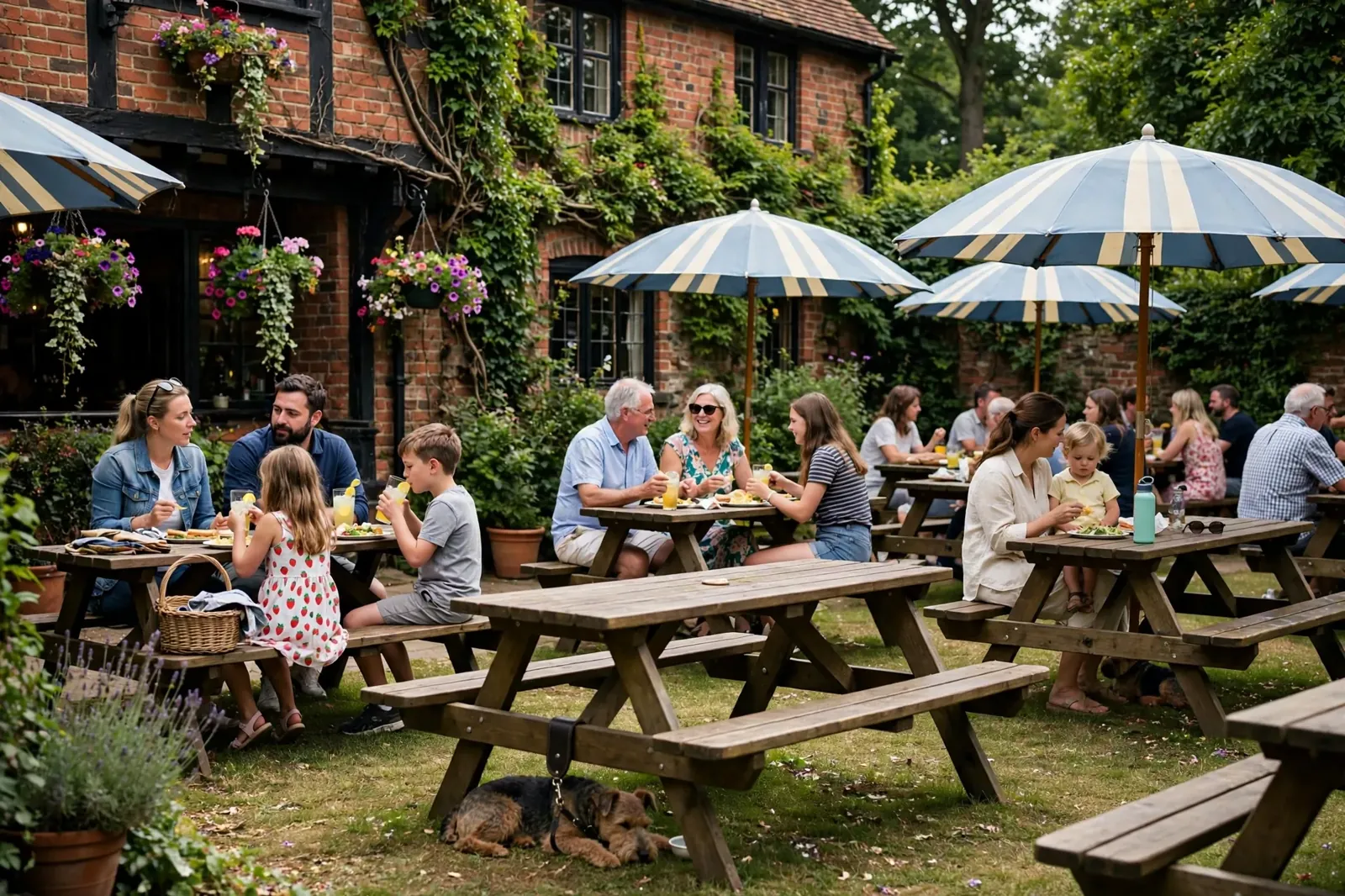
Finally, use the visit as a reason for a longer autumn day out. Many pumpkin farms sit near country parks, riverside walks or village pubs, and a walk after the picking gives the dog the exercise it missed while on a lead in the field. Our guide to dogs in pub gardens covers the etiquette of a post-picking drink with a muddy dog, including where to sit and what to bring, and it pairs naturally with an October farm visit. A pumpkin patch, a walk and a pub garden, in that order, is a classic autumn day, and it is one the dog will enjoy from start to finish, provided the mud kit is packed and the lead stays short.
Practical questions
Before you go
Are dogs allowed at pumpkin patches in the UK?
Many are, but not all, and the rule can change between the field and the cafe. Check the farm's own page before you travel, and expect a lead rule everywhere on site.
Can my dog eat pumpkin?
Plain cooked pumpkin in small amounts is generally fine for dogs, but raw pumpkin, stalks, mouldy flesh and carved lanterns left outdoors are not treats, so keep the dog away from discarded pumpkins.
Should my dog stay on a lead at a pumpkin patch?
Yes. Fields are working farmland with other visitors, children, wheelbarrows and sometimes livestock nearby, so a short lead is the rule even at farms that call themselves dog-friendly.
What should I pack for a muddy pumpkin patch visit?
Pack wellies, a towel, a drying coat, poo bags, water and a bowl, and a boot liner or old sheet for the car, because October fields are often wet and rutted.
When is the best time to visit a pumpkin patch with a dog?
A weekday morning early in October is usually quietest, with the best choice of pumpkins and the firmest ground, while the weekend before Halloween is the busiest and muddiest.
Do pumpkin patches charge for dogs?
Most do not charge for a dog, but many charge an entry fee per person at peak times, and some require a pre-booked ticket, so check the booking terms before you set off.