This guide is independent and contains no paid placement. If affiliate links are added later, they will be clearly marked and will not change our editorial checks.
Dogs can enjoy a UK ski break, but they cannot ski, ride the lifts or walk the pistes. The trip works when the dog gets its own snow walks, a warm place to dry off and a proper place to stay, while the humans ski in shifts or book short sessions. Choose the resort for the base area and the forest trails, not for the slopes the dog will never use.
Start with Scotland, not the Alps
When people picture dogs at ski resorts, they usually picture the Alps: deep snow, wooden chalets, a dog asleep by a stove while the family skis all day. The British version is smaller, windier and far less predictable, and that difference shapes every decision in this guide. The United Kingdom has five lift-served ski areas, all in Scotland: Cairngorm Mountain, Glenshee, Glencoe Mountain, the Lecht and Nevis Range. There are no lift-served ski resorts in England or Wales, although indoor snow centres and dry slopes exist further south. A dog-friendly ski break in Britain is therefore, in practice, a Scottish Highlands break with skiing attached, and the drive, the weather and the accommodation all need Highland planning rather than Alpine planning.
Scottish snow is famously changeable. A resort can have excellent cover one week and bare patches the next, and high winds can close lifts even when the snow looks perfect from the car park. The ski season typically runs from around December to April, with the most reliable conditions often arriving in late January, February and early March, but no week is guaranteed. That uncertainty is the first thing to explain to anyone travelling with a dog: the plan must have a good non-skiing day built in from the start, because the dog still needs exercise, toileting and stimulation on a day when the lifts do not run. A resort with forest walks, a village to wander and a dog-friendly cafe nearby is worth far more than a resort with one extra lift and nothing to do at the bottom.
The five resorts also differ in character in ways that matter for dogs. Cairngorm Mountain, near Aviemore, has the largest base area, the most developed village nearby and the widest choice of dog-friendly cottages, lodges and hotels in the surrounding area. Glenshee, on the A93 between Braemar and Blairgowrie, is more exposed and more weather-dependent, with fewer facilities at the base and longer drives to alternative walks. Glencoe Mountain is dramatic and compact, with superb scenery and limited shelter when the wind rises. The Lecht, between Tomintoul and Strathdon, is smaller, family-oriented and often calmer, which suits nervous dogs. Nevis Range, near Fort William, combines gondola access with extensive forest trails lower down, giving dogs more to do on a no-ski day. None of these is objectively best; the right choice depends on the dog, the driving route and how much the humans actually intend to ski.
Distance is the other Scottish reality. Aviemore is roughly a three-hour drive from Edinburgh or Glasgow in good conditions, and Fort William is further still. Add snow, darkness and a dog that needs a stop every two hours, and the journey becomes a full day rather than a transfer. Many owners find that the first and last days of the trip are travel days with no skiing at all, which is fine if the booking reflects it. Arriving in daylight matters more with a dog than without one: unloading in the dark, in wind, on an icy car park, with a dog that has been in the car for hours, is a poor start to any break. Plan the drive so arrival happens before dark, and keep the first evening deliberately quiet.
What dog-friendly means at a resort
The phrase dog-friendly is doing a lot of heavy lifting in resort marketing, and at a ski centre it usually means something narrower than people assume. A resort that describes itself as dog-friendly may mean only that dogs on leads are tolerated in the outdoor base area and the car park. It rarely means dogs can enter the ticket office, the hire shop, the restaurant, the ski school meeting point or the lift queue. It never means dogs can go on the pistes. Before booking, ask for the specific list: where exactly can a dog go on a lead, where must it wait outside, and where is it not allowed at all? A resort that answers with a clear list is being honest; a resort that answers with a slogan is not.
Leads are the baseline rule everywhere. Dogs should be on a short lead in base areas, car parks and around buildings, even if they have excellent recall, because a ski base is full of hazards a dog cannot read: moving vehicles, ski edges, poles, snowcats, gritting lorries and people carrying long equipment at head height for a small dog. A long line is useful on open trails lower down but dangerous around a lift station, where it can tangle in machinery or trip a skier. Carry a short lead for the base and a longer line for the walk, and switch between them deliberately rather than improvising.
Behaviour expectations are higher in winter than in summer. A dog that barks at strangers, chases moving objects or pulls hard on the lead will find a ski base genuinely difficult, because everything moves fast and unpredictably. Skiers in bright clothing, snowboarders sliding sideways, children on sledges and snowcats reversing with beepers are all triggers that do not exist on a summer beach walk. Owners should assess the dog honestly before booking: a calm, well-socialised dog that settles quickly will enjoy the atmosphere, while a reactive or highly prey-driven dog may spend the whole trip stressed. There is no shame in choosing a quieter resort, a midweek date or a cottage with a garden instead of the busiest base area on a Saturday.
Cleaning up after the dog is also more demanding in snow. Waste does not disappear into snow, and it reappears in spring when the snow melts, which is why resorts are strict about it. Carry more bags than seems necessary, because cold fingers and gloves make the job slower, and dispose of bags in the bins provided rather than leaving them beside a trail. Yellow snow is not a joke at a resort: dogs should be encouraged to toilet away from pistes, paths and play areas, and owners should carry water to dilute urine on paths where that is practical. Small courtesies like these are what keep resorts willing to welcome dogs at all.
Finally, check the official guidance before you travel, because resort rules change with conditions. A base area that welcomes dogs in calm weather may restrict access during a storm, a race event or a busy school-holiday week. Lift operations, cafe opening hours and car park arrangements all shift with the season, and the resort website or a short phone call will give the current position far more reliably than a guide written months earlier. Treat any rule quoted here as a starting point and the resort's own current statement as the answer that counts.
Where dogs can actually stay
Accommodation is where a ski trip with a dog succeeds or fails, and it deserves more attention than the skiing itself. The dog will spend far more hours in the accommodation than on any walk, so the right room matters more than the right run. The main options around Scottish resorts are self-catering cottages and lodges, hotels and inns, and holiday parks with lodges or caravans. Each has different dog rules, and the differences are rarely visible on a booking site filter.
Self-catering cottages and lodges are usually the best fit. A cottage with a fenced garden or a secure yard gives the dog a safe toilet area at night without a drive to a trail, and a kitchen lets owners prepare food and dry wet gear without negotiating a hotel dining room. Look for hard floors rather than pale carpet, a boot room or porch where wet dogs can be towelled down, and a drying area for coats and boots. Ask whether the garden fence is genuinely dog-proof: a low dry-stone wall or a hedge with gaps is not a fence for a determined terrier. Confirm the pet fee, the maximum number of dogs and whether dogs may be left alone in the property, and get those answers in writing with the booking confirmation.
Hotels and inns can work well for one calm dog, but the rules are tighter. Many hotels allow dogs only in selected ground-floor rooms, charge a nightly pet fee, and prohibit dogs in the restaurant, bar and breakfast room. Some provide a dog bed, bowl and treats; others expect owners to bring everything. The practical questions are the same as anywhere: where does the dog toilet at night, how far is the room from an exit, and what happens if the dog barks when the owner goes to dinner? A hotel where dogs are welcome in the bar or on the terrace is far more relaxing than one where the dog must stay alone in the room every evening. Our guide to dog-friendly holiday parks in the UK covers the same booking questions in more detail, and the same discipline of asking for written rules applies to a ski lodge.
Holiday parks and lodges near Aviemore and Fort William offer a middle ground: more space than a hotel room, more facilities than a remote cottage, and often a dog exercise area on site. The trade-off is that parks can be busy in school holidays, and the walk from the lodge to open ground may cross roads or shared paths. Check the distance from the unit to the nearest practical toilet walk, whether the decking is safe for the dog, and whether dogs are allowed in the on-site cafe or bar. A park with a shop is useful in winter, when a forgotten bag of dog food means a drive in snow rather than a short stroll.
Drying space deserves its own paragraph because wet dogs and cold lodges are a miserable combination. A dog that has walked in snow will come back wet to the belly, with ice between the toes and snow packed into the coat. The accommodation needs a warm, ventilated spot where the dog can dry without soaking the bedding: a tiled porch, a utility room, or a corner with a washable mat and a towel rail. Bring at least two large towels and a drying coat, and ventilate the room while the dog dries, because a wet dog in a sealed, heated lodge produces condensation quickly. Never dry a dog directly against a radiator or a stove, and never leave a wet dog in a cold car overnight.
Lifts, pistes and the no-go zones
This is the section that surprises first-time visitors most, so it is worth stating plainly: dogs do not go on ski lifts in the United Kingdom, and dogs do not go on groomed pistes. Chairlifts, button lifts, drag lifts and gondolas are designed for people wearing skis or snowboards, with loading and unloading procedures that assume a human passenger who can sit, hold on and step clear. A dog on a lift is a danger to itself, to the lift operator and to other passengers. Resorts prohibit it, insurers prohibit it, and no amount of asking at the ticket office will change the answer. The same applies to the pistes themselves: a dog on a groomed run is invisible to a skier coming downhill at speed, and a collision can injure both badly.
The practical consequence is that skiing and dog care must be planned as two separate activities. A couple travelling together can ski in shifts, with one person on the slopes while the other walks the dog, then swap at lunchtime. A solo traveller needs a different plan: a half-day lift pass, a morning session followed by a long afternoon walk, or a local dog sitter or kennel for the hours on the mountain. Some resorts have ski schools and crèche facilities for children, but there is no equivalent dog crèche on the mountain, so owners should not arrive assuming one exists. Book any dog care in advance, because rural sitters and kennels have limited places in peak weeks.
Base areas have their own hazards even for dogs that stay on the ground. Snowcats and piste bashers operate around the base, often early in the morning and late in the afternoon, and they are large, quiet on snow and difficult to see around. Gritting vehicles spread salt and grit on paths, which is useful for humans and harsh on paws. Ski edges are sharp enough to cut a dog that walks into a rack, and poles left leaning against a wall can fall and startle a dog into traffic. Keep the dog close in the base area, avoid the equipment racks and the lift queue, and treat the base as a transit zone rather than a place to linger.
Children's ski areas and beginner slopes deserve extra caution. These areas look calm and inviting, with slow-moving skiers and bright markers, but they are still working slopes with people falling unpredictably. A dog on the edge of a beginner area can distract a child who is learning to stop, and a loose dog can cause exactly the accident everyone wants to avoid. Stay well clear of marked runs, even at the edges, and use the designated walking routes and forest trails instead. If a walking route crosses a piste, cross quickly, at the marked point, with the dog on a short lead, and do not stop for photographs in the middle of the run.
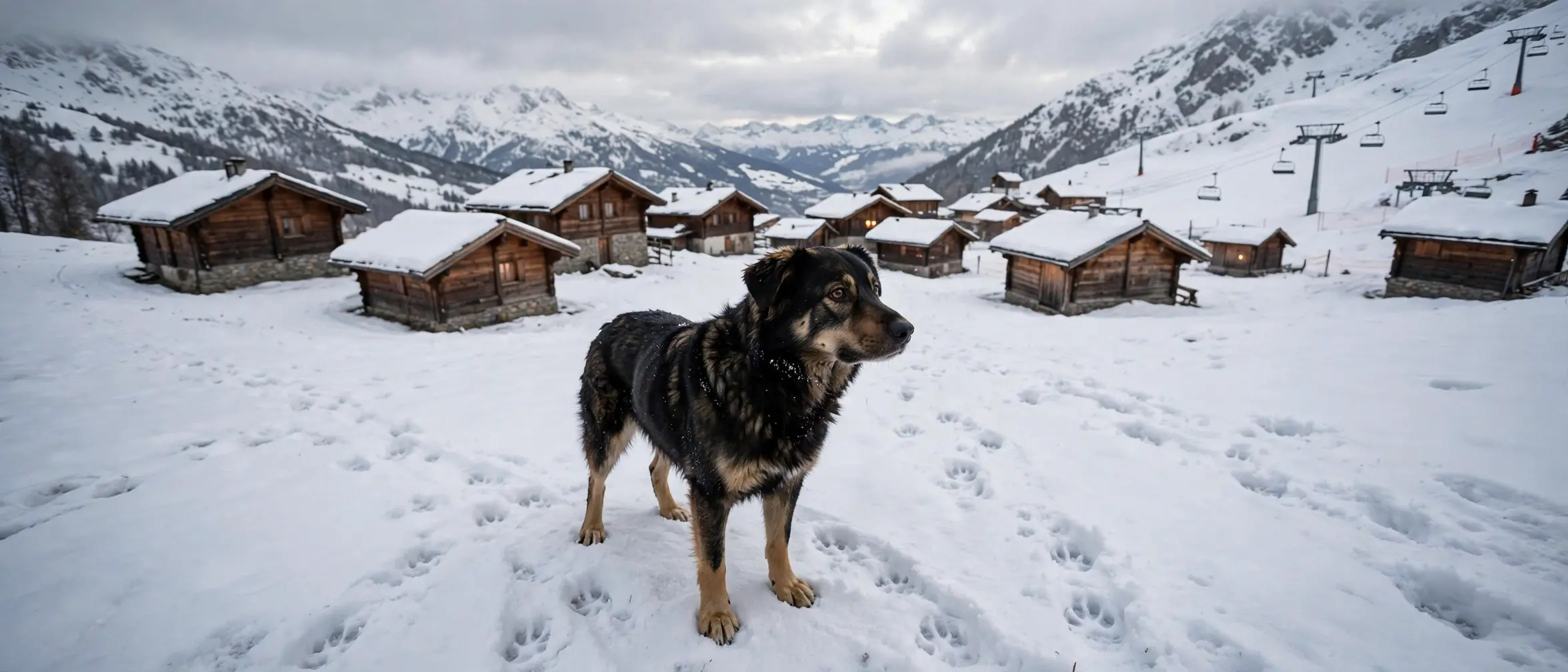
Photographs are worth a note of their own, because the temptation is strong. A dog sitting in deep snow with a lift behind it makes a lovely picture, and it is perfectly possible to take one safely from a designated viewpoint or a walking trail. What is not safe is walking onto a piste, standing under a lift line or letting the dog off the lead near a run to get the shot. Take the photograph from where dogs are allowed, keep the lead on, and accept that the best image may be the one taken from the car park rather than the one taken from the middle of the slope. The dog will not know the difference, and the skiers will be grateful.
Snow walks and sled alternatives
The good news is that a ski resort area offers some of the best winter walking in Britain, as long as owners choose the right routes. Lower forest trails, lochside paths and waymarked valley walks are usually open to dogs on leads throughout the winter, and they are often quieter and more beautiful in snow than in summer. Around Aviemore, the forests of the Cairngorms National Park offer miles of waymarked trails through Scots pine, with views of the mountains and plenty of sniffing interest for a dog. Around Fort William, the lower slopes of Nevis Range and the trails of Glen Nevis give similar options, with the added drama of Britain's highest mountain as a backdrop. These walks are the heart of the trip for the dog, so they deserve proper planning rather than being treated as a filler between ski sessions.
Snowshoeing is the most accessible snow activity for dog owners. Snowshoes let a person walk on deep snow without sinking to the knees, and a fit dog on a lead can usually follow the same route without special equipment, as long as the snow is not too deep for the dog's legs. Hire shops in Aviemore and Fort William rent snowshoes, and some guided walks welcome dogs. Check the route before setting out: a snowshoe trail that crosses steep ground, a frozen burn or an avalanche-prone slope is not suitable with a dog, and the official guidance before you travel should be checked for current conditions. Keep the walk shorter than a summer walk of the same distance, because snow walking is harder work for both species, and build in rest stops where the dog can stand on packed snow rather than sinking into drifts.
Skijoring and sled activities are more specialised but increasingly available. Skijoring involves a dog in a harness pulling a skier on cross-country skis, and it is a genuine sport with its own equipment, training and safety rules. It is not something to improvise on a first trip: the dog needs a proper pulling harness, the skier needs cross-country skis and instruction, and both need a suitable flat trail away from downhill pistes. A few providers in Scotland offer taster sessions, and these are the right way to try it, with an instructor, a suitable dog and a controlled route. The same applies to dog sled experiences: these are usually run by specialist providers with their own teams of trained dogs, and visitors watch or ride rather than harnessing their own pet. Ask the provider directly whether a visitor's own dog can take part, and expect the answer to be no in most cases.
Winter walking also means thinking about daylight. In December and January, Scotland has roughly seven hours of daylight, with sunrise around 8.30am and sunset before 4pm. A walk that would be comfortable in June becomes a race against darkness in January, and a dog that is used to evening walks at home will find itself walking in the dark in the Highlands. Plan the main walk for late morning, when the light is best and the temperature has risen slightly, and carry a head torch and a light for the dog's collar or harness for the return journey. Reflective gear is not optional on a road without pavements in the dark; it is the difference between being seen and being missed.
Off-lead time needs more thought in snow than in summer. A dog that runs freely on a familiar beach may struggle in deep snow, where every step costs energy and the dog can quickly become tired, cold and disorientated. Snow also hides hazards: frozen burns, fences, ditches and holes that would be obvious in summer. Choose off-lead areas carefully, favouring flat, open, familiar ground with clear boundaries, and keep sessions shorter than at home. A long line gives the dog freedom to explore while keeping control, and it is often the best compromise on a winter walk. Watch for the dog slowing down, lifting paws, shivering or seeking shelter, and head back before those signs become a problem rather than after.
Paws, cold and winter health
Cold is the central health question on a ski trip, and it affects dogs in ways that owners sometimes underestimate. Most healthy, well-coated dogs cope well with Scottish winter temperatures, which typically sit between minus five and plus five degrees Celsius at resort level, but wind chill, wet snow and long exposure change the calculation. A dog standing still in wind at minus five degrees loses heat far faster than a dog running in calm air at the same temperature. Small dogs, short-coated breeds, lean breeds such as whippets and greyhounds, puppies, older dogs and dogs with arthritis or heart conditions are all more vulnerable, and they need more protection and shorter outings.
Paws deserve daily attention, because snow, ice, grit and salt attack them from several directions at once. Ice balls form between the toes, especially in long-haired breeds, and they are painful enough to make a dog limp or refuse to walk. Salt and grit used on paths and car parks can dry and crack the pads, and can cause stomach upset if the dog licks them off. Boots solve most of these problems, but only if the dog has been trained to wear them before the trip: a dog that has never worn boots will spend the first walk trying to shake them off rather than enjoying the snow. Introduce boots at home over several days, with treats and short indoor sessions, and carry spares, because boots do fall off in deep snow. Paw balm or wax is a useful backup for dogs that will not wear boots, applied before the walk and reapplied afterwards, but it does not replace boots on heavily gritted paths.
A waterproof coat is the second piece of essential kit for many dogs. It is not about fashion: a coat keeps the core warm and dry, reduces the amount of snow that packs into the fur, and shortens the drying time afterwards. The best coats for resort conditions are waterproof rather than merely water-resistant, with a belly panel that protects the underside and a fit that allows free leg movement. Measure the dog carefully and try the coat at home, because a coat that rubs, slips or restricts movement will be worse than no coat at all. Dry the coat overnight, because a damp coat put on a cold dog in the morning is worse than a dry one.
Feeding and hydration need adjustment in winter. A dog that is walking in snow burns more calories than the same dog walking on a summer path, and may need a slightly larger ration or an extra small meal, particularly on active days. Fresh water is still essential, even though the dog may seem less thirsty in the cold, and snow is not a substitute for water: eating large amounts of snow can lower body temperature and cause stomach upset. Carry water on walks and offer it regularly, and keep the water bowl inside rather than outside, where it can freeze. Avoid letting the dog drink from puddles near roads, where grit, salt and antifreeze can contaminate the water.
Know the signs of cold stress and act early. Shivering, slowing down, lifting paws, whining, seeking shelter and curling into a tight ball are all signals that the dog is cold and the outing should end. Hypothermia is rare in healthy dogs on a normal walk, but it is a real risk for a small or elderly dog left in a cold car, tied outside a cafe in wind, or walked for too long in wet snow. Never leave a dog in a car in winter for longer than a few minutes, and never assume that a thick coat makes a dog immune to cold. Keep the number of a local vet saved in the phone before the trip, and check the official guidance before you travel for the nearest out-of-hours service, because rural practices may be a long drive away and may close early in winter.
Winter driving and the packing list
Winter driving in the Highlands is the part of the trip that most owners underestimate, and it is where good preparation pays for itself. The roads to Cairngorm, Glenshee, Glencoe, the Lecht and Nevis Range all climb, all bend, and all freeze, and a journey that takes two hours in summer can take four in snow. Check the forecast and the road conditions before leaving, allow far more time than the satnav suggests, and keep the fuel tank at least half full, because a diversion or a closure can add a long detour with few filling stations. Snow chains or snow socks are worth carrying for the steepest resort access roads, and drivers should know how to fit them before they need them, in daylight, rather than learning on an icy verge in the dark.
The car itself needs winter preparation. Check the tyres, the battery, the antifreeze, the screen wash and the wipers before the trip, and carry a shovel, a torch, a blanket, a phone charger and a flask of hot water. A dog blanket or a spare towel in the car is useful for a wet dog, and a crate or a proper car harness keeps the dog safe on icy roads where a sudden stop is more likely. Never leave the dog in a parked car while the driver goes to check conditions or buy a ticket; either the dog comes along on a lead or a travel companion stays with the car. Plan stops every two hours for the dog to toilet, drink and stretch, choosing service areas with grass rather than gritted tarmac where possible.
The packing list for the dog is longer than for a summer break, and it is worth writing out in advance. The essentials are: the dog's usual food plus a spare day's supply, a water bowl and a bottle of water, a lead and a long line, a harness, a waterproof coat, boots and spares, paw balm, at least two large towels and a drying coat, poo bags, a torch and a reflective collar or harness light, any medication with the prescription details, the vet's phone number, a familiar bed or blanket, and a chew or a puzzle toy for quiet evenings in the lodge. Add a basic first-aid kit: saline wound wash, bandages, tweezers for thorns or grit, and the phone number of the nearest vet. Pack all of this where it can be reached without unpacking the whole car, because the dog will need the towel, the water and the lead before anything else.
Human kit matters for the dog too. Waterproof boots with good grip, warm gloves that still allow lead handling, a head torch, and layers that can be adjusted as the temperature changes will keep the owner comfortable enough to give the dog a proper walk rather than a hurried five minutes. Ski gear should be packed separately from dog gear, so that wet leads and muddy boots do not end up in the same bag as dry ski socks. A dry bag or a lidded box in the car keeps the dog kit organised and stops the whole vehicle smelling of wet dog by the second day.
Finally, plan for the journey home as carefully as the journey out. A tired dog that has walked in snow for several days may be stiff, sore or simply exhausted, and the drive home is not the time to discover that the dog cannot settle in the car. Allow an extra stop, keep water available, and do not feed a large meal immediately before a long drive. Check the dog's paws once more before leaving, dry the coat and the bedding, and make sure nothing wet is left in a sealed bag to go mouldy. A calm last morning, with a short walk and a slow pack-up, is a better end to the trip than a rushed departure in the dark.
A realistic ski-resort day with a dog
The most useful way to judge whether a ski trip will work is to walk through a single day hour by hour, with the dog's needs given the same weight as the skiing. A realistic winter day starts early, because daylight is short and the dog needs to toilet, eat and settle before the humans leave for the slopes. A short toilet walk at first light, breakfast for the dog, and a brief play or training session in the garden sets the dog up for a calm morning. If one person is skiing and the other is staying with the dog, the morning walk can be the long one, taken while the slopes are quiet and the light is improving.
By mid-morning, the skier is on the mountain and the dog walker is on a forest trail. The walk should be the main exercise of the day for the dog: an hour to ninety minutes on a waymarked route, with sniffing time built in, rather than a forced march to a viewpoint. Snow walking is tiring, so the pace should be slower than a summer walk, with stops for water and for the dog to stand on packed ground. If the weather turns, shorten the walk and head for a dog-friendly cafe, where the dog can dry off and rest while the owner has a hot drink. A dog that has had a good morning walk will settle happily for a quiet afternoon, while a dog that has had only a ten-minute toilet break will be restless and noisy by lunchtime.
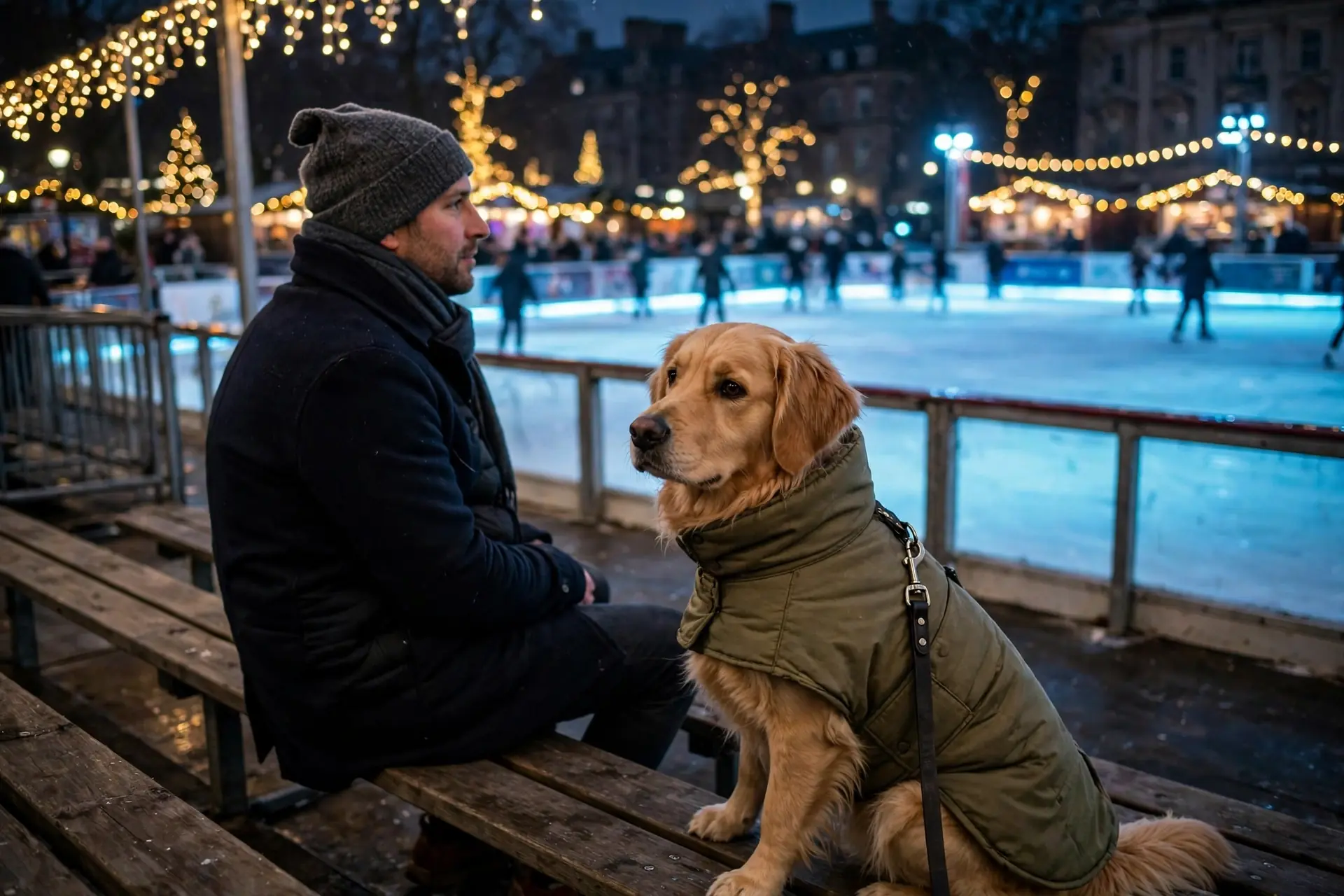
Lunchtime is the natural handover point. The skier comes down, the dog gets a short walk and a drink, and the afternoon is rearranged around whoever is tired. One option is for the second person to ski a half-day session while the first takes the dog for a shorter afternoon walk. Another is for both people to stop skiing and spend the afternoon together: a drive to a nearby village, a lochside walk, or a visit to a dog-friendly attraction. Our guide to dogs at ice rinks in the UK covers another winter day out that pairs well with a resort stay, and the same principle applies: the dog's day should have its own highlights, not just the gaps between the humans' skiing.
Evenings in a ski lodge are quiet by design, and that suits most dogs. A calm evening routine, with the same feeding time as at home, a short last walk before dark, and a familiar bed in a warm corner, will settle the dog far better than a late night in a noisy bar. If the humans want to eat out, check whether the restaurant welcomes dogs on the terrace or in the bar, and if not, plan to eat in or take turns. A dog left alone in a lodge while the owners eat out for three hours is likely to bark, and a barking dog in a quiet lodge building will be heard by every neighbour. The evening is also the time to check paws, dry coats and boots, recharge the head torch, and look at the forecast and the snow report for the next day.
Bad weather days deserve their own plan rather than being treated as failures. A storm day can be a rest day for the dog, with a short toilet walk, indoor training games, a puzzle feeder and a long sleep by the fire, followed by a drive to a lower-altitude walk if the roads allow. Many owners find that the dog enjoys a storm day as much as a ski day, because the pressure is off and the routine is calm. The trip works when the humans accept that not every day will be a ski day, and that a dog's best day may be the one spent wandering a snowy forest rather than waiting in a car park.
Costs, booking and cancellation
A ski break with a dog costs more than the same break without one, and the extra costs are easy to miss when comparing prices. The main additions are the pet fee, which for cottages and lodges typically runs from around twenty-five pounds to seventy-five pounds per dog per week, with hotels often charging five to twelve pounds per night, and the cost of dog care during ski time, whether that is a sitter, a kennel or a second lift pass so two adults can ski in shifts. Add the cost of boots, a coat and extra food if these are being bought for the trip, and the cost of winter driving, including extra fuel and possibly snow chains. A realistic budget adds at least one hundred pounds to the cost of the break for one dog, and more for two.
Booking early matters more in winter than in summer. Dog-friendly cottages near Aviemore and Fort William are limited in number, and the best ones for school-holiday weeks can be booked six to nine months ahead. Midweek dates outside school holidays are easier to find, cheaper, and quieter for the dog, which makes them the best value for most owners. When comparing options, ask for the all-in total in writing: accommodation, pet fees, cleaning charges, damage deposits, parking and any resort charges, so that the comparison is between real totals rather than headline nightly rates. Check what the deposit is, when the balance is due, and what happens if the dog is ill or the roads are closed.
Cancellation terms deserve close reading, because winter is the season when plans change most. Snow, storms, road closures and illness can all force a change of date, and the policy for moving a booking is often more generous than the policy for cancelling it outright. Ask whether the booking can be moved to another date without losing the deposit, and whether the dog's illness counts the same as a human illness under the policy. Travel insurance that covers cancellation is worth considering for an expensive peak-season week, and pet insurance with third-party liability is sensible anyway when a dog will be meeting strangers and other dogs daily in a busy resort area.
One final booking point is the question of numbers. Most cottages and lodges cap the number of dogs at two, and some allow only one, so a three-dog household needs to ask before assuming a booking is possible. Breed and size conditions also apply at some properties, and owners should declare the breed accurately rather than hoping nobody notices. Assistance dogs are a separate category and should not count against pet limits or incur pet fees, but owners should still tell the property in advance so the right room can be allocated. Honesty at booking is always cheaper than a dispute on arrival, especially in winter, when there may be nowhere else to go.
The overall message of this guide is simple: a UK ski resort break with a dog is not a skiing holiday with a dog attached, but a winter holiday in the mountains in which some of the party skis some of the time. Planned that way, with the dog's walks, warmth, food and rest given equal weight, it can be one of the best breaks of the year. Planned the other way, with the dog as an afterthought, it will be stressful for everyone. Choose the resort for its base and its trails, book accommodation that genuinely suits the dog, ski in shifts or in short sessions, and keep the plan flexible enough that a storm becomes a forest walk rather than a ruined day. Check the official guidance before you travel, and the mountains will do the rest.
Practical questions
Before you go
Can dogs go on ski lifts in the UK?
Almost never. UK ski centres do not carry dogs on chairlifts, button lifts or gondolas, and dogs are not allowed on groomed pistes while skiers and snowboarders are using them. Plan the trip so the dog has its own walks and activities at the base, and arrange childcare for the dog during any time you spend on the lifts.
Are Scottish ski resorts dog-friendly?
Parts of them are, but not in the way a beach or a holiday park is. Dogs are usually welcome on leads around the base area, car parks and some cafes, and many nearby lodges and cottages accept dogs. The slopes, lifts and hire shops are generally off limits, so the dog-friendly part of the trip is the village, the forest trails and the accommodation, not the skiing itself.
Do dogs need boots or a coat in the snow?
Many dogs benefit from both in Scottish winter conditions. Boots protect paws from ice, grit and salt on treated paths, while a waterproof coat helps short-coated, small, older or lean dogs stay warm in wind and wet snow. Introduce boots and coats at home before the trip, and check paws for ice balls, cracks and redness after every outing.
Can my dog be left alone in a ski lodge while I ski?
Only if the accommodation explicitly allows it and your dog settles calmly alone. Many lodges and cottages prohibit unattended dogs, and a dog left in an unfamiliar heated room can bark, chew or overheat. The safer plan is to ski in shifts with a travel companion, book a half-day session, or use a local dog sitter or kennel for the hours you are on the slopes.
What is the best alternative to skiing with a dog?
Waymarked winter walks on lower forest trails, snowshoeing on a lead where it is permitted, and supervised sled or skijoring sessions run by local providers are the best options. These give the dog exercise and snow time without putting it on a piste. Check the official guidance before you travel, because access rules change with snow depth, avalanche risk and resort operations.
When is the best time to take a dog to a UK ski resort?
Late January to early March usually offers the most reliable snow in Scotland, while December and April can be thin or stormy. Midweek dates are quieter and easier with a dog than school-holiday weekends. Always check the official snow report and road conditions before you travel, and keep the plan flexible so a closed lift or a storm becomes a forest walk day instead of a wasted trip.